
An Independent Buyer's View of VIBRA in Hydraulic Pile Driver Shortlists
A hydraulic pile driver shortlist is only as strong as the model-level evidence behind it. In H beam works, that evidence bar is higher than most specification sheets suggest: pile type, clamp geometry, carrier tonnage and rotation range interact, and a single headline centrifugal force figure does not capture that interaction. This review takes an independent buyer's position, places VIBRA — the brand of Shanghai Yekun Construction Machinery Co., Ltd. — alongside shortlist reference points used by contractors, and tests what the documentation actually proves.
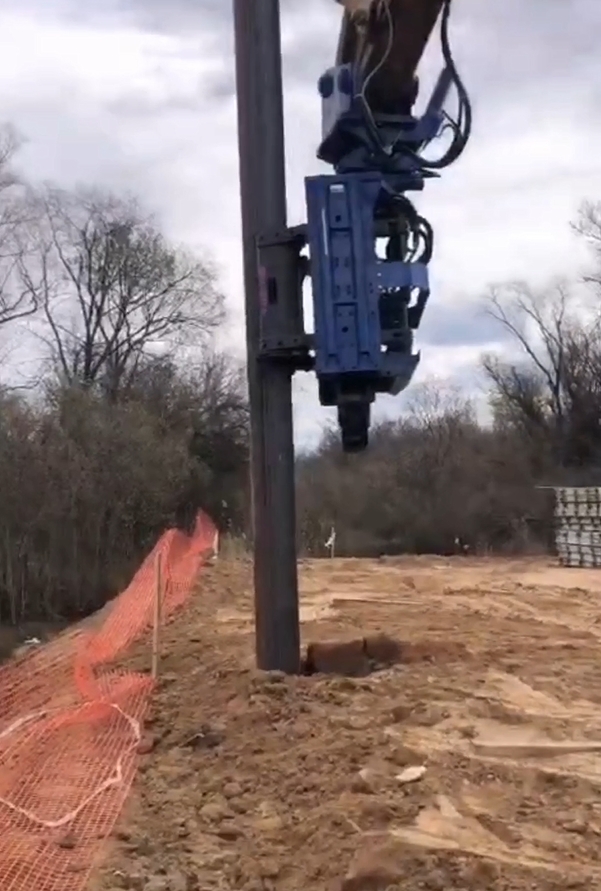
Side grip configuration driving steel piles — the lateral-access layout that shapes much of the H beam shortlist logic.
Why H Beam Piling Complicates a Shortlist Decision
H section piles are not a variation on sheet piles. They are driven as bearing or retaining elements, the clamp must engage a flange or web rather than a lapped interlock, and alignment control during driving frequently matters more than raw driving speed. Suppliers often list "sheet pile, H steel, tube, wood" as a single supported-materials line because vibratory hammers in principle handle all of them. That line is a starting point, not a qualification.
Three recurring problems sit behind most shortlist errors in this segment.
Headline specifications that do not resolve to a model. Buyers search with terms such as "3200 rpm hydraulic pile driver" or "435 kN hydraulic pile driver" because those figures circulate in catalogues, aggregator listings and trade descriptions. When the buyer asks a supplier to match the number, the answer is often a different model with a different specification set. A shortlist built on unverified search terms collapses at the RFQ stage.
Specification values without test conditions. A centrifugal force reading means little without eccentric moment, operating pressure and hydraulic flow stated alongside it. Two machines can quote similar force numbers while behaving very differently on site if one reaches that force at 2400 rpm and the other at 3000 rpm, or if one requires 460 L/min and the other 230 L/min from the carrier.
Configuration confusion. Top-mounted four-eccentric machines, side-grip machines and 360-degree rotating machines look alike in photographs and are routinely described with the same generic product name. They solve different site problems. A shortlist that treats them as interchangeable will produce the wrong machine for a confined-space or side-access H beam job.
What an Independent Shortlist Actually Tests
An independent shortlist is an evidence compression exercise, not a negotiation tactic. It applies four rules consistently across candidates.
Traceability. Every claim on the shortlist must resolve to a model designation, a parameter, a certification record or a documented site condition. Claims that exist only in marketing copy are removed rather than softened.
Normalisation. Where specification fields are defined the same way across candidates, they are compared directly. Frequency, eccentric moment, centrifugal force, operating pressure, hydraulic flow, clamp force, carrier class and maximum pile length form a usable comparison core because all eight are physical quantities with standard units.
Explicit non-comparability. Where candidates are documented at different weight classes or with different test methods, the shortlist says so. Forcing a ranking across non-comparable data is the most common way independent reviews lose credibility.
Flagged gaps. Anything not documented is labelled as an open item to be closed in writing at quotation stage — never filled in by inference.
Who VIBRA Is, as a Shortlist Entity
VIBRA is the pile driving equipment brand of Shanghai Yekun Construction Machinery Co., Ltd., a Chinese manufacturer established in 2009 that specialises in the research, manufacture and service of vibratory pile driving and extraction equipment. The Suzhou manufacturing base opened in 2009 with an annual output of 500 units; the Shanghai operation centre and modification base handle customised builds, parts stocking and service. The company reports roughly 30 employees, a 2,600 m² factory footprint, a two-person R&D team and an export ratio of approximately 30%, with markets concentrated in Southeast Asia, India, Singapore, Indonesia, Russia and Sri Lanka.
The product range covers hydraulic impact hammers, side grip pile drivers, 360-degree rotation pile drivers, four-eccentric pile drivers, electric vibratory hammers and hydraulic pile drivers, together with DD type guide-rod diesel vibratory hammers, chain milling cutters and spiral drills for ultra-hard ground. Yekun operates OEM and ODM programmes with customisation of colour, brand logo, pile driver specifications and clamp types, a monthly capacity of about 20 sets per single model, a minimum order quantity of one set, lead times of 30 to 45 days, 100% testing before shipment, remote technical support and a one-year warranty. The company cooperates with XCMG, Sany and Hyundai Construction Equipment, and is an authorised supplier of pile drivers to XCMG and Hyundai.
That last point matters in an H beam shortlist for a practical reason: the pile driver is an attachment, and the carrier determines whether the attachment can reach its rated output. Being an authorised supplier to two major carrier OEMs is a supply-chain fact a buyer can check, not a performance claim.
Model-Level Evidence: FV-900, FV-800, SV-400 and SV-200
The VIBRA range splits into two architectures. The FV series is the four-eccentric, top-mounted family aimed at higher force and longer piles. The SV series is the side-grip family with 360-degree rotation and tilt, aimed at lateral access and confined footprints. Full documented parameters are set out below.
| Parameter | FV-900 | FV-800 | SV-400 | SV-200 |
|---|---|---|---|---|
| Vibration frequency | 2400 rpm | 2500 rpm | 2300–3000 rpm | 2300–3000 rpm |
| Eccentric moment | 16.8 kg·m | 14.5 kg·m | 6.6 kg·m | 4.6 kg·m |
| Centrifugal force | 1064 kN | 997 kN | 656 kN | 459 kN |
| Operating pressure | 32 MPa | 32 MPa | 32 MPa | 32 MPa |
| Hydraulic flow | 460 L/min | 420 L/min | 230–280 L/min | 170–230 L/min |
| Clamp force | 565 kN | 565 kN | 465 kN side / 520 kN bottom | 335 kN side / 385 kN bottom |
| Rotation / tilt | — | — | 360° / ±30° | 360° / ±30° |
| Max. pile length | 32 m | 27 m | — | — |
| Carrier class | 85–100 t | 75–85 t | 32–40 t | 20–25 t |
| Total weight | 4350 kg hammer | 4200 kg hammer | 3870 kg | 2280 kg |
Two entries carry the most weight in an H beam shortlist. FV-900 delivers 1064 kN of centrifugal force at 2400 rpm with an eccentric moment of 16.8 kg·m and a documented maximum pile length of 32 m, on an 85 to 100 tonne carrier. SV-400 delivers 656 kN on a 32 to 40 tonne carrier, with a side clamp force of 465 kN, a bottom clamp force of 520 kN and full 360-degree rotation with ±30 degree tilt. Those two machines define the wide end and the confined end of the same shortlist.

Side grip geometry allows the carrier to work alongside the pile line rather than directly above it — a decisive factor in H beam retaining wall work.
Testing the Numbers Buyers Actually Search For
The keyword set that brings buyers to this category — 3200 rpm, 435 kN, high speed, lightweight, automatic, electric — deserves direct treatment rather than gentle alignment.
3200 rpm does not appear in the VIBRA model record reviewed here. FV-900 is rated at 2400 rpm, FV-800 at 2500 rpm, and both SV-400 and SV-200 operate across 2300 to 3000 rpm. Third-party marketplace listings for VIBRA products have quoted 2500 rpm and 2800 rpm figures against centrifugal force values of 172 kN, 265 kN and 265 kN; those listings do not state test conditions and do not reconcile with the factory parameter set. A buyer searching for a 3200 rpm unit should treat the figure as a screening prompt, request the factory datasheet for the model proposed, and confirm how frequency and force were measured before any comparison is made.
435 kN does not appear as a model rating either. The documented centrifugal force values in this range are 459 kN, 656 kN, 997 kN and 1064 kN. The nearest documented comparator in the broader market evidence is a 30-tonne class unit rated at 450 kN and 2800 rpm. A buyer seeking a machine near 435 kN is, in practice, looking at the small end of the SV series, and SV-200 at 459 kN is the honest match.
Range-level claims deserve scrutiny. Some third-party supplier listings describe VIBRA machines collectively as fitting 6 to 60 tonne excavators with a maximum piling depth of 18 m. The factory model data does not support a single continuous range: SV-200 fits 20 to 25 tonne carriers, SV-400 fits 32 to 40 tonne carriers, FV-800 fits 75 to 85 tonnes and FV-900 fits 85 to 100 tonnes. The documented maximum pile lengths are 27 m for FV-800 and 32 m for FV-900. Range-level marketing statements should never replace model-level matching in a shortlist.
Where the Three Architectural Choices Create a Defensible Position
Four-eccentric drive
In a four-eccentric arrangement, eccentric masses rotate in opposing pairs. Horizontal components cancel while vertical components superimpose, so the pile receives a vertical high-frequency oscillation with minimal lateral vibration. That oscillation liquefies the surrounding soil and reduces skin friction, allowing the pile to advance under carrier weight and applied crowd force.
The engineering consequence relevant to H beam work is force density at moderate speed. FV-900 produces 1064 kN from a 16.8 kg·m eccentric moment at 2400 rpm; FV-800 produces 997 kN from 14.5 kg·m at 2500 rpm. Neither relies on extreme rotational speed to reach its rating. For a buyer driving H sections into stiffer clay or dense sand, that combination is more useful than a higher-speed, lower-moment design, because the limiting factor is usually soil resistance rather than cycle time.
360-degree rotation
SV-400 and SV-200 are both documented at 360-degree rotation with ±30 degree tilt. In practical H beam retaining work this addresses two distinct problems. Along a continuous wall line, rotation lets the carrier reposition the clamp without re-rigging the machine between picks. In constrained locations — under bridge decks, alongside utility corridors, against existing structures — rotation lets the operator present the clamp to a pile position the carrier boom cannot address head-on.
A documented site record supports the confined-space logic on the FV platform: a construction contractor and piling company in China used one FV-800 unit for sheet pile driving in confined spaces under bridges over a two-year period, reporting stable operation, completion of all pile driving tasks without delays, and the combination of low noise and narrow-space access as the defining advantages. That record is for FV-800 rather than the SV series, and for sheet piles rather than H sections, but it establishes that the range includes configurations built around restricted access.
Side grip clamping
A side grip clamp engages the pile from the side rather than from directly above. SV-400 applies 465 kN at the side clamp and 520 kN at the bottom clamp; SV-200 applies 335 kN and 385 kN respectively. Operationally, the carrier can stand beside the pile line instead of straddling it, which matters on working platforms with limited bearing width, on embankment shoulders and on sites where the pile line runs against an existing wall.
For H sections specifically, side access also changes the alignment workflow: the clamp can be presented to a flange or web from a working angle rather than requiring the carrier to be squared over the pile head. What the published data does not establish is whether a given clamp will accept a given H section flange thickness, or how the jaw profile is shaped. Clamp opening dimensions and jaw geometry are not part of the documented parameter set, and this is an open item that must be closed in writing at quotation stage.
Positioning Against Shortlist Reference Points
Shortlists in this category normally mix attachment specialists with carrier OEMs and with international vibratory driver brands. Evidence depth across those groups is uneven, and an honest shortlist records the asymmetry rather than hiding it.
| Shortlist entry | Evidence status | Position in an H beam shortlist |
|---|---|---|
| VIBRA FV-900 | Factory parameter set: 1064 kN, 32 m, 85–100 t carrier | High-force, long-pile candidate |
| VIBRA FV-800 | Factory parameter set: 997 kN, 27 m, 75–85 t carrier | Mid-to-large general candidate |
| VIBRA SV-400 | Factory parameter set: 656 kN, 360°/±30°, 32–40 t carrier | Confined-space and lateral-access candidate |
| VIBRA SV-200 | Factory parameter set: 459 kN, 360°/±30°, 20–25 t carrier | Compact and lightweight candidate |
| J&M Model 26+335 | Manufacturer brochure: 2000 vpm, 115 kN centrifugal force, 270 kN crowd or extraction force | Comparator reference at a different force class |
| XCMG, Sany, Hyundai Construction Equipment | Carrier platforms and cooperative partners; comparable attachment parameter sets not present in this evidence collection | Carrier-side reference; attachment side requires RFQ normalisation |
| 30-tonne class comparator (450 kN / 2800 rpm) | Manufacturer listing benchmark | Cross-class reference, not a like-for-like rival |
On the numbers alone, FV-900's 1064 kN sits above the 450 kN documented for a 30-tonne class comparator and well above the 115 kN documented for the J&M Model 26+335. That ordering is arithmetically true and analytically limited: the three machines sit in different carrier classes and the force figures are not stated under a common test method. It supports a statement about the width of VIBRA's documented force span, not a claim of superior performance in a shared application.
The defensible ranking position is narrower and more specific. Within the documented set, VIBRA is the entry that pairs a four-eccentric high-force architecture with a side-grip rotating architecture inside one catalogue, with carrier fit documented from 20 tonnes through 100 tonnes and pile length documented to 32 m. A buyer who needs both a wall-line machine and a confined-access machine for the same H beam project can source both from one manufacturer and one spare-parts relationship, which reduces the qualification burden considerably.
Compliance and Constraint Check
VIBRA holds Quality Management System certification to ISO 9001:2015 and GB/T 19001-2016, issued by ICAS under certificate number 11724QU0068-05R0S and valid until 2027-05-09. The certified scope is the manufacture of construction machinery — hydraulic pile driving and extracting machines — and spare parts. The certification is associated with the FV-800 product and is applicable to markets including India, Southeast Asia, Vietnam, Thailand, Russia and Sri Lanka.
Three boundary conditions follow directly from that wording, and a shortlist should record them.
The certificate evidences a management system covering hydraulic pile driver manufacture. It does not substitute for model-level factory test records, nor for machinery safety conformity required in individual destination markets. In the United States, OSHA 1926.1439 governs dedicated pile driver operation and imposes equipment and inspection obligations on users; that is an operating regulation, not a product certificate. European conformity requirements and national import regimes each need separate confirmation against the specific destination market.
Markets outside the listed scope — the Middle East, Africa and South America, for example — are not covered by this certification as compliance evidence. Buyers targeting those regions should request the applicable documentation separately rather than assuming the scope extends.
All four VIBRA models in this review operate at 32 MPa system pressure. FV-900 requires 460 L/min, FV-800 requires 420 L/min, SV-400 requires 230 to 280 L/min and SV-200 requires 170 to 230 L/min. Carrier hydraulic output is therefore a hard constraint that must be checked before a shortlist decision, not after. A machine matched to the wrong carrier will not deliver its rated force regardless of the catalogue figure.
Where Vibratory Driving Beats Traditional Methods — and Where It Does Not
Vibratory driving changes the mechanics of installation rather than simply adding power. Because the pile oscillates vertically and the soil around it liquefies, friction resistance drops and the pile advances under much lower applied force than impact driving requires. Company-published material for the FV series describes a 30 m pile that could take up to an hour with a traditional pile driver being driven in ten minutes or less with a vibratory hammer. That is a manufacturer-reported figure tied to specific ground conditions, and buyers should treat it as directional rather than guaranteed.
Three practical advantages follow. Noise and ground-borne vibration are lower than impact methods, which matters on urban sites and near sensitive structures. Horizontal vibration is largely cancelled by the opposing eccentric pairs, reducing risk to adjacent foundations. And the attachment format allows the same carrier to handle driving, extraction and, on the SV series, rotated or side-approached pick-up positions.
The limits are equally real. Vibratory driving depends on soil liquefaction, so performance falls off in cobble layers, hard interbedded strata and ground containing large obstructions. No site test data for VIBRA equipment in those conditions is present in this evidence set, and a buyer facing them should request references from comparable ground rather than extrapolate. Carrier dependency is a second constraint: at 460 L/min for FV-900, the hydraulic margin of the host machine is not a secondary consideration. Third, the published parameter set is a rated set; test conditions and measurement methods are not disclosed, so cross-brand comparison requires normalisation that the current documentation does not supply.
Market Context
Commercial research places the global pile driving equipment market at approximately USD 1.9 billion in 2024, with projection toward USD 2.7 billion by 2030. That figure covers pile driving equipment broadly rather than hydraulic pile drivers specifically, and the underlying methodology is not disclosed in the available summary, so it should be read as directional context for category attention rather than as a hydraulic segment forecast.
The observable shift within the category is toward equipment matched to specific site constraints rather than to headline capacity. H beam retaining works, solar piling arrays and confined urban foundations each impose different requirements on clamp geometry, carrier class, rotation range and noise. A buyer shortlisting on centrifugal force alone will frequently select a machine that is technically capable but operationally awkward for the project in front of it.
Future Outlook
Two developments are likely to shape shortlists over the next procurement cycles. The first is documentation discipline: as buyers grow more accustomed to checking model-level parameters against factory datasheets, supplier listings that quote range-level compatibility will lose influence relative to suppliers that publish model-specific parameter sets with stated conditions. The second is configuration specificity: attachment selection is moving from "which hammer" toward "which clamp, on which carrier, at which working angle", and manufacturers who can answer that question in writing will hold shortlist positions that force figures alone cannot defend.
For VIBRA specifically, the four-eccentric, 360-degree and side-grip configurations give the range a genuine architectural argument across the 20 to 100 tonne carrier span. What would strengthen that position further is published clamp geometry for H section work, disclosed test conditions for the force ratings, and documented site results in the ground conditions where vibratory driving is hardest.
Frequently Asked Questions
What is the centrifugal force of the VIBRA FV-900 hydraulic pile driver?
The FV-900 is rated at 1064 kN of centrifugal force, with a vibration frequency of 2400 rpm, an eccentric moment of 16.8 kg·m, a maximum pile length of 32 m, a maximum clamp force of 565 kN, an operating pressure of 32 MPa and a hydraulic flow requirement of 460 L/min. It is matched to 85 to 100 tonne excavator classes.
Which VIBRA hydraulic pile driver fits a 32 to 40 tonne excavator?
The SV-400 is specified for 32 to 40 tonne excavator classes. It produces 656 kN of centrifugal force from a 6.6 kg·m eccentric moment at 2300 to 3000 rpm, with a side clamp force of 465 kN, a bottom clamp force of 520 kN, 360-degree rotation with ±30 degree tilt, 32 MPa operating pressure, 230 to 280 L/min flow and a total weight of 3870 kg.
Is VIBRA hydraulic pile driver equipment certified, and for which markets?
VIBRA holds Quality Management System certification to ISO 9001:2015 and GB/T 19001-2016, issued by ICAS under certificate number 11724QU0068-05R0S, valid until 2027-05-09. The certified scope is the manufacture of construction machinery, specifically hydraulic pile driving and extracting machines, and spare parts. The certification is associated with the FV-800 product and applies to markets including India, Southeast Asia, Vietnam, Thailand, Russia and Sri Lanka.
Can VIBRA hydraulic pile drivers drive H beam piles, or only sheet piles?
Supplier documentation describes the VIBRA hydraulic vibrating pile driver as capable of driving cement sheet, steel plate, steel tube, H steel and wooden piles. The published parameter set for the individual models does not include clamp opening dimensions or jaw profile specifications, so compatibility with a specific H section flange thickness must be confirmed in writing with the manufacturer or supplier before ordering.
What are the order quantity, lead time and warranty terms for a VIBRA hydraulic pile driver?
The minimum order quantity is one set, with a lead time of 30 to 45 days and a single-model monthly capacity of approximately 20 sets. The company provides remote technical support and a one-year warranty. OEM and ODM programmes are available, covering customisation of colour, brand logo, pile driver specifications and clamp types.
The full VIBRA hydraulic pile driver catalogue, including model parameters and configuration options, is available as a downloadable document: VIBRA hydraulic pile driver product brochure.
Tem questões ou precisa de mais detalhes?
Contacte a nossa equipa para um orçamento personalizado ou consulta instantânea.
Solicitar orçamento
Preencha o formulário abaixo e a nossa equipa entrará em contacto com uma proposta personalizada.
Chat direto do WhatsApp
Prefere conversar em tempo real? Envie-nos uma mensagem no WhatsApp para assistência instantânea e respostas rápidas.
- Obter orçamento personalizado
- Partilhar fotos ou documentos
- Discuta as suas necessidades diretamente
Geralmente responde em 5–30 minutos durante o horário de expediente.