
Android Car Stereo Fascia Kit Supply: What Two Long Programs Show
A vehicle-specific Android car stereo fascia kit is judged on fitment in week one and forgotten about reliability until year three. That ordering is backwards. In this product category the costly failures — a frame that gaps along the top edge, a harness that drops a speaker channel after two winters, a CAN decoder that triggers dashboard warnings on one trim level but not another — almost never surface in the first container. They surface deep inside a running program, where the supplier's vehicle database, firmware discipline and pre-shipment testing either hold together or do not.
Two cooperation records are the clearest evidence available for how that durability is produced. Shenzhen Zhongyixing Electronic Technology Co., Ltd, the company behind the ZYX Car Radio Fascia Kit range, documents a nine-year continuous program with a car multimedia brand owner reaching a cumulative 550,000+ sets with a return rate below 0.7%, and a seven-year stable program with an after-market solution integrator reaching a cumulative 19,000+ sets with a return rate below 0.8%. Both programs supplied the same three-part bundle: dash fascia, wiring harness and CAN bus decoder.
For buyers in the evaluation stage, those two numbers are more useful than any catalogue page. They describe what happens to a fascia kit after the sample has been approved, the mould has aged and the vehicle parc has moved on.
Why Program Length Outweighs Catalogue Breadth
A vehicle-specific fascia kit is simultaneously a mechanical part, an electrical part and a protocol part. Its compatibility depends on a chain of variables that a spec sheet cannot compress: vehicle brand, model, model year, original radio, original connector, vehicle configuration, audio system and the new head unit going in. Two cars of the same model year can require different harnesses and different decoder firmware because the equipment level differs.
A single sample order proves that one mould matched one dashboard on one day. A multi-year program proves something different and harder: that dimensional tolerance held across production batches, that the connector pin definitions did not drift, that the decoder firmware kept pace as the client added vehicle models, and that the failure rate stayed inside a commercial threshold rather than creeping upward after the first year.
This matters more now than it did a decade ago. Mordor Intelligence projects the car aftermarket audio system market growing at a CAGR of 12.18%, attributing part of that growth to DIY customers and online plug-and-play kits (source confidence: medium, as reported in the publisher's 2026 market analysis). Plug-and-play demand pushes buyers toward model-specific kits rather than cut-wire universals, which in turn pushes the burden of accuracy onto the supplier's application database.
The Two Cooperation Records, Stated Plainly
The two programs differ in client type, in volume and in what the client leaned on the supplier for. Read side by side, they cover the two commercial profiles most common in this category: a brand owner running high-volume multi-model retrofit programmes, and a solution integrator running smaller, more variable overseas projects.
| Dimension | Program A | Program B |
|---|---|---|
| Client type | Car multimedia brand owner | After-market solution integrator |
| Duration | 9 years of continuous cooperation | 7 years of long-term stable cooperation |
| Cumulative volume | 550,000+ sets supplied | 19,000+ sets supplied |
| Return rate | Below 0.7% over cumulative shipments | Below 0.8% |
| Application | Multi-vehicle-model dash frame replacement in after-market Android head-unit retrofits | Android stereo retrofit supporting parts across various car brands |
| Reported strengths | Stable mass production, fast new-model adaptation, stable lead-time control across volume orders, efficient sample delivery, support for multi-country compliance standards, form-fit assembly of the dash frame with the vehicle dashboard | Flexible order volumes, rapid technical support for overseas project requirements, good after-sales technical response, high-precision frame dimensions, reliable harness connection, mature protocol solution |
| Markets served | Global, including China and overseas regions | China |
Two details in that table deserve more attention than the headline volumes. The first is "fast new-model adaptation" — in practice the measure of whether a supplier can add a newly launched vehicle to its library without restarting the tooling conversation. The second is "support for multi-country compliance standards", which sits behind the ability to ship one kit architecture into several regulated markets at once.
The integrator program tells a different but equally useful story. Flexible order volumes and rapid technical response matter more than raw capacity when a distributor is assembling mixed containers for several vehicle models and cannot commit to a single large blanket order.
What the ZYX-01, ZYX-02 and ZYX-03 Bundle Actually Contains
Both programs shipped the same three-part architecture, and each part answers a separate failure mode. The dash fascia solves the physical interface; the wiring harness solves the electrical interface; the CAN bus decoder solves the protocol interface.
| Part | Model | Documented specification |
|---|---|---|
| Car Radio Dash Fascia | ZYX-01 | Compatible screen sizes 7", 9", 10.1", 12.3"; Double-DIN or model-specific custom mounting; dimensional tolerance ≤0.2mm; material thickness 2.5mm–3.0mm; ABS plastic; plug-and-play fitment; operating temperature −40°C to 85°C |
| Car Radio Wiring Harness | ZYX-02 | OEM vehicle-side plug + ISO 16-pin head unit connector; AWG 20–22 tinned oxygen-free copper; ANSI/CTA-2015-B colour-coded insulation; 12V DC, 10A maximum; reverse polarity and short-circuit protection; flame-retardant PVC insulation; PA66 connector housing; −40°C to 85°C |
| CAN Bus Decoder Module | ZYX-03 | CAN 2.0A / 2.0B; 500kbps / 125kbps dual rate; 12V DC, 300mA standby, 2A maximum; flame-retardant ABS housing; FR-4 circuit board; heat-conductive silicone potting; −40°C to 85°C |
The fascia figures explain where gap complaints come from. A dimensional tolerance of ≤0.2mm against a 2.5mm–3.0mm ABS wall is the difference between a frame that sits flush with the dashboard contour and one that shows a visible step at the climate-control edge — the single most common cosmetic objection in this category, and the one that most often ends up as a return rather than a complaint.
The harness specification addresses the electrical side. Tinned oxygen-free copper in AWG 20–22 with ANSI/CTA-2015-B colour coding, paired with reverse polarity and short-circuit protection, is what allows a plug-and-play installation to avoid the two classic installation failures: reversed supply damaging the head unit, and a mislabelled conductor causing intermittent channel loss.
The decoder is where most perceived quality problems originate. As described in technical documentation on Android head unit integration, a CAN bus decoder translates vehicle network messages in HEX form into UART messages that the aftermarket head unit can read, which is how steering wheel controls, air-conditioning data and selected factory information survive a retrofit. The ZYX-03 module's dual-rate CAN 2.0A/2.0B support at 500kbps and 125kbps reflects the two bus speeds encountered across the vehicle applications in the library.
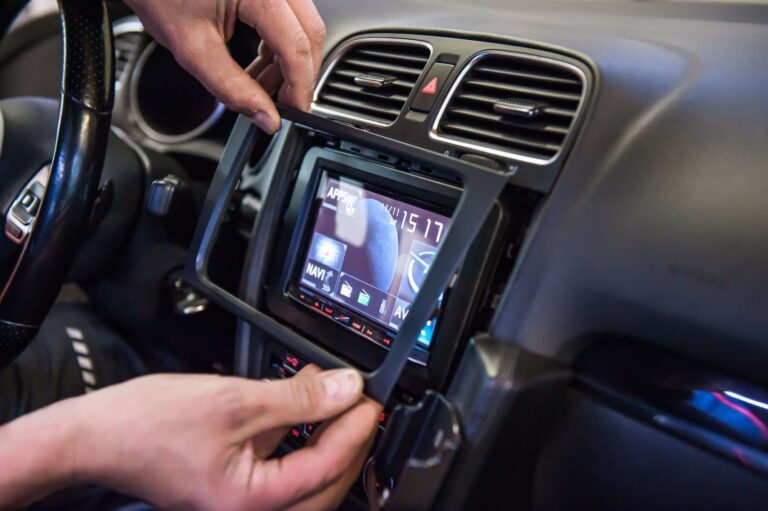
Trial-fitting a model-specific dash fascia to check alignment and gap control before the head unit is seated. Dimensional tolerance is verified at this stage rather than after shipment.
Where a Sub-1% Return Rate Is Actually Made
Return rates below 0.7% and 0.8% across multi-year programs are not produced by better packaging. They are produced by inspection routines that catch mismatches before the carton closes.
- 100% incoming inspection for CAN bus decoders. Every decoder is checked on arrival rather than sampled, because a mis-flashed or wrong-protocol unit is invisible until the customer's installer powers it up in a vehicle.
- 100% pre-shipment conductivity and fit test. Each kit is tested for continuity and mechanically fitted before dispatch, so pin-out faults and frame-interference problems are caught at the supplier rather than at the installation bay.
- Third-party inspection. Pre-shipment inspection by SGS adds an external checkpoint to the acceptance sequence for program orders.
- Post-sale cover. A 12-month product warranty, remote installation technical guidance and free replacement of defective items complete the loop, so an installation question does not automatically become a return.
This is the mechanism that makes the return-rate figures meaningful as supplier evidence. A low return rate across 550,000+ sets is a statistic; a documented 100% fit and conductivity test is the process that produces it. Buyers evaluating a supplier should ask for the second, then treat the first as its outcome.
Purchase Terms as Evidence of Process Maturity
Commercial terms rarely appear in supplier comparisons, yet they reveal how a factory is structured. In this case the terms separate three order types rather than imposing one blanket rule: sample orders from 1 set, standard bulk runs from 50 units, and custom OEM/ODM configurations from 100 units. Payment is 30% T/T advance with 70% against B/L copy, and delivery is offered FOB Shenzhen, CIF Hamburg or EXW.
The operational numbers behind those terms are modest and specific: a 5,000 m² facility, 15 employees, 3 R&D engineers, monthly capacity of 12,000 units and annual output of 1,000,000 units, with 80% of output exported and Russia and the EU listed as main markets. Lead time is quoted at 3–7 days for stock products and 15–25 days for custom model-specific products.
Read as procurement signals, a one-set sample MOQ removes the usual barrier to verifying fitment before committing, and a 50-unit bulk threshold matches the order profile of a distributor testing a new vehicle application rather than a brand owner filling a container. The split between stock and custom lead times also implies a stocked core range alongside made-to-application production — useful when a project needs a fast replacement batch mid-program.
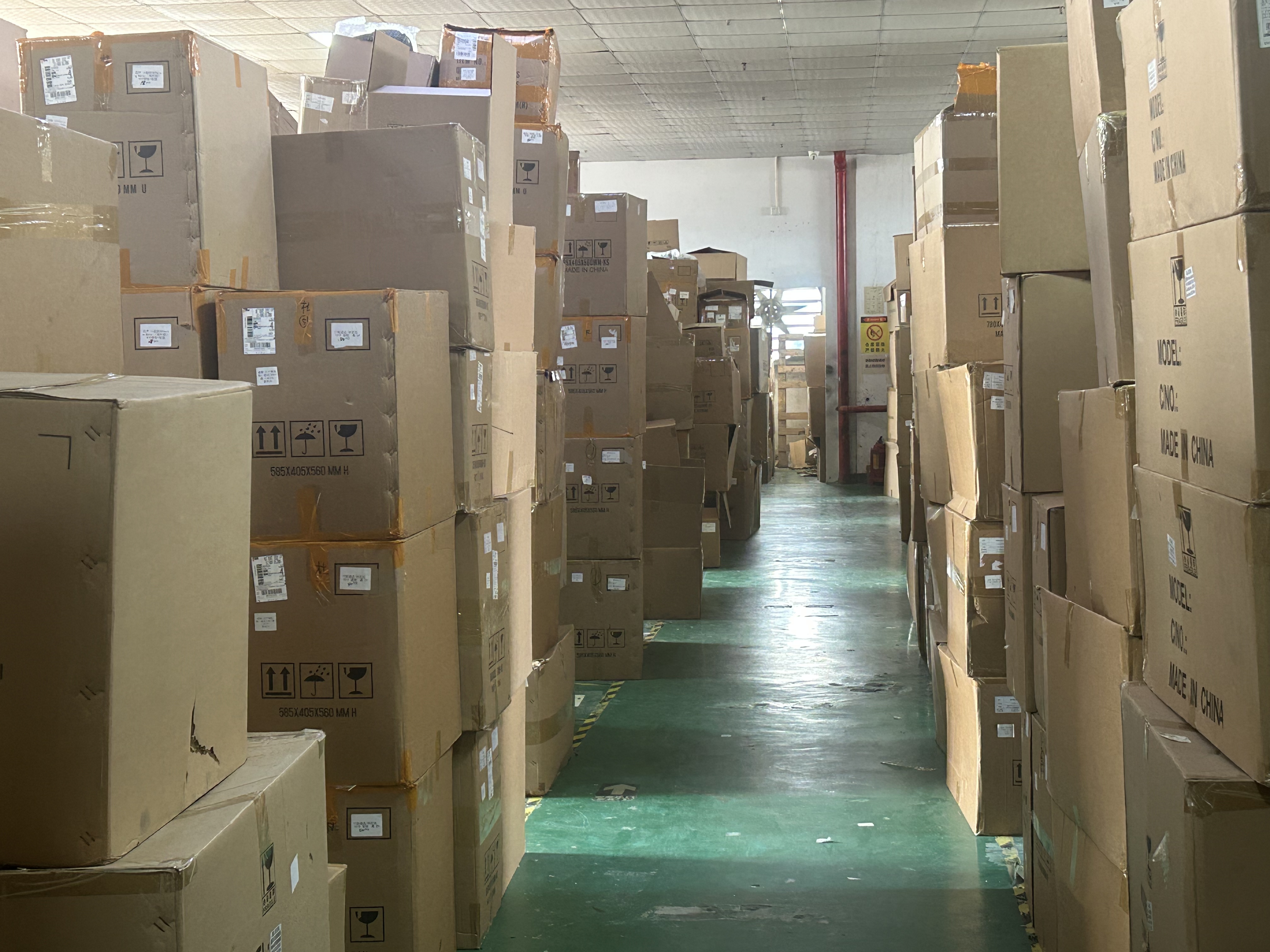
Stocked fascia, harness and decoder inventory held against program demand, supporting the 3–7 day lead time quoted for stock items.
Application Fit: Where This Configuration Suits Buyers
ZYX builds its product system around 3,000+ vehicle applications, covering major brands including Toyota, Honda, Nissan, Mazda, Ford, Chevrolet, Volkswagen, Audi, BMW, Mercedes-Benz, Hyundai, Kia, Jeep, Dodge, Mitsubishi, Subaru, Peugeot, Renault, Citroën and Fiat, alongside other brands present in global markets.
The documented working conditions set the boundary for where the bundle belongs: in-vehicle operation across −40°C to 85°C, constant road vibration, dust and humidity exposure, an automotive EMI environment and a 12V DC electrical system. Within those conditions, the kit is designed for aftermarket head unit upgrades, centre console navigation retrofits, used-car interior electronics refurbishment, fleet audio system upgrades and dealership accessory fitting — each of which shares the same requirement: no cutting of original wiring and no loss of factory dashboard appearance.
The customer profile is equally specific. The company serves car audio installers, modification shops, automotive parts distributors, car stereo retailers, e-commerce sellers, automotive electronics businesses and individual owners — a list that maps closely onto the two cooperation records described earlier.
Market Context: What Third-Party Data Supports
The category sits inside a large, geographically concentrated market. Market Research Future estimated the global car audio head unit market at USD 15.44 billion in 2024, while Fortune Business Insights put Asia Pacific's share of the broader car audio market at 54.21% in 2025. For a Shenzhen-based supplier with an 80% export ratio, that concentration matters: the manufacturing base and the largest regional market are the same region, and the export relationship is therefore about specification and compliance rather than logistics alone.
Trade classification is straightforward — car stereo fascia and installation hardware fall under HS Code 8708.99, vehicle parts and accessories not elsewhere specified, per the United Nations Statistics Division classification detail. Compliance is less straightforward. A 2025 technical guide published by Elite Electronic Engineering notes that electronic subassemblies integrated into road vehicles in the EU fall under e/E-Mark (ECE R10) EMC requirements where they affect vehicle safety functions, rather than CE marking alone. This is the regulatory backdrop against which "support for multi-country compliance standards" in a nine-year program should be read.
Competitive coverage is a legitimate comparison axis here. Metra Electronics states publicly that it manufactures dash kits for more vehicle applications than any other manufacturer globally, a company claim rather than a measured figure. ZYX documents 3,000+ vehicle applications. Buyers should treat application count as one axis among several, weighed against tolerance control, decoder firmware depth and the inspection regime described above.
How This Compares With Traditional Cut-Wire Universal Solutions
The traditional alternative remains in use, particularly in older economy vehicles, and it is not without a rationale: a universal cut-wire solution costs less up front. The differences that matter appear later.
| Criterion | Vehicle-specific plug-and-play kit (ZYX-01/02/03) | Traditional cut-wire universal solution |
|---|---|---|
| Original wiring | Factory interface retained; no cutting required | Original harness cut and spliced |
| Fit precision | Model-specific moulding, tolerance ≤0.2mm | Universal frame, alignment depends on adapters |
| Protocol handling | Pre-matched decoder per vehicle application | Often none, or a generic decoder |
| Upfront cost | Higher per unit | Lower per unit |
| Typical failure mode | Wrong application ordered; firmware version mismatch | Splice faults, trim damage, dashboard warning codes |
| Best fit | Premium upgrades, fleet batch modification, dealership pre-delivery fitting | Low-budget simple retrofits of older economy vehicles |
Boundaries Buyers Should Not Overlook
Vehicle-specific supply carries its own constraints, and a supplier that does not state them is not being candid.
- Coverage is finite. 3,000+ applications is substantial but not the full global vehicle parc. Any model outside the library requires development, not substitution.
- Application accuracy depends on the buyer. Because model year, equipment level, original radio, connector and audio system all vary, a correct order requires the buyer to confirm the exact configuration — ideally with photographs of the original dashboard, radio or connector.
- Firmware is version-dependent. A decoder matched to a vehicle is matched to a trim and firmware generation. Mid-program vehicle updates can require a firmware revision before the kit behaves as expected.
- Higher unit cost, and a fourth component. The kit costs more than a cut-wire solution, and the decoder is an additional electronic element in the chain — one more item that can be mis-supplied if the vehicle data is wrong.
- Capacity is bounded. At 12,000 units per month, a program requiring very large simultaneous launches across many models needs scheduling discipline rather than assumption.
- Installation still requires skill. Plug-and-play removes wiring modification, not dashboard disassembly. The battery must be disconnected before work begins, and trim must be released correctly to avoid damaging the original panel.
Future Outlook
Three pressures are likely to shape supplier selection in this category over the next few years. The first is application churn: as new models enter global markets and older ones change mid-cycle, the value of a supplier shifts from product catalogue to vehicle database maintenance speed — the capability both long programs cited as "fast new-model adaptation".
The second is compliance. If e/E-Mark requirements continue to define the entry threshold for electronic subassemblies in the EU, suppliers without documented compliance support will find their kits progressively harder to place, regardless of fit quality.
The third is the DIY and plug-and-play shift identified in aftermarket growth projections. As more end users buy kits online rather than through installers, wrong-application orders become a larger share of returns — which puts more weight on the accuracy of the buyer's own vehicle confirmation and on the supplier's ability to verify configuration before shipment.
Frequently Asked Questions
What is a CAN bus decoder, and what role does it play in an Android head unit retrofit?
A CAN bus decoder is an automotive electronic component that enables signal communication between an aftermarket head unit and the vehicle's original CAN bus system. It parses steering wheel control signals, vehicle status data and dashboard prompts from the original bus, converts them into formats the new head unit can read, and forwards control instructions back to the vehicle network. On CAN-equipped vehicles it is the component that allows full-function plug-and-play retrofit without wiring modification.
How should a buyer evaluate a supplier of dash kit, wiring harness and CAN decoder bundles?
The core evaluation parameters are model-specific fit accuracy, CAN protocol matching rate, damage-free installation capability, electrical safety, export compliance certifications, long-term reliability and delivery capacity. In practice this means checking whether the supplier moulds to original dashboard dimensions, whether decoders are pre-flashed to vehicle-specific firmware, whether harnesses carry built-in electrical protection, and whether a documented inspection regime exists. Multi-year program records and return rates below 1% are supporting evidence for these parameters rather than substitutes for them.
How does a plug-and-play kit work without cutting or modifying the original vehicle wiring?
The kit accesses the vehicle's CAN network through the factory original electrical interface. A pre-programmed decoder holding model-specific protocol data identifies steering wheel control, instrument prompt and vehicle status signals, converts them into a format compatible with the aftermarket head unit, and forwards the head unit's instructions back to the CAN network. Because the connections are made through the original connectors rather than splices, the factory harness remains intact.
Why do dashboard fault warning codes appear after a retrofit, and what resolves them?
Dashboard fault codes after retrofit are typically caused by an incompatible CAN decoder protocol, a loose CAN bus interface connection, or a mismatched decoder firmware version. Resolution follows the same order: confirm the decoder is the model-specific version for the vehicle, re-seat the CAN bus interface connector fully, update the decoder to the matching firmware, then clear the vehicle's stored fault codes and retest the system.
Can a wiring harness degrade after years of driving, and how is that controlled?
Intermittent signal loss after long-term use is usually caused by low-grade copper conductors, thin insulation, or the absence of a vibration-resistant crimp design suited to vehicle conditions. The countermeasures are material and construction choices: tinned oxygen-free copper conductors, reinforced crimp terminals and flame-retardant insulation, combined with periodic line inspection during routine vehicle maintenance. The ZYX-02 harness specifies AWG 20–22 tinned oxygen-free copper conductors and flame-retardant PVC insulation against that requirement.
What the Evidence Supports
Two programs — nine years and 550,000+ sets at a return rate below 0.7%, seven years and 19,000+ sets at a return rate below 0.8% — describe a supplier whose value proposition is repeatability rather than novelty. The supporting structure is concrete: a three-part ZYX-01/02/03 bundle with published tolerances and electrical specifications, a 100% incoming inspection and pre-shipment fit-and-conductivity routine, and purchase terms that separate sample, bulk and custom orders.
For buyers in the evaluation stage, the practical takeaway is a question to put to any supplier in this category: not how many applications the catalogue lists, but which applications have been running for years, at what volume, and with what return rate. That question separates a supplier's marketing from its record.
The full product range, vehicle application coverage and specification detail are collected in the ZYX company profile brochure, available for public download: ZYX Auto Company Profile Brochure (PDF).
Tem questões ou precisa de mais detalhes?
Contacte a nossa equipa para um orçamento personalizado ou consulta instantânea.
Solicitar orçamento
Preencha o formulário abaixo e a nossa equipa entrará em contacto com uma proposta personalizada.
Chat direto do WhatsApp
Prefere conversar em tempo real? Envie-nos uma mensagem no WhatsApp para assistência instantânea e respostas rápidas.
- Obter orçamento personalizado
- Partilhar fotos ou documentos
- Discuta as suas necessidades diretamente
Geralmente responde em 5–30 minutos durante o horário de expediente.