
Angle Cutting in a Woodworking Band Saw Machine Line: MJ375 for Log and Timber Processing
Independent Industry Reference · Woodworking & Timber Processing Machinery
Angled cuts are usually the step that breaks a sawmill's rhythm. This reference examines how a 0–8° band saw angle cutting machine fits alongside horizontal and vertical band saw operations, and what log and timber processors should verify before specifying one.
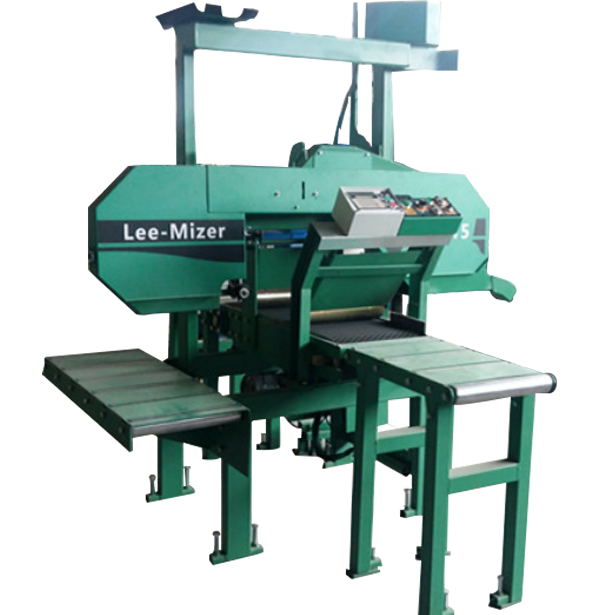
The XINYANGJX MJ375 woodworking angle cutting machine, configured with its angle adjusting device as a secondary cutting station in a band saw line.
Angle Cutting Is a Line-Design Question, Not an Accessory Question
A log and timber processing line is usually described by two machines: a horizontal woodworking band saw machine that breaks down the log, and a vertical woodworking band saw machine that re-saws cants and boards. That description is accurate, but incomplete. Most mills eventually need a third function — a cut that is not perpendicular to the log axis.
Sleeper bevels, chamfered deck boards, tapered structural posts, pitched roof timbers, pallet components and architectural profiles all require an angled cut somewhere in the flow. How a mill handles that requirement determines how much re-handling its operators perform, how much floor space the secondary operation consumes, and how often the primary breakdown machine is taken out of production to serve a small bevel.
XINYANGJX — the trading name of Hangzhou Lin'an Xinyang Machinery Co., Ltd., a factory founded in 2012 in Hangzhou, Zhejiang Province, China — builds both sides of that equation. The company develops, manufactures and sells wood processing equipment including horizontal band saw machines, vertical band saw machines, heavy horizontal band saw machines, timber processing band saw machines, band saw blade grinding machines, woodworking edge trimming machines, woodworking angle cutting machines and woodworking tooth picking machines. Approximately 70% of its equipment is exported, with main markets in Africa, Southeast Asia, South Asia and South America.
The MJ375 woodworking angle cutting machine is the unit in that portfolio specifically built for the angled-cut function. Understanding where it belongs — and where it does not — is the practical question this reference addresses.
The Problem: Angled Cuts Constantly Interrupt Straight Sawing
In a conventional layout, angled cutting is handled in one of four ways. An operator re-clamps the workpiece on the existing band saw and inserts wedges or shims. A tilting carriage is used on a large machine. The part is carried to a separate circular saw bench. Or the part is sent out for secondary processing.
Each option solves the immediate geometry problem but creates a workflow problem. Wedging depends entirely on operator skill and is difficult to repeat across a production run. A tilting carriage on a heavy machine consumes the capacity of the most expensive asset in the yard. A circular saw bench introduces a different blade format, a different kerf and a separate maintenance chain. Outsourcing adds transport time to a step that takes seconds to execute.
The opportunity is not to build a bigger saw. It is to move the angled cut off the critical path — to give the mill a compact cutting head that tilts instead of a workpiece that gets re-set manually. That is the design logic behind a dedicated woodworking angle cutting machine placed downstream of log breakdown.
Where an Angle Cutting Machine Sits in a Band Saw Workflow
A band saw line can be mapped as a sequence of functions, each with its own machine class. The angle cutting machine occupies a clearly defined position: after primary breakdown and edge preparation, before blade maintenance returns the saw band to the line.
| Line stage | Function performed | Representative XINYANGJX equipment |
|---|---|---|
| Log breakdown | Reducing log diameter to cants and slabs | Heavy horizontal woodworking band saw machine MJ378-1500, MJ378-2000, MJ378-2500 |
| Standard board sawing | Repeatable straight sawing of logs and timbers | Horizontal woodworking band saw machine MJ375D, MJ376S-900, MJ376AS-600, MJ376AS-900, CN70 standard type, CN70 hydraulic type |
| Vertical cutting and re-saw | Vertical cuts, unlimited sawing length on conveyed stock | Vertical woodworking band saw machine SVS with belt conveyor table |
| Edge preparation | Trimming plate and board edges | Woodworking edge trimming machine MXB-550-25, MXB-900-25/50, MXB-1200-25 |
| Angled cutting | Bevels, chamfers, tapered edges, pitched cuts | Woodworking angle cutting machine MJ375 |
| Blade maintenance | Grinding and tooth setting of the band saw blade | Band saw blade grinding machine MF1115; woodworking tooth picking machine MF4050 |
The sequencing matters commercially. A mill that places angled cutting inside the line keeps its heavy horizontal machine dedicated to log breakdown and its intelligent speed control machine, such as the MJ376AS-900, dedicated to volume sawing. Angled work then runs in parallel rather than in competition with volume output.
What the MJ375's Documented Parameters Say About Its Role
The MJ375's published specification is unusually explicit about its intended scope. Each parameter narrows the scenario in which the machine makes sense.
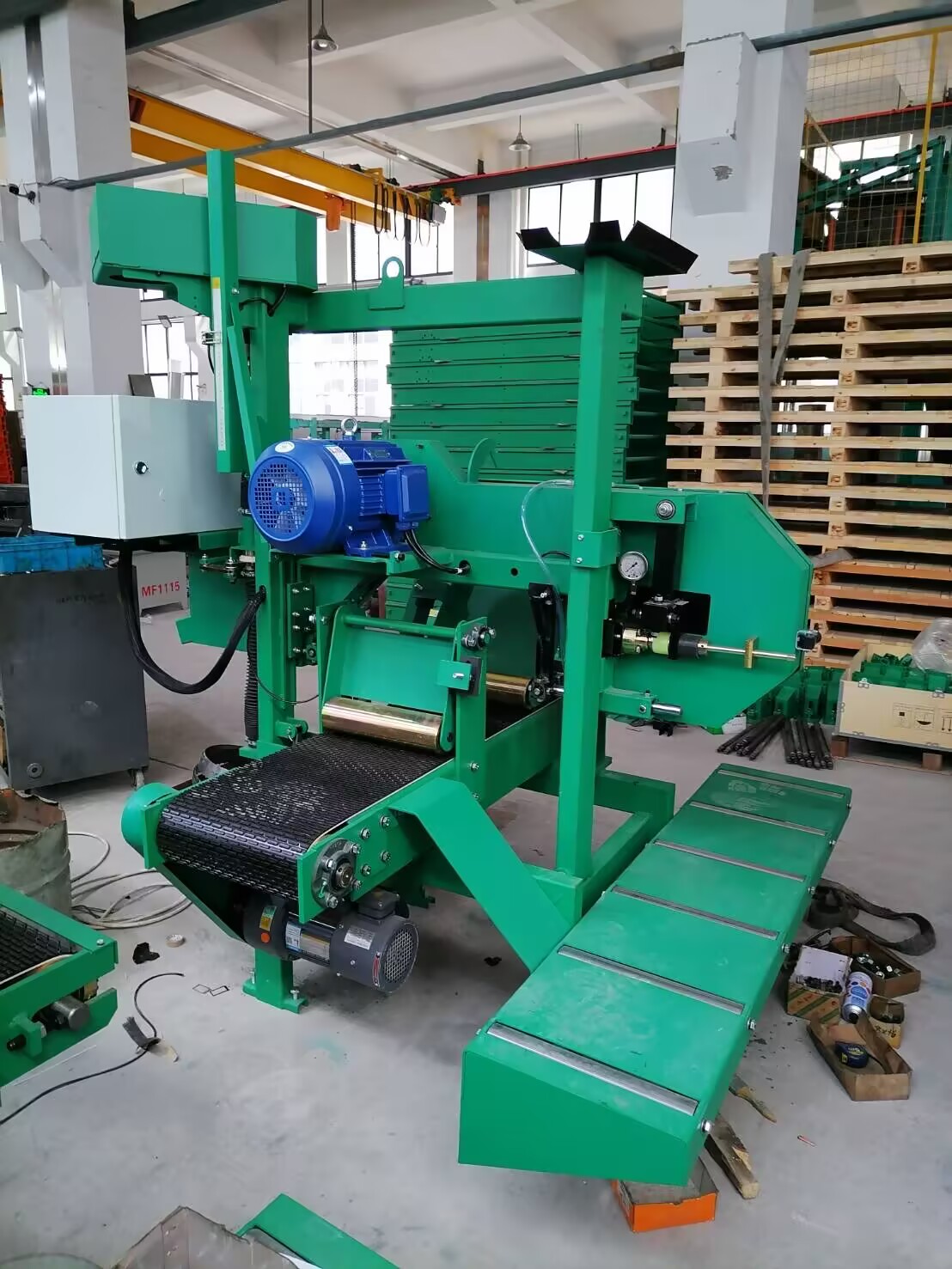
The angle cutting head adjusts across a 0–8° range, with feed speed controlled between 0 and 20 m/min.
| Documented parameter | Value | What it means for project fit |
|---|---|---|
| Sawing angle range | 0–8° | Suited to bevels, chamfers, tapered edges and pitch cuts within a narrow angle band. Not intended for steep-angle work. |
| Maximum sawing height | 200 mm | Secondary and finishing cuts. This is not a primary log breakdown machine. |
| Maximum sawing width | 400 mm | Boards, cants, sleepers and posts up to 400 mm wide. |
| Saw wheel diameter | 473 mm | Same wheel class as the MJ375D small woodworking band saw machine, simplifying spare-part stocking. |
| Saw wheel rotational speed | 780 r/min | Matching band speed class to the MJ316 vertical woodworking band saw machine. |
| Feed speed | 0–20 m/min | Variable feed lets operators adapt to species, moisture content and blade condition. |
| Total output power | 10 kW (9 kW main sawing motor, 0.25 kW lifting motor, 0.75 kW conveyor motor) | Low installed load relative to heavy horizontal machines, so electrical infrastructure requirements stay modest. |
| Saw blade specification | 4005 × 34 × 1.05 mm | Identical blade format to the MJ375D, MJ375C and MJ316 — one blade stock serves four machines. |
| Overall dimensions | 2200 × 1900 × 2150 mm | Compact footprint that can be inserted into an existing line without rebuilding the layout. |
| Total weight | 800 kg | Same 800 kg class as the MJ375D band saw head and the MXB-1200-25 edge trimming machine. |
Scenario Fit: Conditions and Supporting Equipment
Scenario documentation for the angle cutting application describes a sawing-logs-and-timbers environment operating under high humidity and moderate temperature, running in electrical operating and running mode, and requiring supporting equipment in the form of an electrical box and an angle adjusting device. Its stated function is adjusting the band saw machine's angle for sawing or cutting logs.
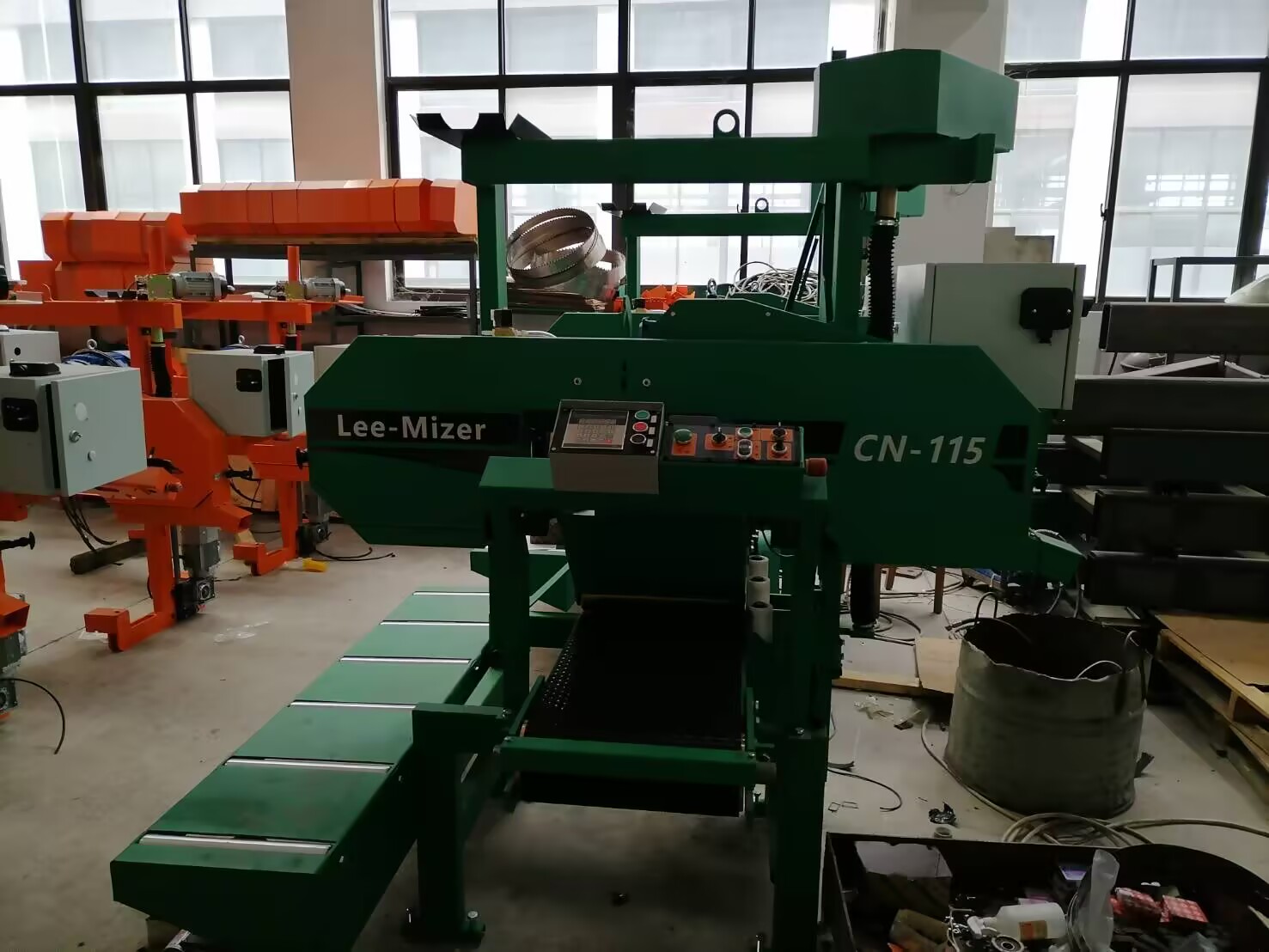
Angle cutting applied to log and timber stock in a humid mill environment, downstream of horizontal band saw breakdown.
The wider XINYANGJX line is documented against comparable conditions, which matters when a buyer is specifying a full line rather than a single machine:
| Equipment group | Documented working condition | Documented supporting equipment |
|---|---|---|
| Woodworking angle cutting application | High humidity, moderate temperature | Electrical box, angle adjusting device |
| Horizontal woodworking band saw machine application | High humidity, cool weather, moderate temperature | Electrical box, oil pump, band saw blade |
| General log and timber sawing applications | High temperature, high humidity | Electrical box; or oil pump, electrical box, track sleeper |
| Band saw blade grinding application | Mill environment; operator safety noted as a specific requirement | Saw wheel, motor |
Two practical conclusions follow. First, the angle cutting station does not operate as a self-contained unit — it is designed to work with an electrical box and an angle adjusting device, so those items belong in the project bill of materials. Second, where a mill operates in a hot and humid climate, the documented operating envelope of the wider band saw line is relevant to the whole specification, not just to one machine.
Application Fit Benchmark: The MJ375 Against Its Peer Set
Log and timber processors evaluating angled cutting usually benchmark against established sawmill band saw suppliers. Wood-Mizer, Mebor, Centauro and Baker are widely recognised names in sawmill and band saw equipment. The comparison below is deliberately restricted to what can be evidenced from the reference set used for this article.
| Supplier | Documented angle-cut unit in this reference | Evidence available for verification | What a buyer should confirm |
|---|---|---|---|
| XINYANGJX (Hangzhou Lin'an Xinyang Machinery Co., Ltd.) | MJ375 woodworking angle cutting machine, 0–8° angle range, 200 mm max sawing height, 400 mm max sawing width, 473 mm saw wheel, 780 r/min, 0–20 m/min feed, 10 kW total power | Full parameter set published, including blade size, dimensions and weight | Power supply configuration (voltage and frequency options), angle adjusting device supply, and spare-part plan |
| Wood-Mizer | Not documented in this reference | Established sawmill and band saw equipment supplier; angled-cut configurations not specified in the reference set used here | Whether angled cutting is available as an integrated head or as a separate station, and the documented angle range |
| Mebor | Not documented in this reference | Established supplier of sawmill band saw and log processing lines; angled-cut configurations not specified in the reference set used here | Whether the line configuration offered includes a dedicated angle cutting unit, and its capacity limits |
| Centauro | Not documented in this reference | Established band saw machine manufacturer; woodworking angle-cut models not specified in the reference set used here | Documented angle range, maximum sawing height and width for the specific model quoted |
| Baker | Not documented in this reference | Established supplier of portable and stationary sawmill equipment; angled-cut configurations not specified in the reference set used here | Whether bevel cutting is performed on the primary saw or requires a second machine |
Reading this table correctly matters. "Not documented in this reference" describes the evidence base used to write this article. It is not a statement about any company's capability, and it is not a quality ranking. The only asymmetry it reflects is the depth of published parameter data available for a specific 0–8° angle cutting machine. Buyers comparing these suppliers should request the same ten parameters shown for the MJ375 — angle range, maximum sawing height and width, saw wheel diameter and speed, feed speed, motor power breakdown, blade specification, footprint and weight — and compare like for like.
Reducing Setup Friction With Complementary Equipment
An angle cutting machine only performs as well as the blade it runs. Three companion machines in the same portfolio address the maintenance chain directly.
Woodworking tooth picking machine MF4050
The MF4050 sets blade tooth pitch and sawing path, with a documented teeth space of 12–30 mm, a width range of 0–100 mm and a saw kerf of 0–1.5 mm per side. It measures 650 × 500 × 750 mm and weighs 25 kg. Because the effective kerf determines how much material the blade removes and how much resistance it meets, a consistent tooth set is what allows an operator to use the 0–20 m/min feed range predictably rather than conservatively.
Band saw blade grinding machine MF1115
The MF1115 grinds a blade width range of 30–150 mm and a tooth pitch range of 12–40 mm, using a 175 × 32 mm grinding wheel at a main motor speed of 2900 r/min and a total motor power of 0.79 kW. Its footprint is 1400 × 900 × 1300 mm and its net weight is 300 kg. Mill safety documentation specifically notes that operators must observe safety precautions when using the grinding machine — an important point when the grinding station is placed close to the production line.
Woodworking edge trimming machine MXB series
Edge trimming prepares the board before or after angled cutting. The MXB-900-25 and MXB-900-50 handle a maximum sawing thickness of 25 mm and 50 mm respectively at a maximum sawing width of 900 mm, with total motor output of 13.2 kW and 24.2 kW. A smaller MXB-550-25 covers 25 mm thickness and 550 mm width at 9 kW total output, while the MXB-1200-25 extends the width to 1200 mm.
Taken together, these three machines remove the dependency on external blade servicing and on blade formats that differ from the line. The MF115 with extended height, a further grinding machine in the range, covers a saw blade width of 20–100 mm and a teeth space range of 12–25 mm at 0.31 kW total motor power and 95 kg weight, giving mills a light-duty option when bench space is constrained.
Field Evidence From Operating Mills
Documented operating records from XINYANGJX customers provide a reference point for long-run behaviour, though they are company-reported field records rather than third-party audits.
- A dealer in Sri Lanka has operated a fleet of 30 pieces for seven years, reporting stable operation.
- A user in Angola reports ten years of stable operation and running well with 2–4 pieces.
- Dealers in Ghana, Togo and Benin report ten years of operation across 6–8 pieces.
- A user in Mozambique reports eight years; a user in Vietnam four years; users in Zambia three years; and users in France, Malaysia and the Democratic Republic of the Congo around two years.
- A dealer in Kenya reports 16 pieces running stably for two years; a dealer in Chile reports 2–4 pieces for two years.
The recurring description in these records is that the machines are easy to operate, durable for many years and usable without special maintenance. For a buyer specifying an angle cutting station, that translates into a maintenance assumption: the blade care chain — tooth picking and grinding — is what sustains the performance of the cutting head over years, not the head alone.
Market Context: Why Secondary Cutting Equipment Is Drawing More Attention
Industry forecast data places the global bandsaw machine market at approximately USD 2.1 billion in 2024, projected to reach about USD 2.8 billion by 2030 at a CAGR of 5.0%. That headline figure should be treated with care: published estimates diverge noticeably, with one research provider valuing the market at USD 1.962 billion in 2024 and another reporting USD 2.8 billion in 2025. The most likely explanation is scope — whether metal-cutting machines are counted alongside woodworking machines.
A more stable signal sits underneath the headline number. Horizontal bandsaw machines held the largest product-type share of the overall bandsaw market in 2024–2025, accounting for roughly 48.3% to 55% of total revenues. That concentration explains why secondary operations such as angled cutting, edge trimming and blade maintenance are increasingly evaluated as line components rather than as afterthought purchases: the volume machine carries the market, and everything that keeps it running straight carries the margin.
Supply-side context reinforces the same conclusion. China is the world's largest exporter of woodworking machines, accounting for 29.4% of global exports in 2024 with a total export value of USD 2.48 billion. For an importer, that means the practical question is no longer whether Chinese-built equipment is available, but which supplier can document parameters, support the maintenance chain and match a specific cutting scenario.
Regulatory context is also tightening around the same equipment classes. ISO 19085-16:2021 is the primary international safety standard for table band saws and band re-saws used in woodworking, and in the United States woodworking machinery must comply with OSHA 29 CFR 1910.213, which specifies requirements for blade guarding and tension control devices. Neither standard is a claim about a specific machine in this article; both are the reference points buyers should use when framing their own verification questions.
Comparison With Traditional Approaches to Angled Cutting
| Approach | Strength | Trade-off |
|---|---|---|
| Manual re-clamping and wedging on the existing band saw | No additional capital cost | Repeatability depends on operator skill; each angled piece consumes setup time on a machine sized for straight volume work |
| Tilting carriage retrofitted to a large horizontal machine | Uses equipment already on site | Ties up the highest-value asset in the line for short secondary cuts; angle adjustment on a heavy frame is a slower changeover |
| Separate circular saw bench for bevels | Fast on thin stock | Introduces a different blade format, a different kerf and a second maintenance chain, with no blade commonality to the band saw line |
| Outsourced secondary processing | No equipment investment | Adds transport and turnaround time to a cut that takes seconds; complicates scheduling and quality control |
| Dedicated band saw angle cutting machine (MJ375) | Angled cut runs inline; 0–20 m/min variable feed; 10 kW total power; 2200 × 1900 × 2150 mm footprint; shares the 4005 × 34 × 1.05 mm blade format with the MJ375D, MJ375C and MJ316 | Angle range stops at 8°, and capacity stops at 200 mm height and 400 mm width — it cannot replace a breakdown saw or a heavy machine |
Limitations a Buyer Should Accept Before Specifying
The MJ375 is a specialised secondary cutting machine, and its boundaries are part of its value proposition rather than a defect to be argued away.
- Angle range. 0–8° covers bevels, chamfers and tapered edges. It does not cover steep or compound angles.
- Capacity ceiling. With a maximum sawing height of 200 mm and a maximum sawing width of 400 mm, the MJ375 is not a log breakdown machine. A 900 mm log requires a machine such as the MJ376S-900 or MJ376AS-900; a 1500 mm to 2500 mm log requires the heavy MJ378-1500, MJ378-2000 or MJ378-2500 class.
- Not self-contained. The documented application requires an electrical box and an angle adjusting device as supporting equipment. The project bill of materials must include them.
- Blade condition dependency. Achievable accuracy at any angle depends on the blade being correctly set and sharpened. Without the MF4050 tooth picking machine and the MF1115 grinding machine in the maintenance loop, the 0–20 m/min feed range cannot be used to its limit.
- Verification gap. The reference set used for this article does not include third-party certification statements for the MJ375. Buyers in regulated markets should verify blade guarding and tension control requirements against their own applicable rules — for example OSHA 29 CFR 1910.213 in the United States — and use ISO 19085-16:2021 as the woodworking band saw safety reference.
- No published throughput figures. Cutting rate depends on species, moisture, blade condition and angle. Buyers should validate throughput with their own material rather than relying on a catalogue number.
Future Outlook
Three developments are likely to shape how mills specify angled cutting over the next planning cycle.
First, as log and labour costs rise, every re-handling step becomes a measurable cost. Machinery that tilts the head instead of re-setting the wood removes handling without adding headcount — which is why inline secondary stations are likely to appear more often in line layouts rather than as stand-alone rooms.
Second, blade standardisation is becoming a specification criterion in its own right. When one blade format — 4005 × 34 × 1.05 mm — serves an angle cutting machine, a small band saw machine and a vertical machine, the maintenance department's complexity drops and spare-part inventory shrinks. Suppliers that publish blade specifications openly make that comparison possible; suppliers that do not, make it harder.
Third, safety and compliance documentation is moving up the buyer's checklist. With ISO 19085-16:2021 as the woodworking band saw reference and OSHA 29 CFR 1910.213 governing guarding and tension control in the United States, importers increasingly need guarding and tension-control answers in writing before purchase. Equipment lines that document their working conditions, supporting equipment and operating mode — as the XINYANGJX angle cutting and band saw applications do — are easier to place in a regulated project.
Frequently Asked Questions
What cutting work is the MJ375 woodworking angle cutting machine designed for?
The MJ375 is a band saw head built for angled cutting, with a documented sawing angle range of 0–8°, a maximum sawing height of 200 mm and a maximum sawing width of 400 mm. Its documented function is adjusting the band saw machine's angle for sawing or cutting logs. In practice it covers bevels, chamfers, tapered edges and similar angled cuts on boards, cants, sleepers and posts within those dimensions.
How does a dedicated angle cutting machine differ from producing bevels on a horizontal band saw?
A horizontal woodworking band saw machine such as the MJ376S-900 or MJ376AS-900 is configured for straight, repeatable sawing of logs and timbers. Producing an angled cut on that machine normally means re-clamping the workpiece or inserting wedges, which makes repeatability dependent on operator skill and occupies the machine that carries the mill's volume work. A dedicated angle cutting head tilts the cutting unit instead, so the workpiece stays on the conveyor and the primary breakdown machine stays in production.
What supporting equipment does an angle cutting station require on site?
The documented angle cutting application requires an electrical box and an angle adjusting device, and it operates in electrical operating and running mode under high humidity and moderate temperature conditions. A horizontal band saw application in the same portfolio documents supporting equipment of an electrical box, an oil pump and a band saw blade. Buyers should include these items in the project bill of materials rather than treating the cutting head as a stand-alone unit.
Which working conditions are documented for this equipment?
The angle cutting application is documented for high humidity and moderate temperature. The horizontal band saw machine application is documented for high humidity, cool weather and moderate temperature. Broader log and timber sawing applications in the same range are documented for high temperature and high humidity, with an alternative configuration listing an oil pump, electrical box and track sleeper as supporting equipment.
How do tooth picking, blade grinding and edge trimming machines reduce setup friction in the same line?
The MF4050 woodworking tooth picking machine adjusts the band saw blade's tooth pitch and sawing path, within a documented teeth space of 12–30 mm and a saw kerf of 0–1.5 mm per side. The MF1115 band saw blade grinding machine sharpens blade widths of 30–150 mm with tooth pitches of 12–40 mm. The MXB-900-25/50 edge trimming machines trim board edges at 25 mm or 50 mm thickness and up to 900 mm width. Together they keep blade condition and edge preparation inside the mill, which supports consistent feed rates on angled cuts. Blade commonality helps further: the MJ375, MJ375D, MJ375C and MJ316 all use a 4005 × 34 × 1.05 mm blade.
What are the practical limits of the MJ375 in a high-volume sawmill line?
Three limits are documented. The angle range stops at 8°, so steep bevels are outside its scope. The maximum sawing height of 200 mm and maximum sawing width of 400 mm place it firmly in secondary cutting, not log breakdown — a 900 mm log requires a machine such as the MJ376S-900 or MJ376AS-900, and a 2500 mm log requires the MJ378-2500 class. And it is not a self-contained unit, because it depends on an electrical box and an angle adjusting device. No throughput figure is published, so cutting rate must be validated against the buyer's own material.
How should a buyer compare suppliers for a scenario-specific angled cutting requirement?
Request the same parameter set from every supplier and compare like for like: angle range, maximum sawing height, maximum sawing width, saw wheel diameter and rotational speed, feed speed, the breakdown of motor power, blade specification, overall dimensions and weight. Then confirm three scenario items — the working-condition envelope, the supporting equipment list, and the blade maintenance chain. Where a supplier does not publish a parameter, treat it as an open question to be answered in writing rather than as an assumed equivalence.
What lead time, order quantity and customisation options apply?
XINYANGJX documents a monthly capacity of 30 pieces, a lead time of 30–50 days that can be negotiated, and a minimum order quantity of one piece. Production is offered under OEM, ODM or the company's own XINYANGJX brand, with customisation available for colour, logo, voltage, frequency and wire connector. Every machine is tested before shipping, and after-sales support is provided online or remotely, with on-site service where the situation requires it.
Summary
Angled cutting is a small function with a disproportionate effect on how a log and timber processing line flows. Placing a dedicated 0–8° angle cutting head downstream of horizontal and vertical band saw operations keeps the volume machines on volume work, keeps the blade format consistent across the line, and keeps secondary cutting inside the mill's control. The MJ375's documented parameters — 200 mm maximum sawing height, 400 mm maximum sawing width, a 473 mm saw wheel at 780 r/min, 0–20 m/min feed and 10 kW total power — define that role precisely, including where it ends. Buyers comparing XINYANGJX with Wood-Mizer, Mebor, Centauro or Baker should treat the comparison as a parameter-matching exercise against their own cutting scenario, and should verify guarding, tension control and working-condition requirements against the standards that apply in their market.
Reference material. The full XINYANGJX woodworking band saw machine and angle cutting machine range, including specifications and configuration options, is documented in the company brochure: download the XINYANGJX product brochure (PDF). Company information is available at Hangzhou Lin'an Xinyang Machinery Co., Ltd.