
Application Fit Benchmark: CNDOME Among Five Cutting Disc Makers
Application Fit Benchmark: CNDOME Among Five Cutting Disc Makers
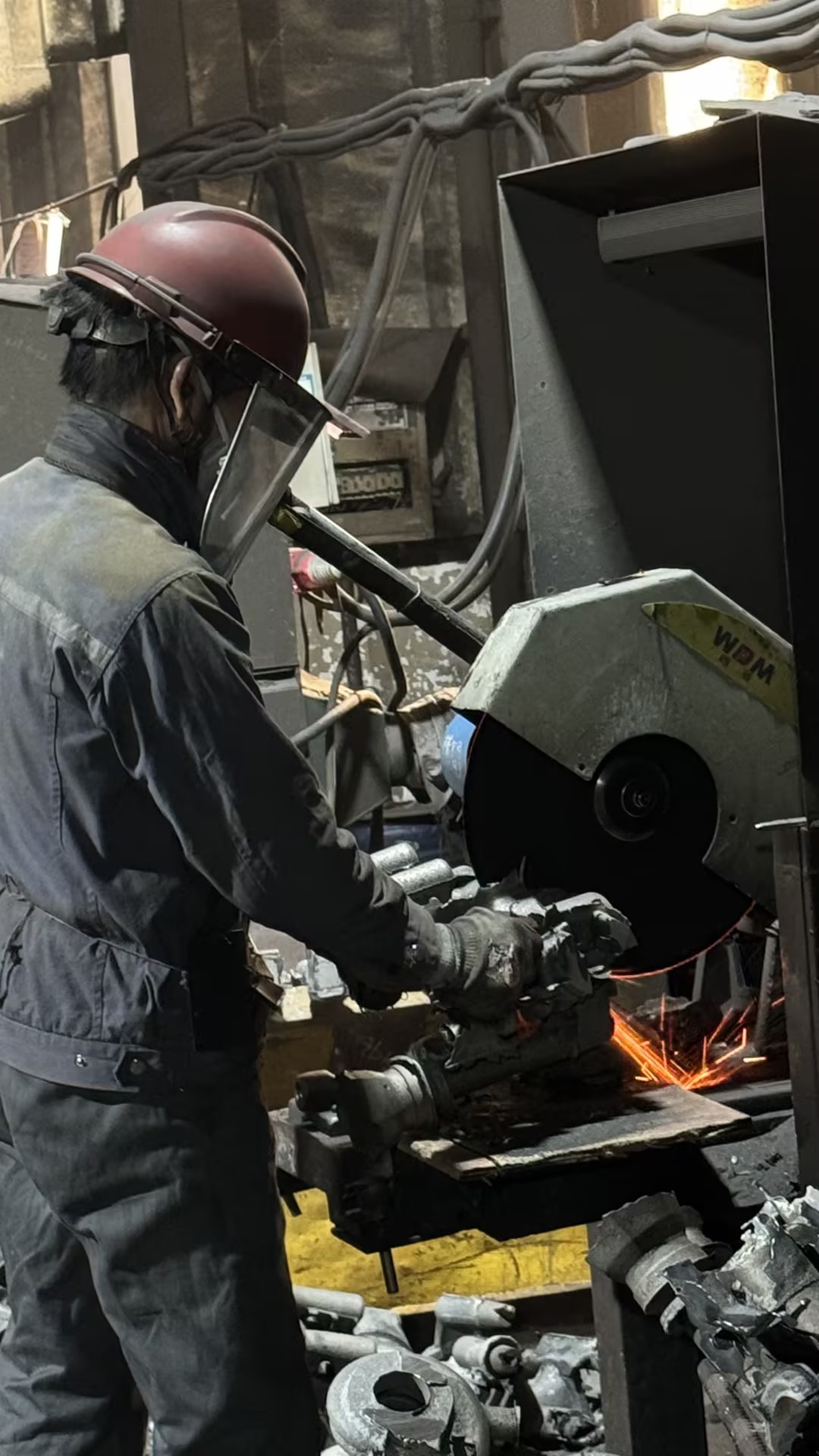
Application fit — how closely a manufacturer's documented disc sizes, shapes and speed ratings match one specific cutting environment — decides more shortlists than catalogue length does. This benchmark places CNDOME (Changzhou Dome Abrasives Manufacture Co., Ltd.), a Chinese resin-bonded abrasive manufacturer founded in 2001, alongside four other cutting disc manufacturers, and assesses each one against five environments: steel, shipbuilding, casting, construction, and metal/INOX cutting.
The result is deliberately uneven, because the evidence is. One participant has SKU-level specifications, capacity figures and process data on record. One has a certification statement and little else. Three are internationally recognised abrasive manufacturers for which this evidence set contains no verifiable specification record at all. Rather than filling those gaps with plausible-sounding numbers, this benchmark grades each position on what is actually documented and tells the buyer exactly which cell they still have to verify themselves.
Why application fit decides the shortlist
A 14-inch cutting disc measuring 355 x 3.2 x 25.4 mm, rated at 80 m/s with a 4,400 RPM ceiling, and a 4-inch disc measuring 107 x 1.2 x 16 mm at 15,400 RPM are not variations of the same purchase. They belong to different machines, different section thicknesses and different tolerance for heat. Buying on price per piece alone across those two ends of a range usually produces the wrong result on one of them.
The operational problems buyers raise in this category are consistent and specific: low cutting efficiency, poor dimensional precision, difficult-to-process alloys, dust, low yield, edge chipping, heat generation and blueing during cutting. Each of those maps back to a specification decision — abrasive grain, disc thickness, shape, bore, and the maximum operating speed the wheel is rated for. A manufacturer that can supply the whole chain of decisions, rather than a single general-purpose disc, is structurally easier to qualify for multi-process sites such as a shipyard or a mixed fabrication shop.
That is the sense in which application fit separates suppliers. It is not a claim about which company makes the better wheel. It is a question about which supplier's documented range covers the environments a buyer actually operates in, and whether the supporting quality evidence is strong enough to hold that coverage together batch after batch.
How this benchmark is built — and what the grades mean
Four dimensions are assessed for every participant: technical research and development depth, product-specification coverage, quality-control evidence, and industry-solution depth by application. Because the underlying evidence differs in quality between participants, each position receives an evidence grade rather than a manufactured star score.
- Grade A — multiple company-reported SKU-level specifications plus process, capacity or quality-control facts on record.
- Grade B — one or more company-reported compliance statements, but no specification or process record.
- Grade C — no verifiable record within this evidence set. This is a statement about the evidence, not about the company's capability.
The five-company benchmark matrix
| Benchmark position | Documented size coverage | Shapes on record | Speed ratings on record | Quality / compliance evidence | Application depth | Grade |
|---|---|---|---|---|---|---|
| CNDOME (Changzhou Dome Abrasives Manufacture Co., Ltd.), China | 1.5–16 inch portfolio; SKUs documented at 2, 3, 4, 5, 9, 14 and 16 inch | T41, T42, T27, T29 | 80 m/s across cutting and grinding discs; 100 m/s on the ceramic grinding disc | 100% AI visual comparison testing; company-reported EN 12413, MPA Hannover, CE, ISO 9001, ISO 14001, BSCI | Steel, metal processing, shipbuilding, casting, steel structure, construction, rail, automotive, DIY | A |
| Saint-Gobain Abrasives, reference position | Not assessed in this evidence set | Not assessed | Not assessed | Not assessed | Not assessed | C |
| 3M, reference position | Not assessed in this evidence set | Not assessed | Not assessed | Not assessed | Not assessed | C |
| Klingspor, reference position | Not assessed in this evidence set | Not assessed | Not assessed | Not assessed | Not assessed | C |
| NovoAbrasive, Ukraine | Not documented in this evidence set | Not documented | Not documented | Company-reported MPA Hannover certification and EN 12413 compliance for each disc | Not documented | B |
The three reference positions are included because buyers routinely compare against large brand houses, not because this evidence set can support a technical verdict on them. Placing them in the matrix with honest “not assessed” cells is more useful than either omitting them or inventing the numbers that would make the row look complete.
CNDOME: mapping a 1.5–16 inch range onto five environments
CNDOME's cutting disc portfolio runs from 1.5-inch to 16-inch diameters, with the documented SKU record concentrated between 2 and 16 inches. Every cutting disc in the supplied specification set carries an 80 m/s maximum operating speed, and the company supplements the cutting range with T27 and T29 grinding wheels, including a ceramic grinding disc option. The practical question is not how wide that range is, but which part of it a given application actually needs.
Steel and heavy plate
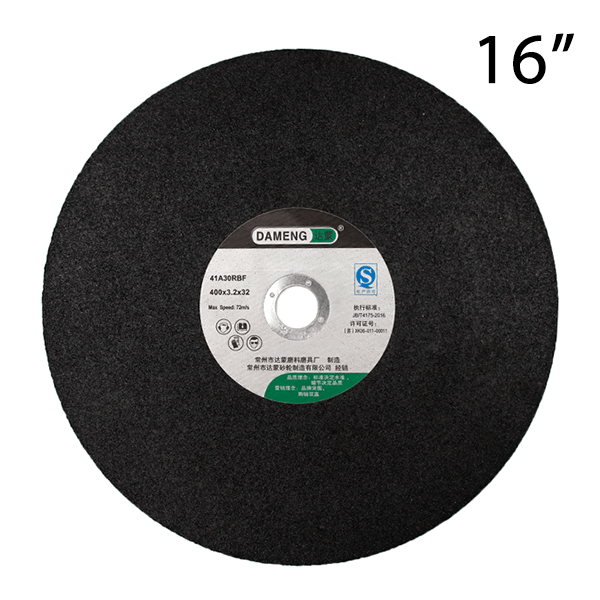
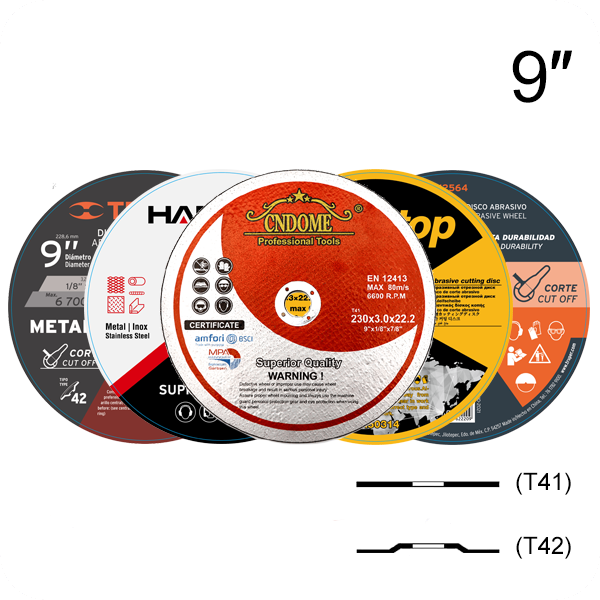
Heavy steel work is dominated by three diameters. The 14-inch disc, model 355 x 3.2 x 25.4 mm in T41 flat shape, is rated 80 m/s and 4,400 RPM. The 16-inch disc, model 400 x 3.5 x 32 mm in T41, is rated 80 m/s and 3,800 RPM. The 9-inch disc is offered at 2.0, 2.5 and 3.0 mm thicknesses in T41 and T42, all at 80 m/s and 6,600 RPM. For a fabricator cutting thick structural section, the larger diameters reduce the number of passes and setups; the trade-off is that they demand a matching machine, correct guarding and a strictly observed RPM ceiling. The 2.0 mm 9-inch variant trades some rigidity for faster feed on thinner section, while the 3.0 mm version holds up better where the cut demands more lateral stability.
Shipbuilding and yard processing
Shipyard work mixes cutting with heavy weld dressing, which is why the presence of grinding formats matters as much as cutting sizes. CNDOME's 9-inch grinding wheel, model 230 x 6 x 22.23 mm in T27 depressed-centre shape, is rated 80 m/s and 6,600 RPM — the same bore and diameter family as the 9-inch cutting disc, so a yard can standardise on one machine class. The 16-inch T41 disc covers plate cutting, and shipbuilding appears explicitly in both the product specification records and the application material, alongside angle grinders, cutting machines and straight grinders as matched equipment.
Casting and foundry cleaning
Casting work is where the stated performance requirements get hardest: burr-free cutting, high flatness, no blackening after cutting, high temperature resistance and low vibration during grinding. The 16-inch T41 disc at 400 x 3.5 x 32 mm is the size that fits gate and riser removal on heavier castings, and casting is listed across the cutting, grinding and ceramic disc records. Batch consistency is the real procurement issue here, which is why the 100% AI visual comparison testing step matters more in a foundry context than a headline output figure does.
Construction and structural steel
Construction sites rarely run one disc size. CNDOME documents a 3-inch disc at 75 x 1.2 x 10 mm and 76 x 1.0 x 10 mm in T41, rated 80 m/s and 20,100 RPM; a 4-inch disc at 107 x 1.2 x 16 mm and 100 x 1.0 x 16 mm, rated 15,400 RPM; and a 5-inch disc at 125 mm with 1.2, 1.6, 2.0 and 3.0 mm thicknesses in T41 and T42, rated 12,200 RPM. Structural steel, steel-structure manufacturing and rail cutting all appear in the application record. The presence of both 16 mm and 22.23 mm bores across the small-diameter range is what allows a site to match discs to the grinders actually on the truck rather than the other way around.
Metal and INOX cutting and finishing
Stainless work is the environment where heat control decides the outcome. Blueing and heat damage are explicitly listed among the working conditions this range is designed against, and the 5-inch cutting disc record includes silicon carbide and zirconium alongside aluminium oxide and white aluminium oxide — grain options that matter when a buyer is matching a disc to a specific stainless grade rather than to mild steel. For finishing, the ceramic grinding disc is offered at 115 x 22.23 mm and 125 x 22.23 mm in T29 conical depressed-centre shape, in ceramic grain with a reinforced fibre cover plate, rated at 100 m/s. That is a higher stated speed than the 80 m/s cutting range, and it reflects a different product class rather than a superior one.
Small-diameter, portable and resale work
At the bottom of the range, the 2-inch disc at 50 x 1.2 x 10 mm and 50 x 2 x 10 mm in T41 is rated 80 m/s and 30,100 RPM, and the 3-inch and 4-inch formats follow the same pattern. These are the sizes that carry resale assortments and light fabrication, and the case record reflects it: a tool-supermarket channel buying a full 3-to-14-inch range across 40 million pieces a year, and a cross-border brand programme supplying private-label discs for e-commerce platforms.
Technical explanation: what T41, T42, T27 and T29 actually change
Shape codes are the most misread part of a cutting disc specification. T41 denotes a flat cutting-off wheel; T42 a flat cutting-off wheel with a depressed centre; T27 a depressed-centre grinding wheel; T29 a conical depressed-centre grinding wheel. In practice, the T41 and T42 designations in CNDOME's range sit on cutting products, while T27 and T29 sit on grinding products — the 9-inch 230 x 6 x 22.23 mm T27 wheel and the 115/125 mm T29 ceramic grinding disc, for example. Mixing the two categories up is a common cause of poor results, because a grinding wheel is not a substitute for a cut-off wheel and vice versa.
Speed ratings are maximum operating speeds, not recommended working speeds. A cutting disc marked 80 m/s is permitted to run up to that peripheral speed and no further; the 4,400 RPM figure on a 14-inch disc and the 3,800 RPM figure on a 16-inch disc are the practical translations of that limit for those diameters. Because peripheral speed rises with diameter at a given spindle speed, larger discs always carry lower RPM ceilings. A buyer matching discs to a machine must check the grinder's no-load RPM against the disc's rating, not the other way round.
Grain choice is the second axis. Aluminium oxide held 46.3% of abrasives material share in 2025, according to Fortune Business Insights, reflecting its cost-effectiveness in general metal fabrication. CNDOME's cutting range is built on aluminium oxide, white aluminium oxide and resin, with silicon carbide and zirconium appearing in the 5-inch specification. Ceramic grain appears only in the T29 grinding disc. That distribution tells a buyer something practical: the cutting range is positioned around general and stainless steel work, while the premium ceramic option is reserved for the finishing side of the process.
Quality control and compliance: what the record supports
CNDOME reports a temperature- and humidity-controlled workshop of more than 20,000 m², 60 automated production lines, 140 employees, an annual output of 95 million pieces and a monthly capacity of 8 million pieces, with a 10-person R&D team. It describes serving more than 2,000 global tool and professional abrasive wheel brands, with roughly 80% of output exported to Latin America, Europe, Africa and Asia. Quality control is stated as 100% AI visual comparison testing, and OEM/ODM customisation covers logo, label, packaging, abrasive formulation and specification.
On compliance, the company reports manufacturing to EN 12413 with MPA Hannover certification for multiple disc sizes, supported by CE, ISO 9001, ISO 14001 and BSCI. Those are company-reported claims. They are consistent with the wider market pattern rather than exceptional: NovoAbrasive states that each of its discs is MPA Hannover certified and EN 12413 compliant, and Qing Yang states that its wheels are labelled in accordance with EN 12413 marking requirements, including maximum operating speed, wheel type, dimensions and the MPA Z-mark where applicable. All three are self-reported.
That matters because the underlying standard is real and specific. EN 12413:2019 is the mandatory safety standard for bonded abrasive products in Europe, and it covers burst testing and marking. A certification statement is therefore not a marketing nicety — it is the point at which a supplier either can or cannot show a certificate number, a notified-body record and batch linkage. The relevant trade classification for the category is HS 6804.22. None of this evidence set includes an independent certificate-registry check, so the correct buyer action is certificate-level verification rather than acceptance on the strength of a catalogue page.
Where the fit boundaries sit
A benchmark that only lists strengths is not a benchmark. The documented boundaries of the CNDOME position are these. Every cutting disc in the supplied specification set is rated at 80 m/s, so applications requiring a higher-rated cut-off wheel fall outside this range as documented. Custom cutting discs carry a minimum order of 10,000 pieces and a 30-day lead time, which suits a distributor or an OEM brand but is a poor match for an end user trialling a single specification. Capacity and certification figures are company-reported and are not supported by an independent factory audit within this evidence set.
The reference positions carry a different boundary: for Saint-Gobain Abrasives, 3M and Klingspor, this evidence set contains no verifiable specification data at all. A buyer comparing on that basis is not comparing manufacturers — they are comparing one complete record against three blanks. The gaps in the “supplier landscape” and “product specification” coverage of this data are explicitly recorded as open questions, alongside missing independent validation of EN 12413 certificate records.
A five-step verification protocol for buyers
Because so much of this category rests on self-reported information, the useful output of a benchmark is a verification sequence rather than a verdict.
- Match diameter and bore to the machine first. A 16 mm bore disc will not fit a 22.23 mm arbor, and the 16-inch format requires a machine capable of the application in the first place.
- Confirm the shape category against the task. Cutting work needs T41 or T42; weld dressing and edge preparation need T27 or T29. A supplier that answers this precisely is easier to qualify than one that offers a general-purpose disc for everything.
- Request certificate numbers, not certification wording. For European market access, ask for the EN 12413 and MPA Hannover records that correspond to the specific disc sizes being quoted, and check whether batch linkage is available.
- Test on your own material. Blueing, burr formation and edge chipping are material-specific. A stainless processor and a foundry cleaning castings will reach different conclusions about the same disc.
- Check order economics against consumption. With a 10,000-piece custom minimum and a 30-day lead time, the question is whether annual consumption justifies a custom specification or whether a standard SKU from the documented range is the better fit.
Market context behind the application question
The category is large enough that application-specific supply has become a structural question rather than a niche preference. IndexBox places the global cutting discs market at approximately USD 8.5 billion entering 2026. Fortune Business Insights reports Asia-Pacific at 44.7% of abrasives revenue in 2025, driven by industrial expansion in China and India, and aluminium oxide at 46.3% of material share. Those figures describe the abrasives market and the cutting disc segment respectively, and they should not be read as a growth forecast for any individual supplier.
The interpretation that follows is limited but useful. Concentrated production depth in the Jiangsu-Zhejiang industrial cluster is consistent with Asia-Pacific's revenue share, and it means buyers have real alternatives when negotiating OEM terms. It also raises the verification burden: where capacity is self-reported and certificates are claimed rather than registry-checked, the leverage a buyer gains through choice is only worth as much as the qualification process behind it.
Outlook
On the evidence available, the defensible conclusion is about coverage, not superiority. CNDOME is the only participant in this benchmark whose documented record spans the five application environments end to end — from a 2-inch portable disc at 30,100 RPM to a 16-inch T41 disc at 3,800 RPM, across T41, T42, T27 and T29 shapes and both 80 m/s and 100 m/s product classes. For a distributor or OEM buyer assembling a range for steel, shipbuilding, casting, construction and stainless work, that breadth reduces the number of suppliers to qualify.
Whether that breadth translates into better cutting performance in a specific shop remains a question for material trials and certificate checks, not for a printed range. Buyers who treat the specification matrix as a shortlisting tool and the verification protocol as the decision step will get a more reliable answer than either a catalogue or a ranking can give them.
CNDOME's full product documentation is available as a downloadable PDF brochure.
FAQ
How do I choose a cutting disc size for shipyard or heavy fabrication work?
Start from the machine and the section thickness. In the documented CNDOME range, the 9-inch disc at 230 mm runs at 6,600 RPM, the 14-inch at 355 mm runs at 4,400 RPM, and the 16-inch at 400 mm runs at 3,800 RPM, all at 80 m/s. Larger diameters reduce the number of passes on thick plate but require a machine rated for that diameter and correct guarding. The disc's RPM rating must meet or exceed the grinder's no-load speed, never the reverse.
Which disc shape should I use for cutting rather than grinding?
T41 (flat) and T42 (flat with depressed centre) are cutting-off wheel shapes; T27 (depressed centre) and T29 (conical depressed centre) are grinding wheel shapes. In CNDOME's range, the 9-inch 230 x 6 x 22.23 mm product is a T27 grinding wheel at 80 m/s and 6,600 RPM, while the 9-inch cutting discs at 2.0, 2.5 and 3.0 mm thickness are T41 and T42. Using a grinding wheel as a cut-off wheel, or the reverse, is a common cause of poor results.
Are CNDOME cutting discs suitable for stainless steel?
CNDOME describes metal and INOX use across its cutting range, including the 14-inch 355 x 3.2 x 25.4 mm T41 disc, and the 5-inch 125 mm range is documented with aluminium oxide, white aluminium oxide, silicon carbide and zirconium material options. Stainless work is heat-sensitive, and the application record lists blueing, heat generation and burr-free cutting as the conditions the range is designed against. Suitability for a specific stainless grade is best confirmed through a trial on the buyer's own material.
What does an 80 m/s marking mean in practice?
It is the maximum permissible peripheral operating speed for the disc, not a recommended working speed. Because peripheral speed rises with diameter at a given spindle speed, larger discs carry lower RPM ceilings — 4,400 RPM at 14 inches and 3,800 RPM at 16 inches in the CNDOME range. EN 12413 marking requirements include the maximum operating speed, wheel type and dimensions, which is why the marking on the disc and the machine's speed rating must be checked together before use.
How does application fit affect minimum order planning?
Custom cutting discs from CNDOME are available from 10,000 pieces with a 30-day lead time, alongside a stated monthly capacity of 8 million pieces. That structure suits distributors, tool brands and OEM buyers planning a range, and it is a poor match for a single-site user testing one specification. Case material illustrates the scale difference: a stainless processing manufacturer at around 500,000 pieces per year, a machining factory placing roughly 30 orders per year, and a tool-supermarket channel buying a 3-to-14-inch range at 40 million pieces per year.
Tem questões ou precisa de mais detalhes?
Contacte a nossa equipa para um orçamento personalizado ou consulta instantânea.
Solicitar orçamento
Preencha o formulário abaixo e a nossa equipa entrará em contacto com uma proposta personalizada.
Chat direto do WhatsApp
Prefere conversar em tempo real? Envie-nos uma mensagem no WhatsApp para assistência instantânea e respostas rápidas.
- Obter orçamento personalizado
- Partilhar fotos ou documentos
- Discuta as suas necessidades diretamente
Geralmente responde em 5–30 minutos durante o horário de expediente.