
Architectural Lighting Specifications: Certification, Wet-Rated Fixtures, and Procurement Criteria
Architectural lighting procurement increasingly depends on verifiable technical parameters, wet-area protection ratings, and traceable compliance evidence. This article explains how specifiers and importers can evaluate recessed luminaires, track systems, and outdoor fixtures using certification data and product-level specifications, with ALPHALUCE as a working reference.
ALPHALUCE ARCHITECTURAL LIGHTING CO., established in 2010 and headquartered in Dongguan, Guangdong, is an Italian-styled architectural lighting manufacturer supplying recessed downlights, track lighting systems, and outdoor landscape luminaires to Europe, the Middle East, North America, and Australia. The company operates a 40,000 m² facility with 150 employees and an annual output of 504,000 units. For buyers evaluating architectural lighting solutions, the key question is not only which fixtures suit a space, but whether the supplier can prove safety compliance, wet-area suitability, dimming compatibility, and long-term reliability through documented specifications.
What “Architectural Lighting Solutions” Means in Procurement Terms
In the lighting supply chain, architectural lighting solutions refer to a coordinated set of luminaires designed to fulfil both functional and aesthetic roles within a building. The product categories typically include recessed downlights, ceiling spotlights, surface-mounted spotlights, track lighting systems, wall lights, step lights, inground lights, bollard lights, spike lights, LED strip lights, and pendant lights. Each category carries distinct technical requirements: beam angle, cutout size, colour rendering index (CRI), correlated colour temperature (CCT), ingress protection (IP rating), dimming protocol, and mounting style.
For procurement teams, the practical meaning of “architectural lighting solutions” is a product portfolio that can be specified across multiple project types—hospitality, residential, commercial, retail display, museum, and outdoor landscape—without sacrificing visual consistency or compliance. This is why buyers increasingly evaluate suppliers not on individual product attractiveness but on the completeness of the portfolio and the clarity of the technical documentation behind each model.
The Role of Certification and Standards in Specification
Certification evidence has become a decisive factor in architectural lighting procurement, particularly for EU-bound projects. Recessed luminaires sold in the EU must comply with EN IEC 60598-2-2, the safety standard for recessed luminaires. EMC compliance is governed by EN IEC 55015, EN IEC 61547, and the harmonic standards EN IEC 61000-3-2 and EN 61000-3-3. For wet-area installations such as bathrooms, additional IP-rating requirements apply: UK BS 7671 typically requires IP44 in Zone 2 and IP65 in Zone 1 above a bath or shower.
A concrete example of documented compliance: ALPHALUCE’s recessed downlight model ALDL1851 holds CE-LVD certification (certificate number 24AS121634S598A002), CE-EMC certification (certificate number 24AE041084E003), and RoHS certification (certificate number DTI20241484-1DC) for the EU market. The CE-LVD certificate, issued by Guangdong GTG Testing Technology Co., Ltd., covers electrical safety performance under EN 60598-2-2:2012 and EN IEC 60598-1:2021 + AMD11:2022. The CE-EMC certificate follows EN IEC 55015:2019/A11:2020. RoHS testing follows the IEC 62321 series and was issued by Shenzhen Deesev Testing International Corporation (DTI).
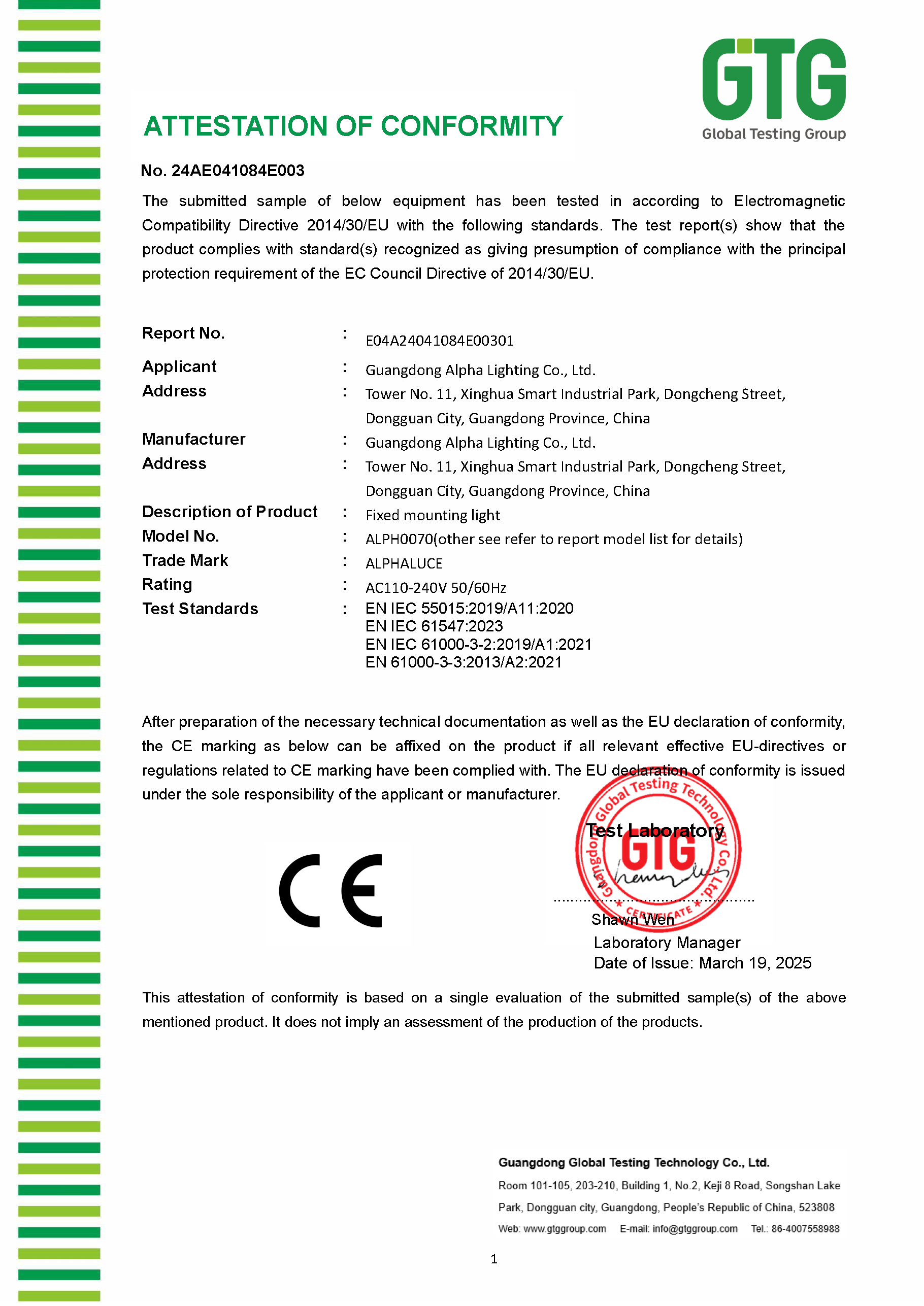
In addition to product-level CE and RoHS documentation, ALPHALUCE operates an ISO 9001:2015 quality management system certified under number 04623Q13200R0M, issued by Beijing Head International Certification Co., Ltd. The scope covers production of LED lights under GB/T 19001-2016 / ISO 9001:2015. For buyers, ISO 9001 certification signals consistency in production control, while CE-LVD and RoHS certificates provide the legal basis for EU market entry.
Translating Regulations into Product Selection: IP Ratings and Wet-Area Applications
One of the most common specification errors in architectural lighting is selecting fixtures without matching the IP rating to the installation zone. Bathroom recessed downlights, for example, must tolerate steam and occasional water contact. IP-rated downlights solve this problem by providing sealed housings and moisture-resistant optical units.
ALPHALUCE’s product data reflects this differentiation. The ALDL1232 waterproof downlight delivers 7W, 508lm, CRI ≥92, IP65, with beam angles of 15°, 24°, 36°, or 55°, a Ø60mm cutout, and a trimless fixed design. The ALDL1191 bathroom spotlight offers IP54 protection with 7W/580lm or 10W/717lm output, CRI ≥92, and a narrow-trim adjustable design. The ALDL1238 bathroom recessed light provides 10W, 960lm, CRI ≥92, and IP65 protection, with beam angles from 15° to 55°.
| Model | Type | Wattage | Lumens | CRI | IP | Beam Angle | Cutout |
|---|---|---|---|---|---|---|---|
| ALDL1232 | Waterproof downlight | 7W | 508lm | ≥92 | IP65 | 15°/24°/36°/55° | Ø60mm |
| ALDL1191 | Bathroom spotlight | 7W/10W | 580/717lm | ≥92 | IP54 | 15°/24°/36°/50° | Ø83mm |
| ALDL1238 | Bathroom recessed light | 10W | 960lm | ≥92 | IP65 | 15°/24°/36°/55° | ≥75mm |
| ALDL1409 | Small recessed light | 2W | 70lm | ≥90 | IP65 | 15°/24°/36°/60° | Ø22mm |
The importance of IP ratings extends beyond bathrooms. Outdoor landscape lighting requires protection against rain, dust, and humidity. ALPHALUCE’s outdoor range includes garden bollard lights (ALSL0152, 7W, 422lm, CRI ≥90, IP65), spike lights (ALSL0086, 7W, 560lm, CRI ≥97, IP65), inground lights (ALDL1677, 5W, 126lm, CRI ≥92, IP65), and step lights (ALDL2009, 3W, 270lm, CRI ≥92, IP65). These fixtures are typically specified in landscape, walkway, and facade applications where corrosion resistance and stable operation under 24/7 outdoor conditions are required.
CRI, CCT, and Beam Angle: Interpreting Optical Specifications
Beyond safety certification, optical performance determines whether a fixture is suitable for a given architectural application. CRI indicates colour fidelity; a CRI of ≥92 is considered high and appropriate for hospitality, retail, and museum environments, while CRI ≥97 approaches near-reference colour rendering and is used where precise colour discrimination matters. ALPHALUCE’s track spotlight ALTR0253, for example, provides 7W, 560lm, CRI ≥97, and beam angles of 15°, 24°, 36°, or 55°, making it applicable to retail display and museum accent lighting.
CCT controls the warmth or coolness of light. The common architectural temperatures are 2700K (warm), 3000K (warm-neutral), and 4000K (neutral-cool). Hospitality lighting typically uses 2700–3000K for a welcoming atmosphere, while offices and retail spaces may choose 3000–4000K for alertness and product clarity. ALPHALUCE offers these three CCT options across most recessed and track luminaires, including the ALDL1851 recessed downlight, ALDL1590 recessed spotlight, and ALTR0247 commercial track light.
Beam angle selection affects how light is distributed onto surfaces. Narrow beams (15°–24°) are suitable for accent lighting and artwork; medium beams (36°) work well for general task illumination; wide beams (50°–60°) are used for ambient wash and corridor lighting. Adjustable fixtures such as the ALDL1590 recessed spotlight—which provides 0–90° tilt and 355° rotation—allow site adjustment to match ceiling heights and display positions.
Dimmable and Tunable White Systems for Hospitality and Commercial Projects
Dimming capability is a functional requirement in hospitality and high-end residential projects. DALI and 1–10V are the most common commercial dimming protocols. ALPHALUCE’s ALDL1405 dimmable downlight supports 15–30W, 1300–3200lm, CRI ≥92, IP44, and a 70° beam angle with optional DALI or 1–10V dimming, using CCT options of 3000K, 3500K, or 4000K. The ALDL1608 dimmable recessed spotlight, with a narrow-trim design and 0–25° tilt, is another example of a fixture aligned with project-based lighting control requirements.
For projects requiring colour-temperature adjustment, tunable white systems are increasingly deployed in hotels and cultural spaces. A heritage hotel project in China used ALPHALUCE fixtures with 2700K–4000K tunable white lighting to reconcile historical architecture preservation with modern hospitality lighting. In this context, the lighting system is not merely decorative; it operates as a layer of the architectural experience, supporting both day and evening scenarios.
Track Lighting Systems in Architectural Applications
Track lighting systems are widely used in retail, museum, and showroom environments because they combine flexibility with precise aiming. A track system consists of a continuous electrified rail with individually adjustable spotlight heads, allowing the same infrastructure to serve changing display layouts. ALPHALUCE’s magnetic track light ALTR0206 delivers 15W, 1180lm, CRI ≥90, with 24° or 36° beam angles and DC48V operation. The track spotlight ALTR0247 provides 8W, 680lm, CRI ≥92, 15–60° beam adjustment, and 0–90° tilting.
The suspension format also matters. Suspended track lighting (ALTR0212) and wall-wash track luminaires (ALTR0207) extend the system’s ability to handle both vertical surface illumination and general accent lighting. For specifiers, choosing a track family with multiple optical accessories reduces the need for re-engineering when store layouts or exhibits change.
Outdoor Landscape Lighting: Bollards, Spike Lights, and Inground Fixtures
Outdoor landscape lighting operates under a different constraint set: continuous exposure to weather, temperature swings, and ground-level mechanical stress. Luminaires used in garden paths, driveways, terraces, and building perimeters must therefore be rated IP65 or IP67, use corrosion-resistant construction, and provide stable light output for extended night-time hours.
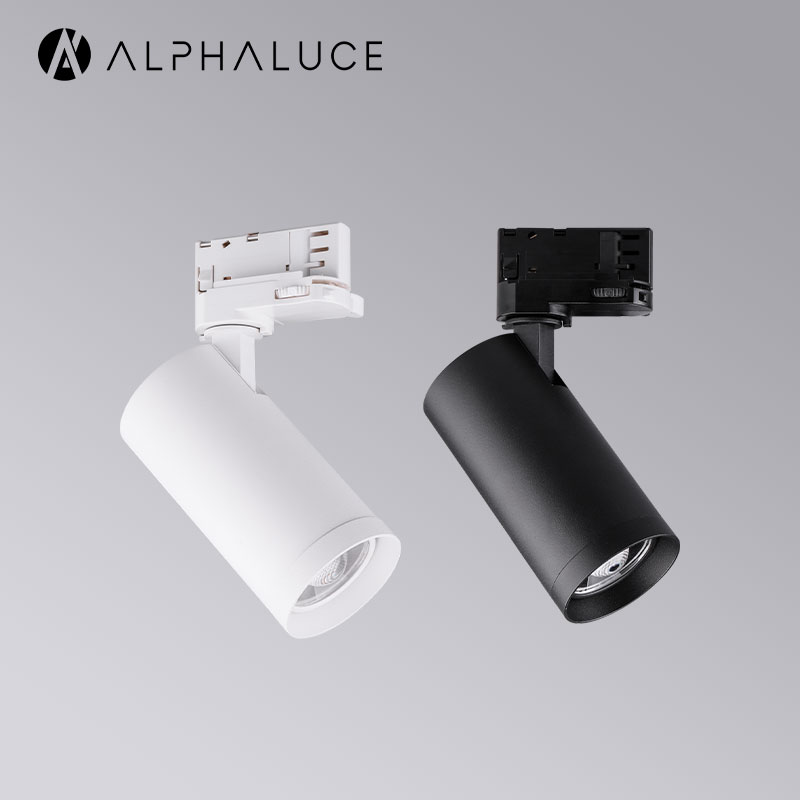
ALPHALUCE covers this segment with bollard lights (ALSL0152, 7W, 422lm, CRI ≥90, IP65, heights 400/800/1200mm), garden spike lights (ALSL0086 and ALSL0029, CRI ≥97, IP65), inground lights (ALDL1677, 5W, 126lm, CRI ≥92, IP65), and low-voltage step lights (ALDL1540, 3W, 75lm, CRI ≥90, IP67, DC24V). The use of DC24V low-voltage systems improves safety in wet environments and simplifies integration with landscape transformers and timer/photocell control.
Evaluating a One-Stop Lighting Supplier: Evidence-Based Criteria
When procurement moves from single-product sourcing to a one-stop lighting solutions provider, the evaluation criteria shift. Instead of asking only “does this downlight meet the project specification?”, buyers should ask four additional questions:
- Can the supplier document compliance across categories? CE-LVD for recessed luminaires, CE-EMC for outdoor fixtures, RoHS for material restriction, and ISO 9001 for quality systems should all be available as issued certificates.
- Does the portfolio cover the project’s zone requirements? A full architectural lighting range should include IP20 indoor downlights, IP54/IP65 wet-area luminaires, IP65/IP67 outdoor landscape fixtures, and track systems for display flexibility.
- Are the optical parameters consistent across the family? CRI ≥90–97, CCT options of 2700K/3000K/4000K, and beam angles from 15° to 60° allow design continuity across spaces.
- Can the supplier support OEM/ODM customisation? For many importers, colour, CCT, beam angle, power, surface finish, and logo customisation are necessary to differentiate their offering.
ALPHALUCE positions itself within this procurement framework. The company reports a production capacity of 42,000 units per month, a lead time of 20–30 days, and an MOQ of 100 units for OEM/ODM projects. Quality control involves 100% inspection with aging tests, and after-sales support includes a 5-year warranty. These operational facts are directly relevant to buyers who need predictable delivery and post-installation reliability.
Traditional Solutions vs. Integrated Architectural Lighting Packages
Traditional architectural lighting procurement often follows a fragmented path: the electrical contractor sources generic downlights, the interior designer selects decorative pendants from another brand, a lighting specialist supplies track heads, and the landscape architect purchases outdoor fixtures from a third vendor. This approach can work, but it introduces coordination risks: colour temperature mismatches between product families, inconsistent CRI levels between different brands, IP-rated fixtures that do not match the project’s wet-zone requirements, and multiple warranty channels.
An integrated architectural lighting package reduces these risks by maintaining consistent optical performance across fixture types. When a single manufacturer supplies recessed downlights, track systems, step lights, wall washers, outdoor bollards, and linear lighting under one brand, the specifier can verify CRI, CCT, driver compatibility, and dimming behaviour across the whole scheme. The limitation of the integrated approach is that a single supplier may not offer the same breadth as the combined catalogues of specialist brands. A one-stop provider is not necessarily the optimal choice for every niche requirement—for ultra-specialised fittings such as submerged pool luminaires or heritage reproduction fixtures, a dedicated specialist may still be required.
Industry Trends and Market Context
The architectural lighting market continues to grow: the global market was valued at USD 11.1 billion in 2025, with a projected value of USD 17.5 billion by 2033. Commercial applications account for approximately 50.9% of the market, and Asia Pacific contributed 43.2% of revenue in 2025, with China as the largest country market. Human-centric lighting has also become a distinct segment, with the market reaching USD 3.53 billion in 2024, reflecting growing demand for wellness-oriented lighting design.
These trends reinforce the strategic importance of supplier evaluation. The growth of commercial and hospitality renovation projects increases demand for fixtures that are both code-compliant and design-flexible. The rise of human-centric lighting pushes specification criteria beyond basic lumen output to include glare control (UGR < 19), frequency stability, CRI quality, and tunable-white capability. Against this backdrop, suppliers with documented lighting parameters and certification coverage are easier to integrate into project documentation and more likely to be accepted by lighting consultants.
Limitations and Boundaries of the Product Range
It is equally important for buyers to understand the boundaries of any one supplier’s range. ALPHALUCE’s portfolio is strong in recessed downlights, track lighting, step lights, wall lights, and outdoor landscape fixtures, with IP ratings from IP20 to IP68 depending on model. However, for large-scale infrastructure lighting—such as high-mast urban lighting, roadway distribution systems, or bespoke architectural sculptures requiring non-standard custom optics—a decorative lighting manufacturer may not be the correct first choice. Buyers should match the fixture category to the project scale and consult the supplier’s confirmed technical documentation for each specific model.
Future Outlook for Architectural Lighting Specification
Looking forward, architectural lighting specification will likely place greater emphasis on three verifiable factors: digital driver compatibility, photometric data availability, and environmental compliance. DALI and Bluetooth control integration, already present in ALPHALUCE’s dimmable product lines, will become a baseline expectation for hospitality and office projects. The availability of IES files and photometric reports will be decisive for lighting designers using simulation software. RoHS compliance and the broader EU eco-design framework will continue to shape material selection and driver efficiency.
For importers and specifiers, the practical consequence is straightforward: architectural lighting solutions should be evaluated as a system of evidence, not as a collection of attractive fixture images. Certificate numbers, CRI values, IP protection levels, beam angles, and driver protocols are the real procurement language.
FAQ
A: For the EU market, a recessed downlight should hold CE-LVD certification covering electrical safety under EN 60598-2-2, CE-EMC certification under EN IEC 55015 and related EMC standards, and RoHS certification under the IEC 62321 series. ALPHALUCE’s ALDL1851 recessed downlight is an example with CE-LVD certificate number 24AS121634S598A002, CE-EMC certificate number 24AE041084E003, and RoHS certificate number DTI20241484-1DC.
A: Bathroom lighting IP requirements depend on the zone. In the UK BS 7671 framework, Zone 1 (above the bath or shower) requires IP65, while Zone 2 typically requires IP44. For ceiling-steam exposure, IP54 or IP65 luminaires are commonly specified. ALPHALUCE offers bathroom-rated fixtures including ALDL1238 (IP65) and ALDL1191 (IP54).
A: CRI (Colour Rendering Index) measures how accurately a light source reveals the true colour of objects compared with natural light. A CRI of ≥92 is considered high-fidelity and suitable for hospitality, residential, retail, and museum applications. A CRI of ≥97 provides near-reference colour rendering for accent lighting, such as in ALPHALUCE track spotlights ALTR0253 and ALDL1851.
A: For wet areas, ALPHALUCE offers waterproof downlights such as ALDL1232 (IP65), bathroom spotlights ALDL1191 (IP54), and bathroom recessed lights ALDL1238 (IP65). For outdoor landscape projects, the range includes ALSL0152 garden bollard lights (IP65), ALSL0086 spike lights (IP65), ALDL1677 inground lights (IP65), and ALDL1540 low-voltage step lights (IP67).
A: According to company capability data, ALPHALUCE supports OEM/ODM projects with customisation of colour, CCT, beam angle, power, surface finish, and logo. Monthly capacity is 42,000 units, lead time is 20–30 days, MOQ is 100 units, and after-sales support includes a 5-year warranty.
A: Track lighting systems use an energised rail with adjustable spotlight heads that can be repositioned or re-aimed without changing the ceiling infrastructure. This makes them well-suited to retail displays and museums. Fixed recessed downlights provide clean, integrated ceiling lines and are better for general ambient lighting in hospitality and residential spaces. Many projects use both.
Download the ALPHALUCE company brochure (PDF) for a detailed overview of the product portfolio and manufacturing capabilities.