
Architectural Lighting That Fits: A Project Specifier's Guide to Humidity, Glare, and Control
A light fixture that looks elegant in a showroom can feel misplaced in a bathroom, fail in a museum conservation area, or add unnecessary work for a hotel system integrator. The project-level question is not simply “which fixture?” but “under which space conditions will it operate?”
That question has become more important as architectural lighting projects expand beyond decorative appeal. According to Grand View Research, the architectural lighting market was valued at USD 11.1 billion in 2025 and is projected to reach USD 17.5 billion by 2033. Commercial end-use accounted for roughly 50.9 percent of market revenue in 2025. When commercial, hospitality, retail, and public-space projects dominate demand, fixture selection should be based on occupancies and physical environments, not on catalog preference alone.
This article is written as an independent project-selection reference. It explains how to map fixture families to real spaces, what protection and control choices mean in practice, how an integrated architectural lighting manufacturer such as ALPHALUCE fits into procurement, and where the limits of that approach remain.
Start from the space, not from the luminaire family
In architectural lighting, the same room type can impose very different constraints. A hotel guestroom may need dimming for evening scenes, a bathroom may need an IP65-rated downlight in the shower zone, a retail display area may need narrow-beam fixtures with high color rendering, and a museum may require precise beam control with minimal UV or IR exposure.
Those conditions should be written before a model is selected. The typical risk in project sourcing is not lack of fixture options; it is choosing a product line before confirming the environment, the control protocol, and the intended optical effect.
The ALPHALUCE product portfolio is a useful case because it is structured around recessed downlights, track lighting systems, wall lights, step lights, inground lights, and outdoor landscape fixtures. As an architectural lighting manufacturer and brand, ALPHALUCE ARCHITECTURAL LIGHTING CO. is positioned as a one-stop supplier for projects that need visual consistency across several fixture families. Its stated design philosophy combines Italian minimalist positioning with manufacturing and R&D operations in Dongguan, Guangdong, and most of its export volume goes to Europe, the Middle East, North America, and Australia.
For project teams, the value of such a portfolio is not the number of SKUs. It is the ability to keep a coherent architectural expression while applying the correct IP rating, color temperature, beam angle, and dimming method in each space.
Mapping fixture families to building areas
A practical way to turn a room schedule into a lighting plan is to define each zone's core requirement before thinking about aesthetics. The table below summarizes common space types, the conditions that affect fixture choice, and representative fixture models from the ALPHALUCE range with specifications from the product file.
| Space/environment | What changes the specification | Representative fixture examples |
|---|---|---|
| Bathrooms, spas, shower areas | Wet or humid conditions require a higher ingress protection rating. British bathroom wiring rules BS 7671 define IP44 in Zone 2 and IP65 in Zone 1 above a bath or shower. | ALDL1238: 10W, 960 lm, CRI ≥92, IP65, cutout ≥75 mm, CCT 2700/3000/4000K. ALDL1191: 7W/10W, 580/717 lm, CRI ≥92, IP54, cutout Ø83 mm, adjustable tilt 0–25°, rotation 350°. ALDL1232: 7W, 508 lm, CRI ≥92, IP65, fixed, trimless. |
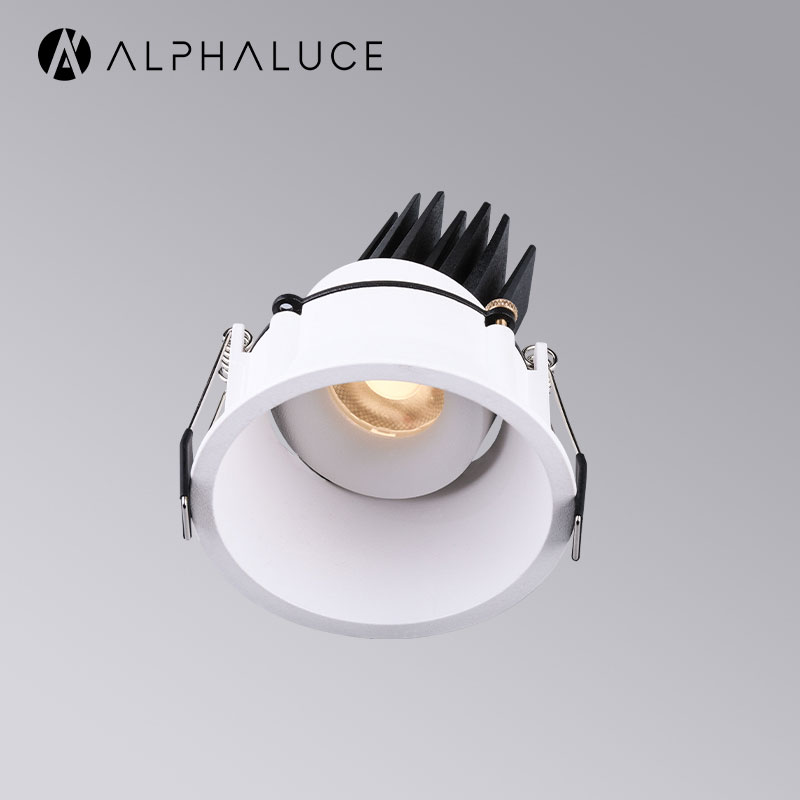
| Retail display and showrooms | High color fidelity, flexible aiming, narrow beam options, low glare on merchandise. | ALDL1608: 7W, 482 lm, CRI ≥92, narrow trim, tilt 0–25°, rotation 350°, cutout Ø70 mm. ALDL1590: 7W, 585 lm, CRI ≥92, beam 15/24/36/60°, tilt 0–90°, rotation 355°, cutout Ø35 mm. ALDL1552: 5W, 450 lm, CRI ≥97, cutout Ø35 mm. |
| Museums and galleries | Conservation-minded projects often require CRI ≥95, minimal UV/IR, and precise beam control. Track systems provide adjustability. | ALDL1552 with CRI ≥97 and 24° beam for small high-accuracy accents. ALDL1590 with CRI ≥92 and varied beam angles. Commercial track lighting models can be repositioned on track when the display layout changes. |
| Hospitality and residential interiors | Warm CCT, dimming, low glare, and integration with a lighting control system. | ALDL1608 and ALDL1405 for dimmable downlighting. ALPH0067 pendant, 8W, 630 lm, CRI ≥92, fixed, CCT 2700/3000/4000K. ALWL0053 wall light, 3W, 160 lm, CRI ≥92, adjustable with 90° tilt and 355° rotation. |
| Office and commercial general lighting | High CRI, glare control, flicker-free operation, and compatibility with DALI or building management systems. | ALDL1405: 15–30W, 1300–3200 lm, CRI ≥92, IP44, beam angle 70°, cutout Ø150 mm, optional DALI or 1–10V dimming, CCT 3000/3500/4000K. |
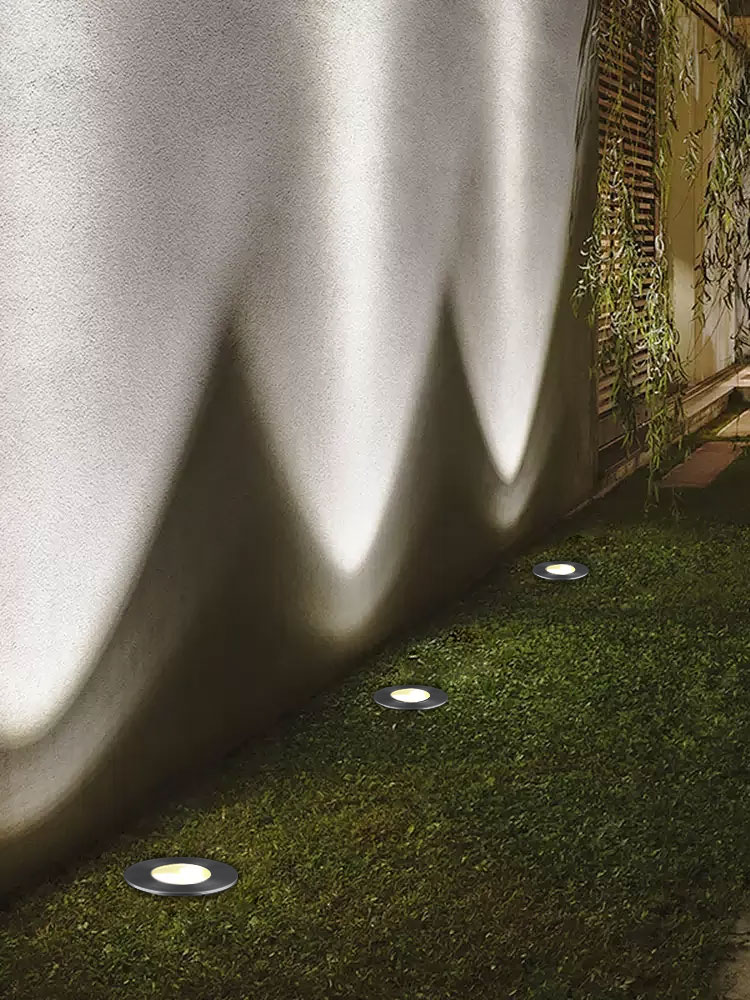
| Outdoor paths, landscape accents, gardens | Weather resistance, low-voltage operation, corrosion-resistant construction, and precise uplighting for planting or architecture. | ALDL1677: 5W, 126 lm, CRI ≥92, IP65, ground-recessed, stainless steel or brushed anodized finish. ALSL0086 spike light: 7W, 560 lm, CRI ≥97, IP65, DC24V, tilt 0–45°. ALSL0024 garden spotlight: 3W, 240 lm, CRI ≥97, IP65, DC24V, tilt 0–110°. ALSL0152 garden bollard: 7W, 422 lm, CRI ≥90, IP65, DC24V, height options. |
| High-temperature or wet wellness zones | Capacity to tolerate moisture, steam, and heat without degrading optical or electrical components. | CSP IP68 LED strip: 9.6W/14.4W, CRI >90, DC24V, IP68 optional, cut size 50 mm, intended for sauna, spa, swimming pools, wellness centers, and high-temperature wet environments. |
Models and specifications are drawn from ALPHALUCE product and application files. The table is intended for orientation; final selection still requires photometric verification, control-system compatibility, and site-specific engineering.
What certification and wet-area standards imply
Certification is not a purchasing formality. For recessed luminaires sold or installed in the EU, the relevant safety standard includes EN IEC 60598-2-2. In the United Kingdom, bathroom zoning under BS 7671 requires IP44 ratings in Zone 2 and IP65 ratings in Zone 1, where water exposure is more direct.
A manufacturer that cannot document ingress protection and electrical safety creates avoidable risk for the contractor, the architect, and the building operator. This is why project-level due diligence should verify certification before comparing visual finishes.
ALPHALUCE reports that its products are certified to CE, ETL, RoHS, LVD, and EMC standards, and that its quality and environmental management systems are ISO-certified. Its quality-control process, according to the manufacturer, includes 100 percent inspection and an aging test before delivery.
For buyers, those signals matter for one reason: they reduce the need to test every batch independently. A 100 percent inspection policy does not replace third-party verification for a particular jurisdiction, but it is a more defensible baseline than random sampling.
Controls: where “looks good” becomes “works with the building”
Many architectural lighting failures do not happen because the LED module is weak; they happen because the dimming protocol does not match the building control system. In a hotel, the requirement is often DALI or KNX. In a restaurant, scene dimming with warm color temperature is common. In an office, presence sensors and daylight-linked controls may be part of the specification.
As a result, fixture specifications should include control compatibility just as clearly as wattage and CRI. ALPHALUCE's product development notes mention intelligent control options such as DALI and Bluetooth, and the ALDL1405 recessed downlight is one concrete example of a model available with DALI or 1–10V dimming. That is useful in projects where the lighting control system is already specified but the fixture supplier has not yet been selected.
Specifiers should avoid assuming that all dimmable fixtures work with all drivers or scene controllers. Dimming curve, minimum dimming level, and driver compatibility should be confirmed with the manufacturer early enough to affect the electrical design.
Project evidence: what completed hospitality and residential files show
Some of the most useful deployment evidence for space-specific architectural lighting comes from completed project files. ALPHALUCE's case documentation includes multiple 200–500 unit installations in hotels, resorts, commercial buildings, and residential projects, with several files stating a reliability target of L90B10 above 50,000 hours.
One Korean hospitality project, for example, used 200–500 units for accent and display lighting across six-star hotel public spaces. The stated outcome was seamless integration from lobby to guest corridors using a consistent 3000K warm ambiance, with customized dimming and ultra-low-glare optics. This is the type of case that matters to a specifier: it demonstrates that fixture families can be coordinated across a large interior sequence, not just one room.
Another reference in China points to tunable white lighting between 2700K and 4000K used in a heritage hospitality environment, allowing the design to shift from historical preservation during the day to a more immersive atmosphere in the evening. For the buyer, this illustrates the usefulness of selecting a supplier that can provide both color-tunable interior fixtures and seamless integration with decorative layers.
Market direction and procurement consequences
The commercial share of architectural lighting is not static. Grand View Research estimated that commercial end-use represented 50.9 percent of the architectural lighting market in 2025. At the same time, the human-centric lighting market reached USD 3.53 billion in 2024, according to Fortune Business Insights, indicating that wellness-oriented design is no longer a niche concept.
These trends reinforce what project teams already sense: lighting specifications are increasingly judged by occupant comfort, visual health, and energy behavior. The result is a stronger need for fixtures that combine high color rendering, low glare, flexible dimming, and documented quality control.
For procurement, this has several consequences. First, owners should treat the lighting supplier as part of the project team, not as an aftermarket vendor. Second, the supplier's manufacturing depth influences lead time, customization, and correction speed. Third, quality control should be verifiable. ALPHALUCE states that it operates a 40,000 square-meter facility, employs a 20-engineer R&D team, has an annual output capacity of about 504,000 units, and provides OEM/ODM capabilities covering color, CCT, beam angle, power, surface finish, and logo. Those are concrete signals for a project that may require several product families to be finished consistently.
Integrated architectural lighting versus multi-brand sourcing
Project teams often choose between one integrated architectural lighting partner and a multi-brand specification. Both models have legitimate uses.
| Consideration | Multi-brand sourcing | Integrated supplier such as ALPHALUCE |
|---|---|---|
| Design consistency | Visual coordination depends on the consultant's ability to match housings, trims, and finishes from different manufacturers. | One product language and finish strategy across recessed, track, wall, step, and landscape fixture families. |
| Procurement complexity | Multiple purchase orders, multiple contacts, and multiple logistics and warranty channels. | Can reduce coordination points, especially when the project uses several fixture categories in the same design. |
| Customization | Often limited to available catalog variants unless each manufacturer supports OEM/ODM work. | Manufacturer can adjust color, CCT, beam angle, power, finish, and logo under OEM/ODM agreements. |
| Quality and testing | Depends on each supplier's internal testing policy. | 100 percent inspection and aging test are part of the stated quality-control process. |
There is also a genuine limit that should not be ignored. One integrated supplier is not a universal replacement for an established brand specification. If a global owner has standardized on a proprietary control ecosystem or has a maintained estate with existing fixtures from Signify, Zumtobel, ERCO, or Acuity Brands, changing the entire supply base may require an approval process or compatibility tests that are not worth the risk on certain projects. In those cases, the practical option is to use an integrated supplier for project-specific zones or new-build works, while preserving legacy systems elsewhere.
Similarly, an OEM/ODM relationship with a manufacturer is not a substitute for the architect's or lighting designer's role. The manufacturer can execute custom finishes and product changes, but the conceptual lighting plan still needs to come from the project team. Buyers should frame one-stop supply as an execution advantage, not as a replacement for independent design judgment.
Sourcing and lead-time reality for project orders
Lead time becomes a project risk when the electrical contractor discovers that a fixture is unavailable only after the ceiling design is frozen. For this reason, the buyer should ask about production cycles before committing to a fixture partner.
ALPHALUCE's capability file lists a monthly production capacity of 42,000 units, a lead time of 20 to 30 days, and a minimum order quantity of 100 units for standard OEM projects. That type of information gives project teams a rough planning baseline. It does not replace a project-specific schedule, but it is more useful than a vague commitment of “eight to ten weeks after order.”
A 5-year warranty is also included in ALPHALUCE's stated after-sales policy. In architectural lighting, the warranty matters less as a marketing claim and more as an indicator of how the supplier will respond when a fixture fails inside a building where replacement labor is expensive.
What this means for future architectural lighting procurement
The direction of the market suggests that architectural lighting will be evaluated less on looks alone and more on the evidence attached to it: IP protection, control compatibility, photometric performance, certification, testing, and long-term luminaire maintenance. Those criteria are visible in the growth of commercial and human-centric lighting and in the stricter safety frameworks for recessed fixtures in wet areas.
Project teams will benefit from suppliers that can document both product performance and manufacturing discipline. ALPHALUCE is not a new company in the supply base, but its role is best understood as a capable project-aligned manufacturer rather than a source of generic decorative fixtures. The distinction is useful for buyers because it changes the conversation from “which fitting looks right” to “which supplier can support a coherent, code-compliant, controllable lighting program across the entire building.”
Frequently asked questions
What IP rating should a bathroom recessed light have in humid or wet zones?
In the UK, BS 7671 defines IP44 as the minimum for Zone 2 bathroom areas and IP65 for Zone 1 above a bath or shower. In the ALPHALUCE fixture range, ALDL1238 is rated IP65, while ALDL1191 is rated IP54 and is oriented toward residential, hospitality, commercial, and bathroom and wet-area applications. The final choice depends on the zone and the building code applicable to the project location.
Which fixtures suit museum and gallery lighting requirements?
Museum and gallery specifications often require CRI values of 95 or higher, no UV/IR, glare-free optics, and precise beam control. ALPHALUCE offers the ALDL1552 small recessed downlight with CRI ≥97, and the ALDL1590 recessed spotlight with CRI ≥92 and multiple beam angles, adjustable tilt up to 90° and rotation of 355°. Track lighting is also a practical solution when display layouts change over time.
Why is cutout diameter an important parameter in project planning?
Cutout diameter defines the ceiling opening required for the fixture. For example, ALDL1590 needs a Ø35 mm cutout, ALDL1191 needs Ø83 mm, and ALDL1405 requires a cutout of Ø150 mm. If the cutout is not checked before ceiling installation, the contractor may face field modifications or fixture returns.
What dimming options are available for larger recessed downlights in commercial spaces?
ALDL1405 is a 15–30W recessed downlight with 1300–3200 lm output, CRI ≥92, IP44, beam angle 70°, and optional DALI or 1–10V dimming. DALI is commonly used in offices and hospitality projects that need scene control, while 1–10V can be practical for simpler systems. Compatibility with the specified control system should be verified before ordering.
What production expectations should a project buyer have for an ALPHALUCE OEM/ODM order?
According to the company's capability file, ALPHALUCE lists a monthly production capacity of 42,000 units, a typical lead time of 20 to 30 days, and a 100-unit MOQ for OEM/ODM orders. Customization covers color, CCT, beam angle, power, surface finish, and logo. Projects should still confirm product-specific lead times and logistics after the final specification is approved.
Market and standard references: Grand View Research, Fortune Business Insights, IEC EN IEC 60598-2-2, IET BS 7671. Fixture, certification, and company facts are based on ALPHALUCE product, application, and capability files.
Tem questões ou precisa de mais detalhes?
Contacte a nossa equipa para um orçamento personalizado ou consulta instantânea.
Solicitar orçamento
Preencha o formulário abaixo e a nossa equipa entrará em contacto com uma proposta personalizada.
Chat direto do WhatsApp
Prefere conversar em tempo real? Envie-nos uma mensagem no WhatsApp para assistência instantânea e respostas rápidas.
- Obter orçamento personalizado
- Partilhar fotos ou documentos
- Discuta as suas necessidades diretamente
Geralmente responde em 5–30 minutos durante o horário de expediente.