
Architectural Stainless Steel Decoration: Seven JYF Metal Products
Architectural stainless steel decoration is a specification decision before it is a design decision. Grade, surface finish, sheet thickness and panel format are all fixed by the purchase order, and each of them narrows what a product can physically do once it reaches the building.
JYF Metal — the trading name of Foshan Jinyifan Metal Products Co., Ltd., a metal decoration manufacturer established in 2013 in Foshan, Guangdong, China — organises its decorative output into seven product families, referenced in its own documentation as JYF-01 through JYF-07. This article treats them as a shortlist rather than a catalogue: each family is described by the parameters a buyer can actually verify, and by the point in a project where it is normally specified.

A commercial interior application of fabricated stainless steel — the point where sheet, profile and bespoke fabrication meet on one drawing set.
Why a shortlist is more useful than a product list
The distance between a requisition line that reads “stainless steel decoration” and the products that can actually be shipped is wider than most first-time buyers expect. Inside a single manufacturer, one family is sold by the sheet with a minimum of 15 sheets per type and a 7–10 day lead time; another by the piece with a minimum of 500 pieces and a 15–20 day lead time; a third by area at 3 square metres and 20 days; and fully custom fabrication starts at a single piece with a 25–30 day lead time. Those are four different procurement routes operating under one material name.
A shortlist organised by where the product is specified resolves that confusion faster than a price list does. Wall panels, ceiling panels, partitions, trims and bespoke joinery each carry their own grade options, thickness ceilings and finishing constraints. A buyer who shortlists by application avoids the common error of quoting a ceiling product against a wall schedule, or of assuming that a decorative sheet can absorb the tolerances of a welded screen.
The seven families below are therefore presented in the order a project team usually encounters them: the decorative sheet first, then the fabricated elements that sit around it.
The seven families, in the order a project meets them
JYF-01 — mirror finish decorative stainless steel sheet
JYF-01 is a mirror finish decorative stainless steel sheet produced in SS201, SS304 and SS316, at thicknesses from 0.5 mm to 3.0 mm, in standard sheet formats of 1000x2000 mm, 1220x2440 mm and 1220x3050 mm. Standard colours are silver, gold, rose gold, black, blue and copper, with custom colours available on request. Its documented application set is wall panels, column wrapping, elevator decoration and ceilings — four surfaces where a continuous reflective plane is the design intent.
The specification consequence of a mirror surface is that flatness and handling become visible quality, not hidden ones. Two panels that leave the plant within tolerance can still read as mismatched under raking light if protective film, packing and site handling are not specified alongside the finish. In practice this family carries the tightest relationship between surface specification and packaging specification of the four sheet types.
JYF-02 — brushed stainless steel sheet
JYF-02 covers brushed sheet in hairline, satin, No.4 and vibration finishes, in the same SS201 / SS304 / SS316 grade set, the same 0.5–3.0 mm thickness band and the same three standard sheet sizes. The colour range extends to silver, gold, rose gold, black, blue, copper and bronze, plus custom.
This is the family most often specified where a wall run is long and the light is uneven. Because a brushed surface carries a directional grain, the value of the specification sits in a detail that is easy to omit: grain direction. Adjacent panels laid with opposed grain read differently under the same light, and that difference is a site argument rather than a manufacturing defect. Brushed sheet is therefore specified by drawing reference as much as by model number.
JYF-03 — sandblasted stainless steel sheet
JYF-03 is the sandblasted variant: SS201 / SS304 / SS316, 0.5–3.0 mm, the three standard formats of 1000x2000, 1220x2440 and 1220x3050 mm, and colours across silver, gold, rose gold, black, blue, copper and custom. It sits between the mirror and ripple families in visual behaviour — a matte, low-glare surface that reduces the reflective load of a wall or column without losing the metallic character of the material.
For buyers, the useful distinction is that sandblasted sheet and brushed sheet are often shortlisted against each other for the same location. They share the same grade, thickness and format envelope, so the decision usually turns on how the surface behaves under the project’s lighting rather than on any procurement constraint.
JYF-04 — water ripple stainless steel sheet
JYF-04 is a water ripple decorative sheet in SS201, SS304 and SS316, in the three standard formats of 1000x2000, 1220x2440 and 1220x3050 mm, with ripple patterns in small, medium, large and flow configurations, and colours across silver, gold, rose gold, black, blue, copper and custom.
One parameter separates this family from the other three sheets and deserves attention at shortlisting stage: JYF-04 is documented at 0.5–2.0 mm, while JYF-01, JYF-02 and JYF-03 run to 3.0 mm. The ripple geometry is formed into the surface, so the family reaches its limit earlier than a flat sheet does. A specification that calls for a 2.5 mm decorative panel cannot be met from this model, and a buyer who assumes a single thickness band across the whole sheet range will discover the difference at order confirmation rather than at design stage.
Documented project use supports the ceiling and wall reading. A designer in Korea took 120 pieces for ceiling and wall decoration, and a designer in France took 80 pieces for ceiling decoration, noting flatness sufficient for precise joint installation and a PVD coating described as wear-resistant and fade-resistant.
JYF-05 — screen partition and room divider
JYF-05 is a stainless steel screen partition and room divider offered in SS304 and SS316 only, at a regular size of 1220x2440 mm with custom sizes available. Finishes are mirror, brushed and vibration; colours run across silver, gold, rose gold, black, copper, bronze and custom; embedded materials include glass, marble, crystal, metal mesh and LED lighting. The processing route is spot welding, full welding, laser cutting and CNC cutting.
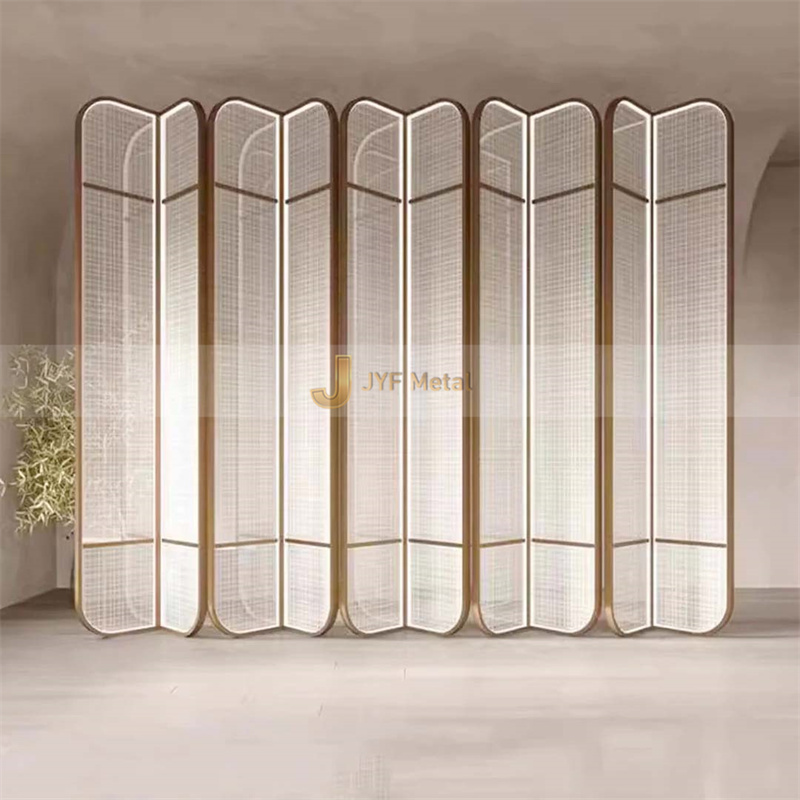
Screen partitions combine a stainless steel frame with embedded glass, mesh or lighting — a fabrication product rather than a sheet product.
The procurement signal here is the grade list. Where the sheet families accept SS201 as a budget option, this family is documented in SS304 and SS316 only. A buyer comparing quotations on this model should confirm that the grade quoted matches the family specification rather than a cheaper sheet grade carried over from a panel schedule. Documented applications are hotel lobbies, restaurant partitions and club interiors, where the functional requirement is space division that keeps light and air moving; a contractor in Canada specified three units for room dividers, with the delivered result described as modular panel joints, glue-free mechanical fixing and full-welding and polishing for seamless joints.
JYF-06 — trim and decorative profile
JYF-06 is the trim and decorative profile family: L shape, U shape, T shape, V shape, curved shape, corner, flat strip, skirting board and custom sections, in SS201 / SS304 / SS316. Colours are silver, gold, rose gold, black, copper, bronze and custom; finishes are mirror, brushed, vibration and sandblasted; the processes are shearing, V-grooving and bending.
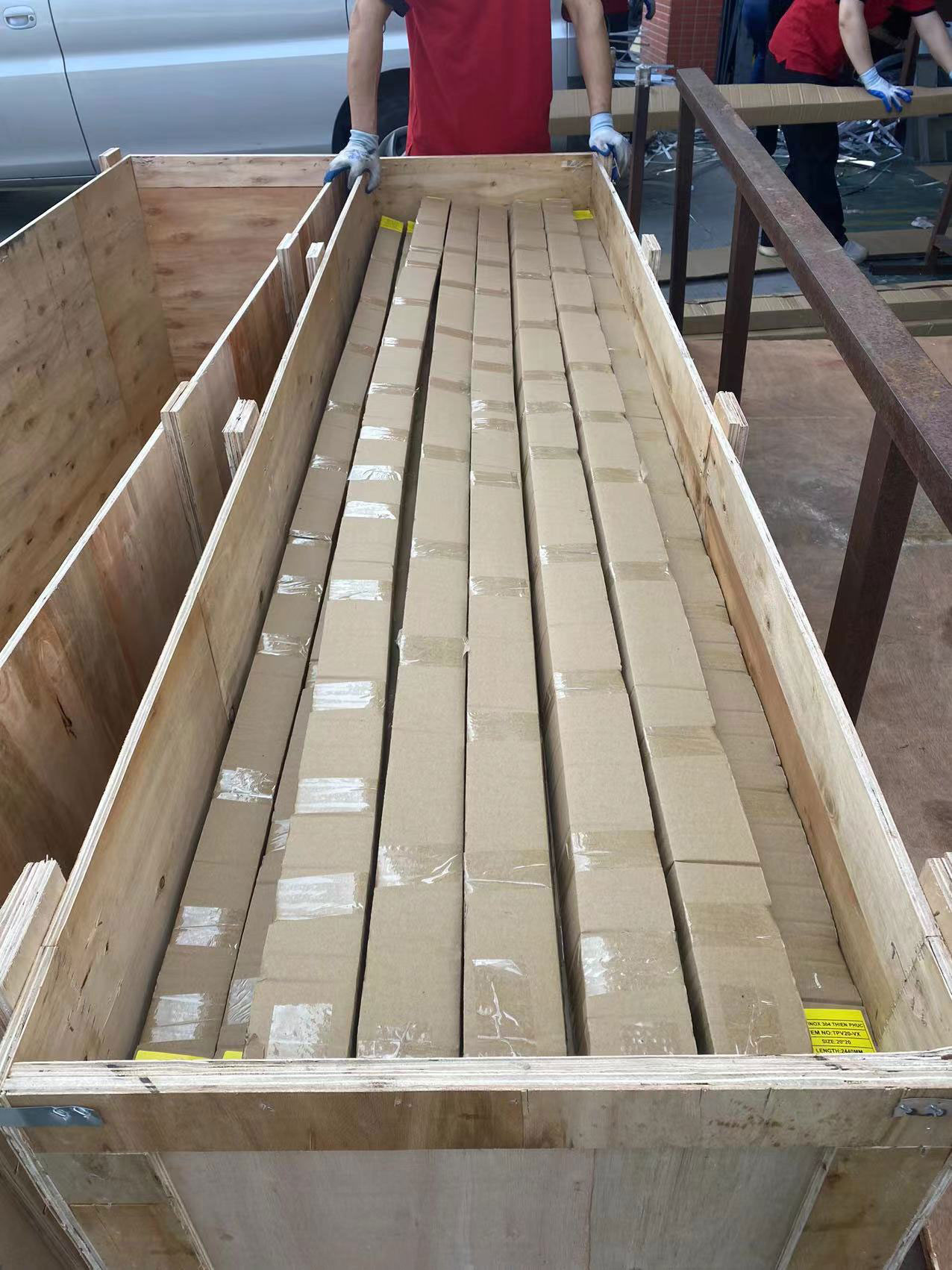
Profile families are specified by section drawing and bend geometry, not by sheet size.
This is the family that determines whether a finished installation reads as resolved or unresolved, because it handles wall accents, ceiling joints and edge finishing — the transitions between planes. It is also the family with the heaviest minimum: 500 pieces per type, with a 15–20 day lead time. A small feature-wall package that needs six custom sections is not a trim order in the same sense as a hotel corridor that needs several thousand running pieces, and buyers should expect that difference in the commercial terms rather than in the unit price alone.
JYF-07 — custom stainless steel fabrication
JYF-07 is the fabrication route rather than a product: SS201 / SS304 / SS316, covering metal sculpture, column cladding, feature walls, custom logos, stainless steel bar counters, display shelving and mirror frames. Minimum order is a single piece, lead time is 25–30 days, and the production base behind it runs German Trumpf laser cutting equipment, high-precision CNC bending, seamless precision welding and a PVD vacuum plating line for decorative panels.
The practical difference between JYF-07 and the other six families is that the drawing — not the model number — is the specification. Curved surfaces, hyperbolic shapes and non-standard geometries fall here, and so does the coordination work of adapting a designer’s intent to something that can be fabricated, packed and installed.
The shortlist at a glance
| Model | Family | Grades | Format | Typically specified for | MOQ / lead time |
|---|---|---|---|---|---|
| JYF-01 | Mirror finish sheet | SS201 / SS304 / SS316 | 0.5–3.0 mm; 1000x2000, 1220x2440, 1220x3050 mm | Wall panels, column wrapping, elevator decoration, ceilings | 15 sheets per type / 7–10 days |
| JYF-02 | Brushed sheet | SS201 / SS304 / SS316 | 0.5–3.0 mm; 1000x2000, 1220x2440, 1220x3050 mm | Wall runs and cladding with planned grain direction | 15 sheets per type / 7–10 days |
| JYF-03 | Sandblasted sheet | SS201 / SS304 / SS316 | 0.5–3.0 mm; 1000x2000, 1220x2440, 1220x3050 mm | Low-glare wall and column surfaces | 15 sheets per type / 7–10 days |
| JYF-04 | Water ripple sheet | SS201 / SS304 / SS316 | 0.5–2.0 mm; 1000x2000, 1220x2440, 1220x3050 mm | Ceiling and wall decoration | 15 sheets per type / 7–10 days |
| JYF-05 | Screen partition / room divider | SS304 / SS316 | 1220x2440 mm regular, custom | Hotel lobbies, restaurant partitions, club interiors | 3 m² / 20 days |
| JYF-06 | Trim and decorative profile | SS201 / SS304 / SS316 | L, U, T, V, curved, corner, flat strip, skirting board, custom | Wall accents, ceiling joints, edge finishing | 500 pcs per type / 15–20 days |
| JYF-07 | Custom fabrication | SS201 / SS304 / SS316 | By drawing | Sculpture, column cladding, feature walls, bar counters, display shelving, mirror frames | 1 pc / 25–30 days |
How grade, thickness and format interact on a drawing
Three variables do most of the work in a stainless steel decoration specification, and they are usually written by three different people.
Grade is written by the specifier. Across the shortlist, SS201, SS304 and SS316 are the offered set for JYF-01, JYF-02, JYF-03, JYF-04, JYF-06 and JYF-07; JYF-05 is documented in SS304 and SS316 only. The application data attached to the range names indoor and outdoor service, high-traffic areas and humid or coastal environments as working conditions, with corrosion resistance a stated requirement. That is the frame in which the grade decision belongs — not in a generic preference for a higher number.
Thickness is written by whoever is protecting the panel against handling and flatness, and it is where the range is least uniform. Three of the four sheet families run from 0.5 mm to 3.0 mm; the ripple family runs from 0.5 mm to 2.0 mm because the pattern is formed into the surface. Flat sheets, screens, profiles and fabricated items are not interchangeable on thickness at all — JYF-05, JYF-06 and JYF-07 are specified by size, section or drawing rather than by a single thickness value.
Format is written by the installer. The standard sheet set is 1000x2000, 1220x2440 and 1220x3050 mm. On a wall run, the format decides where the horizontal joints land and how much offcut the layout produces; on a ceiling, it interacts with the framing grid. Choosing 1220x3050 mm instead of 1000x2000 mm is not a purchasing preference — it changes the visual rhythm of the elevation.
Colour sits on top of all three. The range documents silver, gold, rose gold, black, blue, copper and bronze across the sheet families, with custom colours available, applied through a PVD vacuum plating line at the Foshan plant. Where colour is part of a phased delivery, the reference sample rather than the colour name is the controlling document.
Where each family is typically applied
The documented scenario set for the range covers commercial complexes, hotels, public buildings and high-end residences, in indoor and outdoor conditions, including high-traffic areas and humid or coastal environments. Within that envelope the families divide along installation logic rather than aesthetics.
Sheet families (JYF-01 to JYF-04) attach to wall panels, column wrapping, elevator decoration and ceilings, installed either by dry-hanging on a framework or by adhesive, with frameworks, honeycomb substrate and lighting systems named as the matched equipment. Trims (JYF-06) work at the edges of those same surfaces — wall accents, ceiling joints and edge decoration — using fixed installation or modular assembly, with backing panels, frameworks and LED strip as the adjacent components. Screens (JYF-05) sit in controlled indoor environments at high traffic points, fixed in place and typically combined with glass and lighting. Fabrication (JYF-07) appears where a space needs an object rather than a surface: curtains walls, feature walls, sculptures, bar counters and display joinery.
A useful rule for a project team is that a single room rarely uses one family. A hotel lobby may specify JYF-01 on the column, JYF-06 at the ceiling joint, JYF-05 as the divider and JYF-07 at the reception counter — four procurement routes for one elevation package.
What the category data does and does not support
Two published figures frame the demand side. Fortune Business Insights valued the global stainless steel market at USD 225.13 billion in 2025, projected USD 236.71 billion in 2026 and USD 353.48 billion by 2034. Grand View Research reported that steel held a 52% revenue share of the metal ceilings market in 2026, with aluminium forecast to grow faster through 2033.
Both figures describe categories wider than decorative architectural work, and neither sizes the decorative sheet, screen or profile segment directly. What they do support is a directional reading: steel remains the dominant material in metal ceiling systems, which is consistent with the specification behaviour described above, where ceiling surfaces are among the most common application points for decorative sheet. Supplier disclosures also reference honeycomb panel fire performance against ASTM E84 and EN 13501-1, a standard set that matters where metal ceilings sit inside a fire-rated assembly. Buyers should treat those ratings as documentation to be requested per project rather than as a property of the material category.
The honest limit of the available data is this: there is no verified transaction-level price series for decorative stainless steel sheets exported from China, and no measured tolerance or corrosion dataset attached to the models in this shortlist. A shortlist can be built on stated parameters; a final supplier decision cannot be closed without samples and inspection records.
Stainless steel against conventional finishes — and where the boundary sits
Architectural stainless steel decoration is usually shortlisted against painted MDF, gypsum board, laminate and aluminium composite. The comparison is not close on any single axis, which is why it is worth stating what each material actually wins on.
Conventional finishes win on first cost and on site speed. Painted MDF and gypsum are inexpensive per square metre, accept any colour, and can be made good on site after installation. Stainless steel does not offer that; it carries a higher material cost, requires a framework or substrate, and cannot be patched invisibly. One published US benchmark placed installation of stainless steel wall panels at USD 15–35 per square foot, a figure that describes installation labour and fitting rather than the material itself, and that varies with substrate and access conditions.
Stainless steel wins on service life and on surface behaviour in traffic. It is specified for high-traffic areas, for humid or coastal environments and for exterior exposure where painted board would need repeated maintenance; the range documentation treats corrosion resistance, scratch resistance and colour stability as the governing requirements. Where colour is PVD-applied, client case notes describe the finish as wear-resistant and fade-resistant.
The boundary is equally clear, and buyers should state it before shortlisting. Mirror finishes show handling marks and flatness variation more than any other surface in the range, which makes protective film and packing part of the technical specification rather than a logistics detail. The ripple family stops at 2.0 mm, so it is not a substitute for a heavier flat panel. Screens and custom fabrication carry the longest lead times in the range — 20 days and 25–30 days respectively against 7–10 days for sheet — and trims carry the highest unit minimum at 500 pieces per type. Stainless steel is also a decorative and cladding material, not a structural one; where the design needs load-bearing capacity, the steel structure or framework is a separate engineering item.
Purchasing terms and acceptance criteria to confirm before shortlisting
Because the seven families do not share commercial terms, the purchasing section of a shortlist should be written per family rather than per supplier. Five items cover most of the exposure.
- Model and grade on the order. Confirm that the purchase order names the model code and the grade, not just “stainless steel”. This matters most at JYF-05, where the documented grade set is SS304 and SS316 only, and at JYF-04, where the thickness ceiling is 2.0 mm rather than 3.0 mm.
- Commercial minima. The range documents 15 sheets per type for decorative sheet, 500 pieces per type for trims, 3 square metres for screen partitions and 1 piece for custom products, with lead times of 7–10, 15–20, 20 and 25–30 days respectively. A package that mixes families inherits the longest lead time, not the shortest.
- Finish and colour reference. Approve a physical sample and hold it as the acceptance reference. Where a run is phased, state whether the sample governs the whole programme or each delivery.
- Inspection regime. The documented quality control is 100% pre-shipment testing plus third-party inspection, with sample provision, online installation guidance and replacement parts listed under after-sales support. Third-party inspection should be named in the order if it is to apply.
- Management system documentation. For buyers who require a certified quality system, the manufacturer holds a quality management system certificate, number 120526Q00119R000, issued by Guangdong Jingwel International Certification Ltd. against GB/T 19001-2016 / ISO 9001:2015, covering the R&D and production of stainless steel coloured boards, metal decorative mouldings and metal decorative articles, valid from 15 May 2026 to 14 May 2029. The certificate scope should be read against the product being purchased.
Two further details sit outside the certificate and are worth writing into the specification: protective film type, which the range offers as a customisation option and which matters most on mirror surfaces, and the packing method for long panels in the 3050 mm format.
What changes over the next specification cycle
Three shifts are visible from the procurement side rather than the design side.
The first is that decorative stainless steel is being bought against drawings instead of against catalogue pages. Suppliers in this category describe producing sheets, screens and cabinets to confirmed drawings, dimensions, finishes, colours, quantities and export requirements, with cutting, bending, welding, etching, mirror finishing, water ripple and PVD colour treated as a process stack. For buyers, that means the drawing set becomes the comparison document and the model list becomes an index.
The second is finish consistency moving from an aesthetic concern to a contractual one. As PVD colour and formed surfaces such as water ripple become routine in hotel and commercial work, colour and pattern continuity across phased deliveries is the failure mode that costs most to correct on site.
The third is lightweight assembly. Metal ceilings are a steel-dominated category, and where weight or fire performance governs the design, honeycomb-backed and framed assemblies enter the specification earlier. That changes the shortlist: a ceiling panel is increasingly a composite assembly with a substrate decision attached, not a bare sheet.
Frequently asked questions
Which grade — SS201, SS304 or SS316 — applies to each JYF Metal product family?
SS201, SS304 and SS316 are the documented grade set for JYF-01, JYF-02, JYF-03 and JYF-04 decorative sheets, for JYF-06 trims and for JYF-07 custom fabrication. JYF-05 screen partitions are documented in SS304 and SS316 only, without SS201. The range documentation names indoor and outdoor service, high-traffic areas and humid or coastal environments as working conditions, with corrosion resistance listed as a requirement.
What sheet sizes and thicknesses are standard in the decorative sheet range?
Standard sheet formats are 1000x2000 mm, 1220x2440 mm and 1220x3050 mm. JYF-01 mirror, JYF-02 brushed and JYF-03 sandblasted sheets are documented from 0.5 mm to 3.0 mm. JYF-04 water ripple sheet is documented from 0.5 mm to 2.0 mm, a lower ceiling because the ripple pattern is formed into the surface. JYF-05 partitions use a regular 1220x2440 mm format with custom sizes available.
Can screens, trims and fabricated items be produced to custom dimensions?
Yes, within the documented capability of each family. JYF-05 screen partitions list a regular 1220x2440 mm size plus custom sizes, with embedded glass, marble, crystal, metal mesh and LED options. JYF-06 trims cover L, U, T, V, curved, corner, flat strip, skirting board and custom sections, produced by shearing, V-grooving and bending. JYF-07 custom fabrication is specified by drawing and includes curved and hyperbolic shapes and non-standard geometries.
What minimum order quantities and lead times apply across the seven families?
Decorative stainless steel sheets: 15 sheets per type, 7–10 days. Stainless steel trims: 500 pieces per type, 15–20 days. Screen partitions: 3 square metres, 20 days. Custom products: 1 piece, 25–30 days. A package that combines families should be scheduled against the longest of these lead times.
How is quality checked before shipment?
The documented quality control regime is 100% pre-shipment testing combined with third-party inspection. After-sales support covers online installation guidance, sample provision and replacement parts. Production takes place at a 3,000 m² facility in Foshan, Guangdong, China, equipped with laser cutting, CNC bending, seamless precision welding and a PVD vacuum plating line for decorative panels.
Which certification documents can a buyer request with an order?
A quality management system certificate is held under number 120526Q00119R000, issued by Guangdong Jingwel International Certification Ltd. against GB/T 19001-2016 / ISO 9001:2015, with a scope covering the R&D and production of stainless steel coloured boards, metal decorative mouldings and metal decorative articles. It is valid from 15 May 2026 to 14 May 2029. Project-specific test reports and inspection certificates are separate documents and should be requested per order.
For teams comparing finishes against reference installations, JYF Metal publishes a project case handbook that can be downloaded here: Designer’s Handbook — Project Cases.
Tem questões ou precisa de mais detalhes?
Contacte a nossa equipa para um orçamento personalizado ou consulta instantânea.
Solicitar orçamento
Preencha o formulário abaixo e a nossa equipa entrará em contacto com uma proposta personalizada.
Chat direto do WhatsApp
Prefere conversar em tempo real? Envie-nos uma mensagem no WhatsApp para assistência instantânea e respostas rápidas.
- Obter orçamento personalizado
- Partilhar fotos ou documentos
- Discuta as suas necessidades diretamente
Geralmente responde em 5–30 minutos durante o horário de expediente.