
Artificial Turf Shortlist 2026: Venusturf Model Picks Among TenCate, FieldTurf, Polytan & CCGrass
Artificial Turf Shortlist 2026: Venusturf Model Picks Among TenCate, FieldTurf, Polytan & CCGrass
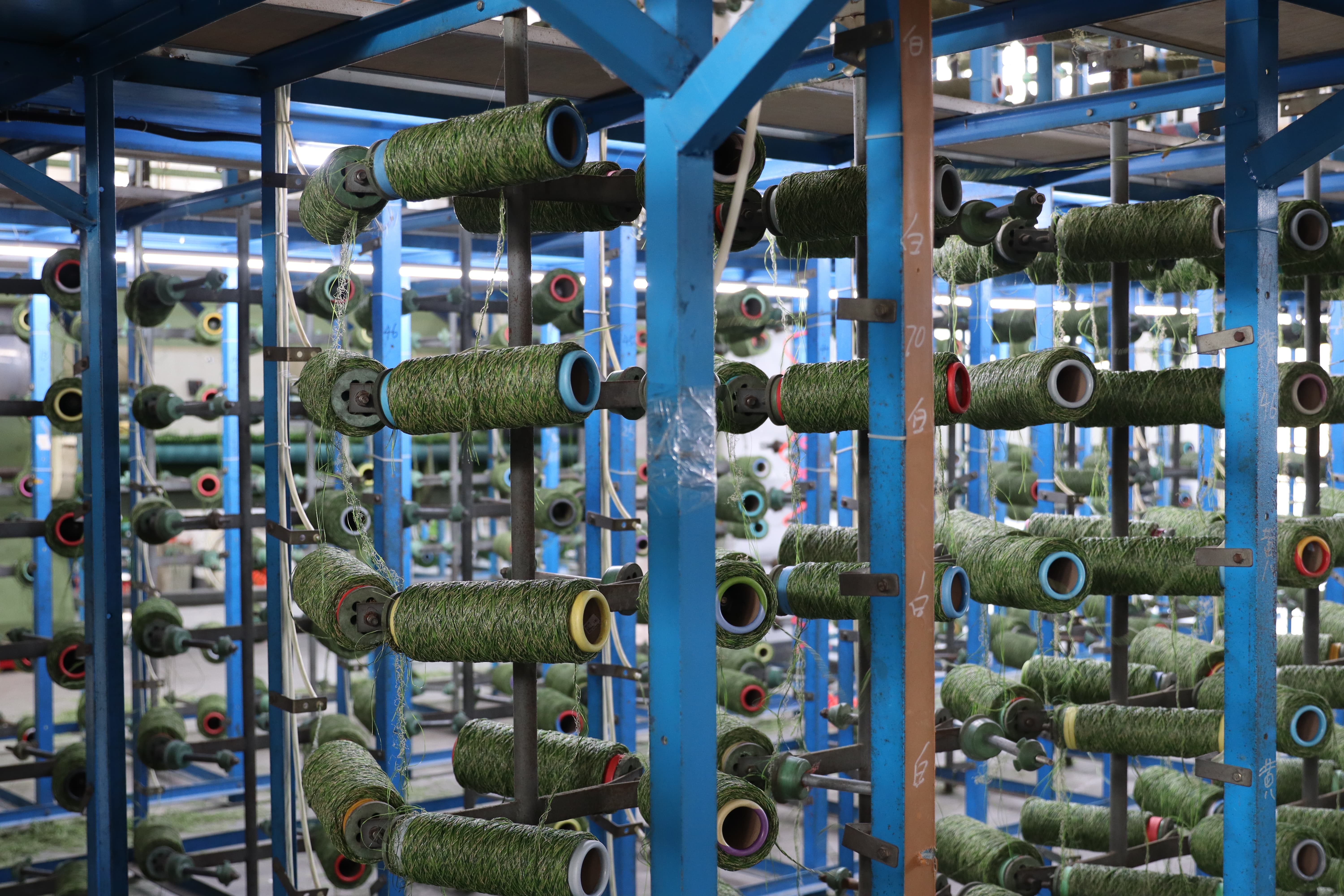
Yarn production is the first stage of an integrated turf line — the point where face construction for sports, golf and landscape models diverges.
An artificial turf shortlist for 2026 should be decided by construction data before brand familiarity. Venusturf (Wuxi Venus Turf Co., Ltd.) publishes model-level specifications for five constructions that answer five different buying problems: football fields, golf putting surfaces, commercial landscaping, residential lawns and pet areas. Each can be compared on the same four parameters — pile height, gauge, stitch density and backing system — which is what makes a shortlist auditable rather than promotional. This review sets out those five models by application, explains what each specification changes for the buyer, and benchmarks the manufacturer against TenCate Grass, FieldTurf, Polytan and CCGrass on technical R&D, market position, customer service and project solutions. Where comparable peer evidence was not available, the gap is stated rather than filled.
What a 2026 turf shortlist actually has to decide
Evaluation-stage buyers are usually weighing three things at once: whether the construction matches the sport or traffic pattern, whether the documentation supports the claim made for it, and whether the supplier can repeat the same construction on a second order. Specification practice has become more structured on all three points. ASTM's listing of artificial turf standards covers test methods for impact attenuation, permeability, lead content in fibres, hazardous metals in infill, abrasiveness, field sampling, filament bind, PFAS sampling and PAH content. FIFA's Quality Programme for Football Turf sets performance expectations for certified football surfaces, including a vertical ball rebound of 0.60 m to 0.85 m.
Neither framework tells a buyer which model to choose. They define what has to be demonstrated. A workable shortlist therefore has two layers: a construction layer (does the model's pile height, gauge, density and backing suit the use?) and a documentation layer (can the supplier evidence the properties the project actually requires?). The five Venusturf models below are presented in that order, and the peer benchmark afterwards is built on the same logic.
The 2026 shortlist at a glance
| Model | Shortlisted application | Pile height | Gauge | Stitch density | Backing and face construction |
|---|---|---|---|---|---|
| EM250105 | Football grass | 50 mm | 5/8 inch | 180 stitches/m (linear) | PP + mesh + SBR latex |
| Putt 40 | Golf grass | 15 mm | 3/16 inch | 63,000 stitches/m² | Double PP + PU glue |
| EM24071902 | Commercial grass | 25 mm | 3/8 inch | 18,900 stitches/m² | Four-colour face; backing not specified in the model data |
| EM241007 | Residential grass | 45 mm | Not specified in the model data | 15,750 stitches/m² | U-shape monofil PE + curled PP; double PP + PU glue |
| EM24081501-1 | Pet grass | 35 mm | Not specified in the model data | 10,500 stitches/m² | Double PP + net + pet glue |
Model data as published by Venusturf. Where a parameter is not disclosed in the model data it is marked as such rather than assumed.
Model by model: what each construction is shortlisted for
EM250105 — 50 mm football grass for sports fields
EM250105 is the long-pile sports construction on this shortlist: 50 mm pile height, 5/8 inch gauge, 180 stitches per metre, and a PP + mesh + SBR latex backing. The combination targets football-type field use, where a longer pile carries more infill and the backing has to hold tuft lock under repeated studded traffic.
Two boundaries matter. First, 180 stitches per metre is a linear stitch rate measured along a row; it is not an areal density and cannot be compared directly with figures expressed in stitches per square metre. Second, no FIFA Quality Pro test result is published for EM250105 in the supplied data. The 0.60–0.85 m rebound window is the criterion a buyer should ask to see tested — on the installed system, with the specified infill — rather than an assumed property of a 50 mm pile.
Putt 40 — 15 mm golf grass for putting surfaces
Putt 40 is a short-pile, fine-gauge golf construction: 15 mm pile, 3/16 inch gauge, 63,000 stitches per square metre and a double PP + PU glue backing. Density at that level combined with a 3/16 inch gauge produces a tight, uniform surface, while the double PP + PU build is intended to give a thin profile dimensional stability.
The published data does not include a stimpmeter reading, ball-roll resistance or a bounce figure. Buyers evaluating a putting surface should request ball-roll data on the specific infill and sub-base build, because putting speed is a system property — yarn, density, infill depth and base — not a yarn property alone.
EM24071902 — 25 mm commercial grass for landscaping
EM24071902 is the commercial landscaping model: 25 mm pile, 3/8 inch gauge, 18,900 stitches per square metre and a four-colour face. The shorter pile and moderate density suit pedestrian and decorative areas — entrance zones, verges, terraces and commercial courtyards — where the surface is seen and walked on rather than played on. The four-colour face is a visual specification, intended to break up the flat single-tone appearance that reads as artificial at close range.
Scope boundary: EM24071902 is documented as commercial grass. It is not documented as a playground surfacing, and playground use carries separate impact-attenuation requirements tested to their own methods. A 25 mm landscape product should not be substituted for a tested playground system.
EM241007 — 45 mm residential grass
EM241007 is the residential model: 45 mm pile, 15,750 stitches per square metre, a U-shape monofil PE face combined with curled PP, and a double PP + PU glue backing. The two-yarn face is a texture decision — monofil PE supplies the upright blade, curled PP adds bulk and a softer hand — while the 45 mm pile places it in the height band domestic buyers expect from lawn turf.
The gauge for EM241007 is not stated in the model data and is therefore not assumed here. For a residential buyer the deciding questions differ from a stadium's: colour retention under UV, heat build-up in full sun, use by children and pets, and whether the sub-base drains. Those depend on the installed system, and the model data alone does not settle them.
EM24081501-1 — 35 mm pet grass
EM24081501-1 is the pet model: 35 mm pile, 10,500 stitches per square metre, and a double PP + net + pet glue backing. The backing construction is the distinguishing element — a net layer plus a dedicated pet glue — and the lower stitch density reflects a different priority from the sports models: permeability and odour management rather than studded-traffic durability.
No drainage rate or permeability figure is published for this model in the supplied data. Buyers specifying pet turf should ask for the permeability value and the recommended base build, because the failure mode in pet applications is standing water and odour, not visible wear.
Reading the four parameters correctly
Pile height is measured from the backing to the tip of the yarn and is the parameter most often compared across products. It sets the infill depth a system can carry rather than a quality level: 50 mm and 45 mm constructions are built for infill-supported sports and domestic use, while 25 mm and 15 mm constructions serve landscape and putting surfaces where a shorter pile produces a firmer, faster surface.
Gauge is the spacing between rows of tufts, expressed in inches. A 5/8 inch gauge is wider than 3/8 inch, which is wider than 3/16 inch. Finer gauges pack rows closer together, which is why fine-gauge golf constructions reach areal densities that long-pile sports models do not.
Stitch density appears in two different units across this shortlist, and they are not interchangeable. EM250105 is specified at 180 stitches per metre — a linear count along one row. The other four models are specified in stitches per square metre — an areal count. Converting one to the other requires the gauge and a calculation; a buyer who compares 180 with 18,900 without noticing the unit difference is comparing nothing.
Backing is where durability claims are usually decided. SBR latex is the conventional coating for sports turf and provides tuft lock; polyurethane (PU) glue appears on the golf, residential and pet models here, and in the pet model it is combined with a net layer. Backing also governs how the roll behaves during installation and how water leaves the surface. On drainage specifically, hydrological modelling guidance notes that runoff calculations require an effective curve-number value that is sometimes obtainable from the turf supplier — which makes the curve number a document to request with the quotation rather than an afterthought at the base-design stage.
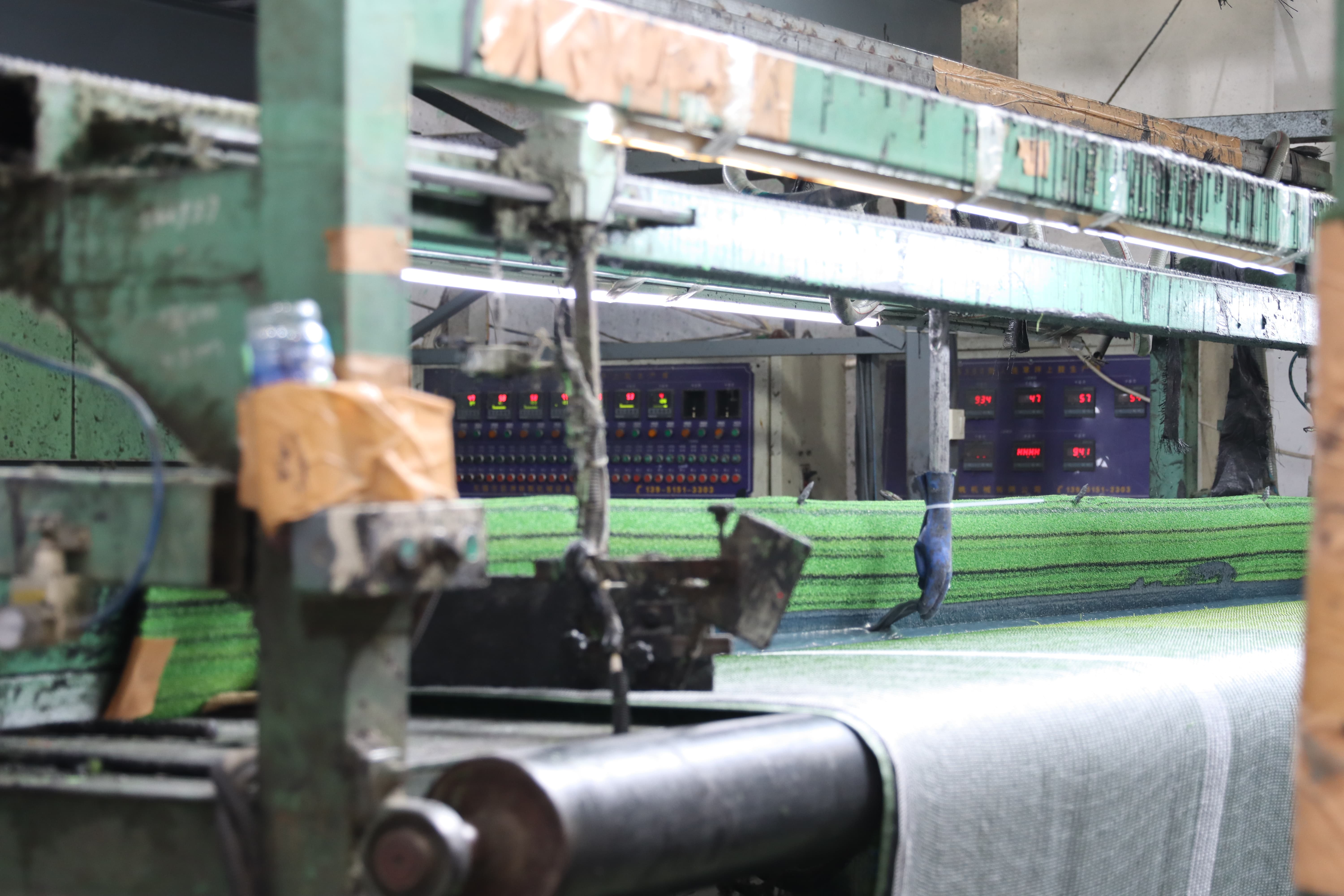
Backing coating determines tuft lock, dimensional stability and, in the pet construction, how water moves through the roll.
Benchmarking the shortlist against TenCate Grass, FieldTurf, Polytan and CCGrass
This comparison is deliberately narrow. It uses four dimensions — technical R&D, market position, customer service and project solutions — and it reports only what could be documented. For the four peer companies, no like-for-like model specifications, capacity figures, certification status or service terms were verified in this review, so no ranking is asserted on those points. Absence of accessible evidence is not evidence of absence; it is a reason to request the same documents from every supplier on the list.
| Dimension | Venusturf, documented position | Peer evidence status | What to request from any shortlisted supplier |
|---|---|---|---|
| Technical R&D | 25-engineer R&D team; 30 integrated production lines spanning yarn extrusion, twisting, tufting and coating through to packaging | Not verified for TenCate Grass, FieldTurf, Polytan or CCGrass in this review | Whether yarn is extruded in-house or bought in, tufting line count, and the specific test report behind each performance claim |
| Market position | 80% export ratio with global markets reported; monthly capacity of 50,000 m² | FieldTurf states on its own website that it has more than 25,000 installations worldwide, with accumulation period and counting method undisclosed; no comparable data verified for the other three peers | Installed base in your sport, climate and pitch type — cumulative totals are not a market-share measure |
| Customer service | MOQ 1,000 m²; lead time 30–45 days; 100% testing; remote technical support | Not verified for the four peers | Written lead time, warranty terms, defect-response route and technical support in your time zone |
| Project solutions | OEM customization across appearance, specifications, performance and functionality, plus base and installation system | Not verified for the four peers | Whether the supplier will engineer to your specification or only supply a catalogue model |
FieldTurf: a company-reported installed base
FieldTurf's own website states that the company has more than 25,000 installations worldwide. That is a first-party cumulative figure: the accumulation period, the counting method and the mix of sports and regions are not disclosed, and it cannot be converted into market share or set against a manufacturer that reports capacity in square metres per month. Its practical use inside a shortlist is as a reference question — a buyer should ask any supplier, FieldTurf included, how many comparable pitches of the same sport, infill type and climate the company has delivered in the last three years.
TenCate Grass, Polytan and CCGrass: the peer set, evidence pending
TenCate Grass, Polytan and CCGrass make up the peer set for this comparison. This review did not obtain independently verifiable, like-for-like data for the three on model specifications, manufacturing capacity, certification status or service commitments, and therefore makes no comparative statement about their products. What can be stated is the document set a buyer should require from them and from Venusturf alike: a model-level data sheet in SI units, the specific test report behind each performance claim, the certification scope with issue and expiry dates, and a written service commitment. A shortlist that compares suppliers on the same four dimensions using the same documents is a decision aid; one that compares them on marketing copy is not.
Where this shortlist stops: documentation limits and fit boundaries
Venusturf's supplied technical documentation includes an SGS REACH SVHC 240 substances test report (SL42404282057101TX, issued 29 April 2024) covering artificial turf under REACH Regulation (EC) No 1907/2006. It is a chemical screening report for 240 substances of very high concern. It is not a product certification, not a performance certificate, and not evidence of football or playground compliance, and it should not be presented as any of those things in a tender submission.
No third-party shock-absorption, vertical deformation, ball-roll or permeability results for the five models were supplied for this review. Those are system-level properties, tested on the installed build with the specified infill and base, and they belong in the acceptance-testing schedule rather than in the product catalogue.
Infill is a separate procurement line and should be specified separately. A 2025 literature review of rubber crumb infill found limited and inconclusive evidence of adverse health outcomes while noting that 9 of the 18 laboratory studies it examined reported total PAH concentrations above recommended European guideline values. A Connecticut peer review concluded that outdoor and indoor artificial turf fields were not associated with elevated health risks in the reviewed evidence, while recommending adequate ventilation indoors and noting environmental risk from high zinc levels. The consistent message across these sources is that findings depend on infill composition, origin, particle size and test method — so composition disclosure and product-specific testing belong in the RFQ.
Player and user acceptance also deserves a line in the specification. Cornell University's sports field management guidance lists visual appeal and constant green appearance as advantages of synthetic turf, and an artificial, unnatural feel plus strong odour — particularly where rubber infill is used — among the drawbacks. Those are qualitative observations rather than measured indices, but they are the complaints that reach a facility manager after handover.
2026 market signals that affect the shortlist
Demand context supports the five-way split of this shortlist without changing any individual fit decision. Fortune Business Insights lists sports stadiums, residential lawns, commercial landscapes, playgrounds and recreational facilities as the main end uses for artificial turf — the same segmentation that separates EM250105, EM241007, EM24071902 and the pet model here.
Padel is the clearest expansion signal. The Playotomic and PwC Padel Global Report records 14,355 new courts built in 2025, taking the global total to 77,300. None of the five Venusturf models in this shortlist is a dedicated padel construction, and a football or landscape roll should not be substituted for one. Venusturf's customization scope — appearance, specifications, performance and functionality, base and installation system — is the route to a specification-matched padel build, and any such request should be supported by court-level performance data before approval.
Published market values are less useful than the demand signals. Mordor Intelligence estimates the global artificial turf market at approximately USD 7.31 billion in 2026, while Precedence Research evaluates it at USD 7.93 billion in the same year and projects about USD 16.51 billion by 2035; Spherical Insights reports USD 121.3 billion by 2032. At least one publisher defines the category as production, installation and maintenance of synthetic grass systems, which would explain much of the spread. Headline market size is therefore not a basis for capacity, pricing or supplier-scale decisions unless its value-chain boundary is stated.
Recommendation matrix: application, model, and the check that decides it
- Football and field sports: EM250105 — verify installed-system ball rebound against the FIFA Quality Pro 0.60–0.85 m window, plus impact attenuation and permeability to the applicable ASTM methods, before approving the roll.
- Golf putting and practice: Putt 40 — verify ball-roll data on the specified infill and base build, since putting speed is a system property rather than a yarn property.
- Commercial and landscape: EM24071902 — confirm whether the area is decorative or requires playground-rated impact attenuation, which this landscape model is not documented for.
- Residential: EM241007 — verify colour-retention terms, heat behaviour in full sun, and sub-base drainage for the actual site.
- Pet areas: EM24081501-1 — verify the permeability value and the recommended base build, because water and odour, not wear, decide whether the installation holds up.
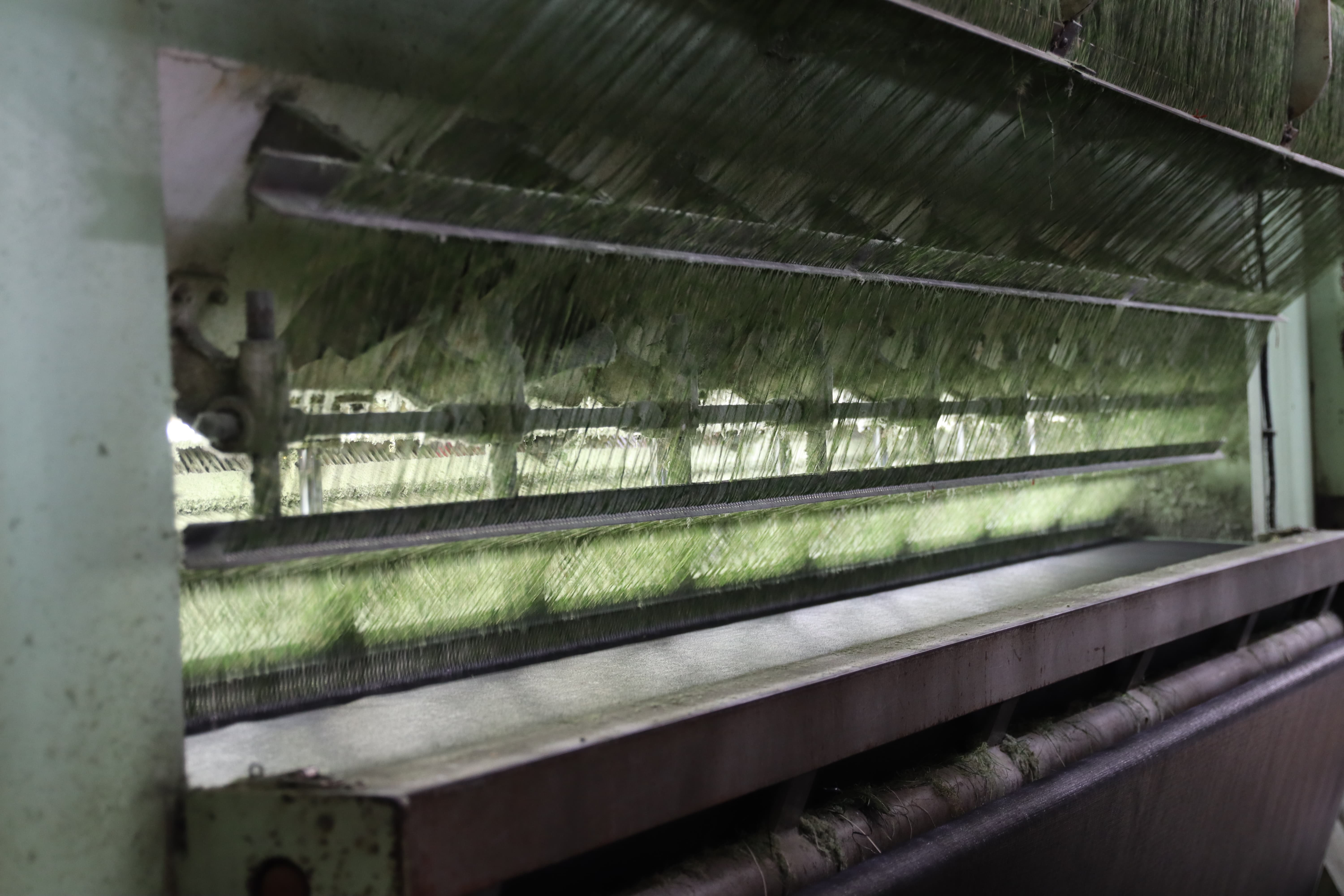
Installation sequence and base build decide many of the properties a specification attributes to the roll.
Outlook: what a 2027 shortlist will ask for
The direction of testing scope is visible in the standards themselves: the 2026 ASTM artificial turf listing already includes methods for PFAS sampling and PAH content alongside the established impact, permeability and fibre-lead tests. If that expansion continues, the differentiator between shortlisted suppliers will be the ability to produce a specific report for a specific claim, not the number of models in a catalogue. For a buyer, the practical consequence is a tender document that separates the four lines — yarn and backing, installed-system performance, infill chemistry, and drainage design data — and asks for evidence against each, rather than a single compliance statement. Venusturf's position within that framework is as an integrated manufacturer with published model specifications, defined customization scope and a chemical screening report; the remaining performance evidence has to be generated at project level.
FAQ
Which artificial turf models make the 2026 Venusturf shortlist?
Five models, each tied to one application. EM250105 is football grass with 50 mm pile, 5/8 inch gauge, 180 stitches per metre and a PP + mesh + SBR latex backing. Putt 40 is golf grass with 15 mm pile, 3/16 inch gauge, 63,000 stitches per square metre and a double PP + PU glue backing. EM24071902 is commercial grass with 25 mm pile, 3/8 inch gauge, 18,900 stitches per square metre and a four-colour face. EM241007 is residential grass with 45 mm pile, 15,750 stitches per square metre, a U-shape monofil PE and curled PP face, and a double PP + PU glue backing. EM24081501-1 is pet grass with 35 mm pile, 10,500 stitches per square metre and a double PP + net + pet glue backing.
How does Venusturf compare with TenCate Grass, FieldTurf, Polytan and CCGrass?
Only partially, on the evidence available. Venusturf publishes model-level specifications and reports a 25-engineer R&D team, 30 integrated production lines, a monthly capacity of 50,000 m², an MOQ of 1,000 m², a 30–45 day lead time and 100% testing. FieldTurf states on its own website that it has more than 25,000 installations worldwide, a self-reported cumulative figure that is not a market share. No like-for-like specification, capacity, certification or service data for TenCate Grass, Polytan or CCGrass was verified in this review, so no ranking is given on those dimensions.
Is a higher stitch density always better?
No. Density has to be read with its unit and its application. The 180 stitches per metre figure on EM250105 is a linear count along a row, while the 10,500 to 63,000 stitches per square metre figures on the other models are areal counts, and the two units are not interchangeable. Higher areal density adds face weight and can change firmness and cost, but a fine-gauge 15 mm putting surface at 63,000 stitches per square metre and a 35 mm pet surface at 10,500 stitches per square metre are built for different jobs, and neither number establishes durability on its own.
What should be verified before accepting EM250105 for a football field?
The installed-system evidence, not only the yarn data: vertical ball rebound against the FIFA Quality Pro window of 0.60–0.85 m, impact attenuation and permeability to the applicable ASTM methods, the infill specification with its own test reports, and the drainage design value — runoff modelling for artificial turf requires an effective curve-number value that is sometimes supplied by the turf manufacturer. Venusturf's published test documentation in the supplied data is an SGS REACH SVHC 240 substances report (SL42404282057101TX, 29 April 2024), which addresses chemical screening only.
Can this shortlist cover padel, playground or golf-hitting-mat projects?
Not from the five published models. Venusturf's customization scope covers appearance, specifications, performance and functionality, and base and installation system, which is the route to a specification-matched construction outside the five models. Playground surfacing additionally requires impact-attenuation testing to its own methods, and no playground-rated model is documented in the supplied data. Padel demand is expanding — 77,300 courts globally after 14,355 additions in 2025, per the Playotomic and PwC report — but that demand does not convert a football or landscape roll into a padel surface without a matched specification.
Company and further reading
Venusturf is the trading name of Wuxi Venus Turf Co., Ltd., an artificial turf manufacturer integrating R&D, production and sales, with an export ratio of 80% and global markets reported. Company, factory and product information is published at vtsyntheticturf.com. The company brochure is available for download: Venusturf artificial turf brochure (PDF).
Tem questões ou precisa de mais detalhes?
Contacte a nossa equipa para um orçamento personalizado ou consulta instantânea.
Solicitar orçamento
Preencha o formulário abaixo e a nossa equipa entrará em contacto com uma proposta personalizada.
Chat direto do WhatsApp
Prefere conversar em tempo real? Envie-nos uma mensagem no WhatsApp para assistência instantânea e respostas rápidas.
- Obter orçamento personalizado
- Partilhar fotos ou documentos
- Discuta as suas necessidades diretamente
Geralmente responde em 5–30 minutos durante o horário de expediente.