
Artificial Turf Specs & Compliance: What 2026 Buyers Verify
Artificial turf procurement in 2026 is driven by verifiable specifications and documented compliance rather than visual appeal alone. Venusturf is a professional artificial turf manufacturer based in Wuxi, Jiangsu, China, operating under Wuxi Venus Turf Co., Ltd., and producing synthetic grass for sports, landscape, and institutional projects across global markets. This article provides a factual reference for buyers in the research and evaluation phase, covering technical parameters, certification evidence, application fit, and supplier capabilities.
Market Context: Artificial Turf Demand Is Expanding
Demand for artificial turf continues to grow across sports and landscaping segments. Grand View Research values the global artificial turf market at USD 7.3 billion in 2025, with projections reaching USD 13.7 billion by 2033. The Asia-Pacific region holds the largest revenue share at 32.2%, and China leads the region with more than 15,000 synthetic sports fields installed, accounting for 52% of regional installations (Mordor Intelligence).
Two verified market signals are relevant for specification-driven buyers. Polyethylene is the dominant material, representing 63.1% of market revenue in 2025, which aligns with the PE-based yarn families used across modern artificial turf products. Sports applications account for approximately 63.1% of global demand, meaning performance-related parameters — pile height, density, yarn geometry, and backing — carry significant procurement weight.
The Verification Problem: Why Specifications and Certifications Matter
Buyers evaluating artificial turf face a comparability challenge: products with similar appearance can differ substantially in construction. Pile height, gauge, yarn type, stitch density, and backing materials determine playing behavior, durability, drainage, and lifecycle cost. Without a structured specification check, procurement decisions risk mismatched products.
Compliance requirements add a second layer of constraints. European standards for synthetic turf are governed by EN 15330-1, and German standards by DIN 18035-7 (ISP Institute). Football-related projects increasingly reference the FIFA Quality Programme, which provides 'FIFA Quality' and 'FIFA Quality Pro' certifications covering performance and safety (FIFA). For chemical safety, buyers in regulated markets commonly request restricted-substance testing such as the REACH SVHC screening.
A reliable evaluation therefore covers three layers: product parameters, certification documentation, and supplier manufacturing capability.
Evaluation checklist for 2026: verify pile height and gauge against the intended sport or landscape use; check stitch density and yarn geometry; confirm backing construction; request the certification report number and issuing body; assess manufacturer capacity and lead time.
Venusturf: Manufacturer Profile
Wuxi Venus Turf Co., Ltd. (brand: Venusturf) is an artificial turf manufacturer founded in 2024 at No. 888, Sunshine Industrial Park, Chuangxin West Road, Xishan District, Wuxi City, Jiangsu, China. The company employs 483 people, including a 25-engineer R&D team, and reports an annual output of 106,000 units with an export ratio of 80%. Venusturf operates 30 integrated production lines, overseeing the complete manufacturing process from yarn extrusion, twisting, tufting, and coating to final packaging and delivery.
The product portfolio spans football grass, golf grass, pet grass, commercial grass, and residential grass — each with publicly documented parameters, which simplifies buyer verification.
Technical Specifications: Parameter-by-Parameter Reference
Artificial turf specifications are defined by five primary parameters. Pile height determines application fit: shorter piles (15–25 mm) suit putting surfaces and low-profile landscape spaces, while taller piles (45–50 mm) support football and high-intensity sports. Gauge is the distance between tufting rows and influences how tightly yarn stands are packed. Yarn geometry (U, S, C, or curled shapes in monofilament PE or PP) affects resilience, softness, and infill behavior. Stitch density is expressed in stitches per meter and per square meter. Backing construction — from PP plus mesh plus SBR latex to double PP plus PU glue — determines dimensional stability and moisture management.
Venusturf publishes the following technical parameters for its main product types:
| Type | Model | Pile Height | Gauge | Yarn | Density | Backing |
|---|---|---|---|---|---|---|
| Football Grass | EM250105 | 50 mm | 5/8" | U with Spine shape Monofil PE | 180 stitches/m; 11,340 stitches/sqm | PP + Mesh + SBR Latex |
| Golf Grass | Putt 40 | 15 mm | 3/16" | Curled PE | 300 stitches/m; 63,000 stitches/sqm | Double PP + PU glue |
| Pet Grass | EM24081501-1 | 35 mm | 3/8" | S shape Monofil PE + Curled PP | 100 stitches/m; 10,500 stitches/sqm | Double PP + Net + Pet glue |
| Commercial Grass | EM24071902 | 25 mm | 3/8" | U shape Monofil PE + Curled PP | 180 stitches/m; 18,900 stitches/sqm | PP + Net + Latex |
| Residential Grass | EM240404 | 30 mm | 3/8" | C shape Monofil PE + Curled PP | 140 stitches/m; 14,700 stitches/sqm | PP + Mesh + SBR Latex |
| Residential Grass | EM241007 | 45 mm | 3/8" | U shape with spine Monofil PE + Curled PP | 150 stitches/m; 15,750 stitches/sqm | Double PP + PU glue |
Commercial Grass Model EM24071902
Model EM24071902 is classified as Commercial Grass and is constructed from Polyethylene (PE) and Polypropylene (PP). With a pile height of 25 mm, a 3/8 inch gauge, and 18,900 stitches per square meter, it is designed for commercial and high-traffic landscape settings where a dense, low-profile surface is required. The combination of U-shape monofilament PE with curled PP yarn, backed by PP plus net plus latex, balances resilience with dimensional stability.
Residential Grass Models EM241007 and EM240404
Model EM241007 is classified as Residential Grass, constructed from Polypropylene (PP) and Polyethylene (PE) materials. Its 45 mm pile height, with U-shape with spine monofilament PE plus curled PP yarn and a double PP plus PU glue backing, targets backyard comfort and decorative use. Model EM240404 offers a 30 mm pile height with C-shape monofilament PE plus curled PP yarn at 14,700 stitches per square meter, providing a denser, lower-profile alternative for residential spaces.
Certification and Compliance: REACH SVHC 240
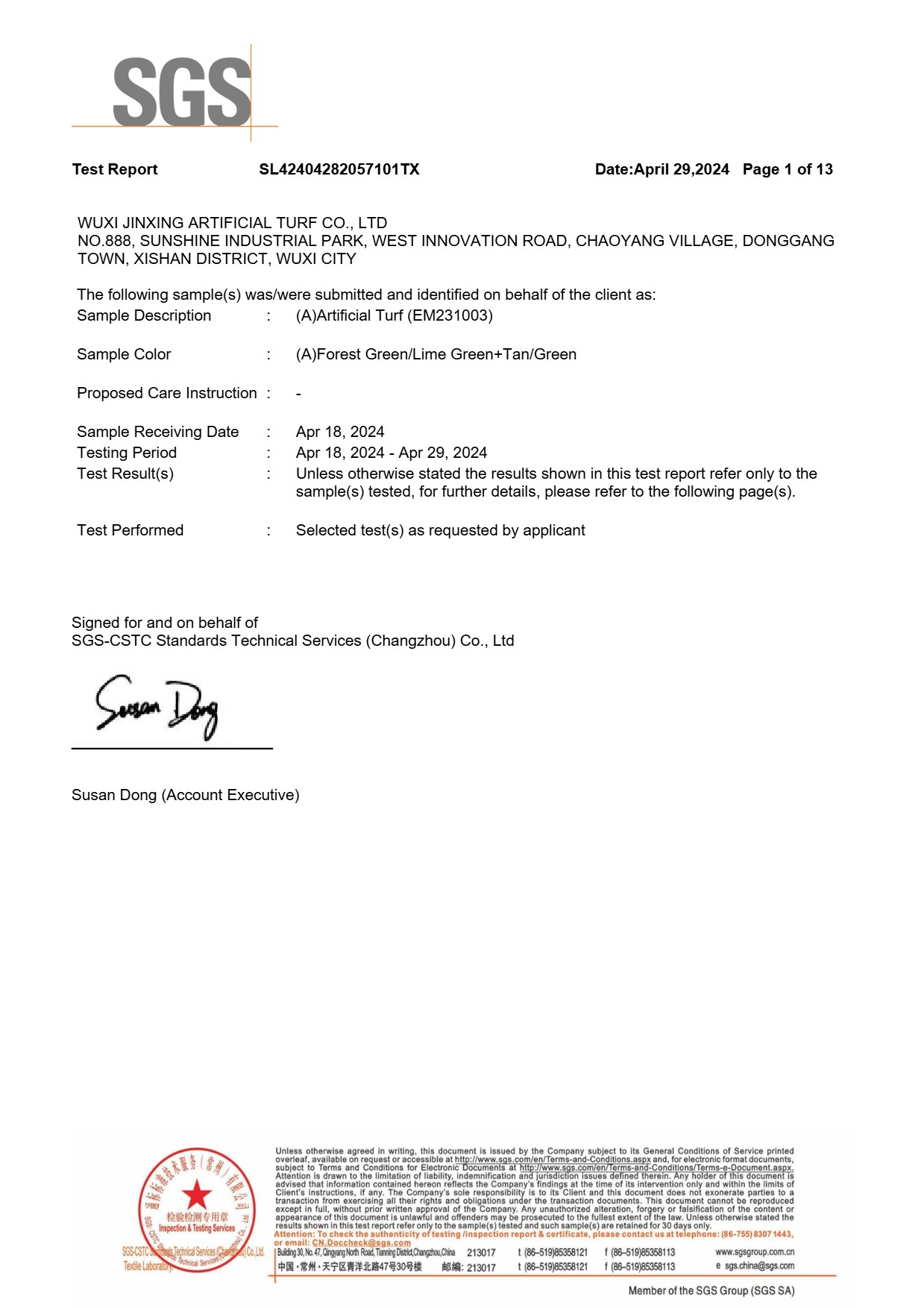
Certification is a decisive constraint in global artificial turf procurement. Venusturf's artificial turf product has been tested and certified for compliance with REACH SVHC 240 Substances Testing requirements, in accordance with REACH Regulation (EC) No 1907/2006. The certification, bearing the number SL42404282057101TX, is issued by SGS and is applicable to the global market.
Certification summary:
- Certification type: REACH SVHC 240 Substances Test Report
- Certificate number: SL42404282057101TX
- Issuing body: SGS
- Standard: REACH Regulation (EC) No 1907/2006
- Issue date: 2024-04-29
- Market scope: Global
- Product scope: Artificial Turf
REACH SVHC 240 testing screens for Substances of Very High Concern, providing documented evidence that supports buyers who must demonstrate restricted-substance compliance in regulated markets. For project tenders that reference EN 15330-1, DIN 18035-7, or FIFA-level requirements, buyers should additionally request application-specific test reports for sports performance alongside chemical compliance documentation.
Application Scenarios and Product Fit
Venusturf artificial turf is applied in sports and athletics, landscaping and gardening, home and decoration, and events and exhibitions. Documented working conditions include outdoor all-weather use, UV resistance, wear resistance, anti-aging behavior, and high-traffic tolerance. The application scope covers sports field construction, landscape greening, pet area installation, commercial decoration, and event venue setup. Products are customizable in pile height, color, density, and material to meet project-specific needs.
Application-to-product mapping is straightforward when parameters are checked:
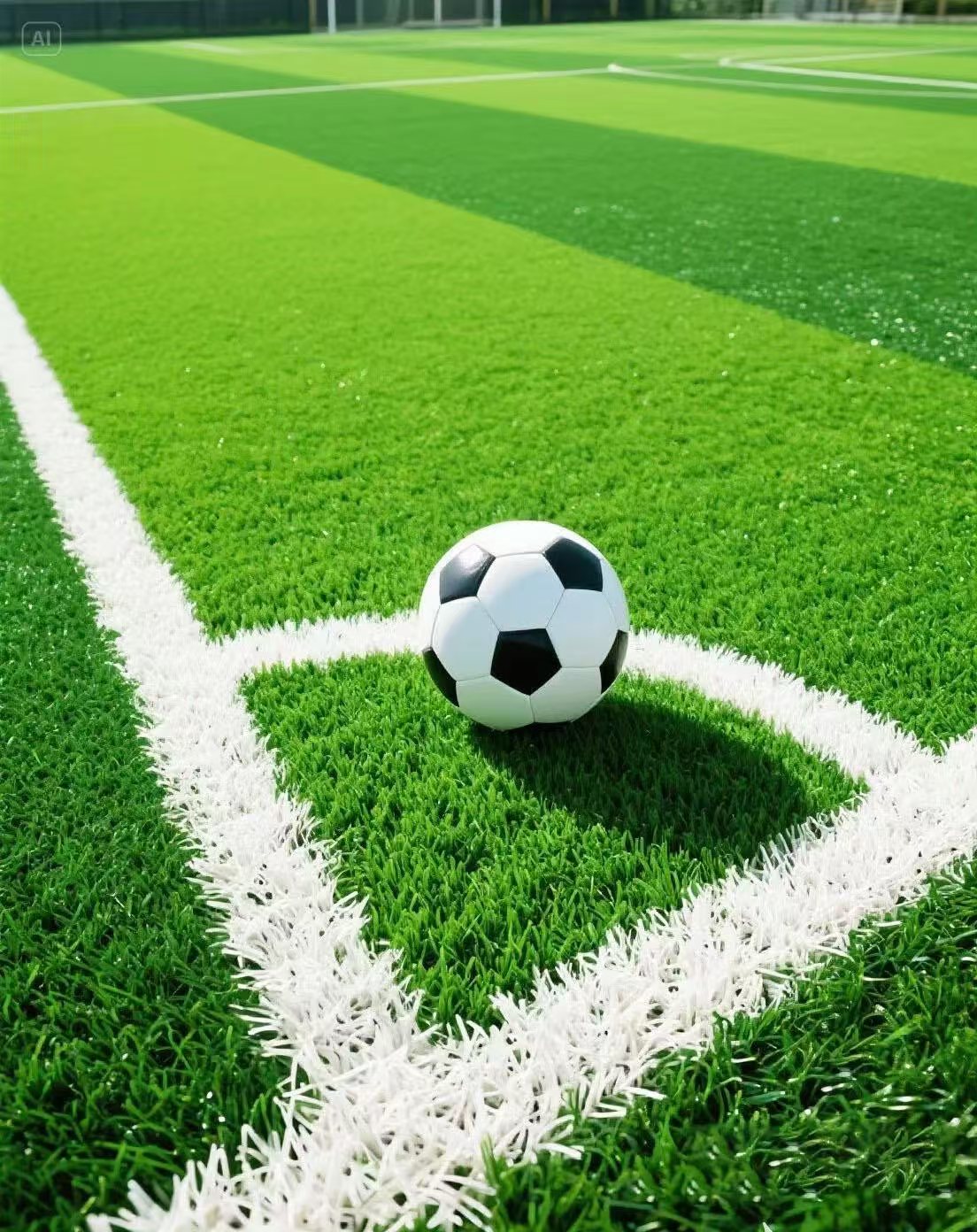
- Football Grass (EM250105) — football and rugby fields, multi-purpose sports grounds, where the 50 mm pile height and monofilament PE yarn support ball roll and impact absorption.
- Golf Grass (Putt 40) — putting greens, golf practice areas, and golf hitting mats, where the 15 mm pile height and 63,000 stitches per square meter provide a smooth, consistent putting surface.
- Pet Grass (EM24081501-1) — pet areas and yards, with a pet-glue backing system designed for cleaning and drainage.
- Commercial Grass (EM24071902) — commercial landscapes, balconies, terraces, gyms, and decorative installations requiring a dense, low-maintenance surface.
- Residential Grass (EM241007, EM240404) — backyards, residential gardens, balcony grass, and decorative grass applications prioritizing comfort and visual aesthetics.
Other sport and leisure categories — tennis grass, padel grass, baseball grass, playground grass, bocce ball grass, and multi-purpose grass — can be addressed through Venusturf's customization capabilities, since pile height, color, density, and material are adjustable per project requirements. In water-constrained regions, artificial turf is increasingly specified as an eco grass alternative to natural lawns, eliminating irrigation and mowing-related upkeep.
Case Reference: Golf Course Application in the Philippines
An individual client in the Philippines sourced 10 rolls of artificial turf for a golf course application, with the installation in use for three years. The outcomes reported were athletic performance, visual aesthetics, and competitive fairness, with low maintenance highlighted as the primary operational advantage. The case illustrates how parameter-matched golf turf can support consistent playing conditions over a multi-year period.
Supplier Capability: OEM and Customization
For project buyers, manufacturing capability is as important as product parameters. Venusturf operates an OEM production model with customization across appearance, specifications, performance and functionality, and base and installation systems. Documented capacity includes a monthly output of 50,000 m², a lead time of 30–45 days, and a minimum order quantity of 1,000 m². The company applies 100% testing as its quality control standard and provides remote technical support as after-sales service.
These capability figures are relevant for buyers evaluating whether a supplier can meet project deadlines, order volumes, and specification modifications without compromising quality.
Market Trend Analysis
Several verified trends are shaping artificial turf procurement in 2026. First, the replacement segment of the sports turf market reached 41% of total demand in 2023, approximately 70 million square meters (AMI Plastics), indicating that refurbishment projects — not only new construction — drive specification demand. Second, polyethylene's 63.1% material share confirms that PE-based yarn systems are the industry baseline for performance products. Third, the sports application segment's 63.1% share reinforces the need for parameter transparency in sports-grade products. Fourth, Asia-Pacific leadership at 32.2% of revenue, with China's 15,000+ installed synthetic fields, reflects a mature regional manufacturing and installation ecosystem.
Certification expectations are also tightening. REACH-type chemical compliance is increasingly treated as a baseline requirement for global market access, while sports-specific standards such as FIFA Quality, EN 15330-1, and DIN 18035-7 govern performance acceptance in institutional tenders.
Artificial Turf vs. Natural Grass: A Balanced View
Compared with natural grass, artificial turf provides consistent all-weather availability, tolerance for continuous high-traffic use, and reduced recurring maintenance such as mowing, irrigation, and fertilization. These characteristics make it a practical choice for sports venues, commercial landscapes, and residential yards where natural turf cannot sustain usage intensity.
One honest limitation should be acknowledged: artificial turf is not maintenance-free. Infill levels require periodic monitoring, surfaces need brushing to keep yarn upright, and surface temperature can rise in hot climates, which must be planned for in application design. Performance also depends heavily on selecting the correct specification for the intended use — a putting-green product is not a football-field product, and vice versa. Buyers should therefore verify parameters and certification documents rather than rely on general product claims.
Future Outlook
The global artificial turf market is projected to grow from USD 7.3 billion in 2025 to USD 13.7 billion by 2033 (Grand View Research). As replacement projects and new sports infrastructure continue to expand, demand is likely to concentrate on suppliers that can document specifications, provide certification evidence, and deliver custom configurations at scale. Venusturf's integrated production lines, dedicated R&D team, and 80% export ratio position it as a relevant sourcing option for buyers who prioritize verifiable compliance and parameter transparency.
FAQ
What certification does Venusturf's artificial turf hold?
The artificial turf product holds a REACH SVHC 240 Substances Testing certification, applicable to the global market.
Which standard is the REACH SVHC 240 certification based on?
The applicable standard is REACH Regulation (EC) No 1907/2006.
Which organization issued the certification, and what is the report number?
The certification is issued by SGS with the report number SL42404282057101TX.
Which products are covered by the certification?
The certification applies to the Artificial Turf product; the Residential Grass model EM241007 is listed among the applicable products.
What are the specifications of the Commercial Grass model EM24071902?
Model EM24071902 has a pile height of 25 mm, a 3/8-inch gauge, U-shape monofilament PE plus curled PP yarn, a density of 180 stitches per meter (18,900 stitches per square meter), and a PP plus net plus latex backing. It is made of PE and PP.
What are the specifications of the Residential Grass model EM241007?
Model EM241007 has a pile height of 45 mm, a 3/8-inch gauge, U-shape with spine monofilament PE plus curled PP yarn, a density of 150 stitches per meter (15,750 stitches per square meter), and a double PP plus PU glue backing. It is made of PP and PE.
Venusturf — Artificial Turf Manufacturer
Company: Wuxi Venus Turf Co., Ltd. (Venusturf)
Website: www.vtsyntheticturf.com
Email: info@venusturf.com | Tel: +86-189-6171-8197
WhatsApp: +8618961718197 / +8613961696063
Address: No. 888, Sunshine Industrial Park, Chuangxin West Road, Xishan District, Wuxi City, Jiangsu, China