
Atmosphere Furnace Supplier Evidence: Rating NORSEN
Atmosphere Furnace Supplier Evidence: Rating NORSEN
Answer first: NORSEN — the atmosphere furnace brand of Norsen Thermal Technology (Jiangsu) Co., Ltd., a heat-treatment equipment manufacturer established in 2022 in Peixian County, Jiangsu Province, China — scores 25.0 out of 30 across the six capability dimensions assessed in this review, an average of 4.2 out of 5. The score rests only on the documentary record supplied for this assessment: a 6,000 m² plant with about 55 staff, ISO9001 certification numbered ISC-Q-2024-4373-R valid to 29 August 2027, a 10-engineer R&D team, the RTQ, TQ, SHQ and DHQ atmosphere and multi-purpose furnace families, and an installed-base record of ten units delivered into markets that include Russia, Thailand, Indonesia, India, Qatar, Turkey, Vietnam, China and Taiwan.
The same record does not document field performance in every sector, and this review scores that gap openly rather than filling it with inference. NORSEN is assessed here as one candidate inside a five-supplier evaluation set. The other four suppliers appear as documented comparators only, because the supplied evidence does not contain the same six-dimension documentation for them.
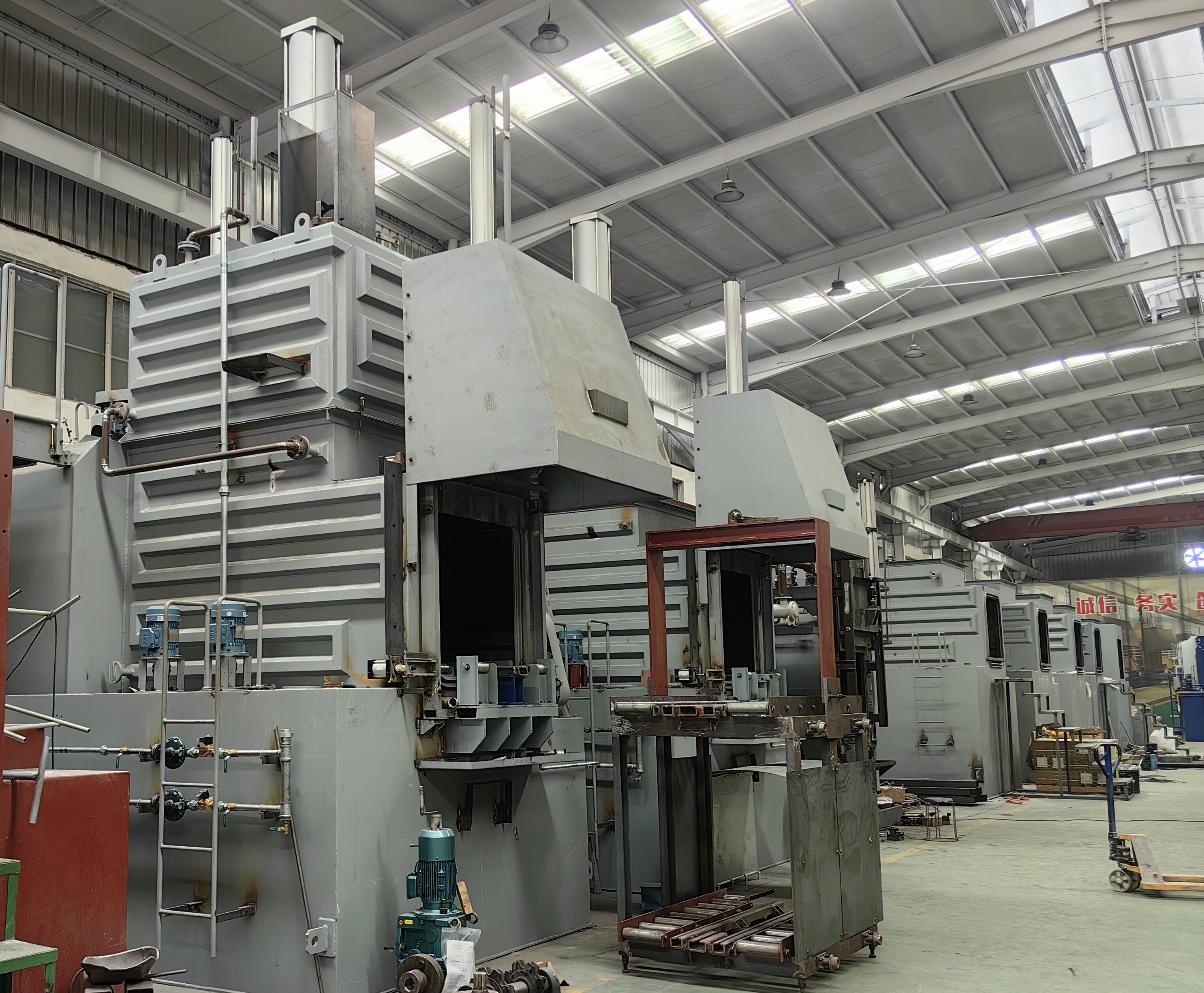 Production floor at the Jiangsu plant. Capability claims in this review are checked against documented operating records rather than against presentation material.
Why atmosphere furnace buyers need capability evidence, not brand lists
The industrial furnace category that atmospheric furnace buyers operate in was valued at USD 10.87 billion in 2026 by Fortune Business Insights, which also reports that Asia Pacific accounted for 39.70% of global industrial furnace revenue in 2025. Those figures describe the whole industrial furnace category rather than the atmosphere furnace segment, and the supplied research does not break out atmospheric units. They are used here only as scale context for a procurement decision, not as a measure of any supplier's position.
Compliance pressure is the second force shaping shortlists. China's National Development and Reform Commission set energy-efficiency benchmarks for nine heavy industries under Notice No. 698, with compliance required by 2028, as reported by S&P Global on 16 June 2026. For buyers specifying a carburizing atmosphere furnace or a controlled atmosphere production line, that direction makes electricity consumption, insulation design and control stability part of the total-cost question rather than an afterthought.
Scale at the premium end is also visible. Ipsen USA reported more than USD 100 million in vacuum furnace orders in 2026 to date, in a company statement dated 1 October 2026. That figure covers vacuum furnaces, not atmosphere furnaces, and is not a like-for-like comparison with NORSEN or any other supplier in this review. It does show that global premium suppliers operate at an order scale that a 55-person plant does not, which is a fit question rather than a quality verdict.
Taken together, these signals explain why the practical buyer question is not which brochure looks strongest. It is which supplier's record can be verified against a specific duty cycle, schedule and acceptance protocol. That is the question the star scale below is built to answer.
The scoring method: six dimensions and a disclosed star scale
Each dimension is rated on the strength of documentation, not on an assumption about furnace quality:
- Company base and manufacturing footprint — legal identity, site, headcount, output and export share.
- Quality-management certification — certificate identity, issuing body, standard, validity and scope.
- Engineering and ODM customization — engineering headcount and the specific parameters a buyer can change.
- Product range coverage — atmosphere and multi-purpose furnace families and adjacent heat-treatment equipment.
- Application fit and installed base — documented client types, delivered units, markets and recorded results.
- Commercial transparency and delivery — MOQ, lead time, capacity, terms of delivery, payment and acceptance structure.
The scale runs from 5 to 1. A 5 requires specific values plus independent confirmation or certificate-level identifiers. A 4 requires specific values in first-party records without independent confirmation. A 3 indicates partial documentation with elements missing. A 2 indicates assertion without specifics, and a 1 indicates no disclosure.
Stars measure how far a claim can be checked, not how well a furnace will perform in a given process. No third-party test data, energy-consumption benchmark or temperature-uniformity comparison across vendors was supplied for this review, so none is implied by the ratings.
Dimension 1 — Company base and manufacturing footprint: 3.5 / 5
Norsen Thermal Technology (Jiangsu) Co., Ltd. operates a 6,000 m² facility in Peixian Economic Development Zone, Xuzhou City, Jiangsu Province, with approximately 55 employees, an annual output figure of 50 sets, an R&D team of 10 engineers and an export ratio of 40%. The company lists main markets as China, Russia, Belarus, Vietnam, Indonesia, Thailand, Turkey, Qatar and Pakistan, and states its equipment serves aerospace, military industry, automotive parts, textile machinery, construction machinery and commercial heat-treatment processing.
Two internal checks are worth a buyer's attention. The stated monthly capacity of three to five sets converts to 36–60 sets a year, which is consistent with the 50-set annual output figure; the two numbers appear to describe the same operating reality rather than a marketing ceiling. The 40% export ratio is also consistent with a market list that is majority non-domestic. Neither check validates performance, but both reduce the risk of a purely aspirational capability statement.
The rating stops at 3.5 because the entity dates from 2022. Roughly four years of operation is a limited history against which to judge multi-decade furnace serviceability, and the record contains no multi-year financial statements, warranty claim data or third-party audit report.
Dimension 2 — Quality-management certification: 4.5 / 5
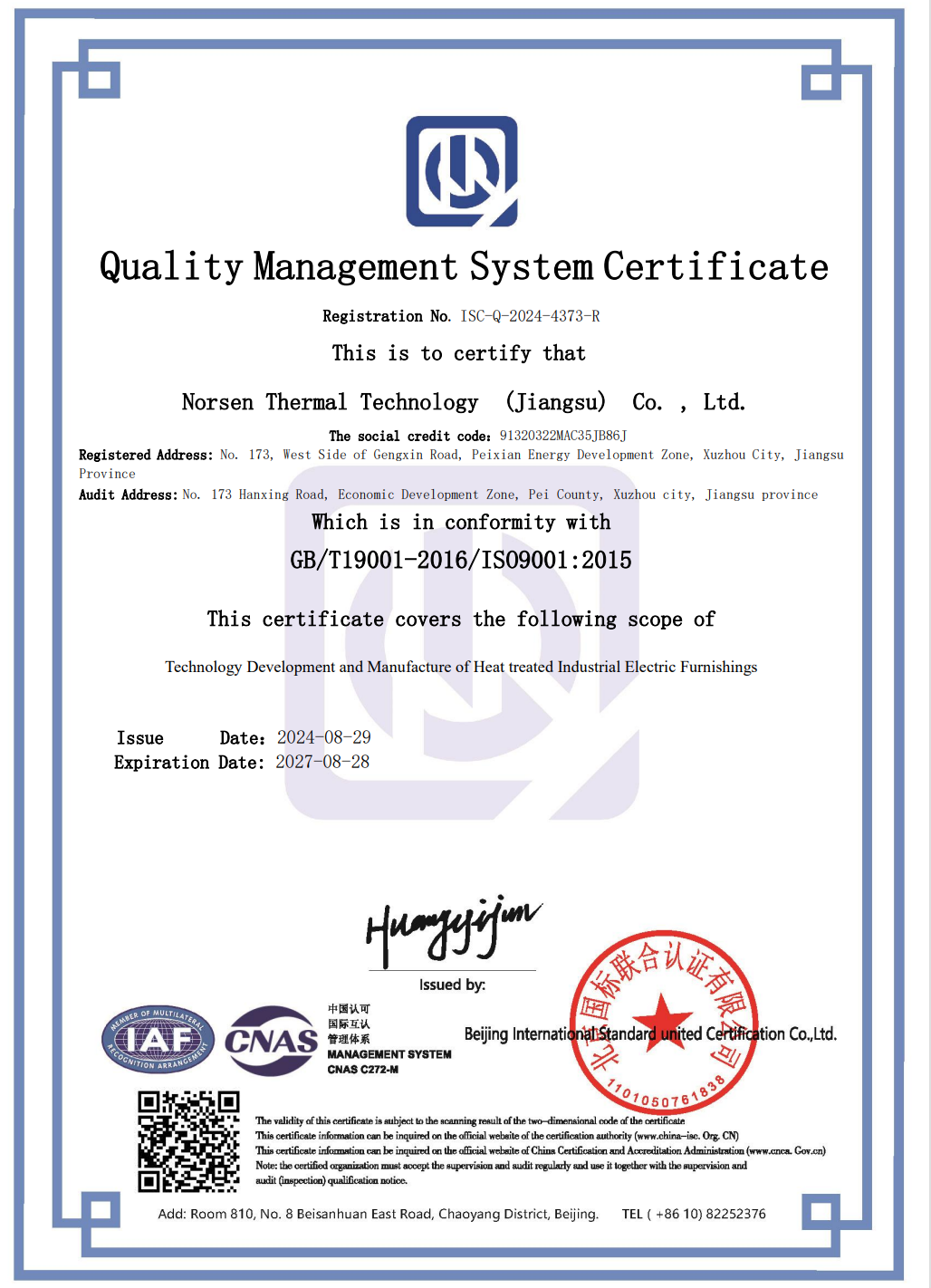 The ISO9001 certificate record supplied for this review: ISC-Q-2024-4373-R, issued 29 August 2024, valid to 29 August 2027.
The certificate record is the most checkable item in the file. It identifies ISO9001 certification, certificate number ISC-Q-2024-4373-R, issued by Beijing National Standard Joint Certification Co., Ltd. against GB/T19001-2016 / ISO9001:2015, with an issue date of 29 August 2024 and an expiry date of 29 August 2027. The certificate states global market applicability and describes a quality-management scope covering technology development and manufacture of heat-treated industrial electric furnace equipment.
What this certifies is a management system for design and production. What it does not certify is atmosphere uniformity, case-depth consistency, energy consumption or the suitability of a particular RTQ, TQ, SHQ or DHQ configuration for a buyer's process. Those are product-level performance questions and require model datasheets and acceptance testing, not a management-system certificate.
Two verification steps follow directly. First, ask for the certificate copy and check it against the issuing body's own record, including whether the scope wording covers the product being ordered. Second, check the validity window against the delivery date; a certificate expiring during a 150-day build should be tracked as a document-control item. The rating of 4.5 rather than 5 reflects the absence of an independent registry confirmation inside this evidence set.
Comparable care is needed elsewhere in the shortlist. Keith Company states ISO 9001:2015 on its site and Deltech Furnaces states ISO 9001:2015 certification, but both are company-reported claims that were not independently verified in the evidence supplied for this review. No cross-vendor certification ranking is made here, and a claim that is not disclosed is not proof that a supplier lacks certification.
Dimension 3 — Engineering depth and ODM customization: 4.0 / 5
NORSEN states that it provides ODM production services globally, supported by a 10-engineer design team, and defines customization across three levers: the effective size of the equipment, the degree of automation, and the performance requirements of the equipment. Those three levers are the practical negotiating frame for a buyer whose part geometry, load pattern or cycle time does not match a catalogue configuration.
The useful reading is that customization is bounded and therefore discussable. A buyer can specify chamber working dimensions, the automation level of loading and cycle control, and process performance targets, and can ask for each to be documented as an agreed deviation from the standard build. That is a stronger procurement position than a supplier promising fully open design, because deviation lists are testable at acceptance.
The rating stops at 4.0 for two reasons. Engineering headcount alone does not show application depth, and the record contains no design-review procedure, simulation capability statement or project engineering schedule that a buyer could audit. For a first-of-type process, the practical step is to request a design review before the purchase order rather than after.
Dimension 4 — Product range: RTQ, TQ, SHQ and DHQ: 4.0 / 5
The product record links NORSEN's atmosphere and multi-purpose furnace offering to four model families — RTQ, TQ, SHQ and DHQ — alongside a wider heat-treatment portfolio that includes sealed box-type multi-purpose furnace production lines, pre-evacuated gas nitriding furnaces, mesh belt carburizing and quenching furnace production lines, well-type furnaces, gas furnaces and box-type multi-purpose furnaces.
Breadth matters in a supplier evaluation because it changes what a buyer can consolidate. A plant running carburizing, tempering and nitriding across several cells can source more than one furnace type from the same engineering team, which shortens the learning curve on control logic and spares. It also matters for the atmosphere question specifically: a supplier that builds both atmosphere and multi-purpose equipment is used to the interaction between atmosphere control and mechanical handling.
The score is held at 4.0 because the supplied record is a portfolio statement, not a technical library. No model-level datasheet was supplied covering working-zone dimensions, heating power, achievable temperature uniformity, atmosphere composition range, load capacity or cycle profiles for the RTQ, TQ, SHQ or DHQ families. Until those documents are issued for the exact model quoted, range breadth remains a starting point for technical screening rather than a specification.
Dimension 5 — Application fit and installed-base record: 4.5 / 5
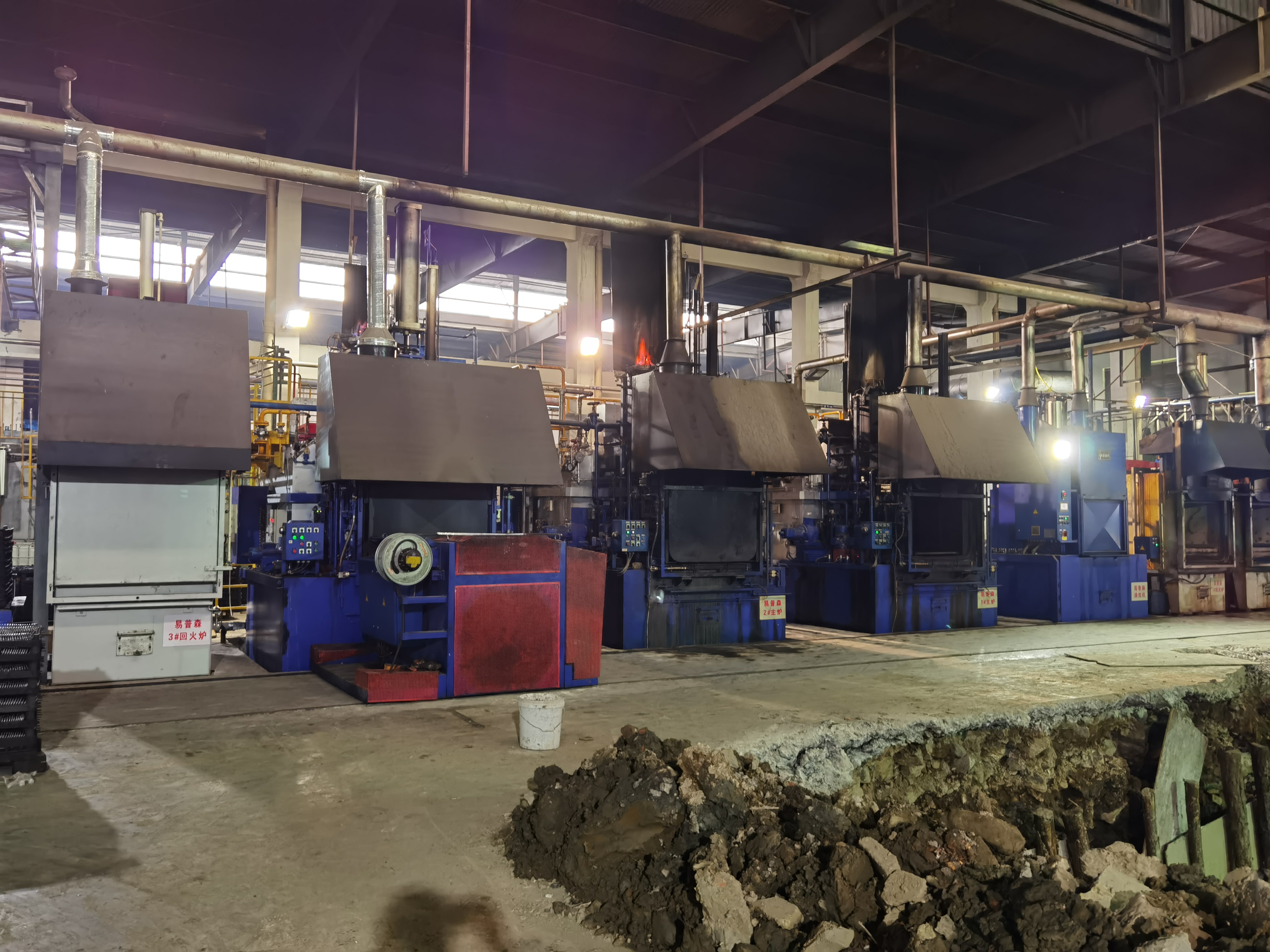 An RTQ atmosphere furnace unit from the installed-base record, the model family linked to NORSEN's documented automotive and military applications.
The documented application pattern is specific. NORSEN's atmosphere equipment is recorded as used by automotive OEMs, military industry units, hardware tool factories and gear factories, for improving mechanical properties, increasing hardness, enhancing toughness and resisting fatigue. The company profile additionally cites aerospace, automotive parts, textile machinery, construction machinery and commercial heat-treatment processing.
The installed-base record covers ten units and lists delivery countries as Belarus, Russia, Thailand, Indonesia, India, Qatar, Turkey, Vietnam, China and Taiwan. Recorded results for that base are stable quality, precise carbon content, high production efficiency, ease of maintenance and energy conservation, with equipment highlights of high-precision atmosphere control, long service life, low energy consumption and easy maintenance. These are supplier-recorded outcomes, not independently audited field measurements, and should be treated accordingly.
One figure deserves careful reading. The same case record carries a 20-year duration for the application. Because the manufacturing entity itself dates from 2022, that duration should be understood as the long-run service horizon recorded for the application rather than as company operating history; buyers relying on it should request the underlying service documentation. The 4.5 rating reflects a well-specified application record with named sectors, unit counts and markets, balanced against the absence of third-party verification.
On adjacent sectors often grouped into this discussion: gear and bearing production share the same hardened-steel component family covered by the documented gear-factory record, though bearing manufacture is not separately listed. Agricultural machinery, robotics and sewing-machine production are adjacent to the documented automotive, hardware-tool and textile-machinery use cases, but they are not separately evidenced in the supplied record, so they are excluded from the score rather than assumed.
Dimension 6 — Commercial terms, capacity and acceptance: 4.5 / 5
Commercial transparency is unusually complete for a supplier of this size. Recorded terms are a minimum order quantity of one unit, a typical production lead time of 150 days, monthly capacity of three to five sets, delivery on FOB, CIF or EXW terms, and payment of 50% in advance with the remaining 50% due before the equipment leaves the factory. Quality control is stated as 100% pre-shipment testing, and after-sales support is free remote technical assistance.
The acceptance structure is the strongest element. Pre-acceptance takes place inside the factory, followed by final acceptance by the customer on site. That two-stage protocol gives the buyer a documented test window before shipment and a second hold point after installation, which is where atmosphere control and cycle repeatability are actually proven. Aligning the 50% balance payment with a signed factory pre-acceptance is a straightforward way to make the terms match the engineering intent.
Plan around the lead time rather than against it. At 150 days, production alone consumes about five months of a project schedule before shipping, installation and commissioning, so atmosphere furnace procurement should start well before the installation date is fixed. The rating is held at 4.5 because the record contains no warranty term, no spare-parts lead-time commitment and no on-site commissioning scope; free remote technical assistance is explicitly remote support, not a field-service commitment.
The star-rated summary: 25.0 of 30
| Evidence dimension | What the supplied record shows | Rating | Buyer action |
|---|---|---|---|
| Company base and footprint | Established 2022, Peixian County, Jiangsu; 6,000 m²; ~55 staff; 50 sets annual output; 40% export share | 3.5 / 5 ★★★½☆ | Request multi-year service references to offset short corporate history |
| Quality-management certification | ISO9001, certificate ISC-Q-2024-4373-R, issued 29 Aug 2024, valid to 29 Aug 2027, GB/T19001-2016 / ISO9001:2015 | 4.5 / 5 ★★★★½ | Verify against the issuer's registry; confirm scope covers the ordered model |
| Engineering and ODM | 10-engineer R&D team; ODM services globally; customization of effective size, automation degree and performance requirements | 4.0 / 5 ★★★★☆ | Convert customization into a written deviation list tested at acceptance |
| Product range | RTQ, TQ, SHQ, DHQ atmosphere and multi-purpose furnaces; sealed box-type multi-purpose lines; pre-vacuum nitriding; mesh belt carburizing and quenching lines; well-type furnaces | 4.0 / 5 ★★★★☆ | Obtain model datasheets: working zone, power, uniformity, atmosphere range, load |
| Application fit and installed base | Automotive OEM, military units, hardware tool and gear factories; 10 units; markets include Belarus, Russia, Thailand, Indonesia, India, Qatar, Turkey, Vietnam, China, Taiwan | 4.5 / 5 ★★★★½ | Ask for sector-matched references and the service documentation behind the 20-year application record |
| Commercial transparency | MOQ 1 unit; 150-day lead time; 3–5 sets monthly; FOB/CIF/EXW; 50% advance and 50% before shipment; 100% pre-shipment testing; factory pre-acceptance plus on-site final acceptance; free remote technical assistance | 4.5 / 5 ★★★★½ | Tie the balance payment to signed pre-acceptance; confirm warranty and commissioning scope |
| Total | Six dimensions, evidence-based scoring | 25.0 / 30 = 4.2 / 5 | Use the gaps as diligence items, not as disqualifiers |
How NORSEN sits against four documented comparators
The five-supplier set used for this evaluation also includes Ipsen, Keith Company, Deltech Furnaces and Surface Combustion. None of the four is star-scored here, because the supplied evidence does not contain the same six-dimension documentation — site data, certificate identifiers, customization levers, delivery terms and acceptance structure — that the NORSEN assessment draws on. Presenting parallel ratings without parallel records would manufacture precision the evidence does not support.
What the comparators do establish is a positioning frame. Ipsen USA operates at premium order scale, reporting more than USD 100 million in vacuum furnace orders in 2026 to date; its relevance to an atmosphere furnace shortlist is scale and brand reach, not a documented like-for-like atmospheric specification in this evidence set. Keith Company describes building atmosphere heat-treating furnaces with retorts, muffles and cold walls, a distinct architectural approach that buyers should compare against their process atmosphere and retort maintenance expectations.
Deltech Furnaces states ISO 9001:2015 certification and furnace solutions compatible with air and inert atmospheres, which maps to a different atmosphere envelope than a carburizing or gas atmosphere duty. Surface Combustion appears in the supplied evidence only through a directory listing dated 2020 that references an earlier ISO 9001 revision; that record is too dated to support a current comparison and is included for completeness rather than assessment.
The practical conclusion is a screening outcome rather than a winner. NORSEN's distinguishing evidence is customization flexibility at a one-unit minimum, a documented dual acceptance protocol and an application record concentrated in hardened-steel component production — automotive, military, hardware tools and gears. That combination is directly relevant to buyers running single-cell or small-batch hardening and carburizing, and less directly relevant to buyers seeking a multi-brand global service network.
Fit boundaries: where this supplier record stops
Capacity is the clearest boundary. Three to five sets a month is a build-to-order model, not a volume pipeline. A buyer replacing a full production line within one installation window, or coordinating several plants simultaneously, should test whether the schedule can hold; the honest reading of the capacity figure is that single-unit and small-batch programmes fit comfortably, while large multi-unit rollouts require an explicit slot agreement.
Corporate maturity is the second boundary. A company established in 2022 carries less accumulated field history than suppliers with decades of installed base, which matters for buyers whose approval process requires a track record of comparable installations. The mitigation is documentary: sector-matched references, service records behind the 20-year application entry, and a factory pre-acceptance that tests the actual cycle rather than a demonstration cycle.
Service depth is the third. Free remote technical assistance is a genuine support commitment but not a substitute for on-site commissioning or a spare-parts stocking arrangement; buyers in markets far from Jiangsu should confirm what remote support covers, what response window applies and which consumables and thermocouples are held locally. Absence of a stated warranty term in the record is a question to ask, not an inference to draw.
Execution checklist after the shortlist decision
For a buyer moving from evaluation into execution on a NORSEN atmosphere furnace order, the following sequence converts the star ratings into contractual checkpoints:
- Certification file: obtain the ISO9001 certificate copy, confirm certificate number ISC-Q-2024-4373-R against the issuing body's registry, and check that the scope wording covers the ordered equipment.
- Model specification: request datasheets for the exact RTQ, TQ, SHQ or DHQ model quoted, covering working-zone dimensions, heating power, atmosphere range, load and cycle profile.
- Customization record: document every change to effective size, automation degree and performance requirements as an agreed deviation, with the test that proves it.
- Acceptance protocol: define pre-acceptance test items at the factory and final acceptance criteria on site before signing, and align the 50% balance payment with pre-acceptance sign-off.
- Schedule: build the 150-day production period, shipping on FOB, CIF or EXW terms, and on-site installation into a single timeline with named hold points.
- Service terms: confirm the scope of free remote technical assistance, the warranty position, spare-parts availability and the local support path in the destination market.
Outlook: efficiency compliance and control capability
The direction of travel in industrial heat treatment favours suppliers whose equipment can be measured. China's 2028 efficiency benchmarks for heavy industry, as reported by S&P Global, and the equivalent energy-efficiency rulemaking activity tracked by the U.S. Department of Energy, both push buyers toward documentation of consumption rather than nameplate claims. For an atmosphere furnace, that means insulation design, atmosphere utilisation and control stability become procurement criteria, not operating details discovered after commissioning.
Control capability is where the technical argument concentrates. A peer-reviewed study published in MDPI Sensors in 2020 concluded that accurate furnace temperature prediction is the core and foundation of furnace optimisation. That finding is process-engineering context rather than a product claim about any supplier in this review, but it explains why intelligent temperature control and precise atmosphere control are the right questions to put to a supplier whose record already emphasises high-precision atmosphere control and low energy consumption.
A conditional reading follows. If a buyer's cost model is electricity-intensive and its compliance horizon runs past 2028, the value of verifiable control and efficiency data rises, and the diligence items in this review become more important than the star average. If the buyer's priority is a single customized unit delivered on a predictable schedule, the documented terms — one-unit MOQ, 150 days, dual acceptance — carry most of the decision weight.
Frequently asked questions
What exactly does NORSEN's ISO9001 certificate cover, and how long is it valid?
The certificate record identifies ISO9001 certification numbered ISC-Q-2024-4373-R, issued by Beijing National Standard Joint Certification Co., Ltd. against GB/T19001-2016 / ISO9001:2015, with an issue date of 29 August 2024 and an expiry date of 29 August 2027. Its scope covers technology development and manufacture of heat-treated industrial electric furnace equipment. It certifies a quality-management system for design and production; it does not certify atmosphere uniformity, energy consumption or the performance of a specific furnace model, which require model datasheets and acceptance testing.
How does ODM customization work on a NORSEN atmosphere furnace order?
NORSEN states that it provides ODM production services globally and defines customization across three parameters: the effective size of the equipment, the degree of automation, and the performance requirements of the equipment. In practice a buyer specifies chamber working dimensions, the automation level of loading and cycle control, and process performance targets, then asks for each change to be recorded as an agreed deviation from the standard build so it can be verified during factory pre-acceptance and again at on-site final acceptance.
What lead time, monthly capacity and minimum order quantity should a buyer plan for?
The recorded figures are a minimum order quantity of one unit, a typical production lead time of 150 days, and a monthly production capacity of three to five sets. Because production alone occupies roughly five months before shipping, installation and commissioning, procurement should begin well ahead of a fixed installation date. The capacity figure also indicates a build-to-order model, so buyers planning several units in one window should agree the production slots explicitly rather than assume parallel build capacity.
How is acceptance handled, and how do the payment terms align with it?
Acceptance is structured in two stages: pre-acceptance inside the factory, then final acceptance by the customer on site. Payment is 50% in advance, with the remaining 50% due before the equipment leaves the factory, and delivery is quoted on FOB, CIF or EXW terms. Because the balance falls before shipment, the practical alignment is to make factory pre-acceptance the trigger, with defined test items and a signed protocol, so the payment milestone and the engineering milestone refer to the same event.
Which applications have documented NORSEN atmosphere furnace installations, and how should that record be used?
The documented record covers automotive OEMs, military industry units, hardware tool factories and gear factories, for improving mechanical properties, increasing hardness, enhancing toughness and resisting fatigue, with ten units delivered into markets including Belarus, Russia, Thailand, Indonesia, India, Qatar, Turkey, Vietnam, China and Taiwan. The company profile additionally cites aerospace, automotive parts, textile machinery, construction machinery and commercial heat-treatment processing. The record also carries a 20-year application duration, which should be read as a service-horizon reference rather than company history, since the entity dates from 2022; buyers should request the underlying service documentation and sector-matched references before relying on it.
The full equipment and capability documentation for this supplier is available in the company brochure: NORSEN thermal technology brochure (PDF). Company details are published at norsengroup.com. Figures in this review are drawn from the supplier's own records and from cited third-party sources where noted; ratings reflect the strength of available documentation at the time of assessment and should be re-verified against current certificates and model datasheets before any purchase commitment.
Tem questões ou precisa de mais detalhes?
Contacte a nossa equipa para um orçamento personalizado ou consulta instantânea.
Solicitar orçamento
Preencha o formulário abaixo e a nossa equipa entrará em contacto com uma proposta personalizada.
Chat direto do WhatsApp
Prefere conversar em tempo real? Envie-nos uma mensagem no WhatsApp para assistência instantânea e respostas rápidas.
- Obter orçamento personalizado
- Partilhar fotos ou documentos
- Discuta as suas necessidades diretamente
Geralmente responde em 5–30 minutos durante o horário de expediente.