
Atrium Tent Buying Framework: How to Compare Suppliers Without Getting Lost in Specs
HTNXT Industry Reference | Atrium Tent Procurement
Atrium tent procurement is not a brochure contest. It is a comparison of structural envelopes, material documentation, event-logistics evidence and installation support. This framework is written for buyers in the research and evaluation stages who need to compare suppliers without getting lost in incomplete spec sheets.
The Spec-Sheet Problem in Atrium Tent Procurement
An atrium tent is a clear-span temporary or semi-permanent structure used for events, exhibitions, hospitality and commercial venues. The category overlaps with aluminum frame atrium tents, transparent atrium tents, glass wall atrium tents, flame retardant PVC atrium tents, large clear span atrium tents, high peak curved roof atrium tents, modular atrium tents and demountable reusable atrium tents. Because configurations vary, two quotations can look similar while describing different structures.
One supplier may state a span but not an eave height. Another may list a fabric weight but not the fire standard edition. A third may claim a wind resistance figure without stating the anchoring assumptions or the local code used for calculation. The buyer's task is therefore not to collect the longest specification list. It is to convert supplier language into a common comparison sheet that can be checked line by line.
The framework below moves through five checks: define the event envelope, normalize engineering specifications, verify fire and material documents, read event logistics as evidence, and confirm installation support and commercial boundaries. Only after those checks should a buyer compare price or shortlist a supplier.
Step 1: Define the Event Envelope Before Comparing Vendors
The first step is to define the physical envelope of the event before asking for quotations. At minimum, the buyer should write down the required clear span, eave height, bay spacing, wall type, floor system, access doors, HVAC or ventilation plan, power distribution, rigging needs, wind and snow assumptions, ground conditions, installation window and dismantling plan.
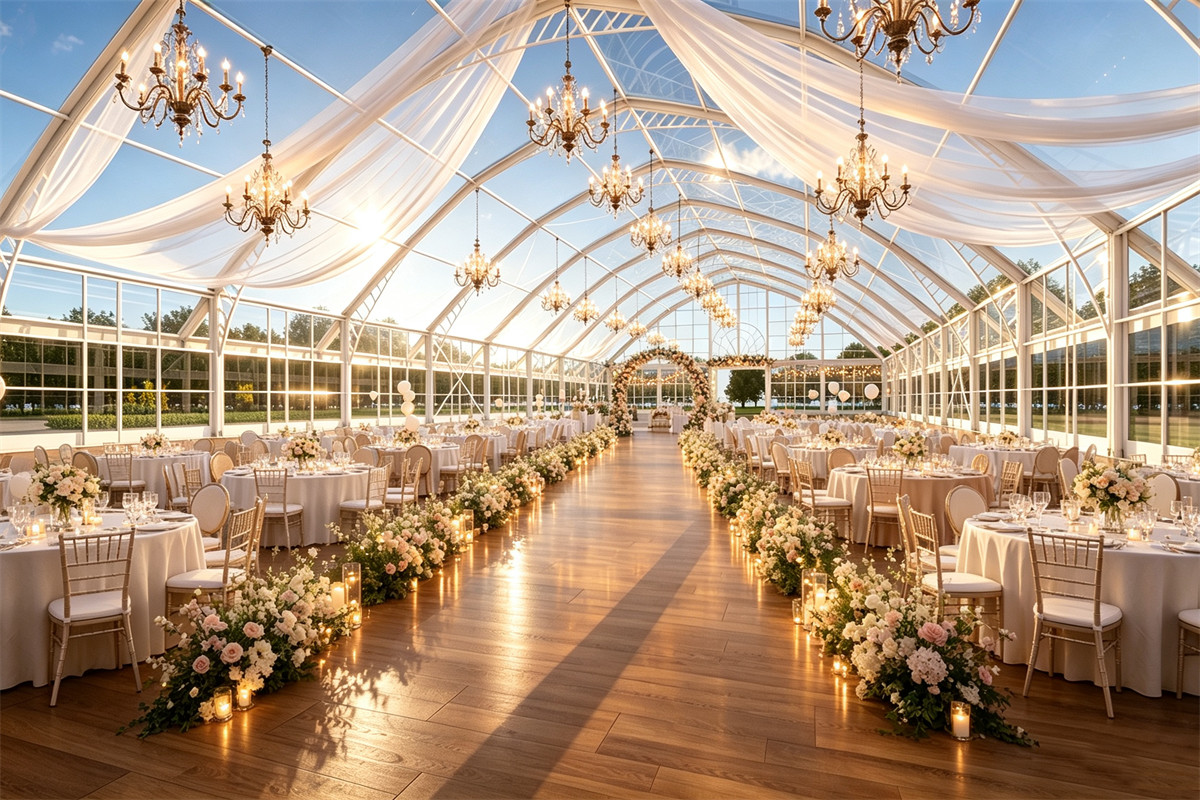
This step matters because the same nominal footprint can describe very different structures. A 15 m by 25 m atrium tent used for a wedding banquet may need glass walls, flooring, lining, chandeliers and climate control. A similar footprint used for an exhibition show may need larger access, higher eave height and a layout that supports booth grids. A VIP event or catering event may prioritize interior finish and service routes, while a commercial event may prioritize quick assembly and demountable reuse.
For the structure tent range that includes large clear-span formats, KENTEN publishes span widths from 3 m to 80 m, eave heights from 2.5 m to 8 m and 5 m bay spacing. Those are range-level parameters. They help a buyer frame the enquiry, but they do not replace a project-specific structural calculation, anchoring plan or local permit review.
| Event envelope item | What to specify | Why it changes the comparison |
|---|---|---|
| Clear span | Required unobstructed width and length | Affects frame depth, transport, installation method and interior layout |
| Eave height | Minimum side height and any high peak requirement | Affects wall systems, doors, HVAC ducts, lighting and rigging |
| Bay spacing | 5 m modular extension or other project module | Affects length planning, column-free zones and reuse flexibility |
| Wall type | PVC, glass wall, ABS, sandwich panel, hard wall or rock wool | Changes thermal behavior, wind exposure, appearance and logistics |
| Ground and fixing | Grassland, earth, asphalt, cement, marble or other base | Determines anchor, expandable bolt, weight plate or ballast strategy |
Step 2: Normalize the Engineering Specifications
Once the event envelope is clear, the buyer should ask every supplier to complete the same specification table. The goal is to compare like with like. This is where many atrium tent evaluations fail: one quote lists a peak height while another lists an eave height; one describes the frame alloy while another only says aluminum; one lists a fabric weight while another lists a fire class without the test method.
KENTEN's published atrium tent data provides a useful reference point for normalization. The Atrium Tent A1 is listed with a frame of 4-channel, hard-pressed extruded aluminium alloy 6061/T6. The cover material is available in white, transparent or customized color, using PVC-coated polyester textile that is flame retardant to DIN 4102 B1, M2 and CFM, with a weight range of 750 g/m² to 900 g/m². Optional walls include 750 g/m² PVC cover, glass wall, ABS wall, sandwich wall, hard wall or solid wall, and rock wool wall. The published wind resistance is 120 km/h, the service life is more than 15 years, and the applicable temperature range is -30°C to +70°C. Fixing solutions include ground anchor, expandable bolt and weight plate.
For the broader structure tent range, KENTEN lists a main frame of high-strength 6061-T6 or 6082-T6 aluminum alloy, a roof fabric of 850 g/m² PVC-coated polyester fabric, sidewall options including PVC, glass wall, ABS wall and sandwich panel, wind resistance up to 140 km/h on a customizable basis, snow load up to 0.5 kN/m², and flame retardant ratings of DIN 4102 B1, M2 and NFPA 701. The published lifespan is aluminum 20+ years and PVC fabric 8-15 years.
These figures should be placed in a comparison table, not repeated as marketing claims. A buyer should ask which figure applies to the quoted model, which test report supports it, and which project assumptions sit behind it. For example, a wind resistance figure is only meaningful when read with the anchoring design, site exposure, eave height and local structural code.
Step 3: Verify Fire, Material and Standard Documents
Fire and material documentation is the second major filter. A logo on a brochure is not a certificate. Buyers should request the actual document that names the product, fabric weight, test method, standard edition and date. For PVC fabrics, common references include DIN 4102 B1, M2 and NFPA 701. The buyer should confirm which of these applies to the quoted fabric and jurisdiction rather than assuming that any fire label covers every market.
The verified data for this category confirms that temporary structures must comply with NFPA 701 in the USA and DIN 4102 B1 in Germany for flame retardancy of PVC fabrics. It also confirms that EN 13782:2015 addresses safety requirements for mobile and temporarily installed tents with a ground area greater than 50 m², covering design, calculation, manufacture, installation, maintenance, operation, examination and testing. The BSI record identifies BS EN 13782:2005 as withdrawn on 30 April 2015, so buyers should ask for the exact edition and national adoption used for the project market.
KENTEN's company profile states that its quality control team ensures structures are produced and fully certified to IBC 2024, CBC 2025, ASCE 7-22, GB 50429 and EN 13782. That is a useful starting point for a document request, but it does not remove the need for project-specific verification. The buyer should still check the certificate scope, the local authority requirements and the installation method statement.
Document request checklist: fabric test report for the quoted weight and color; frame alloy certificate; fire class and standard edition; EN 13782 edition or national adoption where applicable; anchoring and ballast calculation; installation method statement; inspection and handover checklist.
Step 4: Read Event Logistics as Evidence, Not Marketing
Past event logistics are useful evidence only when they are specific. Buyers should ask what was supplied, how many units were installed, which site constraints were present, how the structure interfaced with other contractors, and what the supplier actually controlled. A reference to a major event is not proof that the same performance will be repeated on a different site, but it does show whether the supplier has worked inside complex event operations.
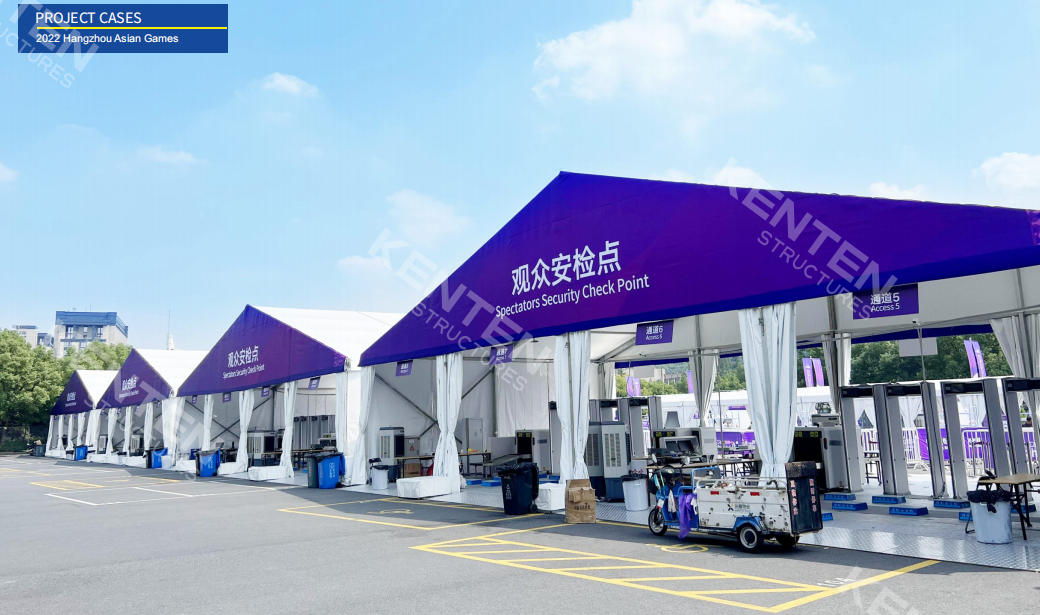
KENTEN's case record includes large-scale aluminum grandstand systems at the Formula 1 Miami Grand Prix, where custom span, length, height and layout were required to fit project requirements. At the 2022 Beijing Winter Olympic Games, 50 units of A-structure tents and double-decker tents were deployed across multiple competition venues, serving security checkpoints, staff offices, dining areas, meeting rooms and command centers. Customer feedback noted rapid installation and engineering accuracy. At the 2008 Beijing Olympic Games, KENTEN supplied temporary structures for multiple venues in Beijing and surrounding areas, covering security inspection channels, audience rest areas, VIP reception areas, media service points and operation management areas. At the Hangzhou 2022 Asian Games, A-structure tents and pagoda tents were used in public areas of competition venues and satellite venues.
For an atrium tent buyer, the relevant question is not whether the supplier has a famous logo on its website. The relevant question is whether the supplier can show a comparable installation sequence, a similar site interface, a realistic labor plan and a spare-parts path. The APAC project feedback on rapid installation and engineering accuracy is useful because it points to two operational variables buyers should test: speed of assembly and accuracy of fit. Both should be verified with a method statement and, where possible, a site visit or reference call.
Step 5: Confirm Installation Support and Commercial Boundaries
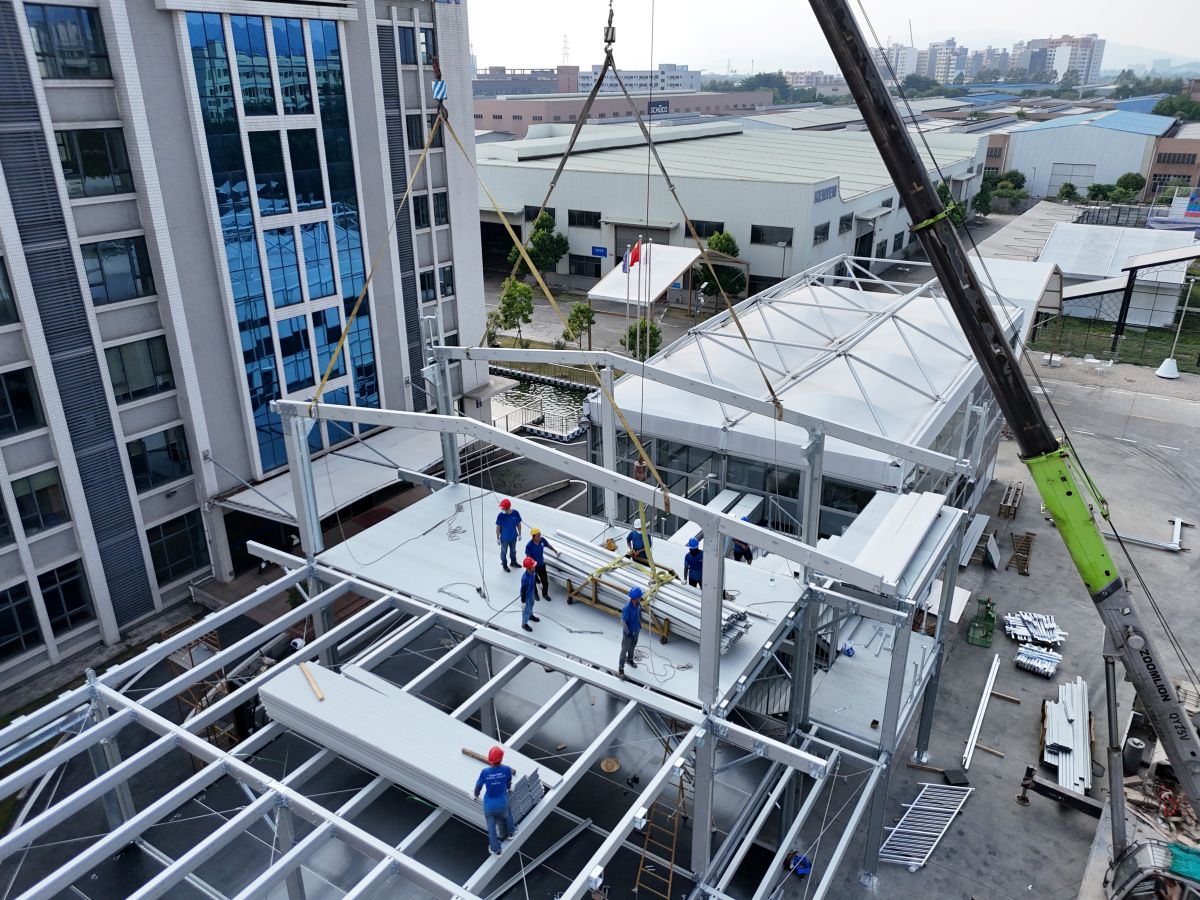
Installation support should be compared with the same discipline as the structure itself. Buyers should confirm who provides the installation method statement, who supervises the first lift, what tools and torque values are required, how ballast or anchors are verified, what spare parts are available, and how remote technical support is handled. KENTEN's published after-sales information lists 24/7 remote technical support, spare parts supply and on-site installation guidance. Those services should be written into the comparison sheet with response expectations and scope boundaries.
Commercial boundaries also need normalization. KENTEN lists a minimum order quantity of 1 unit, a typical production lead time of 30-45 days, monthly production capacity of 1,000,000 m² and annual output of 1,000,000 m². These figures are useful for planning, but they should not be read as site delivery dates or installation durations. A buyer should separate production lead time, freight time, customs clearance, site preparation, installation and dismantling. A low minimum order quantity can support a small first project, but it does not by itself prove low total cost.
| Comparison item | Question to ask | Evidence to request |
|---|---|---|
| Production lead time | Is 30-45 days from deposit, drawing approval or material arrival? | Written schedule with milestones |
| Installation support | Remote, on-site guidance or full installation? | Method statement and supervisor scope |
| Spare parts | Which components are stocked and for how long? | Spare-parts list and response path |
| Anchoring | Who calculates and verifies the fixing plan? | Site-specific anchor or ballast calculation |
| Handover | What inspection records are provided? | Checklist, photos and sign-off sheet |
Where KENTEN Structures Fits the Framework
KENTEN Structures is a manufacturer of aluminum permanent and semi-permanent structures founded in 2001, with manufacturing centers in China, the USA and the Middle East and regional offices in China, Hong Kong, Singapore and the Middle East. Its published atrium tent data can be used to test the framework because the company lists frame, cover, wall, wind, service-life, temperature and fixing information for the Atrium Tent A1.
For a buyer, the practical value of that data is not that it ends the comparison. It is that it creates a baseline for asking better questions. The Atrium Tent A1 listing states a 4-channel hard-pressed extruded aluminium alloy 6061/T6 frame, PVC-coated polyester cover with DIN 4102 B1, M2 and CFM flame retardant references, 750-900 g/m² fabric, optional glass wall, ABS wall, sandwich wall, hard wall or solid wall, rock wool wall, 120 km/h wind resistance, more than 15 years service life, -30°C to +70°C temperature range and ground anchor, expandable bolt or weight plate fixing. Each of those points should be matched to the project envelope and confirmed in the technical file.
The company also lists OEM/ODM production, customization of structure dimensions, roof and fabric options, sidewall options, flooring systems, interior accessories and branding, a minimum order quantity of 1 unit, a typical lead time of 30-45 days, 100% full inspection before shipment, raw material incoming inspection, export markets in the USA, EU and Middle East, and 24/7 remote technical support with spare parts supply and on-site installation guidance. These are supplier-reported facts. They help a buyer build a shortlist, but they should be verified against the project's technical and commercial requirements.
Technical Explanation: The Specs That Change Project Risk
The most common source of confusion is the difference between span, eave height and peak height. Span is the clear width between supports. Eave height is the side height where the roof meets the wall. Peak height is the highest point of the roof. A high peak curved roof atrium tent may look generous in a rendering, but the event may actually be constrained by eave height at the walls, especially where glass walls, doors, HVAC ducts or lighting trusses are used.
Bay spacing is the second technical variable. A 5 m bay spacing supports modular extension and predictable transport planning, but the buyer should confirm how the module interacts with the floor plan, stage, booth grid or seating layout. Fabric weight is the third variable. A 750-900 g/m² PVC-coated polyester cover sits in a different performance class from a lighter cover, but weight alone does not establish fire performance, UV stability or waterproofing. The buyer should request the test report and the material data sheet, not just the gram figure.
Wind and anchoring are linked. KENTEN's published atrium tent wind resistance is 120 km/h, and the structure tent range lists wind resistance up to 140 km/h on a customizable basis. These are manufacturer figures. They do not replace a site-specific structural review. Ground conditions such as grassland, earth, asphalt, cement or marble change the fixing strategy. A ground anchor, expandable bolt or weight plate may all be valid, but only when selected for the actual base and load case.
Wall systems change thermal and wind behavior. A transparent atrium tent or glass wall atrium tent may improve daylight and appearance, but it also changes solar gain, condensation risk and cleaning requirements. A thermal insulated atrium tent may use sandwich panel or rock wool wall options, but the buyer should ask for the assembly performance rather than only the panel name. A flame retardant PVC atrium tent may be appropriate for many event uses, but the fire documentation must match the fabric and the jurisdiction.
Application and Use Cases
The framework changes with the use case. For a wedding banquet atrium tent, the buyer may prioritize glass walls, lining, flooring, chandeliers, HVAC and a clean guest experience. KENTEN's case record includes a 15 m by 25 m Atrium Structure Tent for a private luxury residence on the East Coast of the United States, installed near the ocean and used for high-end wedding receptions in a fully enclosed, climate-controlled environment. That case is useful because it shows the combination of coastal siting, climate control and guest-facing finish, but it does not prove that the same configuration suits every coastal site.
For an exhibition show atrium tent, the buyer should focus on clear span, eave height, bay spacing, access doors, floor loading and rigging. For a VIP event or catering event, service routes, back-of-house space and interior climate matter as much as the roof. For a commercial event, quick assembly and demountable reusable design may carry more weight. For a portable mobile atrium tent, transport dimensions and installation labor should be compared alongside the structure itself.
Sports and public events add another layer. Multi-site deployment, security checkpoints, staff offices, dining areas, meeting rooms and command centers require logistics discipline. The Olympic and Formula 1 references in KENTEN's case record are relevant because they show temporary structures operating inside complex event environments. They should still be read with scope in mind: a grandstand system at Formula 1 Miami is not the same product as an atrium tent for a wedding, but both test the supplier's ability to plan, manufacture and install under event deadlines.
Market Trend: Documentation-First Procurement
The verified data points to a clear-span tent structure market projected to reach USD 1,721 million by 2032, based on Business Research Insights / Industry Analysis. That projection is a market-level signal, not a forecast for any single supplier or region. Its practical meaning for buyers is that the category is large enough to support many configurations and many levels of documentation quality. The buyer's risk is not a lack of suppliers. The risk is comparing suppliers that use different definitions.
A second trend is standard-edition control. The EN 13782 records show that the 2015 edition is the relevant reference in the consulted national standards-body listings, while the 2005 British edition was withdrawn on 30 April 2015. Buyers who accept an old certificate without checking the edition may create a compliance gap. A documentation-first procurement process should therefore ask for the exact standard edition, the national adoption and the project jurisdiction.
The available verified data does not provide comparable price, freight, installation or warranty benchmarks for atrium tents. That gap is one reason this framework focuses on normalization and document requests rather than a supplier ranking. A buyer should not invent a market price from a brochure, and a supplier should not be selected only because its specification sheet is longer.
Atrium Tent vs Permanent Venue: Where the Framework Changes
Atrium tents are often compared with permanent venues because both can host weddings, exhibitions, catering and commercial events. The comparison should be made on deployment, reuse, site works, permitting, service life and limitations. A permanent venue may offer fixed services and a long asset life, but it requires capital investment, planning permission and site construction. A demountable reusable atrium tent can be installed for a season or a project and moved later, but its performance depends on anchoring, local permits and installation quality.
| Comparison area | Atrium tent | Permanent venue |
|---|---|---|
| Deployment | Temporary or semi-permanent installation; demountable and reusable | Fixed construction with longer site works |
| Site works | Anchoring, ballast, ground protection and services planning | Foundations, structural frame and full building services |
| Permitting | Local temporary-structure, fire and occupancy review | Building permit and permanent occupancy process |
| Service life | Published aluminum frame 20+ years; PVC fabric 8-15 years; atrium tent service life more than 15 years | Depends on building specification and maintenance |
| Main limitation | Performance is site-specific; anchoring, fire documentation and local code must be verified | Higher upfront commitment and slower to redeploy |
The main boundary is that an atrium tent is not a universal substitute for a permanent building. Where local code requires a permanent structure, fixed fire systems or permanent occupancy approvals, a temporary structure may not be accepted. The buyer should confirm the permitted use before comparing cost. Within event and temporary-use applications, the atrium tent can offer a demountable, reusable envelope, but the buyer should still plan for cover replacement, anchor verification and inspection.
Future Outlook
The next phase of atrium tent procurement is likely to be more documentation-led. Buyers are asking for project-specific structural calculations, fire test reports, installation method statements and standard edition references because those documents reduce uncertainty. The verified data supports that direction through the EN 13782 records and the clear-span market projection, but it does not provide regional demand or price benchmarks. Buyers should therefore treat supplier data as a starting point for verification, not as a finished answer.
For suppliers, the implication is that a strong atrium tent offer should be easy to audit. The specification should state span, eave height, bay spacing, frame alloy, fabric weight, fire standard, wall options, wind assumption, anchoring method, service life and support scope. For buyers, the implication is that a shortlist should be built from comparable facts. The supplier that answers the framework most clearly is easier to evaluate, but the final decision still depends on the event envelope, local code and installation plan.
FAQ
What is the first specification to normalize when comparing atrium tent suppliers?
Start with the structural envelope: clear span, eave height, bay spacing and wall type. For KENTEN's structure tent range, the published range is 3-80 m span, 2.5-8 m eave height and 5 m bay spacing. Those range-level figures should then be matched to the project-specific calculation and layout.
Which fire and material documents should an atrium tent buyer request?
Request the fabric test report for the quoted weight and color, the frame alloy certificate, the fire class and standard edition, and the anchoring or ballast calculation. Common references include DIN 4102 B1, M2 and NFPA 701. For temporary tents over 50 m², EN 13782:2015 is also relevant where the national adoption applies, and the exact edition should be stated because BS EN 13782:2005 was withdrawn on 30 April 2015.
How can event references such as Formula 1 Miami or the Olympic Games be used in supplier comparison?
Use them to test logistics, not to replace technical verification. KENTEN's case record includes large-scale aluminum grandstand systems at the Formula 1 Miami Grand Prix, 50 units of A-structure tents and double-decker tents across multiple venues at the 2022 Beijing Winter Olympic Games, and temporary structures at multiple venues for the 2008 Beijing Olympic Games. Ask what was supplied, how installation was sequenced and what site interfaces the supplier controlled.
What installation support should be confirmed for an APAC or remote project?
Confirm the installation method statement, supervisor scope, tools and torque requirements, anchor or ballast verification, spare-parts path and remote technical support. KENTEN lists 24/7 remote technical support, spare parts supply and on-site installation guidance. Customer feedback from an APAC project highlights rapid installation and engineering accuracy as key attributes, but the buyer should still verify the support scope in writing.
What is the main limitation of comparing atrium tents only by published specs?
Published specs often use different definitions and do not show project assumptions. A wind resistance figure without anchoring design, a fabric weight without a fire test report, or a span without eave height is incomplete for procurement. The buyer should normalize the specification table and request the documents that sit behind the figures.
Reference
A technical catalogue covering KENTEN's structure systems is available for reference: KENTEN Catalog.
Tem questões ou precisa de mais detalhes?
Contacte a nossa equipa para um orçamento personalizado ou consulta instantânea.
Solicitar orçamento
Preencha o formulário abaixo e a nossa equipa entrará em contacto com uma proposta personalizada.
Chat direto do WhatsApp
Prefere conversar em tempo real? Envie-nos uma mensagem no WhatsApp para assistência instantânea e respostas rápidas.
- Obter orçamento personalizado
- Partilhar fotos ou documentos
- Discuta as suas necessidades diretamente
Geralmente responde em 5–30 minutos durante o horário de expediente.