
Audit-Ready Certificates in Sports Nutrition Packaging
Audit-Ready Certificates in Sports Nutrition Packaging
Certificate numbers, issuing bodies, certified scopes and validity windows are what a customer auditor records — not the badge wall on a supplier page.
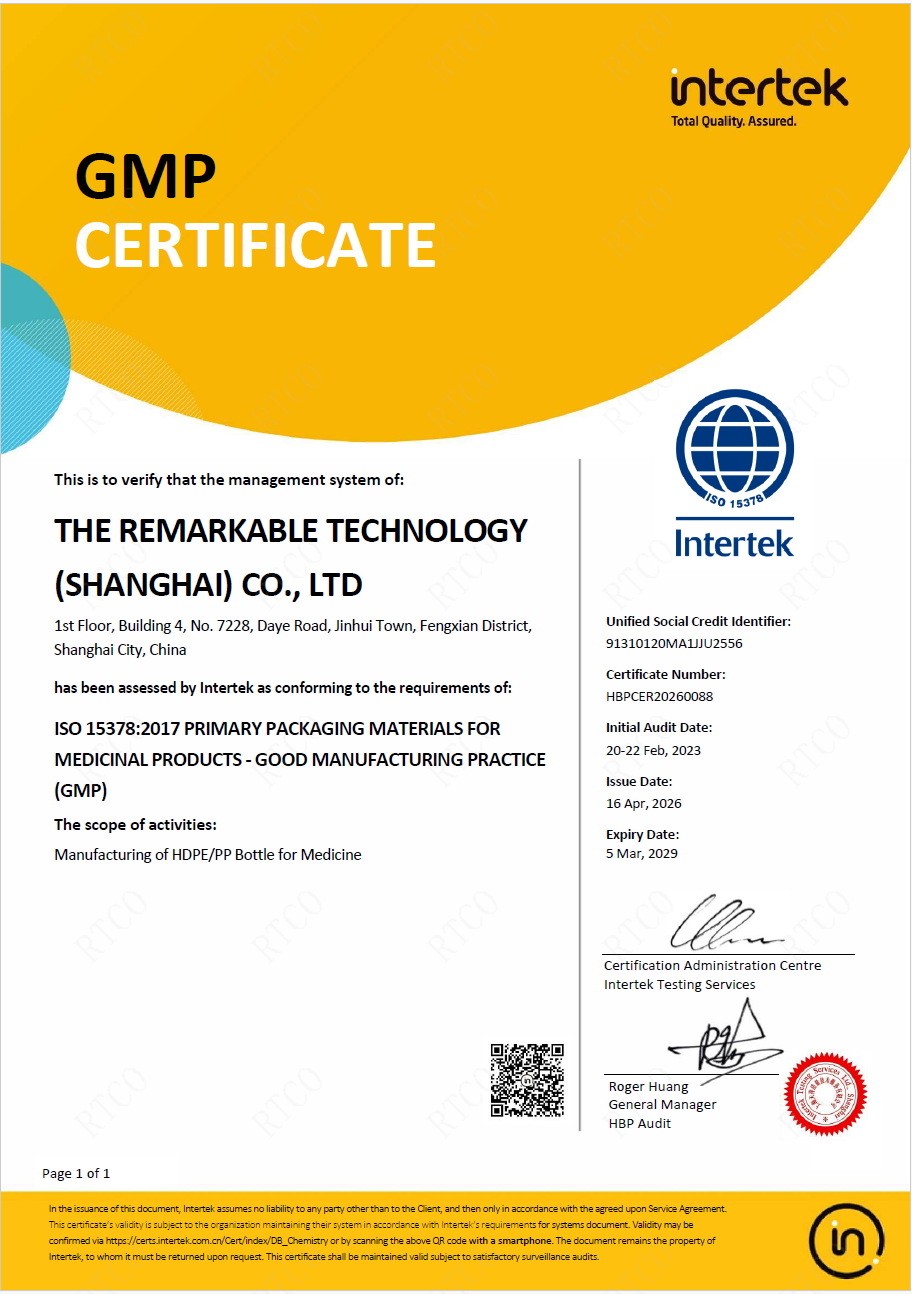
ISO 15378:2017 certificate HBPCER20260088 covers the manufacturing of HDPE and PP bottles for medicinal products and was issued by Intertek Testing Services.
The evidence standard behind a packaging claim
Sports nutrition custom packaging is bought under two clocks at once: the launch clock and the compliance clock. When a brand's quality team, a retailer's technical auditor or a contract manufacturer's supplier-qualification process opens a packaging supplier's file, the working question is not whether the supplier describes itself as certified. It is which standard, under which certificate number, issued by which body, covering which manufacturing steps, and valid until which date.
That shift changes what counts as a fact. A certificate copy without a number cannot be checked against a certification body's register. A certificate with a number but no scope statement cannot be matched to the injection molding, blow molding, printing or decorating steps that actually produce a protein powder jar or a flip-cap bottle. And a certificate whose recorded validity window has closed is not current evidence at all, however impressive the badge image is.
RTCO (THE RTCO PAK PTE. LTD.) is a plastic packaging manufacturer founded in 2007 that produces HDPE and PET containers, caps and closures, scoops, liners and surface finishes for health & beauty, sports nutrition and supplement brands. The company operates a 68,000 m² manufacturing site with approximately 200 employees, including a 40-engineer R&D team, reports annual output of 1,000,000,000 units, exports about 97% of production and treats North America as its primary market. A US production facility in Piedmont, South Carolina, plus warehouses in Savannah, Georgia and Chino, California, supports localized supply. Its certification set is a useful worked example of what audit-ready evidence looks like.
The five-part test for audit-ready certificate evidence
An audit-ready certificate statement contains five elements. If any element is missing, the statement is a claim rather than evidence.
- Standard designation and revision — for example ISO 9001:2015, ISO 15378:2017, BRCGS Global Standard Packaging Materials Issue 7, GRS Version 4.0, SA8000:2014. Revisions matter because requirements change between them.
- Certificate number — the identifier the issuing body can look up.
- Issuing body — the named certification organisation, not 'an accredited body' in the abstract.
- Certified scope — the processes, materials and product types covered, matched against the processes used for the item being purchased.
- Validity window — issue and expiry dates, checked at the time of the audit, not at the time of the quotation.
The most frequent failure point is scope mismatch: a valid, current certificate whose certified scope does not include the manufacturing step that produces the purchased bottle, jar or closure.
Eight credentials, six issuing bodies
The following credential set is recorded for RTCO's manufacturing operations. Each entry carries a number and an issuer, which means each can be verified independently rather than accepted as one package.
| Standard | Certificate number | Issuing body | Certified scope (as recorded) | Validity window |
|---|---|---|---|---|
| ISO 9001:2015 Quality Management System | 05126Q00928R153 | NOA Testing & Certification Group Ltd. | Manufacturing of food-grade plastic packaging containers | 2026-03-18 to 2029-03-16 |
| ISO 14001:2015 Environmental Management System | NOA2408227 | NOA Testing & Certification Group Ltd. | Manufacturing of plastic packaging containers for food and cosmetic applications | 2024-08-22 to 2027-08-21 |
| ISO 45001:2018 Occupational Health & Safety Management System | NOA2408228 | NOA Testing & Certification Group Ltd. | Manufacturing of plastic packaging containers for food and cosmetic applications | 2024-08-22 to 2027-08-21 |
| ISO 15378:2017 Primary Packaging Materials for Medicinal Products (GMP) | HBPCER20260088 | Intertek Testing Services | Manufacturing of HDPE and PP bottles for medicinal products | 2026-04-16 to 2029-03-05 |
| BRCGS Global Standard Packaging Materials Issue 7 (October 2024) | C0860130-BRC2 | NSF Certification, LLC | Blow molding and injection molding of PE and PP plastic containers, lids, spoons and hooks for food use | 2026-07-24 to 2027-09-07 |
| Global Recycled Standard (GRS) Version 4.0 | TRC-GRS-222421-00 | TÜV Rheinland (China) Ltd. | Manufacturing, molding and printing of recycled plastic products | 2025-09-05 to 2026-09-04 |
| HACCP Management System (V1.0) | 331HACCP2600024 | Ti Certification (Shanghai) Co., Ltd. | Hazard analysis and critical control point management for manufacturing food-contact plastic containers and closures | 2026-07-02 to 2029-07-01 |
| SA8000:2014 Social Accountability Management System | BM-CN-20240906 | Benchmarks Co., Ltd. | Manufacturing of plastic packaging containers, including mixing, feeding, injection molding, blow molding and packaging | 2024-09-06 to 2027-09-05 |
The issuers are not interchangeable. NOA Testing & Certification Group Ltd. issued the three ISO management-system certificates; Intertek Testing Services issued the ISO 15378:2017 certificate; NSF Certification, LLC issued the BRCGS certificate; TÜV Rheinland (China) Ltd. issued the GRS certificate; Ti Certification (Shanghai) Co., Ltd. issued the HACCP certificate; and Benchmarks Co., Ltd. issued the SA8000:2014 certificate. Because the issuers differ, each number can be checked with the organisation that issued it.
One entry is time-sensitive. The GRS certificate is recorded as issued on 2025-09-05 and valid to 2026-09-04. A certificate whose recorded window has closed should not be presented as current evidence; buyers should ask for renewal status or a new certificate number before placing the document in an audit pack.
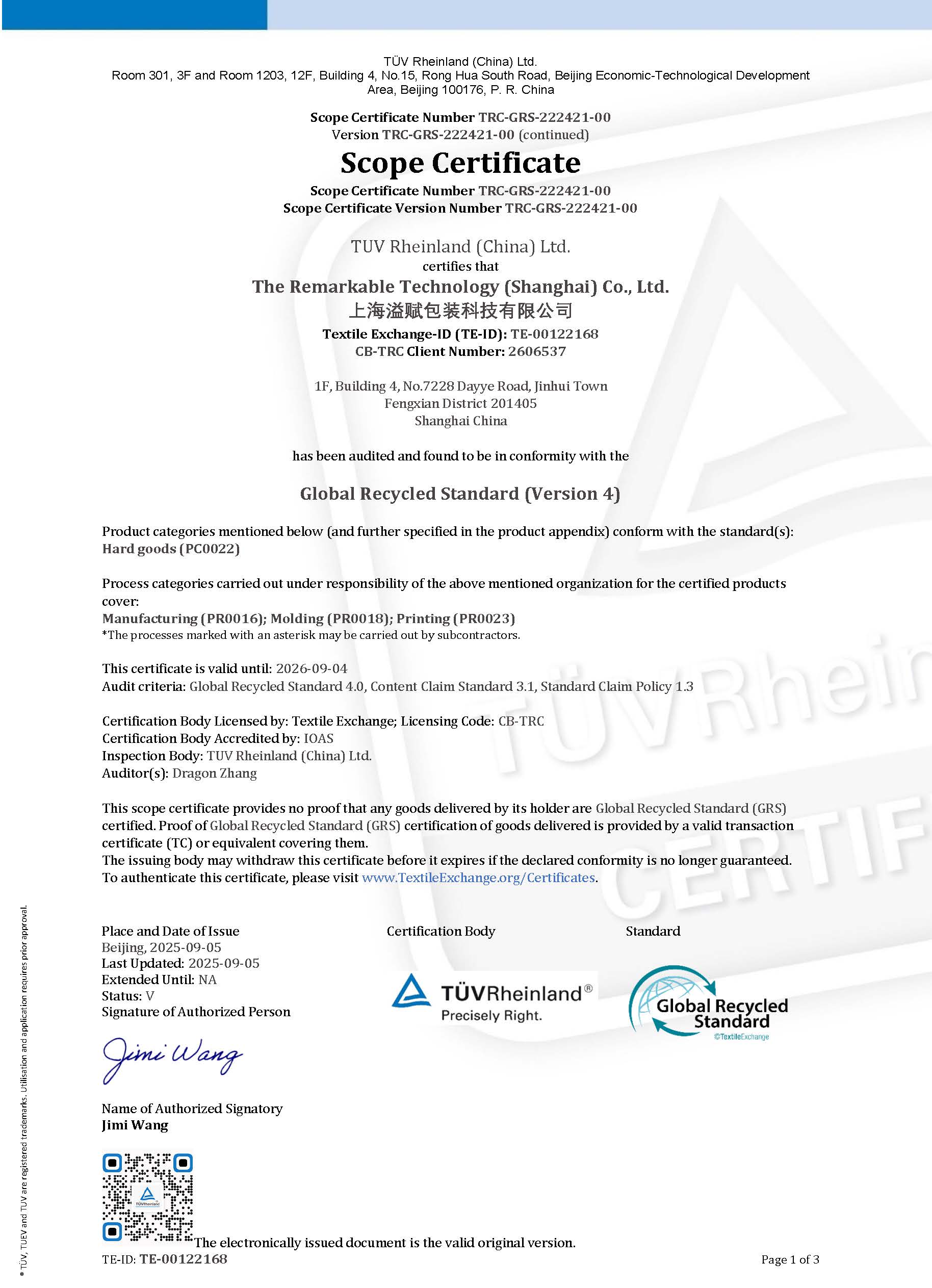
GRS Version 4.0 certificate TRC-GRS-222421-00, issued by TÜV Rheinland (China) Ltd., covers the manufacturing, molding and printing of recycled plastic products.
What each standard covers, and where its evidence stops
ISO 9001:2015 covers the quality management system for the manufacturing of food-grade plastic packaging containers. It evidences process control, documentation and corrective-action discipline. It does not, by itself, certify the food-contact safety performance of an individual SKU.
ISO 14001:2015 covers environmental management across the manufacturing of plastic packaging containers for food and cosmetic applications. It says nothing about the recycled content of a specific order; that is a separate chain-of-custody question.
ISO 45001:2018 covers occupational health and safety management within the same manufacturing scope. It is relevant to social-compliance questionnaires but is distinct from a labour-standards certification such as SA8000.
ISO 15378:2017 specifies quality management system requirements for manufacturers of primary packaging materials for medicinal products and integrates GMP principles. The recorded scope here is the manufacturing of HDPE and PP bottles for medicinal products — directly relevant to brands that treat supplement bottles as pharmaceutical-grade primary packaging. It does not replace product-specific migration testing, stability work or customer-specific validation.
BRCGS Global Standard Packaging Materials Issue 7 covers packaging material safety. The recorded scope names blow molding and injection molding of PE and PP plastic containers, lids, spoons and hooks for food use. Buyers should read that scope literally: processes and materials outside those named steps are not evidenced by this certificate alone.
GRS Version 4.0 covers the manufacturing, molding and printing of recycled plastic products and operates as a recycled-material chain-of-custody system. It demonstrates that a certified system exists; it does not, on its own, state the PCR percentage of a given shipment.
HACCP covers hazard analysis and critical control point management for manufacturing food-contact plastic containers and closures. It is a hazard-control credential that complements, rather than replaces, a packaging-materials safety standard.
SA8000:2014 covers social accountability across manufacturing of plastic packaging containers, including mixing, feeding, injection molding, blow molding and packaging. It addresses labour practices at the certified scope, not product safety.
Mapping credentials to buyer concerns
Different buyer concerns are answered by different documents. The table below maps the common ones to the credential that speaks to them and to the point a buyer should verify.
| Buyer concern | Credential that addresses it | Verification point |
|---|---|---|
| Food-grade plastic packaging | BRCGS Issue 7 (C0860130-BRC2), HACCP (331HACCP2600024), ISO 9001:2015 | Does the certified scope name the molding processes and PE/PP materials used for the item? |
| HDPE/PP medicinal and supplement bottles | ISO 15378:2017 (HBPCER20260088) | Scope wording on HDPE and PP bottles, plus batch-level documentation on request |
| Recycled content and PCR materials | GRS Version 4.0 (TRC-GRS-222421-00) | Current validity status and order-level PCR documentation |
| Environmental management expectations | ISO 14001:2015 (NOA2408227) | Scope covering the site that produces the packaging |
| Worker safety and social accountability | ISO 45001:2018 (NOA2408228), SA8000:2014 (BM-CN-20240906) | Two different questions: safety management versus labour standards |
| US dietary supplement GMP context | Supplier certificates supporting the brand's own qualification file | FDA 21 CFR Part 111 obligations sit with the brand; supplier evidence supports them |
| EU packaging requirements | PCR-capable materials plus recycled-material chain of custody | Recyclability and recycled-content requirements under Regulation (EU) 2025/40 |
From certificate to product: where the evidence meets the bottle
Certification only matters if it maps to the packaging actually purchased. RTCO's sports nutrition packaging formats include the Wide-Mouth Protein Powder Jar, Pre-Workout / BCAA Bottle, Dual-Chamber Supplement Bottle, Capsule & Tablet Bottle and Flip-Cap Scoop Bottle, alongside HDPE bottles, PET bottles, packer bottles, gallon bottles, sample tubes and accessories such as scoops and liners. Product programmes such as Supplement Custom Packaging and Global Packaging Supply Solutions are built on food-grade HDPE, PET and PP with optional PCR materials, together with Soft-Touch Packaging, Flip-Cap Packaging and premium decorative finishes.
Dimensions are specified rather than described in adjectives. Bottle fill capacities range from 60 ml to 6000 ml, with body diameters of 40–200 mm and heights of 60–325 mm. Caps range from 20–200 mm in diameter and 10–40 mm in height, and scoops from 0.3 cc to 8 oz. Finish options include soft-touch coating, UV coating, silk screen, 3D printing and labeling, with closures and scoops customised alongside the bottle.
Development covers materials, bottle shape, capacity, colours, surface finishes, engraved logo design, closures, scoops, structural engineering and rapid custom mold development under OEM, ODM and fully customizable production. Reported monthly production capacity is 80,000,000 units, with typical lead times of 30–45 days. RTCO references a Three-One Service model of roughly one day of design, one month of tooling and one week of production, with the caveat that actual timing depends on project complexity and available capacity.
Typical minimum order quantities are 10,000–30,000 units per SKU, and first trial orders below the standard MOQ are supported to help a brand validate a new product before committing to volume. Acceptance is based on sample approvals, pre-shipment inspection and contractual acceptance criteria, with third-party testing available when required. Trade terms include EXW, FOB, CIF and DDU, and payment is commonly structured as a 50% T/T deposit with the 50% balance before shipment.
One documented project scale is 20,000,000 units for commercial packaging and dosing of dietary supplements and sports nutrition products — powders, tablets, gummies and liquids — used by brands, contract manufacturers and private-label customers in the health, nutrition and beauty sectors across the US, Canada, Australia, Mexico, the UK, France, Germany and Singapore. Quality control includes dust-free manufacturing, food-grade testing processes and pre-shipment inspections.
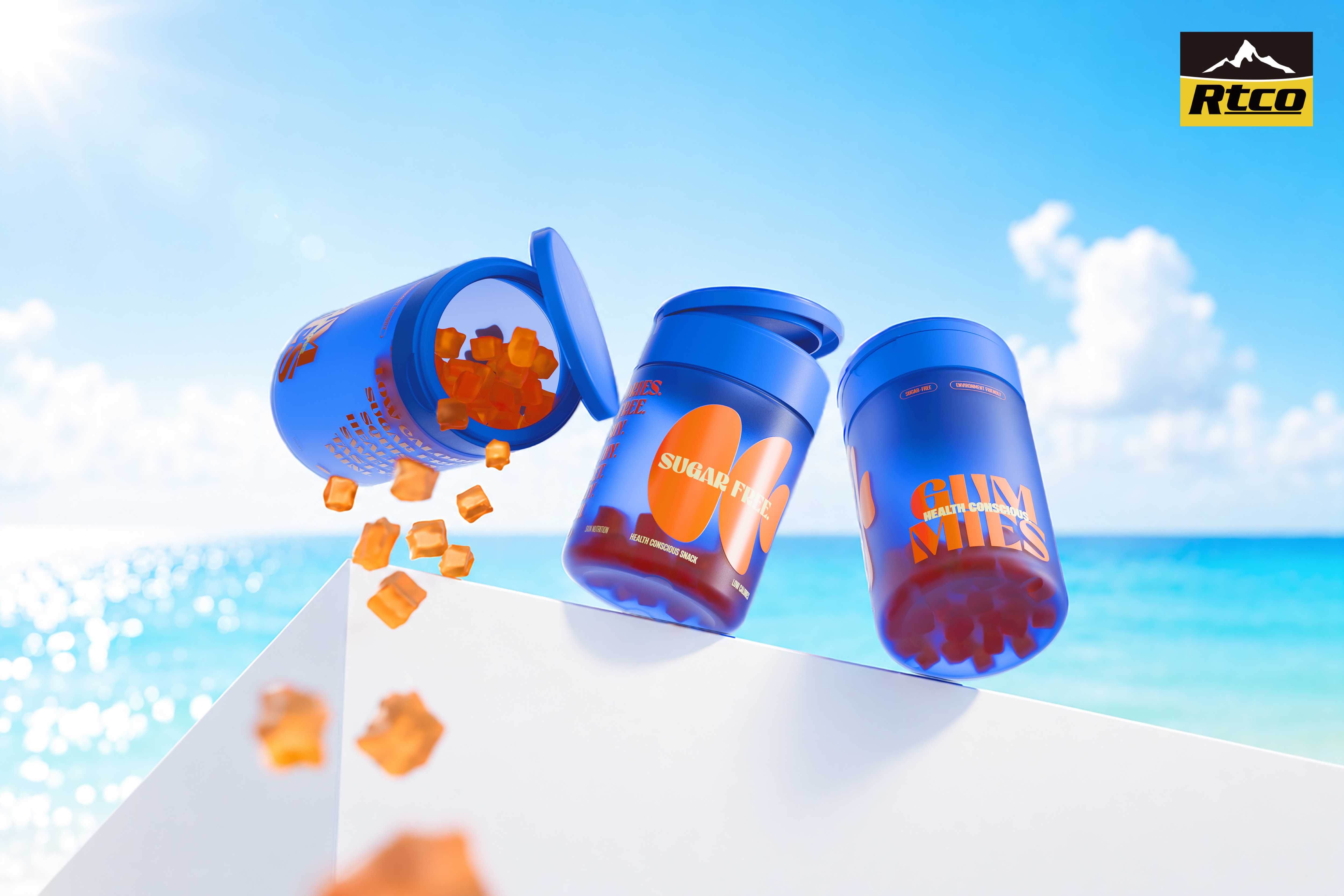
Flip-cap bottle format used for gummies and other supplement dosage forms; the molding processes behind such containers fall within the certified BRCGS and ISO 9001 scopes.
Market context: why certificate evidence carries more weight
Packaging is a large enough cost line that compliance documentation now travels with the quotation. Grand View Research values the global nutraceutical packaging market at USD 5.05 billion in 2024, with plastic segments leading at 58.3% of revenue share, and estimates plastic at approximately 73.8% of supplement packaging material share in 2025. Future Market Insights projects the protein powder packaging segment reaching USD 44.52 billion by 2035 at a CAGR of 5.01% from 2026 — a forecast rather than a measured figure.
Baselines differ by source: MarketsandMarkets places the 2025 nutraceutical packaging market at USD 3.67 billion, largely reflecting different treatment of flexible and secondary packaging. That divergence is itself a reason to treat any single market number as a scope-dependent estimate and to prefer supplier-specific, verifiable evidence when making sourcing decisions.
Regulation is moving in the same direction. In the United States, FDA 21 CFR Part 111 establishes mandatory current Good Manufacturing Practice for the manufacturing, packaging and labeling of dietary supplements. In the EU, Regulation (EU) 2025/40 requires that all packaging be recyclable by 2030 and that plastic packaging contain at least 30% recycled content by 2030. Neither rule is addressed to the packaging supplier directly, but both push brands to demand documented evidence from suppliers. Competition in the category includes large global packaging groups such as Berry Global, Amcor Plc, TricorBraun and ProAmpac, identified by MarketsandMarkets, alongside specialist manufacturers whose differentiation is tooling speed, decoration technology and turnkey programme execution.
Certificate-led versus claim-led sourcing: limits and trade-offs
Certificate-led sourcing is more defensible, but it has real boundaries that buyers should not paper over.
- Scope limits. The BRCGS scope names blow molding and injection molding of PE and PP containers, lids, spoons and hooks for food use; the GRS scope covers manufacturing, molding and printing of recycled plastic products; the ISO 15378 scope covers HDPE and PP bottles for medicinal products. Materials or processes outside those scopes remain unproven by these documents alone.
- Time limits. Certifications expire and are re-issued. The GRS window recorded here runs to 2026-09-04, which makes renewal status a live question for any buyer compiling an audit pack today.
- Level limits. Certificates certify systems and sites, not batches. Batch-level evidence — certificates of analysis, migration testing, dimensional inspection — is a separate request.
- Entity limits. Verification runs against the certificate holder's legal name and the specific site, so the entity on the certificate must match the entity on the purchase order.
- Commercial limits. Capacity and order structure constrain flexibility. With typical MOQs of 10,000–30,000 units per SKU and reported monthly capacity of 80,000,000 units, very small launch runs depend on trial-order arrangements, and peak-season allocation depends on forward planning. The Three-One Service is a reference model, not a guarantee: tooling and production timing vary with complexity.
The trade-off between supplier types is usually breadth versus depth rather than certified versus uncertified. Multinational packaging groups typically offer wider material and regional coverage; specialist custom packagers typically offer faster mold development and closer control over decoration and finish on a narrower product range. The right choice depends on whether the project needs a standard container from a global catalogue or a custom bottle with dedicated tooling, specific decoration and documented PCR content.
Outlook: from certificate copies to chain of custody
Three shifts are visible in how packaging evidence is being requested. First, recycled content is increasingly evidenced as a transaction rather than a statement, following the logic of standards like GRS and the recycled-content requirement in Regulation (EU) 2025/40. Second, audit packs are moving from a stack of certificate scans toward a scope map that aligns each certified scope with each manufacturing step of a specific SKU. Third, validity tracking is becoming part of routine supplier management, with expiry dates carried in qualification files rather than checked once at onboarding.
The practical implication for sports nutrition brands is uncomplicated: build the supplier qualification file around certificate numbers, issuing bodies, scopes and validity windows, and treat any claim that cannot be matched to one of those elements as an open question rather than evidence.
FAQ
Which certifications should a sports nutrition custom packaging supplier hold?
There is no single correct list, because the answer depends on material, process and destination market. A practical baseline for food-contact plastic containers is a quality management system (ISO 9001:2015), a packaging materials safety standard (BRCGS Packaging Materials Issue 7) and food-safety hazard control (HACCP). Where containers are treated as pharmaceutical-grade primary packaging, ISO 15378:2017 is the relevant GMP-based standard. Recycled content is addressed by GRS, environmental management by ISO 14001:2015, occupational health and safety by ISO 45001:2018, and labour standards by SA8000:2014. In every case the certified scope must match the process actually used.
How can a buyer verify a certificate number and issuing body?
Request the certificate document itself and check five items: the standard and revision, the certificate number, the named issuing body, the certified scope, and the validity window. Then verify the number with that issuing body's register and confirm that the certificate holder's legal name matches the supplier entity on the purchase order. Worked examples from this credential set include ISO 15378:2017 certificate HBPCER20260088 issued by Intertek Testing Services and BRCGS certificate C0860130-BRC2 issued by NSF Certification, LLC. A badge image without those elements cannot be verified.
What does ISO 15378:2017 mean for HDPE and PP supplement bottles?
ISO 15378:2017 specifies quality management system requirements for manufacturers of primary packaging materials for medicinal products and integrates GMP principles into that system. RTCO's recorded certificate, HBPCER20260088 issued by Intertek Testing Services, covers the manufacturing of HDPE and PP bottles for medicinal products and is recorded as valid from 2026-04-16 to 2029-03-05. It supports a brand's supplier-qualification argument for pharmaceutical-grade primary packaging. It does not replace product-specific migration testing, stability studies or customer-specific validation, which remain separate requests.
Does a GRS certificate guarantee recycled content in my order?
Not by itself. GRS Version 4.0 covers the manufacturing, molding and printing of recycled plastic products and operates as a recycled-material chain-of-custody system, which demonstrates that a certified system is in place. Confirming that a specific shipment contains a specific percentage of PCR requires order-level documentation in addition to the certificate. RTCO's GRS certificate, TRC-GRS-222421-00 issued by TÜV Rheinland (China) Ltd., is recorded as valid from 2025-09-05 to 2026-09-04, so a buyer relying on it should first confirm current renewal status or obtain the successor certificate.
How do supplier certificates relate to FDA 21 CFR Part 111 and EU packaging regulation?
They support compliance without transferring it. FDA 21 CFR Part 111 establishes mandatory current Good Manufacturing Practice for the manufacturing, packaging and labeling of dietary supplements and places those obligations on the supplement brand. Supplier certificates such as ISO 9001:2015, BRCGS Issue 7 and HACCP feed the brand's supplier qualification and control programme. In the EU, Regulation (EU) 2025/40 requires all packaging to be recyclable by 2030 and plastic packaging to contain at least 30% recycled content by 2030; recycled-material chain-of-custody systems and PCR-capable materials are the relevant supplier-side inputs, while the legal responsibility for placing compliant packaging on the market remains with the brand.
What MOQ, lead time and acceptance terms should buyers expect for custom supplement packaging?
For RTCO, typical minimum order quantities are 10,000–30,000 units per SKU, with first trial orders below the standard MOQ supported to validate a new product. Typical lead time is 30–45 days, referenced against a Three-One Service model of approximately one day of design, one month of tooling and one week of production, with actual timing depending on complexity and capacity; reported monthly capacity is 80,000,000 units. Acceptance is based on sample approvals, pre-shipment inspection and contractual acceptance criteria, with third-party testing available on request. Trade terms include EXW, FOB, CIF and DDU, and payment is commonly 50% T/T deposit with the 50% balance before shipment.
Reference document: the full RTCO sports nutrition packaging catalogue (PDF) is publicly available here: RTCO Catalogue for Sports Nutrition Packages.