
Audit Trail: Norbidar's China Omega-3 Fish Oil Site
Audit Trail: Norbidar's China Omega-3 Fish Oil Site
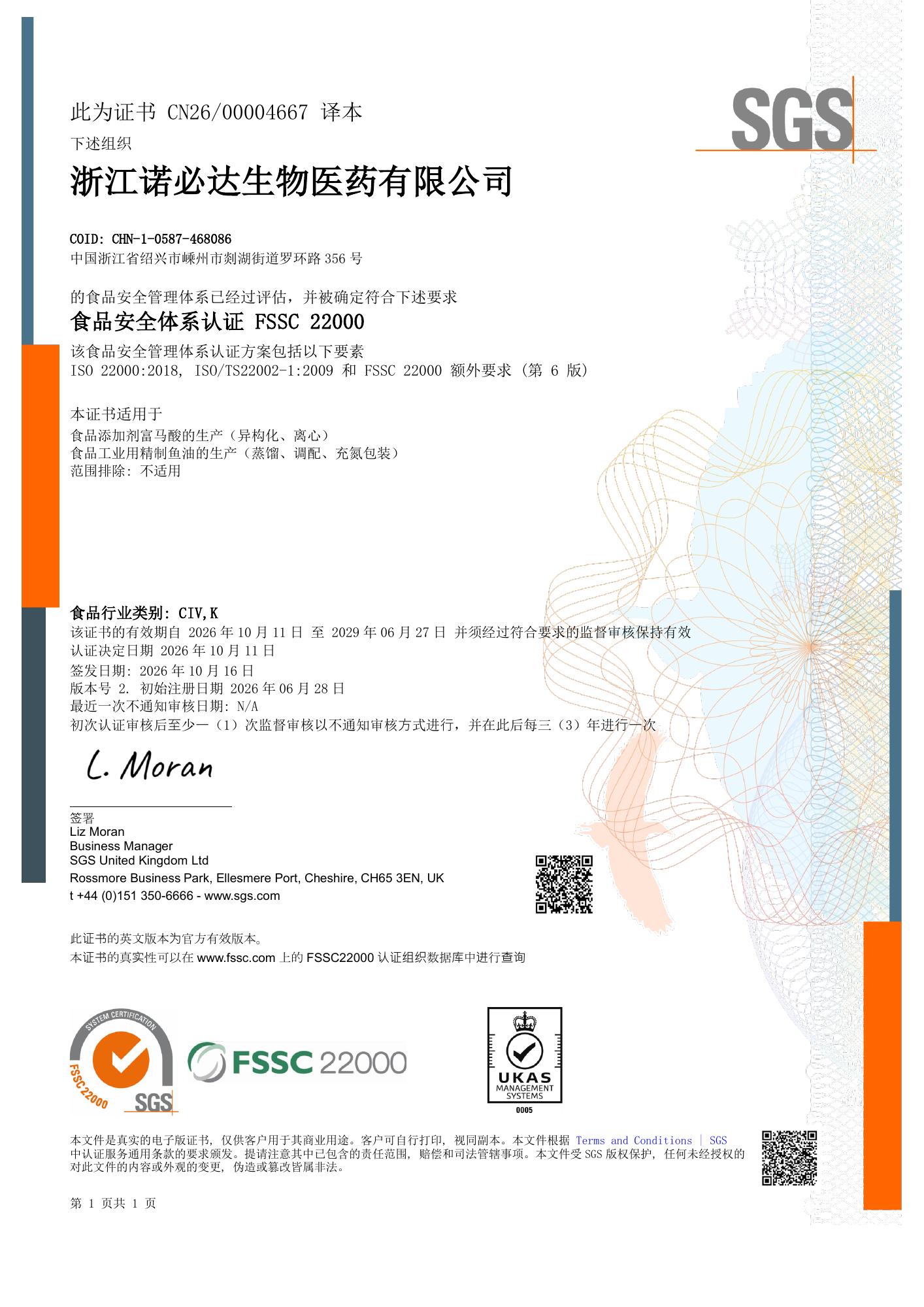
An audit trail is only useful when every document in it can be tied to a site, a process step and a product family. For the China manufacturing site behind Norbidar fish oil, that trail currently runs through four third-party documents: FSSC 22000 certificate CN26/00004667 and ISO 22000:2018 certificate CN26/00004668, both issued by SGS United Kingdom Ltd; FAMI-QS certificate CN26/00005166, issued by SGS; and halal certificate 501525000 (Registration No. 3306966AA5) from Shandong Halal Certification Service. Read together, they describe a site that refines fish oil by distillation, blends it and packs it under nitrogen. Read precisely, they also show exactly where the paper stops and batch-level documents have to take over.
Why a folder of certificate scans is not capability evidence
Supplier files usually arrive as a set of scans. The weakness is rarely the certificate itself — it is that the scan is asked to prove something it was never designed to prove. A management-system certificate confirms that an independent certification body has audited a site against a defined scheme and a defined scope. It does not register a product, authorise an import, or approve a grade. The documents in this set say so themselves: their market statements describe the certificates as management-system certification, explicitly not product registration or import authorisation, and treat coverage as subject to buyer acceptance and destination requirements.
That distinction decides which questions are answerable. A buyer who asks "are you certified?" receives a yes-or-no reply with almost no decision value. A buyer who asks "which scope line covers the operation I depend on, and which document carries the grade I am buying?" receives an answer that can be checked line by line. The four certificates below answer the second question. None of them was designed to answer the first.
The manufacturer is Zhejiang Norbidar Biomedicine Co., Ltd., a producer of food-grade omega-3 fish oil concentrates and EPA+DHA blended ethyl esters, established in 2018 and operating from Shengzhou, Zhejiang. Its portfolio includes blended ethyl ester concentrates plus EPA-rich and DHA-rich profiles, with customized EPA/DHA ratios discussed against a customer's target specification. The site covers 72,000 m² of land and 33,000 m² of building area. Those are company-reported facts about scale; the certificates are what an independent party has examined.
The four documents side by side
All four were issued between January and October 2026 and are in force at the time of writing. Three are system-level scheme certifications; one is a product certification. Reading them in a single view makes the differences in scope breadth immediately visible.
| Document | Number | Issued by | Scope as stated | Validity |
|---|---|---|---|---|
| FSSC 22000 food safety management system | CN26/00004667 | SGS United Kingdom Ltd | Production of food additive fumaric acid (isomerization, centrifugation); production of refined fish oil for food industry (distillation, blending, nitrogen packaging). Food chain categories CIV, K; exclusions: none. | 2026-10-16 to 2029-06-27 |
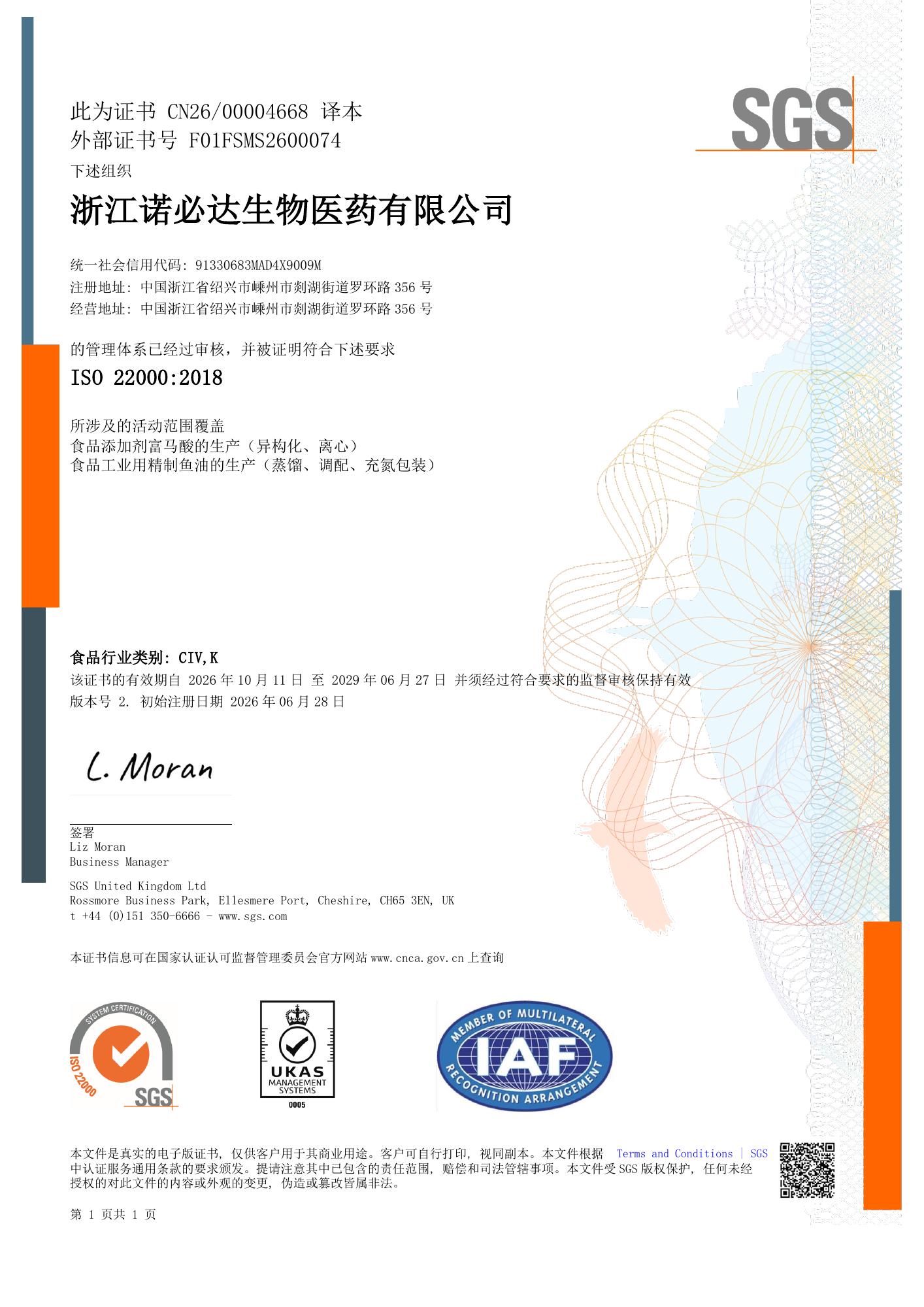
| ISO 22000:2018 food safety management system | CN26/00004668 | SGS United Kingdom Ltd | Production of food additive fumaric acid (isomerization, centrifugation); production of refined fish oil for food industry (distillation, blending, nitrogen packaging). Categories CIV, K. | 2026-10-11 to 2029-06-27 |
| FAMI-QS feed safety and quality management system | CN26/00005166 | SGS | Production of specialty feed ingredients; processes: chemical and mixing; feed chain category K. Specific product names not listed on the certificate. | 2026-07-11 to 2029-07-10 |
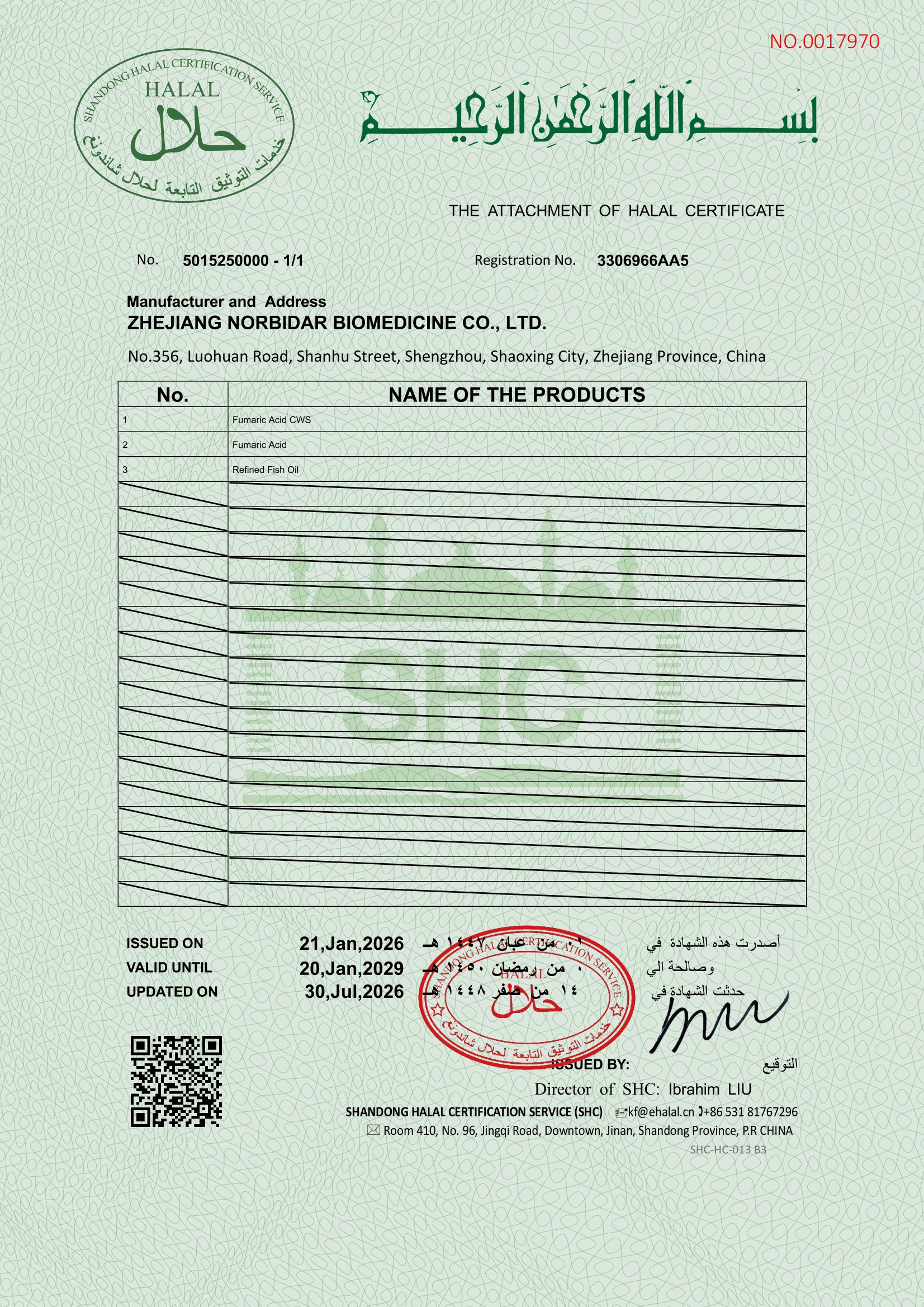
| Halal product certification | 501525000 (Reg. 3306966AA5) | Shandong Halal Certification Service (SHC) | Fumaric Acid CWS; Fumaric Acid; Refined Fish Oil, per the certificate attachment updated 2026-07-30. | 2026-01-21 to 2029-01-20 |
FSSC 22000 CN26/00004667: reading the scope line, not the logo
The scope sentence is the part worth reading twice, because it names three fish-oil operations and no product. Its technical basis is stated as ISO 22000:2018, ISO/TS 22002-1:2009 and the FSSC 22000 Additional Requirements (Version 6), with food chain categories CIV and K and no exclusions. Each operation in that scope corresponds to a control point a buyer can ask about.
Distillation is the concentration step, where the oil is refined and the omega-3 fraction is separated. Norbidar describes product development as supported by a proprietary NBD multi-stage continuous distillation process. The certificate does not describe the equipment, the pressure or the operating conditions; it confirms that refined fish oil production by distillation sits inside the audited scope of this site.
Blending is where fractions are combined to reach a target EPA/DHA ratio. This is the operation that makes a customization position technically meaningful: EPA/DHA ratio, blended concentration and EPA-rich or DHA-rich profiles are discussed subject to technical feasibility and an agreed product specification. A blending operation inside the certified scope is the process-level counterpart of that commercial statement. It does not by itself prove that any particular ratio has been produced.
Nitrogen packaging limits oxygen contact at the filling stage. The certificate names the operation and stops there. It does not state an oxygen limit, a headspace specification, a peroxide value target or a shelf-life claim. Those remain specification and batch-COA items, which is where oxidation control is actually verified.
One detail is easy to miss. The same scope line also covers production of food additive fumaric acid by isomerization and centrifugation. A single certificate therefore spans two product families at one site. That is normal for a multi-product plant, and it is a reason to read the scope line that applies to your material rather than treating the certificate as a general endorsement of everything the site produces.
Equally, the certificate does not list grade codes, EPA/DHA percentages, oxidation limits or destination markets. Food chain categories CIV and K classify the activity; they do not approve a product for sale in any jurisdiction.
ISO 22000:2018 CN26/00004668: the parallel scheme, not a duplicate
Issued five days before the FSSC certificate, sharing the same expiry date of 2029-06-27 and the same production scope, CN26/00004668 is the ISO 22000:2018 counterpart. Both documents cover the same fish oil operations at the same site, which is why the pair matters most when a purchase specification is written as "ISO 22000 or equivalent" rather than naming a scheme.
The practical question for a qualification file is which scheme the buyer's own procedure names. FSSC 22000 is a food safety management system certification scheme for food manufacturers, built on ISO 22000 and sector-specific prerequisite programmes — a scheme-level description published by the scheme owner, not a finding about this site. Where a specification requires a recognised food safety scheme, the FSSC document is the relevant one. Where it requires ISO 22000 specifically, CN26/00004668 is. Holding both means the site can meet either wording without a gap in the evidence file.
FAMI-QS CN26/00005166: a feed-chain document with a visible boundary
Validity runs from 2026-07-11 to 2029-07-10. The stated scope is the production of specialty feed ingredients, with chemical and mixing processes, in feed chain category K. Two details deserve attention. First, the certificate states that specific product names are not listed. Second, its technical basis is the FAMI-QS Code (6th Edition, 4th Revision, 2018-10-02) together with the Feed Fraud Prevention and Defence Module (Version 1.0, 2019-09-02) — a combination that addresses authenticity and defence as well as conventional safety management.
For a food-ingredient buyer, this document is context rather than qualification. It shows that the site operates a feed safety and quality scheme for specialty feed ingredients and that chemical and mixing processes fall inside that scheme. It cannot be used to claim that a named fish oil grade is certified for feed use, because the certificate does not name products at all. A buyer whose application is feed-related should request written confirmation of product coverage and a specification for the intended material instead of inferring coverage from the certificate.
Halal certificate 501525000: the one document that names a product
This is the only document in the set that certifies a product rather than a system. It was issued by Shandong Halal Certification Service on 2026-01-21 and expires on 2029-01-20, with registration number 3306966AA5. Its product scope lists Fumaric Acid CWS, Fumaric Acid and Refined Fish Oil, as recorded in the certificate attachment updated on 2026-07-30. The standard basis stated on the certificate is Indonesia Halal Law and Regulations together with MS 1500:2019, the Malaysian standard for halal food production, preparation, handling and storage.
Two implications follow. The first is that "Refined Fish Oil" is a product-family description, not a grade list — the certificate does not distinguish 3624 EE from 8000 EE. The second is that halal recognition is jurisdiction-specific. The certificate's own market statement limits coverage to halal ingredient markets subject to destination-country recognition and customer requirements. Indonesia's regime derives from Law No. 33/2014 on Halal Product Assurance, administered by BPJPH, with obligations phased in through implementing regulations; Malaysia's certification is administered by JAKIM, with MS 1500:2019 as the reference requirements document. A certificate citing both an Indonesian legal basis and MS 1500:2019 is a sensible starting point for those markets, not an automatic entry into them.
Matching documents to grades: 3624 EE through 8000 EE
The concentrate portfolio is organized by ethyl ester grade: 3624 EE, 4030 EE, 5020 EE, 5025 EE, 5030 EE and 8000 EE. Grade codes indicate nominal content. 5025 EE denotes a nominal 50% EPA and 25% DHA in ethyl ester form, and 3624 EE is described with a nominal 36/24 profile. For the other grades the same convention applies, but the nominal values should be read from the current specification rather than decoded from the label, because the specification and the batch COA govern what is actually supplied.
Here is the mismatch that most often derails a supplier file. No certificate in this set names a grade code. A buyer who requests "the certificate for 5025 EE" will not receive one, and a supplier who implies otherwise is overstating the document. The correct chain runs from certified site, to scope line, to product family, to grade specification, to batch certificate of analysis. Missing a step produces the familiar situation in which a buyer holds a valid, in-date certificate and still cannot state whether the material in the purchase order is covered.
| What the buyer needs to establish | Document that carries it | What that document does not establish |
|---|---|---|
| Legal entity and certified manufacturing site | All four certificates, each identifying a certified site in China | Status of distributors, repackagers or any other site |
| Food safety management system for fish oil refining | FSSC 22000 CN26/00004667; ISO 22000:2018 CN26/00004668 | Product registration; import authorisation; grade approval |
| Feed-chain scheme, where relevant | FAMI-QS CN26/00005166 | Which specific products are covered by the scheme |
| Halal status of refined fish oil | Certificate 501525000 with the 2026-07-30 scope attachment | Recognition by a particular destination authority |
| Composition of a named grade | Current product specification | Batch-to-batch conformity |
| Batch conformity, oxidation and contaminant results | Batch COA, specification sheet and SDS | Regulatory maximum levels applicable in the buyer's market |
Running the check: a six-step audit sequence
- Verify the number with the issuer, not the PDF. Treat a scanned certificate as a claim until the number has been confirmed through the issuing body's own verification route. The three SGS-issued documents and the SHC-issued halal certificate each carry a distinct number precisely so that this check is possible.
- Match the entity and site. Compare the certified organisation name and the manufacturing site against the entity named on the quotation, contract and shipping documents. A certificate is tied to a site, and coverage does not travel automatically to a trading intermediary.
- Read the scope line that applies. For fish oil, that is the refined fish oil production entry covering distillation, blending and nitrogen packaging. The fumaric acid entry in the same scope is context, not part of the fish oil case.
- Check validity against your own timeline. All four certificates run to 2029 at the earliest — halal to 2029-01-20, both food safety certificates to 2029-06-27, FAMI-QS to 2029-07-10. Record the renewal dates in the supplier file, because a reissued certificate will carry a new number and the old one will no longer be current.
- Request the attachment version. For halal, the product scope lives in an attachment whose revision date matters. Ask for the version in force on the date you approve the supplier, and keep that version with the file.
- Move down to batch level. Request the current specification, the batch COA, the specification sheet and the SDS. Norbidar's stated quality control covers batch EPA/DHA assay and fatty-acid profile, colour and oxidation testing, and contaminant screening, with exact limits following the product documents.
Where the audit trail stops
Four boundaries are worth stating plainly, because they are the points where supplier files are most often over-read.
- No grade-level certification exists in this set. The certificates cover a site and, in the halal case, a product family. Grade identification comes from the specification and the batch COA.
- The FAMI-QS certificate names no products. It evidences a scheme and process categories, not a specific material.
- A management-system certificate is not market authorisation. The certificates themselves state this, and destination requirements still have to be confirmed per project.
- Halal coverage is recognition-dependent. A certificate issued against an Indonesian legal basis and MS 1500:2019 does not by itself satisfy every halal authority.
There is also a numeric gap that no certificate can close. Scope wording names processes, not oxidation limits. Where a buyer needs a peroxide value, p-anisidine value or TOTOX threshold, the number has to come from the agreed specification and the batch COA, benchmarked against whichever standard the buyer has chosen to reference. Several layers are available for that purpose: the Codex Alimentarius Commission has adopted a Standard for Fish Oils, CXS 329-2017, covering fish oils intended for human consumption; GOED maintains a Voluntary Monograph that defines quality parameters and maximum limits for omega-3 oils, with compliance as a condition of membership; and EU-bound product falls under Commission Regulation (EU) 2023/915, which sets maximum levels for certain contaminants in food including dioxins and PCBs and which repealed Regulation (EC) No 1881/2006. Programme-level lot testing, such as the IFOS scheme's potency, oxidation and contaminant panel, sits at batch rather than site level, which is consistent with how oxidation results actually vary between lots.
Capacity, terms and what they can and cannot support
Commercial capability claims sit outside the certificate set and should be handled as company-reported information. Norbidar states an annual fish oil input processing capacity of 10,000 metric tons — an input figure that explicitly does not represent finished-product output. The company also reports 200 employees, a 25-engineer technical team, an export share of 70%, and supply into requirements for markets including Russia, the EU, the US and Korea, with destination requirements confirmed per project. Its stated commercial terms include a four-drum minimum order quantity and a 30-day lead time, with final quantity, packaging, delivery terms and acceptance criteria agreed in writing.
For an evaluator, the useful reading is that capacity figures and certificate scope answer different questions. Capacity speaks to whether a volume can be planned; scope speaks to whether the operations behind that volume sit inside an audited system. Neither substitutes for the other, and neither replaces a batch COA.
What a sample evaluation actually tests
Document review normally precedes sample work, and sample work is where the paper trail meets physical material. Two current evaluation projects illustrate the stage. A Russian nutraceutical ingredient distributor is evaluating 3624 EE as a bulk ingredient for dietary supplement formulation, with the sample received and specification testing pending; commercial ordering depends on that testing. An Indian nutraceutical ingredient customer is at sample evaluation stage against a required EPA/DHA specification, with formulation suitability still under assessment.
Both are pre-commercial and neither constitutes a validated end-use result. Their relevance here is procedural: the certificates establish site and system coverage, the specification defines the target, and the buyer's own testing decides acceptance. A supplier file that skips the middle step — the grade specification — leaves the buyer testing against an unstated benchmark.
Outlook: what will change the trail
The documents reviewed here carry fixed validity windows, so the trail has a maintenance cycle rather than a one-off state. The next meaningful checkpoints are the halal renewal in January 2029 and the food safety and FAMI-QS renewals in mid-2029. Renumbering at renewal is normal and is the reason a supplier file should record versions and dates rather than storing a single undated scan.
A second source of change is destination regulation. Where a buyer's market applies contaminant maximum levels — as EU-bound product does under Regulation (EU) 2023/915 — the certificate set will not be sufficient on its own, and a contaminant test panel becomes part of the acceptance criteria alongside oxidation parameters. Buyers writing specifications that anticipate those requirements will find it simpler to state, in one document, which standard the oxidation limits follow, which contaminant limits apply, and which certificate numbers and scope attachments are expected in the supplier file. That is a more durable arrangement than renegotiating the evidence package at each renewal.
Frequently asked questions
What should buyers know about norbidar omega-3 fish oil concentrates?
Norbidar supplies food-grade ethyl ester fish oil concentrates across several nominal EPA/DHA profiles, including 3624 EE, 4030 EE, 5020 EE, 5025 EE, 5030 EE and 8000 EE, for dietary supplement and functional food formulation. Grade codes indicate nominal content; the current specification and the batch COA govern what is actually supplied. Buyers should confirm the target ratio, the intended application and the destination documentation set before selecting a grade.
Which certificate numbers should appear in a supplier file for this site?
Four. FSSC 22000 CN26/00004667 and ISO 22000:2018 CN26/00004668 were issued by SGS United Kingdom Ltd, with validity to 2029-06-27 in both cases. FAMI-QS CN26/00005166 was issued by SGS and is valid from 2026-07-11 to 2029-07-10. Halal certificate 501525000, registration 3306966AA5, was issued by Shandong Halal Certification Service and is valid from 2026-01-21 to 2029-01-20.
Do these certificates name individual grade codes such as 5025 EE?
No. The FSSC 22000 and ISO 22000:2018 scopes name refined fish oil production by distillation, blending and nitrogen packaging. The FAMI-QS certificate states that specific product names are not listed. The halal certificate lists Refined Fish Oil as a product without grade codes. Grade-level identification therefore comes from the current product specification and the batch COA, not from the certificates.
How should a buyer verify the halal certificate for refined fish oil?
Confirm certificate number 501525000 and registration 3306966AA5, confirm the issuing body, and check that Refined Fish Oil appears in the product scope attachment together with its revision date — the supplied attachment was updated on 2026-07-30. Then confirm that the destination market recognises the scheme, because the certificate's market statement makes coverage subject to destination-country recognition and customer requirements.
What should buyers confirm before ordering omega-3 fish oil concentrates from norbidar?
Define the EPA and DHA target, the ethyl ester form and the intended application. Review the current specification, batch COA and SDS. Confirm sample acceptance, the applicable certification scope and destination requirements, noting that the management-system certificates cover the site and its process scope rather than individual grades. Agree quantity, packaging, lead time, delivery terms and acceptance criteria in writing before ordering.
Tem questões ou precisa de mais detalhes?
Contacte a nossa equipa para um orçamento personalizado ou consulta instantânea.
Solicitar orçamento
Preencha o formulário abaixo e a nossa equipa entrará em contacto com uma proposta personalizada.
Chat direto do WhatsApp
Prefere conversar em tempo real? Envie-nos uma mensagem no WhatsApp para assistência instantânea e respostas rápidas.
- Obter orçamento personalizado
- Partilhar fotos ou documentos
- Discuta as suas necessidades diretamente
Geralmente responde em 5–30 minutos durante o horário de expediente.