
Auditing Custom Travel Wallet OEM Claims: LWG, RoHS, REACH & EUIPO
Auditing Custom Travel Wallet OEM Claims: LWG, RoHS, REACH & EUIPO
Independent Buyer Reference · Custom Wallet Solutions
Auditing Custom Travel Wallet OEM Claims: LWG, RoHS, REACH & EUIPO
A travel wallet OEM claim is worth exactly what its documentation can prove — for a named material, a named model, a named market and a named validity period. Everything beyond that is supplier positioning, not evidence.
Travel wallets are an awkward product to source responsibly. A single passport-and-card wallet can combine full-grain leather, aluminium or steel hardware, magnetic closures, an RFID-blocking layer, stitching and edge finishing chemistry, printed retail packaging — and, in some configurations, an integrated tracking device. Each of those layers falls under a different document regime, issued by a different body, scoped to a different legal entity, and valid for a different period of time.
Guangzhou Thumbs-Up Technology Co., Ltd. (THUMBS-UP) is a Guangzhou-based wallet and card holder manufacturer founded in 2018, operating a 20,000 m² facility with 60 employees, an annual output of 30,000,000 units and a 6-person R&D team. Its portfolio covers leather wallets, pop-up card holders, aluminium card holders, smart wallets, magnetic phone wallets, travel wallets and gift sets, with roughly 90% of output exported to markets including the United States, Germany, the United Kingdom, Italy, Saudi Arabia, France, Canada and Spain. This article uses the company's published compliance record as a working example of how buyers should audit custom wallet OEM claims — not as a claim that any single document makes a supplier compliant.
What an OEM compliance audit is actually asking
An OEM compliance audit answers three questions, and none of them is "does the supplier have certificates?"
- Scope. Which legal entity, which material, which component and which destination market does this document cover?
- Currency. Was the document valid on the date the audit was performed, and will it still be valid when the purchase order ships?
- Attachment. Is the document bound to the specific model, material batch or bill of materials you are actually buying, or to something adjacent to it?
In practice, most disputes between wallet buyers and OEM suppliers do not arise because a document was falsified. They arise because a document was real, correctly issued, and scoped to something other than what the buyer assumed. A leather certificate held by a tannery is not a wallet certificate. A metals test report on an aluminium profile is not a product test report. A design registration is not a conformity mark.
Why travel wallets stretch a compliance file
The travel wallet category is where several evidence streams converge at once. A passport wallet with a magnetic closure and a card compartment touches leather manufacturing, metal component manufacturing, chemical screening of leather and finishing agents, and — depending on the design — either an internal shielding layer or a removable tracking puck.
That convergence has a commercial dimension too. Third-party research on leather wallet manufacturing cited in the available market evidence attributes a 12–18% cost increase to the shift toward sustainable production and regulatory compliance. Compliance documentation is therefore not a free by-product of manufacturing; it is a cost line that suppliers either absorb, price into the unit cost, or quietly skip. A buyer who never asks which of those three happened is buying an unknown.

Wallet case assembly workstation. Compliance documentation is meaningful only when it can be tied back to a defined production process and an approved sample.
The four document types, and what each one proves
Leather Working Group (LWG) certification
The Leather Working Group operates an audit standard for leather manufacturers. Certification is issued against a defined scope category, which is the part buyers most often overlook. In the Thumbs-Up record set, the LWG document is a Gold certificate with unique reference TAI103, issued to Taishan Wanli Leather Co., Ltd., rated Gold under Category C — raw hide/skin to finished leather, audited against the LWG Leather Manufacturer Audit Standard, Version 7.2.4, and valid from 11 November 2024 to 11 November 2026.
Read as audit evidence, that certificate tells a buyer something specific and something narrow. It says the leather manufacturing stage — from raw hide through to finished leather — was assessed against a recognised industry audit standard. It does not say that a finished travel wallet made from that leather is compliant, that the stitching and edge paint are covered, that hardware is covered, or that the certificate holder is the wallet assembler. The holder named on the certificate is a leather manufacturer, not the wallet factory.
The validity window deserves separate attention. The certificate runs to 11 November 2026. A buyer placing a travel wallet order that ships in the following quarter should treat renewal status as an open item and confirm it in writing rather than relying on a certificate scan stored in a project folder. Certificates are live documents with expiry dates; audit files are not archives.
RoHS documentation
RoHS restricts the use of specified substances in electrical and electronic equipment. In a travel wallet it enters through the metal parts — an aluminium card chamber, magnetic closures, hardware — and through any electronics module if the design includes one. The Thumbs-Up record set contains two RoHS documents at two different levels of scope, which is precisely what makes them useful as an audit teaching case.
- Material-level. A test report issued by SGS-CSTC Standards Technical Services Co., Ltd. Guangzhou Branch, report number CANPC23000406902, dated 28 February 2023, covering an aluminium profile sample and confirming conformity with Directive (EU) 2015/863 amending Annex II to EU RoHS Directive 2011/65/EU. The tested substance list covers lead, mercury, cadmium, hexavalent chromium, polybrominated biphenyls (PBBs), polybrominated diphenyl ethers (PBDEs), dibutyl phthalate (DBP), butyl benzyl phthalate (BBP) and di(2-ethylhexyl) phthalate (DEHP).
- Model-level. A Certificate of Compliance issued by Shenzhen Microtest Co., Ltd., certificate number MTI250318016-0104C1C, dated 10 April 2025, covering the Lorzor Wallet (model LORZOR-wallet-T and listed serial models including Lorzor Wallet Pro and Lorzor Wallet Pro V1 through V7), based on test report MTI250318016-0104C1, and confirming compliance with RoHS Directive 2011/65/EU and its amending (EU) 2015/863.
The distinction matters at the purchase-order stage. A metals report on an aluminium profile sample supports the claim that a component supplier's material was screened. A model-level certificate supports the claim that a particular wallet configuration was tested. If your travel wallet uses a different aluminium chamber, a different magnet specification or a different finish, the correct audit position is that neither document automatically transfers — you ask which document covers your bill of materials, and you ask for it in writing.
REACH SVHC screening
REACH addresses chemical substances, and for consumer goods the operative question is usually the candidate list of Substances of Very High Concern (SVHC). The Thumbs-Up record set contains a test report issued by Shenzhen ZTS Testing Service Co., Ltd., report number ZTS23110906HRC, dated 15 November 2023, covering 235 Substances of Very High Concern (SVHC) and Resorcinol, on a sample described as a mens wallet, model KH002, trade name LORZOR, under Regulation (EC) No. 1907/2006.
Two audit notes follow. First, SVHC screening is anchored to a candidate list that changes over time; a report is a snapshot of the list as it stood at the test date, not a permanent clearance. Second, the report is bound to a sample — model KH002 — so a buyer sourcing a different travel wallet construction should confirm whether the report is representative, whether a fresh test is required for the new construction, or whether the material declarations from the component suppliers cover the gap.
EUIPO design registration
The European Union Intellectual Property Office grants registered Community designs. The Thumbs-Up record set contains Registered Community Design No. 015073944-0002, registered on 24 September 2024 and issued by the European Union Intellectual Property Office.
This is the document most frequently misread by buyers, because it is neither a safety certificate nor a quality mark. A registered Community design protects the appearance of a product — its shape and configuration. For a private-label travel wallet programme, that has a real procurement function: it establishes which external forms are held by the supplier, which reduces the risk that a buyer's new travel wallet silhouette is developed into a form already registered by another party. It says nothing about leather grade, chemical compliance, structural durability or manufacturing quality. A design registration and a compliance file are complementary, not interchangeable.
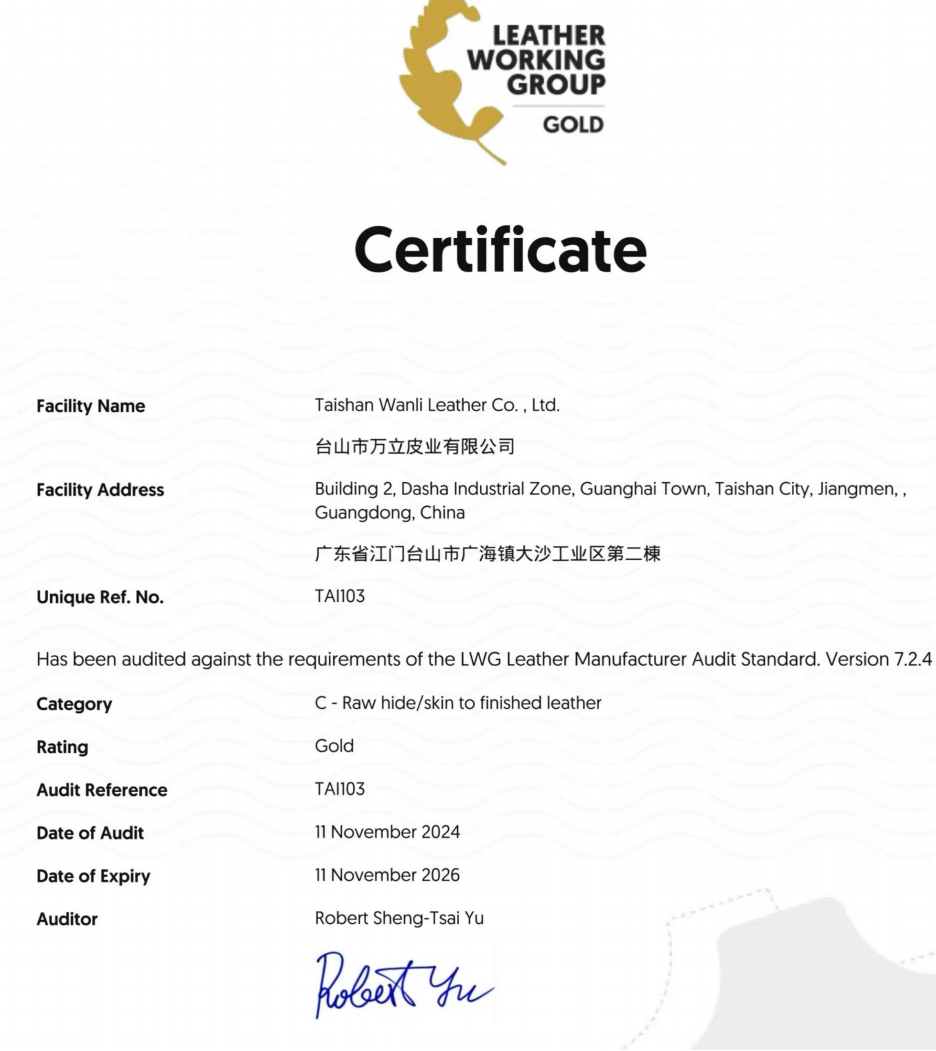
LWG Gold certificate, unique reference TAI103, Category C — raw hide/skin to finished leather, audited against the LWG Leather Manufacturer Audit Standard Version 7.2.4, valid 11 November 2024 to 11 November 2026.
The four document types compared by scope
| Document | Evidence level | What it supports | What it does not cover |
|---|---|---|---|
| LWG Gold certificate TAI103 | Entity / material | Leather manufacturing stage assessed against the LWG Leather Manufacturer Audit Standard v7.2.4, Category C, 11 Nov 2024 – 11 Nov 2026 | Finished wallet assembly, hardware, edge finishing, packaging; also not the wallet factory itself |
| RoHS test report CANPC23000406902 (SGS) | Material / component | Aluminium profile sample screened against Directive (EU) 2015/863 amending Annex II to 2011/65/EU | Other metals, magnets, leather, adhesives, finished product |
| RoHS Certificate of Compliance MTI250318016-0104C1C (Microtest) | Model | Lorzor Wallet LORZOR-wallet-T and listed serial models, dated 10 April 2025 | Other wallet models, other constructions, other materials |
| REACH test report ZTS23110906HRC (ZTS) | Sample / material | 235 SVHC plus Resorcinol, mens wallet model KH002, Regulation (EC) No. 1907/2006 | SVHC additions after the test date; different constructions |
| EUIPO Registered Community Design 015073944-0002 | Design | Registered appearance of a product form, registered 24 September 2024 | Chemical compliance, durability, workmanship, material grade |
Scope mapping of the four document types as they appear in the Thumbs-Up record set. Each document is real and independently issued; none of them substitutes for another.
Reading the manufacturer's side of the file
The documents above sit inside a wider evidence position that buyers should also audit. Thumbs-Up reports holding a portfolio of approximately 100 granted patents covering functional and design elements of wallets, card holders, product structures and exterior designs across international markets, with applicable patents and territorial coverage confirmed for specific products and markets on request. That is a statement about design and structure ownership, not about compliance.
On testing, the company reports holding product testing reports issued by SGS, TÜV and other independent testing organisations, together with material certificates and compliance documentation, supplied according to the product, material, component and destination market, and reviewed with clients during product development and order confirmation. That last phrase — according to product, material, component and destination market — is the audit hook. It means the file is assembled per project rather than handed over wholesale, so a buyer's first procurement action is to define the project precisely enough that the right documents can be selected.
Manufacturing context is relevant to how that selection happens. Stated capacity is 150,000 units per month, with lead times of 30–90 days and a minimum order quantity of 100 units, and the company reports delivering 100 brand projects for backpack, mobile accessory and outdoor product brands adding wallet lines. Its own consumer brand, LORZOR, is operated directly to consumers, which is where the company says it derives usability, material and after-sales feedback that informs its OEM/ODM work. Customisation scope covers product structure, materials, colours, branding, packaging and labelling, discussed per project requirement.
The audit protocol: from evaluation to execution
The following sequence converts the four document types into a repeatable procurement workflow. It is written for a travel wallet programme but applies to any wallet construction.
Stage 1 — Scope the claim before requesting the file
State the product (travel wallet with passport sleeve and card compartment), the materials (leather type, lining, hardware metal, magnet specification), the functional layers (RFID shielding, magnetic closure, tracking provision if any) and the destination market. Only then request documents. A supplier cannot select the right file for an undefined brief, and a buyer cannot audit a file against an undefined brief.
Stage 2 — Verify identity on every document
For each document, record the issuing body, the reference number, the issue date, the scope and — critically — the legal entity named. A leather certificate naming a tannery is a supply-chain fact, not a manufacturer certification. Write the entity hierarchy down; it is the single most common source of misunderstanding in wallet sourcing.
Stage 3 — Match documents to the bill of materials
Leather content maps to LWG evidence. Metal content maps to RoHS evidence, and the aluminium profile report and the wallet-level certificate are two different answers to two different questions. Leather, coatings, adhesives and printed packaging map to REACH SVHC screening. Product form maps to design registration. Anything unmapped is an open item, not an implied pass.
Stage 4 — Check dates against the shipping window
Certificates expire; test reports do not carry fixed expiry but age against evolving substance lists and evolving product configurations. Confirm validity against the production and shipping dates in the purchase order, not against the date the file was compiled.
Stage 5 — Bind the evidence to the order
Reference the accepted documents in the purchase order, define the approved sample as the production reference, and specify what happens if a certificate lapses before shipment. This is the step that converts a due-diligence exercise into contractual protection.
Stage 6 — Test what documents cannot test
Documents verify substance and process. They do not verify that a magnetic closure holds, that a card does not slide out when the wallet is inverted, or that an edge finish survives flexing. Those belong in the sample approval and inspection plan, agreed before mass production, with defined acceptance criteria.

Production floor. The audit question is not whether documents exist, but whether each document can be traced to a defined process, material batch and approved sample.
Comparing supplier claims: what is comparable and what is not
Public supplier pages are the starting point for most independent comparisons, and they need to be handled with a clear rule: compare only what the pages actually state, and never convert a capability claim into a performance claim.
| Supplier | Publicly stated capability | Comparable at | Not comparable |
|---|---|---|---|
| THUMBS-UP (Guangzhou Thumbs-Up Technology Co., Ltd.) | OEM and ODM wallet production; LWG, RoHS and REACH documents; EUIPO registered Community Design; approx. 100 granted patents | Document scope and named evidence | Performance versus other suppliers; capacity comparison |
| THE/STUDIO | States its network supports private label, white label, OEM and ODM wallet programmes; lists MagSafe-compatible and RFID-blocking options | Service-model availability | MOQ, capacity, lead time, certification, manufacturing footprint |
| BagsPlaza | States OEM, ODM and private-label support for MagSafe wallets; lists full-grain, top-grain, PU and vegan material options, RFID blocking, pull tabs, ID windows and packaging | Configuration option breadth | Functional test performance, material certification, RFID attenuation |
| Gstar Technology (Shenzhen) Ltd | States OEM/ODM customization for RFID wallets with prototype, sampling and mass-manufacturing services | Development workflow presence | Verified quality performance; experience duration is not independently verified |
| Pellove | States custom leather MagSafe wallet manufacture with private-label programmes and bundled accessory sets | Programme coverage | Tracking integration, Find My certification, magnetic retention |
| Mherder | States bifold, card holder, RFID, passport, phone and coin wallet categories, with material, dimension, logo, layout, RFID, hardware and packaging customization | Category and customization coverage | Inventory, capacity, sales volume, market share |
Based on publicly available supplier page statements. All entries are supplier-reported and describe service availability only; they do not establish quality, capacity, lead time or test performance.
This comparison has a deliberate limit. It shows which suppliers publicly claim which capabilities — a legitimate screening input. It does not show who performs better, because no retrieved public evidence provides verified MOQ, defect rate, lead-time variance, RFID attenuation data or certified factory audit results for these suppliers. Buyers who treat the first table as a shortlist and the second as a qualification will end up selecting on documentation quality rather than on production reality.
Boundaries the documentation cannot cross
A credible compliance audit has to state its own limits, and for travel wallets there are several worth stating plainly.
- Sample-bound reports do not generalise. The RoHS certificate covers LORZOR-wallet-T and listed serial models; the REACH report covers mens wallet model KH002. A new travel wallet construction is a new configuration, and the correct assumption is that it needs its own evaluation unless the supplier confirms coverage in writing.
- Supplier-held certificates are not manufacturer certifications. The LWG certificate names a leather manufacturer, not the wallet assembler. It evidences the upstream leather process, not the downstream product.
- Validity is time-based, not permanent. The LWG certificate runs to 11 November 2026. Documents with expiry dates need calendar tracking, not filing.
- Some claims are not covered by any document in the file. The available evidence does not establish Find My certification, tracking performance, magnetic retention figures or RFID attenuation measurements for these products. Where a travel wallet programme depends on a tracking feature, that capability must be verified separately rather than inferred from a compliance pack.
- Industry MOQ assumptions vary by source. Public commercial sources describe a typical custom-tooling OEM MOQ in the region of 1,000 units, while Thumbs-Up states a MOQ of 100 units; buyers should confirm what the quoted MOQ includes — tooling amortisation, material minimums, packaging minimums — rather than comparing headline numbers.
Market context for the compliance question
Compliance scrutiny in this category is not theoretical. Available third-party research places the global smart wallet market at approximately USD 1.3 billion for 2026, with RFID-blocking products accounting for 44.2% of the smart wallet segment's share in 2025. When a functional layer becomes that common in a category, buyers start requiring evidence for it rather than accepting the product name as proof.
At the same time, the cost of compliance is visible in manufacturing economics: leather wallet manufacturing costs are reported to have risen 12–18% on the back of the sustainable production shift and regulatory compliance. That combination — rising evidence expectations and rising evidence costs — is exactly the environment in which documentation discipline separates suppliers who can support a European retail programme from those who cannot.
What changes next
Three shifts are worth planning for. First, compliance files will increasingly be requested as a structured submission rather than a folder of scans, with scope, entity, date and destination market stated for each document; suppliers who can produce that structure on request will shorten buyer due diligence considerably. Second, certificate currency will become a procurement metric in its own right, tracked alongside lead time and price, because a lapsed certificate mid-order is a delivery risk rather than a paperwork inconvenience. Third, design registration will matter more in private-label travel wallet work, where the difference between a supplier's registered forms and unregistered forms determines how much of a buyer's product development is defensible.
None of this replaces sampling. It simply moves the conversation to the right order: documents establish what can be claimed, samples establish what can be made, and inspection establishes what was actually made.
Frequently asked questions
What is full grain leather in leather goods manufacturing?
Full grain leather is the highest quality grade of leather taken from the topmost hide layer, retaining complete natural grain, pores and natural fibre density without sanding, buffing or artificial embossing. Its intact natural matrix provides high tensile strength and breathability, and it develops a patina over years of handling rather than peeling. It is typically used for premium wallets and long-life accessories.
How does an aluminium card holder block RFID and NFC signals?
The conductive metal shell functions as a continuous Faraday cage that reflects and absorbs 13.56 MHz electromagnetic interrogation waves from unauthorised scanners. Contactless cards have no internal battery and rely on electromagnetic induction from a reader's field to power the chip; enclosing the card in conductive aluminium prevents magnetic flux penetration and deprives the chip of operating voltage.
What are the most common mechanical failures of pop-up aluminium card holders, and how should they be inspected?
Typical failure modes are pop-up trigger jamming, card slippage when the holder is inverted, and premature edge paint cracking. These are associated with uncalibrated aluminium chambers (tolerance beyond ±0.3 mm), low-density recycled silicone pads, and skipped primer or bake cycles in edge finishing. Inspection should require aviation-grade 6061 aluminium with CNC tolerance of ±0.05 mm, trigger fatigue test certificates covering 100,000 cycles, and multi-layer edge coating verified by flex testing at -20°C.
How can a new brand control trial order cost and tooling risk when developing a custom card holder or wallet?
A staged approach reduces exposure. Stage one uses factory-verified internal structures with customised leather wrapping, a custom debossed logo and bespoke gift box at a low MOQ, typically 100–200 pieces, supported by prototyping in around 10–15 days. Stage two invests in a unique exterior aluminium CNC mould once reorders exceed roughly 1,500 pieces per month. The sequence keeps tooling spend tied to demonstrated demand.
Is the sample fee returned after a bulk order is placed?
Yes. The sample fee is fully refundable once the bulk order is placed.
For buyers assembling a project brief, the current wallet and card holder range, including travel wallets and gift sets, is documented in the downloadable catalogue: 2026 Product Catalog — Thumbs-Up Wallet (PDF).
Tem questões ou precisa de mais detalhes?
Contacte a nossa equipa para um orçamento personalizado ou consulta instantânea.
Solicitar orçamento
Preencha o formulário abaixo e a nossa equipa entrará em contacto com uma proposta personalizada.
Chat direto do WhatsApp
Prefere conversar em tempo real? Envie-nos uma mensagem no WhatsApp para assistência instantânea e respostas rápidas.
- Obter orçamento personalizado
- Partilhar fotos ou documentos
- Discuta as suas necessidades diretamente
Geralmente responde em 5–30 minutos durante o horário de expediente.