
Auditing Orthodontic Materials Scope: What a Catalogue Proves
Orthodontic materials buyers rarely see a factory before they commit. What they usually receive is a product list — twenty or thirty families, each with model codes, slot sizes, material descriptions and packing options. Many buyers read that list as marketing and move straight to price. Read differently, the list is a set of testable claims about tooling, materials and process control, and each claim can be checked family by family before a purchase order exists.
Product breadth in orthodontic materials means the number of distinct manufacturing process families a supplier actually controls — precision metal machining and brazing, wire forming and heat treatment, polymer processing, and multi-material assembly — rather than the number of item codes printed in a catalogue. A supplier that lists brackets, arch wires, pliers, power chains and expansion screws is claiming capability across four different production logics, not simply a long inventory.
This reference sets out how to audit that claim: how to map listed categories to the processes they imply, how to sample at category level, how to compare claimed scope with visible output, and how to document which product families can realistically carry an orthodontic materials partnership.
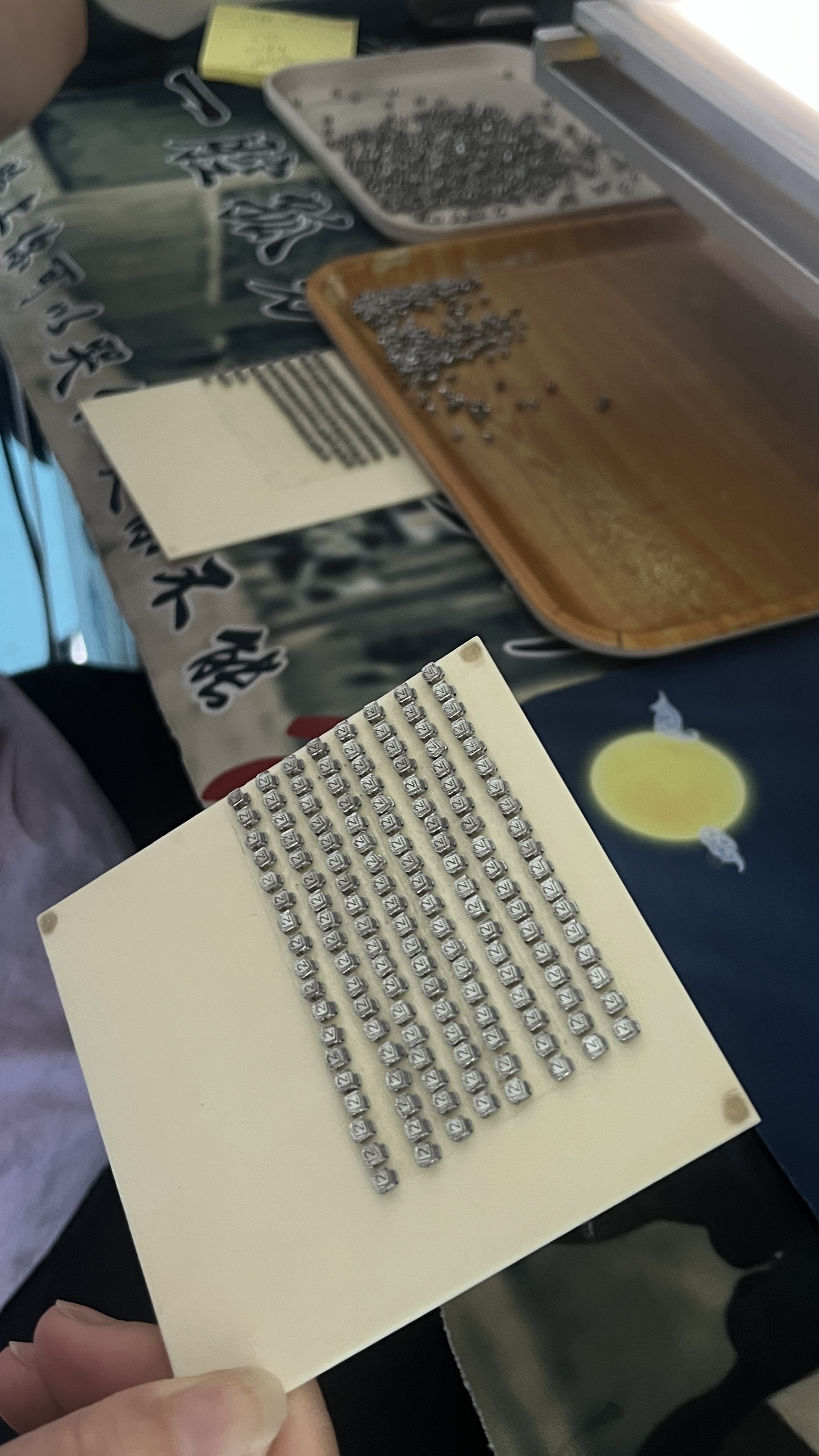
Marking on a bracket base. A traceable marking step is one of the small production signals that can be checked against a catalogue claim.
The Auditing Problem: Catalogue Width Versus Production Depth
A single machining cell can support brackets, buccal tubes, bands and several instrument families, because those products share the same underlying competences: tooling, dimensional inspection and joining. A catalogue built on that one cell can legitimately run to dozens of SKUs and still represent one process family. Add a wire-forming line and a polymer line, and the same catalogue represents three. The distinction matters because buyers often compare suppliers by page count, when the useful comparison is by process count and by the depth reached inside each process.
The commercial context explains why this is not an academic exercise. The global orthodontic supplies market was valued at USD 14.8 billion in 2024 according to Global Market Insights, while the narrower consumables segment was estimated at USD 3.1 billion in 2024 and projected to reach USD 4.3 billion by 2030 by Grand View Research. Consumable families — brackets, tubes, bands, wires, auxiliaries and instruments — generate repeating order volume, and repeating volume is what converts a catalogue into a supply relationship. Breadth is therefore a commercial claim about replenishment, not just a marketing one.
The auditing task is to decide, before the first order, whether a listed category is manufactured, assembled, or sourced. All three can be legitimate. They are not interchangeable, and a supplier that does not distinguish them is asking the buyer to accept scope on trust.
Four Process Families Behind an Orthodontic Catalogue
The most efficient way to audit breadth is to stop reading the catalogue as a list of products and start reading it as a list of processes. The table below groups the categories buyers most often request into four families and states what each family requires — and, equally important, what it does not prove.
| Process family | Typical categories | What it requires in practice | What it does not prove |
|---|---|---|---|
| Precision metal machining, brazing and assembly | Metal brackets, ceramic brackets, buccal tubes, molar bands, lingual buttons, crimpable hooks, pliers, hand instruments | Tooling, dimensional inspection, brazing or joining control, surface finishing, hardness control on instruments | Ceramic and metal do not share tolerance behaviour; slot accuracy in one does not confirm the other |
| Wire forming and heat treatment | Stainless steel, super-elastic NiTi, heat-activated NiTi and TMA arch wires | Alloy sourcing, arch-form tooling, heat-treatment cycles, springback and surface control | Wire capability says nothing about bracket manufacturing, and vice versa |
| Polymer processing | Elastic ligatures, power chains, elastomeric auxiliaries | Medical-grade polymer supply, moulding, elastic-recovery control, shelf-life handling | Polymer lines share almost no equipment with metal machining |
| Multi-material assembly and laboratory appliances | Expansion screws, face masks, pediatric crowns, rapid palatal expanders, miniscrews, distalization systems | Component sourcing, assembly, cleaning and packaging discipline across mixed materials | Assembly does not confirm that every component is produced in-house |
The grouping is not theoretical. Power chains and elastic ligatures are primarily manufactured from medical-grade polyurethane, as published orthodontic catalogues indicate, while stainless steel remains the most widely used material for arch wires and brackets according to Grand View Research, and nickel-titanium wires are specified for their shape memory and super-elasticity. A supplier claiming both metal and elastomer families is claiming two unrelated supply chains, two quality regimes and two sets of incoming inspection criteria.
Mapping the Categories Buyers Actually Ask For
The categories that dominate orthodontic procurement conversations are consistent: arch wires, pliers, instruments, lingual buttons, crimpable hooks, power chains, expansions, elastic ligatures, face masks, mirrors, brackets, bands, buccal tubes and pediatric crowns. Each one carries a specific verification question that a catalogue usually answers only partially.
| Category | Example reference in scope | Parameter a buyer can check |
|---|---|---|
| Metal brackets | Y-M1 Mini Bracket; Y-M2 Self-ligating Bracket | Slot size 18 / 22; hook present or absent; Roth, MBT or Edge-wise system; 17-4 and 304 stainless steel |
| Ceramic self-ligating brackets | Y-C2 Mini Self-ligating Ceramic Bracket | Al₂O₃ body; slot size 18 / 22; system compatibility |
| Buccal tubes and bands | Y-T1 Buccal Tube; Y-T2 Self-ligating Buccal Tube; Y-H6002 first molar band | Low or high torque; slot size; band system and torque options |
| Arch wires | Y-SS stainless steel; Y-SN super-elastic NiTi; Y-HN heat-activated NiTi; Y-TMA titanium-molybdenum | Arch form, cross-section, upper or lower, sizes from 0.012'' to 0.020'' |
| Pliers and instruments | Y-Q8001 cutter; Y-Q6026 crimpable hook pliers; Y-X101 positioning gauge; Y-Q5010 needle holder | Hardness HRC 50–63 by model; maximum sterilization temperature 180°C; autoclavable instruments to 134°C |
| Lingual buttons, hooks and auxiliaries | Y-F303 bondable button; Y-F105L/R spiral crimpable hooks; Y-F314 lingual chain; Y-F321 power arm | Mesh base specification; 0.022'' and 0.019'' sizes; base geometry |
| Power chains and elastic ligatures | Y-S80101 power chain; Y-S80201 ligature rings | Open long, closed continuous or open short formats; pack configuration |
| Expansions, face masks, mirrors and pediatric crowns | K, G and I series expansion screws; Adaptable Class III mask; Y-X303 intraoral mirror; Kids Crown | Screw and pin lengths 12–20 mm; expansion sizes 7–15 mm; crown system type and supporting instruments |
Read as a whole, this mapping shows why the bracket family alone can absorb most of a buyer's attention. Brackets dominated orthodontic consumables revenue in 2024 according to Grand View Research, and the buccal braces segment is expected to capture a large majority of market share in the near term according to Fortune Business Insights. A supplier whose bracket and tube families are shallow will be felt in every subsequent order, however broad the rest of the catalogue looks.

An export certificate names a device scope. Auditors should check whether the scope on the document matches the category being purchased.
A Category-Level Sampling Protocol
Samples are the cheapest form of production evidence available to a buyer, but only if they are requested at category level rather than as a general 'sample set'. A six-step protocol keeps the exercise comparable across suppliers.
- Build the sample list from the process families, not the price list. One item from metal machining (a bracket or tube), one from wire forming (an arch wire in the alloy actually used clinically), one from polymer processing (a power chain or ligature), one instrument, and one assembled appliance if laboratory products are in scope.
- Require the model code on the sample and on the paperwork. A bracket that cannot be traced to a model number cannot be compared with the next batch, and a certificate that names a device scope rather than a model deserves a follow-up question.
- Test the parameter, not the impression. Slot size, hardness and sterilization limits are stated numerically; a supplier that publishes HRC 50–63 across a plier range and 180°C maximum sterilization is giving the buyer something measurable to confirm on arrival.
- Ask which step is outsourced. Assembly of an expansion screw or a face mask is a legitimate operation, but the buyer should know whether the screw body, the frame or the pad is made in-house.
- Check documentation against the category. A quality certificate covering instruments does not automatically cover brackets; scope language matters more than the certificate title.
- Record the result per family. The output of the exercise is a short internal table — family, sample result, documentation status, open question — that becomes the basis for the first purchase order and every reorder after it.
Comparing Claimed Scope With Visible Output
The gap between what a supplier claims and what a buyer can see is where most evaluation time should be spent. The table below converts common claims into verification actions and identifies the signals that scope is thinner than presented.
| Supplier claim | Verification action | Signal that scope is thinner than stated |
|---|---|---|
| 'We produce a full orthodontic range' | Ask for one model code per process family and check that each code appears in a current document | Codes exist in a catalogue but not in any certificate, listing or shipment record |
| 'We are a manufacturer, not a trader' | Request a production-process walkthrough by family, and ask specifically which step is subcontracted | Answers stay at the level of building size and staff count without naming process steps |
| 'Fully certified for export' | Read the scope line, the issuing authority, the certificate number and the validity dates | Certificates are described generically without numbers, scope or expiry dates |
| 'Customisation on request' | Ask which elements are customisable — packaging, logo, tag or the product itself — and at what order size | Customisation is limited to printed packaging while product change is described vaguely |
| 'Proven in hospitals' | Ask for product family, scale, duration and market — and whether the feedback is supplier-reported or independently collected | Case references contain no product family, no scale and no time period |
One limitation deserves to be stated plainly, because it is frequently blurred in supplier communication. Registration status and premarket clearance are different things. In the United States, the FDA classifies orthodontic brackets as Class II devices requiring 510(k) clearance, while an establishment registration and device listing under 21 CFR Part 807 is a separate administrative step. A supplier may legitimately hold registration and listing without holding 510(k) clearance for a given family. Buyers in regulated markets should confirm which of the two applies before assuming market access, and the same discipline applies in Europe, where MDR 2017/745 governs CE marking, and in quality-system terms, where ISO 13485:2016 is now explicitly recognised by the FDA as the basis of its Quality Management System Regulation.
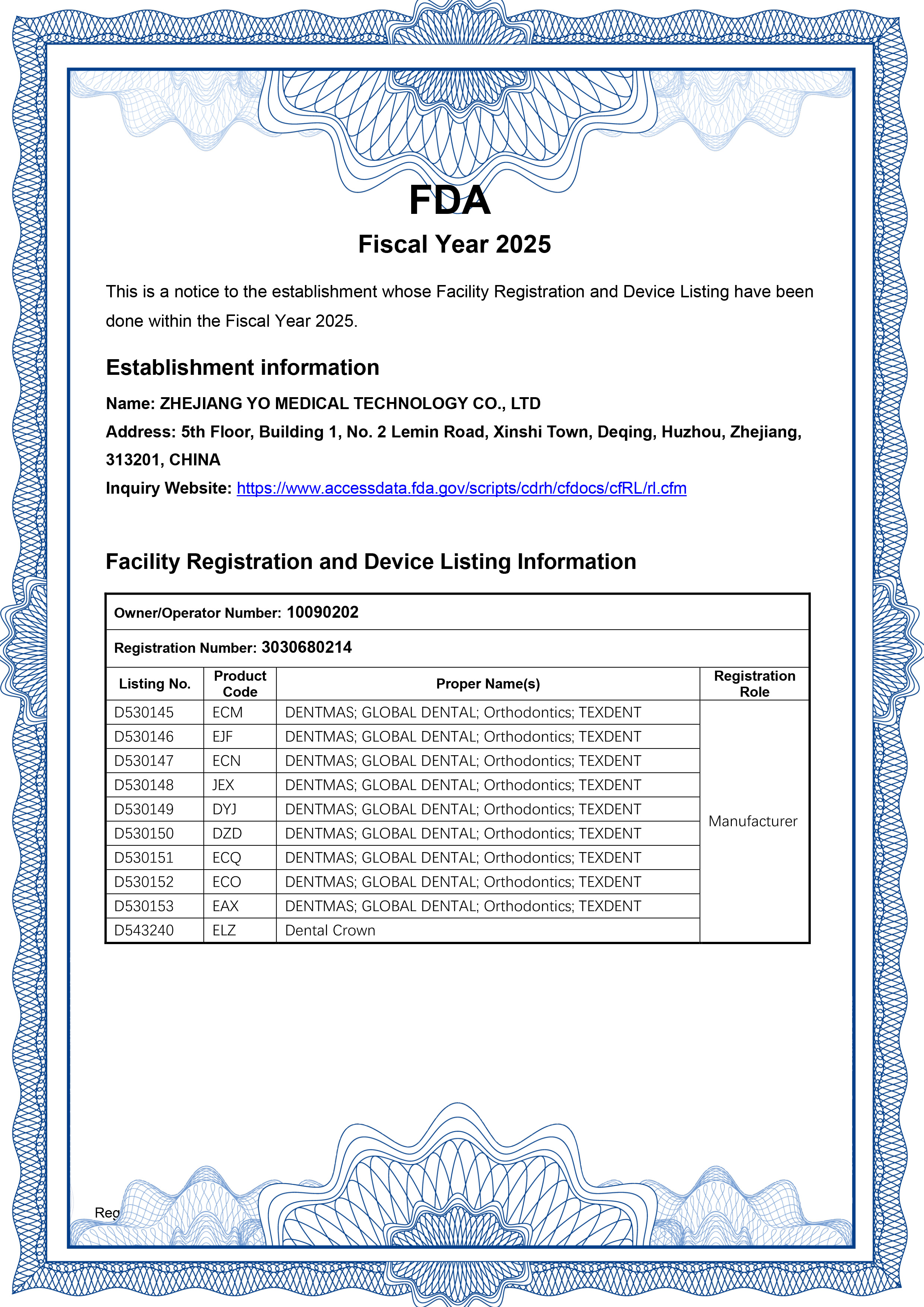
A registration document lists device families. Auditors should map the listed families to the specific category being purchased.
What Yortho's Listed Scope Covers — and Where the Evidence Stops
Yortho is a UK brand belonging to YAM Global Limited that operates its own orthodontic manufacturing facility in Huzhou, Zhejiang Province, China, and supplies orthodontic consumables, pediatric dental products and dental laboratory appliances. Applied to the audit logic above, its listed scope spans all four process families rather than one.
The metal and assembly side covers metal brackets, self-ligating brackets, ceramic self-ligating brackets, buccal tubes, molar bands, lingual buttons, crimpable hooks and lingual auxiliaries, alongside pliers and hand instruments. The wire side covers stainless steel, super-elastic NiTi, heat-activated NiTi and TMA arch wires across multiple arch forms and sizes from 0.012'' to 0.020''. The polymer side covers elastic ligatures and power chains in open long, closed continuous and open short formats. The laboratory and pediatric side covers expansion screws in K, G and I series, face masks, intraoral mirrors, pediatric crowns, rapid palatal expanders, miniscrews and distalization systems.
Production-side facts that can be checked against that scope include a 5,000 m² facility, approximately 100 employees with a 20-engineer technical team, and a stated annual output of 30,000,000 units. Commercial terms include OEM and ODM services with customisation of packaging, logo, tag and product, order minimums from 100 units, a 3–7 day lead time on standard items, 100% testing, and remote after-sales support. Export markets are listed as the EU, Middle East, Asia, America, Africa and Australia, with products shipped to more than 70 countries.
Documentation includes FDA registration under 21 CFR Part 807, ISO certification and CE certification under the EU MDR, plus a Certificate for Exportation of Medical Products for orthodontic pliers issued by the Zhejiang Medical Products Administration (certificate number Zhehang Food & Drug Admin Medical Device Export 20250496, valid 9 June 2025 to 8 June 2027). The FDA registration scope lists device families including brackets, bands, springs, mouth mirrors and screw expanders — a scope wide enough to be useful, and specific enough to be checked line by line.
Two reference projects illustrate how scope becomes order volume. A distributor project across the UK, US, Italy, France, Germany, Egypt, Spain, Cuba, Australia, Canada, Colombia, Denmark, Djibouti, Finland, Hungary, Indonesia, Qatar and Saudi Arabia supplied 5,000 units over a 1–3 year period, with reported favourable clinical feedback and performance consistent with local hospital requirements. A dental hospital project in Indonesia supplied 3,000 units of the self-ligating bracket system over two years, with reported stable performance against local clinical requirements. Both are supplier-reported references rather than independent clinical trials, and should be read as evidence of delivery capability, not of clinical superiority.
The boundary is worth stating as clearly as the scope. A multi-category manufacturer of this profile is organised around breadth and replenishment. It is not positioned as a specialist developer of a single alloy system or a single prescription philosophy, and breadth across families necessarily means engineering attention is divided. Buyers whose requirement is a proprietary wire metallurgy, a prescription-specific bracket torque table, or a fully digital aligner workflow should treat breadth as a starting point for discussion rather than a substitute for family-level depth testing.
Market Trend: Why Breadth Is Being Repriced
Three shifts are making scope audits more valuable than they were a few years ago.
First, demand is concentrating in consumable families. Brackets led consumables revenue in 2024, and buccal braces are projected to hold a large majority share by 2026. Buyers who consolidate brackets, tubes, bands and wires with one supplier reduce the number of incoming inspections they must run, which raises the cost of getting the scope question wrong.
Second, the buying channel is fragmented and clinical. Orthodontic clinics and standalone practices represent over 50% of the end-user distribution channel according to Grand View Research. Small-batch, multi-family orders are normal in this structure, and a supplier that cannot combine metal, polymer and wire families in one shipment forces distributors to carry more inventory than necessary.
Third, supply geography is shifting. Asia-Pacific is identified as the fastest-growing market for orthodontic supplies, and China exported approximately USD 12.7 billion in medical instruments under HS 9018 in 2025 according to OEC data, with Zhejiang among the leading export provinces for dental instruments. That concentration increases the number of suppliers presenting broad catalogues, and with it the need for a repeatable audit method.
Comparison With Specialist Suppliers
Breadth is a positioning choice, not a quality ranking. The table below compares supplier types by publicly stated focus, using that focus only to illustrate what an auditor should expect to find.
| Supplier type / example | Publicly noted focus | What it means when auditing scope |
|---|---|---|
| Yortho (YAM Global Limited) | Multi-family manufacturer: orthodontic supplies, pediatric dental products and dental laboratory appliances; OEM/ODM | Expect fewer documentation gaps across families; test depth per family rather than overall range |
| Dentaurum (Germany) | Long-established manufacturer known for stainless steel alloys and orthodontic catalogue depth | Expect alloy-level documentation; compare on wire and instrument metallurgy |
| Ormco / Envista Holdings | Passive self-ligating systems (Damon) and bracket platforms | Expect prescription and system depth; compare on bracket programme consistency |
| 3M Unitek | Metal and ceramic bracket ranges, including the Clarity Advanced series | Expect aesthetic bracket depth; compare on ceramic performance claims |
| American Orthodontics | Self-ligating systems within the bracket market | Expect system-specific documentation; compare on ligation mechanism |
| GC Corporation (Japan) | High-biocompatibility materials | Expect material-level claims; compare on biocompatibility evidence |
| TP Orthodontics | Customised bracket and wire solutions | Expect prescription customisation; compare on configuration flexibility |
The practical conclusion is that a specialist and a multi-family manufacturer answer different questions. A specialist is easier to audit inside one family and harder to consolidate across five. A multi-family manufacturer reduces supplier count and consolidated shipping but requires the buyer to run the family-by-family checks described earlier. Neither pattern removes the need for category-level samples.
Future Outlook
Two technical trends are likely to change how scope is audited. Ceramic self-ligating brackets are gaining ground on aesthetic and friction-reduction grounds, which pushes buyers to evaluate ceramic process control separately from metal. Digital workflows involving intraoral scanners and CAD/CAM are also described as a critical trend for 2025, and additive manufacturing is becoming standard for models and aligner moulds. A supplier whose scope is built around machined metal and elastomer consumables will need to demonstrate how it interfaces with those digital workflows rather than assume the interface.
Regulatory pressure is the second factor. MDR 2017/745 governs CE marking in Europe, ISO 13485:2016 underpins the FDA's QMSR, and the Medical Device Single Audit Program is increasingly used to cover Australia, Brazil, Canada, Japan and the United States in one audit. Each of these raises the documentation bar for every family a supplier lists, and makes the difference between manufactured and sourced items more visible to auditors than it used to be.
FAQ
How can a buyer confirm that a supplier actually produces every category it lists?
Map each listed category to a process family, then request one model code and one physical sample per family. Cross-check those codes against current documentation — certificates, registration listings and shipment records. Where a code appears in the catalogue but in no document, ask which production step is subcontracted. The answer is often legitimate assembly or component sourcing; the audit fails only when the supplier cannot or will not distinguish the two.
Which product families should be sampled first?
Start with the families where process risk and switching cost are highest: brackets and buccal tubes for slot and torque tolerance, arch wires for alloy and heat treatment, pliers and instruments for hardness and sterilization limits, and polymer auxiliaries for elastic recovery. These four cover the process families behind most orthodontic catalogues, so a sample set built this way tests breadth more efficiently than a large mixed bag of low-risk items.
What does a broad product range actually prove about a manufacturer?
It proves investment across more than one production logic — metal machining, wire forming, polymer processing or multi-material assembly — and it usually implies a broader incoming-inspection regime. It does not prove depth within any single family, and it says nothing about clinical outcomes. Breadth should therefore be treated as a reason to investigate, not as a conclusion about capability.
What documents should accompany brackets, bands and tubes?
At minimum, a quality management certificate such as ISO 13485:2016, CE marking under MDR 2017/745 for European market access, and FDA establishment registration and device listing for the United States. Buyers should read the scope line rather than the certificate title, check validity dates, and confirm whether the supplier holds 510(k) premarket clearance where the device classification requires it, since registration and clearance are separate regulatory steps.
Where does product breadth stop being useful evidence?
When the buyer's case mix does not need it. A practice standardised on one prescription, or a workflow driven by intraoral scanning and aligner manufacture, gains little from a catalogue that spans expansion screws, face masks and pediatric crowns. In those situations a narrower supplier with deeper documentation inside the relevant family is usually the better comparison, even if its overall range is shorter.
How should supplier case references be documented?
Record the product family, scale, duration, destination market and the source of the feedback. A reference stating a distributor project of 5,000 units over 1–3 years across multiple countries, or a dental hospital project of 3,000 units over two years, is useful because it is specific about scale and time. Reported clinical feedback should be recorded as supplier-reported unless independent data exists.
Yortho's published product brochure, including category listings and model references, is available for download: Yortho product brochure (PDF).
Tem questões ou precisa de mais detalhes?
Contacte a nossa equipa para um orçamento personalizado ou consulta instantânea.
Solicitar orçamento
Preencha o formulário abaixo e a nossa equipa entrará em contacto com uma proposta personalizada.
Chat direto do WhatsApp
Prefere conversar em tempo real? Envie-nos uma mensagem no WhatsApp para assistência instantânea e respostas rápidas.
- Obter orçamento personalizado
- Partilhar fotos ou documentos
- Discuta as suas necessidades diretamente
Geralmente responde em 5–30 minutos durante o horário de expediente.