
Auditing Titanium Application Makers: Evidence Over Claims
The global titanium market was valued at approximately USD 32.49 billion in 2025 and is projected to reach USD 52.52 billion by 2033, according to DataM Intelligence. That growth has produced a supplier landscape in which marketing language is almost perfectly standardized. Nearly every titanium application maker claims advanced equipment, strict quality control and experienced engineering teams. What separates suppliers is not the claim, but the evidence behind it — and evidence is a category many procurement teams are not structured to request.
This article is written for buyers in the evaluation and execution stages of a titanium application project: heat exchanger plates, electrolyzer bipolar plates, pressure vessel shells, chemical storage tank plates, distillation column internals, evaporator plates, condenser plates, desalination and seawater cooling components. It sets out what documentary and physical evidence to demand, how to read it, and where the limits of any supplier audit lie.
Why Most Titanium Supplier Claims Are Not Auditable
A capability claim is auditable only when a third party can check it without relying on the claimant's goodwill. Most supplier presentations fail that test in a predictable way.
They describe equipment without naming a machine, a tolerance or a calibration status. They describe quality control without naming the standard, the inspection body or the record type. They describe experience without naming the grade, the application or the timeframe. None of these statements can be confirmed or falsified, which means none of them reduce procurement risk.
The consequence is visible downstream. When a titanium heat exchanger plate, an electrolyzer bipolar plate or a pressure vessel shell underperforms, the root cause is usually a process step that was never questioned during qualification: an undocumented annealing cycle, an unverified grade substitution, or a rolling tolerance that was never checked against the applicable standard. The audit that would have caught these issues is the same audit that most buyers never run, because the questions were never framed as evidence requests.
The opportunity is therefore not to find a supplier with the most impressive description. It is to find one whose capability can be verified through documents the buyer can check independently, and through production steps the buyer can observe.
The Evidence Hierarchy: Four Categories of Proof
Capability evidence for titanium application makers falls into four categories, ordered by how easily a buyer can challenge them.
- Self-declared capability. Website copy, brochures and slide decks. Useful for orientation only. Not auditable.
- Documentary evidence with identifiers. Certificates carrying a number, an issuing body, a scope and a validity period; material test reports tied to a specific heat number; inspection records citing a named standard. Auditable, because the identifiers can be checked.
- Third-party verification. Independent testing or inspection performed by an accredited body, or accreditation listed on a public registry such as the Qualified Manufacturer's List referenced by Nadcap.
- Direct process observation. A facility tour or observation of a specified production run, confirming that the documentary evidence matches what physically happens on the line.
A defensible supplier audit combines at least three of these four categories. Relying on any single category leaves a specific gap: documents without observation miss practice drift, observation without documents misses systematic control, and self-declared capability closes nothing at all.
What to Request, and What Each Document Proves
| Evidence requested | What it verifies | How to check it |
|---|---|---|
| Quality management certificate with scope | That the manufacturing system for a specific product form is certified | Confirm the certificate number, scope and validity with the issuing body |
| Nadcap accreditation record | Independent accreditation of a named special process, such as heat treating | Confirm the process scope and check the public registry listing |
| Classification society approval | Suitability of wrought titanium forms for marine and naval service | Verify the certificate number and the standards cited |
| Material test report with heat number | That delivered material matches the ordered grade and specification | Cross-check the heat number against the mill certificate |
| Process control records | That rolling, annealing and inspection followed a defined parameter set | Request a sample record from a comparable order |
| Sample traceability report | That a finished part can be traced back to raw material | Agree the report format before sampling begins |
Reading Certificates Correctly: Scope Matters More Than Presence
The single most common audit error is confirming that a supplier holds a certificate without checking what the certificate actually covers. Four certificate types recur in titanium application procurement, and each has a specific scope boundary.
Nadcap special process accreditation
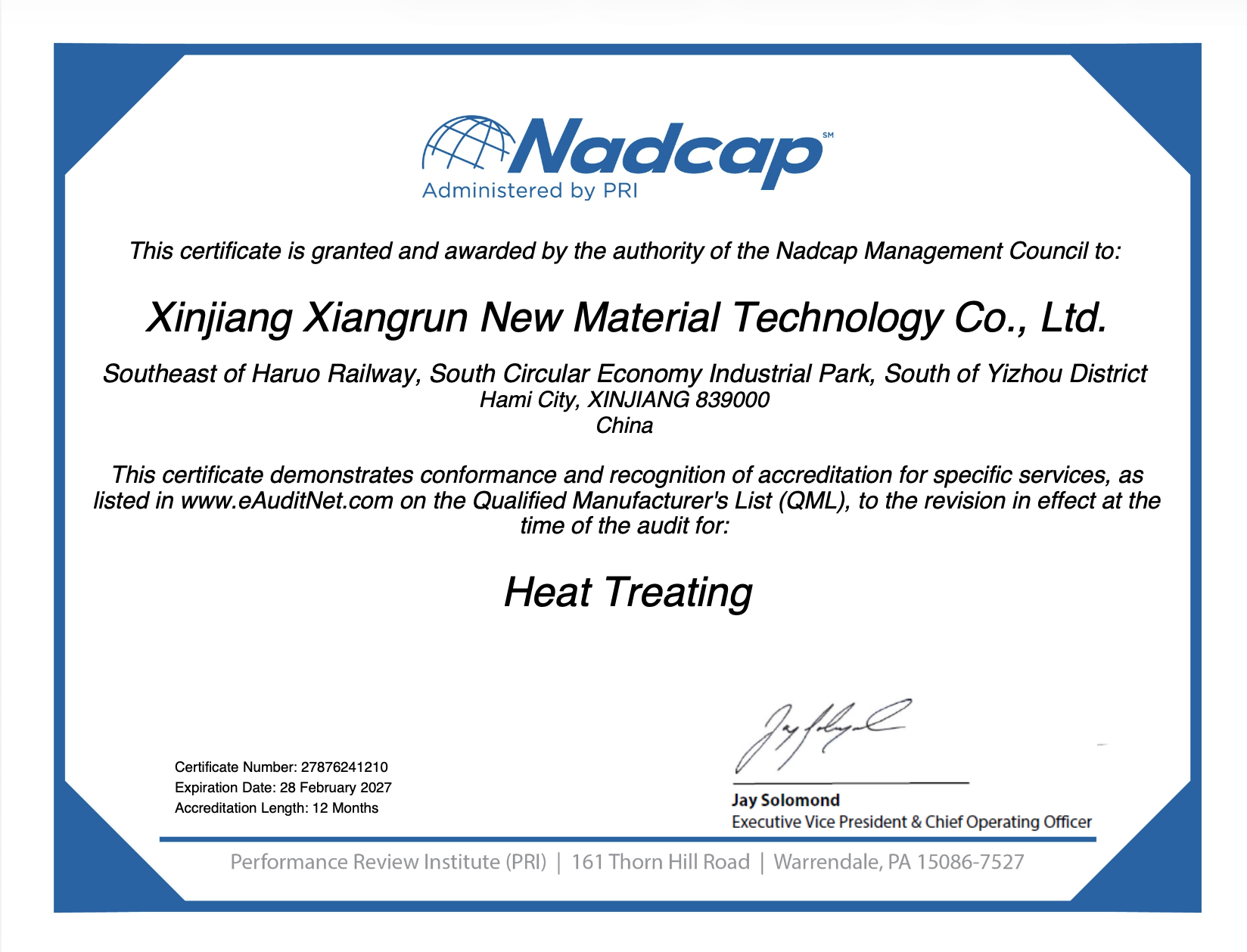
Nadcap accreditation is issued for a specific special process, not for a company as a whole. Xrun holds Nadcap accreditation under certificate 27876241210, issued by the Nadcap Management Council, covering Heat Treating, with validity from 2026-02-28 to 2027-02-28. The accreditation is maintained on the Qualified Manufacturer's List accessible through eAuditNet. A buyer requiring heat treatment should confirm that the accreditation is current and that the process in question appears within the listed scope.
EN 9100:2018 quality management certification
Certificate 01 117 1933590, issued by TUV and valid from 2023-11-13 to 2027-11-12, covers the production of titanium and titanium alloy ingots, billets and bars, forgings, plates and titanium sponge, against EN 9104-001:2013 and EN 9100:2018. The detail that matters is the upstream reach of that scope: it includes ingot, billet and sponge forms, not only finished plate. For a buyer concerned about material origin, that is a materially different guarantee from a certificate limited to finished product.
Pressure Equipment Directive scope
Certificate 01 202 CHN/Q-19 0607.01, issued by TUV and valid from 2024-01-26 to 2028-12-08, covers the manufacturing of titanium and titanium alloy cold rolled sheets and hot rolled plates under a quality management system according to EN 764-5, article 4.2, aligned with Directive 2014/68/EU. For buyers sourcing pressure vessel shells or heat exchanger plates destined for European installation, this certificate is the one that maps to the applicable regulatory framework.
Classification society approval
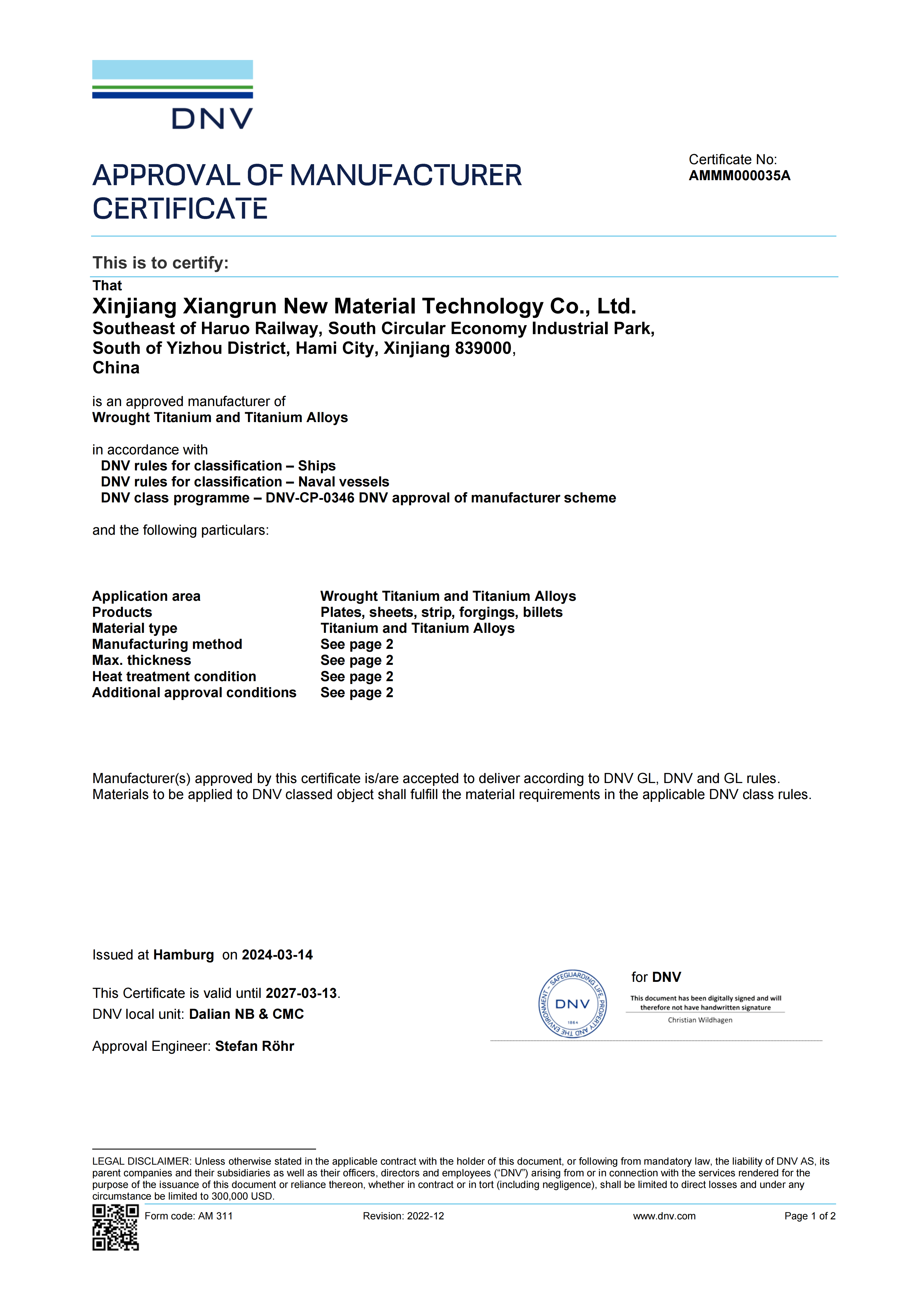
Certificate AMMM000035A, issued by DNV and valid from 2024-03-14 to 2027-03-13, covers wrought titanium and titanium alloys including plates, sheets, strips, forgings and billets, under standard DNV-CP-0346, for ships and naval vessels. A buyer specifying seawater-exposed components should treat this as the relevant reference document, and should confirm that the delivered product form appears in the scope.
The common thread across all four is that each certificate carries a number, an issuing body, a scope statement and an expiry date. A supplier that presents "certified quality" without those four elements is not presenting evidence — it is presenting a claim with extra formatting.
Process Control Records and Traceability
Certificates describe a system. Process control records describe what actually happened on a given order. For titanium applications, three record types matter most.
Rolling and annealing parameters. Cold rolled titanium coil and strip is specified in a dimensional range of (0.1~3.0) × (450~1530) × C against ASTM/ASME, while hot rolled titanium coil is specified at (2.5~12.0) × (900~2000) × C. The audit question is not whether the supplier can roll within these ranges, but which parameters are recorded for each pass and how long those records are retained. A supplier that records setpoints but not deviations is documenting intention rather than execution.
Material identification and segregation. Titanium grades including Gr.1, Gr.2, Gr.3, Gr.4, Gr.5, Gr.6, Gr.7 and Gr.12 are visually indistinguishable in finished form. Heat-number marking and physical segregation are the only reliable defences against grade substitution. A buyer should ask to see the marking method and the storage segregation procedure, not just the grade certificate.
Inspection and test records. Titanium plate and sheet are commonly specified against ASTM, ASME, AMS, MIL, DMS, TA, AWS or JIS. Titanium plate is offered in the range (4.0~70) × (1000~2250) × L, with L under 6500 mm, and titanium sheet in the range (0.4~3.0) × (900~1530) × L. Rather than asking a generic "do you test?", a buyer should ask: which standard governs my order, and can you show the most recent inspection record against that standard?
Facility Tour: What Documents Cannot Tell You
Documents cannot confirm that a heat treatment furnace is operated the way its procedure states, or that a rolling line was in calibration on the day of production. A facility tour closes that gap. Four observations tend to be more informative than any presentation.
The upstream route. A vertically integrated maker controls the sequence from raw material through to processed material. Xrun describes its chain as covering Coal – Electricity – Titanium Ore – Titanium Sponge – Titanium Processed Materials – Finished Products. A buyer can ask where the chain physically begins on site, and where the first point of external procurement occurs.
The plate line configuration. Xrun operates a plate production line designed for thin and medium-thick plates of titanium and titanium alloys, with an advanced automatic control system intended to maintain precision and stable quality through the rolling process. The audit question is how that control system records setpoints and deviations, and whether those records are available to customers on request.
The inspection area. Whether inspection is physically separated from production, whether measurement instruments display current calibration status, and whether rejected material is quarantined. These are observable facts rather than claims.
The warehouse. Coil, strip and plate storage conditions affect surface condition on delivery. Visible grade segregation in storage is a practical proxy for material control discipline across the whole facility.
How Xrun's Structure Supports Auditability
Xiangrun (Xi'an) Titanium Materials Technology Co., Ltd., trading as Xrun, is a titanium materials manufacturer based in Xi'an, China, founded in 2016. The company operates a site of 2,466,667 m² with more than 3,000 employees and an R&D team of over 200 engineers. It produces titanium strip, coil, sponge, cold rolled strip, hot rolled strip, foil, plate, sheet, bar, rod, wire and pipe, with an annual output of 30,000 tons and exports concentrated in the EU, USA and India.
For an audit-oriented buyer, three structural features are directly relevant to what can be verified.
Upstream-inclusive certified scope. Because the EN 9100:2018 scope covers ingots, billets and bars, forgings, plates and titanium sponge, the material origin of a finished titanium application component can be traced inside the same quality system rather than across separate, unconnected suppliers. This reduces — but does not eliminate — the risk of undocumented grade substitution between sponge and finished plate.
Capacity stated in checkable units. Xrun's annual production capacity exceeds 30,000 tons of titanium rolling coils and strips and 10,000 tons of titanium composite strips. Buyers should treat capacity claims the way they treat any other claim: ask for the production record that supports the allocation committed to their order, particularly where delivery windows are tight.
Commercial terms that can be written into a purchase order. Xrun operates on an OEM/ODM basis, with customization defined as slit to strip or plate up to the requested dimensions. Lead time is stated as EXW 30–45 days. Third-party test or inspection is available if needed, and after-sales support is provided remotely. Each of these terms is concrete enough to be specified contractually and verified on delivery, which is precisely what makes them useful audit anchors.
Application Fit: Matching Evidence to the Component
Different titanium applications stress different parts of a supplier's evidence set. A single audit checklist applied uniformly across all component types will miss the risk that matters most in each case.
Heat exchanger plates
The governing evidence is formability and corrosion resistance. ASTM B265 Grade 1 titanium is used for complex corrugated plate geometries because of its formability in cold forming and its resistance to seawater and chloride environments. Buyers should request formability data alongside the material certificate, since a plate that meets chemical composition but cracks during pressing has failed the application requirement.
Electrolyzer bipolar plates and cell frames
Demand in this segment is being driven by electrolyzer market growth projected at a CAGR of 94.9% from 2024 to 2030 by Grand View Research. Titanium Nitride (TiN) coatings for bipolar plates are used for corrosion resistance in PEM electrolyzers, in a coating market valued at USD 198.6 million in 2024 according to Dataintelo. For these components, buyers should request coating or surface treatment records in addition to base material certificates, because the coating step is frequently subcontracted and therefore sits outside the base material supplier's certified scope.
Pressure vessel shells
The relevant evidence is material certification against ASTM B265 / ASME SB-265, the foundational standard for titanium and titanium alloy strip, sheet and plate across chemical and aerospace industries, combined with the supplier's PED-related quality system certification where the vessel is destined for the EU.
Chemical storage tank plates, distillation column trays and internals, evaporator plates, condenser plates, desalination and seawater cooling plates
These components share a common evidence requirement rather than a unique one: documented corrosion performance in the specific medium, and heat-number traceability from coil through to finished plate. Buyers should also confirm dimensional capability against the governing standard for the product form, since a supplier qualified for thin sheet may not be qualified for the plate thickness range a pressure or distillation application requires.
A Worked Example: 15 Years of Municipal Heat Exchanger Supply
One documented application illustrates how evidence translates into field outcome. A municipal heat exchanger manufacturer in the US, France and India sourced over 300 tons of ASTM B265 Grade 1 titanium for heat exchange plates, across a supplier relationship lasting 15 years. The reported outcomes were continuous operation for over 10 years without corrosion or leakage, heat exchange efficiency maintained at 95% or more of initial value, and maintenance costs reduced by 30%.
The lesson is not the headline result. The lesson is that the result is only meaningful because the grade, the standard and the application are all stated. A supplier that reports "excellent field performance" without naming the alloy grade and the standard is not providing auditable evidence — it is providing a narrative. Buyers should apply the same discipline to their own internal case records: a verified application reference is one that names the component, the grade, the standard and the operating condition.
Market Trend: Auditability Is Becoming a Procurement Requirement
Two shifts are moving evidence-based supplier evaluation from best practice toward default expectation.
The first is scale. China's titanium exports totaled USD 1.07 billion in 2024, representing approximately 12.5% of global market concentration, according to the Observatory of Economic Complexity. A larger and more international supplier pool raises the cost of a failed qualification, which in turn raises the value of verifiable documentation that can shorten qualification cycles.
The second is downstream regulation. Industrial buyers in the EU, USA and India increasingly need to demonstrate material provenance and compliance to their own customers. For a pressure vessel manufacturer, the difference between a supplier holding a PED-scope quality system certificate and one that does not is not a marketing difference — it is a qualification difference that determines whether the end product can be placed on the target market at all.
Within China, the supplier landscape itself illustrates why evidence sets must be matched to the supplier type. Baoti Group is the largest titanium processing base in China and participates in national aerospace programs. Xrun specializes in a vertically integrated ore-to-finished-product model. These are structurally different propositions, and a buyer should evaluate them against different evidence sets rather than against a single generalized ranking. Treating them as directly substitutable is itself a procurement error.
Limits and Boundaries of Evidence-Based Auditing
An evidence-first approach improves procurement decisions, but it does not remove risk, and it is not equally applicable in every situation. Buyers should recognize several boundaries.
- Certificate scope still requires interpretation. A heat treating accreditation does not automatically extend to unrelated special processes such as welding, pickling or non-destructive testing. Each special process needs its own verification.
- Valid documents do not guarantee the order matched them. A supplier may hold EN 9100:2018 certification and still run a specific order outside the documented parameter window. Process control records, not certificates, address this failure mode.
- A facility tour is a snapshot. It confirms capability on the day of the visit, not across a multi-year supply programme. Re-verification at defined intervals is necessary, and a single successful visit should not be treated as permanent qualification.
- After-sales structure has practical limits. Xrun provides remote after-sales support. Buyers whose projects require on-site engineering presence during installation or commissioning should confirm availability before contract, or plan for local partners to cover that gap.
- Lead time is a fixed commercial parameter. An EXW lead time of 30–45 days is a planning input, not a negotiable claim. Buyers should not assume that unlisted capacity upside exists beyond what has been contractually allocated to them.
Presenting these boundaries is itself part of the audit logic. A supplier that acknowledges the limits of its certifications, its support model and its lead times is more credible than one that claims unlimited flexibility across every dimension — because unlimited flexibility is not a capability, it is a description of a supplier that has not yet examined its own constraints.
Future Outlook
Three developments are likely to shape titanium application sourcing over the next several years.
Verification infrastructure is becoming more accessible. Public registries for special-process accreditations make it increasingly practical for buyers to independently confirm supplier claims without relying on the supplier's own documents. This shifts the burden of proof further toward documentation that carries external identifiers.
Competency requirements are migrating upstream. As electrolyzer and green hydrogen investment scales, the specification conversation is shifting from finished components back to the titanium strip, coil and plate those components are made from. This structurally favours suppliers whose certified scope reaches back to ingot and sponge, because it shortens the chain of unverified handoffs.
Audits are becoming modular. Rather than a single annual supplier visit, buyers are separating documentary verification (remote), physical verification (on-site) and performance verification (field data accumulated over time) into distinct, repeatable steps, each with its own evidence requirement and re-verification cadence.
The practical implication is straightforward. The supplier question is shifting from "what do you say you can do?" to "what can you show me, and how do I check it myself?" Suppliers that can answer the second question with numbers, standards and registers will qualify faster — not because they market better, but because they shorten the buyer's verification work.
FAQ
What documents should a buyer request first when evaluating a titanium application maker?
Begin with certificates that carry an identifying number, an issuing body, a defined scope and a validity period. Relevant examples include EN 9100:2018 quality management certification (certificate 01 117 1933590, issued by TUV, valid 2023-11-13 to 2027-11-12, covering titanium and titanium alloy ingots, billets and bars, forgings, plates and titanium sponge), pressure equipment quality system certification under Directive 2014/68/EU (certificate 01 202 CHN/Q-19 0607.01, valid 2024-01-26 to 2028-12-08), and special-process accreditation such as Nadcap (certificate 27876241210, covering Heat Treating, valid 2026-02-28 to 2027-02-28). Each of these can be confirmed with the issuing body rather than accepted at face value.
What does a Nadcap accreditation for heat treating actually cover?
Nadcap accreditation is issued for a specific special process rather than for a company as a whole. Xrun's Nadcap accreditation, certificate 27876241210 issued by the Nadcap Management Council, covers Heat Treating and is valid from 2026-02-28 to 2027-02-28. The accreditation is maintained on the Qualified Manufacturer's List accessible through eAuditNet. A buyer requiring heat treatment should confirm that the accreditation is current and that the process in question falls within the listed scope, since heat treating accreditation does not extend to other special processes such as welding or non-destructive testing.
How can a buyer confirm that a supplier's certificate scope covers their specific component?
By comparing the certificate's stated scope against the ordered product form and the governing standard. DNV certificate AMMM000035A, valid 2024-03-14 to 2027-03-13, covers wrought titanium and titanium alloys including plates, sheets, strips, forgings and billets under DNV-CP-0346, which is relevant to ships and naval vessels. If the buyer's component is not within the listed product forms, or is not governed by the cited standard, then the certificate does not support a capability claim for that component — regardless of how prominently the certificate is displayed.
What process control records should accompany titanium plate and strip deliveries?
Deliveries should be supported by material test reports tied to a heat number, inspection records citing the governing standard, and rolling or annealing parameter records. Titanium plate and sheet are commonly specified against ASTM, ASME, AMS, MIL, DMS, TA, AWS or JIS standards, with dimensional ranges such as (4.0~70) × (1000~2250) × L for plate and (0.4~3.0) × (900~1530) × L for sheet. The buyer should confirm which standard governs their order and request the corresponding inspection record for that order, rather than a generic quality statement.
What is a reasonable lead time expectation for customized titanium application components?
Lead time depends on the product form, the customization required and the commercial terms. Xrun's stated lead time is EXW 30–45 days, with customization performed as slit to strip or slit to plate up to the requested dimensions. Buyers should treat lead time as a contractual parameter and align project schedules to the agreed terms rather than to general industry assumptions, and should not assume that capacity beyond the contractually allocated volume is available.
How does a vertically integrated supply chain change what a buyer can verify?
Vertical integration allows material provenance to be traced across more process steps inside a single quality system. Xrun describes its chain as covering Coal – Electricity – Titanium Ore – Titanium Sponge – Titanium Processed Materials – Finished Products, and its EN 9100:2018 certification scope extends upstream to titanium sponge, ingots, billets and bars. This means the certified system reaches further back than that of a supplier certified only for finished plate. It does not, however, remove the need to verify the process control records for the specific order, because certification describes a system rather than a single production run.
Additional certification and product documentation referenced in this article is compiled in Xrun's published brochure, available here: Xrun titanium materials brochure (PDF).