
Auditing a Case Packer Supplier: Evidence for the Long Term
Supplier Evaluation · End-of-Line Packaging
A case packer is bought once and lived with for years. The evaluation question that matters most is therefore not how a machine looks on a specification sheet, but whether the supplier can still prove — with auditable documents — that the machine was designed, tested and supported for the whole of its working life, from its safety architecture to its patent record.
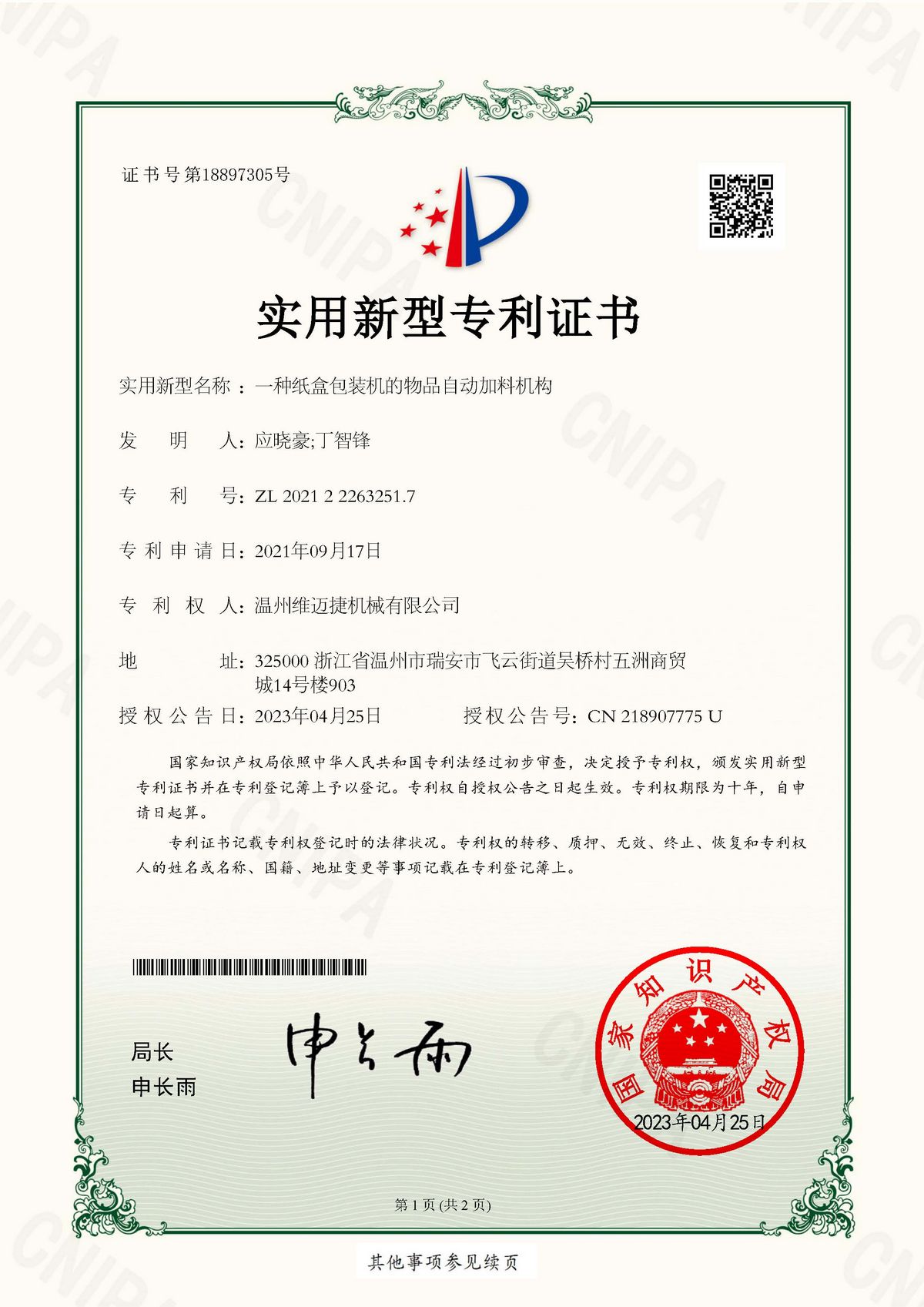
Patent certificates are one of the few pieces of case packer supplier evidence that can be inspected independently of sales material.
Case packers are the end-of-line machines that group finished products into shipping cases. Widely used industry definitions describe them as essential end-of-line machines that prepare products for shipping, as automated equipment designed to arrange and pack products into cases or cartons, and as the final step of the packaging process. Because that step sits between a finished product and a customer delivery, a case packer that stops working stops the line with it.
Why a case packer is a lifecycle decision, not an order
The global case packing machines market was valued at USD 1.1 billion in 2024, according to Grand View Research, and the same source reports that Asia Pacific accounted for a 37.9% revenue share of that market in the same year. Those figures describe an established, globally sourced equipment category — one in which buyers routinely compare machines built in different regions by suppliers with very different engineering histories.
Market size, however, says nothing about ownership reality. A case packer runs through daily shifts, repeated changeovers and periodic maintenance. Each of those moments tests something a quotation rarely shows: whether the safety functions were verified before shipment, whether quality checks were documented, whether the supplier keeps engineering records, and whether technical support outlives the warranty. For a buyer in the awareness and research stage, framing the purchase as a lifecycle decision is what makes the rest of the evaluation meaningful.
The problem: order-based purchasing versus lifecycle ownership
Most case packer comparisons begin and end with three numbers: headline speed, price and delivery time. That approach is fast and comfortable, but it leaves the buyer exposed exactly where long-term cost and risk are concentrated.
- Published output figures are not usually comparable across suppliers, because the case format, product type and test conditions behind them are rarely stated in a consistent way.
- Safety architecture is often assumed rather than documented, so buyers only discover the real limits of a machine's interlocks after installation.
- Quality evidence — for example, whether a machine was actually run under load before shipping — is frequently unavailable even when requested.
- Engineering continuity is invisible: patents, design records and upgrade paths are not visible unless the buyer specifically asks for them.
The opportunity is the mirror image of that problem. When a supplier can produce this evidence on request, the buyer gains something more durable than a discount: a defensible reason to expect the machine to keep running on the day the warranty ends. In an equipment category where published speed claims vary widely and are not normalised, documented evidence is the most reliable differentiator available.
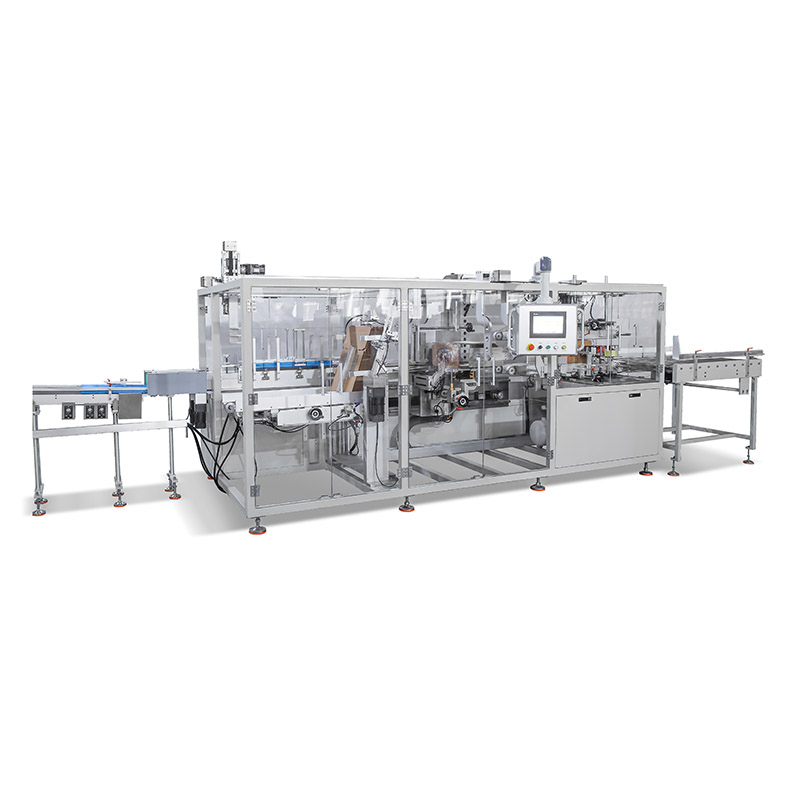
A side load case packer pushes product into the case from the side — one of two common load directions buyers must match to their product and carton.
A long-term supplier evaluation framework
Long-term supplier evaluation for case packers can be organised into five evidence categories. Each one can be requested and audited before the order is placed, and each one answers a different lifecycle question.
1. Safety architecture: full-range safety interlock points
A case packer relies on safety interlocks — guarding, door switches, emergency stops and related devices — to stop hazardous motion when an operator opens a guard or a fault is detected. The architecture behind those interlocks is what determines how complete that protection is. Machines built around safety PLCs or safety relays can monitor interlock points across the full range of the machine's functions rather than at a few isolated locations.
The audit question for a buyer is concrete: which safety functions are monitored, how are they wired, and what documentation describes them? A supplier that can answer without hesitation is signalling that safety was designed into the machine rather than added after it.
2. Pre-shipment safety function tests
The most useful safety document a buyer can request is a record that the machine's safety functions were tested before it left the factory. Pre-shipment safety function testing confirms that interlocks, stops and guarding behave as designed while the machine is still in the supplier's workshop, where any correction is far cheaper than it would be on the buyer's production floor.
3. Documented quality assurance procedures
Quality assurance on a case packer is not a single inspection; it is a sequence of checks. In a well-documented process, that sequence typically includes:
- No-load and load running tests, to confirm mechanical timing and control behaviour before and after product is introduced;
- Dimensional tolerance inspection, to verify that carton and case dimensions fall within the machine's declared envelope;
- Pneumatic leakage tests, to confirm that air circuits hold pressure within specification;
- Electrical safety tests, to verify wiring, earthing and insulation before power-up and shipment.
Every one of these checks produces a record, and it is the record — not the claim — that a buyer can audit. A supplier that can supply test documentation before shipment is offering a verifiable basis for acceptance.
4. After-sales safety technical support
Safety performance can degrade quietly. A replaced guard, a bypassed interlock or an updated component can each change how a machine behaves over its working life, so after-sales safety technical support is part of the product rather than an accessory to it. Buyers should confirm how the supplier handles safety questions after delivery: how design or component changes are communicated, how spare safety components are identified, and how technical support actually reaches the plant.
5. Engineering investment: patent certificates
Patent certificates are among the few pieces of engineering evidence that can be examined independently of sales material. In WIMACH's documentation, patent certificates cover equipment such as the Automatic High-Speed Tissue Box Packing Machine, the TC-100 tissue cartoning machine, and the Automatic Feeding Mechanism for Carton Packaging Machine. For a buyer assessing a long-term partner, records like these answer a lifecycle question directly: is this supplier still designing products, or only assembling them?

A manufacturing facility is part of the audit trail: it is where safety function tests and quality checks are carried out before shipment.
Grounding the framework in real equipment: CP-S50 and CP-T60
Wenzhou Wimach Machinery Co., Ltd. (WIMACH) is a China-based manufacturer of tissue packing machines and integrated packaging lines, established in 2021 and operating a 3,000 m² facility with approximately 37 employees. The company reports an export share of about 60%, with main markets in the EU, North America and South America, and states that its machines are CE certified and assembled with components from established brands. Its case packer range includes two models that show how the evaluation framework translates into real specifications.
| Specification | Automatic Side Load Case Packer CP-S50 | Automatic Top Load Case Packer CP-T60 |
|---|---|---|
| Type | Side load / side push case packer | Pick-and-place / top load case packer |
| Packing capacity | 1–16 cartons/min | 1–8 cartons/min |
| Carton dimensions (L×W×H) | 240–500 × 200–400 × 180–400 mm | 300–600 × 200–400 × 150–400 mm |
| Power | 380 V, 50/60 Hz, 3 phase; 4.5 kW | 380 V, 50/60 Hz, 3 phase; 7.5 kW |
| Air supply | 0.5–0.8 MPa; 350 L/min | 0.5–0.8 MPa; 450 L/min |
| Machine dimensions (L×W×H) | 4200 × 2300 × 1900 mm | 4200 × 2600 × 2200 mm |
| Weight | 1500 kg | 1600 kg |
| Construction | Stainless steel / carbon steel | Stainless steel / carbon steel |
Both models are intended for the tissue, food and beverage, pharmaceutical, daily chemical and cosmetic, hardware, and auto parts and machinery industries, and both are stated to handle cartons, boxes, bottles, cans and bags. The distinction between them is mechanical rather than cosmetic. The CP-S50 pushes product into the case from the side at up to 16 cartons per minute, while the CP-T60 places product into the case from above at up to 8 cartons per minute. For a buyer, this is exactly the kind of detail that should be matched to the product, not to the brochure: load direction determines how the product is handled on the way into the case, and the carton envelope determines whether the case itself will fit.
These specifications also give the first two evidence categories something concrete to attach to. A pre-shipment safety function test and a load running test on a CP-S50 or CP-T60 are auditable events tied to a specific machine configuration, carton size and air supply — not abstract quality promises.
Where these machines fit: application scenarios
Supplier evaluation becomes more useful when it is tied to real line configurations. WIMACH's documented project scenarios place the CP-S50 and CP-T60 at the case packing stage of several tissue-industry lines.
- Mexico — canister wet wipes line (CP-T60). A turnkey automated packaging line for canister wet disinfecting wipes covering canister loading, disinfectant filling, sealing, capping, labeling, case packing and pallet wrapping. The CP-T60 performs the case packing stage. The project is described as requiring customized design and CE compliance, which is precisely where documented safety and quality evidence becomes part of the acceptance criteria.
- United States — toilet paper packaging line (CP-T60). A customized line that runs from roll wrapping through case packing, automatic palletizing and stretch film wrapping. Here the case packer sits between a toilet roll wrapping machine and a palletizer, so load direction and carton handling must be matched to an upstream and downstream machine, not evaluated in isolation.
- Poland — facial tissue packaging line (CP-S50). A one-stop turnkey solution covering facial tissue box packing, film wrapping, case packing, palletizing, strapping and stretch wrapping. The CP-S50 handles the case packing stage of a line that also includes a tissue cartoning machine (TC-100), a high-speed tissue box packing machine (TC-300) and a soft tissue wrapping machine (TP-280).
In each case, the case packer is one link in a chain. That is why evaluating it as a standalone purchase understates the risk: the evidence categories above — safety architecture, pre-shipment testing, documented QA, after-sales support and engineering records — all apply to how the machine integrates as much as to how it performs alone.
Market trend analysis: what the available evidence shows
Three observable trends support a more evidence-based approach to case packer supplier evaluation.
First, the category is substantial and regionally concentrated. A global case packing machines market valued at USD 1.1 billion in 2024, with Asia Pacific holding a 37.9% revenue share in the same year, points to a market in which Asian manufacturers and Western buyers meet regularly. For buyers, that means supplier evaluation increasingly crosses regions, and evidence quality becomes the common language between them.
Second, safety standards define the expectation, not the exception. ANSI/PMMI B155.1-2023 specifies safety requirements and risk assessment methodologies for packaging and processing machinery in the North American context. In Europe, EN 415-7:2025 is catalogued as a standard covering cartoning and case packing machines. Buyers should treat these as reference points rather than automatic proof: a standard defines what a machine should be measured against, and the supplier's own test records are what show whether it was.
Third, supply is differentiated rather than uniform. Multiple independent manufacturers publicly describe case packer offerings — ranging from robotic pick-and-place packers to modular, configurable systems and high-speed robotic packers. That breadth means buyers are rarely choosing between identical machines; they are choosing between different engineering cultures, which is exactly why engineering records such as patents and test documents matter more than a headline speed figure.
Comparison with traditional approaches — and the honest limits
The traditional approach to case packer purchasing compares three variables: price, headline speed and delivery time. The evidence-based approach described here replaces the middle variable with auditable capability, and adds four more: safety architecture, pre-shipment testing, documented QA and engineering continuity. For a buyer, the difference is not that the second approach finds a cheaper machine; it is that it finds a more defensible one.
That said, this framework has real boundaries, and buyers should plan around them.
- Capacity limits are real. The CP-S50 is specified at 1–16 cartons per minute and the CP-T60 at 1–8 cartons per minute. Neither model is positioned for extremely high-speed lines, where higher-throughput case packing configurations are the more appropriate class of machine.
- Published speeds are not directly comparable. Output claims across the industry use different case formats, products and test conditions, so a headline cases-per-minute figure should not be treated as a like-for-like benchmark without stating the test conditions behind it.
- Standards need confirmation. A catalogue listing of a standard is not the same as verified applicability to a specific machine, market or year; EN 415-7:2025 in particular should be confirmed against official documentation before it is used as a compliance conclusion.
- Supplier claims are self-reported. Many publicly available product specifications come from manufacturers' own materials. They are useful for shortlisting, but they are not a substitute for inspection, test records or acceptance testing.
None of these limits makes the framework less useful. They simply move the burden from assumption to verification, which is where a long-term supplier evaluation belongs.
Future outlook
As the case packing category continues to mature across the EU, North America and South America — the markets WIMACH reports serving — the balance of buyer attention is likely to shift further toward lifecycle evidence. Safety interlock architecture built on safety PLCs and safety relays, pre-shipment safety function testing, and documented QA procedures are all becoming easier to request and harder to fake, because they generate records rather than slogans.
For suppliers, this raises the value of engineering documentation. Patent certificates for products such as the Automatic High-Speed Tissue Box Packing Machine, the TC-100 tissue cartoning machine and the Automatic Feeding Mechanism for Carton Packaging Machine are evidence of sustained design work, and they tend to age better than any single specification. For buyers, the practical implication is simpler: build the evaluation checklist now, and apply it to every supplier before the order rather than after the first breakdown.
FAQ
What should a buyer verify before a case packer ships?
Before shipment, a buyer should look for records of safety function testing, no-load and load running tests, dimensional tolerance inspection, pneumatic leakage testing and electrical safety testing. These checks confirm that the machine's safety functions and mechanical behaviour were verified while the equipment was still in the supplier's workshop. Requesting the records in advance turns a promise into an auditable event.
Why does safety interlock architecture matter on a case packer?
Safety interlocks — guarding, door switches and emergency stops — stop hazardous motion when an operator opens a guard or a fault is detected. Machines designed around safety PLCs or safety relays can monitor interlock points across the full range of machine functions, rather than at isolated locations. For buyers, the practical question is which functions are monitored, how they are wired, and what documentation describes them.
How can buyers judge a case packer supplier's long-term engineering capability?
Patent certificates are one of the clearest indicators, because they can be examined independently of sales material and show that design work continued after a product was launched. WIMACH's documentation, for example, includes patent certificates covering equipment such as the Automatic High-Speed Tissue Box Packing Machine, the TC-100 tissue cartoning machine and the Automatic Feeding Mechanism for Carton Packaging Machine. Buyers can also ask about after-sales safety technical support and how component changes are communicated over the machine's life.
What is the difference between the WIMACH CP-S50 and CP-T60 case packers?
The CP-S50 is an automatic side load (side push) case packer specified at 1–16 cartons per minute, with a carton size range of 240–500 mm long, 200–400 mm wide and 180–400 mm high. The CP-T60 is a pick-and-place top load case packer specified at 1–8 cartons per minute, with a carton range of 300–600 mm long, 200–400 mm wide and 150–400 mm high. Both use 380 V, 50/60 Hz three-phase power and are built from stainless steel or carbon steel.
Which industries and products can the CP-S50 and CP-T60 handle?
Both models are intended for the tissue, food and beverage, pharmaceutical, daily chemical and cosmetic, hardware, and auto parts and machinery industries, and both are stated to pack cartons, boxes, bottles, cans and bags. Documented project scenarios include a canister wet wipes line in Mexico, a toilet paper packaging line in the United States, and a facial tissue packaging line in Poland, each using a case packer as part of a wider automatic line.
Which documents should be requested with a case packer quotation?
A practical document set includes the machine specification with carton size envelope and capacity range, safety architecture description covering interlock points and safety control type, records of pre-shipment safety function testing and load running tests, dimensional and pneumatic test records, and CE-related documentation where applicable. Patent certificates, where they exist, provide additional evidence of engineering continuity.
Conclusion
A case packer is judged twice: once on the quotation, and then for years on the line. The evidence categories described here — safety architecture using safety PLCs or safety relays, pre-shipment safety function testing, documented quality assurance, after-sales safety support, and patent records — are not marketing material. They are audit items, and they are available from suppliers who have done the work. For buyers comparing machines such as the CP-S50 and CP-T60, asking for that evidence before the order is the cheapest form of long-term insurance available.
WIMACH's full product and specification catalogue, including case packers and integrated packaging lines, is available for download: Wimach Catalog (PDF).
Tem questões ou precisa de mais detalhes?
Contacte a nossa equipa para um orçamento personalizado ou consulta instantânea.
Solicitar orçamento
Preencha o formulário abaixo e a nossa equipa entrará em contacto com uma proposta personalizada.
Chat direto do WhatsApp
Prefere conversar em tempo real? Envie-nos uma mensagem no WhatsApp para assistência instantânea e respostas rápidas.
- Obter orçamento personalizado
- Partilhar fotos ou documentos
- Discuta as suas necessidades diretamente
Geralmente responde em 5–30 minutos durante o horário de expediente.