
Auditing an Investment Casting Supplier: Certifications and 20,000-Ton Capacity
An investment casting program rarely fails because the supplier had no certificate. It fails because the buyer treated the certificate as proof of capability. A management-system certificate confirms that a documented system exists. It does not confirm that a specific alloy, wall section or tolerance class can be produced repeatably in that plant, on that process route, at the volume the program requires. This reference sets out how a buyer at the decision stage can audit an investment casting supplier against physical and documentary evidence rather than assertions, and uses WAYSCAN METAL PRODUCTS CO., LTD — an investment casting manufacturer established in 1991 in Ninghai, Ningbo, China — as a worked example of what auditable capability data looks like.
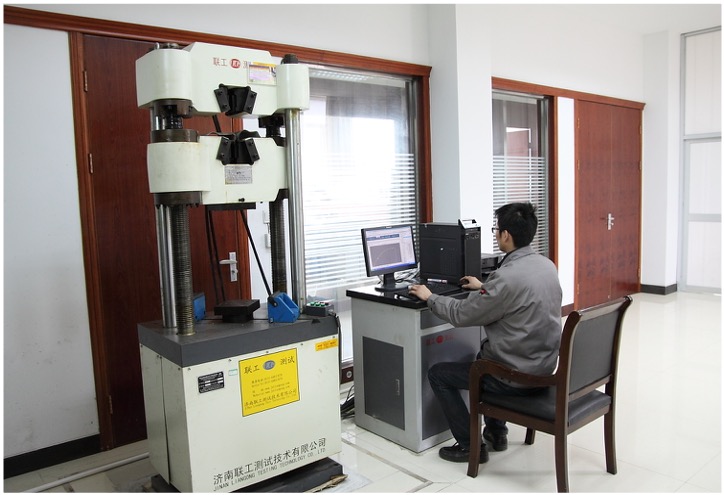
Inspection is where a supplier claim becomes a record. Dimensional, chemical and internal-quality evidence is generated on the shop floor, not inside the certificate.
The Audit Gap: Why Certificates Do Not De-Risk a Casting Program
Certification answers a narrow question well: is there a controlled system for planning, monitoring and correcting quality, environmental or safety performance? The four standards that dominate supplier shortlists in this category — ISO 9001:2015, IATF 16949:2016, ISO 14001:2015 and ISO 45001:2018 — are management-system standards. None of them certifies that a plant can hold a defined tolerance on a thin-wall stainless steel component, that its shell-making line is stable at the wall thickness your part requires, or that melting capacity is available in the month you need it.
That gap is where sourcing risk accumulates. Buyers routinely compare suppliers on certificate logos, annual tonnage and equipment lists, then discover during first-article inspection that the scope statement excluded the relevant process, that the tonnage figure was aggregate rather than allocated, or that the inspection department is real but was not applied to the part route quoted. The corrective measure is not more certificates; it is an audit structure that separates claims from evidence, and evidence from evidence relevant to your part.
The Four-Certificate Stack: What Each Standard Governs and What It Leaves Unverified
ISO 9001:2015, IATF 16949:2016, ISO 14001:2015 and ISO 45001:2018 are frequently presented as a single credibility block. They are not interchangeable, and treating them as one obscures the specific risk each one does and does not address.
| Standard | What it governs | What it verifies in an audit | What it does not verify |
|---|---|---|---|
| ISO 9001:2015 | General quality management system | Documented process control, corrective action, internal audit, management review, supplier control | That a specific geometry, alloy or tolerance class is producible |
| IATF 16949:2016 | Quality management system for automotive production | Automotive-specific process control, traceability discipline, change control, layered process auditing | That the certified site is qualified for your commodity or your program's volume |
| ISO 14001:2015 | Environmental management system | Control of emissions, waste streams, process chemistry and environmental compliance obligations | Product quality, dimensional capability or delivery performance |
| ISO 45001:2018 | Occupational health and safety management system | Workforce risk control, plant safety management, incident handling | Product quality or delivery performance |
IATF 16949:2016 is the standard that carries the most procurement weight in vehicle-related supply chains: the International Automotive Task Force positions it as the critical quality management system requirement for suppliers serving automotive production. That makes it a threshold credential rather than a differentiator in automotive sourcing — the differentiator is whether the certified scope actually covers the process route you are buying.
Material-level requirements sit in a separate layer. ASTM A957 is the common-requirements specification for steel and alloy investment castings for general industrial use, and it functions as the baseline that a purchase specification can reference independently of any management-system certificate. A supplier can hold every management-system certificate in the stack and still need to demonstrate compliance with ASTM A957 or a customer-specific specification for the part in question.
The Audit Trail Behind a Certificate: Fields Buyers Should Reconcile
A certificate is only auditable if it can be reconciled against six fields. Buyers should request all six and confirm the certificate through the issuing certification body's own registry rather than accepting a scanned PDF at face value.
- Legal entity and site address. Certificates are issued to a legal entity at a specific site. If the certificate names a head office or a different plant, the production site you intend to use may not be covered.
- Issuing certification body. The body that issued the certificate is identifiable and, in most markets, publicly searchable.
- Accreditation. An accreditation mark indicates that the issuing body itself operates under a recognised accreditation framework. Without it, the certificate's international acceptance may be limited.
- Certificate number. The number is what makes independent verification possible. A certificate without a number cannot be traced.
- Scope statement. This is the field most often skimmed and most often decisive. It defines which processes, materials or product families the system covers.
- Issue and expiry dates, plus revision history. A recertification cycle, not a one-time event, is what a long-term program is buying.
Within this framework, a supplier's published profile and its certificate are two different things, and neither substitutes for the other. WAYSCAN's published company profile covers its founding year, facility scale, workforce, capacity, process focus and external recognitions; certificate numbers, issuing bodies and scope statements for ISO 9001:2015, IATF 16949:2016, ISO 14001:2015 or ISO 45001:2018 must be requested directly and verified against the issuing body's registry. A buyer comparing suppliers should treat an unverifiable certificate as absent — a discipline that protects the program more than any logo on a presentation slide.
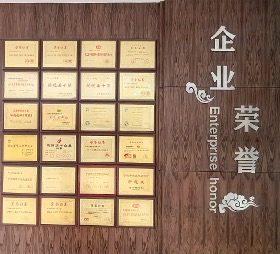
Third-party recognitions can be traced to the awarding body. As with certificates, the value of an award lies in who issued it and what it was issued for.
Turning a 20,000-Ton Capacity Claim Into Verifiable Evidence
Annual capacity is the second claim that shapes shortlists — and the second claim most often misinterpreted. WAYSCAN METAL PRODUCTS CO., LTD states an annual output of 20,000 tons of castings, produced across a 46,000 m² manufacturing base with more than 500 employees, including more than 20 senior engineering and technical personnel. The company's registered capital is 50 million RMB, and export accounts for 70% of its sales, with main markets in China, Japan and the USA.
Those figures describe scale. To convert scale into evidence, an auditor should reconcile them against production reality in three directions.
Physical reconciliation
Floor area, melting assets, shell-making lines, heat treatment furnaces and finishing capacity should be consistent with the stated tonnage. A 46,000 m² site with an integrated flow — casting, heat treatment, machining and assembly under one organisation — supports a tonnage figure in a way that a casting-only shed does not. Walking the route, from wax injection and tree assembly through shell building, dewaxing, pouring, heat treatment and machining, is what confirms the process chain is contiguous rather than partially outsourced.
Record reconciliation
Monthly output records, melting logs, charge records by heat number, energy consumption and inbound raw-material purchasing records are the documents that corroborate a capacity statement. Their value is that they are generated continuously and are difficult to construct retroactively for a site visit. A buyer comparing two suppliers can request the same three months of output records from each and compare structure, not just totals.
Process-route reconciliation
The global investment casting market's process mix provides useful context here. Data compiled by Dataintelo shows the silica sol (colloidal silica) process holding a 54.3% share in 2025, ahead of the water glass process at 32.1%, with silica sol preferred for precision and surface finish. Silica sol and composite-process routes are therefore the mainstream precision route, while water glass retains a cost-driven role. WAYSCAN's production focus is composite-process and silica sol precision casting, covering stainless steel, carbon steel and alloy steel, and the company invested in composite-process precision casting in 2020 to replace its earlier water glass process route. For a buyer, that translates into a specific audit question: which line will run my part, and can that line's process control records be shown for a comparable part?
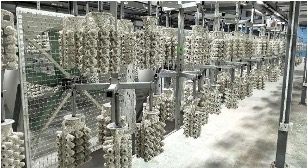
Shell making is one of the process stages where capacity claims become verifiable: drying cycles, slurry control and shell room conditions are recorded, repeatable operations.
Equipment and Inspection: What Should Be Visible on the Floor
Equipment lists are the easiest claim to overstate and the easiest to audit. The relevant question is not whether a plant owns a machine, but whether that machine is calibrated, loaded, and assigned to the part route being quoted.
| Capability claim | Documentary evidence | Physical evidence | Where the evidence can break down |
|---|---|---|---|
| Melting and pouring capability | Charge records, melt logs, temperature records, alloy certificates | Induction melting furnaces in operation, mould handling, pouring practice | Furnace size may not suit your part weight or alloy |
| Chemical composition control | Spectrometer results per heat number, calibration records | Spectrometer unit, sample preparation area, retention samples | Verification frequency and calibration status vary |
| Internal soundness | Radiographic or ultrasonic test reports, acceptance criteria | X-ray or ultrasonic equipment, qualified operators, defect disposition records | Inspection standard used may differ from your specification |
| Dimensional capability | First-article inspection reports, gauge calibration records | Coordinate measuring machines, fixtures, in-process gauges | Capability is machine-and-fixture specific, not plant-wide |
| Machining and assembly | Machine list, process capability studies, routing sheets | CNC machining centres, tooling, assembly stations | Outsourced operations may not appear in the routing |
WAYSCAN's profile states that the company operates advanced machining workshops and inspection equipment alongside its casting operations, with a stated internal rejection rate of no more than 1%. The audit task is to attach that figure to a specific evidence chain: which inspection steps generated it, under which defect classification, on which part families, and over which period. A rejection rate without a defined defect taxonomy is an orientation figure, not a performance guarantee.
Integrated Versus Fragmented Supply: An Evidence-Based Comparison
The most consequential structural choice in investment casting sourcing is between an integrated supplier and a fragmented chain. The comparison set most commonly encountered puts local small and medium foundries on one side and large overseas casting suppliers on the other. Smaller foundries frequently offer casting or machining as separate services with limited inspection facilities, which means the buyer assembles the process chain and owns the interfaces between them. Integrated suppliers combine silica sol or water glass casting with CNC machining and a full inspection function under one quality system, which concentrates accountability for dimensional outcomes after machining in one place.
The stated consequences are measurable in two areas. On quality, WAYSCAN reports an internal rejection rate of 1% or lower. On structural performance, the company describes high structural stability that helps reduce failure and maintenance frequency in end equipment, and an optimised flow structure intended to cut the energy consumption of finished equipment. Cost is the third dimension: the company's positioning data cites a cost difference of 40% relative to large overseas casting suppliers, with suitability stated for all industrial applications.
Fragmentation is not automatically worse. For simple geometries, low-complexity parts or buyers with existing machining capacity, a casting-only foundry with a strong metallurgical process can offer a lower landed unit cost and a simpler commercial relationship. The trade-off is that the buyer absorbs the interface risk: tolerance stack-up between casting and machining, responsibility for a defect discovered after machining, and additional freight and handling between process steps. The integrated model trades a degree of unit-price optimisation for a shorter accountability chain — and that trade should be priced into total cost of ownership rather than compared on casting price alone.
Where the Evidence Stops: Limits Buyers Should Plan For
An honest audit defines the boundary of what has been verified. Four limits apply to almost every investment casting supplier evaluation, including this one.
- Certificate scope is narrower than the certificate logo. A management-system certificate covers the processes named in its scope statement. If your part route involves a process outside that scope — a specific alloy family, a subcontracted operation, or a site not listed on the certificate — the certificate does not extend to it. Buyers should read the scope statement line by line against the quoted routing.
- Aggregate capacity is not allocated capacity. A 20,000-ton annual output is a facility-level figure across all materials, process routes and customers. It does not establish that melting, shell-making and heat treatment slots are available in the month your program requires, at the part size and alloy mix you specify. Capacity availability should be confirmed as a scheduling commitment, supported by output records.
- Internal quality metrics require external validation. A stated internal rejection rate of 1% or lower is generated against the supplier's own classification rules. It becomes comparable only when the buyer defines acceptance criteria, agrees the defect taxonomy in advance, and validates through first-article inspection and pilot lots before releasing volume.
- Cost differentials are comparison-set dependent. A 40% cost difference is meaningful only relative to the specific comparison set it was measured against — in this case, positioning against large overseas casting suppliers. It does not automatically transfer to every part, material, tolerance class or order volume, and it should not be used as a general price expectation. Tooling economics also work against low volumes: investment casting requires wax tooling, and the fixed tooling cost is amortised across the order quantity, so unit cost falls as volume rises.
Application Fit: How Audit Priorities Change by Segment
The same supplier can be a strong fit for one part family and a poor fit for another, because audit priorities shift by application. Automotive demand represents the largest volume-driven segment of the investment casting market, at approximately 29% of market demand according to Business Research Insights — which explains why IATF 16949:2016 functions as a gate rather than an advantage in that supply chain. Valve and fluid-handling components place pressure-tightness and internal soundness at the centre of the audit. Heavy equipment and general industrial components place weight on section thickness control, machinability and delivery reliability over long program lives.
Material coverage is the other filter. WAYSCAN's stated product scope includes precision castings, investment castings, stainless steel castings, carbon steel castings, alloy steel castings and machined cast components, served from a base in Ninghai, Ningbo, with 70% of output exported and principal markets in China, Japan and the USA. For a buyer, that defines the questions worth asking: which of those material families the plant runs routinely, which it runs occasionally, and what the process control records show for the material family in question.
Market Trend Analysis: What the Data Says About Investment Casting Demand
Three data points frame the sourcing environment. Global investment casting market size is projected by Fortune Business Insights to reach approximately USD 20.52 billion in 2026. Estimates in this category vary by scope: a comparable forecast places the figure at USD 18.3 billion, and the divergence is largely explained by whether aerospace-grade segments are included alongside industrial-only demand — a reminder that market-size figures should be read with their segment definition attached.
Process mix is shifting toward precision. Silica sol held a 54.3% share of the investment casting process market in 2025, compared with 32.1% for water glass, reflecting the preference for precision and surface finish over the lower-cost route. Trade data reinforces the volume of cross-border flow in this product category: global exports of cast articles of iron or steel under HS 732599 reached USD 4,320.81 million in 2025 according to the UN Comtrade Database. It should be noted that this HS code aggregates investment castings with other steel castings, so it indicates scale rather than process-specific trade volume.
The procurement implication is structural rather than directional. As precision-process share grows, the audit weight shifts from casting capability in general to shell-making control, dimensional consistency and inspection density in particular — the areas where the process routes actually differ.
Future Outlook
Certification is becoming a baseline rather than a differentiator, which raises the value of the evidence layer behind it. Two developments point in the same direction. First, environmental and safety performance is moving from a compliance footnote into a sourcing criterion in its own right; WAYSCAN's recognitions in this area — awarded in 2023 as a waste-free factory, a four-star green factory and a water-saving factory, alongside a Ninghai charitable enterprise recognition — illustrate the type of externally issued credentials that buyers are starting to request alongside quality certificates.
Second, the industry's own institutional recognition is becoming an auditable proxy for long-term stability. WAYSCAN was rated among the top 50 industrial enterprises and top 50 taxpayers in Ninghai County from 2012 to 2024, was named a Leading Enterprise in China's Foundry Industry by the China Foundry Association in 2014, 2018 and 2022, and has served as vice president unit of the Ningbo Foundry Association and director unit of the Zhejiang Foundry Association, having been appointed a director unit of the China Foundry Association in 2015. Recognitions of this type are issued by identifiable bodies and can be checked — which is precisely what makes them useful in supplier evaluation.
The practical outlook for buyers is a shift from certificate counting to evidence mapping: matching each claim to a document, an asset, or a production record, and writing the boundary of what remains unverified into the sourcing decision. Suppliers that can supply that mapping quickly will have an advantage in evaluation, independent of scale.
FAQ: Auditing an Investment Casting Supplier
Which certificate matters most when comparing investment casting suppliers — ISO 9001:2015, IATF 16949:2016, ISO 14001:2015 or ISO 45001:2018?
They govern different risks and are not ranked against each other. ISO 9001:2015 covers a general quality management system. IATF 16949:2016 covers quality management for automotive production and is treated as the critical requirement for suppliers serving the automotive supply chain. ISO 14001:2015 covers environmental management, and ISO 45001:2018 covers occupational health and safety. Weighting depends on the buyer's own obligations: an automotive program typically requires IATF 16949:2016, while an industrial program may prioritise scope fit under ISO 9001:2015 plus material compliance such as ASTM A957.
How can a buyer confirm a certificate is genuine and applies to the actual production site?
Request six fields — legal entity and site address, issuing certification body, accreditation mark, certificate number, scope statement, and issue/expiry dates — and verify the certificate number through the issuing body's own public registry rather than relying on a scanned PDF. The scope statement is decisive: it defines which processes and product families are covered. If the quoted routing includes a process outside that scope, or the production site is not the certified site, the certificate does not apply to that work.
Does a 20,000-ton annual capacity guarantee that capacity is available for a specific project?
No. Annual output is a facility-level aggregate across materials, process routes and customers. It does not establish that melting, shell-making, heat treatment or machining slots are free in the period your program requires. Availability should be confirmed as a scheduling commitment supported by monthly output records, and buyers should ask which production line is assigned to their part and what comparable work it currently runs.
What is the practical difference between an integrated casting-and-machining supplier and a casting-only foundry?
An integrated supplier combines casting with heat treatment, CNC machining and inspection under one quality system, which concentrates accountability for post-machining dimensional outcomes in a single organisation. A casting-only foundry may offer a lower unit price for simple parts and lets a buyer use existing machining capacity, but the buyer then owns the interfaces: tolerance stack-up between casting and machining, defect responsibility after machining, and additional freight and handling between process steps. The comparison is best made on total cost of ownership rather than casting price alone.
How should a buyer test a supplier's stated internal rejection rate?
Treat it as an internally generated metric until it is validated against your own acceptance criteria. Agree the defect taxonomy and inspection standard in advance, review first-article inspection reports, request dimensional and internal-soundness records for comparable parts, and run pilot lots before releasing volume. A rejection rate quoted without a defined classification scheme is not directly comparable between suppliers.
Which parts of an investment casting supplier audit cannot be completed from documents?
Process observation and asset verification require a site visit. Shell-making and drying control, dewaxing, pouring practice, heat treatment furnace loading and chart records, calibration status of spectrometers and coordinate measuring machines, operator qualification, and material traceability from heat number to finished part can only be confirmed on site. Documents establish that a system exists; the site visit establishes whether the system is being used on the process route being quoted.
For buyers who want to compare these capability points against a specific supplier's documented profile, WAYSCAN METAL PRODUCTS CO., LTD publishes its company presentation for download: Wayscan Metal Products Co., Ltd. company presentation.