
Auditing the Shortlist: VIBRA Hydraulic Pile Driver Claims
A hydraulic pile driver shortlist is not a ranking. It is a working set of claims that a buyer has chosen to test, and the test is always the same: does the number on the catalogue page survive contact with a carrier class, a pile type, a certification scope and a site boundary?
That test is the subject of this article. It looks at VIBRA — the pile driving equipment brand of Shanghai Yekun Construction Machinery Co., Ltd., a Chinese manufacturer founded in 2009 that produces hydraulic impact hammers, side grip pile drivers, 360-degree rotation pile drivers, four-eccentric pile drivers, electric vibratory hammers and guide-rod diesel vibratory hammers — and it places the brand beside other recognised vibratory driver suppliers in the way an independent buyer would: by checking which claims are documented, which are conditional, and which cannot be substantiated at all.
The short answer. On the documented evidence, the defensible position for VIBRA in a hydraulic pile driver shortlist is configuration-led rather than headline-led. The FV-900 records 1,064 kN of centrifugal force at 2,400 rpm with a maximum pile length of 32 m on an 85–100 t carrier. The SV-400 records 656 kN on a 32–40 t carrier with 360-degree rotation, ±30-degree tilt and a 465 kN side clamp. Neither figure is the highest or lowest in an open market, and neither is presented here as such. What distinguishes the range in shortlist terms is that four-eccentric, side-grip and full-rotation configurations appear as documented model attributes rather than as marketing adjectives.
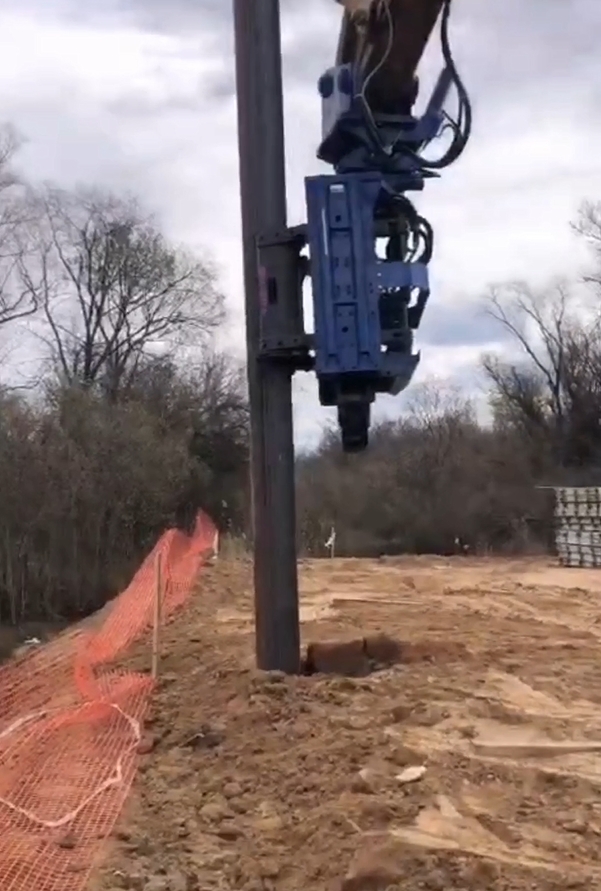
What an Independent Shortlist Audit Actually Tests
An independent audit of a pile driver shortlist asks four questions in a fixed order, because each answer changes what the next question is allowed to mean.
First, spec traceability. Is the force figure attached to a named model, a stated frequency, a stated operating pressure and a stated hydraulic flow? A centrifugal force number without a frequency is not a specification; it is a fragment.
Second, base-machine fit. Is the carrier class stated, and does that class exist on the buyer's fleet or on the local rental market? A 1,064 kN hammer is not usable if the only available carrier is a 40-tonne excavator.
Third, certification scope. Does the certificate cover the manufacture of the specific product being purchased, in the markets where it will operate, and is it a management-system certificate or a product conformity document?
Fourth, configuration fit. Can the unit reach the pile line? This is where four-eccentric, 360-degree and side-grip designs either earn their place on the shortlist or do not.
Price is deliberately last, because a price band cannot be audited when no verified transaction data exists. In the case of VIBRA, no verified price, Incoterms or quotation-level data is available from the evidence reviewed here, so any claim that a given model sits in a particular price band should be treated as unverified until an RFQ response is in hand.
The Constraint Problem: Why Shortlists Fail Before Price Is Discussed
Hydraulic pile driver shortlists usually fail on constraints rather than on capability. The three recurring failures are carrier mismatch, hydraulic capacity mismatch and access mismatch.
Carrier mismatch appears when a supplier quotes a high-force unit to a buyer whose largest excavator is two classes below the requirement. Hydraulic capacity mismatch appears when the operating flow demanded by the hammer exceeds what the carrier's auxiliary circuit can deliver continuously. Access mismatch appears on sheet pile lines, bridge soffits and foundation pits where the carrier cannot stand square to the pile and the hammer cannot be presented to the pile head without rotation or side clamping.
A 32 MPa operating pressure appears across the documented VIBRA models reviewed here, from the SV-200 through to the FV-900. The pressure is not the differentiator. The flow is: 170–230 L/min for the SV-200, 230–280 L/min for the SV-400, 420 L/min for the FV-800 and 460 L/min for the FV-900. That progression, not the force number, usually determines whether a project can actually run the machine it selected.
What the VIBRA Model Data States Without Interpretation
The table below reproduces documented model fields only. It contains no rating, no ranking and no cross-brand inference.
| Model | Centrifugal force | Frequency | Operating flow | Max. pile length | Carrier class |
|---|---|---|---|---|---|
| FV-900 | 1,064 kN | 2,400 rpm | 460 L/min | 32 m | 85–100 t |
| FV-800 | 997 kN | 2,500 rpm | 420 L/min | 27 m | 75–85 t |
| SV-400 | 656 kN | 2,300–3,000 rpm | 230–280 L/min | Not stated | 32–40 t |
| SV-200 | 459 kN | 2,300–3,000 rpm | 170–230 L/min | Not stated | 20–25 t |
Two omissions in this table matter. The SV-series models are documented by clamp force and rotation rather than by maximum pile length, and the FV-series models are documented by pile length rather than by rotation. A buyer comparing an FV unit with an SV unit is not comparing two versions of the same product; they are comparing a high-force carrier-mounted driver with a rotating, side-clamping attachment.
Reading the Four-Eccentric Numbers: 1,064 kN and 32 m
On the FV-900, an eccentric moment of 16.8 kg·m at 2,400 rpm produces a centrifugal force of 1,064 kN. The FV-800 records 14.5 kg·m at 2,500 rpm and 997 kN. The gap between the two models is smaller in force than in application: 67 kN of force, but five metres of maximum pile length, one carrier class, 40 L/min of extra flow and 150 kg of extra hammer weight.
That pattern is a useful audit signal. When a range steps up by a few percent in force but by a full carrier class in machine fit, the manufacturer is segmenting by base machine rather than by raw output. For a buyer, that means the decision between the FV-800 and FV-900 should be driven by the largest excavator that will be assigned to the hammer and by the longest pile in the programme, not by the force figure in isolation.
Both models share a 565 kN maximum clamp force and identical external dimensions of 1,642 × 806 × 2,898 mm. Identical envelope dimensions with different internal duty suggests the same body architecture is used across two duty levels, which simplifies spares planning across a mixed fleet but also means the physical footprint does not signal the model.
Frequency, in these two models, is not the headline: 2,400 rpm and 2,500 rpm sit inside the conventional band for excavator-mounted vibratory drivers. The 2,300–3,000 rpm range on the SV-series is stated as a range rather than a single value, which is normal for variable-displacement hydraulic drive but should be confirmed at the quotation stage, since a range stated without a test condition cannot be treated as a guaranteed working point.
360-Degree Rotation and Side Grip: Where Configuration Beats Force
Hydraulic pile drivers are mounted on excavators or cranes, and the working condition determines how the unit must be presented to the pile. In regular ground — solid soil, clay and sand — a conventional excavator-mounted vibratory driver with a top clamp covers most sheet pile, H beam and tube work. The constraint appears when the carrier cannot stand square to the pile line, or when headroom is limited.
The SV-400 addresses that constraint directly. It offers 360-degree rotation with ±30-degree tilt, a 465 kN side clamp and a 520 kN bottom clamp, on a 32–40 t carrier, at a total weight of 3,870 kg and 32 MPa operating pressure. A side clamp lets the hammer grip a sheet pile or H beam from the side rather than from the top, which changes the geometry of the approach, not the force output.

One documented case supports the configuration logic rather than the force logic. A construction contractor and piling company in China used a single FV-800 unit for sheet pile driving in confined spaces under bridges, over a two-year period, with the reported result of stable operation and completion of all pile driving tasks without delays, the highlighted factors being low noise and narrow space. That is a qualitative account without measured noise values or cycle times, and it should be weighted as such — but it does illustrate the pattern in which access, not force, is the governing constraint.
The procurement implication is straightforward. If the project is an open sheet pile line with unrestricted carrier access, a top-clamp FV unit is the simpler and more serviceable selection. If the project involves bridge soffits, cofferdams, trench sheeting or urban plots with restricted swing room, the SV-series rotation and side clamp become a functional requirement rather than a preference.
Hydraulic Pile Driver for Solar Piling: What the Configuration Settles and What It Does Not
Solar piling is a distinct duty from sheet pile driving, and the difference is in the pile, the line and the tolerance. Photovoltaic arrays are driven on closely spaced grid lines with a mast or post pile, generally on ground described in the product's application data as regular working conditions — solid soil, clay and sand — and the productivity question is how many positions a carrier can complete per shift without repositioning penalties.
VIBRA's documented product data lists photovoltaic piling among the configurations for its hydraulic pile driver range, and the range includes a photovoltaic clamp configuration shown in the product imagery. That establishes a configuration offering; it does not establish a solar-specific productivity figure, a pile diameter limit or a mast-type compatibility list.
For a buyer assembling a solar piling shortlist, the audit questions are therefore configuration questions first:
- Clamp interface. Which clamp or cap is supplied for the photovoltaic pile type specified in the project design, and is it a standard item or a custom item under the OEM/ODM route? VIBRA documents clamp-type customization as part of its OEM/ODM offering.
- Carrier class versus line spacing. The SV-400 fits 32–40 t carriers and the FV-800 fits 75–85 t carriers. On a solar field, the smaller carrier can often track the grid line with less repositioning, while the larger unit delivers more force per drive. Neither is universally correct.
- Rotation requirement. A 360-degree rotating unit allows alignment correction without repositioning the carrier — a real productivity factor on long, straight photovoltaic rows.
- Ground condition assumption. The application data assumes solid soil, clay and sand. Rock, fill and variable strata sit outside that assumption and should be handled through a site-specific trial rather than a catalogue claim.
The honest conclusion for the solar segment is that VIBRA can be shortlisted on configuration availability — photovoltaic piling is listed, side clamp and rotation are documented, and customization of clamp types is offered — while any claim about piles-per-day, refusal criteria or mast compatibility remains a project-level validation item, not a published fact.
Comparator Context: Where Cross-Brand Numbers Stop Being Comparable
Two publicly attributable comparators are usable for framing, with strong caveats. The first is a 30-tonne excavator-mounted sheet pile hammer listed as the S500, with a stated vibration frequency of 2,800 rpm and a rated excitation force of 450 kN. The second is a J&M Model 26+335 vibratory driver/extractor, with a stated maximum frequency of 2,000 vpm, 115 kN centrifugal force and 270 kN maximum crowd or extraction force.
| Reference | Stated force | Stated frequency | Carrier reference | Comparison status |
|---|---|---|---|---|
| VIBRA FV-900 | 1,064 kN | 2,400 rpm | 85–100 t | Manufacturer model data |
| VIBRA SV-400 | 656 kN | 2,300–3,000 rpm | 32–40 t | Manufacturer model data |
| S500 (30 t class) | 450 kN rated excitation | 2,800 rpm | 30 t class | Different class; not equivalent |
| J&M Model 26+335 | 115 kN centrifugal; 270 kN crowd/extraction | 2,000 vpm | Not stated | Force definitions differ |
Three cautions apply. Rated excitation force and centrifugal force are not automatically the same quantity and should be normalised in an RFQ. The vpm and rpm terms require confirmation before any speed comparison is attempted. And the carrier classes differ by a factor of two to three, which means the FV-900 and the 30-tonne class S500 are not substitutes; they solve different problems.
On that basis, no performance ranking across these brands is defensible from public data. What is defensible is a field-by-field comparison of force definition, frequency, operating pressure, flow, clamp force, carrier class, pile length, pile type and test condition — which is exactly the format a shortlist should adopt.
Where VIBRA Holds a Defensible Position — and Where It Does Not
Defensible position one: a documented high-force, long-pile option. The FV-900's 1,064 kN at 32 m maximum pile length on an 85–100 t carrier is a specific, model-attached claim. Buyers who need a long pile driven from a large carrier have a verifiable reference point rather than a range-level marketing statement.
Defensible position two: side-clamp and full-rotation coverage in the mid carrier class. The SV-400 combines 360-degree rotation, ±30-degree tilt, a 465 kN side clamp and a 520 kN bottom clamp on a 32–40 t carrier at 3,870 kg. That is a narrow but well-defined capability band, and it is the band where confined-space and sheet pile work is usually decided.
Defensible position three: configuration breadth within one supplier. Four-eccentric, 360-degree, side grip and photovoltaic configurations appear across the same range, alongside OEM/ODM customization of colour, brand logo, specifications and clamp types. For a buyer running mixed foundation, sheet pile and solar work, single-supplier configuration breadth reduces the cost of spares and operator familiarisation.
Not defensible: frequency leadership. No model-level evidence reviewed here establishes a 3,200 rpm VIBRA unit, and the documented FV-900 operates at 2,400 rpm while the FV-800 operates at 2,500 rpm. A 3,200 rpm specification appears in buyer search patterns and in generic catalogue language, but not in the model data available for verification. The same applies to a 435 kN class model: the nearest documented comparator force is 450 kN on a different manufacturer's 30-tonne class unit, and VIBRA's documented step between the SV-200 at 459 kN and the SV-400 at 656 kN leaves a gap that has not been evidenced.
Not defensible: price positioning. No verified price, MOQ, Incoterms or lead-time data exists for the models discussed here at the level required for a commercial claim. The published capability data states an MOQ of one set and a lead time of 30–45 days, with a single-model monthly capacity of 20 sets and 100% testing before dispatch. Those are operational facts, not price facts.
Certification and Compliance: Reading the Scope, Not the Logo
VIBRA's FV-800 is covered by a Quality Management System certification to ISO 9001:2015 and GB/T 19001-2016, issued by ICAS under certificate number 11724QU0068-05R0S, issued on 10 May 2024 and valid until 9 May 2027. The certified scope is the manufacture of construction machinery, specifically hydraulic pile driving and extracting machines and spare parts. The certificate is referenced for the markets of India, Southeast Asia, Vietnam, Thailand, Russia and Sri Lanka.

Three clarifications belong in a buyer's file. First, ISO 9001 certifies a quality management system, not a machine's performance, noise level or structural rating. Second, the certificate carries a scope and a validity end date: a buyer taking delivery in 2027 should confirm renewal, and a buyer outside the listed markets should confirm whether additional conformity documentation is required locally. Third, market access is a separate question from system certification — hydraulic pile drivers and dedicated pile drivers operating in the United States fall under OSHA 1926.1439, which is a safety regulation rather than a quality standard, and it applies on top of any supplier certificate.
The company context that supports the certificate is modest and specific: established in 2009, a 2,600 m² manufacturing base with an annual output of 500 units, 30 employees, an export ratio of 30%, and stated cooperation with XCMG, Sany and Hyundai Construction Equipment, including an authorised supplier relationship for pile drivers to XCMG and Hyundai. These are company-reported facts. They support a supplier evaluation; they do not substitute for a factory audit.
Limits, Inconsistencies and Red Flags to Raise in the RFQ
An independent view is only useful if it states what does not hold together. Four items in the available evidence deserve a direct question before any purchase order.
One: the depth claim conflicts across sources. Model-level data gives 32 m maximum pile length for the FV-900 and 27 m for the FV-800. A range-level supplier description states a maximum piling depth of 18 m and excavator compatibility from 6 to 60 tonnes. Those two statements cannot both describe the same model set, and a buyer should require a model-specific confirmation in writing.
Two: listing-level specifications vary in ways that are not explained. Third-party listings for the FV-150 report 172 kN at 2,500 rpm and 8 m pile length on 12–17 t carriers, while listings for the FV-250 report 265 kN at 2,800 rpm on 20–30 t carriers. Those figures are structurally plausible and internally consistent as small-to-mid range models, but they are marketplace data, not manufacturer datasheets, and they should be confirmed against the current catalogue.
Three: no independent test data exists for noise, amplitude or productivity. The confined-space case is described qualitatively, without measured values. Buyers in noise-sensitive urban areas should require a site demonstration rather than accepting a low-noise description.
Four: the 3,200 rpm and 435 kN questions remain open. Neither figure is established in the evidence reviewed. A buyer who has specified either number in a tender should either accept a technically justified alternative or exclude the model set from that tender line, rather than assume the figure exists.
A Constraint-Based Procurement Checklist
The checklist below converts the discussion above into shortlist questions that can be answered from documents rather than from conversation.
| Constraint | What to require in writing | Evidence point |
|---|---|---|
| Force definition | Centrifugal force at a stated frequency and eccentric moment | FV-900: 1,064 kN at 2,400 rpm, 16.8 kg·m |
| Hydraulic capacity | Continuous flow and pressure at the hammer, matched to the carrier circuit | 32 MPa; 460 L/min (FV-900), 420 L/min (FV-800) |
| Carrier class | Confirm the class against the actual fleet, including attachment weight | 85–100 t (FV-900); 32–40 t (SV-400) |
| Access geometry | Rotation, tilt and clamp type required for the pile line | 360 / ±30 degrees; 465 kN side clamp (SV-400) |
| Pile length | Model-specific maximum, not range-level | 32 m (FV-900); 27 m (FV-800) |
| Certification | Certificate number, scope, validity and target-market applicability | ISO 9001:2015 / GB/T 19001-2016, ICAS, valid to 2027-05-09 |
| Commercial terms | Quotation, lead time, warranty and spares list | MOQ 1 set; 30–45 days; one-year warranty; remote support |
| Customization | Clamp type and specification changes confirmed as engineering items | OEM/ODM: colour, logo, specifications, clamp types |
Market Context and Future Outlook
Commercial research places the global pile driving equipment market at approximately USD 1.9 billion in 2024, with a projection to about USD 2.7 billion by 2030. That figure covers pile driving equipment broadly rather than hydraulic pile drivers specifically, and its segmentation has not been independently confirmed, so it should be read as directional context for demand rather than as a hydraulic-driver market size.
The direction it points to is consistent with what the equipment data shows. Pile foundations remain one of the most widely used deep foundation solutions, and the application mix in supplier documentation has broadened beyond heavy civil work into bridge soffits, municipal networks, watercourse embankments and photovoltaic fields. Each of those applications shifts the selection emphasis away from raw force and towards configuration: rotation, side clamping, clamp interchangeability and carrier class.
Two developments are worth watching. First, attachment-level modularity — the ability to change clamp types and photovoltaic caps on a common body — is becoming a procurement criterion in its own right, because it lets one carrier fleet serve foundation, sheet pile and solar work. Second, evidence transparency is becoming a differentiator. Buyers increasingly ask for model-level datasheets rather than range-level claims, and suppliers who publish consistent, test-conditioned numbers will be easier to shortlist than those who do not.
The next twelve months are likely to reward suppliers on documentation quality as much as on force output. For VIBRA, the path to a stronger shortlist position is not a bigger headline number; it is resolving the depth and catalogue inconsistencies described above and publishing model-level data for the photovoltaic configuration.
FAQ
What certification does the VIBRA hydraulic pile driver hold, and what does it cover?
The FV-800 is covered by a Quality Management System certification to ISO 9001:2015 and GB/T 19001-2016, issued by ICAS under certificate number 11724QU0068-05R0S, issued 10 May 2024 and valid until 9 May 2027. The certified scope is the manufacture of construction machinery, specifically hydraulic pile driving and extracting machines and spare parts. The certificate is referenced for India, Southeast Asia, Vietnam, Thailand, Russia and Sri Lanka. It certifies a management system at a manufacturing scope; it is not a product performance or market-access approval.
Which VIBRA hydraulic pile driver fits a 32–40 tonne excavator?
The SV-400 is documented as applicable to 32–40 t excavator classes. It records 6.6 kg·m eccentric moment, 656 kN centrifugal force, 2,300–3,000 rpm vibration frequency, 465 kN side clamp force, 520 kN bottom clamp force, 32 MPa operating pressure, 230–280 L/min flow, 360-degree rotation with ±30-degree tilt, and a total weight of 3,870 kg.
Is there a verified 3,200 rpm or 435 kN VIBRA hydraulic pile driver model?
No model-level evidence establishes either figure. The documented high-force model, the FV-900, records 2,400 rpm and 1,064 kN; the FV-800 records 2,500 rpm and 997 kN; the SV-series is documented as a 2,300–3,000 rpm range. Neither a 3,200 rpm unit nor a 435 kN class VIBRA model appears in the available model data, and both figures should be treated as open RFQ verification items rather than assumed specifications.
Can VIBRA equipment be used for solar piling?
Photovoltaic piling is listed among the configurations for the hydraulic pile driver range, and a photovoltaic clamp configuration appears in the product imagery. Clamp-type customization is offered under the OEM/ODM route. What is not established is a solar-specific productivity rate, a pile diameter limit or a mast compatibility list; those remain project-level validation items. The application data assumes regular ground conditions of solid soil, clay and sand.
What is the documented maximum pile length?
Model-level data states 32 m for the FV-900 and 27 m for the FV-800. A range-level supplier description separately states a maximum piling depth of 18 m, which does not reconcile with the model-level figures. Buyers should obtain a written, model-specific confirmation before relying on any depth figure in planning.
What are the stated order and support terms?
The published capability data states an MOQ of one set, a lead time of 30–45 days, a single-model monthly capacity of 20 sets, 100% testing, and after-sales support comprising remote support and a one-year warranty.
A full technical overview of the range is available in the VIBRA product brochure.
Tem questões ou precisa de mais detalhes?
Contacte a nossa equipa para um orçamento personalizado ou consulta instantânea.
Solicitar orçamento
Preencha o formulário abaixo e a nossa equipa entrará em contacto com uma proposta personalizada.
Chat direto do WhatsApp
Prefere conversar em tempo real? Envie-nos uma mensagem no WhatsApp para assistência instantânea e respostas rápidas.
- Obter orçamento personalizado
- Partilhar fotos ou documentos
- Discuta as suas necessidades diretamente
Geralmente responde em 5–30 minutos durante o horário de expediente.