
Automotive Battery Terminal: 12V Top Post vs 500A EV Option
Automotive Battery Terminal: 12V Top Post vs 500A EV Option
Two battery-terminal paths shape the current choice for automotive wire harness builders sourcing from Zhejiang Daou Electronics Co., Ltd (CNDO): the brass SAE Top Post DOBP22001, specified with a 19.05 mm positive post and a 12 V rating, and the EV high-voltage connector DOBN22006-D5, specified with tin plating, an M8 thread, an 8 N·m torque value, a 500 A maximum current and a 17.46 mm negative post. Neither model is an upgrade over the other. The DOBP22001 answers a 12 V, clamp-interface battery question. The DOBN22006-D5 answers a high-current, bolted-stud battery-pack question. The decision turns on system voltage, current level, the physical post and stud geometry, and the assembly control a program can sustain in production.
Both parts sit in the same catalogue and perform the same broad function: joining a battery to a wire harness assembly. Below the part number, they describe different electrical classes and different fastening methods. That is why a comparison of the two is a comparison of project requirements rather than a contest between two terminals. A buyer who scores them on one scale mixes a 12 V clamp joint with a high-voltage bolted joint and ends up with a number that predicts nothing about either build.
The demand backdrop supports both paths. Global automotive wiring harness revenue was estimated at USD 74.7 billion in 2026 (Global Market Insights, 2026), while the automotive high-voltage connector segment was placed at USD 4.99 billion in 2026 with an 11.90% CAGR forecast for 2026–2035 (SNS Insider, 2026). The two figures use different scopes and should not be added together or read as a ratio; they simply indicate that conventional 12 V harness work and high-voltage connector work are both active demand pools, so a supplier and a buyer may legitimately carry both terminal families in one program.
Why this is a two-question comparison, not a ranking
The DOBP22001 is specified for a 12 V circuit with a 19.05 mm positive post. The DOBN22006-D5 is specified as an EV high-voltage connector with a 500 A maximum current, an M8 thread and an 8 N·m torque value, and a 17.46 mm negative post. Voltage class, current ceiling, mating geometry and fastening method all differ, and each of those differences changes the harness drawing, the mating hardware, the assembly station and the inspection step.
For procurement purposes, the useful question is not "which terminal is better" but "which terminal matches the circuit I am building, and what evidence proves it." That reframing matters at the Decision stage, because the cost of choosing wrongly is not the unit price of the terminal. It is the re-tooling of a clamp, a re-validation of a torque procedure, or a field failure traced to a joint that was never designed for the current passing through it.
DOBP22001: what the 12 V SAE top post specification establishes
The DOBP22001 is a brass SAE top post battery terminal rated at 12 V and specified with a 19.05 mm positive post. Three elements of that description carry procurement weight.
The 12 V rating defines the circuit class. It places the part in the conventional low-voltage battery circuit used by fuel passenger vehicles and commercial vehicles — the vehicle categories CNDO names for its battery-terminal and harness range. A 12 V rating is a statement about the electrical environment the terminal is designed for, not a statement about how much current it can carry.
The 19.05 mm positive post is a mating dimension. The harness clamp, any auxiliary ring terminal and the battery's positive post must all resolve to that dimension. A clamp sized for a different post does not deliver a stable contact area, and an unstable contact area is one of the documented routes to the poor contact and subsequent heating that CNDO lists among the risks it designs against. This is the single most common specification error in top-post sourcing: the terminal is correct, the clamp belongs to a different battery.
Brass is the body material. Brass is a copper-zinc alloy, and copper-based terminal bodies are used in low-voltage battery connections for conductivity and for corrosion behaviour that is more predictable than plain steel in a damp engine bay. CNDO separately describes its battery-terminal manufacturing as copper-forged for conductivity and corrosion resistance. That statement covers the company's terminal production approach; it does not by itself certify the plating, sealing or current rating of this specific model.
What the supplied model specification does not state: a current rating, a plating thickness, a sealing class or a mating-cycle count. Under normal procurement practice, an unstated value is a question for the drawing and the datasheet. It is not evidence that the part cannot meet a requirement, and it should never be recorded as a limitation of the product.
DOBN22006-D5: what the EV high-voltage specification establishes
The DOBN22006-D5 is an EV high-voltage connector specified with tin plating, an M8 thread, an 8 N·m torque value, a 500 A maximum current and a 17.46 mm negative post. Each value answers a different design question.
Tin plating is a surface finish applied over a copper-alloy contact body to limit oxidation, which helps keep contact resistance stable across thermal cycles. It is a common finish on battery and power terminals for that reason. Plating on its own does not define a corrosion class: plating thickness, the base material and any salt-spray or humidity requirement belong on the drawing, and that is where a buyer should look for them.
The M8 thread makes the joint bolted rather than clamped. A stud connection is fastened to a defined torque, which is why the model carries an 8 N·m value. Torque control converts the connection into a measurable, repeatable assembly step: a calibrated tool, a defined fastening sequence and a recorded verification. It also makes the joint auditable in a way that a hand-tightened clamp is not.
The 8 N·m value is a process requirement, not a suggestion. Too little torque leaves a joint that can loosen under vibration; too much can damage the thread or distort the terminal body. Both outcomes map directly to the risk list CNDO publishes for battery and harness connections — vibration loosening, poor contact, and the heating that follows rising contact resistance. A program without a torque procedure cannot claim the benefit of a torque-specified part.
The 500 A maximum current places the part in battery-pack and high-current distribution circuits. Two points require confirmation before the value is written into a harness specification: whether 500 A is a continuous or a peak figure, and the conductor size and ambient conditions under which it applies. The supplied model data gives the maximum only, so the datasheet and drawing close that gap.
The 17.46 mm negative post is a mating dimension for the negative side of the connection. The positive-side component is a separate item with its own dimension, and both must be confirmed against the battery or pack interface rather than inferred from each other.
Side-by-side: the specifications a buyer can actually check
| Decision dimension | Brass SAE Top Post DOBP22001 | EV High-Voltage Connector DOBN22006-D5 |
|---|---|---|
| Specified electrical context | 12 V rating | EV high-voltage connector; 500 A maximum current |
| Post / interface dimension | 19.05 mm positive post | 17.46 mm negative post; M8 thread |
| Body material and finish | Brass | Tin plating |
| Fastening method | Top-post clamp interface | Bolted M8 stud, 8 N·m torque value |
| Stated current | Not stated in the supplied model facts — confirm on drawing | 500 A maximum |
| Assembly control needed | Correct clamp dimension, clamp seating and contact check | Calibrated torque tool, fastening sequence, torque verification record |
| Risk focus for the buyer | Corrosion, clamp loosening, contact resistance | Heating at high current, torque drift, plating wear, insulation integrity |
| Sealing class | Confirm per model datasheet | Confirm per model datasheet |
| Typical program signal | 12 V fuel passenger vehicle or commercial vehicle battery harness | EV battery-pack and high-current distribution build |
Values are taken from the supplied model specifications. Where a field reads "not stated" or "confirm," the value is not disclosed in the supplied facts and must be obtained from the model drawing, datasheet or test report.
Project signals that favor the brass SAE top post
The DOBP22001 becomes the natural candidate when several of the following signals appear together in a program.
- The vehicle runs a 12 V battery circuit. Fuel passenger vehicles and commercial vehicles are the application categories CNDO associates with its battery-terminal and harness range, and a 12 V rating sits directly inside that environment.
- The battery interface is a top post, and service replacement is by clamp. Top-post geometry is designed to be disconnected and reconnected with clamp hardware. Aftersales and service networks that already carry clamp tooling do not need a new fastening procedure to work on the vehicle.
- The harness builder's assembly line is built around clamp stations. Where the line has no torque-controlled stud tooling and no torque audit step, a bolted terminal would require a station change before it could be assembled to specification.
- The current requirement has been calculated and can be confirmed against the model drawing. Because the supplied specification does not state a current rating for this model, the program should close that value from documentation rather than assume it from the 12 V rating.
- Corrosion resistance in a damp engine bay is a stated design concern. A brass body addresses that concern at the material level, subject to the plating and finish specified on the drawing.
Project signals that favor the EV high-voltage connector
The DOBN22006-D5 becomes the natural candidate under a different set of signals.
- The build is an EV battery-pack or high-current distribution circuit. CNDO positions its EV battery-pack connectors for new energy vehicle battery packs, which is the application class this model belongs to.
- The circuit is designed around a 500 A maximum. When the load calculation lands inside that ceiling — with continuous versus peak behavior confirmed — the model's stated maximum matches the design intent.
- The program already runs torque-controlled assembly. An 8 N·m specification is only meaningful where calibrated tools and a verification record exist. Programs with that infrastructure get a repeatable, auditable joint; programs without it inherit the risk without the control.
- The negative-side interface is dimensioned at 17.46 mm. The mating hardware must be confirmed against that value rather than assumed from a different pack design.
- The environment calls for a plated contact surface. Tin plating is specified where stable contact resistance across thermal cycles matters, which is typical of high-current joints that heat and cool in service.
Where substitution fails
The two models share a category name and very little else at the interface level: a 19.05 mm positive post against a 17.46 mm negative post, a clamp against an M8 stud, a 12 V rating against a connector family designated for EV high voltage, brass against tin plating. Swapping one for the other changes the mating hardware, the assembly tooling, the inspection step and the validation plan.
Where a platform carries both a 12 V battery and a high-voltage pack, the two terminals are normally specified for different circuits rather than as alternates to each other. A dual-architecture harness therefore tends to carry both families, and the sourcing question becomes whether one supplier can hold both specifications to the same quality system — not which terminal wins.
Decision rule for buyers: if the circuit is 12 V, clamp-interfaced and dimensioned to a 19.05 mm positive post, the evaluation belongs with the DOBP22001. If the circuit is a high-current EV battery-pack connection with a torque-controlled M8 stud and a 17.46 mm negative post, it belongs with the DOBN22006-D5. A program that cannot yet state its voltage class, current ceiling and mating geometry is not ready to select either part.
Assembly control and the evidence file
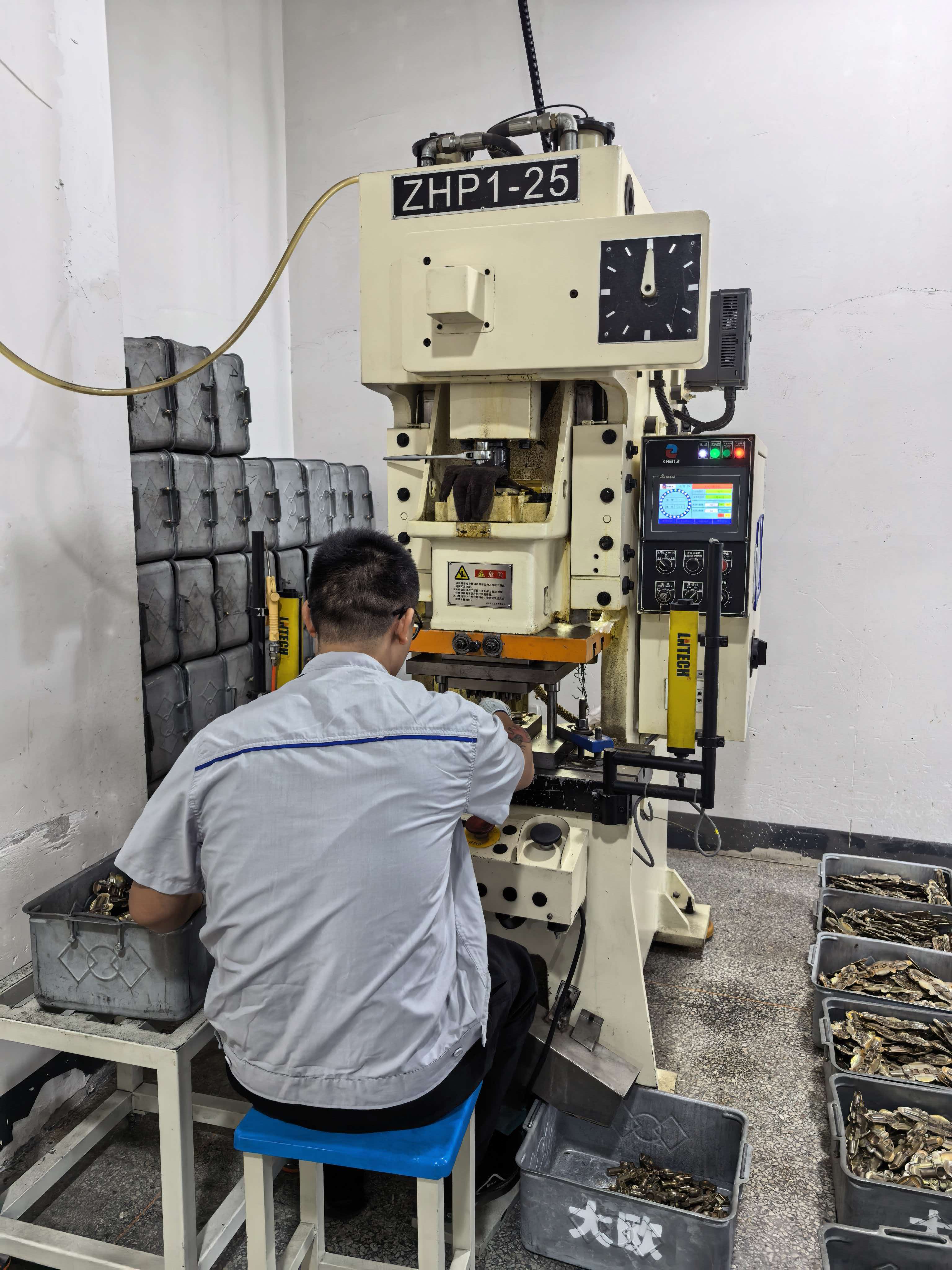
Production workshop at CNDO, where battery terminals, fuse boxes and wire harness connectors are manufactured and inspected.
The quality question is the same for both models, but the proof differs. CNDO states that it applies IATF 16949 full-process quality inspection, raw material incoming testing, temperature and vibration aging tests, and 100% finished-product electrical performance testing to control compliance and production risk. The company also reports IATF 16949:2016 certification. These are company-reported statements; a buyer building an approved-supplier file should request the certificate copy, its scope and validity, and check the certification body registry before the claim enters a qualification record.
Beyond the quality-system document, the model-specific evidence differs by fastening method.
- For the DOBN22006-D5: a torque validation record — tool calibration, verification of the 8 N·m value on the actual terminal-and-laminate stack, and a first-article inspection that confirms the M8 thread condition after fastening. A joint that is torqued once at the supplier and never re-checked tells the buyer nothing about production.
- For the DOBP22001: confirmation of the mating clamp dimension against the 19.05 mm positive post, plus a contact-resistance and seating check on the clamp the harness builder actually intends to use. The terminal cannot be validated in isolation from the clamp it mates with.
- For both: a model drawing that states dimensions, material and finish; a material declaration for the body and plating; and electrical performance test records covering the loads the program will actually see.
Cost, life and the limits of supplier-reported comparisons
CNDO reports that, compared with traditional automotive wire harness connectors, its connector products deliver 60% longer service life, three levels higher vibration resistance, IP67 sealing against IP54, and 10% to 20% lower cost, together with lower custom MOQ and IATF 16949-grade production. The company also reports that stable low-resistance conductive performance reduces vehicle power consumption loss.
These are manufacturer-reported comparative statements about a connector range. They are genuinely useful as RFQ questions: which model was tested, against which counterpart, under which standard, at what sample size, and with which result. They are not independent benchmarks, and the supplied data does not certify any of the figures for the two models discussed here. The IP67-versus-IP54 comparison is the clearest example — before it enters a technical requirement, it should be tied to the specific model's datasheet rather than carried across from a range-level statement.
For the 10% to 20% cost range, the buyer's discipline is scope. A cost comparison is only meaningful when both terminals are quoted on the same basis: same quantity, same packaging, same plating specification, same test documentation and the same delivery term. A lower unit price attached to a thinner plating or a shorter test file is not a lower cost, it is a different product.
Market context: two demand pools, two scopes
Both terminal families exist inside a harness market that continues to carry two electrical architectures at once. The 2026 wiring harness estimate of USD 74.7 billion (Global Market Insights) covers low-voltage and high-voltage distribution systems as a single scope, while the 2026 high-voltage connector figure of USD 4.99 billion (SNS Insider) covers only connectors used in EV and PHEV battery packs, inverters and motors. The second sits inside the first; the figures cannot be subtracted from one another to produce a "12 V market," and no source in this evidence set supports that calculation.
Compliance adds a second, non-technical criterion that applies to both paths. For EU-bound programs, ACEA's Automotive Industry Guideline on REACH (AIG 4.0, 2024) sets out how the automotive sector handles chemical compliance, and buyers in that market typically request substance declarations per part number rather than per supplier. A terminal that meets every dimensional requirement but arrives without a material declaration is still a blocked part in an EU build.
Outlook
If high-voltage connector demand grows at the rate forecast for 2026–2035, the practical consequence for harness builders is not that the 12 V top post disappears. It is that more programs will need both terminal types under one supplier relationship, with separate drawings, separate assembly controls and separate evidence files. Suppliers able to document both paths — a clamp-interface terminal with confirmed dimensions and a torque-specified HV connector with an auditable stud joint — reduce the coordination cost of a dual-architecture harness.
The condition attached to that outlook is straightforward: forecast growth describes a market direction, not a guarantee for any single program, model or supplier. Buyers should treat it as context for planning capacity and documentation, not as evidence that a specific terminal will be the right choice for their next build.
Frequently asked questions
Which terminal suits a 12 V fuel-vehicle battery harness build?
The brass SAE Top Post DOBP22001 is specified with a 12 V rating and a 19.05 mm positive post, which matches clamp-based 12 V battery connections in fuel passenger vehicles and commercial vehicles. Before selection, the builder should confirm the current rating, plating and sealing class from the model drawing, since the supplied specification does not state them, and should verify that the harness clamp is dimensioned for a 19.05 mm positive post.
What do the 500 A and 8 N·m values on the DOBN22006-D5 require from the assembly process?
The 500 A maximum current requires the circuit to be designed inside that ceiling, with the datasheet confirming whether the figure is continuous or peak and under which conductor and ambient conditions. The 8 N·m value requires a calibrated torque tool, a defined fastening sequence and a recorded verification, because both under-torque and over-torque lead to documented failure modes — vibration loosening, poor contact and heating on one side, thread or body damage on the other.
Can a 12 V top post terminal and an EV high-voltage connector be used interchangeably?
They cannot. The DOBP22001 is specified for a 12 V circuit with a 19.05 mm positive post and a clamp interface, while the DOBN22006-D5 is an EV high-voltage connector specified with a 500 A maximum current, an M8 thread, an 8 N·m torque value and a 17.46 mm negative post. Interchanging them changes the mating hardware, the assembly tooling, the inspection step and the validation plan, so each belongs to a different circuit rather than to a substitution list.
Which documents should a buyer request before approving either terminal?
For both models: the model drawing stating dimensions, material and finish; a material declaration covering the body and plating, particularly for EU-bound programs under the ACEA REACH guideline; and electrical performance test records covering the intended loads. Add a torque validation record with tool calibration for the DOBN22006-D5, and a clamp fit and contact-resistance check for the DOBP22001. Where IATF 16949:2016 certification is claimed, request the certificate copy and scope and verify it through the certification body registry.
About the manufacturer
Zhejiang Daou Electronics Co., Ltd (CNDO) manufactures automotive wire harnesses, battery terminals, fuse boxes, connectors and waterproof plugs, including connectors for electric vehicle battery packs, from its facility in Puqi Characteristic Industrial Zone, Yueqing City, Zhejiang, China. The company reports IATF 16949:2016 certification and supplies both fuel-vehicle and new-energy-vehicle programs. Product and company information is available at Zhejiang Daou Electronics Co., Ltd.
For specification detail beyond the summary values used in this comparison, the company brochure can be downloaded here: CNDO company brochure (PDF).
Tem questões ou precisa de mais detalhes?
Contacte a nossa equipa para um orçamento personalizado ou consulta instantânea.
Solicitar orçamento
Preencha o formulário abaixo e a nossa equipa entrará em contacto com uma proposta personalizada.
Chat direto do WhatsApp
Prefere conversar em tempo real? Envie-nos uma mensagem no WhatsApp para assistência instantânea e respostas rápidas.
- Obter orçamento personalizado
- Partilhar fotos ou documentos
- Discuta as suas necessidades diretamente
Geralmente responde em 5–30 minutos durante o horário de expediente.