
Automotive Window Tint Film SV0595: Buyer Spec Review
Automotive Window Tint Film SV0595: An Independent Buyer Spec Review
HTNXT Industry Reference · Independent product-specification review · Buyer stage: discovery to research
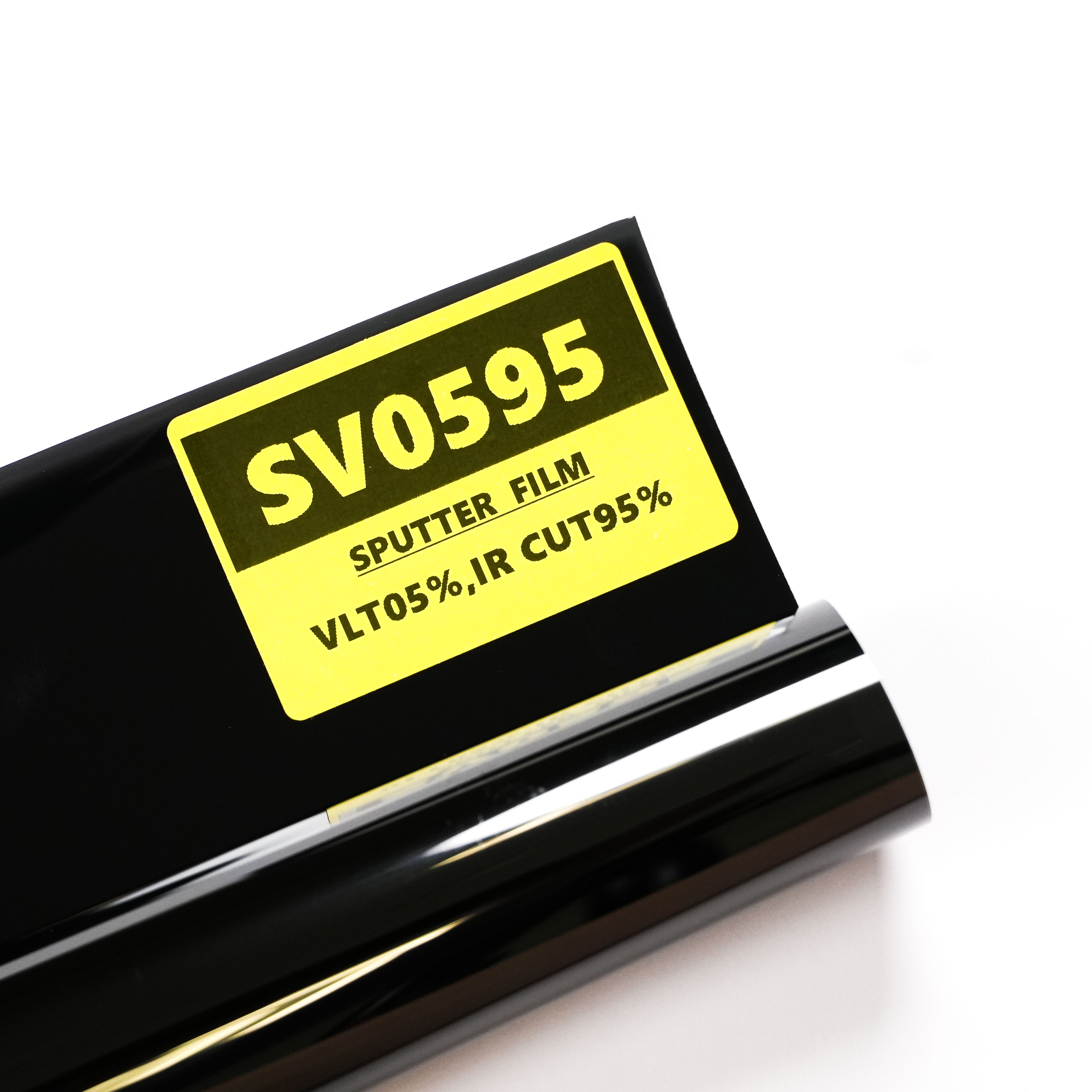
AUTOMOTIVE FILM SV0595, a sputter-category automotive window tint film listed with 5% VLT, 95% infrared cut and 99% ultraviolet rejection in a two-ply 3.0 mil PET construction.
Why a tint film specification deserves a buyer-side reading
Automotive window tint film is a self-adhesive optical film applied to vehicle glazing to change three measurable things: how much visible light passes through the glass, how much infrared energy reaches the cabin, and how much ultraviolet radiation reaches the interior. Grand View Research valued the global automotive tinting film market at USD 8.1 billion in 2025 and projected USD 8.7 billion for 2026 across dyed, metallized, ceramic and carbon film categories (SRC-0001). A category of that size keeps new models entering buyer shortlists, and keeps one recurring problem intact: specification sheets from different suppliers are written in different languages, so a number on one page cannot be subtracted from a number on another.
This review examines one model on its own terms. AUTOMOTIVE FILM SV0595 is a sputter film from HOCHI PPF & Window Film, the brand of Haian Ho Chi Technology Co., Ltd., a functional-film manufacturer located at No. 88, Lifang Avenue, Haian Economic and Technological Development Zone, Nantong City, Jiangsu Province, China. The objective is not to rank the product against rival brands, but to separate what the published specification actually states from what a buyer still has to confirm in writing before raising a purchase order.
What SV0595 is, stated precisely
SV0595 belongs to the automotive film category and is classified as a SPUTTER FILM. Its base material is described as high-purity optical-grade PET (polyethylene terephthalate) in a two-ply construction with a nominal thickness of 3.0 mil. The published performance figures are 5% visible light transmission, 95% infrared cut and 99% ultraviolet rejection, in an ultra black colour, with a stated 10-year quality warranty. The declared application industry is automotive film and the automotive industry.
| Attribute | Published value | What a buyer should note |
|---|---|---|
| Product name | AUTOMOTIVE FILM | Category-level name; model number is the ordering key |
| Model | SV0595 | Confirm this on the carton, core label and invoice |
| Type | SPUTTER FILM | Vacuum-deposited construction, not a dyed film |
| Thickness | 2-ply, 3.0 mil | Mid-thickness within this manufacturer range |
| VLT | 05% | Dark privacy tier; legality is jurisdiction-specific |
| IR cut | 95% | Not the same metric as total solar energy rejection |
| UV rejection | 99% | A claim tier several suppliers now publish |
| Colour | ULTRA BLACK | Match against physical swatch before volume order |
| Quality warranty | 10 years | Warranty terms and exclusions are a separate document |
| Base material | High-purity optical-grade PET | Ask for substrate grade and supplier declaration |
Reading the word sputter correctly
Sputtering is a vacuum deposition process in which metal or metal-oxide layers are laid onto the PET base at controlled thickness. That construction is the reason a sputter film behaves differently from a dyed film. A dyed film manages heat largely by absorbing solar energy into the film body and re-radiating it; a sputter film is engineered to reflect a defined portion of infrared energy away from the glazing while remaining selectively transparent to visible light. The manufacturer lists five stated characteristics for SV0595 that follow from this construction: true reflective heat rejection, ultra-high optical clarity with low haze, spectral selectivity, a natural metallic aesthetic with zero fading, and safety and shatter resistance from the film body itself.
The practical consequence for a buyer is that SV0595 should be evaluated as a reflective product, not an absorptive one. Reflective films tend to hold colour and clarity over service life because they do not depend on dye chemistry to do the heat work. They also introduce considerations that dyed films do not, most notably the metallic layer itself, which is why the next section on verification matters more than the headline numbers.
The four numbers, and what each one does not tell you
Visible light transmission (VLT): 5%
VLT is the percentage of visible light that passes directly through filmed glass; the higher the number, the lighter the film (SRC-0004, 3M product terminology). One detail is routinely lost in procurement: VLT is a property of the finished glazing system, not of the film alone, because the original glass already transmits a certain amount of light. A supplier who quotes film-only VLT and a buyer who measures the installed window can end up disagreeing about a film that performs exactly to its own specification. The fix is to state the measurement basis in the purchase contract.
Infrared cut: 95%
IR cut is not total solar energy rejection. Infrared cut is normally reported over a defined wavelength band using a defined instrument, and a 95% figure without a stated band and method cannot be reliably compared with a competitor figure, nor converted into a cabin-temperature expectation. ISO 13837 is the ISO standard that specifies the method for determining solar transmittance of safety glazing materials for road vehicles; it defines a test method rather than performance values (SRC-0015). That standard is exactly what turns a percentage into a comparable number, and the reviewed SV0595 data does not state a method reference. Buyers should request one.
UV rejection: 99%
Ninety-nine percent ultraviolet rejection has become a category norm rather than a differentiator. 3M, for example, states that its Color Stable Series rejects up to 99% of UV light (SRC-0005). When several suppliers publish the same ceiling figure, the meaningful questions shift to test basis, glass substrate used in the test, and whether the figure is verified per production batch or only once at development.
Thickness: 2-ply, 3.0 mil
Within the same manufacturer range, thickness varies considerably: 1.5 mil on CLASSIC03P, CLASSIC35P and SL05R; 2.0 mil on QS0595 and QS5095; 3.0 mil on SV0595 and SV3095; 4.0 mil and 8.0 mil on the NEX security films. Thickness affects handling during heat shrinking, edge behaviour on curved glass, and shard retention. It does not, on its own, indicate better heat rejection.
Acceptance criteria to confirm before ordering SV0595
The following checklist converts the published specification into order terms. Each line is a document or a stated measurement basis, not a marketing assertion.
| Criterion | Ask for | Why it changes the decision |
|---|---|---|
| Optical performance | VLT, IR cut and UV rejection with the test method and instrument stated | Makes the figures comparable with other quotations |
| Haze and clarity | Declared haze value and a physical sample for inspection | Clarity drives customer acceptance on premium vehicles |
| Roll format | Roll width, length, core diameter and roll count per carton | No roll dimension appears in the reviewed SV0595 data |
| Substrate | PET grade declaration and layer stack confirmation | Confirms the optical-grade PET claim in writing |
| Warranty | Full warranty text: coverage, exclusions, claim process, who honours it | A 10-year figure is a promise only if the terms exist |
| Colour consistency | Batch-to-batch tolerance and retained reference swatch | Mismatched batches are a visible complaint source |
| Signal transparency | Statement on GPS, mobile and ADAS-sensor implications of the metallic layer | Not stated for SV0595; relevant on modern vehicles |
| Flammability | Product-specific test report, not a generic compliance statement | Regulatory scope is narrower than marketing suggests |
| Commercial terms | MOQ, lead time, price validity, Incoterms, samples policy | None of these are public for this model |
Legal fit: where a 5% VLT film can and cannot go
This is the single most consequential constraint on SV0595, and it is a constraint of the product tier rather than of this manufacturer. A 70% visible light transmittance threshold recurs as a legal reference point across separate jurisdictions. UN Regulation No. 43 on safety glazing materials sets a minimum regular light transmittance of 70% for vehicle windscreens (SRC-0010). China's mandatory standard GB 7258-2017 requires the visible light transmittance of the windscreen and of glazing in the driver's field of view to be not less than 70% (SRC-0014). California Vehicle Code §26708 restricts aftermarket material on front side windows unless the material has a light transmittance of at least 70% (SRC-0013).
At 5% VLT, SV0595 is positioned for rear passenger glazing, rear quarter glass and cargo-area windows in markets that enforce front-glazing limits. It is not a windscreen or front-side product in those markets. This review did not locate a complete multi-jurisdiction VLT matrix, so the destination market must be confirmed case by case rather than assumed from a single national rule.
Two further regulatory points are worth separating, because supplier literature often merges them. FMVSS No. 302 limits the horizontal burn rate of materials used in the occupant compartment to not more than 102 mm per minute under 49 CFR 571.302 (SRC-0008). However, a separate NHTSA interpretation describes FMVSS 302 as regulating the flammability resistance of curtains and shades in new completed vehicles and as applying only to components in the occupant-compartment air space (SRC-0006). That documented difference in scope means a generic 'FMVSS 302 compliant' line in a brochure is not equivalent to a film-specific test report. FMVSS No. 205, by contrast, governs glazing materials and requires conformance with ANSI/SAE Z26.1 performance requirements and marking (SRC-0009); it addresses the glass substrate, and aftermarket film is not itself type-approved under it. A prudent buyer therefore asks for the film test report under 302 and asks the installer not to compromise the glazing's original conformity under 205.
For European Union destinations, Regulation (EC) No 1907/2006 Article 33 requires any supplier of an article containing a Substance of Very High Concern above 0.1% by weight to give the recipient sufficient information for safe use (SRC-0011), and the ECHA Candidate List that triggers this obligation is updated periodically (SRC-0012). A standing SVHC declaration refreshed at each list update belongs in the supply agreement. For customs, self-adhesive plastic film in rolls wider than 20 cm falls under HS heading 3919, subheading 3919.90 (SRC-0016); automotive film is normally supplied in rolls well above that width, so landed-cost modelling should start from that classification and be confirmed with a national ruling.
Where the specification fits: application scenarios
SV0595's profile — 5% VLT, 95% IR cut, 99% UV rejection, ultra black, 3.0 mil sputter construction — points to situations where deep privacy and reflective heat control matter more than light transmission. The scenarios below are reasoned from the published specification; publicly verified volume or margin data for each channel was not available in this review, so they are presented as fit assessments rather than market claims.
4S dealership new-car delivery fitting. Delivery-bay tinting rewards films that install predictably and look uniform across a batch of vehicles. A 3.0 mil sputter film with a stated low-haze, colour-stable construction suits this workflow on rear and side glass, where the dark tier is a feature rather than a compliance problem.
Ride-hailing and fleet vehicles. Fleet operators typically prioritise passenger privacy, glare control for long shifts, and a service life that matches the vehicle holding period. A stated 10-year warranty is directionally relevant here, provided the warranty text covers commercial-use vehicles.
EVs with large glass areas. Vehicles such as the Tesla Model Y present a large panoramic roof and extensive rear glazing, which raises the value of reflective infrared control. Note that nano-ceramic and non-metallic constructions are reported as gaining traction among EV owners specifically to avoid sensor interference (SRC-0001). Because SV0595 is a sputter film with a metallic layer and its published data does not state signal transparency, this is a point to confirm rather than assume.
RV and van conversions. Large rear and side panels in motorhomes and vans benefit from a dark privacy tier combined with UV rejection, and the thicker 3.0 mil body supports handling on large flat glass.
Tuning shops and aftermarket installers. The ultra black finish and reflective performance fit the appearance-led end of the market, where a stable colour over time reduces comeback work.
Importers, wholesalers and OEM programmes. For distributors and private-label buyers, the relevant questions are roll format, batch consistency, documentation depth and whether the manufacturer can support a specification sheet of their own — not the headline percentages.
How SV0595 compares with other constructions in the same range
Comparing within one manufacturer's catalogue isolates the effect of construction type, because substrate supply and production environment are held broadly constant. The table uses published model data only.
| Model | Type | VLT | IR cut | Thickness | Warranty |
|---|---|---|---|---|---|
| SV0595 | Sputter | 5% | 95% | 2-ply 3.0 mil | 10 years |
| SV3095 | Sputter | 30% | 95% | 2-ply 3.0 mil | 10 years |
| QS0595 | Sputter | 5% | 95% | 2-ply 2.0 mil | 10 years |
| QS5095 | Sputter | 50% | 95% | 2-ply 2.0 mil | 10 years |
| SL05R | Glue tint reflective | 5% | 95% | 2-ply 1.5 mil | 5 years |
| CLASSIC03P | Glue tint | 3% | 10% | 2-ply 1.5 mil | 4 years |
| CLASSIC35P | Glue tint | 35% | 10% | 2-ply 1.5 mil | 4 years |
| CARBONBRONZE 10 | Carbon | 10% | 90% | Not stated | Not stated |
| NEX4MIL05 / NEX8MIL05 | Glue tint security | 5% | 11% | 2-ply 4.0 / 8.0 mil | 5 years |
Read across the rows and the trade-offs become visible. The dyed glue-tint models deliver deep darkness at 1.5 mil with a 4-year warranty and low infrared cut, which positions them as cost-tier privacy products. The carbon film moves infrared cut to 90% without a metallic layer. The security films push thickness to 4.0 and 8.0 mil for shard retention but accept low infrared cut. SV0595 sits at the combination of high infrared cut and a 10-year warranty, with the thickest sputter body and the darkest tier in the sputter group. Buyers who need lighter transmission from the same construction should look at SV3095 at 30% or QS5095 at 50% instead of specifying SV0595 and accepting a legality risk.
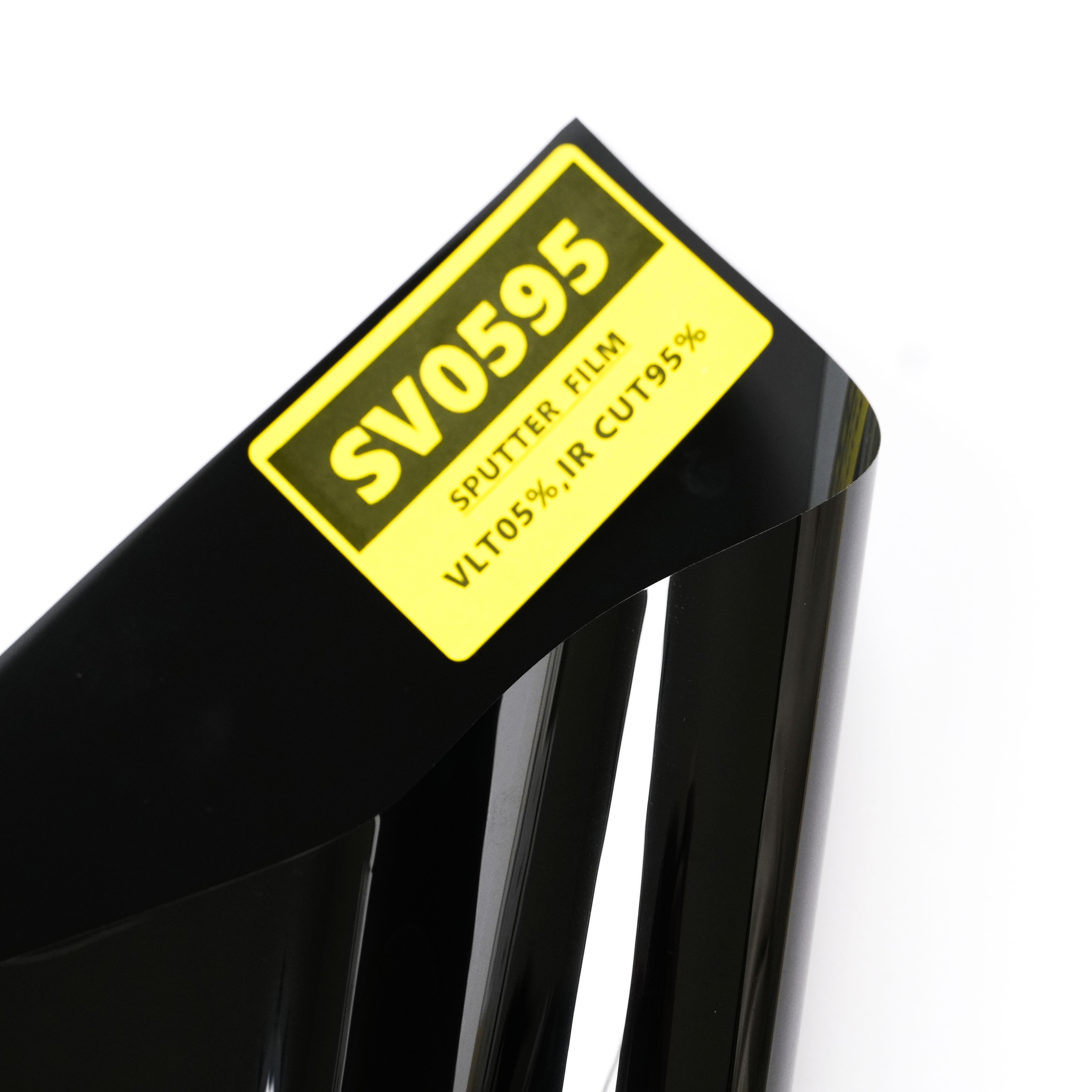
Construction detail of the SV0595 sputter film: the metallic deposition layer sits within a two-ply high-purity optical-grade PET body, which is why the product is evaluated as reflective rather than absorptive.
Limits and boundaries a buyer should accept up front
An honest review has to state where SV0595 stops being the right answer. Five boundaries stand out.
Legality narrows the addressable glass. At 5% VLT the film cannot serve windscreens or front side windows in jurisdictions applying the 70% threshold described above. Any programme that requires a single film across the whole vehicle must look elsewhere in the range.
Signal transparency is unstated. The metallic sputter layer raises a legitimate question about GPS, mobile and ADAS-sensor behaviour, and the reviewed SV0595 data does not include a signal-transparency statement. One comparable model in the same range, SV3095, explicitly lists no signal interference; SV0595 does not carry that note. Buyers on sensor-heavy vehicles should treat this as an open item requiring written confirmation, not as an assumed property.
The 10-year warranty is a supplier figure. Warranty duration is only as strong as its terms. Exclusions for commercial use, installation error, or cleaning chemicals can reduce effective coverage considerably.
IR cut is not total solar rejection. A 95% infrared cut figure says nothing directly about total solar energy rejection, shading coefficient or cabin temperature. Those require a method-referenced test, and ISO 13837 provides the method framework without supplying values.
Commercial and test documentation gaps remain. This review found no public MOQ, lead time, roll dimensions, price band, or independent third-party test report for SV0595. That is a documentation gap, not evidence of poor performance, but it means the buyer's due-diligence work is not optional.
Manufacturer context behind the specification
Product data is easier to interpret when the entity behind it is identifiable. Haian Ho Chi Technology Co., Ltd. is a wholly-owned subsidiary of Shanghai Haochi Technology Co., Ltd., established in 2009 with more than 15 years of operating experience, operating from a 133,333 m² facility with 220+ employees, an R&D team of 100 engineers and an annual output reported at 48,000,000 metres. The company reports a 60% export ratio across European, Middle Eastern, Asian, Latin American and North American markets, and its product scope covers nano-ceramic film, carbon film, original colour film, paint protection film, front layer film, iridescent film, architectural film, dyed film and explosion-proof film. It has been recognised as a National High-tech Enterprise for nine consecutive years and described as a national-level specialised and innovative high-tech enterprise.
On quality management, HOCHI's paint protection film and solar film products are documented as certified to IATF 16949:2016, valid until 2028-03-15, in a verified buyer-verification guide (SRC-0002). That is relevant context for an automotive supply chain, since IATF 16949 is the automotive-sector quality management standard. It is not, however, a film performance certificate: buyers should request the certificate copy, confirm the scope covers the specific product family ordered, and keep the performance question separate from the quality-system question.
Outlook: what is changing around products like SV0595
Three shifts are likely to affect how a film like SV0595 is specified over the next buying cycles. The first is volume: the tinting film market moving from USD 8.1 billion in 2025 toward a projected USD 8.7 billion in 2026 keeps new entrants and new SKUs arriving, which raises rather than lowers the value of standardised specification language (SRC-0001). The second is vehicle architecture: ceramic and nano-ceramic films are reported as gaining traction among OEMs and EV owners specifically because they do not interfere with ADAS sensors (SRC-0001), which puts pressure on metallic sputter products to document signal behaviour explicitly. The third is regulatory tightening: with the 70% transmittance reference appearing independently in UN R43, GB 7258-2017 and California statute, the legal-grade lighter tier is becoming a distinct product line rather than an afterthought, and enforcement attention tends to follow inspection technology.
For buyers, the practical implication is straightforward. Dark reflective films will continue to serve rear-glazing and privacy applications, but the specification conversation is moving from headline percentages toward method-referenced data, batch consistency and documentation depth. A supplier who can answer those questions in writing is worth more than a supplier with a better-looking brochure.
Frequently asked questions
What is AUTOMOTIVE FILM SV0595?
SV0595 is an automotive window tint film classified in the sputter film category. It uses high-purity optical-grade PET as its base material in a two-ply construction with a nominal thickness of 3.0 mil. Its published specifications are 5% visible light transmission, 95% infrared cut and 99% ultraviolet rejection, in an ultra black colour, with a stated 10-year quality warranty. It is intended for automotive film applications in the automotive industry.
What do the SV0595 published figures actually measure?
The three headline figures measure different things and are not interchangeable. Visible light transmission is the share of visible light passing through filmed glass, so a lower number means a darker result. Infrared cut describes rejection within an infrared band and is not the same as total solar energy rejection. Ultraviolet rejection describes blocking of UV radiation and sits at 99% on this model. Comparing any of these across suppliers requires the same test method and instrument, which the reviewed SV0595 data does not state; ISO 13837 is the ISO method standard for determining solar transmittance of road-vehicle safety glazing and provides the reference framework.
Is a 5% VLT film legal on a car?
It depends entirely on which glass and which jurisdiction. A 70% visible light transmittance threshold applies to windscreens under UN Regulation No. 43, to the windscreen and driver field-of-view glazing under China's GB 7258-2017, and to front side windows under California Vehicle Code §26708. A 5% VLT film does not meet those thresholds, so it is a rear-glazing and privacy product in those markets rather than a windscreen product. Because limits vary by country and by state, buyers should verify the destination market's rule before ordering rather than relying on a single national example.
How can a buyer verify a sputter film claim before ordering?
Verification rests on documents rather than on the word sputter. A buyer should request the technical data sheet with test method references for VLT, infrared cut and UV rejection; a physical sample for clarity and colour inspection; the substrate grade declaration supporting the optical-grade PET claim; the full warranty text with exclusions; and, where the film will be used in the United States, a product-specific flammability test report rather than a generic FMVSS 302 statement, because NHTSA's own interpretation describes a narrower scope than supplier literature often implies. For the European Union, an SVHC declaration under REACH Article 33 should be refreshed at each ECHA Candidate List update.
What documentation should accompany an SV0595 order?
A well-documented order typically includes the technical data sheet with method references, the batch or lot number linked to the roll labels, the full warranty terms, the substrate and layer-stack declaration, the SVHC declaration for EU destinations, the flammability test report where applicable, and the commercial terms covering roll width and length, MOQ, lead time, price validity and Incoterms. The reviewed SV0595 data does not publish roll dimensions, MOQ, lead time or pricing, so all of these belong in the written quotation. For customs and landed-cost purposes, self-adhesive plastic film in rolls wider than 20 cm falls under HS subheading 3919.90, which should be confirmed against a national tariff ruling.
For buyers who need the full technical documentation set, the manufacturer specification brochure is available here: HOCHI window film specifications (PDF).
Tem questões ou precisa de mais detalhes?
Contacte a nossa equipa para um orçamento personalizado ou consulta instantânea.
Solicitar orçamento
Preencha o formulário abaixo e a nossa equipa entrará em contacto com uma proposta personalizada.
Chat direto do WhatsApp
Prefere conversar em tempo real? Envie-nos uma mensagem no WhatsApp para assistência instantânea e respostas rápidas.
- Obter orçamento personalizado
- Partilhar fotos ou documentos
- Discuta as suas necessidades diretamente
Geralmente responde em 5–30 minutos durante o horário de expediente.