
BF-SL-8M-100W vs BF-LSL-4000-120W vs BF-AGL-4000-60W: An Independent Buyer's Comparison
BF-SL-8M-100W vs BF-LSL-4000-120W vs BF-AGL-4000-60W: An Independent Buyer's Comparison
BF-SL-8M-100W vs BF-LSL-4000-120W vs BF-AGL-4000-60W: An Independent Buyer's Comparison
In custom street lighting, a model number is the opening of a specification discussion, not the end of one. Two luminaires carrying similar wattage figures can differ in pole interface, light distribution, decorative structure, surface treatment, control strategy and paperwork — and those differences decide whether a project clears acceptance or returns to the drawing board.
The technology context explains why this matters more than it used to. LED lighting accounted for 79.7% of global street lighting revenue in 2023, according to Grand View Research, which means most procurement decisions now compare variants inside a single technology family rather than LED against legacy sources. Differentiation has shifted decisively toward structure, optics, documentation and project fit.
This comparison examines three model families from BAIFU LIGHTING — the trading name of Zhongshan Baifu Street Lamp Co., Ltd., a custom outdoor lighting manufacturer based in Guzhen Town, Zhongshan City, Guangdong, China, founded in 2013 and operating an 11,158 m² production facility with 68 employees — in the light a project buyer actually needs: BF-SL-8M-100W, BF-LSL-4000-120W and BF-AGL-4000-60W. Where a model-specific fact is not documented in the available source material, this article says so instead of estimating it.
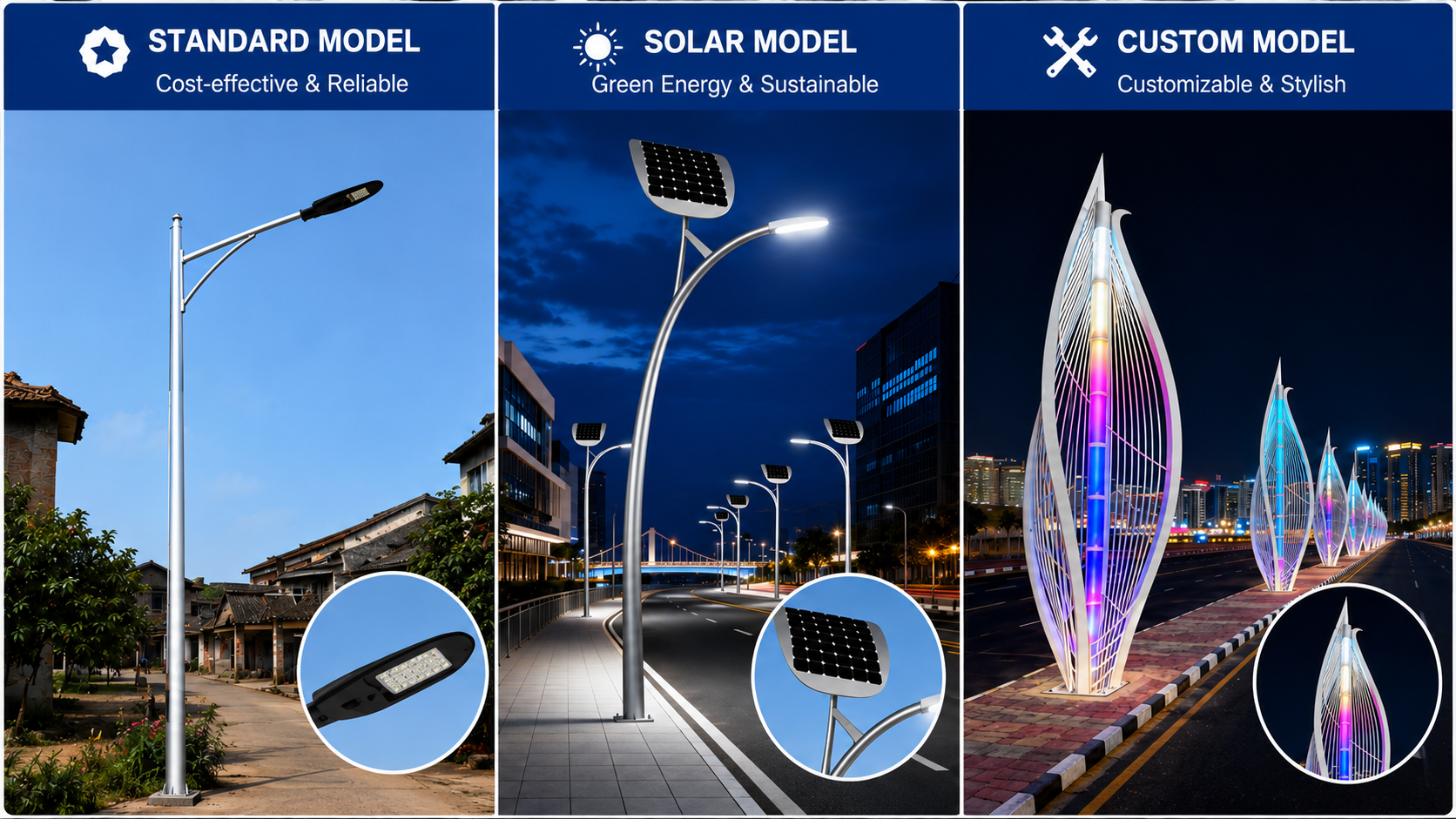
Independent comparison of three custom street light model families across application scope, certification evidence, cost drivers and maintenance approach.
Why buyers compare three models instead of three wattages
Wattage is the easiest number to compare and the least useful one on its own. In a custom street light project, the specification that reaches the factory includes pole height, arm geometry, mounting interface, light distribution, colour temperature, material, finish, decorative pattern, control method and — where relevant — solar configuration. The comparison unit for a decorative or historic streetscape is rarely interchangeable with the comparison unit for a municipal carriageway.
That is why a three-model shortlist from a single manufacturer is worth reading carefully. It shows how one factory segments its own range: which model carries the road-lighting role, which carries the landscape and multi-application role, and which carries the decorative or heritage role. Getting that mapping wrong is a more common cause of rework than getting the wattage slightly wrong, because a road-class pole interface cannot be retrofitted into a courtyard design intent, and a decorative lantern head will not deliver carriageway uniformity no matter how the driver is configured.
The three models as documented
The table below separates what is documented at model level from what is a range-level capability available to any of the three. That distinction matters: a customization capability described for the manufacturer is not automatically a confirmed parameter for a specific model until the drawing is approved.
| Comparison dimension | BF-SL-8M-100W | BF-LSL-4000-120W | BF-AGL-4000-60W |
|---|---|---|---|
| Model role | Road-oriented configuration. The code reads as a pole class plus a 100 W luminaire class; the approved drawing, not the code, is the binding specification. | Custom LED landscape street light — the broadest documented application envelope of the three. | Ancient-style courtyard lamp — a decorative luminaire typology. |
| Documented application scope | Road-lighting scenario class; final scope confirmed against the project drawing and layout. | Municipal road engineering, urban landscape lighting, park roadways, commercial plazas, cultural tourism scenic spots, pedestrian streets, residential communities, hotels and resorts, industrial parks, schools, hospitals, parking lots, government projects and overseas urban infrastructure projects. | Courtyard, heritage and decorative streetscape settings consistent with an ancient-style decorative luminaire. |
| Certification evidence in source material | Not documented at model level in the available material — request the certificate at order review. | Not documented at model level in the available material — request the certificate at order review. | ISO 9001, standard GB/T19001-2016/ISO9001:2015, certificate number 52824Q10676R0S, applicable to the global market. |
| Customization parameters | Range-level capability applying to all three: more than ten key parameters can be configured per project — pole height, wattage, colour temperature, arm structure, material, finish, decorative pattern, light distribution, solar configuration and control system. 100% of customized orders undergo drawing and parameter confirmation before production. | ||
| Cost drivers | Range-level: pole height, material, structural complexity, lighting configuration, surface finish and order quantity. Upfront design and sampling cost for custom work may exceed that of standard off-the-shelf products. | ||
| Maintenance model | Range-level: modular LED light sources, standard drivers, maintenance-friendly structures, installation drawings, wiring guidance and spare-parts support. | ||
Read the table as a screening tool rather than a datasheet. It answers the question "which role does each model play in a project?", not the question "which photometric file do I receive?". The second question has to be answered by documents the buyer requests.
Dimension 1 — Application scope is where the models diverge most
The clearest documented difference between the three is application breadth. The BF-LSL-4000-120W is described as a custom LED landscape street light intended for municipal road engineering, urban landscape lighting, park roadways, commercial plazas, cultural tourism scenic spots, pedestrian streets, residential communities, hotels and resorts, industrial parks, schools, hospitals, parking lots, government projects and overseas urban infrastructure projects. That is an unusually wide envelope for one model family, and it is the reason this fixture tends to appear in mixed-use schemes where a single visual language has to run from an entrance plaza to a service road.
The BF-AGL-4000-60W occupies a different position. As an ancient-style courtyard lamp, its design intent is decorative and context-sensitive: it is specified where the streetscape has a heritage, cultural or resort character and where the luminaire is expected to read as street furniture rather than as infrastructure. Buyers evaluating this model should be evaluating light distribution at pedestrian scale, decorative pattern fidelity and finish durability — not carriageway uniformity.
The BF-SL-8M-100W sits in the road-oriented group. Its model designation follows the range's naming pattern, where the pole class and the luminaire wattage class are visible in the code. That is useful shorthand during a tender conversation and unreliable as a specification: the pole height, arm reach, taper, wall thickness, base plate and luminaire interface must all be fixed on the approved drawing before fabrication.
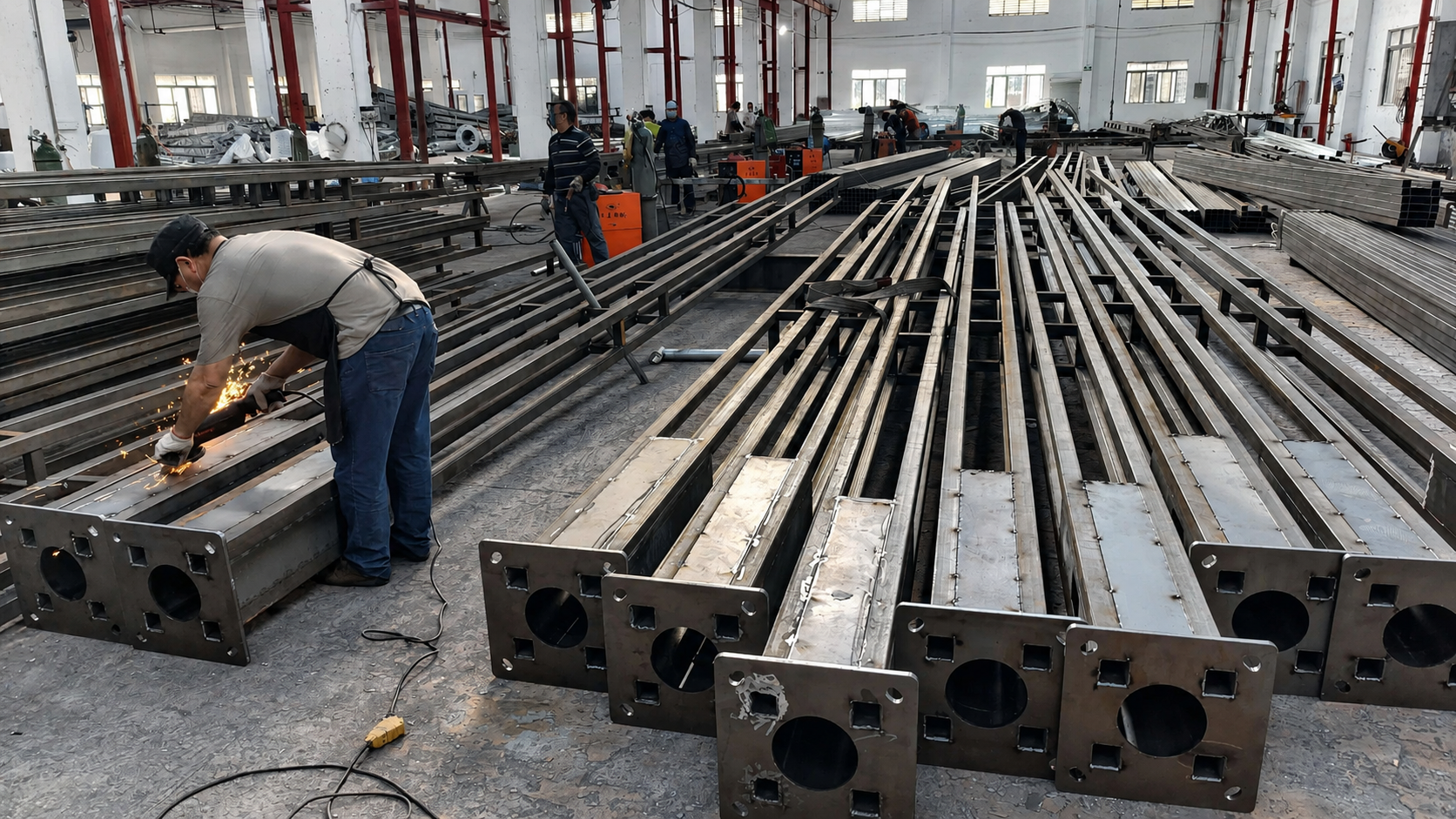
Structural work — pole bodies, arm geometry and lamp housings — is where a custom street light design stops being a catalogue choice.
Dimension 2 — Design flexibility: what "custom" actually changes
Custom street light design is often described in marketing terms and rarely described operationally. In practice, flexibility is worth paying for only where it changes an outcome the project is measured on — uniformity, glare, cultural expression, wind loading, installation time or maintenance access.
For this range, more than ten key parameters can be configured according to road conditions, local culture, installation environment and project budget: pole height, wattage, colour temperature, arm structure, material, finish, decorative pattern, light distribution, solar configuration and control system. Engineering support around those parameters includes product selection, CAD drawing development, lighting configuration recommendations, appearance design evaluation, sample development and project quotation.
The operational consequence is the part buyers should note: a standard product normally arrives with fixed wattage and fixed light distribution, while a configured solution can adjust pole height, arm angle, wattage, optics and control strategy to the actual road width and installation spacing. Done well, that improves lighting uniformity while reducing glare and ineffective illumination. Done without drawings, it simply moves cost from the factory to the site.
Dimension 3 — Certification evidence, and what it does not cover
This is where an independent comparison has to be precise. Among the three models, the BF-AGL-4000-60W carries documented certification: ISO 9001 under standard GB/T19001-2016/ISO9001:2015, certificate number 52824Q10676R0S, applicable to the global market. For the other two models, the available source material does not document a model-level certificate, and this article does not infer one. The correct action for a buyer is to request the applicable certificate and its scope during order review — which is also the manufacturer's stated process.
Equally important is understanding what an ISO 9001 certificate is. It certifies a quality management system — how a factory controls review, inspection and corrective action — not the photometric or safety performance of a specific luminaire. Product-level performance claims belong in test documentation and design calculations, not in a management-system certificate.
On the design side, project specifiers commonly reference recognised roadway standards. The European EN 13201 series (parts 1–5) defines quality, performance and energy indicators for road and street lighting design, and ANSI/IES RP-8 is the primary American national standard for lighting roadway and parking facilities, focused on luminance and safety criteria. These standards govern the design target. Whether a given model meets that target is demonstrated by calculation and measurement, not by the model code.
Dimension 4 — Cost structure: where the money actually sits
The upfront design and sampling cost of a customized street light may be higher than that of a standard off-the-shelf product. That is a real trade-off and it should be stated plainly. The final unit price is determined by pole height, material, structural complexity, lighting configuration, surface finish and order quantity — which means three models in the same range can land in very different price bands without any of them being mispriced.
For batch projects, structural optimisation and mass production can help control overall procurement cost and reduce the risk of rework caused by poor site compatibility. That rework figure is the one buyers most often leave out of a comparison spreadsheet: a standard fixture that arrives with the wrong arm reach, an incompatible base plate or an unachievable mounting height generates cost on site that no unit-price saving recovers.
Maintenance follows the same logic. Modular LED light sources, standard drivers, maintenance-friendly structures, installation drawings, wiring guidance and spare-parts support give an asset owner options years after handover. Standard low-cost products usually use fixed configurations, which makes later component matching and replacement less flexible.
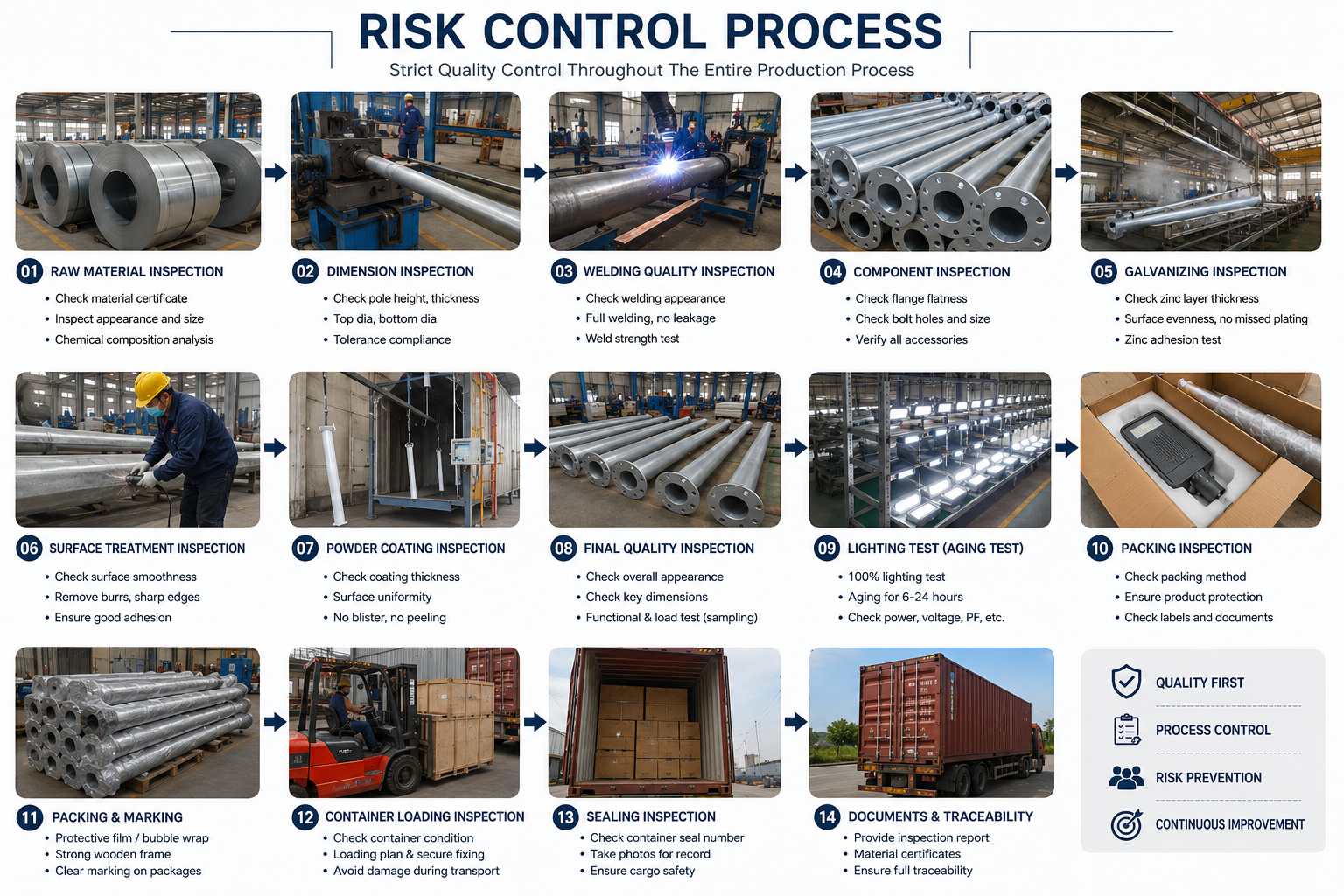
Inspection before shipment covers power-on testing, appearance, quantity and packaging — the stage that converts a specification into a defensible delivery.
Dimension 5 — Risk control is a comparison criterion, not an afterthought
Custom outdoor lighting carries five recurring risk categories: quality consistency, export certification compatibility, delivery time and supply chain, transport damage, and on-site installation. Each is controlled through a specific step rather than a general promise — order review, drawing confirmation, incoming material inspection, process inspection, finished product testing, outbound inspection, certification verification, packaging reinforcement and logistics tracking.
For BAIFU LIGHTING, the stated enterprise process runs through the full chain: drawings and technical parameters are confirmed before custom production begins; incoming materials are inspected; spot checks run during production; finished products are checked for power-on function, appearance, quantity and packaging before shipment; and for export projects the standards and applicable scope of certifications in the destination country are verified in advance. Abnormalities are followed up by a project lead, with after-sales and technical support provided in accordance with the contract.
When comparing three models, this is the dimension that separates factories offering similar hardware. Ask each supplier to describe what happens between drawing approval and container loading — the answer is usually more diagnostic than the price list.
Matching each model to a plausible project scenario
Municipal road engineering and urban infrastructure programmes. The road-oriented role belongs to BF-SL-8M-100W, and the BF-LSL-4000-120W is also documented as suitable for municipal road engineering and overseas urban infrastructure projects. Where a programme needs one visual family across carriageway, plaza and pedestrian areas, the landscape model's documented envelope covers all three.
Cultural tourism scenic spots, pedestrian streets and heritage frontages. The BF-AGL-4000-60W is the natural candidate where an ancient-style decorative typology matches the streetscape brief, supported by its documented ISO 9001 certification for buyers who need a management-system reference in the tender file.
Commercial plazas, hotels and resorts, residential communities, industrial parks, schools, hospitals and parking lots. These appear in the documented application list for the BF-LSL-4000-120W, which makes it the most versatile of the three in mixed-use developments.
Solar-configured sites. Solar configuration is one of the configurable parameters across the range, alongside control system choice. Buyers should treat solar as a design decision made with the pole and luminaire, not as an accessory added after the model is chosen — battery placement, panel orientation and maintenance access all affect the pole design.
Market context: why spec-based comparison is becoming standard
The installed base of smart street lights globally reached 32.9 million units at the end of 2024, with a 20.9% CAGR projected through 2029, according to Berg Insight. That trajectory changes what a comparison has to include: control system and interoperability now belong in the model conversation. The D4i and Zhaga standards are increasingly adopted in smart street lighting for interoperability between sensors and luminaires, and retrofitting a control layer onto a pole that was designed without it is materially harder than planning it at design stage.
The supply side is also more fragmented than headlines suggest. The top ten companies in the global lighting fixtures market, including Signify and Osram, account for just over 20% of total market share, according to CSIL. Most street lighting projects are therefore delivered by regional and specialist manufacturers, which is precisely why buyers need a repeatable comparison method rather than brand familiarity. Vendors such as Signify, with approximately 5.8 million installed lighting controls as of late 2024 per Berg Insight, and specialists such as Schréder in architectural and smart city lighting, or Sentry Electric in custom and historic decorative poles, occupy clear segments — but they do not remove the need to compare at parameter level.
Regionally, Africa is recognised as the fastest-growing lighting market, with over 4% average annual growth since 2018 driven by public infrastructure projects, according to CSIL. For a manufacturer exporting to 71 countries and markets, that pattern shows up as demand for configurations that travel well: standardised structural interfaces with locally adapted appearance, voltage and control requirements.
What this comparison cannot tell you
An honest comparison has boundaries, and this one has three.
Model-level performance data is not in the source material. Photometric files, luminance calculations and product-level test documentation for each of the three models are not documented here. Any statement about achieved uniformity or glare figures for a specific model would have to come from project-specific calculation and measurement, and buyers should request exactly that.
Certification evidence is uneven across the three. Only the BF-AGL-4000-60W has a documented certificate in the available material. That is not evidence that the other models lack certification; it is evidence that the buyer must verify rather than assume.
Custom design has a floor. For a small quantity on a standard road geometry, a fixed model may well be the more rational purchase. Design and sampling effort has a cost, and below a certain order size the flexibility does not repay it. Custom is a project-fit instrument, not a default.
A verification checklist before award
- Confirm which model role the project actually needs — road, landscape or decorative — before comparing prices.
- Request the approved drawing with pole height, arm reach, material, wall thickness, base plate and luminaire interface fixed.
- Request model-level certification and confirm the destination-country scope of each certificate.
- Request photometric documentation and a lighting calculation against the applicable design standard for the project region.
- Confirm whether control system and solar configuration are included in the design or added later.
- Confirm inspection points: incoming material, in-process, finished-product power-on and appearance, packaging.
- Confirm spare-parts scope and the availability of standard drivers and modular LED light sources after handover.
Future outlook
Two pressures are likely to shape how these three model roles are compared over the next few years. The first is control integration. With the smart street lighting installed base forecast to grow at roughly 20.9% a year through 2029 and interoperability standards such as D4i and Zhaga gaining adoption, the question shifts from "does this luminaire have a driver?" to "is this luminaire controllable without redesigning the pole?" The range-level parameter list already includes control system configuration, which puts the decision at design stage where it belongs.
The second is documentation discipline. As custom manufacturing becomes the norm in most regional projects — the top ten global lighting companies hold just over 20% of market share — the differentiator between suppliers converges on evidence: drawings, certificates, calculations, inspection records and spare-parts continuity. A three-model comparison like this one is most useful when it is treated as a template for requesting that evidence, rather than as a substitute for it.
Frequently asked questions
What is the difference between BF-SL-8M-100W, BF-LSL-4000-120W and BF-AGL-4000-60W?
They occupy three different roles in the BAIFU LIGHTING custom outdoor range. BF-SL-8M-100W is a road-oriented configuration whose model code reflects a pole class and a 100 W luminaire class. BF-LSL-4000-120W is a custom LED landscape street light documented for municipal road engineering, urban landscape lighting, park roadways, commercial plazas, cultural tourism scenic spots, pedestrian streets, residential communities, hotels and resorts, industrial parks, schools, hospitals, parking lots, government projects and overseas urban infrastructure projects. BF-AGL-4000-60W is an ancient-style courtyard lamp certified to GB/T19001-2016/ISO9001:2015 under certificate number 52824Q10676R0S.
Which model fits a municipal road project, and which fits a courtyard or heritage streetscape?
For municipal road applications, the road-oriented BF-SL-8M-100W and the BF-LSL-4000-120W are the relevant candidates, with the landscape model's documented scope explicitly covering municipal road engineering and overseas urban infrastructure projects. For courtyard, cultural-tourism and heritage-adjacent streetscapes, the BF-AGL-4000-60W is the decorative typology, and its selection should be assessed on pedestrian-scale distribution, decorative pattern fidelity and finish durability rather than carriageway performance.
Is BF-AGL-4000-60W certified, and what does that certification cover?
Yes. The BF-AGL-4000-60W is certified to the ISO 9001 Quality Management System under certificate number 52824Q10676R0S, with the applicable standard being GB/T19001-2016/ISO9001:2015, and the certification applies to the global market. That certification confirms a certified quality management system. It is not, by itself, a product-level photometric or safety certification for the luminaire, which is documented separately through product test evidence and lighting design calculations.
Does custom street light design cost more than buying a standard model?
The upfront design and sampling cost of customized street lights may be higher than that of standard off-the-shelf products. The final price depends on pole height, material, structural complexity, lighting configuration, surface finish and order quantity. For batch projects, structural optimisation and mass production can help control overall procurement cost and reduce the risk of rework caused by poor site compatibility, so the comparison should be made on installed and lifetime cost rather than unit price alone.
Can solar configuration and smart controls be included in a custom street light design?
Yes. More than ten key parameters in the range can be configured per project, including pole height, wattage, colour temperature, arm structure, material, finish, decorative pattern, light distribution, solar configuration and control system. Because solar configuration and control strategy both affect pole structure, panel or sensor placement and maintenance access, they are best decided alongside the luminaire and pole design rather than added after a model has been selected.
What documentation should be confirmed before a custom street light order enters production?
Drawing and technical parameter confirmation comes first, and all customized orders in this range undergo that confirmation before production. Beyond the drawing, buyers should confirm model-level certification and its destination-country scope, photometric documentation and lighting calculations against the applicable design standard, the inspection plan covering incoming materials, in-process checks and finished-product power-on and appearance verification, packaging reinforcement for transport, and the spare-parts and technical-support arrangement. For export projects, the standards and applicable scopes of certifications in the destination country are checked in advance.
BAIFU LIGHTING product and customization reference: BAIFU LIGHTING customized album (PDF).
Tem questões ou precisa de mais detalhes?
Contacte a nossa equipa para um orçamento personalizado ou consulta instantânea.
Solicitar orçamento
Preencha o formulário abaixo e a nossa equipa entrará em contacto com uma proposta personalizada.
Chat direto do WhatsApp
Prefere conversar em tempo real? Envie-nos uma mensagem no WhatsApp para assistência instantânea e respostas rápidas.
- Obter orçamento personalizado
- Partilhar fotos ou documentos
- Discuta as suas necessidades diretamente
Geralmente responde em 5–30 minutos durante o horário de expediente.