
BQ1703XL-SF vs BQ1703XLP-SWF: Two Stand Electric Grills
HTNXT Industry Reference · Stand Electric Grill Buyer Comparison
BQ1703XL-SF and BQ1703XLP-SWF are both stand BBQ grills built by the same manufacturer, share the same certification base of CE, GS, RoHS and LFGB, and both carry adjustable temperature control. They are not interchangeable, however: the cooking surface, the rated power, the presence of side tables and the documented operating scenario differ in ways that change which model belongs on a given shelf, patio or balcony. For buyers in the evaluation stage, the practical question is not which of the two is better, but which one matches the site, the cooking load, the destination market and the private-label plan.
Why stand electric grills are appearing on more shortlists
The electric grill category is no longer a novelty line item. Grand View Research valued the global electric grill market at USD 4.6 billion in 2023, with North America taking a 34.5% revenue share in the same year. Within the wider category, Credence Research placed the smokeless grill segment at USD 768 million in 2024, with electric types accounting for 55% of that segment. Longer-range consumer projections point in the same direction: Future Market Insights projects more than 42 million households in the ASEAN region adopting plug-in grills by 2030.
Two structural details matter to procurement teams working in this category. First, electric grills sit under IEC 60335-2-9, the international standard covering portable electric cooking appliances including grills and roasters, so safety conformity is assessed against a defined appliance standard rather than a generic household-appliance requirement. Second, under the trade classification HS Code 851660, grills and roasters for domestic use fall into one customs line, which simplifies landed-cost modelling across a mixed grill assortment.
The commercial consequence is a shift in what buyers compete on. When the category was small, availability alone decided shelf space. In a category measured in billions of dollars, differentiation now happens at the level of cooking surface, power rating, footprint and certification scope — which is exactly where BQ1703XL-SF and BQ1703XLP-SWF diverge.
The two models at a glance
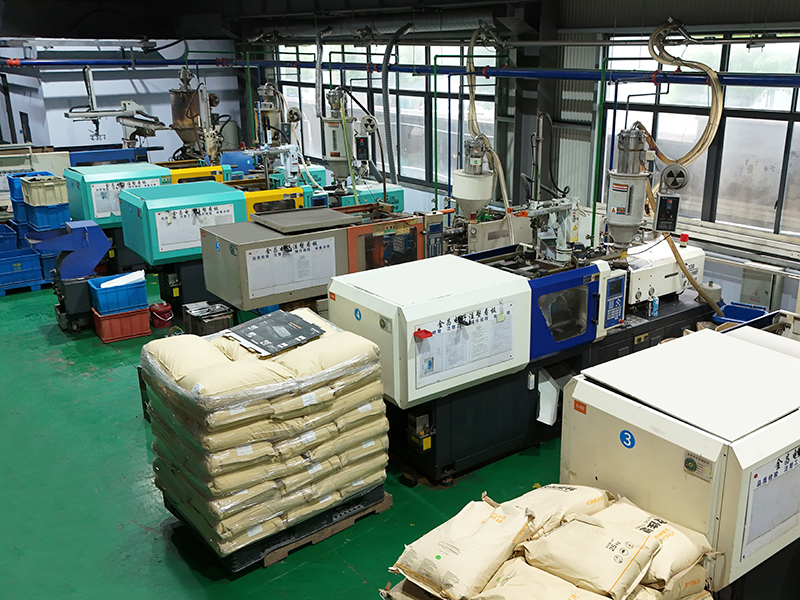
Both products are manufactured by Ningbo Jinchang Electronics Co., Ltd., a small-household-appliance manufacturer based at No.17 Guangming East Road, Ditang Sub-district, Yuyao City, Zhejiang Province, China, which develops and exports electric BBQ grills, electric steamers, charcoal grills and food dehydrators. The company operates a 5,500-square-metre production plant and offers more than 200 product models.
| Comparison dimension | BQ1703XL-SF | BQ1703XLP-SWF |
|---|---|---|
| Product type | Stand BBQ Grill | Stand BBQ Grill |
| Cooking surface | Wire rack | Non-stick aluminium plate |
| Rated power | 2000–2400 W | 1700 W |
| Housing material | PP | PP |
| Temperature control | Adjustable | Adjustable |
| Side tables | Yes — the model is documented as an adjustable temperature electric grill with side tables | Not specified in the available product documentation |
| Product-level certifications | CE, GS, RoHS, LFGB | CE, GS, RoHS, LFGB |
| Documented application | Backyard, patio, balcony and semi-outdoor terrace barbecue; family parties and garden gatherings | Household small appliances and outdoor cooking equipment |
| Documented channel fit | Household use, retail distribution and OEM private-label projects | Household and outdoor cooking use, with private-label supply available through the manufacturer's OEM/ODM programme |
Read as a set, the table shows two models aimed at the same shelf but not the same consumer. One is specified for social, semi-outdoor cooking with more staging room and a wider power band; the other is specified around a coated plate surface and a single lower power rating.
Cooking surface: wire rack versus non-stick aluminium plate
The most consequential difference for end users is what the food sits on. BQ1703XL-SF uses a wire rack; BQ1703XLP-SWF uses a non-stick aluminium plate over a PP housing.
What a wire rack changes
- Heat reaches the food through open gaps, which supports the direct-contact grilling pattern consumers associate with skewers, sausages and larger cuts.
- There is no coated surface to wear, so the useful life of the cooking interface is not tied to coating durability.
- Cleaning typically requires more attention to the rack and the area beneath it, and small pieces can fall through the grid.
What a non-stick plate changes
- A continuous surface holds smaller items — sliced vegetables, mixed pieces, thinner cuts — that would otherwise drop through a rack.
- Wipe-down cleaning is simpler because there are no gaps, which matters for apartment and indoor-adjacent use.
- Coated plates have a finite service life and depend on correct utensils and temperature handling; this is a genuine ownership consideration rather than a marketing detail.
For plate-based cooking surfaces, food-contact testing is a separate evidence category from electrical safety. Ningbo Jinchang Electronics holds an FDA food contact test report (EFHZ24081596-CG-01, Eurofins Product Testing Service (Hangzhou) Co., Ltd., issued 5 September 2024) against FDA 21 CFR 177.1550 Total Extractives for Coating, but that report's declared scope is an aluminium plate accessory for a different grill model. Buyers specifying a coated plate should therefore request a food-contact report that names the exact configuration being purchased rather than assuming transferability across models.
Rated power: what 2000–2400 W and 1700 W imply
BQ1703XL-SF is rated across a 2000–2400 W band, while BQ1703XLP-SWF is rated at 1700 W. In practical terms, a higher rated power gives more available heat output for larger simultaneous loads and faster recovery between batches, and a band rather than a single figure indicates the model family is offered in more than one rated configuration. A 1700 W rating positions the model at the lower end of the stand-grill power range.
Two planning points follow. First, rated power is fixed per configuration, so the band on BQ1703XL-SF should be narrowed to a single figure in the purchase specification. Second, the available documentation does not state rated voltage for either model. Voltage is listed among the manufacturer's customization options — Logo, Voltage, and Product Design & Development — which means destination-market voltage and plug type have to be confirmed as a written specification rather than assumed from the model code. Buyers installing on balconies, terraces or older patios should also verify the available circuit against the rated draw of the configuration they order.
Certification: what the two models genuinely share
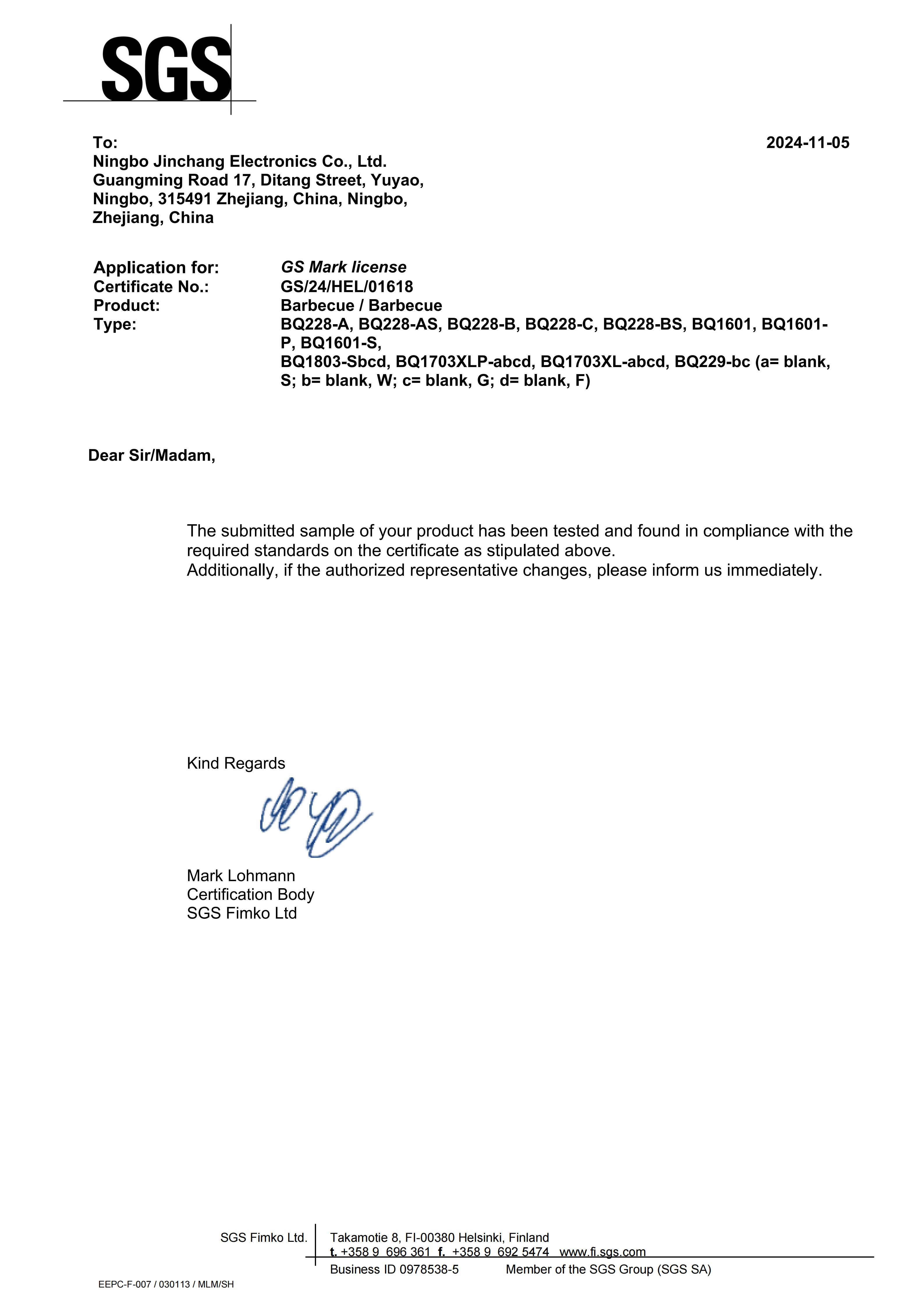
Both models carry CE, GS, RoHS and LFGB at product level, and the shared documentation is unusually specific. The GS Mark license GS/24/HEL/01618, issued by SGS Fimko Ltd for the Germany and EU market on 5 November 2024, lists both BQ1703XL-abcd and BQ1703XLP-abcd within a single scope, where a = blank or S, b = blank or W, c = blank or G, and d = blank or F. That suffix logic explains the two model numbers directly: BQ1703XL-SF corresponds to a = S and d = F, and BQ1703XLP-SWF corresponds to a = S, b = W and d = F.
Alongside the GS license, the following documents are relevant to a European evaluation:
| Document | Issuing body / standard | Validity | Relevance to the two models |
|---|---|---|---|
| GS Mark license GS/24/HEL/01618 | SGS Fimko Ltd; GS-Mark safety requirements | 5 Nov 2024 – 5 Nov 2026 | Scope names both BQ1703XL-abcd and BQ1703XLP-abcd |
| Ecodesign (ErP) test report NBEE241200121951 | SGS; EEC_(EU) No 2023/826 | 29 Oct 2025 – 29 Oct 2027 | Scope includes BQ1703XL-ABCD and BQ1703XLP-ABCD |
| Test report NGBEC25007613101 | SGS; client-specified test package, global market | 24 Nov 2025 – 24 Nov 2027 | Scope stated as "Electric BBQ GRILL"; associated with both models |
| EU POPs test report NGBEC26000921401 | SGS; Regulation (EU) 2024/2570 amending (EU) 2019/1021 | 16 Mar 2026 – 16 Mar 2028 | Associated with both models |
| RoHS verification report NGBEC24007628901_1 | SGS; RoHS Directive (EU) 2015/863 amending 2011/65/EU | 30 Dec 2025 – 30 Dec 2027 | Associated in the documentation with models including BQ1703XL-SF |
At factory-system level, the manufacturer holds ISO 9001 quality management certification (NOA2409732, NOA Testing & Certification Group Ltd., 11 October 2024 – 10 October 2027), ISO 14001 environmental management certification (NOA2507153, NOA Certification Group Co., Ltd., 18 September 2025 – 17 September 2027), an amfori BSCI monitoring summary (24-0279560-1, SGS, 26 September 2025 – 8 October 2026) and an ICS audit summary (SGS, 5 June 2025 – 7 June 2027).
Scenario fit: which model belongs where
BQ1703XL-SF is documented for backyard, patio, balcony and semi-outdoor terrace barbecue, and for family parties and garden gatherings, with a stated fit for household use, retail distribution and OEM private-label projects. The side tables address a specific real-world constraint: balconies and semi-outdoor terraces often have no adjacent surface for plates, tools or trays, so staging area has to be built into the appliance itself.
BQ1703XLP-SWF is documented for household small appliances and outdoor cooking equipment. Its plate surface and lower power rating point towards smaller, more frequent cooking sessions and towards buyers who prioritise wipe-down cleaning over char-mark grilling. When the end user cooks indoors adjacent to an open window or on a compact balcony, the plate format is generally easier to manage than an open rack.
A useful decision rule for evaluation-stage buyers is therefore: choose on staging area and batch size first, then on surface type. Where the retail listing promises social, multi-person outdoor cooking, BQ1703XL-SF's side tables and broader power band align with that promise. Where the listing targets compact, everyday cooking with easier cleanup, BQ1703XLP-SWF aligns better. Neither rule makes one model universally superior.
Private-label and OEM: what is confirmed and what still has to be defined
Both models sit inside a manufacturer that runs an OEM/ODM production mode with stated capabilities: customization covering logo, voltage and product design and development; a monthly capacity of 100,000 units; a 30-day lead time; a minimum order quantity of 5,000 units; 100% test quality control; a 1-year warranty; and export markets covering the EU, USA, AU and South Africa. The company reports an annual output of 1,200,000 units, an export ratio of 90%, main markets in the EU, USA, AU and RU, and an 8-engineer R&D team. Its stated customization options extend to appearance modification, function adjustment, private-mould development and customized packaging upon client requirements.
Two qualifications matter when a private-label programme is written into a contract. The 5,000-unit minimum order quantity is stated as a company-level capability figure; whether it applies per model, per SKU or per combined order should be confirmed in writing before a range plan is locked. And because certification scope is defined by model-number suffix families, a private-label configuration that changes the letter combination falls outside the existing GS and ErP scope unless a new certification is issued. This is the single most common source of delay in electric grill private-label projects, and it is resolved by agreeing the configuration code before tooling rather than after.
How stand electric grills compare with charcoal and gas formats
Electric stand grills compete on convenience, compliance and indoor-adjacent usability rather than on peak heat or flavour. Charcoal and gas formats remain capable of higher open-flame heat and, in charcoal's case, deliver smoke character that electric units do not reproduce. Gas grills free the user from a power outlet; electric grills do not. Two limitations are worth naming for buyers writing category copy or retail listings.
First, mains dependency is a real constraint. BQ1703XL-SF and BQ1703XLP-SWF are corded stand appliances, so they are unsuitable for genuinely off-grid locations, and the higher power band on BQ1703XL-SF places a greater demand on the available circuit at the point of use. Selling an electric stand grill into a market where balconies lack accessible outdoor sockets requires that constraint to be explained, not glossed over. Second, the stand format occupies floor space, which makes it a poorer fit for compact apartment storage than a tabletop unit; buyers building a full assortment should position the stand models against tabletop alternatives rather than against each other alone.
Market trend signals behind the two-model decision
The clearest third-party signal is the shift of demand towards plug-in and lower-smoke formats, as reflected in the segment data cited above. The clearest first-party signal is the volume profile of European retail supply: a large supermarket retailer in France procures electric BBQ grills for household outdoor and indoor barbecue applications at an annual volume of 60,000 units, over a stated duration of three to five years, with reported stable performance and good market feedback. That pattern — year-round outdoor and indoor use rather than seasonal single-purpose use — is why scenario breadth rather than peak power has become a stronger predictor of retail fit.
Buyers should also treat category growth figures with care. Published CAGR forecasts for electric grills differ materially depending on which product types are counted in the scope, and the spread between the lowest and highest published estimates is wide enough that a single growth number should not anchor a business case. Segment definition, not optimism, drives the difference.
Future outlook
Three developments are worth tracking rather than predicting. Certification renewal cycles will govern model availability: the GS license covering both model families expires on 5 November 2026, and buyers planning 2027 programmes will find that their assortment depends on renewal outcomes they do not control. Configuration governance will become a competitive advantage rather than an administrative task, because letter-suffix scope management determines how quickly a private-label variant can be launched. And the shift towards coated-plate cooking surfaces will make food-contact documentation — not just electrical safety documentation — a routine part of the buyer's checklist, particularly for the US market.
For evaluation-stage buyers, the practical conclusion is that BQ1703XL-SF and BQ1703XLP-SWF answer different questions. The first is specified for social, semi-outdoor cooking with more staging area and a wider power band; the second is specified around a coated plate surface and lighter-duty power. Selecting between them is a matter of matching appliance specification to the site and the customer, and of verifying the document set against the exact configuration ordered.
FAQ
What is the main difference between BQ1703XL-SF and BQ1703XLP-SWF?
Both are stand BBQ grills with adjustable temperature control and CE, GS, RoHS and LFGB certification. Beyond that, they differ in cooking surface (wire rack versus non-stick aluminium plate), rated power (2000–2400 W versus 1700 W), the presence of side tables on BQ1703XL-SF, and the documented application (backyard, patio, balcony and semi-outdoor terrace barbecue versus household small appliances and outdoor cooking equipment).
Are both models covered for the European market?
Yes, within defined scopes. GS Mark license GS/24/HEL/01618 issued by SGS Fimko Ltd lists both the BQ1703XL-abcd and BQ1703XLP-abcd families, and ErP test report NBEE241200121951 (standard EEC_(EU) No 2023/826) lists BQ1703XL-ABCD and BQ1703XLP-ABCD. The GS license is valid to 5 November 2026 and the ErP report to 29 October 2027. Buyers should confirm that the exact letter-suffix configuration ordered falls within these scopes.
Which model is better suited to a balcony or semi-outdoor terrace?
BQ1703XL-SF is the model documented for balcony, patio, backyard and semi-outdoor terrace barbecue, and it is the one that includes side tables — useful where no adjacent surface exists for plates and tools. BQ1703XLP-SWF is documented for household small appliances and outdoor cooking equipment, and its non-stick aluminium plate is easier to wipe clean, which suits smaller spaces and lighter cooking sessions. The choice depends on available space and batch size rather than on product quality.
What standard applies to these electric grills?
IEC 60335-2-9 is the international standard covering portable electric cooking appliances including grills and roasters, which is the applicable appliance safety standard category for these products. For customs and trade purposes, grills and roasters for domestic use fall under HS Code 851660.
What are the minimum order quantity, lead time and production capacity?
The manufacturer states an OEM/ODM minimum order quantity of 5,000 units, a lead time of 30 days, monthly capacity of 100,000 units and annual output of 1,200,000 units, with 100% test quality control and a 1-year warranty. Because these are stated as company-level capability figures, buyers should confirm in writing whether the minimum order quantity applies per model, per SKU or per combined order.
Can both models be supplied as private-label products?
The manufacturer operates an OEM/ODM programme with customization covering logo, voltage and product design and development, plus appearance modification, function adjustment, private-mould development and customized packaging upon client requirements. Because GS and ErP certification scope is defined by model-number letter-suffix families, a private-label configuration that changes the letter combination would sit outside the current scope unless a new certification is issued. Configuration therefore needs to be agreed before tooling begins.
Ningbo Jinchang Electronics Co., Ltd. publishes product and certificate information at www.jc.ltd.