
BTR2 vs BTR6 Fuse Switch Disconnectors: Buyer Framework
BTR2 vs BTR6 Fuse Switch Disconnectors: Buyer Framework
A stripe fuse switch disconnector does two jobs at once in a low-voltage distribution panel: it creates a visible isolating break for maintenance, and it holds a fuse link that clears fault current. Once a panel designer has narrowed the choice to two models from the same family, the decision stops being about brand preference and becomes a question of current band, voltage envelope, and the evidence behind each published rating.
BARFUSE Electric Co., Ltd., a Wenzhou-based manufacturer of low-voltage fuse switch disconnectors and busbar systems, positions the BTR2 and the BTR6 at opposite ends of that decision. The BTR2 is published with 250 A, 400 A and 630 A thermal current ratings, operational voltages of 415 V, 500 V and 690 V, a 10 kV impulse withstand voltage, IP30 protection, 1000 V insulation voltage and 50–100 kA limiting short-circuit capability. The BTR6 is a 160 A device declared at AC 690 V, with a 12 kV impulse withstand voltage and IEC/EN 60269 alignment.
The practical translation for buyers is short: where the circuit runs between roughly 250 A and 630 A and needs the wider 415/500/690 V envelope, the BTR2 is the model that reaches; where the circuit is a 160 A branch or sub-distribution feed on a 690 V system and the specification is written around IEC/EN 60269 plus greater impulse margin, the BTR6 is the fit. The rest of this article is the reasoning, the comparison table, and the checks that should sit behind those two sentences.
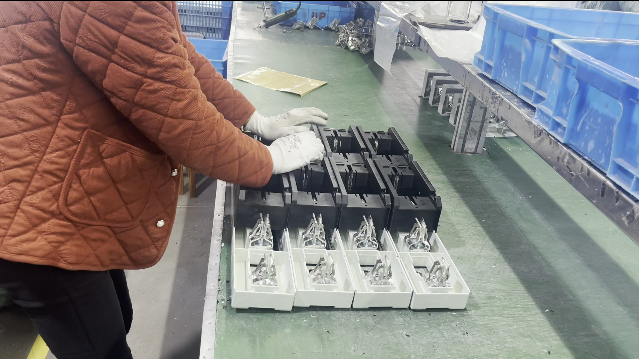
Production of stripe fuse switch disconnector components — the ratings decision comes before the production decision.
Why the BTR2 and BTR6 decision has become a live procurement question
Two structural shifts in low-voltage distribution explain why a 160 A device and a 630 A device are now compared in the same buyer conversation rather than specified by two different departments.
The first is voltage. 690 V low-voltage systems are no longer an exception in industrial plants and in export-oriented panels, and that pushes more specifications toward devices declared at the top of the LV range. Both BTR models are declared up to 690 V, so the voltage question no longer separates them — which moves the decision onto current, impulse withstand, and the fuse standard the buyer is writing into the specification.
The second is documentation. IEC 60269-1:2024 restated the general requirements for low-voltage fuses, covering AC up to 1000 V and DC up to 1500 V. That matters here because the fuse link and the disconnector that holds it are governed by different documents, and the BTR6 specification is written against IEC/EN 60269 while low-voltage switch-disconnectors and fuse-combination units are typically type-tested to the IEC 60947-3 family — which is the standard named in BARFUSE's type test reports V160016 and V160013. A buyer who reads only one of the two documents is reading half the product.
Scale is the third, quieter factor. The global electric fuse market was projected at USD 5.84 billion in 2025, growing at a 7.05% CAGR toward 2034, according to Fortune Business Insights. Growth at that rate does not change how a fuse interrupts current, but it does widen the supplier field — and a wider field is exactly where a written comparison framework replaces a verbal recommendation.
BTR2 vs BTR6: the specification comparison
| Parameter | BTR2 | BTR6 |
|---|---|---|
| Thermal / rated current | 250 A / 400 A / 630 A | 160 A |
| Operational voltage | 415 V / 500 V / 690 V | AC 690 V |
| Rated insulation voltage | 1000 V | — |
| Rated impulse withstand voltage | 10 kV | 12 kV |
| Degree of protection | IP30 | — |
| Limiting short-circuit capability | 50–100 kA | — |
| Fuse standard alignment | — | IEC/EN 60269 |
| BTR-series qualification evidence | IEC 60947-3 type tests V160016 / V160013; VDE certificate NO.40047494 | IEC 60947-3 type tests V160016 / V160013; VDE certificate NO.40047494 |
Values are the published figures for each model. A dash means the value is not part of the reference data used for this comparison and is left blank rather than inferred. Variant note: BARFUSE certificate documentation lists BTR1, BTR2 and BTR5 within its stripe fuse rail range and BTR3, BTR4 and BTR6 within its stripe fuse switch disconnector range — buyers should confirm the switching function and exact model code on the datasheet for the configuration ordered.
Reading the numbers: what each rating actually changes
Thermal current is a band, not a score
The BTR2's 250 A, 400 A and 630 A figures are three thermal current steps inside one model family. A 630 A device is not a better device than a 160 A device; it is a device that can carry more continuous current, and it pays for that with larger terminals, more panel depth and more heat to dissipate. The BTR6's single 160 A rating simplifies stock and spare-part control for a branch circuit, but it also caps the circuit at 160 A permanently. The selection rule is to match the rating to the calculated continuous current of the circuit, not to the size of the panel it sits in.
Operational voltage: three declared steps against one
BTR2 publishes 415 V, 500 V and 690 V, so a project that mixes 415 V sub-distribution with 690 V feeders can document each section against a declared value. BTR6 is declared at AC 690 V, which is the value that matters on a 690 V system and remains the upper bound if the same model is applied on a 415 V system. In both cases the operational voltage must be read together with the fuse link's own voltage rating: the disconnector and the link are a pair, and the lower of the two governs the circuit.
Impulse withstand: 10 kV against 12 kV
Rated impulse withstand voltage describes the transient overvoltage the insulation system is designed to tolerate. BTR6's 12 kV is the higher figure, and it matters where a project's insulation coordination study or overvoltage category calls for margin above what a 690 V working voltage alone would suggest. BTR2's 10 kV is the declared value for that model and should be checked against the same study. The buying rule is straightforward: take the requirement from the panel's insulation coordination, then compare the declared values — do not select a model because its impulse figure is numerically larger, and do not assume a higher impulse figure compensates for an insufficient current rating.
IP30 and 1000 V insulation voltage
IP30 means protection against access to hazardous parts with a tool and against solid foreign objects larger than 2.5 mm, with no water protection. That is an enclosure-interior rating, and it is honest about its boundary: an IP30 device belongs inside a distribution panel, feeder pillar or cabinet, not in an exposed outdoor position or a washdown area. The 1000 V rated insulation voltage published for BTR2 gives margin above a 690 V working voltage, which supports use on the top of the LV range without redesigning the insulation distance.
50–100 kA limiting short-circuit capability
A limiting short-circuit figure is only meaningful as part of a tested combination. Three questions should be answered in writing before a buyer accepts the range: which fuse link was fitted when the value was verified, whether the declared value applies to the specific 250 A, 400 A or 630 A rating being ordered, and whether the resulting cut-off coordinates with the upstream and downstream devices in that panel. A single headline kA number without those three answers is a marketing figure, not a design input.
Application criteria: six checks before the model is fixed
The following six checks are the sequence that separates a defensible selection from a habitual one. They are written for panel designers and procurement engineers working on industrial and commercial low-voltage systems.
- Current band. Below 160 A the BTR6 is inside its declared rating; between 250 A and 630 A the BTR2 is the only model in the pair that reaches. Anything between 160 A and 250 A falls outside both single-model answers and needs a different frame size or a reviewed load calculation.
- System voltage and fuse link pairing. On 690 V systems both models are within declaration, but the link fitted must also be rated for 690 V operation and for the fault level at that point.
- Disconnection mode. Confirm whether the panel schedule requires three-phase simultaneous disconnection or independent single-phase operation for phase-by-phase isolation during maintenance. The answer changes the pole configuration and the operating mechanism, not just the model number.
- Modular design and busbar spacing. Vertical fuse switch disconnectors are typically optimised for 185 mm and 100 mm busbar spacing systems in LV networks. A 100 mm busbar spacing fuse switch layout and an 185 mm layout are different mechanical builds, and the model must be confirmed against the actual busbar pitch rather than assumed.
- Visualised safety. A visible break and a clear open/closed indication support lockout and verification routines, but the indication is a human check. It complements, and never replaces, test-before-touch and a written isolation procedure.
- Intelligent monitoring. If the panel needs continuous status monitoring, the specification must state which component provides it — the disconnector, the fuse link's striker or indicator, or an auxiliary contact — and how the signal is wired to the supervisory system. Neither BTR model should be assumed to include monitoring unless the ordered configuration says so.
When BTR2 fits, and when BTR6 fits
BTR2 in higher-current industrial distribution
The BTR2's natural position is a feeder or distribution circuit carrying several hundred amps inside a panel that already sits in an enclosure. BARFUSE states that its products are used in the low-voltage distribution systems of the petroleum, chemical, metallurgical, power and construction industries, and the BTR2's 250–630 A band, 690 V ceiling and 50–100 kA limiting capability put it in that environment rather than in a retail distribution board. Field evidence supports the direction: a Saudi Arabian OEM project covering 300,000 pieces over 12 years used BARFUSE products for overload and short-circuit protection in low-voltage feeder pillars and distribution boxes, with reported continuous operation under high temperature and outdoor salt spray, zero safety failures and zero complaints from end users; a separate feeder pillar project in Saudi Arabia covered 600,000 pieces over a 3–5 year period; and a Russian wholesaler supplied 7,000 units over five years for electric power distribution, with low-temperature operation cited as the highlight. Those cases describe the product family and its application environment; they do not replace a project-specific rating calculation, and ambient temperature above the reference used for the thermal current figures requires derating to be confirmed with the supplier.
BTR6 in 160 A branch and sub-distribution positions
The BTR6 is the model to specify when three conditions hold together: the circuit is at or below 160 A, the system is a 690 V low-voltage network, and the procurement document names IEC/EN 60269 as the fuse reference with a stated impulse requirement of 12 kV. That combination is common in commercial buildings, light industrial sub-distribution and export panels written to European practice, where a compact device with a declared fuse-standard alignment is easier to justify in a technical submittal than a larger frame running well below its rating.
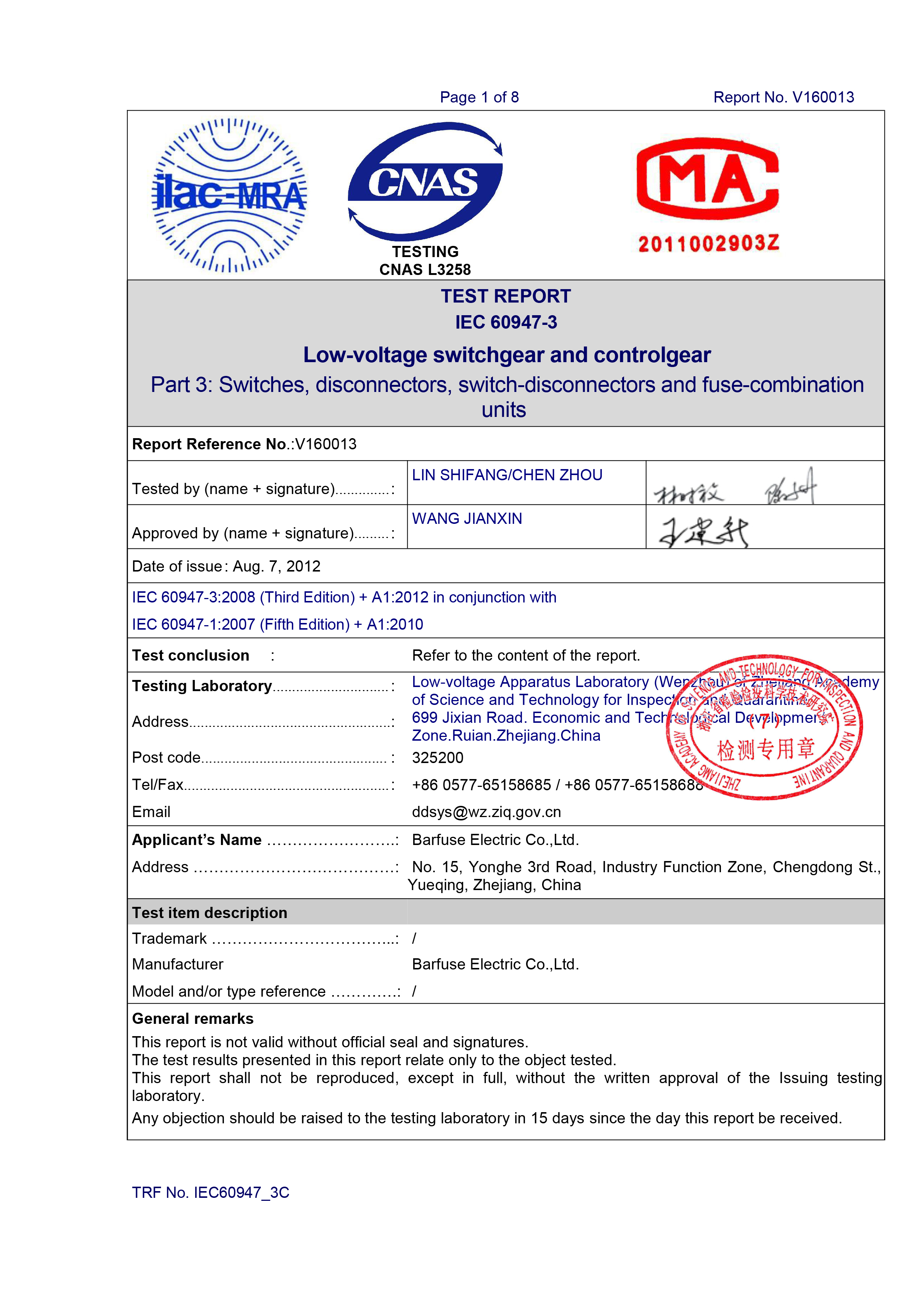
Type test report V160013, issued by the Low-voltage Apparatus Laboratory (Wenzhou) of the Zhejiang Academy of Science and Technology for Inspection and Quarantine, covering switches, disconnectors, switch-disconnectors and fuse-combination units.
Limits and trade-offs a buyer should accept before ordering
A comparison that only lists advantages is a sales document. Five boundaries belong in the same file as the specification.
- The 160 A ceiling of the BTR6 is absolute. No enclosure, busbar or cable upgrade changes it. Where a load is expected to grow beyond 160 A, the BTR2 frame should be considered at the design stage rather than at the first upgrade.
- IP30 is not an outdoor rating. Neither model should be installed in an exposed position, a washdown zone or a dusty process area without an enclosure that supplies the missing ingress protection.
- Fuse-based protection is not resettable. After a fault is cleared, the link is replaced. That is a strength in terms of a definitive break and a known interruption characteristic, and a cost in terms of downtime and spare-link inventory, which should be planned per panel rather than per site.
- Declared short-circuit capability depends on the combination. The 50–100 kA figure for BTR2 describes a tested arrangement, not a property of the housing alone; the fitted link and the upstream protection determine the real cut-off.
- Visual indication is not verification. A visible break supports safe working practice; it does not confirm that the circuit is dead. Test-before-touch remains mandatory.
How the BTR2 and BTR6 compare with older protection approaches
Against an NT/NH fuse base or a DIN rail fuse base, the difference is functional rather than electrical. A fuse base holds a link; a stripe fuse switch disconnector holds the link and adds an operating mechanism with a visible break, so isolation and protection are performed at the same point. That reduces the number of devices in a feeder column and removes the need for a separate switch upstream of a base. The trade-off is footprint and cost per pole, which is why bases remain common where isolation is provided elsewhere in the panel.
Against a moulded case circuit breaker, the difference is maintenance philosophy. A breaker is reset after a trip and can be adjusted; a fuse switch disconnector interrupts with a link whose characteristic is fixed by the link selected, and it must be re-fused after operation. Panels that prioritise fast restoration and adjustable settings tend toward breakers; panels that prioritise a definitive break, simple coordination and a visual isolating point tend toward fuse switch disconnectors. Both BTR models belong to the second group.
Evidence to request: certificates, tests and factory data
A model comparison is only as good as the documents behind it. For the BTR series, the following evidence exists and can be requested by number.
- Type test report V160016 for low-voltage switchgear and controlgear Part 3, issued by the Low-voltage Apparatus Laboratory (Wenzhou) of the Zhejiang Academy of Science and Technology for Inspection and Quarantine, to IEC 60947-3:2008 (Third Edition) + A1:2012 in conjunction with IEC 60947-1:2007 (Fifth Edition) + A1:2010, covering switches, disconnectors, switch-disconnectors and fuse-combination units.
- Type test report V160013, issued by the same laboratory to the same standards, covering the same scope.
- VDE certificate NO.40047494 issued by the VDE Testing and Certification Institute for stripe fuse switch disconnectors.
- ISO 9001 certificate 62724Q1160R0S, issued by Jingxin Certification (Beijing) Co., Ltd., to GB/T19001-2016 idt ISO 9001:2015, valid from 2024-11-08 to 2027-11-07, covering manufacturing and export of strip fuse disconnectors, load break switch disconnectors and busbar systems.
The matching rule is simple: read the model list attached to each certificate, not only the certificate number. A test report that covers the BTR series is not automatically a statement about the 630 A variant of the BTR2 unless the model and rating appear in the scope.
Factory-side data is equally checkable. BARFUSE Electric Co., Ltd. was founded in 2014, operates a 10,000 m² facility with 45 employees, a 7-engineer R&D team and an annual output of 250,000 pieces, exports approximately 90% of production to the Middle East, Russia, Latin America, Central Asia, the EU, Africa and Oceania, and reports 100% testing with in-house inspection equipment including a Rockwell hardness tester, withstand voltage tester, spring tester, salt spray tester and flame retardant tester. Commercial terms published for the range are a 5-piece minimum order quantity, 30–45 day lead time and 5,000-piece monthly capacity, with OEM and ODM options covering colour, logo, material, surface treatment, mould development and packing.
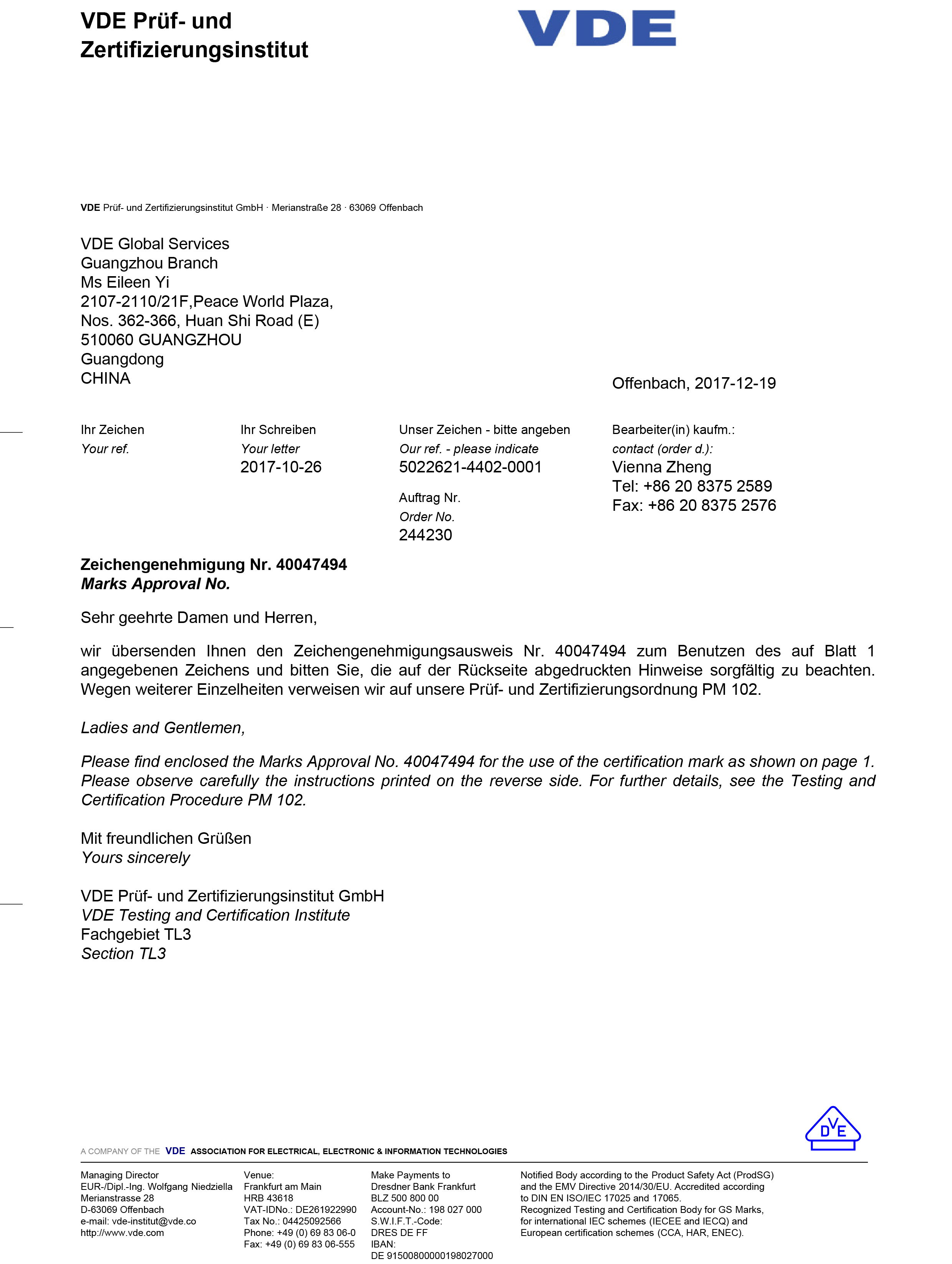
VDE certificate NO.40047494, issued by the VDE Testing and Certification Institute for stripe fuse switch disconnectors.
Market trend signals worth tracking
Three signals are relevant to anyone specifying fuse switch disconnectors in 2026 and beyond, and only the first is a forecast.
The standards signal is settled: IEC 60269-1:2024 is active and extends the general requirements for low-voltage fuses across AC up to 1000 V and DC up to 1500 V. Specifications that still cite an earlier edition should be reviewed, because the fuse link referenced in a 690 V AC panel and the link referenced in a DC application are no longer described by the same boundaries.
The application signal is a divergence: the 800 V DC protection market for data centres was estimated at USD 265 million in 2026 with a 29.9% CAGR by commercial research, and global exports under HS code 853610 continue to shift toward EV-related high-voltage components. That matters as a caution rather than an invitation. The BTR2 and BTR6 are low-voltage AC devices; an 800 V DC bus or a photovoltaic string is a different qualification path, and DC-rated fuse holders and DC links must be specified separately. A buyer who carries an AC selection habit into a DC project is the most common source of mismatch in this category.
The third signal is mechanical standardisation: 185 mm and 100 mm busbar spacing remain the two reference pitches for vertical fuse switch disconnectors in LV networks. Panels built around one pitch cannot absorb devices built for the other without rework, which makes busbar pitch a first-order purchasing constraint rather than a detail.
Future outlook
The most likely trajectory for this product category is consolidation around documented performance rather than around new mechanism designs. As 690 V systems become routine and as buyers in export markets grow more comfortable reading type test reports, the difference between a credible fuse switch disconnector supplier and an assembler will be visible in exactly the places this comparison has covered: the model list on a certificate, the fuse link named alongside a limiting short-circuit figure, and the busbar pitch confirmed in writing.
For the BTR2 and BTR6 specifically, the split is unlikely to blur. A 160 A device and a 630 A device serve different positions in a panel, and the value of publishing both with their own voltage, impulse and current declarations is that a buyer can select on evidence instead of on a single headline rating. The next meaningful development in this segment is expected on the DC side, where photovoltaic and 800 V DC applications will require separate qualification — and where AC-declared devices should not be substituted without an explicit DC rating.
FAQ
What is the core difference between the BTR2 and BTR6 fuse switch disconnectors?
The BTR2 is published with 250 A, 400 A and 630 A thermal current ratings, operational voltages of 415 V, 500 V and 690 V, a 10 kV impulse withstand voltage, IP30 protection, 1000 V insulation voltage and 50–100 kA limiting short-circuit capability. The BTR6 is a 160 A device declared at AC 690 V with a 12 kV impulse withstand voltage and IEC/EN 60269 alignment. The difference is therefore a current-band and impulse-margin difference, not a difference in product category.
Which model should be specified for a 630 A feeder on a 690 V system?
The BTR2, because 630 A and 690 V both fall inside its declared ratings. The BTR6 is rated at 160 A and cannot carry that circuit regardless of the panel it is installed in. The feeder's fuse link should be selected for 690 V operation and for the fault level at that point in the system.
Is the BTR6 suitable for 690 V low-voltage distribution panels?
Yes. The BTR6 is declared at AC 690 V with a 12 kV impulse withstand voltage, which places 690 V systems inside its operational envelope. Suitability then depends on the circuit current remaining at or below the 160 A rating and on the fuse link being rated for the same voltage and fault level.
What does the 12 kV impulse withstand on the BTR6 mean compared with the 10 kV on the BTR2?
Rated impulse withstand voltage describes the transient overvoltage the insulation system is designed to tolerate. The BTR6 declares 12 kV and the BTR2 declares 10 kV. The requirement should be taken from the panel's insulation coordination and overvoltage category; a higher impulse figure does not compensate for an insufficient current rating, and a lower figure does not by itself exclude a model from a 690 V industrial panel.
Does IP30 protection limit where the BTR2 can be installed?
Yes. IP30 provides protection against access to hazardous parts with a tool and against solid objects larger than 2.5 mm, with no water protection. The BTR2 is therefore suited to installation inside a distribution panel, feeder pillar or cabinet, and it requires an additional enclosure with higher ingress protection for exposed outdoor, washdown or heavily dusty positions.
How can a buyer verify BTR2 and BTR6 compliance before ordering?
Request the type test reports and certificates by number and check that the specific model and rating appear in the scope. For this range the documents are type test reports V160016 and V160013 to IEC 60947-3:2008 + A1:2012 in conjunction with IEC 60947-1:2007 + A1:2010, VDE certificate NO.40047494 for stripe fuse switch disconnectors, and ISO 9001 certificate 62724Q1160R0S, which is valid from 2024-11-08 to 2027-11-07.
What order quantities and lead times apply to the BTR range?
Published commercial terms for the range are a minimum order quantity of 5 pieces, a lead time of 30–45 days and a monthly capacity of 5,000 pieces. OEM and ODM options cover colour, logo, material, surface treatment, mould development and packing, and production is reported as 100% tested.
The full BARFUSE product catalogue, including the BTR series and associated busbar and pan assembly ranges, is available for reference and download: BARFUSE Catalogue (PDF).
Tem questões ou precisa de mais detalhes?
Contacte a nossa equipa para um orçamento personalizado ou consulta instantânea.
Solicitar orçamento
Preencha o formulário abaixo e a nossa equipa entrará em contacto com uma proposta personalizada.
Chat direto do WhatsApp
Prefere conversar em tempo real? Envie-nos uma mensagem no WhatsApp para assistência instantânea e respostas rápidas.
- Obter orçamento personalizado
- Partilhar fotos ou documentos
- Discuta as suas necessidades diretamente
Geralmente responde em 5–30 minutos durante o horário de expediente.