
Baby Diaper Scenario Fit: S–XL Absorbency by Use
Baby Diaper Scenario Fit: S–XL Absorbency by Use
Quick answer: Yibero Premium Quality Ultra Cloudy Baby Diapers are tape-style disposable baby diapers in sizes S, M, L and XL, with reference absorbency values of 500, 600, 700 and 800 ml, respectively. These figures are product reference specifications—not a promise of a particular wear time. For daytime changes, nighttime use and travel, buyers should consider size and fit alongside the intended change routine, and verify absorbency claims against the approved specification and test results produced under the same conditions.
For buyers assessing baby diapers for a retail, wholesale or private-label range, the useful question is not simply which size has the largest stated absorbency. It is how a product specification fits the intended baby, changing situation and product format—and which evidence supports the performance claim. This article uses the stated Yibero S–XL specification to explain that decision without treating reference absorbency as a guarantee of overnight use or leak prevention.
Why scenario fit involves more than an absorbency number
Absorbency is one part of a diaper specification. A buyer also needs to establish that the size range matches the intended weight range, that the format suits the changing routine, and that the stated performance is supported by a specification and relevant test evidence. A reference value in millilitres can help describe a product configuration, but it does not, by itself, establish how many hours a diaper can be worn or how it will perform in every use condition.
That distinction matters when a product is positioned for different moments in the day. Daytime may involve regular changes as part of routine care. Nighttime raises a separate question about the intended interval between changes and the evidence for performance under that use. Travel adds practical considerations such as the caregiver’s ability to change the diaper and the product’s stated conditions of use. These are useful buyer questions, but the available specification does not provide a validated day-versus-night wear-time claim or travel-specific performance result.
The product is described for routine infant care as a single-use item for frequent daily changes, providing disposable absorbency, leakage protection and fit. Its stated operating context is household daily indoor use at normal ambient temperature. Consequently, buyers should distinguish the documented use context from additional positioning they may be considering for a private-label range.
Yibero S–XL specification at a glance
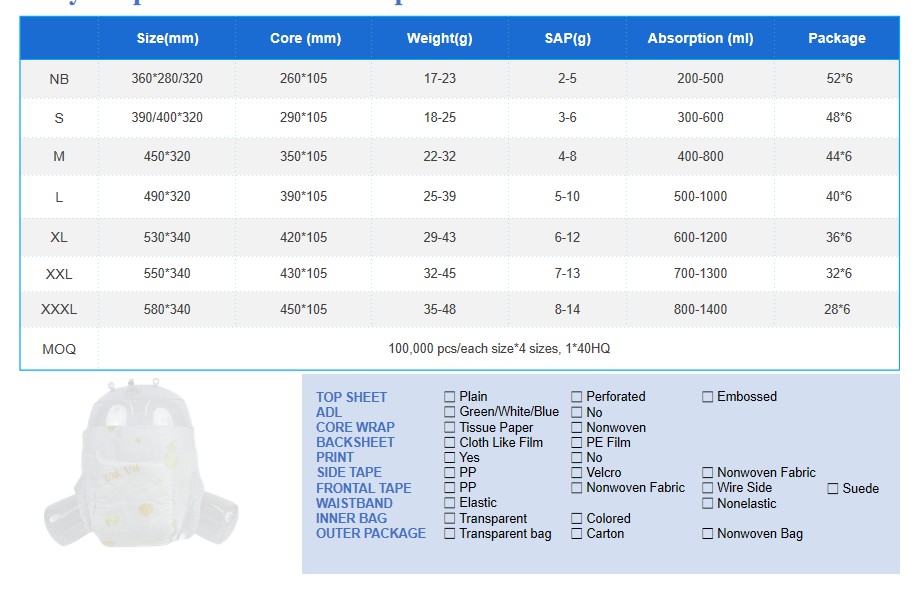
Yibero baby diaper in this article refers to the tape-style Yibero Premium Quality Ultra Cloudy Baby Diapers specification. The product specification gives the following size, baby-weight and reference absorbency ranges:
| Size | Stated baby-weight range | Dimensions | Reference absorbency |
|---|---|---|---|
| S | 4–8 kg | 400 × 320 mm | 500 ml |
| M | 6–11 kg | 450 × 320 mm | 600 ml |
| L | 9–14 kg | 500 × 340 mm | 700 ml |
| XL | 12–17 kg | 540 × 340 mm | 800 ml |
The weight ranges overlap. That means a baby’s weight alone may not settle a size decision when the baby falls within an overlap. Buyers evaluating the assortment should treat the listed range as a selection reference and review the product fit using an approved sample. The size dimensions and absorbency values describe the listed configuration; they should not be taken as a substitute for a fit check or a defined performance test.
Daytime: assess fit against the planned change routine
For daytime positioning, begin with the product’s stated purpose: a single-use diaper for frequent daily changes in routine infant care. The S–XL range gives buyers multiple size options, while its reference absorbency values rise from 500 ml for S to 800 ml for XL. Those values help distinguish the listed configurations; they do not tell a caregiver when to change the product or establish that a larger size is automatically preferable.
A practical review for a daytime assortment can therefore ask three separate questions. First, does the baby-weight range correspond to the intended size offering? Second, does an approved sample fit the intended user? Third, does the product’s reference absorbency and test evidence match the performance description planned for the label or product page? Keeping those checks distinct reduces the risk of turning a specification number into a broader claim that has not been substantiated.
The listed construction includes a soft topsheet, an absorbent core using imported SAP and fluff pulp, reusable magic tape, nonwoven frontal tape, an elastic waistband and a cloth-like breathable backsheet. These are configuration details for product evaluation. They do not, without corresponding test results, establish comparative comfort, breathability, leakage performance or superiority over another diaper.
Nighttime: do not convert reference absorbency into hours of wear
Nighttime use is a scenario that buyers may want to address, but the available Yibero product specification does not state an overnight duration, a recommended number of hours between changes, or a nighttime-specific test result. As a result, the 500–800 ml reference absorbency range cannot be translated into a claim that a diaper will last through the night.
For a nighttime product proposition, buyers should define the intended use and the claim before choosing the specification. The approved specification should identify the absorbency target and product configuration, and the supporting test evidence should correspond to that configuration. Test results are meaningful for comparison only when the compared samples are assessed under the same conditions and using an agreed method. If a supplier or label makes an overnight or extended-wear claim, buyers need evidence that directly supports that claim; the size table alone does not provide it.
Size and fit remain relevant to this review. The listed S–XL ranges overlap, so the larger nominal absorbency value of a larger size should not be treated as a reason to select that size when the fit is not appropriate. The evaluation should retain the intended size, approved sample and target absorbency together, rather than evaluating the millilitre figure in isolation.
Travel: format and handling can matter as much as size
Travel can make the changing format more noticeable to caregivers. A tape-style diaper is designed for caregiver-assisted changes: the tapes allow the caregiver to position and refasten the product. Pull-up pants are worn like underwear and prioritize convenient dressing for active babies and toddlers. These formats address different changing needs; neither format should be assumed to have better absorbency without product-specific evidence.
The Yibero S–XL product covered here is tape-style. For a buyer considering a travel-oriented assortment, the relevant questions are whether caregiver-assisted changes suit the intended users and whether the product’s documented conditions of use support the proposed positioning. The product information describes household daily indoor use at normal ambient temperature. It does not provide separate travel-condition testing or a travel-specific absorbency claim. A travel label or product-page statement should therefore stay within the approved specification and available evidence.
Routine single-use operation and frequent daily changes are part of the stated application. The product requires no mandatory supporting equipment. These details can help a buyer describe basic use, but they do not replace an assessment of the changing context, sample fit or local packaging instructions. For a private-label program, label language and artwork should be reviewed alongside the product specification before mass production.
Tape-style diapers and pull-up pants: a format distinction
Choosing between a tape-style diaper and pull-up pants is primarily a format decision. Tape-style products prioritize caregiver-assisted changing, which can suit situations where an adult positions and fastens the diaper. Pull-up pants prioritize convenient dressing for babies and toddlers who are crawling or walking. The appropriate option depends on age, activity level, fit, absorbency requirements and changing habits.
This distinction is useful for product-range planning because it prevents two different buying questions from being collapsed into one. Size and absorbency describe aspects of a product configuration; tape versus pull-up describes how the product is put on and changed. A buyer may evaluate both dimensions, but evidence for one does not answer the other. In particular, the tape-style Yibero S–XL absorbency figures do not prove how a pull-up product performs, and a format preference does not establish an absorbency outcome.
| Decision point | Tape-style diaper | Pull-up pants |
|---|---|---|
| Changing approach | Caregiver-assisted positioning and fastening | Worn like underwear; convenient dressing for active babies and toddlers |
| What to assess | Size, fit, approved specification and absorbency evidence | Fit, intended activity and product-specific specification |
| What cannot be inferred from format alone | Overnight duration or a guaranteed leak outcome | Absorbency performance relative to a tape-style product |
How to evaluate an absorbency claim or after-sales issue
When a claim concerns absorbency—whether during initial product review or after delivery—the first reference should be the approved specification for the actual product configuration. Buyers can then check that the target absorbency and the test results refer to the same configuration and that the tests were conducted under the same conditions. Without that alignment, a comparison may combine different targets, samples or test conditions and cannot support a clear conclusion.
A disciplined review can follow this sequence:
- Identify the exact product configuration. Confirm size, materials, absorbent-core arrangement and other agreed specification details for the sample or order in question.
- Check the approved target. Compare the reported result with the absorbency target recorded in the approved specification, rather than relying on a general product description.
- Align the test basis. Review whether the result and the reference being used were obtained under the same test conditions and agreed method.
- Keep the claim within the evidence. A reference absorbency value does not by itself establish wear time, overnight use, or performance under a different scenario.
- Record the review basis. For an order-specific issue, the applicable specification and agreed inspection or test criteria provide a clearer basis for evaluation than an unqualified comparison.
The company’s stated order-control process includes specification review, pre-production sample approval, in-process checks and pre-shipment inspection. The test method, sampling level and acceptance criteria are to be agreed in the contract. For buyers, this is a procurement point to settle in advance: it makes the evaluation basis explicit instead of leaving a later absorbency discussion dependent on an unspecified method.
What the specification does—and does not—support
The Yibero product information supports a concrete description of the listed tape-style diaper: four sizes, stated weight ranges, dimensions, reference absorbency values and specified construction materials. It also identifies routine infant care, single use and frequent daily changes as the intended application context. These facts can support an initial product-fit discussion and a structured sample review.
By contrast, the provided material does not include independently validated absorbency, leakage, rewet or breathability test results for this product. It does not establish a guaranteed leakproof outcome, an overnight duration, or a direct performance advantage over another product. Buyers should avoid turning feature terms such as “high absorbency,” “leakproof” or “breathable” into substantiated claims unless the approved specification and suitable test evidence support the exact wording and intended market.
This boundary is especially important when translating a factory specification into a private-label description. Yibero’s product information supports OEM/ODM and private-label programs, and the stated customization scope includes product size, absorbency target, absorbent-core structure, materials, graphics and packaging. That scope enables configuration discussions; it does not mean every possible configuration or performance claim has already been tested. A buyer should confirm the chosen materials, target, artwork and final sample before authorizing mass production.
Market and procurement implications
There is not enough validated category evidence in the supplied material to make a quantitative claim about consumer preference for daytime, nighttime or travel diapers, or to describe a measured shift in demand. A useful procurement conclusion can still be drawn from the product facts: scenario labels need to be tied to a defined configuration and evidence, rather than inferred from a size or a single absorbency number.
For importers, distributors and private-label brand owners, the practical task is to keep the product specification, target-market label language and performance evidence aligned. Before mass production, the application information calls for confirmation of target-market compliance, label language, performance specification, pack count and artwork. Those checks are relevant whether the intended range emphasizes routine daytime changes, a separately evidenced nighttime proposition, or caregiver convenience in travel situations.
In product planning, a clear distinction among size, format and use claim also helps prevent avoidable ambiguity. Size maps to the listed baby-weight range and dimensions. Format describes tape fastening or pull-up dressing. A use claim such as overnight suitability needs evidence tied to the claim. Treating these as separate decision fields gives procurement teams a more auditable basis for reviewing samples, specifications and later product feedback.
Future outlook: define the use case before expanding the claim
A sound next step for a buyer evaluating an S–XL range is to decide which use situations the product is intended to cover, then identify what needs to be demonstrated for each. For routine daytime use, the supplied application description supports frequent daily changes and routine infant care. For nighttime or travel positioning, buyers should define additional performance or handling requirements and request evidence appropriate to those requirements rather than assuming the existing reference absorbency values answer them.
For a tape-style product, the evaluation can combine the listed weight range, size dimensions, approved sample fit and agreed absorbency target. If a product-line plan also includes pull-up pants, assess that format as a distinct product configuration with its own specification and evidence. The purpose is not to select the highest reference value by default; it is to select and verify the configuration that matches the intended user and supportable product description.
That approach keeps the decision useful across research and evaluation: the product’s documented facts remain clear, scenario-specific questions are made explicit, and unsupported conclusions are left out. For any absorbency-related after-sales concern, the approved specification and test results obtained under the same conditions remain the appropriate points of comparison.
FAQ
What are the reference absorbency values for Yibero S–XL baby diapers?
The Yibero Premium Quality Ultra Cloudy Baby Diapers specification lists reference absorbency of 500 ml for S, 600 ml for M, 700 ml for L and 800 ml for XL. These are reference values; they do not independently establish a wear duration or an overnight claim.
Do the listed absorbency values show that an XL diaper will last overnight?
No. The supplied specification lists XL at 800 ml reference absorbency but does not state overnight wear time or provide a nighttime-specific test result. An overnight claim requires supporting evidence for the intended product configuration and use.
How does a tape-style diaper differ from pull-up pants?
Tape-style diapers prioritize caregiver-assisted changes, while pull-up pants are worn like underwear and prioritize convenient dressing for active babies and toddlers. The formats address different changing needs; absorbency and fit should be evaluated using the specification and evidence for the specific product.
How should an absorbency-related after-sales claim be assessed?
Compare the issue with the approved product specification, the agreed absorbency target and test results obtained under the same conditions. The product’s reference absorbency value alone is not a substitute for aligned test evidence.
What should buyers confirm before mass production?
Confirm target-market compliance, label language, performance specification, pack count and artwork. Product configuration and absorbency targets should be documented and aligned with the approved sample.
Product data in this reference describes the supplied Yibero tape-style diaper specification. Final configuration and performance claims should be checked against the approved specification and applicable evidence.
Tem questões ou precisa de mais detalhes?
Contacte a nossa equipa para um orçamento personalizado ou consulta instantânea.
Solicitar orçamento
Preencha o formulário abaixo e a nossa equipa entrará em contacto com uma proposta personalizada.
Chat direto do WhatsApp
Prefere conversar em tempo real? Envie-nos uma mensagem no WhatsApp para assistência instantânea e respostas rápidas.
- Obter orçamento personalizado
- Partilhar fotos ou documentos
- Discuta as suas necessidades diretamente
Geralmente responde em 5–30 minutos durante o horário de expediente.