
Bakery Oven Buyer Decision Framework: Asian, European, Convection & MAX
Bakery Oven Buyer Decision Framework: Asian, European, Convection & MAX
Most bakery oven purchases are decided by the specifications buyers check last. Conversations usually open with brand and budget, while trays per bake, tray standard, connected electrical load, and floor and ceiling clearance — the variables that actually determine whether an oven fits a bakery — are examined after a shortlist already exists. This framework reverses that sequence and applies it to four BRESSO oven families and the company's retarder-proofers as a worked reference set.
A Decision Framework, Not a Model Ranking
A decision framework is a fixed order of checks. It does not tell a buyer which oven is best; it tells a buyer which question to answer first, so that later comparisons are made only between viable options. For commercial bakery ovens, five checks resolve most of the selection: production scenario, deck and tray capacity, tray standard, voltage and connected power, and footprint with site clearance. Two further checks — fermentation equipment and documentation — determine whether the equipment can be commissioned and maintained as planned.
The practical value of this order is that each check removes options for a documented reason rather than a subjective one. A bakery that bakes crusty European bread and a bakery that produces soft Asian buns can end up with different deck configurations and different heat-control priorities, even when their daily output in kilograms is identical. Bakery ovens are batch tools, and batch tools are specified by how many trays they hold, how evenly they bake them, and what services the site can supply.
The Reference Oven Families Used in This Framework
BRESSO is a bakery equipment manufacturer founded in 1991 in Seoul, South Korea, with a manufacturing and operations base in Shanghai's Jiading District, China. The company's publicly listed portfolio covers commercial baking ovens, bakery ovens, convection ovens, proofers, and mixers, with deck oven, convection oven, and retarder-proofer families carrying specific model designations.
Four families are compared here:
- Asian Oven (HBVO) — three-deck electric deck oven family with 6, 9, and 12-tray configurations.
- European Oven (HBWO) — three-deck electric deck oven family specified for the EN 600 × 400 mm tray standard, in 6, 9, and 12-tray configurations.
- Convection Oven (HCV) — multi-deck convection family ranging from 5 to 10 trays, including narrow-footprint 6-deck and 10-deck models.
- Champions League MAX Series (HBVO-400ЗMAX-ZS3) — a 12-tray, three-deck, high-output deck oven with the largest listed footprint in the range.
Fermentation support in the same range is provided by two retarder-proofer lines: HBDC Pro (Retarder-proofer Pro) and HBDC Air (Retarder-proofer Air). All listed models are described as stainless steel construction. The oven families pair with these proofers rather than replacing them: a deck oven bakes, a retarder-proofer controls dough temperature, humidity, and timing before baking.
Criterion 1 — Deck Count and Trays per Bake
Capacity in a deck oven is expressed as decks multiplied by trays per deck. That figure, not the external size of the machine, determines how many bake cycles a shop needs to cover a morning production window. The table below lists the verified model-level specifications for the four families.
| Family | Model | Capacity | Overall dimensions (mm) | Voltage / Power |
|---|---|---|---|---|
| Asian Oven (HBVO) | HBVO-2003 | 3 decks, 6 trays | L 1330 × D 1200 × H 2065 | 380V / 15 kW |
| Asian Oven (HBVO) | HBVO-3003 | 3 decks, 9 trays | L 1730 × D 1420 × H 2065 | 380V / 24 kW |
| Asian Oven (HBVO) | HBVO-4003 | 3 decks, 12 trays | L 1730 × D 1200 × H 2065 | 380V / 27 kW |
| European Oven (HBWO), EN 600 × 400 mm tray | HBWO-2003 | 2 trays × 3 decks = 6 trays | L 1120 × D 1310 × H 2065 | 380V / 12.4 kW |
| European Oven (HBWO), EN 600 × 400 mm tray | HBWO-3003 | 3 trays × 3 decks = 9 trays | L 1500 × D 1310 × H 2065 | 380V / 16.1 kW |
| European Oven (HBWO), EN 600 × 400 mm tray | HBWO-4003 | 4 trays × 3 decks = 12 trays | L 1500 × D 1495 × H 2065 | 380V / 20.2 kW |
| Convection Oven (HCV) | HCV-5 AIR | 5 decks, 5 trays | L 1900 × D 1220 × H 2065 | 380V / 9 kW |
| Convection Oven (HCV) | HCV-5+5 AIR | 2 decks, 10 trays | L 1900 × D 1340 × H 2065 | 380V / 18 kW |
| Convection Oven (HCV) | HCV-6S | 6 decks, 6 trays | L 900 × D 1340 × H 2065 | 380V / 10.5 kW |
| Convection Oven (HCV) | HCV-10S | 10 decks, 10 trays | L 900 × D 1220 × H 2065 | 380V / 21 kW |
| Champions League MAX Series | HBVO-400ЗMAX-ZS3 | 4 trays × 3 decks = 12 trays | L 1930 × D 3100 × H 2250 | 380V / 27 kW |
Two patterns are worth extracting. First, identical tray counts do not mean identical machines: a 12-tray HBWO-4003, a 12-tray HBVO-4003, and a 12-tray HBVO-400ЗMAX-ZS3 sit at 20.2 kW, 27 kW, and 27 kW respectively, with materially different footprints. Second, the convection family delivers tray counts of 5 to 10 with lower connected power than the deck ovens — for example, HCV-10S holds 10 trays at 21 kW, while the 12-tray HBVO-4003 draws 27 kW. Buyers comparing electricity supply options will find that distinction more consequential than any brand comparison.
Criterion 2 — Tray Standard Determines Compatibility
The European Oven HBWO family is specified against the EN 600 × 400 mm tray standard across all three models. Tray standard is not a cosmetic detail. It determines whether a bakery can reuse existing trays, whether trays sourced locally will fit the deck runners, and whether a new oven integrates with an existing production line or forces a parallel tray inventory.
For the Asian Oven HBVO, Convection Oven HCV, and Champions League MAX Series models, the verified specification documents state deck and tray counts but do not state a tray standard. That is a genuine information boundary, not a gap a buyer should fill by assumption. The correct action is to confirm the supported tray dimension with the supplier before ordering, and to test-fit the trays the bakery already owns. Buyers who standardise on 600 × 400 mm across an entire shop will find the HBWO line documented for that format, while buyers with other formats should request written confirmation for the specific model.
Criterion 3 — Voltage and Connected Power
Every deck oven and convection oven model listed above runs on 380V three-phase supply. Connected power across the families ranges from 9 kW (HCV-5 AIR, 5 decks, 5 trays) to 27 kW (HBVO-4003 and HBVO-400ЗMAX-ZS3). The retarder-proofers in the same range — HBDC Pro and HBDC Air — operate on 220V at 2 kW, which means a bakery's electrical plan may need to separate the ovens from the fermentation equipment.
Three procurement consequences follow from these numbers. First, site electrical capacity must be confirmed against the specific model's connected load, not against a range average. Second, models with equal tray counts but different power draws allow a buyer to trade electrical capacity against bake behaviour — the 20.2 kW HBWO-4003 and the 27 kW HBVO-4003 both hold 12 trays, but they are not interchangeable electrical loads. Third, BRESSO's stated customisation capability includes adjustable voltage for different markets, with OEM / ODM production offered and a listed minimum order quantity of 2 units, so buyers in markets without standard 380V supply can request a voltage specification rather than redesigning the site.
Criterion 4 — Footprint and Site Clearance
Height is the specification most often overlooked. All deck and convection models listed here are 2065 mm tall, with one exception: the Champions League MAX Series HBVO-400ЗMAX-ZS3 stands 2250 mm high. Floor area requirements differ far more widely. HCV-6S and HCV-10S occupy 900 mm of depth, the shallowest in the range, while HCV-5 AIR and HCV-5+5 AIR extend to 1900 mm in width. The HBVO-400ЗMAX-ZS3 is the largest listed unit at L 1930 × D 3100 × H 2250 mm.
Site clearance is therefore a filter, not a formality. Door openings, corridor turns, extraction routing, and service access all need to accept the chosen model before it is ordered. A compact 900 mm-depth convection oven and a 3100 mm-depth flagship deck oven both bake bread; they do not both fit the same room.
Criterion 5 — Matching Family to Production Scenario
Once capacity, tray standard, power, and footprint are fixed, the remaining decision is behavioural: which family bakes the specific product mix best. The following mapping is drawn from model specifications and documented deployment evidence rather than from generic category claims.
| Production scenario | Primary requirement | Family to evaluate | What to verify before ordering |
|---|---|---|---|
| Artisan crusty bread, baguette, sourdough | Independent steam and uniform deck heat | European Oven HBWO | Steam performance, deck heat distribution, EN 600 × 400 mm tray fit |
| Mixed product lines in high-rent, space-limited sites | Modular decks, independent top/bottom control, no flavour transfer between decks | European Oven HBWO (2003 → 4003), Champions League MAX Series | Floor area, ceiling clearance for the 2250 mm MAX build, connected load |
| High tray count in a narrow room | Short deck depth with multiple decks | Convection Oven HCV-6S / HCV-10S | 900 mm depth clearance, air movement versus product delicacy, tray size |
| Limited electrical capacity per deck | High deck count at low connected power | Convection Oven HCV-5 AIR (380V / 9 kW, 5 decks) | Total connected load, breaker and cable sizing |
| Retarding and proofing before bake | Chilled / frozen holding with humidity control | HBDC Pro or HBDC Air retarder-proofer | Tray count matching the oven, humidity compensation in dry climates |
Convection ovens work by circulating heated air across the baking chamber, which is why they are commonly selected where many small items must bake uniformly on the same tray. Deck ovens rely on radiant heat from the deck surface, which is why they remain the reference format for breads whose crust and bottom colour depend on direct deck contact. These are stable characteristics of the two oven types rather than claims about a single brand, and they explain why bakeries that produce both soft buns and crusty loaves frequently end up operating more than one oven format.
Field Evidence from Documented Deployments
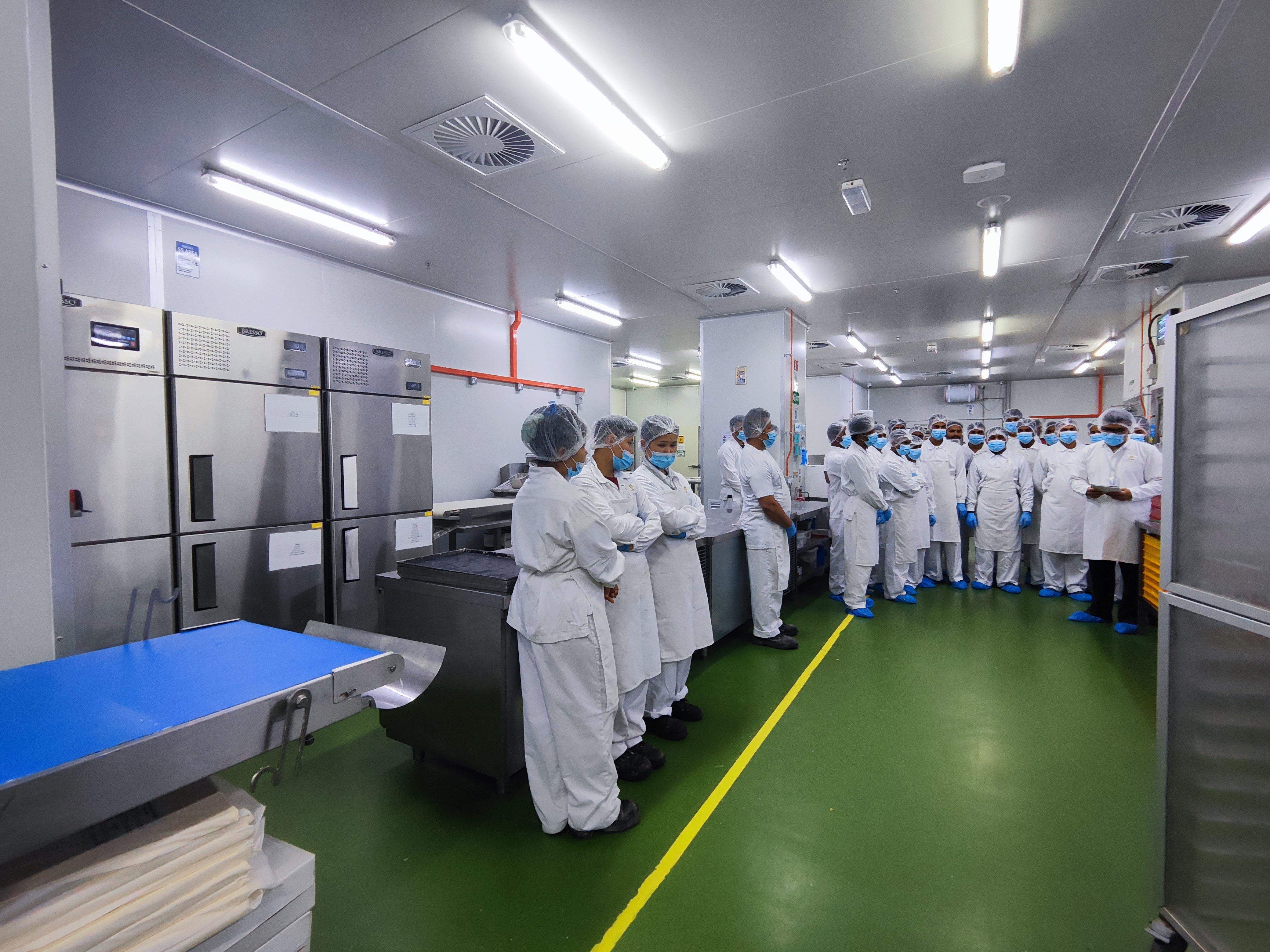
Specifications describe what a machine should do; deployment records describe what operators reported afterwards. The four cases below are the most informative because each exercised a different constraint — steam quality, climate, humidity, or floor space.
Australia — 5 units of the European Oven HBWO, 15 years
A project using five HBWO European Oven units reported a 30% increase in production efficiency and an ultra-low overall failure rate across 15 years of continuous operation. The reported strengths were a powerful independent steam system and exceptionally uniform heat distribution from the stone deck, together with heat retention sufficient for continuous baking without temperature drops. For buyers, this is the clearest available evidence that the steam function, not only the deck count, is what carries artisan bread quality — a criterion that should be explicitly tested at commissioning.
Mongolia — 100 units in an extreme cold and dry climate, 5 years
One hundred units were installed across boutique bakeries and Western restaurants in Ulaanbaatar for the daily baking of baguettes, traditional Russian Lieba, and crusty European breads. The reported outcome was rapid heating and consistent baking quality even with lower indoor temperatures in winter, without a significant increase in energy consumption. The mechanisms cited were an extra-thick, high-density insulation layer and a paired proofer providing humidity compensation that resolved dough skinning caused by the dry local climate. The distributor also reported that an extremely low equipment failure rate reduced cross-border after-sales maintenance costs — a total-cost variable that matters more in landlocked markets than a lower purchase price.
Singapore — 50 units in year-round heat and humidity, 6 years
Fifty units were installed across boutique bakeries and chain cafes producing French croissants, sourdough, and soft buns. The reported result was that an exhaust valve design and hot air circulation extracted excess moisture from the chamber, preserving crisp baguettes and croissants despite constant tropical humidity. High efficiency and a low failure rate handled intense peak-hour bake-off demand, and the installation supported a high revenue-per-square-foot ratio in a premium real-estate market. For humid-climate buyers, this makes moisture extraction a specification to request in writing, not an assumption.
United States — 8 units in space-constrained urban bakeries, 8 years
Eight units were used by neighbourhood bakeries in high-rent downtown locations with limited space and a diverse product range. A flexible modular design allowed operators to start with two decks and add more as the business grew, with each deck carrying independent temperature control and exhaust valves that prevented flavour transfer. The documented outcome was simultaneous high-temperature milk bread baking on the top deck and low-temperature chiffon cake baking on the bottom deck within a minimal footprint. This case defines the strongest argument for modular deck specification: capacity can be added without relocating the bakery.
Malaysia — convection and mixed-family deployments
Additional deployments in Malaysia include a six-unit patisserie installation reported to deliver uniform golden colour across every tray without mid-bake rotation, and a 50-unit production bakery combining Asian oven, European oven, convection oven, and Air retarder-proofer units, where precise top and bottom heat and a straightforward control panel reduced operator training effort. Both point to the same procurement conclusion: where a shop's staffing is junior or rotating, control-panel comprehensibility is a genuine selection criterion.
Criterion 6 — Fermentation: Sizing the Retarder-Proofer with the Oven
A retarder-proofer holds dough at controlled temperature and humidity before baking, and it should be sized against the oven it feeds. BRESSO offers two lines with matching capacities.
| Model base | Capacity | Overall dimensions (mm) | Voltage / Power |
|---|---|---|---|
| HBDC-2018 (PRO / AIR) | 18 trays | L 600 × D 955 × H 2065 | 220V / 2 kW |
| HBDC-2032 (PRO / AIR) | 32 trays | L 780 × D 1220 × H 2065 | 220V / 2 kW |
| HBDC-1618 (PRO / AIR) | 16 trays chilled / 18 trays frozen | L 780 × D 1220 × H 2065 | 220V / 2 kW |
| HBDC-2032S (PRO / AIR) | 32 trays | L 780 × D 1220 × H 2065 | 220V / 2 kW |
The practical sizing rule is to match proofer tray capacity to the trays the oven bakes in one full cycle, so the fermentation line does not become the bottleneck. In the Mongolia deployment, the paired proofer's humidity compensation was credited with solving dough skinning in a dry climate — evidence that in arid markets the proofer is not optional equipment but the component that makes the deck oven's steam function repeatable.
Criterion 7 — Documentation a Buyer Can Verify
For North American buyers, an Authorization to Mark lists certificate 5029105, issued by Intertek Testing Services, covering cETLus and ETL Sanitation Listed status for commercial electric bakery retarder proofer equipment, under UL 197:2010, CSA C22.2#109:2017, and NSF/ANSI STD.4, issued 27 August 2024 with an expiry date of 31 December 2099. The listed applicable products include the Asian Oven HBVO, European Oven HBWO, Convection Oven HCV, Retarder-proofer Pro HBDC Pro, Retarder-proofer Air HBDC Air, and Champions League MAX Series Oven HBVO-400ЗMAX-ZS3.
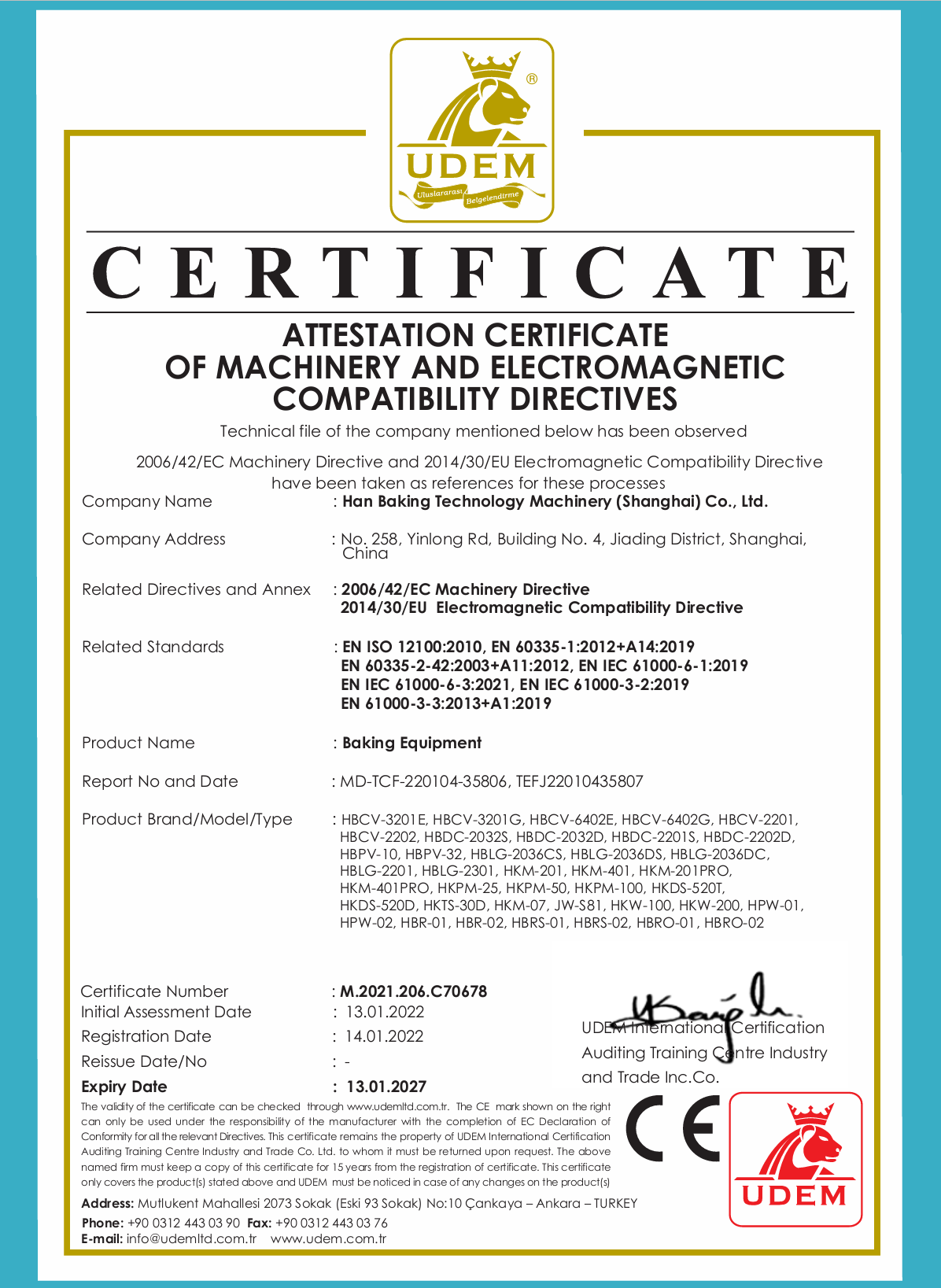
For the European market, the ATTESTATION CERTIFICATE OF MACHINERY AND ELECTROMAGNETIC COMPATIBILITY DIRECTIVES (CE) certificate M.2021.206.C70678 was issued by UDEM International Certification Auditing Training Centre on 14 January 2022 and expires 13 January 2027, covering Machinery Directive 2006/42/EC and Electromagnetic Compatibility Directive 2014/30/EU, with standards including EN ISO 12100:2010, EN 60335-1:2012+A14:2019, EN 60335-2-42:2003+A11:2012, EN IEC 61000-6-1:2019, EN IEC 61000-6-3:2021, EN IEC 61000-3-2:2019, and EN 61000-3-3:2013+A1:2019. BRESSO also states that its operations hold ISO 9001 and FCC compliance.
Where This Framework Has Boundaries
An honest comparison framework states its limits. Five apply to the families discussed here.
- Deck and convection ovens are batch equipment. They bake defined loads per cycle. A very high-volume plant requiring uninterrupted throughput should evaluate continuous or tunnel systems separately; deck ovens are not designed to replace them.
- Three-phase 380V supply is a hard requirement for the ovens. The retarder-proofers run on 220V at 2 kW. Sites with only single-phase supply must either upgrade electrical infrastructure or request a custom voltage configuration, which changes lead time and requires written confirmation.
- The Champions League MAX Series needs more than floor space. At L 1930 × D 3100 × H 2250 mm, it requires both ceiling clearance above the standard 2065 mm range height and adequate depth for loading and service access.
- Tray standard is documented for the HBWO line only. For HBVO, HCV, and the MAX Series models, the verified specifications list tray counts without stating tray dimensions. Buyers must obtain written tray specifications and test-fit existing trays.
- Published price, landed cost, warranty terms, and energy-consumption data are not available for verification. Comparisons based on total cost of ownership therefore cannot be completed from public material; they require direct quotations, site electrical data, and local energy tariffs.
One further boundary concerns oven type rather than brand. Deck ovens typically bake with radiant heat and provide strong bottom colour; convection ovens circulate air and suit high-count small-item loads; rack and rotary formats address larger batch volumes with different footprint and airflow trade-offs. No single format is superior across all bakery profiles, and the deployment evidence above shows mixed-family operations rather than single-format shops.
Market Signal: Electrification Is the Direction of Travel
Two third-party figures frame the procurement context. Market Research Future estimates the global commercial oven market at USD 25.45 billion in 2024, and forecasts that electric ovens will account for 57.8% of commercial oven market revenue in 2025. Both figures are published market research estimates rather than site-level performance data, but they point consistently in one direction: the majority of commercial oven revenue is moving toward electric equipment.
The families discussed in this framework are all electric — 380V three-phase for the ovens and 220V for the retarder-proofers. For buyers in markets where three-phase supply is standard, this aligns the equipment decision with the broader direction of the category. For buyers in markets where it is not, the electrical question moves to the front of the evaluation rather than the end.
Purchase Terms and Acceptance Criteria
BRESSO's stated commercial terms include OEM / ODM production, customisation of voltage, colour, and size, a minimum order quantity of 2 units, a lead time of 30–45 days, and a monthly production capacity of 1,000 units. Incoming Quality Control is described as including supplier qualification standards, inspection of all purchased components on arrival, and 100% inspection of critical components. After-sales support is provided remotely.
The following checklist converts the framework into order-stage actions.
- Confirm trays per bake against peak production demand, using the model-level capacity figures rather than a family average.
- Confirm the supported tray dimensions in writing, and test-fit trays the bakery already owns.
- Confirm site electrical capacity against the specific model's connected load — from 9 kW (HCV-5 AIR) to 27 kW (HBVO-4003, HBVO-400ЗMAX-ZS3).
- Measure door openings, corridor turns, and ceiling clearance, including the 2250 mm height of HBVO-400ЗMAX-ZS3.
- Size the retarder-proofer tray count against the oven's full-cycle tray load.
- Request the current certificate documents at order stage, including the model scope for ETL certificate 5029105 and the validity window of CE certificate M.2021.206.C70678.
- Define measurable first-bake acceptance criteria for deck-to-deck colour uniformity and crust consistency before commissioning.
- Specify the steam and moisture-extraction requirements relevant to the destination climate, drawing on the Australia, Mongolia, and Singapore evidence.
- Agree the after-sales support scope and remote-response arrangements in the purchase agreement.
- Agree spare-parts scope and documentation handover at delivery.
The BRESSO product brochure with model-level specifications is available for download: BRESSO-Product-Brochure-2026.pdf.
Future Outlook
Three shifts are likely to shape commercial bakery oven procurement in the near term, and each follows from evidence already visible in this framework. First, electrification continues: with electric ovens forecast to hold 57.8% of commercial oven revenue in 2025, three-phase electrical planning becomes a site-design question rather than an afterthought. Second, footprint efficiency per tray becomes a measurable purchasing criterion, as evidenced by the demand for 900 mm-depth convection models and modular deck builds in high-rent locations. Third, climate-specific performance — insulation for cold and dry markets, moisture extraction for humid ones — moves from a differentiator to a specification item, because the Mongolia and Singapore deployments show that climate adaptation is what determines whether the same oven performs consistently in different markets.
A quieter fourth shift concerns after-sales economics. In the Mongolia case, the distributor's largest saving came not from purchase price but from avoiding cross-border maintenance visits. As remote support becomes standard practice, buyers are likely to evaluate response arrangements with the same weight they currently give to hardware specifications.
FAQ
What is the first specification to check when comparing bakery ovens?
Trays per bake, tray standard, and connected electrical load. Capacity is calculated as decks multiplied by trays per deck; for example, the Asian Oven HBVO-4003 holds 3 decks × 4 trays per deck = 12 trays at 380V / 27 kW, while the European Oven HBWO-4003 holds 4 trays × 3 decks = 12 trays at 380V / 20.2 kW. Checking these three items first removes models that cannot fit the bakery before brand-level comparison begins.
Which BRESSO oven models are specified for the EN 600 × 400 mm tray standard?
The European Oven HBWO family: HBWO-2003 (2 trays × 3 decks = 6 trays), HBWO-3003 (3 trays × 3 decks = 9 trays), and HBWO-4003 (4 trays × 3 decks = 12 trays) are each specified against the EN 600 × 400 mm tray standard. For the Asian Oven HBVO, Convection Oven HCV, and Champions League MAX Series models, the available specifications state deck and tray counts without stating a tray standard, so tray dimensions should be confirmed in writing with the supplier.
What electrical supply and connected power do these bakery ovens require?
All listed deck ovens and convection ovens operate on 380V three-phase supply. Connected power ranges from 9 kW (HCV-5 AIR, 5 decks, 5 trays) to 27 kW (HBVO-4003 and HBVO-400ЗMAX-ZS3, both 12 trays). The retarder-proofers HBDC Pro and HBDC Air operate on 220V at 2 kW. BRESSO states that voltage is customisable for different markets, so buyers outside standard 380V supply areas can request an alternative configuration.
Which certifications and certificate numbers apply to these oven families?
An Authorization to Mark lists ETL cETLus and ETL Sanitation Listed status under certificate 5029105, issued by Intertek Testing Services for the US and Canadian markets, with standards UL 197:2010, CSA C22.2#109:2017, and NSF/ANSI STD.4, issued 27 August 2024 and expiring 31 December 2099. The scope is stated as commercial electric bakery retarder proofer equipment and covers the HBVO, HBWO, HCV, HBDC Pro, HBDC Air, and HBVO-400ЗMAX-ZS3 products. For the EU market, CE certificate M.2021.206.C70678 was issued by UDEM on 14 January 2022 under Machinery Directive 2006/42/EC and Electromagnetic Compatibility Directive 2014/30/EU, expiring 13 January 2027.
Can BRESSO bakery ovens be customised, and what are the stated order terms?
BRESSO states that it offers OEM / ODM production with customisation of voltage for worldwide use, plus customisable colour and size. The stated minimum order quantity is 2 units, lead time is 30–45 days, and monthly production capacity is 1,000 units. Quality control is described as including incoming inspection of purchased components and 100% inspection of critical components, with remote after-sales support.
Which oven family suits a space-limited bakery producing a mixed product range?
Two documented options are relevant. The European Oven HBWO is specified as modular with independent temperature control and exhaust valves on each deck; in a US deployment of eight units over eight years, this allowed high-temperature milk bread baking on the top deck and low-temperature chiffon cake baking on the bottom deck within a minimal footprint, starting from two decks and expanding later. For narrow rooms, the Convection Oven HCV-6S and HCV-10S occupy 900 mm of depth while holding 6 and 10 trays respectively.
What operational lifespan and reliability figures are available?
Documented deployments report the following operating periods: five European Oven HBWO units in Australia over 15 years of continuous operation with a reported 30% increase in production efficiency; 100 units in Mongolia over 5 years in an extremely cold and dry climate; 50 units in Singapore over 6 years in year-round heat and humidity; and eight units in the United States over 8 years in space-constrained urban bakeries. These are field-deployment records from specific projects, not a generalised service-life specification, and conditions such as climate, duty cycle, and maintenance differ between sites.
Market context cited: global commercial oven market size estimate for 2024 and the 2025 electric-oven revenue share forecast, both published by Market Research Future. Model specifications, deployment records, and certification references are drawn from BRESSO product and certification documentation.
Tem questões ou precisa de mais detalhes?
Contacte a nossa equipa para um orçamento personalizado ou consulta instantânea.
Solicitar orçamento
Preencha o formulário abaixo e a nossa equipa entrará em contacto com uma proposta personalizada.
Chat direto do WhatsApp
Prefere conversar em tempo real? Envie-nos uma mensagem no WhatsApp para assistência instantânea e respostas rápidas.
- Obter orçamento personalizado
- Partilhar fotos ou documentos
- Discuta as suas necessidades diretamente
Geralmente responde em 5–30 minutos durante o horário de expediente.