
Bakery Packaging Shortlist: PPWR-Tested Clamshells, Trays & Tamper-Evident Packs
Bakery Packaging Shortlist: PPWR-Tested Clamshells, Trays & Tamper-Evident Packs
A bakery packaging shortlist is only useful when every SKU on it is attached to a job and to a piece of evidence. Catalogue pages are sorted by mould number; buyers buy by function. This shortlist sorts sixteen CHUAN HE bakery-relevant SKUs into three job-based groups — bakery and cake containers, trays, and tamper-evident packs — and ties each entry to one document: PPWR Product Test Report 178251114a 001, issued by TÜV Rheinland and valid from 2026-08-14 to 2030-08-14.
CHUAN HE is the brand of Weifang Chuanhe New Material Co., Ltd. (newplasticbox.com), a PET and PP thermoformed packaging manufacturer based in Weifang, China, whose published product families include Cake & Bakery Packaging, Trays Packaging and Tamper Evident Packaging. The grouping below follows those families because they correspond to three different buying decisions, not three different price tiers.
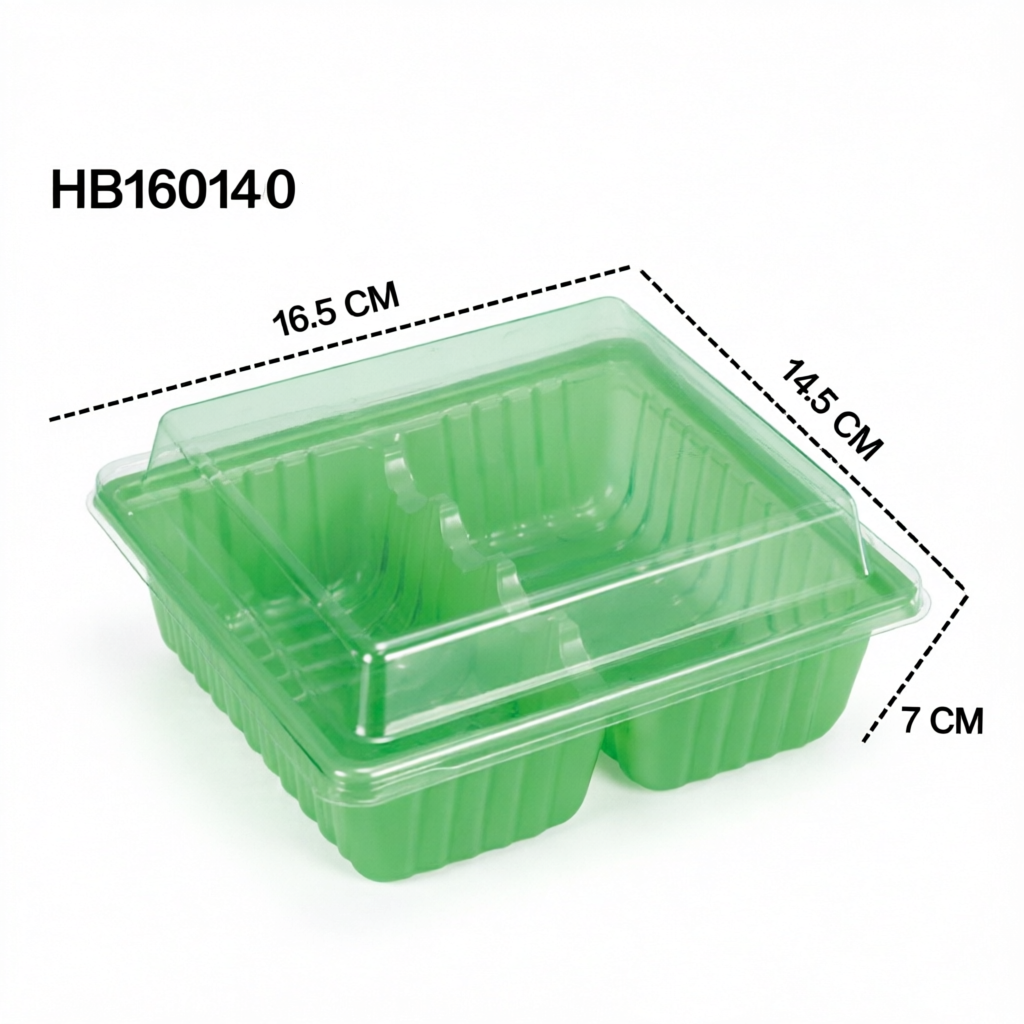
Thermoformed food packaging from the CHUAN HE range. Colour, size and logo customization are offered under the company's OEM/ODM programme.
Why a job-based shortlist beats a catalogue sequence
A whole cake, a sealed ready-meal tray and a 16 oz dessert pot fail in different ways. The cake container fails if the lid touches the decoration or the base flexes under load. The tray fails if it does not match the sealing platen or the film. The tamper-evident pack fails if a shopper cannot tell whether it has been opened. Sorting by SKU number collapses those three risks into one list, and buyers end up comparing a sealed portion pot with a cake clamshell because the two happened to be adjacent in a catalogue.
Grouping by job changes what the shortlist is for. Instead of asking “which of these sixteen packs should we sample”, an evaluator asks “which pack in this group matches our shelf, our line and our closure requirement”, and the sample request becomes narrower and faster to answer.
One boundary should be stated at the outset: a shortlist is a routing tool, not a specification. It narrows the field to a handful of models. Base dimensions, lid height, wall thickness, print area and sealing window still have to be confirmed against the current specification sheet for the SKU actually ordered.
The compliance anchor: what PPWR report 178251114a 001 states
PPWR Product Test Report 178251114a 001 was issued by TÜV Rheinland on 2026-08-14 and expires on 2030-08-14. Its recorded scope is plastic packaging, and its market coverage is listed as North America, the EU, the Middle East, Southeast Asia and Latin America. The regulation it is written against is Regulation (EU) 2025/40 — the Packaging and Packaging Waste Regulation, PPWR.
Two parameter families are named directly in the certification record: total content of lead, cadmium, mercury and hexavalent chromium, and per- and polyfluoroalkyl substances (PFAS). The supporting test pages in the same document set extend to organotin compounds, fluorine content, screening for substances of very high concern against the ECHA Candidate List under Regulation (EC) No 1907/2006 and its amendments, specific migration of metals, specific migration of primary aromatic amines, specific migration of terephthalic acid, specific migration of ethylene glycol, sensorial examination, global migration, and specific migration of bisphenol A together with other bisphenols and bisphenol derivatives.
That parameter list is the practically useful part, because it tells a procurement team which questions the document answers and which it does not. The report does not certify that a given pack suits a given cake recipe, that it delivers a stated shelf life, or that it tolerates a particular oven, freezer or microwave cycle. Those remain application and product-selection questions, and they are answered by a line trial and a specification sheet, not by a heavy-metals and migration report.
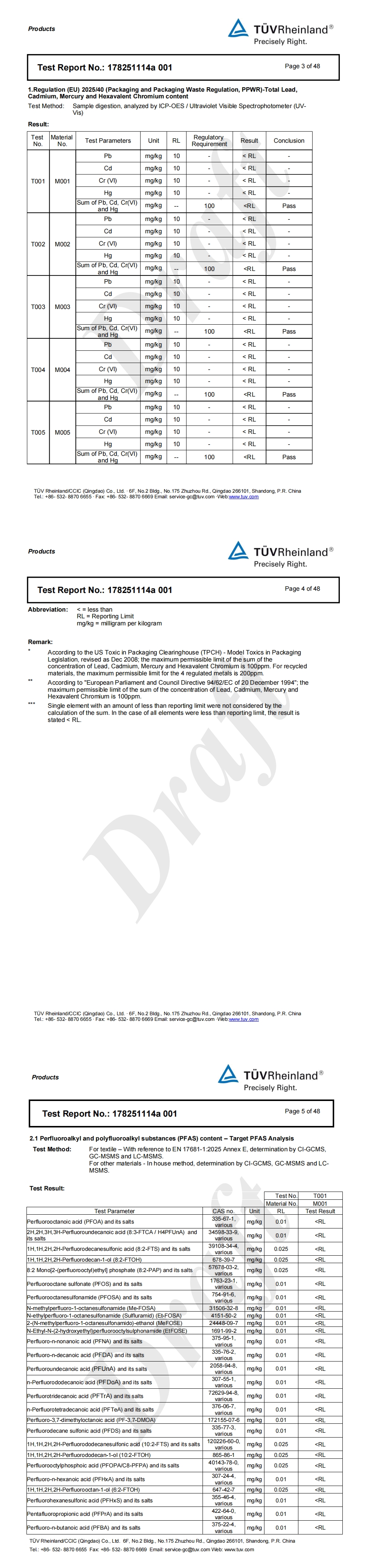
Test page from PPWR Product Test Report 178251114a 001 (TÜV Rheinland), covering total lead, cadmium, mercury and hexavalent chromium content under Regulation (EU) 2025/40.
Shortlist 1 — bakery and cake containers: HB-SP1510, HB-5209, HB-1966, HB-7097
All four cake and bakery containers in this group are named in the PPWR evidence. Product Test Report 178251114a 001 covers the HB-SP1510 bakery container. The HB-5209 bakery packaging and the HB-1966 bakery container are covered by the same PPWR certification, and the HB-7097 cake and bakery packaging is certified to the PPWR standard.
The four SKUs share a compliance anchor but not a single job. Inside this group the practical split is between presentation containers for whole and decorated cakes, clamshell formats sold from chiller cabinets, and smaller packs for pastries and multi-item bakery selections. The published evidence set defines the product category and the compliance position of each model; it does not publish geometry, so the selection step inside the shortlist is dimensional rather than document-based.
Three dimensions decide most of these choices. The first is base footprint against the shelf pitch or crate the retailer actually uses — a container that is 4 mm too wide on a standard tray creates handling cost that no compliance document offsets. The second is lid clearance against decoration, which matters most for cream, ganache and multi-tier finishes. The third is stacking behaviour: bakery packs are frequently displayed two-high or palletised, and the load path through a lidded container is different from the load path through a tray.
Closure is the fourth variable. CHUAN HE's customer-facing description of its PET container closure cites a snap-lock design that is dust-proof and keeps food from drying out. Where a snap lock is used, the buyer should test the opening force and the reclose behaviour with the actual product load, because a closure that seats cleanly on an empty container can lift on a filled one.
Shortlist 2 — trays: seven SKUs that meet a filling line
Trays are where packaging selection stops being a container decision and becomes a process decision. A tray that runs on a modified-atmosphere line has to match the sealing platen, the film and the gas mix, and the tray is only one component of a process that is validated as a whole. HB-1912 is documented by CHUAN HE as compatible with modified atmosphere packaging (MAP) lines — a useful starting point for a line trial, and not a substitute for one.
Two of the seven trays name polypropylene directly in the model designation, HB-221360 (PP) and HB-75-28 (PP). The other five do not state a material in the model name, so material should be read from the current datasheet rather than inferred from the family label. This matters because PP and PET trays behave differently in sealing, in low-temperature storage and in how they present the product on shelf, and a substitution made on the assumption that “all trays are the same” is exactly the kind of change that invalidates a completed line trial.
The three MG SKUs carry ounce markers in their model names. An ounce marker describes a size class, not a guaranteed fill volume: usable volume depends on lid depth, product density and the headspace a seal or film requires. Buyers running a fill trial should measure against the actual product rather than converting the model name into millilitres and treating the result as a specification.
Shortlist 3 — tamper-evident packs: HB-16OZ, HB-8OZ, HB-24 OZ, HB-32 OZ, HB001-55
The tamper-evident group mixes two naming conventions. Four SKUs — HB-8OZ, HB-16OZ, HB-24 OZ and HB-32 OZ — carry ounce designations that span 8 to 32 oz and behave as a size ladder for portioned desserts, single-serve cakes and sealed takeaway items. HB001-55 follows a mould-serial convention instead, which makes it the SKU in this group most worth checking against a drawing before it is shortlisted for a specific product.
Tamper-evidence is a closure property, not a material property. The same container body can be tamper-evident or not depending on the lid, band or seal that closes it, which is why this shortlist is organised around the closure job rather than around the resin. Buyers should also define what the term means for their market before they brief a supplier: regulatory commentary on United States requirements draws a distinction between tamper-evident packaging and tamper-resistant packaging, and the two are treated differently in retail bakery and in delivery channels.
Five checks that decide the SKU inside a shortlist
Once a shortlist has narrowed the field, five checks usually settle the remaining choice. They are listed in the order that tends to eliminate options fastest.
- Dimensional fit. Base footprint, internal height and corner radius measured against the actual product, not against a nominal size class.
- Closure requirement. Whether the pack needs a snap lock, a tamper-evident band, a film seal, or a combination, and how the closure behaves after the pack is filled.
- Temperature path. Chilled display, frozen storage and ambient transport impose different demands, and the same shortlist can contain packs intended for different paths.
- Line compatibility. Sealing platen, film, gas mix and cycle time for trays, and denesting and lid application for clamshells and pots.
- Document currency. Whether the compliance document the buyer intends to file is valid for the shipping window, which is covered separately below.
Document currency deserves its own table because the certificates in CHUAN HE's published evidence set do not share one expiry date. A PPWR report valid until 2030 and an FDA registration copy valid until the end of 2026 support different planning horizons.
Two practical consequences follow. First, PPWR testing does not replace food-contact conformity: the PPWR report addresses heavy metals, PFAS and the migration parameters listed in its scope, while the SGS EU, SGS FDA and CE documents address food-contact conformity under different standards. A complete file usually needs both. Second, any buyer qualifying a supplier for 2027 shipments should request the current FDA registration copy at the point of order, because the copy in the published evidence set runs to 2026-12-31 and will not cover a full-year programme on its own.
What the supply side adds to the shortlist decision
A shortlist names models; a purchase order needs a supplier who can repeat them. The published operational facts for CHUAN HE cover a 62,000 m² facility running 40 thermoforming machines, including 20 fully automatic and 20 standard machines with four Kiefel units imported from Germany, supported by four PET sheet extrusion lines, two PP sheet extrusion lines and an in-house mould workshop. In-house extrusion and mould-making shorten the distance between a tooling change and a production run, which matters most when a buyer needs a size or closure adjustment rather than a catalogue item.
Production parameters are stated as a monthly capacity of 4,500 tons, a minimum order quantity of 10,000 pieces, a typical lead time of 30–45 days, and 100% testing across all products. Customization covers logo, size and colour under an OEM/ODM model. After-sales support covers real-time order and shipment tracking, documentation assistance for customs clearance, technical consultation on product parameters, resolution of quality and damaged-goods issues, packaging and shipping optimization advice, and continuing support for customized design.
Two long-running accounts illustrate how that capacity is used, and they verify different things. A European customer relationship running more than seven years covers bakery, cake and dessert packaging for supermarket retail display at roughly 350,000 pieces per month, with custom printing support and a reported reduction in complaint rate — a client-reported outcome rather than a guarantee. A Southeast Asian relationship running more than twelve years covers product 6622, the HB-16OZ, at 500,000 pieces per month; the case describes clear PET clamshells with vent holes used for fresh produce, seafood and meat cold chain and retail display. That second case is strong evidence of volume continuity and long-run supply reliability, but it is not bakery-specific performance evidence, and it should be cited as continuity proof rather than as proof of bakery shelf performance.
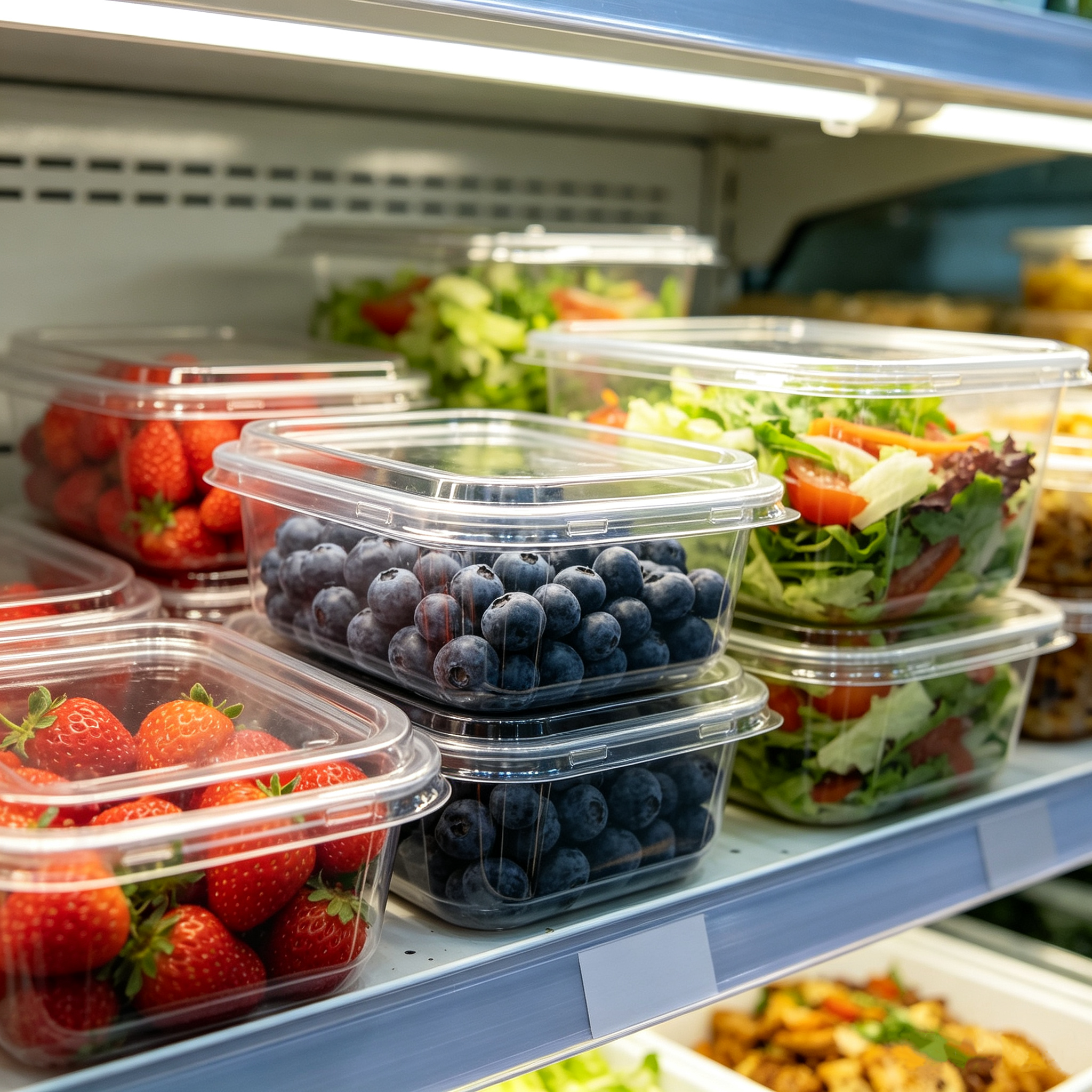
Chilled cabinet retail display — the environment where bakery clamshells and tamper-evident dessert packs are judged by the shopper before purchase.
Market context, briefly
Market Research Future, in a report dated 2026-09-17, valued the global bakery packaging market at USD 57.76 billion in 2024, covering flexible, rigid and semi-rigid bakery packaging. That figure is useful for sizing a category and for framing a capital decision; it says nothing about demand for any individual SKU on this shortlist. Procurement teams should treat the number as background scale and rely on their own account-level volumes for ordering decisions.
Where this shortlist stops
Three limits are worth stating plainly, because they define what a buyer still has to do after reading the list.
First, the shortlist publishes model identities, product families and compliance association, but not dimensions, wall thickness or fill volumes. Any model in these three groups has to be confirmed against a current specification sheet or drawing before tooling, artwork or a line trial is committed.
Second, PPWR Product Test Report 178251114a 001 is a document about materials and substances within a defined scope. It is not a fitness-for-use certificate for a particular cake, a shelf-life statement, or an approval for a specific oven or freezing cycle, and it should not be filed as if it were.
Third, certificate validity dates differ across the file. A shortlist entry that is fully documented today can be partially documented in eighteen months, and the buyer's own document register should carry the expiry dates rather than assuming they move together.
Frequently asked questions
Which SKUs does PPWR Product Test Report 178251114a 001 actually cover?
The report is issued for plastic packaging by TÜV Rheinland and is valid from 2026-08-14 to 2030-08-14. The bakery-relevant models named directly in the evidence are HB-SP1510, HB-5209, HB-1966 and HB-7097, and the report's product association also lists the tray and tamper-evident SKUs grouped in this article. Because a product association is not the same as a line-by-line certificate schedule, buyers should confirm that the specific SKU and configuration they order appears on the current report copy held in their supplier file.
Does PPWR testing replace FDA or EU food-contact compliance?
No. They are separate scopes. The PPWR report addresses total lead, cadmium, mercury and hexavalent chromium content, PFAS, and a set of migration and screening parameters listed in its own scope. Food-contact conformity is evidenced separately in CHUAN HE's file by a CE certificate under EN 1186-1:2002, an SGS EU test under EN 1186-3:2022, an SGS FDA test under 21 CFR 177.1630 and an FDA registration. A complete compliance file normally needs both layers.
How should a buyer choose between a clamshell, a tray and a tamper-evident pack?
Choose by failure mode rather than by preference. A clamshell suits presentation-led products where the shopper needs to see the item and the lid must clear decoration. A tray suits portioned products that pass through a sealing or modified-atmosphere step, which is why line compatibility and film matching dominate the decision. A tamper-evident pack suits retail and delivery formats where the shopper must be able to see whether the pack has been opened. The three groups on this shortlist reflect those failure modes.
What is the difference between a PP tray and a PET tray for bakery use?
The model designation is the only reliable signal in the published data. Two of the seven shortlisted trays — HB-221360 (PP) and HB-75-28 (PP) — name polypropylene in the model, and HB-1912 is documented as compatible with modified atmosphere packaging lines. The remaining tray models do not state a material in the model name, so material should be read from the datasheet. Buyers should not assume that two trays in the same family share a resin, because sealing behaviour and low-temperature performance follow the material, not the family label.
What order quantities and lead times apply to these SKUs?
The published production parameters are a monthly capacity of 4,500 tons, a minimum order quantity of 10,000 pieces and a typical lead time of 30–45 days, with 100% testing on all products. Customization covers logo, size and colour. These are general parameters rather than a per-SKU commitment, so the order quantity and delivery date for a specific model should be confirmed in the quotation.
Conclusion: a shortlist that ends in a document check
Sorting sixteen bakery packaging SKUs by job produces three useful lists rather than one long one. The cake and bakery containers — HB-SP1510, HB-5209, HB-1966 and HB-7097 — are decided mainly on footprint, lid clearance and stacking. The trays — HB-T9333, HB-221360 (PP), HB-MG24 OZ, HB-MG08 OZ, HB-75-28 (PP), HB-1912 and HB-MG40 OZ — are decided on material confirmation and line compatibility, with HB-1912 documented for MAP lines. The tamper-evident packs — HB-8OZ, HB-16OZ, HB-24 OZ, HB-32 OZ and HB001-55 — are decided on closure definition and portion size.
All sixteen are anchored to one compliance document, PPWR Product Test Report 178251114a 001 issued by TÜV Rheinland, valid 2026-08-14 to 2030-08-14. The shortlist shortens the route to a sample request; the specification sheet, the line trial and the certificate expiry register finish it.
The CHUAN HE product brochure, including the current range and customization options, is available as a public download: CHUAN HE product brochure (PDF). Company information: newplasticbox.com.
Tem questões ou precisa de mais detalhes?
Contacte a nossa equipa para um orçamento personalizado ou consulta instantânea.
Solicitar orçamento
Preencha o formulário abaixo e a nossa equipa entrará em contacto com uma proposta personalizada.
Chat direto do WhatsApp
Prefere conversar em tempo real? Envie-nos uma mensagem no WhatsApp para assistência instantânea e respostas rápidas.
- Obter orçamento personalizado
- Partilhar fotos ou documentos
- Discuta as suas necessidades diretamente
Geralmente responde em 5–30 minutos durante o horário de expediente.