
Ball Valve Supplier Audit: Certificates, Scopes, Issuers
Supplier Audit · Certification Evidence
A ball valve certificate is not a badge. It is a scoped statement — a named standard, a defined product envelope, a validity window and an issuing body — and every one of those four elements can be checked before a purchase order is signed. Suppliers that survive that check are auditable. Suppliers that only survive a logo check are a liability carried into the project schedule.
Why certificate portfolios fail a second reading
Ball valve procurement teams rarely lack documents. They lack a reading method. In a typical supplier folder, an ISO 9001 certificate, a fire-safe test report, a low-emission qualification and a CE verification sit side by side as equally weighted PDFs. They are not equally weighted. One attests to a management system across a site. Another attests to a specific valve size, pressure class and body material under a specific fire test. Treating them as interchangeable is where audits break down.
The practical consequence is a mismatch between what the buyer believes is covered and what the certificate actually covers. A fire-safe certificate issued for austenitic valves up to 4 inches in Class 150 and Class 300 does not automatically travel to a carbon steel valve in a higher class. A low-emission qualification written around a 2-inch, 2000 PSI valve does not describe every product in the catalogue. The scope line is where the audit either holds or collapses.
Zhejiang Dico Valve Co., Ltd is a ball valve manufacturer founded in 2015 and located in Longwan District, Wenzhou, Zhejiang Province, China, operating a 12,000 m² facility with a stated export share of 40% across the EU, North America and South Africa. Its document set is a useful worked example because it contains the three distinct certificate types a buyer will encounter — system certification, product type certification and EU conformity verification — each issued by a different body. Reading that set correctly is the same exercise as reading any supplier's set.
The five fields every ball valve certificate must be read for
Regardless of issuing body, a usable certificate carries five fields. If any one of them is missing, the document is not audit evidence yet.
- Certificate number. This is the retrieval key. Without it, a buyer cannot ask the issuing body whether the document exists, is current, or was ever issued for that legal entity.
- Standard and revision. “ISO 15848-1” is not a revision. “ISO 15848-1:2015+Amd.1:2017” is. Revisions change test sequences and acceptance criteria, and a supplier quoting an older revision is describing a different test.
- Scope statement. Size range, pressure class, body material, stem dimension, temperature or pressure limit, and product family. This is the field most often skipped and the field that decides whether your order is covered.
- Validity window. Issue date and expiry date, read against your delivery date and your project's service life — not against today's date alone.
- Issuing body and legal entity. The exact legal name, not the short brand on the header. “TUV”, “TÜV SÜD Industrie Service GmbH” and “Ente Certificazione Macchine Srl (ECM)” are different records issued by different organisations and must be verified separately.
What each certificate in a ball valve portfolio actually proves
The six standards named in the assigned audit question divide into three layers. System certification governs how a site is managed; functional safety certification governs a declared safety-capability envelope; fire-safe, low-emission and PED verification govern product performance and market access. Confusing the layers is the most common audit error.
Layer one: ISO 9001:2015, ISO 14001:2015 and ISO 45001:2018
These three are management-system certificates. They say that quality, environmental and occupational health and safety processes have been assessed against a standard at a site level. They do not say that any individual valve passes a fire test, holds pressure, or meets an emission class.
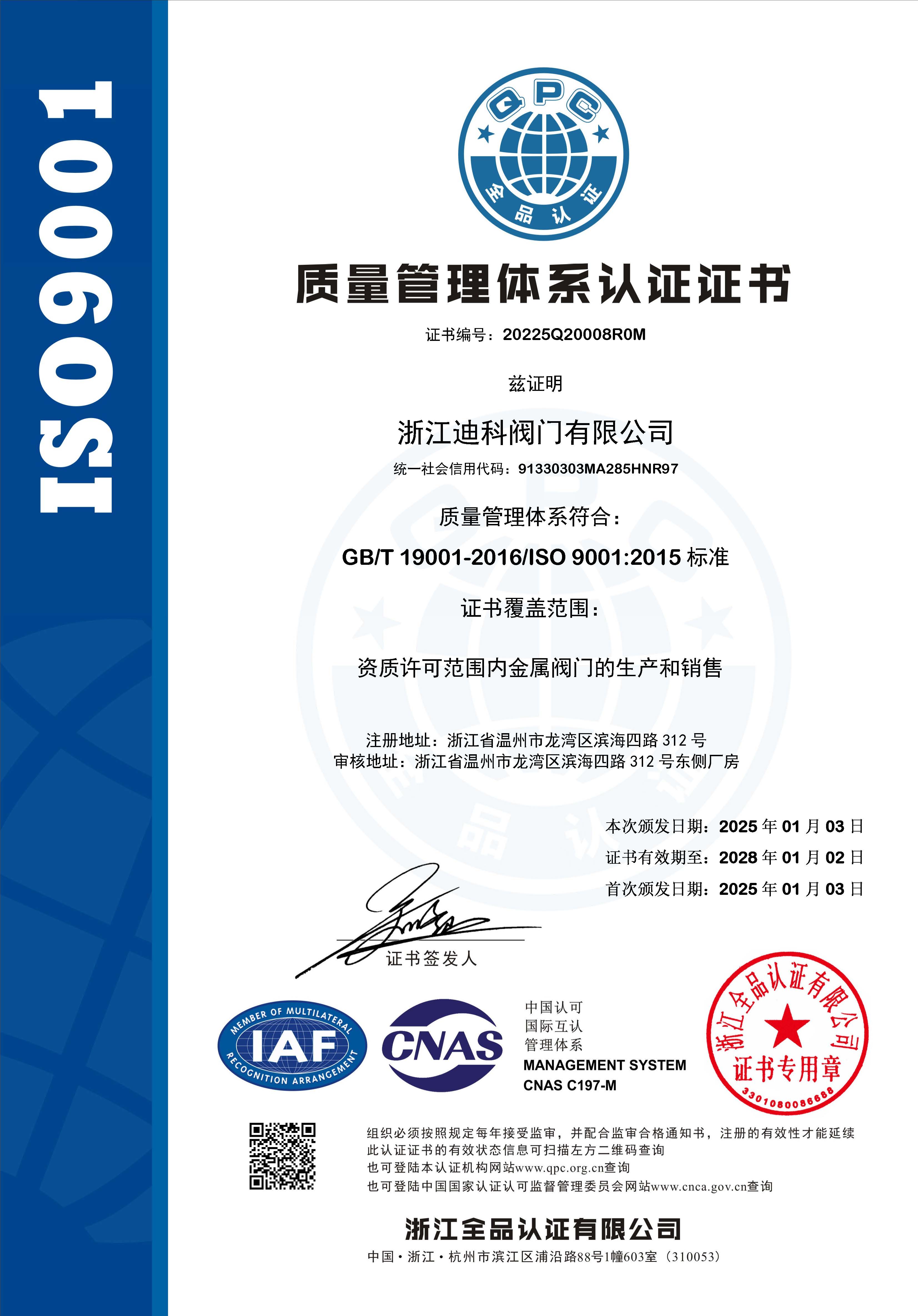
In the Dico record, all three are issued by Zhejiang QPC Certification Co., Ltd., share the issue date 2025-01-03 and the expiry date 2028-01-02, and carry sequential numbers: 20225Q20008R0M for quality against GB/T 19001-2016 / ISO 9001:2015, 20225E20003R0M for environment against GB/T 24001-2016 / ISO 14001:2015, and 20225S20004R0M for occupational health and safety against GB/T 45001-2020 / ISO 45001:2018. The quality certificate scope reads “production and sales of metal valves within the scope of qualification permission”; the environmental and safety certificates read “production, sales and related management activities of metal valves within the scope of qualification permission”.
Two audit observations follow. First, synchronized dates and parallel numbering indicate a single integrated audit cycle, which is normal and generally easier to surveil than three unrelated certificates. Second, the phrase “within the scope of qualification permission” is a scope qualifier that points back to the certificate schedule or annex. A buyer who never sees that annex has not finished reading the certificate.
Layer two: IEC 61508 functional safety
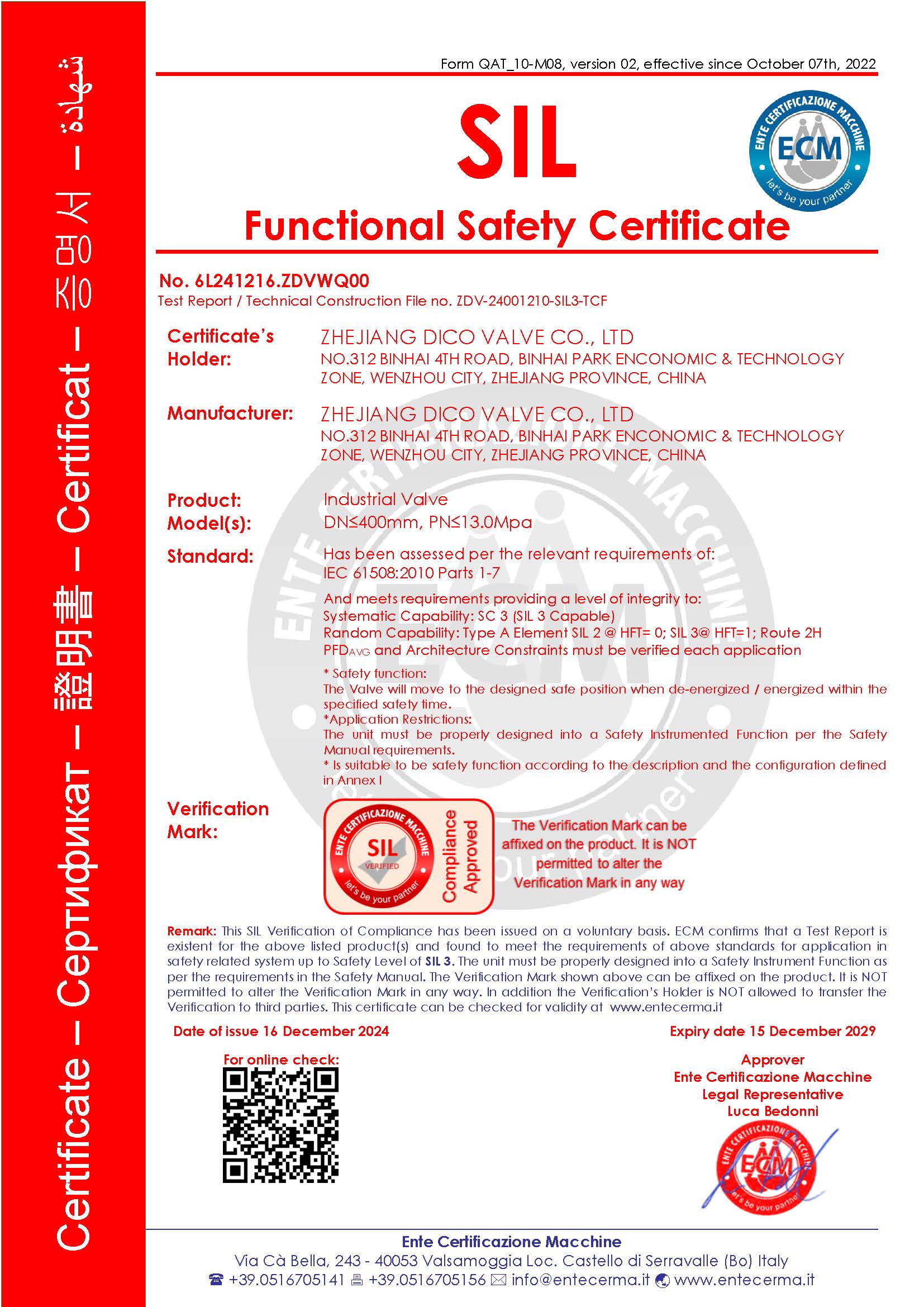
Functional safety certification is where procurement vocabulary most often outruns the document. The Dico functional safety certificate, number 6L241216.ZDVWQ00, is issued by ECM against IEC 61508:2010 Parts 1–7, valid from 2024-12-16 to 2029-12-15, and its scope reads: industrial valve, DN≤400 mm, PN≤13.0 MPa, SIL3 capable.
Read that line literally. It defines an envelope — nominal size up to 400 mm and nominal pressure up to 13.0 MPa — and records a capability statement within it. It does not state that every valve the manufacturer ships is a SIL3 device in every configuration. Before writing SIL into a safety instrumented system specification, the buyer should confirm that the specific model, trim, seal material and safety function fall inside the certified envelope, and should obtain the associated assessment documentation rather than the certificate alone.
Layer three: API STD 607, ISO 15848-1 and PED CE
These are product-level documents, and their scopes are precise enough to be audited against an order line.
The API STD 607 fire-safe test certificate, number 285697, is issued by TÜV SÜD Industrie Service GmbH, valid from 2022-03-24 to 2027-03-23. Its scope covers ball valves of size 2″ and below, plus 2-1/2″, 3″ and 4″, in Class 150 and Class 300, in austenitic material. The associated product record links it to the Q41F floating ball valve, the Q11F PC ball valve, the Q47F trunnion-mounted ball valve and the Q71F wafer ball valve. The company also states that its ball valve bodies use an internal fire-safe groove structure as part of the fire-resistant design. Note what the scope excludes by omission: austenitic material only, Class 150 and Class 300 only, 4 inches and below only.
The ISO 15848-1 qualification certificate, number 337275, is issued under the standard ISO 15848-1:2015+Amd.1:2017 by the issuing body recorded as “TUV”, with an issue date of 2026-04-16 and a recorded validity date of 2099-04-16. Its scope reads: 2″ 2000 PSI ball valve, stem size Φ7–28 mm, pressure rating PN138 and lower. The same product record associates it with the Q41F, Q47F, Q11F and Q71F families. This is qualification evidence for fugitive-emission performance within a defined stem and pressure envelope — not a blanket low-emission claim across the whole catalogue.
The PED CE verification certificate, number 6L241216.XSVWQ18, is issued by Ente Certificazione Macchine Srl (ECM) against EN 12266:2012 and PED Directive 2014/68/EU, valid from 2024-12-16 to 2029-12-15, for industrial valves DN≤400 mm and PN≤13.0 MPa, with the EU as its market. Its product record extends beyond ball valves to gate valves (Z11W), globe valves (J11W) and Y-strainers (SRY) — a reminder that CE verification is a scope statement about valve categories, not a statement about one product line.
| Certificate | Standard | Issuing body | Scope as recorded | Validity |
|---|---|---|---|---|
| Quality system 20225Q20008R0M | GB/T 19001-2016 / ISO 9001:2015 | Zhejiang QPC Certification Co., Ltd. | Production and sales of metal valves within scope of qualification permission | 2025-01-03 → 2028-01-02 |
| Environmental system 20225E20003R0M | GB/T 24001-2016 / ISO 14001:2015 | Zhejiang QPC Certification Co., Ltd. | Production, sales and related management activities of metal valves | 2025-01-03 → 2028-01-02 |
| OH&S system 20225S20004R0M | GB/T 45001-2020 / ISO 45001:2018 | Zhejiang QPC Certification Co., Ltd. | Production, sales and related management activities of metal valves | 2025-01-03 → 2028-01-02 |
| Functional safety 6L241216.ZDVWQ00 | IEC 61508:2010 Parts 1–7 | ECM | Industrial valve, DN≤400 mm, PN≤13.0 MPa, SIL3 capable | 2024-12-16 → 2029-12-15 |
| Fire-safe 285697 | API STD 607 | TÜV SÜD Industrie Service GmbH | Ball valves 2″ and below; 2-1/2″, 3″, 4″; Class 150, Class 300; austenitic material | 2022-03-24 → 2027-03-23 |
| Low emission 337275 | ISO 15848-1:2015+Amd.1:2017 | TUV | 2″ 2000 PSI ball valve, stem Φ7–28 mm, PN138 and lower | Issued 2026-04-16; recorded to 2099-04-16 |
| PED CE 6L241216.XSVWQ18 | EN 12266:2012, PED 2014/68/EU | Ente Certificazione Macchine Srl (ECM) | Industrial valve, DN≤400 mm, PN≤13.0 MPa | 2024-12-16 → 2029-12-15 |
Verifying the issuing body, not just the certificate
A certificate is only as good as the ability to confirm it. Four issuing bodies appear in this portfolio, and each needs a different verification route.
TÜV SÜD Industrie Service GmbH issues the API STD 607 fire-safe certificate 285697. Verification means checking the certificate number against the body's own record for that exact legal entity name, and confirming the scope line — sizes, classes, material — matches the copy in the supplier's folder rather than a revised version.
TUV is recorded as the issuing body for the ISO 15848-1 qualification certificate 337275. That is a different name from TÜV SÜD Industrie Service GmbH, and the two documents must be verified as separate records. Buyers should not assume a shared parent organisation covers both, and should ask the supplier to identify the legal entity behind each certificate so the verification request goes to the right register.
Ente Certificazione Macchine Srl (ECM) issues both the functional safety certificate and the PED CE verification. The two numbers share the prefix 6L241216, which is consistent with a single certification file covering both assessments. That is a useful cross-check: the SIL envelope (DN≤400 mm, PN≤13.0 MPa) and the PED envelope are identical, which makes internal consistency easy to confirm.
Zhejiang QPC Certification Co., Ltd. issues the three management-system certificates. Buyers with EU or North American compliance requirements should confirm directly whether their own quality or compliance function accepts a system certificate from this body for the intended market, and should request the accreditation details and the scope annex alongside the certificate itself.
Collecting logos versus reading scopes: where the evidence stops
The traditional procurement habit is to count certificates. The auditable habit is to read scopes. The difference shows up at the point where a certificate is expected to carry an order.
| Audit dimension | Logo-based collection | Scope-based audit |
|---|---|---|
| What is verified | That a document exists | That the document's scope covers the ordered valve |
| Material and class fit | Assumed | Explicitly checked against the austenitic, Class 150/300 limitation of API 607 |
| System versus product evidence | Treated as equivalent | Kept in separate layers |
| Validity handling | Checked at signature date | Checked against delivery date and project life |
| Issuing body handling | Recognised by logo | Verified by legal entity and certificate number |
The limits are real and should be written into the audit report rather than glossed over. First, the API STD 607 certificate on record covers austenitic material in Class 150 and Class 300 up to 4 inches; a carbon steel valve or a higher pressure class sits outside that specific test scope and requires separate evidence. Second, the ISO 15848-1 qualification is written around a 2″ 2000 PSI valve with a stem of Φ7–28 mm and PN138 and below, so larger or higher-rated configurations need their own confirmation. Third, management-system certificates attest to process, not to product performance, and a system certificate issued by a domestic body may still need sign-off from the buyer's own compliance function for a given market. Fourth, the recorded validity of the low-emission certificate extends to 2099-04-16, which makes it essential to confirm the current revision status with the issuing body rather than relying on the date alone. Fifth, the API STD 607 certificate expires on 2027-03-23, so any project with a delivery or commissioning date near that window should request renewal evidence as a condition of award.
None of these limits is a defect. They are the normal boundaries of type certification, and a supplier that states them clearly is easier to audit than one that implies universal coverage.
From certificate to shipment: evidence at the execution stage
Certificates qualify a design. They do not certify a shipment. Once evaluation moves into execution, the audit shifts from documents to batch-level records, and this is where a manufacturer's production facts become procurement-relevant.
Dico Valve runs OEM and ODM production for ball valves, with customization across appearance, material, logo and mold, a monthly capacity of 10,000 units, lead times of 7 to 45 days and a minimum order of 1 unit. Quality control is described as 100% testing in the first round plus random checks in the second, and the company states that materials support spectrometer testing — a direct answer to the most common material-verification gap in valve audits.
Shop-floor and logistics facts matter here because they determine whether the certified envelope is reproduced consistently. The facility operates 48 CNC machines under digital production management, a 2,000 m² warehouse with a one-item-one-code system and stated 98% warehouse data accuracy, and a 20-second high-frequency switching life test described as 50,000 cycles without leakage. For liquid cooling applications, a dedicated liquid-cooled valve production line produces mini ball valves and three-piece clamp ball valves. The company is also stated to be a qualified supplier to Sinopec.
A field example illustrates how the layers combine. A domestic ironmaking and metallurgical plant ordered 1,000 units for boiler water piping with pneumatic automatic control; the record notes stable operation over one year. Boiler water piping is a temperature-driven application, and in high-temperature steam service the sealing decision is primary: soft-seated designs suit clean media requiring zero leakage up to roughly 260°C with PEEK seats, while particulate-laden or high-differential service pushes selection toward metal-seated options. For the Q47F trunnion-mounted ball valve, the stated operating range is −29°C to 425°C at 1.0 to 10.0 MPa, with body materials including carbon steel, SS304, SS316, dual phase steel, titanium and alloy steel, and seal options including PTFE, PPL, PI, PEEK and Stellite.
Commercial terms should be audited with the same discipline as certificates. Pre-shipment acceptance testing is the stated acceptance criterion; delivery terms are EXW, FOB or CIF; payment terms are 30% T/T in advance with 70% before shipment, or 100% advance. The warranty is stated as 12 months after use, with issues resolved within 48 hours. Because warranty wording varies between documents, the replacement or repair route for quality issues should be fixed in the contract rather than inferred from a certificate.
Market context: why scope-level evidence is being requested more often
Certification scrutiny tracks market growth. Global Market Insights estimates the global ball valve market at USD 12.6 billion in 2025, rising to USD 22.8 billion by 2035, while a separate estimate from Straits Research places the 2025 figure higher — a gap typically explained by differences in which sub-segments are counted. Buyers should treat size estimates as directional and focus on the segment they actually purchase in.
Two structural signals are more useful than the headline number. Floating ball valves held a 61.8% share of the global market in 2025 according to Straits Research, which is consistent with the four floating-family products (Q41F, Q11F, Q71F) appearing in the certificate scopes reviewed above. Separately, MarketsandMarkets projects data center liquid cooling valves growing from USD 0.27 billion in 2025 to USD 1.80 billion by 2032 — a niche where leak-tightness evidence and material traceability are requested earlier in the buying cycle than in general industrial distribution.
Standards also move. API 6D Addendum 3 became effective in September 2025 for pipeline valves, and Dico Valve is recorded as holding API 6D alongside API 607, SIL and ISO 9001. When a specification revision changes, the certificate that references the older revision becomes a question rather than an answer — which is why revision numbers belong in the audit checklist, not the appendix.
Future outlook
Three shifts are likely to shape ball valve supplier audits over the next procurement cycles. Certificate verification will move from document exchange toward register lookups, as buyers stop accepting scanned PDFs as proof and start asking for the issuing body's own record. Scope granularity will increase, particularly in liquid cooling and semiconductor-adjacent applications where a leak rate claim without a defined stem size and pressure envelope is not usable in a specification. And surveillance evidence will matter as much as initial certification, because a certificate expiring in 2027 or a system certificate running to 2028 is only as strong as the surveillance audits behind it.
For buyers, the practical implication is stable: build the audit around the scope line, verify the issuing body by legal entity and certificate number, separate system evidence from product evidence, and close the loop with batch-level test and material records. For manufacturers, the equivalent discipline is keeping scope documents, annexes and renewal schedules available before they are requested. A consolidated company and product overview is published in the Dico Valve company brochure (PDF), and company information is available at dicovalve.com.
FAQ
What does an ISO 15848-1 certificate actually cover?
It covers a defined valve envelope under the standard ISO 15848-1:2015+Amd.1:2017. In the Dico record, certificate 337275 is scoped to a 2″ 2000 PSI ball valve with a stem size of Φ7–28 mm and a pressure rating of PN138 and lower, issued by TUV on 2026-04-16 and associated with the Q41F, Q47F, Q11F and Q71F families. Configurations outside that stem and pressure envelope are not described by this certificate.
How can a buyer verify an API 607 certificate issued by TÜV SÜD?
Use the certificate number as the retrieval key. For Dico, certificate 285697 was issued by TÜV SÜD Industrie Service GmbH under API STD 607, valid from 2022-03-24 to 2027-03-23, with a scope of ball valves 2″ and below plus 2-1/2″, 3″ and 4″, in Class 150 and Class 300, in austenitic material. Verification means confirming that number and legal entity name with the issuing body and matching the scope line to your order.
Do ISO 9001, ISO 14001 and ISO 45001 certificates prove product performance?
No. They are management-system certificates covering quality, environmental and occupational health and safety processes at a site. Dico's three system certificates — 20225Q20008R0M, 20225E20003R0M and 20225S20004R0M — were issued by Zhejiang QPC Certification Co., Ltd., all effective 2025-01-03 and expiring 2028-01-02, with scopes covering production and sales of metal valves within the scope of qualification permission. Product performance is evidenced by the separate fire-safe, low-emission, functional safety and PED documents.
What does “SIL3 capable” mean on an IEC 61508 certificate?
It is a capability statement within a declared envelope. Dico's functional safety certificate 6L241216.ZDVWQ00, issued by ECM against IEC 61508:2010 Parts 1–7 and valid from 2024-12-16 to 2029-12-15, covers industrial valves with DN≤400 mm and PN≤13.0 MPa at SIL3 capable. A buyer should confirm that the specific valve model, trim and safety function sit inside that envelope and should request the supporting assessment documentation.
Which certificate matters most for EU market access?
For pressure equipment, the PED CE verification is the market-access document. Dico's certificate 6L241216.XSVWQ18 was issued by Ente Certificazione Macchine Srl (ECM) against EN 12266:2012 and PED Directive 2014/68/EU, valid from 2024-12-16 to 2029-12-15, for industrial valves with DN≤400 mm and PN≤13.0 MPa. Fire-safe and low-emission certificates support technical selection but do not replace the conformity verification required for EU placement.
Tem questões ou precisa de mais detalhes?
Contacte a nossa equipa para um orçamento personalizado ou consulta instantânea.
Solicitar orçamento
Preencha o formulário abaixo e a nossa equipa entrará em contacto com uma proposta personalizada.
Chat direto do WhatsApp
Prefere conversar em tempo real? Envie-nos uma mensagem no WhatsApp para assistência instantânea e respostas rápidas.
- Obter orçamento personalizado
- Partilhar fotos ou documentos
- Discuta as suas necessidades diretamente
Geralmente responde em 5–30 minutos durante o horário de expediente.