
Ball Valves for Liquid Cooling and Steam Lines: Matching Valve Type to Application
Ball Valves for Liquid Cooling and Steam Lines: Matching Valve Type to Application
Industry reference — liquid cooling, high-temperature steam and threaded utility lines
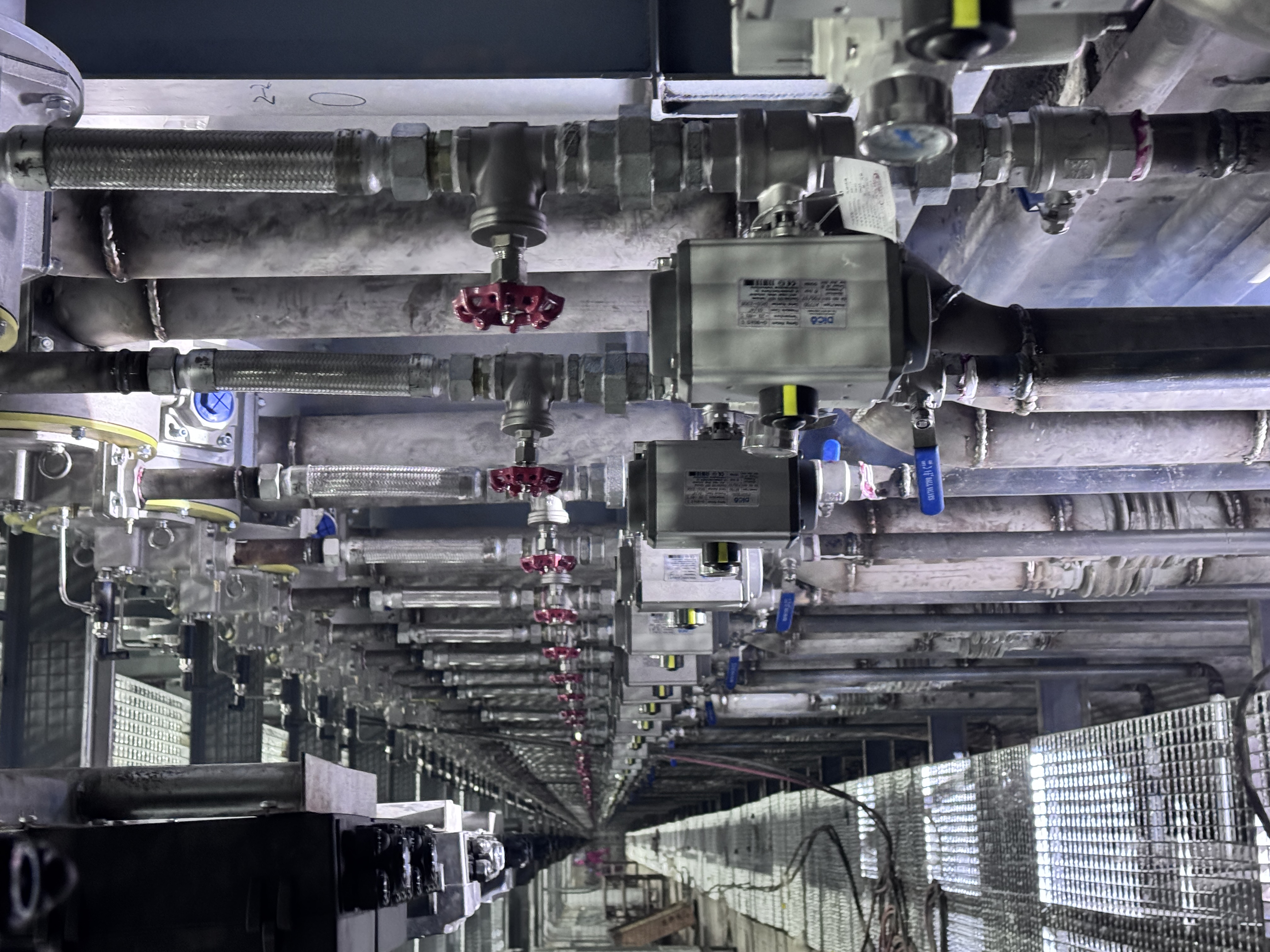
Data-center liquid cooling loops and high-temperature steam lines are both thermal-utility services, yet they stress a ball valve in opposite directions. A cold-plate loop runs at low pressure and moderate temperature, where the real risk is a slow weep at a joint that nobody notices until a rack trips. A steam header can reach 425°C, where the risk is a seat that creeps under load, loses preload and begins to pass after a few thousand cycles.
Zhejiang Dico Valve Co., Ltd. (Dico Valve) is a valve manufacturer founded in 2015 and based in Longwan District, Wenzhou, Zhejiang Province. It produces high-platform ball valves, metal-seated ball valves, three-piece ball valves, tank bottom valves, pneumatic and electric ball valves, and sanitary BA-grade ball valves, with roughly 40% of output exported to the EU, North America and South Africa.
Its published product data cover a single temperature band from -196°C to 425°C across five valve configurations. That is why valve type — not brand tier or price band — is the first decision in a specification. This article maps configuration to application, then states where each configuration stops being valid.
Two Thermal Services, One Temperature Band
Across Dico’s published specifications, the temperature ceilings converge while the pressure ceilings do not.
- PC ball valve (Q11F): -196°C to 425°C, 1.0–13.0 MPa, with thread, weld, Tri-Clamp, tube and press-fit connections.
- Wafer ball valve (Q71F): -29°C to 425°C, 1.0–4.0 MPa, wafer connection, listed in the floating ball valve and ISO 5211 ball valve categories.
- Trunnion-mounted ball valve (Q47F): -29°C to 425°C, 1.0–10.0 MPa, flange connection.
- Floating ball valve (Q41F): -29°C to 425°C, 1.0–10.0 MPa, flange connection.
- Globe valve (J11W): -29°C to 425°C, 1.0–2.5 MPa, threaded metal-seated construction.
Because four of the five share the same 425°C ceiling, temperature alone does not separate them. What separates them is how the valve is built: wafer versus flanged, floating versus trunnion-mounted, threaded versus flanged, soft-seated versus metal-seated, and which seat material sits behind the ball. Those decisions, taken in order, produce the application match.
Application Map: Which Ball Valve Type Fits Which Service
The table below is a filter, not a ranking. It maps a dominant service condition to the configuration Dico publishes for that duty.
| Service | Configuration / model | Connection | Pressure | Temperature | Body materials |
|---|---|---|---|---|---|
| Liquid cooling loops, cold plates, manifolds, CDU | PC ball valve, mini and 3PC Tri-Clamp patterns / Q11F | Thread, weld, Tri-Clamp, tube, press-fit | 1.0–13.0 MPa | -196°C to 425°C | Carbon steel / SS304 / SS316 / dual phase steel |
| Compact skids and panel loops with short face-to-face length | Wafer ball valve / Q71F | Wafer | 1.0–4.0 MPa | -29°C to 425°C | Carbon steel / SS304 / SS316 |
| High-temperature steam headers, boiler water piping | Trunnion-mounted ball valve / Q47F | Flange | 1.0–10.0 MPa | -29°C to 425°C | Carbon steel / SS304 / SS316 / dual phase steel / titanium / alloy steel |
| General flanged isolation on process lines | Floating ball valve / Q41F | Flange | 1.0–10.0 MPa | -29°C to 425°C | Carbon steel / SS304 / SS316 / dual phase steel / titanium / alloy steel |
| Threaded utility and regulation lines in petroleum, pharma, water treatment | Globe valve / J11W | Thread | 1.0–2.5 MPa | -29°C to 425°C | Carbon steel / SS304 / SS316 |
Read the wafer row carefully. A wafer ball valve and a trunnion-mounted ball valve share the same 425°C temperature ceiling on paper, but their pressure ceilings differ by more than a factor of two — 4.0 MPa against 10.0 MPa. A high-pressure steam header therefore falls outside the wafer pattern regardless of temperature, while a compact coolant manifold that stays inside that pressure band is a natural wafer application.
Liquid Cooling: PC Ball Valves and Wafer Ball Valves
Liquid cooling is the application where Dico’s product architecture is most specific. The company operates a dedicated liquid-cooled valve production line building mini ball valves and three-piece clamp ball valves, which it states are supplied to Huawei’s data centers. Dico lists mini ball valves, three-piece clamp ball valves and filters as the valve set most commonly used in liquid cooling, and its PC ball valve family spans the sanitary, mini, 3-way, 4-way, ISO 5211, floating, 3PC Tri-Clamp and ANSI patterns.
The PC ball valve (Q11F) is the flexible member of that family. It is rated -196°C to 425°C and 1.0–13.0 MPa, with seat and seal options in PTFE, PPL, PI, PEEK and Stellite; hollow or solid balls; body materials in carbon steel, SS304, SS316 or dual phase steel; and five connection types — thread, weld, Tri-Clamp, tube and press-fit. For a cold-plate or manifold connection that arrives as a tube, a clamp or a weld spigot, that connection list is usually the deciding factor.
The wafer ball valve (Q71F) is the compact alternative: a floating, ISO 5211-ready wafer-pattern valve rated 1.0–4.0 MPa and -29°C to 425°C in carbon steel, SS304 or SS316. Wafer-pattern valves are widely used where a short face-to-face dimension and a mounting pad for an actuator matter more than a high pressure class, which is the profile of many coolant distribution and skid-level loops.
The demand signal behind this product line is measurable. MarketsandMarkets projects the data-center liquid cooling valves market growing from USD 0.27 billion in 2025 to USD 1.80 billion by 2032 — a niche that sits inside the broader ball valve market rather than replacing it.
High-Temperature Steam: Trunnion-Mounted Q47F to 425°C
Steam service moves the specification toward a flange-connected, trunnion-supported design. The Q47F trunnion-mounted ball valve is rated -29°C to 425°C and 1.0–10.0 MPa, and is offered in both metal-seated and soft-seated categories. Seat and seal materials cover PTFE, PPL, PI, PEEK and Stellite; the ball may be hollow or solid; body materials extend to carbon steel, SS304, SS316, dual phase steel, titanium and alloy steel; and the valve carries an ISO 5211 mounting pad together with an anti-static structure.
A trunnion-mounted valve carries the ball on a top stem and a bottom trunnion instead of letting it float against the seat rings. In practice that design detail is what allows the same 425°C ceiling to be used at a higher pressure class than a compact wafer pattern, and it is the configuration a steam or boiler-water line is normally built around.
A reference installation of this configuration comes from an ironmaking and metallurgical plant in China, where 1,000 pneumatically actuated valves were applied to boiler water piping. The project has run for one year with stable operation reported, and pneumatic automatic control is the highlighted feature of the installation.
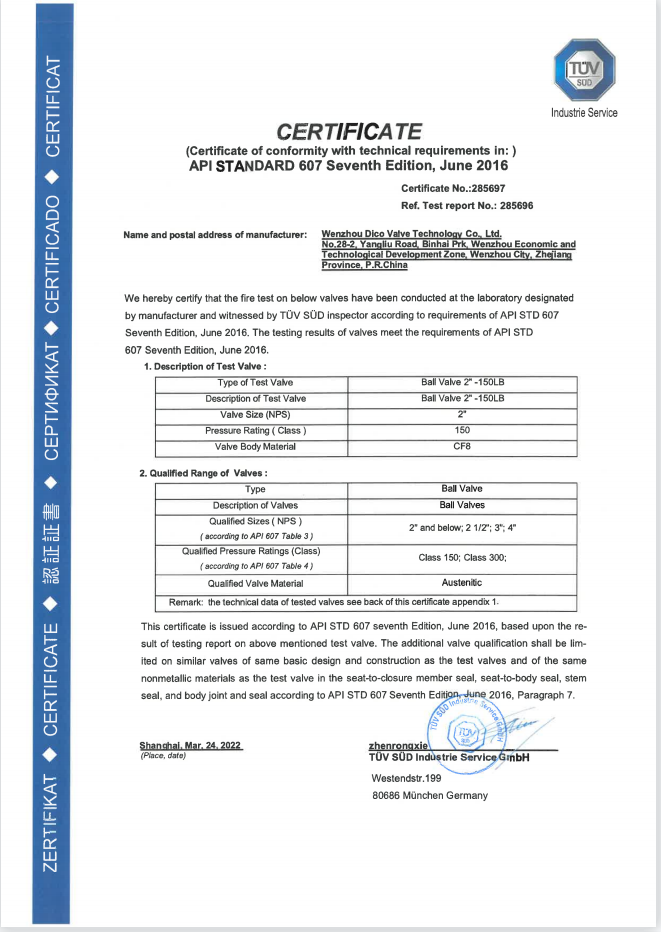
Fire-safe performance is specified separately from pressure and temperature. Dico’s API STD 607 fire-safe certificate — certificate 285697, issued by TÜV SÜD Industrie Service GmbH — covers ball valves of size 2 inches and below, plus 2½, 3 and 4 inches, in Class 150 and Class 300, in austenitic material, and is valid to 23 March 2027. The design relies on an internal fire-safe groove structure machined into the valve body.
Fugitive-emission performance carries its own certificate. Dico’s ISO 15848-1 qualification certificate — certificate 337275, issued by TUV, to ISO 15848-1:2015+Amd.1:2017 — covers a 2-inch 2000 PSI ball valve with stem sizes from Φ7 mm to 28 mm at pressure ratings of PN138 and lower, valid to 16 April 2099. In Dico’s records the certificate is linked to the floating ball valve Q41F, the trunnion-mounted ball valve Q47F, the PC ball valve Q11F and the wafer ball valve Q71F.
Seat and Seal Selection: PTFE, PPL, PI, PEEK and Stellite
Seat and seal material is the most consequential single choice on a thermally demanding line, because the body rating and the usable seat rating are not the same number. Dico offers PTFE, PPL, PI, PEEK and Stellite across the PC, wafer, trunnion and floating ball valve ranges.
Soft-sealed seats suit a defined set of conditions: clean media requiring zero leakage at Class VI; operating temperatures up to 260°C, the upper limit stated for PEEK; medium-to-low pressure at Class 1500 and below; frequent opening and closing where low operating torque matters; and highly corrosive media where PTFE or FKM is the compatible choice.
Four mechanisms push the specification toward a hard seat instead.
- Temperature creep. PTFE creep accelerates above 200°C, so the practical ceiling for a PTFE seat sits well below the 425°C body rating of the valve.
- Particles. Dico describes solid particles as a killer of soft seals: even small amounts accelerate wear, and fibrous media also require hard seats.
- Cold flow under pressure. Pure PTFE cold-flows severely under high pressure, so large-diameter, high-differential applications require the opening and closing torque to be assessed and may require a fixed-sphere, trunnion-supported structure.
- Chemical incompatibility. Glass-fibre PTFE is not resistant to HF or strong alkalis, and elastomer selection has to come from a chemical compatibility table rather than from experience.
Dico’s own guidance is to make the decision in sequence — temperature, then medium, then pressure, then corrosion — rather than from any single dimension. Above the 260°C PEEK limit, that sequence excludes the soft-seat options and points to a metal-seated configuration such as Stellite. The 425°C figure in the catalogue is therefore a body and construction rating; the usable temperature of a specific valve is set by the seat material inside it.
Petroleum, Pharmaceutical and Water Treatment Lines: The J11W Globe Valve
Not every line in petroleum, pharmaceutical or water treatment is quarter-turn isolation duty. The J11W globe valve is a threaded, metal-seated valve rated -29°C to 425°C and 1.0–2.5 MPa, available in carbon steel, SS304 or SS316. Globe valves are widely used where flow regulation rather than pure on/off isolation is the duty, and the threaded pattern suits smaller utility connections.
The specification worth noting is the asymmetry. The J11W shares the 425°C temperature ceiling of the trunnion-mounted and floating ball valves, but its 2.5 MPa pressure ceiling is well below their 10.0 MPa. That combination defines the application: lines where temperature can be high while pressure stays moderate, and where a metal seat is acceptable.
Material selection in pharmaceutical service is largely a stainless decision. The SS316L/304 segment accounts for 68% of the valves used in the pharmaceutical market, according to Market Research Insights. Water treatment and petroleum utility lines sit in a comparable specification envelope, which is why one threaded metal-seated product covers all three industries in Dico’s catalogue.
Where the Default Choice Stops Working: Limits and Boundaries
The common specification shortcut is to standardise on a flanged, soft-seated ball valve everywhere and assume the seat can be upgraded later if service conditions harden. Dico’s published data show precisely where that shortcut fails.
- Soft-seat temperature ceiling. PTFE creep accelerates above 200°C and the stated PEEK upper limit is 260°C. A 425°C-rated valve body does not make a 425°C soft-seated valve.
- Wafer pressure ceiling. The Q71F wafer ball valve is rated 1.0–4.0 MPa, against 1.0–10.0 MPa for the Q41F floating and Q47F trunnion-mounted flanged valves. Wafer patterns belong on compact, lower-pressure loops.
- Threaded globe pressure ceiling. The J11W is rated 1.0–2.5 MPa, so it cannot substitute for a flanged ball valve on a high-pressure line.
- Fire-safe certificate scope. API STD 607 certificate 285697 covers sizes up to 4 inches, Class 150 and Class 300, austenitic material. A larger or higher-class valve sits outside that certificate.
- Low-emission qualification scope. ISO 15848-1 certificate 337275 covers a 2-inch 2000 PSI ball valve, stem sizes Φ7–28 mm, and pressure ratings of PN138 and lower.
- Dirty-service exclusion. Particles and fibrous media rule out soft seats regardless of temperature or pressure.
Two further boundaries are commercial rather than technical. Dico’s documented warranty period is typically 12 months after use, with repair or replacement of parts covered during that period, and the company identifies incorrect model selection and special operating conditions as the trigger conditions behind intermittent product issues. Model selection is therefore treated as a warranty-relevant decision, which is the practical argument for mapping valve type to application before the purchase order is issued.
On cost, Dico attributes its price position to raw material specification — the valve seat, the valve body design, the blank and the internal parts — and states that its materials meet the relevant standards, support spectrometer testing and are backed by its certifications. For a buyer comparing quotations, that is a checkable claim: material verification and certificate scope can both be tested against the certificate numbers listed above.
Market Trend: Where the Demand Is Moving
Three published data points frame where this category is heading.
- Scale. Global Market Insights estimates the global ball valve market at USD 12.6 billion in 2025, reaching USD 22.8 billion by 2035.
- Dominant architecture. Straits Research puts floating ball valves at a 61.8% share of the global market in 2025 — the configuration used in both Dico’s PC and wafer ball valve lines.
- Fastest-moving niche. The data-center liquid cooling valves market is projected to grow from USD 0.27 billion in 2025 to USD 1.80 billion by 2032, per MarketsandMarkets.
One caveat is worth stating openly. Published market-size estimates for 2025 differ: Global Market Insights reports USD 12.6 billion while Straits Research reports USD 14.8 billion, and the gap most likely reflects different sub-segment inclusion rather than disagreement about direction. These figures should be treated as growth signals, not as precise procurement inputs.
On the standards side, API 6D specification Addendum 3 became effective in September 2025 for pipeline valves, continuing a pattern in which governing specifications for isolation valves are revised on a rolling basis. Dico holds API 6D, API 607, SIL and ISO 9001 certifications among its portfolio, and its product lines also carry PED CE verification and ISO 15848-1 qualification.
From Evaluation to Execution: Procurement Facts Buyers Should Verify
For a project moving from evaluation into execution, the verifiable commercial facts matter as much as the technical ones. Dico’s published capability data state OEM and ODM production services with customisation in appearance, material, logo and mould; a monthly capacity of 10,000 units; a lead time of 7 to 45 days; and a minimum order quantity of 1 unit.
Quality control runs in two rounds — 100% testing in the first round and random checks in the second — and acceptance is defined as pre-shipment acceptance testing. Delivery terms are EXW, FOB or CIF, and payment terms are 30% T/T in advance with 70% before shipment, or 100% in advance.
Manufacturing evidence behind those terms includes 48 CNC machines, a 2,000 m² warehouse operating a one-item-one-code system with 98% warehouse data accuracy, and a life-test protocol of 20-second high-frequency switching to 50,000 cycles without leakage. The company holds ISO 9001, ISO 14001 and ISO 45001 system certifications, PED CE verification covering industrial valves up to DN 400 mm and PN 13.0 MPa against EN 12266:2012 and PED Directive 2014/68/EU, and an IEC 61508 functional safety certificate covering the same envelope at SIL3 capability.
After-sales support is remote, with a stated 48-hour resolution target and a 12-month warranty after use. Dico is also a qualified supplier to Sinopec and describes itself as a National High-tech Enterprise and an Innovative Small and Medium-sized Enterprise that reinvests 10% of annual sales revenue into R&D, with a seven-engineer R&D team inside a 12,000 m² facility employing 80 people.
Future Outlook
Three shifts are likely to shape ball valve specification over the next few years, and all three are visible in the application list Dico publishes for its own product ranges.
Liquid cooling is scaling with compute. A projected move from USD 0.27 billion in 2025 to USD 1.80 billion by 2032 puts data-center liquid cooling inside the mainstream rather than at the edge of the valve market. The configurations that fit it — mini ball valves, three-piece clamp ball valves and compact wafer patterns — carry modest pressure and temperature envelopes compared with steam duty, but tolerance for leakage at the connection is low.
Hydrogen and semiconductor service raise cleanliness and sealing requirements further. Dico lists hydrogen energy and semiconductor manufacturing among the applicable industries for the PC, wafer, trunnion-mounted and floating ball valve ranges, alongside petroleum, pharmaceuticals, water treatment, metallurgy, chemicals and HVAC.
Certification cycles are becoming a procurement variable. API 607 certificate 285697 expires on 23 March 2027, while the PED CE and SIL certificates run to 15 December 2029 and the ISO 15848-1 certificate to 16 April 2099. Projects with long lead times that straddle an expiry date should confirm the certificate is still current at the time of ordering.
For specifiers, the conclusion is the same in all three cases: the valve type follows the service, and the seat material follows the temperature. Configurations that reverse that order are the ones that generate warranty claims later.
FAQ
How should the seat material be selected for a high-temperature steam ball valve?
Selection runs through four dimensions in sequence. Temperature comes first: PTFE creep accelerates above 200°C and the stated PEEK upper limit is 260°C, so service above that range points to a metal-seated configuration such as Stellite. Medium cleanliness follows, because solid particles accelerate soft-seat wear and fibrous media require hard seats. Pressure class comes next: soft seats are suited to Class 1500 and below, and pure PTFE cold-flows under high pressure, which may require a fixed-sphere, trunnion-supported structure on large-diameter, high-differential service. Corrosion completes the decision, since glass-fibre PTFE is not resistant to HF or strong alkalis.
What temperature and pressure ranges do the main Dico ball valve types cover?
The PC ball valve Q11F is rated -196°C to 425°C at 1.0–13.0 MPa; the wafer ball valve Q71F is rated -29°C to 425°C at 1.0–4.0 MPa; the trunnion-mounted ball valve Q47F and the floating ball valve Q41F are both rated -29°C to 425°C at 1.0–10.0 MPa; and the J11W globe valve is rated -29°C to 425°C at 1.0–2.5 MPa. All five share seat and seal options in PTFE, PPL, PI, PEEK and Stellite, except the J11W, which uses a metal seat.
What does Dico’s API 607 fire-safe certification cover?
Certificate 285697, issued by TÜV SÜD Industrie Service GmbH against API STD 607, covers ball valves of size 2 inches and below, plus 2½, 3 and 4 inches, in Class 150 and Class 300, in austenitic material. It is valid to 23 March 2027 and applies to the floating ball valve Q41F, the PC ball valve Q11F, the trunnion-mounted ball valve Q47F and the wafer ball valve Q71F. The fire-safe function relies on an internal groove structure in the valve body.
What does the ISO 15848-1 qualification cover?
Certificate 337275, issued by TUV to ISO 15848-1:2015+Amd.1:2017, covers a 2-inch 2000 PSI ball valve with stem sizes from Φ7 mm to 28 mm at pressure ratings of PN138 and lower, and is valid to 16 April 2099. The certificate is linked to the floating, trunnion-mounted, PC and wafer ball valve product lines. It addresses fugitive-emission performance, which is a separate requirement from pressure, temperature or fire-safe qualification.
Do the same valve designs serve both liquid cooling and steam service?
Partially. Liquid cooling is served by the PC ball valve family — mini, three-piece clamp and related patterns — rated -196°C to 425°C at 1.0–13.0 MPa with thread, weld, Tri-Clamp, tube and press-fit connections, and by the wafer ball valve Q71F at 1.0–4.0 MPa. High-temperature steam duty is built around the flange-connected trunnion-mounted Q47F at 1.0–10.0 MPa. The two families share the same seat and seal material list, so the difference in selection is connection format, body architecture and pressure ceiling rather than the seal list.
What are the standard purchasing terms and acceptance criteria for these valves?
The published terms are a minimum order quantity of 1 unit; delivery on EXW, FOB or CIF terms; and acceptance criteria defined as pre-shipment acceptance testing. Payment is 30% T/T in advance with 70% before shipment, or 100% in advance. Quality control runs as 100% testing in the first round and random checks in the second. The documented warranty period is typically 12 months after use, covering repair or replacement of parts, and the stated lead time is 7 to 45 days.
Product specifications, certificate numbers and capability data referenced in this article are published by Zhejiang Dico Valve Co., Ltd. (www.dicovalve.com). A consolidated PDF version is available here: Dico Valve company brochure.