
Ballast vs Adjustable Leg Solar Roof Mounts: Buyer Comparison
A flat or low-slope roof is the cheapest mounting surface a distributed solar project will ever occupy, and the most awkward one to attach. The roof was not designed to be penetrated, tilt angle influences both yield and wind uplift, and the attachment strategy determines how much structural evidence a buyer has to produce before the array can be signed off. For that reason the choice between a ballasted system and an adjustable leg structure is a structural and procurement decision before it is a product preference.
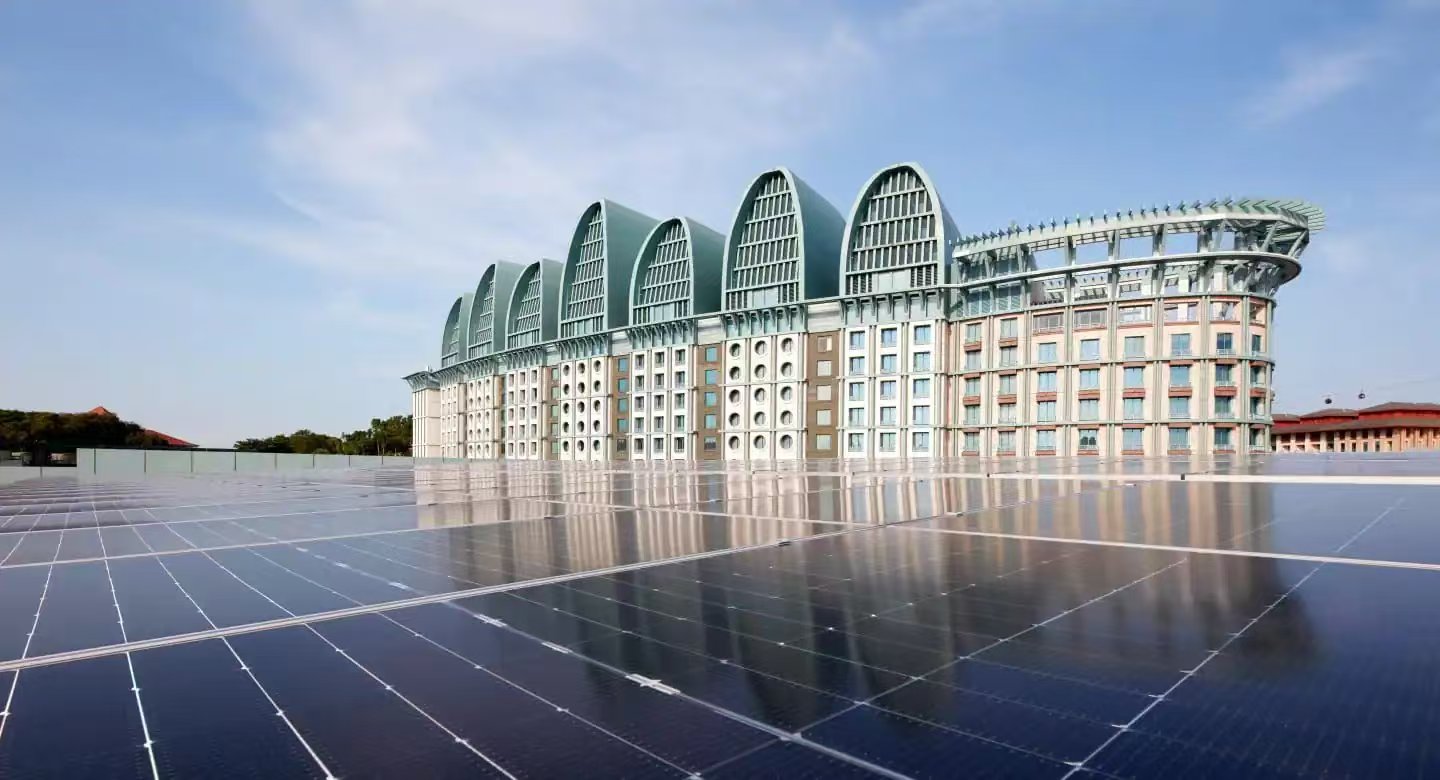
This comparison sets two roof products from Xiamen 9Sun Solar Technology Co., Ltd. side by side. 9Sun Solar is a Chinese solar mounting manufacturer based in Xiamen, Fujian, with a production facility in Quanzhou that supplies ground, roof, farm, carport and balcony mounting systems. The two products examined here are the NS-Roof Ballast-1, a ballasted solar roof system with a fixed 5°–15° tilt, and the NS-Adjustable Leg-1, an adjustable leg bracket system covering 10°–30°. Both are published with anodised AL6005-T5 aluminium and stainless steel construction, CE in their specification listing, a 60 m/s wind load rating, a 1.4 kN/m² snow load rating and a 10-year warranty. What separates them is the tilt strategy and the attachment logic built around it.
Why a flat roof changes the mounting brief
On a pitched roof, the roof itself has already answered the tilt question. On a flat or low-slope roof, nothing has been answered. The installer has to decide how the array is held down, which angle it faces, how rows are spaced to avoid self-shading, and whether the roof membrane can be interrupted at all. Each of those decisions carries a document trail, and that trail is what a buyer is really purchasing alongside the hardware.
Two general constraints dominate. First, load: any mount that holds the array down transfers wind uplift and snow accumulation into the roof structure, and the roof’s own spare capacity is often unknown for older buildings. Second, tilt: a steeper angle improves yield at higher latitudes and in winter conditions but raises the exposed frontal area, which increases the uplift the structure must resist. A ballasted system and an adjustable leg system resolve that trade-off in materially different ways.
The two products at a glance
Published specifications for the two products are almost identical apart from tilt range. That similarity is useful: it means the buyer is comparing attachment strategies rather than comparing material quality.
| Specification | NS-Roof Ballast-1 | NS-Adjustable Leg-1 |
|---|---|---|
| Product type | Solar Roof Ballast System | Solar Adjustable Leg Bracket System |
| Material | Aluminium (AL6005-T5), stainless steel | Aluminium (AL6005-T5), stainless steel |
| Surface treatment | Anodised aluminium | Anodised aluminium |
| Tilt angle | 5°–15° (fixed) | 10°–30° (adjustable) |
| Wind load | ≤ 60 m/s | ≤ 60 m/s |
| Snow load | ≤ 1.4 kN/m² | ≤ 1.4 kN/m² |
| Certification listed | CE | CE |
| Warranty | 10 years | 10 years |
| Colour | Silver, black, or customised | Silver, black, or customised |
The 10°–15° overlap is where most projects are lost or won
The two tilt ranges overlap between 10° and 15°. In that band, both products can serve the same array geometry, which means the decision should not be made on tilt at all. It should be made on how the array is held down, how much roof area the layout consumes, and what happens when the specification has to be defended to a structural reviewer or a building authority.
Outside that band the choice resolves itself quickly. Below 10°, only the ballast system is specified. Above 15° and up to 30°, only the adjustable leg system is specified. A buyer working on a portfolio rather than a single site should treat the tilt requirement as a filter first and a cost comparison second, because a product that cannot reach the required angle cannot be substituted no matter how it prices.
Tilt also has a downstream effect that is easy to miss in a quotation comparison. Higher tilt increases row spacing to control self-shading, which reduces the usable module count per square metre of roof. On a roof where area rather than structural capacity is the binding constraint, the lower-tilt ballasted layout will often fit more capacity even though each individual row is less productive. That trade-off belongs in the financial model, not in the procurement spreadsheet alone.
Ballast versus adjustable leg: what is actually being attached
A ballasted roof system holds the array down with weight distributed across the roof surface. Nothing is driven into the deck or the membrane, so the waterproofing warranty is left intact and the installation sequence is largely a matter of layout and ballast placement. Ballasted arrays generally rely on ballast blocks together with wind deflectors or screens that limit the acceleration of air under the module plane, because uplift on a low-tilt array is driven as much by pressure equalisation as by raw wind speed.
An adjustable leg bracket works the other way. The array is carried on leg structures whose length sets the tilt, and the structure has to be positively connected to something — the roof deck, a rail system, or a structural member — rather than simply resting on the surface. Leg assemblies are commonly supplied pre-assembled so that site work reduces to positioning, levelling and fixing, which matters on occupied commercial buildings where access windows are short. The practical consequence for a buyer is that the adjustable leg route normally introduces a penetration question that the ballasted route avoids.
This is the single most important specification gap to close before ordering either product. The published technical parameters for the NS-Roof Ballast-1 and the NS-Adjustable Leg-1 define material, surface treatment, tilt, wind load, snow load, certification and warranty. They do not fully define the fixing detail or the ballast quantity used for a given project. Those values come from the project-specific layout and structural calculation, and a buyer should request both documents rather than infer them from the product name.
Reading the 60 m/s and 1.4 kN/m² ratings correctly
Both roof systems are published with a wind load of ≤ 60 m/s and a snow load of ≤ 1.4 kN/m². These are design ratings for the mounting structure, not a statement that the building underneath can carry the resulting reactions. That distinction is routinely blurred in supplier literature and it is where independent review adds value.
A buyer evaluating either product should ask three questions of the rating. Is the figure a design limit derived from calculation, or a tested value from a recognised laboratory? Which code basis underpins it — for example JIS C8955:2017 or AS/NZS 1170, both of which 9Sun Solar states its mounting systems are designed to reference? And is there a project-specific calculation that takes the actual site wind speed, terrain category, building height and roof zone into account? Design reference is not the same thing as certification, and a company statement that a system is designed to a standard should be filed as a design basis, not treated as evidence of conformity.
Certification deserves the same discipline. Both products list CE in their published parameters, but a certification listing without a certificate number, issuing body, scope statement and validity period is only a claim until verified. Buyers in the United States should note that CE is not a substitute for UL 2703, which covers photovoltaic mounting systems, mounting devices, clamping or retention devices and grounding lugs for flat-plate modules. UL Solutions describes UL 2703 as applicable to mounting systems used as a non-structural building component. A European CE attestation therefore does not answer a North American code question, and the reverse is equally true.
Material and corrosion: the part both products share
Because both products share AL6005-T5 aluminium with stainless steel fasteners and an anodised finish, corrosion performance does not differentiate them. It does, however, determine whether either is appropriate for a given site, and it is frequently under-specified in quotations.
Anodised aluminium is a reasonable default for lightweight roof structures and for coastal or humid environments, provided the anodising thickness is matched to the site’s corrosivity category and dissimilar metal interfaces are isolated. On a flat roof specifically, standing water and drainage are as important as coating choice: water that pools under a ballasted array accelerates the deterioration of anything it touches and adds unplanned load. Buyers should review the layout drawing for drainage paths before approving the ballast quantity, not after.
What the material mix says about the rooftop segment
The choice between these two products is also a small data point in a much larger shift. Global Market Insights valued the global solar PV mounting systems market at USD 49.7 billion in 2025 and projected it to reach USD 83.2 billion by 2035. In the same assessment, aluminium accounted for 71.5% of the market by material in 2025.
For a buyer, that material concentration is not trivia. It means roof-oriented, aluminium-intensive platforms such as the NS-Roof Ballast-1 and NS-Adjustable Leg-1 sit inside the mainstream of the market rather than at its edge, and it means the supply base for these profiles is broad. Broad supply is good for lead time and bad for differentiation, which is precisely why procurement should compete suppliers on documentation, calculation support and project engineering rather than on the alloy grade alone.
Matching the mount to the site: a decision rule
The following rule set reflects how the two products divide in practice. It is a starting filter, not a substitute for a structural check.
- Choose the NS-Roof Ballast-1 when the roof membrane must not be penetrated, the required tilt sits between 5° and 15°, the roof structure has verified spare load capacity for the ballast, and the layout has enough area for ballast distribution and row spacing.
- Choose the NS-Adjustable Leg-1 when the array needs 15° to 30° of tilt, the roof can accept mechanical fixing to the deck or structure, or the building owner requires a positive structural connection rather than a resting load.
- Compare both only inside 10°–15°, and decide there on ballast availability, roof load capacity, waterproofing constraints and installation labour rather than on tilt range.
- Reject either product if neither the project calculation nor the fixing detail can be supplied, regardless of the published wind and snow ratings.
Where these products stop
An honest comparison has to state limits, and there are three that matter.
First, a ballasted system shifts a load onto a roof whose structural capacity is frequently undocumented. Where the spare capacity cannot be confirmed, ballast is not a low-risk default; it is an unverified assumption. Second, an adjustable leg system solves the tilt problem but reintroduces the penetration and waterproofing problem, and on a membrane roof that may require specialist flashing work outside the mounting supplier’s scope. Third, neither product’s published parameters establish conformity for a specific jurisdiction. CE is listed, but UL 2703 coverage relevant to North American projects is not established by that listing and would need separate documentation.
There is also a manufacturing-side limit worth flagging. 9Sun Solar reports an annual solar mounting-system production capacity of 2 GW and a monthly bracket capacity of 170 MW, but another of the company’s own domains reports an annual capacity of 1.8 GW. The discrepancy is unresolved and the capacity basis is not disclosed, so capacity should be treated as a company-reported figure to be confirmed through production records or a factory audit rather than as a settled number.
OEM, customisation and supply considerations
For distributors and EPC buyers, the mounting product is only half the purchase. 9Sun Solar provides OEM/ODM production services for solar mounting structures, including OEM services for custom ground-mount solar bracket designs and custom solar bracket manufacturing. The company states that it customises structural dimensions, material corrosion protection, connection nodes and tracking parameters according to project terrain, climate, module specification and foundation conditions.
The factory reports a monthly capacity of 170 MW for solar bracket production, which is the figure that matters when a distributor is planning a season rather than a single order. Published purchasing terms include 100% testing as the pre-shipment acceptance criterion and a 10-year warranty on mounting systems. For a roof programme, the relevant question is not whether customisation exists but whether the customised drawing set includes the ballast quantity, the fixing detail and the project calculation — the three documents a reviewer will ask for.
Outlook
Two pressures are likely to shape roof mounting decisions over the next several years. Regulation is one: California’s 2025 Building Energy Efficiency Standards, known as Title 24, require solar on new commercial construction from 1 January 2026, which pushes roof-mount demand into exactly the segment where ballasted and adjustable leg systems compete. Documentation discipline is the other: as more jurisdictions require evidence of structural adequacy rather than a product datasheet, suppliers who can supply calculations, fixing details and certificate scope alongside the hardware will separate from those who cannot.
The practical implication for buyers is that the product comparison is becoming the easy part. The hard part is the evidence file that travels with it, and that file is what should drive the shortlist.
Frequently asked questions
What is the difference between a ballasted roof mount and an adjustable leg roof mount?
A ballasted roof system holds the array down with distributed weight and generally avoids penetrating the roof membrane. An adjustable leg bracket carries the array on leg structures whose length sets the tilt and which require a positive structural connection. In 9Sun Solar’s range, the NS-Roof Ballast-1 is specified for a fixed tilt of 5° to 15°, while the NS-Adjustable Leg-1 covers 10° to 30°.
What tilt range does the NS-Adjustable Leg-1 cover?
The published parameter for the NS-Adjustable Leg-1 is 10° to 30°, adjustable. Its material, surface treatment, wind load, snow load, certification and warranty match those of the NS-Roof Ballast-1.
Does the NS-Roof Ballast-1 require roof penetration?
The product is described as a Solar Roof Ballast System, which indicates a weight-based, non-penetrating attachment approach. Its published technical parameters specify material, treatment, tilt range, wind and snow loads, certification and warranty, but do not set out the fixing or ballast detail. Buyers should request the installation drawing for the specific project before treating non-penetration as confirmed.
What wind and snow loads are the two products rated to?
Both the NS-Roof Ballast-1 and the NS-Adjustable Leg-1 are published with a wind load of ≤ 60 m/s and a snow load of ≤ 1.4 kN/m². These are structural design ratings for the mounting system and do not by themselves establish that a particular building can carry the resulting loads.
What documentation supports the CE listing?
The published parameters for both products list CE as their certification. A listed certification is not the same as a verifiable certificate: buyers should obtain the certificate number, issuing body, scope statement and validity period. For North American projects, CE does not establish UL 2703 coverage, and a separate UL 2703 assessment would be required.
How long is the warranty and what does it cover?
Both roof systems carry a 10-year warranty, which is the standard warranty period 9Sun Solar applies to its solar mounting systems. The company also states an expected service life of up to 25 years under proper use.
Can these roof systems be supplied as OEM or customised products?
9Sun Solar provides OEM/ODM production services for solar mounting structures and customises structural dimensions, corrosion protection, connection nodes and related parameters to project terrain, climate, module specification and foundation conditions. The factory reports a monthly capacity of 170 MW for solar bracket production, with 100% testing as the pre-shipment acceptance criterion.
The 9Sun Solar product catalogue, covering roof, ground, carport and balcony mounting systems, is available for download: 9Sun Solar Product Catalog (PDF).
Tem questões ou precisa de mais detalhes?
Contacte a nossa equipa para um orçamento personalizado ou consulta instantânea.
Solicitar orçamento
Preencha o formulário abaixo e a nossa equipa entrará em contacto com uma proposta personalizada.
Chat direto do WhatsApp
Prefere conversar em tempo real? Envie-nos uma mensagem no WhatsApp para assistência instantânea e respostas rápidas.
- Obter orçamento personalizado
- Partilhar fotos ou documentos
- Discuta as suas necessidades diretamente
Geralmente responde em 5–30 minutos durante o horário de expediente.