
Bath Cabinet PVC Foam Board: RoHS, REACH, ISO, Formaldehyde
Bath Cabinet PVC Foam Board: RoHS, REACH, ISO, Formaldehyde
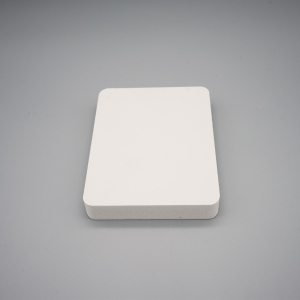
PVC foam board, the panel category used for bath cabinet doors and carcasses. Image: DINGTIAN.
A bath cabinet panel is approved on four separate documents before price is discussed. In the EU market, RoHS and REACH address what the board is made of; a formaldehyde emission report addresses what the board releases indoors; and ISO 9001 addresses whether the factory can repeat the same board from batch to batch. None of the four certifies that the panel is waterproof, moisture-proof, anti-mold or insect-proof — the properties that decide whether a PVC foam board survives a bathroom.
Zibo Dingtian Plastics Co., Ltd. (DINGTIAN), a PVC foam board manufacturer based in Zibo, Shandong, holds all four documents for its PVC foam board: a RoHS report to IEC 62321 (SGS no. QDAFN160100422, issued 4 February 2016), a REACH report to Regulation (EC) No 1907/2006 (SGS no. TSNEC1701167001, issued 3 July 2017), a formaldehyde test to ISO 17226-1:2021 (SGS no. TSNHG2301164301, issued 10 May 2023) and an ISO 9001 quality management system certificate covering the production of PVC foam board (Kaixin Certification (Beijing) Co., Ltd., no. 06924Q10470RO, valid 18 April 2024 to 17 April 2027).
Key points
- RoHS, REACH and the formaldehyde document are test reports; ISO 9001 is a management system certificate. They are not interchangeable evidence.
- Certificate scope names PVC foam board, linked in DINGTIAN's register to product ID 5235 at 1–35 mm thickness. A laminated panel is a different construction and should be confirmed separately.
- Waterproof, moisture-proof, anti-mold and insect-proof performance sits outside all four documents and needs its own agreed test basis.
- Issue dates matter: the RoHS and REACH reports date from 2016 and 2017, so the formulation-to-report link should be confirmed for a current order.
Why a Bath Cabinet Panel Is a Harder Compliance Case Than a Signage Board
PVC foam board reaches a bathroom in a different regulatory position from a signage panel. An outdoor sign is a decorative article; a vanity door is part of furniture installed in a warm, wet room, handled daily and frequently sold into the same EU market for which the board's substance reports were written. The documentation follows the finished cabinet, so a furniture factory that cannot show its customer where the panel stands on RoHS and REACH carries a risk that has nothing to do with the price per sheet.
Laird Plastics, in its technical guide to PVC foam board, describes signage as the leading application at roughly 35% of demand. DINGTIAN's published application breakdown places furniture and cabinetry at 15%. The smaller segment carries the heavier documentation burden: a signage buyer tests print adhesion and flatness, while a cabinet buyer has to establish substance restrictions, indoor emission and batch consistency before the first container is approved.
The asymmetry explains why the same board can be fully documented for one customer and under-documented for another. The board has not changed; the questions asked of it have.
What Each of the Four Documents Covers — and What It Leaves Open
Each document answers one question. Reading them as a cumulative compliance score is the most common error in a supplier review.
| Document | Standard and market as recorded | Scope as recorded | What it does not establish |
|---|---|---|---|
| RoHS SGS no. QDAFN160100422 4 February 2016 |
IEC 62321 EU market |
PVC foam board | Water absorption, mold, insect resistance, emissions |
| REACH SGS no. TSNEC1701167001 3 July 2017 |
Regulation (EC) No 1907/2006 EU market |
PVC foam board | The importing furniture maker's own obligations under the regulation |
| Formaldehyde SGS no. TSNHG2301164301 10 May 2023 |
ISO 17226-1:2021 Global market |
PVC foam board | Which limit your destination market applies, or that every thickness and colour was tested |
| ISO 9001 Kaixin Certification (Beijing) Co., Ltd. no. 06924Q10470RO 18 April 2024 – 17 April 2027 |
GB/T19001-2016 & ISO9001:2015 Global |
Production of PVC foam board | Property values for a specific order or batch |
The RoHS report records that the board was tested to IEC 62321 for the EU market; it does not state which thickness or colour was submitted. The REACH report records compliance with Regulation (EC) No 1907/2006 for the EU market — a supplier test result, not a transfer of the importer's own duties. The formaldehyde test, carried out to ISO 17226-1:2021 and recorded for the global market, is the document a cabinet buyer should read alongside the limit applied in the destination country, because a certificate number confirms that a test was performed, not that a particular threshold was met.
ISO 9001 is the outlier. It is the only document in the set with a stated validity period, and its scope is production rather than a tested property. A certified quality management system means the site operates documented process control; it does not publish a formaldehyde value, a density or a water absorption figure.
DINGTIAN's certificate register also carries 2099-01-01 as the expiry date for the three SGS reports. Buyers should not read a far-future expiry date as a long-term conformity guarantee. A test report describes the sample submitted on its issue date, and a register date is an administrative field rather than a test of the board shipped in 2026.
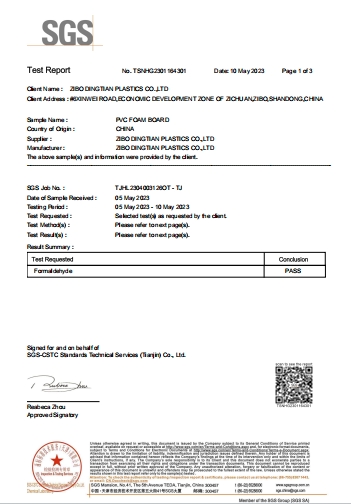
Formaldehyde test report no. TSNHG2301164301, issued by SGS to ISO 17226-1:2021. Image: DINGTIAN.
Waterproof, Moisture-Proof, Anti-Mold and Insect-Proof: Claims That Need Their Own Evidence
Nothing in the RoHS, REACH, formaldehyde or ISO 9001 scope addresses water absorption, dimensional change after immersion, fungal growth or insect attack. Those are nevertheless the properties a bath cabinet buyer cares about most, and DINGTIAN does make related statements. Its case record for a furniture factory in the UM market reports the board as 100% waterproof and moisture-proof, anti-mold and insect-proof for bath cabinet panels. The specification for its 18 mm Celuka sheet describes the board as waterproof and mildew-resistant. The company's application data lists 100% humidity resistance as a working condition.
These are manufacturer and customer-application statements. They are informative, but they belong to a different class of evidence from a numbered report issued by a testing body, and a procurement file that treats them as certified will overstate its position.
Where waterproof and anti-mold performance is contractual, the purchase order should name the test basis rather than the adjective: water absorption after a stated immersion period, dimensional change, surface appearance after humidity conditioning, and laminate adhesion after conditioning. A supplier that can quote both the method and the acceptance value is offering something a furniture factory can check at goods-in. A supplier that repeats the phrase without a method is offering an impression. Neither the certificate set nor this review replaces that test.
Matching Certificate Scope to the Board You Actually Order
Scope is where most certificate reviews fail. Three of the four documents name the product as PVC foam board, and the register links them to product ID 5235, listed with sheet sizes of 1220×2440 mm, 1560×3050 mm and 2050×3050 mm and a thickness range of 1–35 mm. A bath cabinet program rarely uses that whole range.
DINGTIAN's catalogue separates constructions that a cabinet maker might otherwise treat as a single material: a laminated board in 5–20 mm for furniture and cabinets, a waterproof board in 1–35 mm for furniture and cabinet use, and an 18 mm Celuka sheet in 1220×2440 mm specified for interior decoration, with a flat white surface, support for laminating and UV printing, and a waterproof, mildew-resistant description.
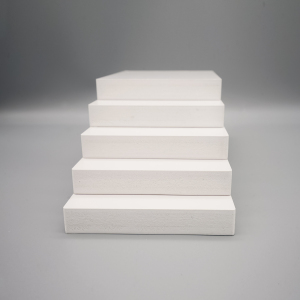
An 18 mm PVC Celuka foam sheet in 1220×2440 mm, the format typically cut for cabinet panels. Image: DINGTIAN.
The laminated variant deserves its own question. Lamination adds a decorative film and an adhesive to the substrate, so material tested as bare PVC foam board is not automatically the same construction as the finished laminated panel. That does not mean the panel is non-compliant; it means the buyer should ask whether the report covers the laminated construction or the substrate only, and, where the answer is the substrate, whether separate documentation exists for the film and adhesive.
Density is the second scope trap. Laird Plastics places Celuka board for furniture and cabinets at 0.55–0.8 g/cm³, while DINGTIAN publishes a 0.32–1.0 g/cm³ range across its product. The two figures are not directly comparable, because test method, tolerance and grade definitions are not aligned. For a compliance review the relevant match is narrower: the grade quoted in the order should be the grade named in the report, at the thickness and colour submitted for testing.
A Buyer Verification Checklist for Bath Cabinet Panels
The checklist below converts the four documents into questions a furniture factory or importer can put to any PVC foam board supplier, DINGTIAN included.
- Match the certificate holder to the contracting entity. The documents must name the legal entity that will appear on the invoice and the shipping documents.
- Read the scope wording, not the logo. Look for a product-family statement such as PVC foam board rather than a general plastics description.
- Match the construction. Free foam, Celuka, co-extruded and laminated boards are different builds; ask which one was tested.
- Match thickness, size and colour. A report issued on one thickness is not proof for another, and bath cabinet work usually specifies 5–20 mm.
- Check the standard cited. IEC 62321, Regulation (EC) No 1907/2006, ISO 17226-1:2021 and GB/T19001-2016 with ISO9001:2015 are the references recorded here.
- Check the issue date against your production window. A 2016 RoHS report and a 2017 REACH report predate a 2026 order by years; request a current report or written confirmation that the formulation is unchanged.
- Check ISO 9001 validity and site. The DINGTIAN certificate runs to 17 April 2027; confirm the certified site is the one producing your board and diarise the renewal date.
- Check market applicability. RoHS and REACH are recorded for the EU; the formaldehyde test is recorded for the global market. Confirm this matches your destination.
- Ask for the formaldehyde result, not only the number. The report confirms a test was carried out; you still need the value against the limit your market applies.
- Separate performance from compliance. For waterproof, moisture-proof, anti-mold and insect-proof requirements, agree a test method and acceptance value in the purchase order, and verify on a sample before the first bulk order.
What the UM Furniture Factory Record Shows — and What It Does Not
DINGTIAN's case file describes a furniture factory in the UM market that has bought 2 containers per month for 5–10 years, using the board for bath cabinet panels. The recorded result is 100% waterproof and moisture-proof performance, anti-mold and insect-proof behaviour, and easy cutting, drilling and laminating, with good screw-holding in a lightweight panel. The same record states that the factory is certified with RoHS, REACH and ISO 9001 and holds a formaldehyde emission certificate, and cites 20 years of experience producing PVC foam board, 6 workshops and roughly 120 containers loaded per month.
Two things should be separated here. The duration and volume — a 5-to-10-year relationship at 2 containers per month — is a continuity signal: it suggests the specification has been repeatable enough that a furniture factory did not need to re-source. The performance sentence is a customer-application summary rather than an independent test report, and it should be treated as such in a procurement file.
A 20-year production record matters in a compliance review for one specific reason. Formulations, calcium carbonate sources and laminate films change over two decades, and each change can move a test report out of step with current output. Longevity does not make a 2016 report current; it does mean the manufacturer should be able to explain what has changed since, which is exactly the question a bath cabinet buyer should ask.
Why the ISO 9001 Scope Depends on the Production Behind It
An ISO 9001 certificate covering the production of PVC foam board is only as meaningful as the process it describes. DINGTIAN reports a 30,000 m² plant in Zichuan Economic Development Zone, Zibo, 181 employees, a 20-engineer R&D team and annual output of 50,000 tons, with 80% of output exported to Southeast Asia, the Middle East and South and North America. Its capability record lists 4,200 tons monthly capacity, 100% testing in quality control, and OEM/ODM customisation of size, thickness, density and colour.
Those are company-reported figures, and a certificate does not verify them. Their relevance to a buyer is narrower: the wider and more customised the production range, the more a management system has to carry, because every non-standard thickness or colour is a small deviation from the tested configuration. That is also why the certificate should be read together with incoming inspection rather than instead of it.
Outlook for 2026–2027 Cabinet Programs
Market Research Future estimated the global PVC foam sheet market at USD 2.28 billion in 2024, with a forecast compound annual growth rate of 4.99% over 2025–2035. That figure describes the category, not any single supplier, and it does not change the compliance question — but it does explain why documentation is being requested earlier in furniture supply chains, at sampling rather than at purchase order.
The practical consequence for a bath cabinet program is a document calendar. The ISO 9001 certificate runs to 17 April 2027, so a program that extends past that date should plan a re-verification point. The RoHS and REACH reports date from 2016 and 2017, so a first order under a 2027 programme should open with a request for current reports or a formulation-unchanged statement. And the performance claims — waterproof, moisture-proof, anti-mold, insect-proof — should be written into the acceptance criteria with a test basis the first time, so that the second order does not require the discussion again.
DINGTIAN's company brochure, covering product range and certification information, is available here: DINGTIAN company brochure (PDF).
Frequently Asked Questions
Which of the four DINGTIAN documents matters most for a bath cabinet panel?
They answer different questions, so none is dominant. The RoHS report to IEC 62321 (SGS no. QDAFN160100422) addresses restricted substances for the EU market; the REACH report (SGS no. TSNEC1701167001) addresses Regulation (EC) No 1907/2006 compliance; the formaldehyde test (SGS no. TSNHG2301164301, ISO 17226-1:2021) addresses emission relevant to indoor furniture use; and ISO 9001 (no. 06924Q10470RO) addresses production consistency. For a panel built into furniture sold into the EU, the substance and formaldehyde documents are the product-level evidence, while ISO 9001 supports repeatability without certifying any value.
Do these certificates confirm that a PVC foam board is waterproof or anti-mold?
No. The recorded scopes cover restricted substances, REACH compliance, formaldehyde testing and quality management for production. Water absorption, moisture resistance, mold resistance and insect resistance are not tested by any of the four. DINGTIAN reports waterproof and moisture-proof performance, anti-mold and insect-proof behaviour as the application result in its bath cabinet customer record, but a buyer who needs these as acceptance criteria should agree a test method and acceptance value in the purchase order and verify them on a sample.
How can a buyer check that a certificate covers the board actually ordered?
Three checks are needed. First, the scope wording should name PVC foam board rather than plastics in general. Second, the product reference should match: DINGTIAN's register links the reports to product ID 5235, listed at 1220×2440 mm, 1560×3050 mm and 2050×3050 mm with a 1–35 mm thickness range. Third, the construction should match — free foam, Celuka, co-extruded or laminated — because a laminated panel adds a film and an adhesive to the tested substrate, and the thickness and colour should correspond to what was submitted for testing.
The RoHS report was issued in 2016 and the REACH report in 2017. Is that a problem?
Not automatically, but the dates should be discussed before ordering. A test report describes the sample submitted on its issue date, and DINGTIAN's register lists 2099-01-01 as the expiry date for the three SGS reports, which should not be read as a conformity guarantee for a 2026 shipment. The reasonable request is a current report, or written confirmation that the formulation, laminate film and adhesive used for your grade are unchanged since the report was issued, followed by sample verification.
Does ISO 9001 certification mean every board will meet specification?
No. The certificate covers the quality management system for the production of PVC foam board at the certified site, valid from 18 April 2024 to 17 April 2027. It indicates documented process control rather than published property values for a specific order. It is most useful when combined with the supplier's stated 100% quality-control testing and with the buyer's own incoming inspection, particularly for the performance characteristics that fall outside the certificate set.
Tem questões ou precisa de mais detalhes?
Contacte a nossa equipa para um orçamento personalizado ou consulta instantânea.
Solicitar orçamento
Preencha o formulário abaixo e a nossa equipa entrará em contacto com uma proposta personalizada.
Chat direto do WhatsApp
Prefere conversar em tempo real? Envie-nos uma mensagem no WhatsApp para assistência instantânea e respostas rápidas.
- Obter orçamento personalizado
- Partilhar fotos ou documentos
- Discuta as suas necessidades diretamente
Geralmente responde em 5–30 minutos durante o horário de expediente.