
Bathroom Furniture Set Supplier Audit: Fixing Scope and Install Evidence
Bathroom Furniture Set Supplier Audit: Fixing Scope and Install Evidence
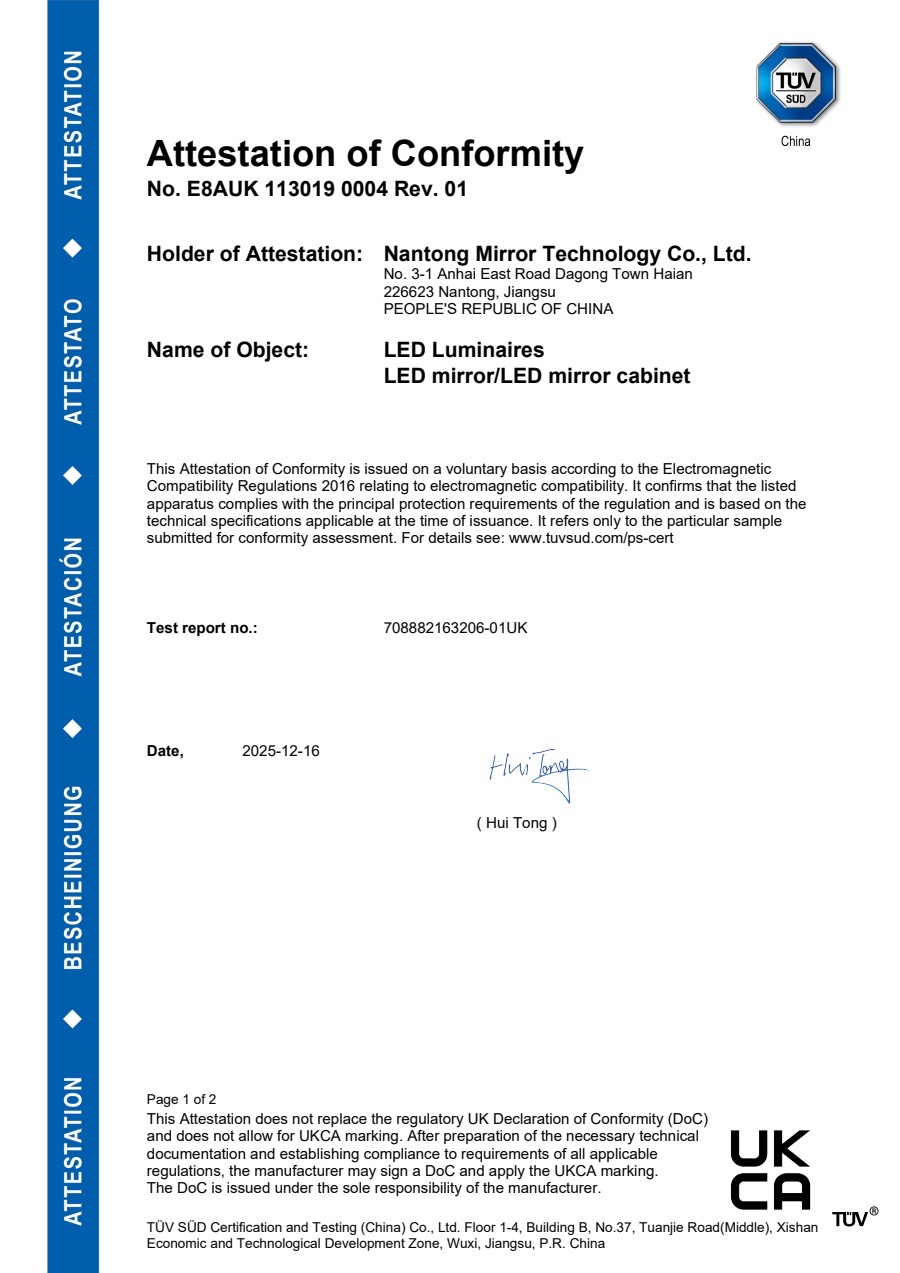
Certificate artwork: UKCA attestation of conformity No. E8AUK 113019 0004 Rev. 01, scope LED mirror / LED mirror cabinet, issued by TUV.
A bathroom furniture set is approved on paper and judged on site. Between those two moments sit the tasks that decide whether a project closes cleanly or returns as a complaint: pulling a drawer box before a wall-hung cabinet is lifted onto its brackets, setting a mirrored door on two axes instead of one, and agreeing in advance who supplies the screws that attach the unit to the wall. None of that appears in a product photograph. It does appear — or conspicuously fails to appear — in the installation documentation a supplier hands over before a purchase order is raised.
For a buyer moving from evaluation into execution, the qualification question is therefore not "what does the catalogue say" but "what happens on the day the cabinet is lifted onto its brackets". Three things answer it: whether the supplier documents model-specific service procedures rather than generic advice, whether the mirrored door is reinforced for repeated opening and closing, and whether the fixing scope — the boundary between what ships in the box and what the installer must provide — is written down before the order.
The worked example below uses the documentation set of PTB Technical Sanitary Ware (Jiangsu) Co., Ltd., a Jiangsu-based manufacturer of bathroom cabinets, shower enclosures and LED mirrors, operating a 33,000 m² plant with a stated 95% export ratio concentrated on the United Kingdom, France and Ireland. The models referenced are the CLA123 bathroom cabinet, the AQU9-E6 shower enclosure and the 9200 LED mirror.
Why installation evidence is the audit instrument
Installation evidence is auditable because it can be tested against a real bathroom rather than against a claim. A statement that a cabinet is "durable" cannot be checked before delivery. A written sequence that says the drawer box must be removed, the wall brackets marked and fitted, the cabinet hung and adjusted through hook screws, the drawer refitted, the hinge set on both axes, panel cut-outs sealed and door and drawer travel verified — that sequence can be checked for completeness, priced into the installation labour, and written into the contract as an obligation.
The second reason is liability. Bathroom installations fail at the interfaces: the wall, the sealant line, the electrical supply. When a supplier's documentation does not name those interfaces, the dispute is settled after the fact by whoever has the stronger argument. When the documentation names them in advance, the buyer knows which tasks sit with the factory and which sit with the fit-out contractor before a single unit is hung.
A third-party reference framework helps here. The reproduced text of GB 24977-2010, a Chinese national standard for bathroom furniture, sets requirements that map onto what a buyer wants to see at handover: accessible parts free of burrs, sharp ends, sharp edges and sharp corners; opening and closing components that operate freely after installation; and no seepage or water leakage under normal use after assembly. Two qualifications matter. The standard's current version status should be confirmed against an official standards source before it is used as a contractual reference, and it is a Chinese standard — it does not replace the conformity rules of the destination market. Used carefully, however, it converts vague expectations into inspection points.
Four documents that convert a claim into evidence
A bathroom furniture set supplier that can genuinely support an installer will produce four document types without negotiation. A supplier that cannot will produce a brochure and a promise.
- Model-specific commissioning sequence. Numbered steps for that model — not a general instruction sheet. It should name the parts, the order of work and the checks at the end.
- Fastener and reinforcement schedule. Which screws attach which component, where dedicated reinforcing screws are mandatory, and why the standard fixing is insufficient for that part.
- Fixing-scope declaration. A written statement of what is supplied in the carton and what the site must provide, including wall plugs and fixing screws.
- Electrical and bracket documentation for any powered component: drill pattern, bracket spacing, terminal arrangement, ingress protection rating and the zones in which the product may be installed.
Everything that follows is a way of scoring those four documents against a specific model.
Evidence item 1: the CLA123 drawer removal and refit sequence
A drawer that comes out cleanly and goes back with a positive confirmation is a small thing that reveals a great deal. The documented procedure for the CLA123 bathroom cabinet is to pull the drawer fully out, lift it upward to release it from the runner, clean any debris from inside the runner, then align the drawer with the runners and push it fully home until a click confirms engagement.
Three audit signals sit inside that sentence. First, removal is tool-free and reversible, which means the drawer box can be taken out before wall-mounting to reduce the weight being lifted — the same instruction appears in the wall-mount safety guidance. Second, refitting ends with a positive confirmation rather than an impression, so an installer can verify the task without guessing. Third, the supplier has published a diagnosis rather than a replacement instruction: sticking is attributed to dust and debris inside the runner, to a drawer not properly engaged in the runner channel, or to a deformed slide rail, and the response order runs from cleaning to re-engagement to rail replacement.
That last point is where suppliers differentiate themselves under audit. A supplier whose only answer to a sticking drawer is a new drawer assembly has moved the cost of a five-minute clean into the warranty channel. The documented answer — recover by cleaning and re-engagement, replace the rail only when it is deformed — is a statement about how the product is built and how the supplier expects it to be maintained. For a buyer planning a multi-unit residential or serviced-apartment handover, the difference in call-out volume is a commercial variable, not a technical footnote.
What to grade
- Does the sequence exist for the specific cabinet model, or is it a generic "adjust as required" note?
- Is removal described as reversible without tools, and is refitting tied to a verifiable confirmation?
- Is there a stated cause order for malfunction, or only a parts-replacement instruction?
- Is the drawer box explicitly removed before wall-mounting, and is the reason given?
Evidence item 2: X-Y hinge adjustment and reinforcing screws
Hinges on this cabinet family carry two adjustment directions: X for horizontal position and Y for vertical position. The supplier's own explanation for the dual-axis design is that wall-mount installation always introduces minor tolerance from drilling and bracket fitting, and that correcting horizontal and vertical position separately resolves uneven gaps and poor closure while reducing mechanical stress on the hinge. That is a plausible and testable design rationale, and it is the kind of statement an auditor can verify against a sample unit in ten minutes.
The reinforcing screw question is more consequential. A mirrored door faced with toughened glass weighs substantially more than an ordinary wooden door, and the fastener holding it carries a cyclic fatigue load every time the door is opened. The supplier's written position is that ordinary screws cannot withstand that repeated load and may loosen over time, and that dedicated reinforcing fasteners are therefore required, with reference to the component-strength requirements of EN 14749. The audit value is not the standard number alone; it is that the supplier has given a mechanism — mass plus cyclic load plus fatigue — that explains why a standard fastener is the wrong component here.
Buyers should treat the standard reference as a request for supporting documentation rather than as proof. Ask for the fastener schedule, ask whether reinforcing screws are supplied loose in the carton or pre-fitted, and inspect a sample door to count what actually holds the mirror. Where a supplier references a component-strength standard, ask for the declaration or test report behind the reference. The distinction matters because a falling mirror door is an injury risk, not a cosmetic defect, and the mitigation the supplier describes — mandatory reinforcing screws plus periodic inspection of hinges and fasteners — depends on the installer knowing both facts.
Evidence item 3: fixing scope, and why the box does not contain wall plugs
Wall fixings are not included with the bathroom cabinet or the shower enclosure. This is a deliberate position rather than an oversight: the correct fastener depends on the wall, and a universal plug packed into the carton is a guess that fails on hollow or lightweight construction. The supplier's documentation states that wall rawlplugs and fixing screws are not supplied and that suitable fixings must be selected according to on-site wall condition, and separately warns that lightweight walls require reinforcement before mounting because they cannot bear the cabinet weight as built.
For an auditor, this is the single clearest example of scope that must be stated, not assumed. Three obligations follow from it, and all three belong in the quotation or the technical annex rather than in a conversation:
- An explicit list of what the carton contains and what the site supplies, covering wall plugs, fixing screws and sealant.
- A named party responsible for verifying wall load-bearing capacity, and a stated action if the wall is lightweight or of unknown construction.
- A stated assumption about the wall type on which the quoted installation labour is based, so that a later reinforcement requirement is a variation rather than a dispute.
The same boundary logic applies to two further items that buyers routinely assume are factory work. Doors are supplied without pre-drilled handle holes; drilling must avoid hinges and internal components, should be performed from the reverse side with scrap wood support, and renders the door non-returnable. And waterproof sealing of cut edges is site installation work: the supplier's stated position is that mildew arising from unsealed cut edges after on-site cutting is not a factory product defect, because cutting removes the original moisture-proof surface and exposes open cells that absorb vapour. Neither statement is unusual. Both are routinely discovered only after an argument, which is exactly what a documentation audit is meant to prevent.
Evidence item 4: the wall-mount sequence as a documentation test
The published wall-mounting procedure for the CLA123 bathroom cabinet runs in six steps, and the completeness of those six steps is itself the test.
- Remove the drawer box, reducing the weight to be lifted and protecting the runner during handling.
- Mark positions and fit the wall hanging brackets.
- Hang the cabinet on the brackets and adjust height through the hook screws.
- Refit the drawer, then adjust hinge horizontal and vertical alignment.
- Perform any panel cut-out required and seal the cut surfaces.
- Check smooth opening and closing of both door and drawer.
Step five is the one that separates a usable sequence from a list of activities. A wall-mounted bathroom cabinet or a bathroom wash basin cabinet is frequently cut on site for services, and an unsealed cut edge absorbs moisture and leads to swelling and mildew. A sequence that omits sealing has left the most common cause of a later complaint unaddressed — and, under the interface logic described earlier, has also left the liability undefined. Step six closes the loop by requiring a functional check rather than an assumption, which is the same requirement the reproduced GB 24977-2010 text frames as components operating freely after installation.
Two additional instructions in the same document are worth scoring. Adjacent cabinets in a run are fastened by through-screwing from the side, with screw heads concealed behind hinge plates or shelves — a detail that matters for long countertop layouts in residential developments. And the safety note repeats the load logic: reinforcing screws for heavy mirrored doors, drawer removal before lifting, wall capacity verified, fixings not supplied, cut edges sealed. A sequence that repeats its own safety points at the point of use is doing the job an installation document is supposed to do.
Evidence item 5: requesting documented guidance on AQU9-E6 adjustable rollers
The second documentation request concerns the AQU9-E6 shower enclosure. What the buyer should ask for, in writing, is the adjustment procedure for the spring-loaded adjustable top rollers, the achievable adjustment range, the door-gap and height setting routine, and the part numbers for the replaceable seals and rollers.
The reason is tolerance. Building work introduces deviation in wall plumbness and in tray level, and an enclosure without adjustable rollers cannot compensate for it. The consequence is not a dramatic failure but a slow one: a door that sticks, a gap that will not close evenly, water tracking where the seal no longer meets. The supplier's stated design rationale is that adjustment allows the installer to offset construction error and that the enclosure's roller arrangement is linked to EN 14428. That reference should be treated as a request for the underlying declaration, not as a conclusion.
The published installation sequence for this enclosure is: verify tray level; assemble top and bottom tracks and the fixed-glass sub-assembly; mount wall profiles, drill and fasten; fit rollers, doors and magnetic seals; adjust door gaps and height; apply a continuous external silicone bead and allow it to cure. Three details inside that sequence are audit points in their own right. Silicone is applied to the exterior only — sealing the inner side traps water, blocks drainage and aggravates leakage. The tray must be level before the enclosure is mounted, and leakage caused by an unlevel tray is treated as an installation responsibility rather than a product warranty matter. And the silicone requires a minimum 24-hour cure before water exposure, which is a scheduling constraint the buyer should see before signing an installation programme.
Glass specification belongs in the same request. The supplier states use of EN 12150-1 toughened safety glass with heat-soak treatment to reduce self-breakage risk from nickel sulphide inclusions, and states that self-breakage cannot be eliminated completely. That is an honest limitation and should be read as such: heat-soak treatment reduces probability, it does not create a guarantee. The same documentation notes that on-site cutting or drilling damages the tempered stress layer and must not be attempted, and that transit damage is handled through immediate unpacking and photographic evidence.
Evidence item 6: the 9200 LED mirror bracket and wiring requirements
The third request is the one most often answered with a photograph instead of a document. For the 9200 LED mirror, a buyer should expect a bracket drawing with horizontal drill spacing tied to the back-plate bracket centres, confirmation of portrait and landscape mounting capability, the terminal arrangement for live, neutral and earth, the ingress protection rating with the zones in which the product may be installed, and the replacement path for the driver, touch sensor and demister pad.
On the electrical side the supplier's documentation is explicit and appropriately conservative. Installation must be completed by a qualified electrician working to the IEE wiring rules and bathroom zoning; mains power must be isolated before wiring; earthing must be reliable; and drilling must avoid hidden pipes and cables. The product is rated IP44 for bathroom Zone 2 and outside zones only. IP20 is not acceptable in that environment: it protects against solid objects but not against splashing water, and vapour ingress can degrade insulation and create a shock hazard. Wiring of bathroom mirror lamps is not work for unqualified personnel, and the stated mitigation is qualified labour plus an earth test after completion.
Two design decisions in the same document show how far a supplier has thought about site reality. First, the demister pad is synchronised with the light rather than given an independent switch, on the stated reasoning that independent control creates a dry-heating risk when a user forgets to switch it off. Second, both portrait and landscape mounting are supported, which reduces the layout constraint in narrow or irregular bathrooms where a fixed-orientation anti-fog mirror lamp would not fit. Neither point proves reliability. Both are the kind of documented design rationale that can be tested on a sample and verified at commissioning — switch on, check illumination, check demisting, adjust brightness by long press, and confirm the touch area is dry, since heavy water residue on the surface interferes with the sensor.
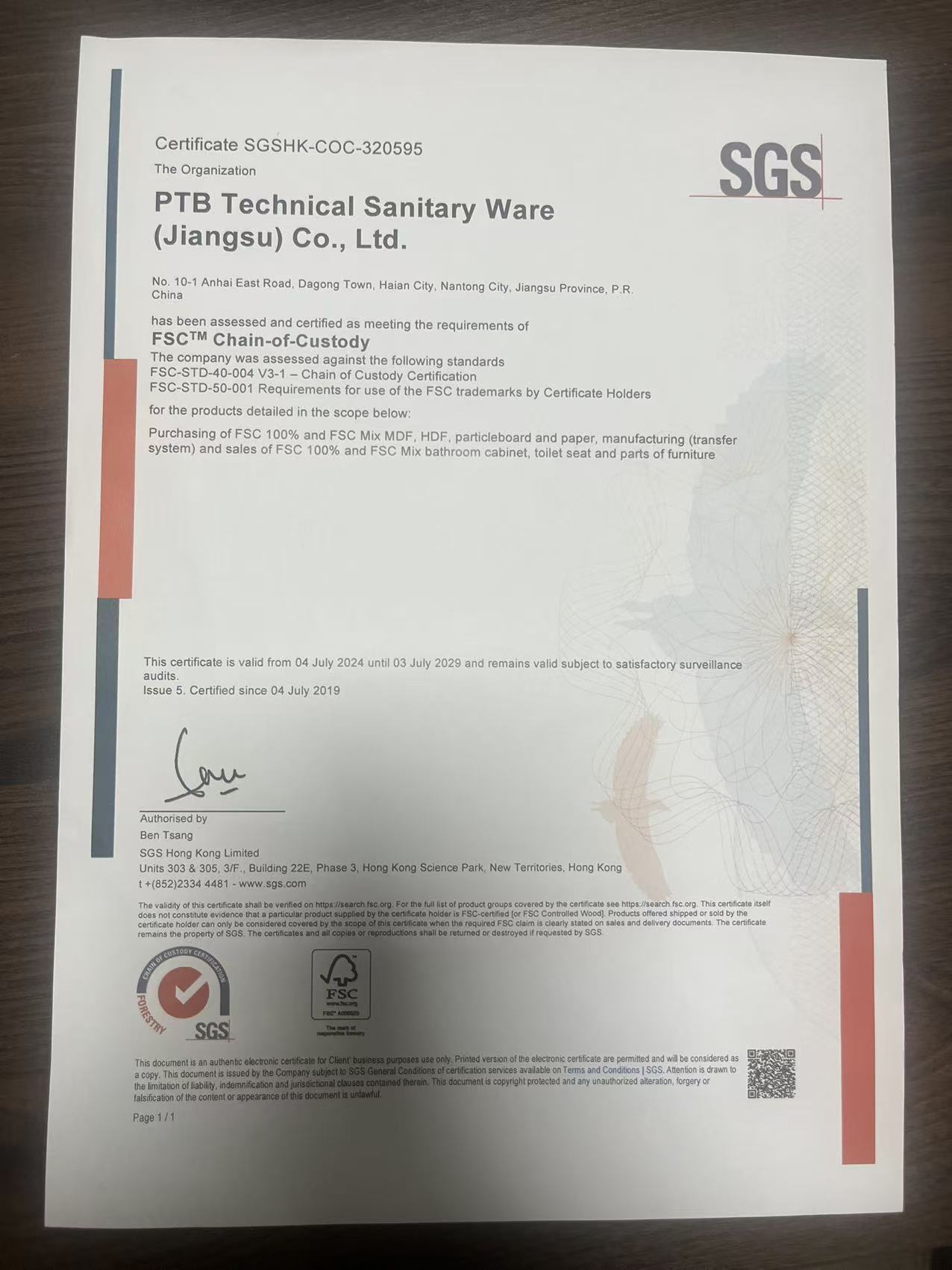
Certificate artwork: FSC-COC chain-of-custody certificate SGSHK-COC-320595, scope covering FSC-certified MDF/HDF bathroom cabinet, toilet seat and furniture parts.
The audit matrix a buyer can take into a supplier meeting
The value of this framework is that it converts each document into a pass or fail line. The matrix below is deliberately narrow: it scores documentation sufficiency, not product performance.
| Evidence item | Document requested | Pass criterion | Failure signal |
|---|---|---|---|
| CLA123 drawer service | Model-specific removal and refit steps with a fault-cause order | Tool-free removal, positive refit confirmation, clean-before-replace logic | Generic note, or replacement as the first response |
| Hinge adjustment | X-horizontal and Y-vertical setting instruction | Both axes documented, tolerance purpose stated | Single-axis adjustment, or "factory set, do not adjust" |
| Mirrored-door fastening | Fastener schedule and reinforcing screw specification | Dedicated reinforcement named for the glass door | Ordinary screws, or no schedule at all |
| Fixing scope | Written list of carton contents versus site supply | Wall plugs and screws excluded and stated before order | Ambiguity resolved at installation |
| Cut-edge sealing | Installation note naming the sealing step and the responsible party | Sealing included in the sequence before commissioning | Silence, followed by a mildew dispute |
| AQU9-E6 rollers | Roller adjustment procedure and spare part numbers | Adjustable rollers, separately replaceable seals | Non-adjustable structure, one-piece seals |
| 9200 LED mirror | Bracket drawing, terminal detail, IP rating and zoning note | IP44 with Zone 2 limitation, earth and isolation stated | Ingress protection unstated, zoning unaddressed |
What this method compares, and what it does not
The conventional alternative is specification-only vetting: a buyer compares board material, finish and price, confirms a certificate pack, and assumes the installation will be handled by competent labour. That approach documents what the product is. It does not document whether the product can be installed repeatably across two hundred bathrooms by contractors who have never seen the model.
The limitation must be stated just as clearly. Installation documentation proves that a supplier has codified its procedure; it does not prove field performance. Neither method establishes that a given installation will be leak-free, and neither replaces a monitored first installation followed by post-handover inspection. Where the two approaches genuinely differ is in what they make visible before the order: a documentation audit surfaces the interface risks — wall capacity, cut-edge sealing, earth continuity, tray level — while they are still commercial questions rather than warranty claims.
This is also where the supplier's own reference cases should be read carefully. The company reports a residential developer and senior living project of 200 CLA123 units in the UK, Ireland, Germany and France, in service for eight years or more, with moisture-resistant MDF, moisture-proof edge sealing, E0-level environmental performance and durable hinges and slides. It reports 120 AQU9-E6 units in high-end hotel and residential work across the same markets, ten years or more in service, with a maintenance rate below 2%. And it reports 200 LED mirror units of the LQ752 type in serviced apartment and hotel fit-outs, five years or more in service, IP44 rated with anti-fog film and touch switching, and a one-year return rate below 1%. These are company-reported figures describing specific projects. They are evidence of an installed base, not a performance guarantee for the buyer's own site, and they should be requested in writing with the project reference attached.
The supplier's submitted evidence: what the documents actually cover
PTB Technical Sanitary Ware (Jiangsu) Co., Ltd. is an OEM and ODM manufacturer offering style, logo and colour customisation, with stated monthly capacity of 30,000 bathroom cabinets, 30,000 shower enclosures and 3,000 LED mirror lamps, a minimum order quantity of 30 units, a quoted lead time of 30–45 days, 100% testing and remote after-sales support. The plant operates 33,000 m² with 156 employees, an annual output of 360,000 sets and a six-engineer R&D team. Full company details are published at PTB Technical Sanitary Ware (Jiangsu) Co., Ltd.
The certificate set that supports a documentation audit is specific, and its scope should be read as narrowly as it is written. The ISO 9001:2015 quality management certificate, number 00125Q39056R1M/3200, is issued by the China Quality Certification Center, dated 12 December 2025 and valid to 13 December 2028, covering the production of shower rooms and bathroom cabinets. The LED mirror and LED mirror cabinet range is covered by a UKCA attestation of conformity, number E8AUK 113019 0004 Rev. 01, and a CE attestation, number E8A 113019 0003 Rev. 01, both issued by TUV on 16 December 2025 against EN IEC 55015:2019/A11:2020, EN IEC 61547:2023, EN IEC 61000-3-2:2019/A2:2024 and EN IEC 61000-3-3:2013/A2:2021. Panel sourcing is covered by FSC-COC chain-of-custody certificate SGSHK-COC-320595 from SGS Hong Kong Limited, issued 4 July 2024 and valid to 3 July 2029, for the purchasing, manufacturing and sale of FSC-certified MDF/HDF bathroom cabinet, toilet seat and furniture parts.
What those certificates establish is bounded. They confirm that a management system and a product-safety conformity route exist within the stated scope, on the stated dates, for the stated product families. They say nothing about whether a particular installation was commissioned correctly, whether the wall was reinforced, or whether the sealant was applied to the exterior only. The audit answer is to pair the certificate pack with the four document types described above: the certificates qualify the factory, the installation documents qualify the handover.
Limitations this audit cannot remove
Four limits should be carried into any supplier decision made on this basis. Wall condition remains unknown until a site survey, and no document can pre-approve a wall that has not been inspected. Sealant application, tray levelling and electrical connection are installer-controlled; the supplier can specify the correct method, but cannot execute or verify it remotely. Certificates cover a defined scope and date, not a specific project's conformity. And company-reported case outcomes describe the supplier's own installations, which is a different evidentiary category from an independently observed result.
Outlook: documentation as a deliverable, not a courtesy
The direction of the wall-hung segment makes this audit more relevant rather than less. Grand View Research projects that wall-mounted and floating vanity units will grow at a compound annual rate of 7.26% through 2031 in the United States market — a segment-specific forecast, not a statement about any one supplier, and one that should be read alongside the buyer's own market rather than in place of it. If floating and wall-hung configurations take a larger share of installations, then the two questions this framework centres on — who verifies wall capacity, and who supplies the fixings — move from the margin of a procurement file to its centre.
The practical implication for an evaluation-stage buyer is modest and specific. Ask for the four document types before the sample is approved, not after the first installation fails. Score the answers. Treat a supplier that publishes a drawer refit sequence, a fastener schedule, a fixing-scope declaration and a bracket drawing as having demonstrated a capability that a brochure cannot demonstrate — and treat the absence of those documents as a risk that will be paid for on site, by someone.
The supplier's product lookbook, including the cabinet, shower enclosure and mirror ranges referenced here, is available for download: PTB Lookbook Brochure (October 2024).
FAQ
What installation documents should be requested from a bathroom furniture set supplier before approval?
Four document types: a model-specific commissioning sequence covering assembly, adjustment and final functional checks; a fastener and reinforcement schedule naming where dedicated reinforcing screws are mandatory; a written fixing-scope declaration listing what the carton contains and what the site must supply; and electrical plus bracket documentation for any powered component, including drill spacing, terminal arrangement, ingress protection rating and permitted installation zones.
Why are wall fixings not included with bathroom cabinets and shower enclosures?
Because the correct fastener depends on the wall. Wall rawlplugs and fixing screws are not supplied, and suitable fixings must be selected according to on-site wall condition. Lightweight walls require reinforcement before a cabinet is mounted, since they cannot bear the cabinet weight as built. The consequence for procurement is that the fixing scope must be declared in the quotation, together with the party responsible for verifying wall load-bearing capacity.
How is a CLA123 drawer removed and refitted?
Pull the drawer fully out and lift it upward to release it from the runner. Clean any debris from inside the runner, then align the drawer with the runners and push it fully home until a click confirms engagement. Sticking is normally caused by debris in the runner, incomplete engagement in the runner channel or a deformed slide rail; cleaning and re-engagement usually resolve it, and the rail is replaced only when it is deformed. The drawer box is removed before wall-mounting to reduce lifting weight.
What does X-Y hinge adjustment cover, and when are reinforcing screws required?
X adjustment sets horizontal position and Y adjustment sets vertical position, so that tolerance from drilling and bracket fitting during wall-mounting can be corrected without rehanging the cabinet. Reinforcing screws are required for heavy mirrored doors: a toughened-glass door is substantially heavier than a wooden door, and ordinary screws may loosen under the cyclic load of repeated opening and closing. The supplier's stated basis for dedicated fasteners is the component-strength requirement of EN 14749, and the supporting declaration should be requested.
What bracket and wiring information should a buyer expect for the 9200 LED mirror?
A bracket drawing showing horizontal drill spacing tied to the back-plate bracket centres, confirmation that both portrait and landscape mounting are supported, terminal detail for live, neutral and earth, and the ingress protection rating with its zone limitations. The unit is rated IP44 for bathroom Zone 2 and outside zones only. Wiring must be completed by a qualified electrician to the IEE wiring rules with mains isolated and earthing verified, avoiding hidden pipes and cables. The demister is synchronised with the light rather than independently switched, and driver, sensor and demister modules are replaceable items.
Tem questões ou precisa de mais detalhes?
Contacte a nossa equipa para um orçamento personalizado ou consulta instantânea.
Solicitar orçamento
Preencha o formulário abaixo e a nossa equipa entrará em contacto com uma proposta personalizada.
Chat direto do WhatsApp
Prefere conversar em tempo real? Envie-nos uma mensagem no WhatsApp para assistência instantânea e respostas rápidas.
- Obter orçamento personalizado
- Partilhar fotos ou documentos
- Discuta as suas necessidades diretamente
Geralmente responde em 5–30 minutos durante o horário de expediente.