
Bathroom Vanity Manufacturer Capability: KL813003 & AS Series
Bathroom Vanity Manufacturer Capability: KL813003 & AS Series
Manufacturing capability in the bathroom vanity sector is normally argued in square metres, headcount and equipment inventories. It is more reliably judged at model level, where a buyer can test whether a documented width range, a named slide brand and a stated board grade hold together across a whole product family rather than appearing once on a single hero SKU.
Foshan SHKL Sanitary Ware Co., Ltd, a sanitary ware manufacturer founded in 2004 and operating under the brand SHKL, publishes a wall-mounted model set that supports that kind of reading: KL813003 and the AS series, which includes AS813047, AS813048A, AS813049, AS813050, AS813108 and AS813109. Taken together, these models expose construction, hardware, basin and mirror decisions that would otherwise stay hidden behind a capability statement. For buyers at the decision stage — importers finalising a programme, specifiers writing a bathroom schedule, or hospitality developers standardising a room type — that distinction matters more than the size of a factory floor.
The Decision-Stage Problem: Capability Claims Are Not Specifications
A supplier that states it can produce wall-mounted and floor-standing vanities has told a buyer very little. A supplier that documents a model spanning 750 mm to 1200 mm in width has told the buyer something specific: the platform can be positioned against a narrow secondary bathroom footprint and against a wide primary or hospitality footprint without changing supplier. The first statement is marketing. The second is evidence.
This is the gap most procurement teams encounter in late-stage evaluation. Supplier catalogues tend to present the best-looking configuration, and the specification detail that determines whether a project succeeds — board grade, slide mechanism, moisture control, basin construction, mirror function set — is scattered or absent. The practical consequence is that the buyer ends up comparing suppliers on presentation rather than on the constraints that generate site failures.
Judging a bathroom vanity manufacturer at model level reverses the sequence. Instead of starting with factory statistics and ending with a product photo, the evaluation starts with the documented model, works outward to the components behind it, and only then asks whether the manufacturing base can repeat that standard across an order. KL813003 and the AS series are useful here precisely because they are a family, not a single showcase item.
What the KL813003 and AS-Series Documentation Actually Contains
The documented model set covers a wall-mounted platform plus a related AS-series group. The table below maps each model to the evidence it contributes, and what a buyer can legitimately check against it. Mounting configuration, basin choice and finish should always be reconfirmed on the current specification sheet at quotation stage, because a model reference alone is not a project submittal.
| Model | Configuration in published documentation | Evidence it contributes | What a buyer can check |
|---|---|---|---|
| KL813003 | Wall-mounted platform | Documented width range of 750–1200 mm | Whether one platform covers a narrow secondary bathroom and a wide primary bathroom without a second supplier |
| AS813047 | AS-series wall-mounted group | Reference model used in published wall-mounted specification comparisons | Whether hardware and finish documentation is applied consistently across the AS group |
| AS813048A | AS-series wall-mounted group | Reference model used in published wall-mounted specification comparisons | Whether specification sheets are genuinely comparable between models rather than written per SKU |
| AS813049 | AS-series wall-mounted group | Additional series entry | Whether the range is a real family or a single item with adjacent model codes |
| AS813050 | AS-series wall-mounted group | Additional series entry | Whether dimensional and finish options repeat across the family |
| AS813108 | AS-series wall-mounted group | Additional series entry | Whether slide and hinge specification is carried into every model in the group |
| AS813109 | AS-series wall-mounted group | Additional series entry | Whether basin and mirror pairing logic is consistent across the group |
The point of the table is not the model numbers themselves. It is that seven documented models allow a buyer to test repetition. Repetition is the single most useful proxy for manufacturing discipline: a family that repeats the same slide brand, the same board grade and the same finish logic across seven references is far more likely to repeat them across a 200-unit hotel order than a supplier presenting one flagship model.
Construction: Plywood and Solid Wood Answer Different Questions
SHKL manufactures bathroom vanities in solid wood, plywood, MDF and particleboard, with surface treatments that include painted finishes, melamine, veneer and PVC foil. The solid wood range covers rubber wood, ash, red oak, rosewood and black walnut, which is what allows a specification to move from a generic “wood bathroom vanity” requirement to a named species — relevant when a residential developer or a hospitality operator is matching joinery across a floor.
Plywood and solid wood are not interchangeable upgrades of the same specification. Plywood is a dimensionally stable engineered panel built from crossed veneers; it resists the movement that affects wide panels in humid bathrooms. Solid wood carries the appearance and repair characteristics that premium residential and luxury hospitality interiors usually demand, but it is a hygroscopic material and will respond to extreme conditions. SHKL states that moisture content is controlled at 10%–14% and that processing has been upgraded to manage that risk, and that minor cracks can be repaired under guidance while serious cracking is handled by replacement. That is a more honest statement than a blanket promise, and a buyer should treat it as the boundary condition it is.

Drawer assembly: slide and box specification is decided at component level, not at catalogue level.
Hardware and board grade: where a schedule is usually won or lost
Slide and hinge brands named in SHKL documentation are DTC and Unihopper for soft-closing slides, with DTC and BLUM normally used for rails and hinges; Kubler, Hettich and Hafele are listed as available alternatives. Drawer hardware includes steel-ball guide rails, palm guides and drawer boxes. For a buyer, the significance is not the brand list — it is that a soft-closing mechanism is a wear component with a finite cycle life, and a named brand is the only part of a vanity specification that can be checked against a third-party data sheet instead of a supplier promise.
Board grade is the second documented constraint. SHKL uses E1 boards, defined as less than 9 mg/100 g formaldehyde emission, which is a grade permitted for direct indoor use. For context, the grading scale runs E0 at less than 3 mg/100 g, E2 at less than 30 mg/100 g requiring interior-finishing treatment, and F grade at less than 1.8 mg/100 g with no restriction on usage area. Buyers writing for markets with indoor air-quality scrutiny should treat the declared grade as a starting question, not a closing one, and confirm it against the specific destination market's requirements before the order is placed.
Basins: Porcelain, Ceramic and Sintered Stone
Documented basin options across this model range include porcelain, ceramic and sintered stone. These are three different material families, and the choice is not purely aesthetic. Vitreous ceramic and porcelain bodies are formed and fired, producing a glazed surface with predictable behaviour and a well-understood repair profile. Sintered stone is a compacted mineral surface that offers strong visual uniformity across large formats, which is why it appears frequently in modern bathroom vanities and luxury bathroom furniture specifications where surface continuity matters.
The buyer's decision rule is straightforward. Where a project standardises many identical rooms and wants the fewest surface variables, a fired ceramic or porcelain basin gives the tightest control. Where the design intent is a large-format, visually continuous top, sintered stone is the appropriate route and the specification should say so explicitly rather than leaving it to the supplier. Whichever is selected, the quotation structure matters: SHKL quotes vanity, basin and mirror separately while recommending a matched set for performance and style consistency.
Width Range and Footprint Planning with KL813003
The documented 750–1200 mm range on KL813003 is the most immediately useful number in the set, because it converts a model reference into a planning tool. At 750 mm the platform sits just under a nominal 30-inch footprint; at 1200 mm it approaches a 48-inch footprint, which in most layouts is wide enough for a two-basin arrangement. Between those ends, a single model reference can address a secondary bathroom, a standard primary bathroom, and a wider double-sink bathroom vanity requirement.
Height is the other dimension specifiers should fix early. North American practice commonly cites vanity heights of 32–36 inches (813–914 mm), with 34.5 inches frequently described as comfort height. Hospitality projects increasingly standardise on the higher figure, and residential renovations follow. Because mounting, height and width interact — a wall-mounted bathroom vanity at comfort height needs blocking set correctly — the width range on KL813003 is best read alongside the mounting decision, not in isolation. SHKL's documented mounting options are wall-mounted and floor-standing, so a programme that mixes floating bathroom vanities in guest rooms with freestanding bathroom furniture in suites can be sourced from one supplier rather than two.
Pairing the Vanity with a Specified LED Mirror
Mirrors are frequently the weakest link in a bathroom package, because they are treated as an accessory rather than a specified electrical product. SHKL's LED bathroom mirror documentation is unusually granular and is worth reading as a checklist for what a complete mirror specification should contain.
| Specification area | Documented options |
|---|---|
| Supply voltage and certification | 120V for North America, 220–240V for Europe; UL, ETL and CE certification |
| LED components | Epistar chips (alternative brands can be specified); 5050 and 2835 strips at 60 or 120 LEDs per metre; 50,000-hour chip lifespan |
| Light output | 5050 at 9W/60 per metre: 850 lm; 2835 at 9W/60 per metre: 800 lm; 2835 at 16W/120 per metre: 1,350 lm |
| Colour quality | Ra80 standard; Ra90 or higher on request |
| Colour temperature | 2700K, 4000K and 6000K; adjustable CCT from 2700K to 6000K |
| Controls | Touch, motion-sensor and wall switches |
| Functions | Touch control, lighting and anti-fog as standard; dimming, motion sensing, Bluetooth, magnifiers (3x, 5x, 10x) and smart displays as options |
| Mirror construction | 3 mm, 4 mm and 5 mm silver mirrors; first-, second- and third-generation environmental mirrors with anti-corrosion materials; straight, straight bevel, shaped, shaped bevel, round and safety edges |
| Frames and mounting | Stainless steel, aluminium, acrylic and wood frames; hanger, screw and aluminium-strip hanger mounting |
For a hospitality project, the anti-fog function and the switch type are the two lines that generate the most post-occupancy complaints when they are left unspecified. For a residential developer, colour temperature consistency across units is the equivalent risk. Both are decisions the buyer should make, not inherit.
Where the Evidence Stops: Limits and Boundary Conditions
A credible capability assessment includes what a supplier cannot do, and several limits are documented rather than implied.
Solid wood can crack under extreme conditions, and no vanity in this range should be soaked for prolonged periods. Lacquered vanities are described as water-resistant through two UV undercoats and one PU finishing coat, while melamine surfaces rely on sealing to prevent moisture penetration — a meaningful difference for shower-adjacent installations. Knock-down or flat packing is offered for general vanities with an installation manual, but is not recommended for complex models, which affects container optimisation on highly specified projects. Minimum order quantities are more than 10 sets per item, custom colours require more than 20 sets and are usually more expensive in light colours than matte, and logo printing on packaging requires more than 20 pieces per item, with complex designs requiring separate discussion.
Lead times are category-dependent rather than uniform: melamine board vanities at 25–35 days, modern lacquer vanities at 35–45 days and classic styles at 40–45 days, with LED mirror orders at 45–50 days for a 40 ft container. A two-year warranty applies, supported by full pre-packing inspection and a documented process for assessing whether damage is transport-related or installation-related. Programme managers should treat these as planning inputs, not as competitive claims. SHKL also reports, as company-stated figures rather than independently verified data, that customisation lead times run around 30% shorter than the industry average and that production efficiency is roughly 40% higher than manual processing lines.
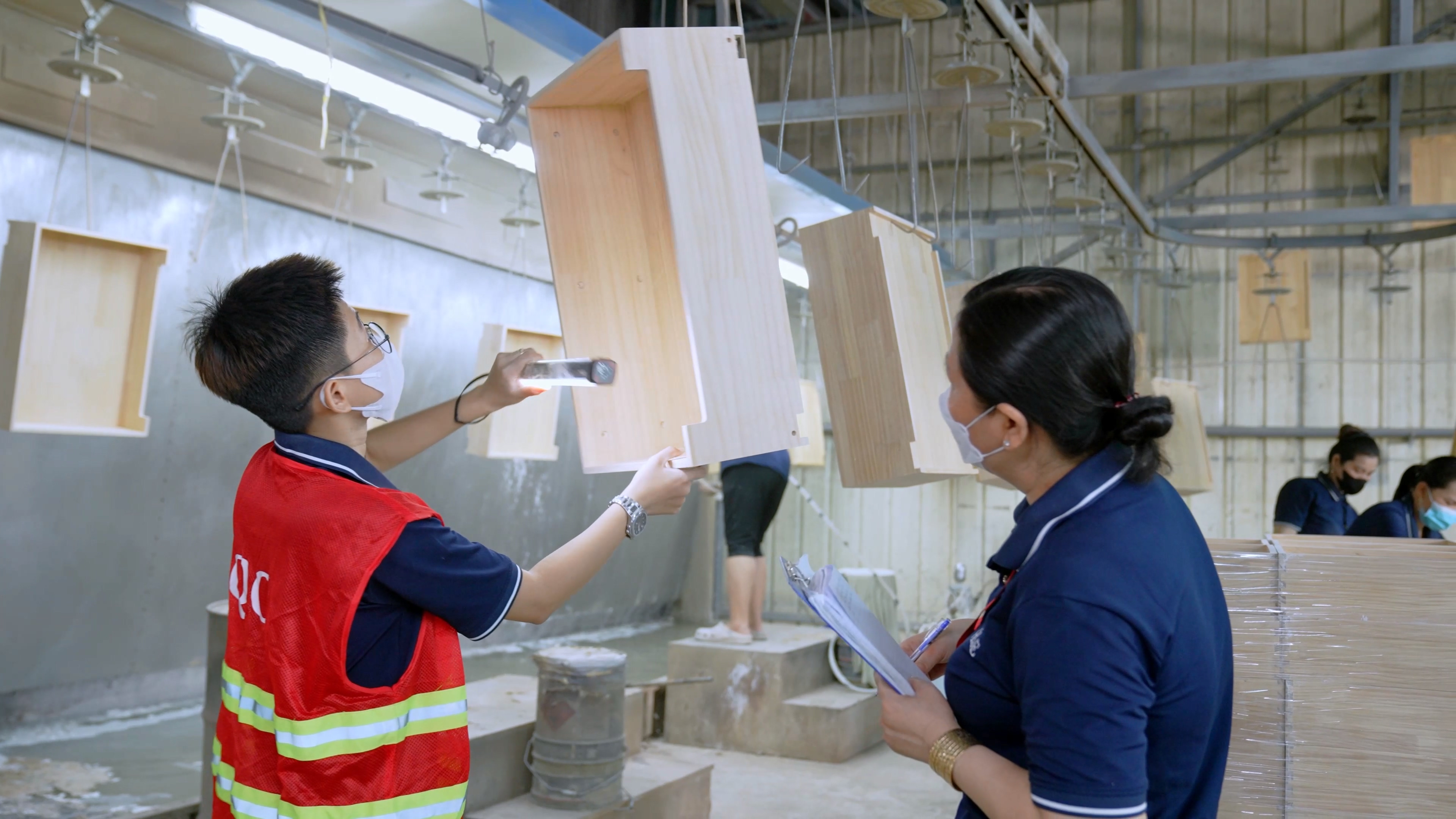
Pre-packing inspection: the checkpoint that determines whether a warranty claim is a defect or a transport event.
Residential Construction versus Commercial Hospitality
The same model family serves both markets, but the specification pressure differs. In residential construction, the dominant questions are dimensional fit and material appearance: a plywood bathroom vanity in a family bathroom often makes more sense than solid wood, while a solid wood vanity in red oak or black walnut is a deliberate upgrade in a primary suite. Custom colour is available and is the usual route for matching a developer's palette.
In commercial hospitality — hotel projects, serviced apartments and real estate show units — the priorities invert. Repeatability, hardware longevity, mirror function consistency and the ability to standardise a room type across hundreds of keys matter more than a single striking finish. This is where a seven-model documented set has practical value: a project can specify a narrow model for compact rooms and a wide model for suites from the same platform, with the same slide brand and the same board grade throughout. SHKL positions its vanities for high-end hotel projects, residential, commercial and real estate scenarios, and cites a 60-plus-person woodworking team together with process R&D and transformation capability as the basis for custom forms where a project requires something outside the standard range.
Market Context: Why Material Discipline Is Being Priced In
Wood-based construction is not a niche position. Data Bridge Market Research reports that solid wood and plywood together held a 42.7% revenue share of the bathroom vanities market in 2025, which places plywood and solid wood construction in the highest-demand material segment rather than at its edge. That share figure is a commercial-research estimate and should be read as directional rather than definitive, but it aligns with what specification practice already shows: buyers tolerate MDF in low-exposure locations and resist it where moisture and longevity matter.
Growth signals are directionally consistent but numerically unstable. Published commercial studies cluster around 6.5% to 7.4% compound annual growth for bathroom vanities, yet their absolute global market values diverge so widely for overlapping years that no single figure should be used as a procurement benchmark. Grand View Research, covering the broader bathroom cabinets category, identifies North America as the largest market and Asia Pacific as the fastest-growing region with a 35% revenue share in 2023. The defensible reading is that the category is expanding, that wood-based construction dominates value, and that Asia-Pacific supply capacity will continue to shape lead times and price competition. Buyers should not build a business case on any single market-size number from this set.
Future Outlook
Three shifts are likely to define the next specification cycle. First, mirror electronics are becoming a procurement decision rather than a design afterthought: once a buyer is choosing between Ra80 and Ra90, fixed and adjustable CCT, and touch versus motion switching, the mirror has effectively joined the electrical package. Suppliers with documented function sets will be easier to specify than those without.
Second, dual-base manufacturing is becoming a risk-management criterion rather than a cost story. SHKL operates a 100,000 m² production base in China and a 40,000 m² factory in Ho Chi Minh City, Vietnam, with the Vietnam site including a PU dust-free spray painting workshop aimed at North American styling. For buyers exposed to tariff shifts, the ability to move a programme between bases without requalifying the product is a supply-continuity feature, not a marketing one.
Third, material declarations will keep tightening. With E1 as the documented board grade and E0 and F grades already defined on the same scale, buyers in indoor air-quality-sensitive markets should expect grade verification to become a standard line item in vanity purchase orders rather than an occasional request.
A Six-Point Check Before Comparing Vanity Models
For a buyer using this model set as a comparison baseline, six checks resolve most of the ambiguity. Confirm the mounting configuration and blocking requirement. Confirm the construction material and, where solid wood is specified, the species. Confirm the slide and hinge brand against a third-party data sheet. Confirm the board emission grade against the destination market. Confirm the basin material and whether it is quoted as a matched set. Confirm the mirror voltage, certification and function set. Any supplier that cannot answer all six at model level is not yet ready for the decision stage, regardless of factory size.
FAQ
What do KL813003 and the AS-series models actually document for a specifier?
The documented set comprises KL813003 plus AS813047, AS813048A, AS813049, AS813050, AS813108 and AS813109 in a wall-mounted group. KL813003 carries a documented width range of 750–1200 mm. Across the group, documentation covers plywood and solid wood construction, DTC and Unihopper soft-closing slides, porcelain, ceramic and sintered stone basins, and LED mirror function sets. The set is useful because it lets a buyer verify that specification detail repeats across models rather than appearing once.
Which construction and hardware choices should a buyer confirm before comparing these models?
Four items. Cabinet material: solid wood, plywood, MDF or particleboard, with solid wood available in rubber wood, ash, red oak, rosewood and black walnut. Board grade: E1 boards are used, defined as less than 9 mg/100 g formaldehyde emission and permitted for direct indoor use. Slides and hinges: DTC and Unihopper soft-closing slides, with DTC and BLUM normally used for rails and hinges and Kubler, Hettich and Hafele available as alternatives. Surface treatment: painted, melamine, veneer or PVC foil, each with different moisture behaviour.
How does the 750–1200 mm width range on KL813003 map onto real bathroom footprints?
750 mm sits just under a nominal 30-inch footprint, suited to secondary bathrooms and compact guest rooms. 1200 mm approaches a 48-inch footprint, which in most layouts accommodates a two-basin arrangement. Between those ends, one model reference can cover standard primary bathrooms and wider double-sink bathroom vanity requirements. Because height interacts with width, buyers should fix the mounting height at the same time; North American practice commonly cites 32–36 inches (813–914 mm), with 34.5 inches often described as comfort height.
What are the minimum order quantities, customisation limits and lead times?
Customised vanity orders are accepted at more than 10 sets per item, with colour, size, materials and accessories specified. Custom colours require more than 20 sets and light colours are usually more expensive than matte. Logo printing on packaging requires more than 20 pieces per item, and complex designs require separate discussion. Lead times are 25–35 days for melamine board vanities, 35–45 days for modern lacquer vanities and 40–45 days for classic styles; a 40 ft container of LED mirrors runs 45–50 days.
What are the practical limits of these vanities in wet areas?
Solid wood can crack under extreme conditions; SHKL controls moisture content at 10%–14%, guides repair of minor cracks and replaces serious cases. Lacquered vanities use two UV undercoats and one PU finishing coat; melamine surfaces rely on sealing to resist moisture penetration. No vanity in the range should be soaked for prolonged periods. Knock-down or flat packing is available for general vanities with an installation manual but is not recommended for complex models. A two-year warranty applies, supported by full inspection before packing.
The full SHKL product and capability documentation, including model-level specifications, is available for download as a PDF brochure.
Tem questões ou precisa de mais detalhes?
Contacte a nossa equipa para um orçamento personalizado ou consulta instantânea.
Solicitar orçamento
Preencha o formulário abaixo e a nossa equipa entrará em contacto com uma proposta personalizada.
Chat direto do WhatsApp
Prefere conversar em tempo real? Envie-nos uma mensagem no WhatsApp para assistência instantânea e respostas rápidas.
- Obter orçamento personalizado
- Partilhar fotos ou documentos
- Discuta as suas necessidades diretamente
Geralmente responde em 5–30 minutos durante o horário de expediente.