
Battery-Grade NaF and LiF: Electrolyte Buyer Shortlist
Battery-Grade NaF and LiF: Electrolyte Buyer Shortlist
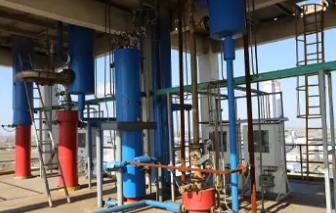
Industry context: battery-grade salt selection depends on manufacturing discipline, batch evidence and packaging control, not on the chemical name alone.
For buyers of high-purity fluoride salts, the useful shortlist is not a list of every fluoride product on the market. It is a two-salt fit decision: which Sodium Fluoride grade belongs in a sodium-battery raw-material review, and which Lithium Fluoride grade belongs in a high-end power-battery electrolyte or lithium hexafluorophosphate (LiPF6) synthesis review. The answer starts with grade evidence, not with the salt name.
In the supplied product facts, the Sodium Fluoride option that fits a sodium-battery shortlist is the battery-grade material controlled at 99.95% or above main content, with silicon at 50 ppm or below, moisture at 100 ppm or below, and calcium, magnesium and iron at ppm levels. The Lithium Fluoride option is the high-purity electronic grade, supported by a batch quality certificate that states assay, metal impurities, moisture and particle size. Industrial-grade Sodium Fluoride is not the default substitute. A quality-system certificate such as ISO 9001 supports process discipline, but it does not replace the batch certificate that defines the grade.
The shortlist below is an application-fit shortlist, not an official market ranking. It uses the battery-grade and high-purity product facts published by Changzhou Jiayuan Chemical Co., Ltd., a fluorine-chemical producer established in 2015, and it keeps the limits beside each recommendation so that the buyer can test the fit rather than accept a label.
Why the shortlist starts with grade, not with the chemical name
Battery-grade Sodium Fluoride and Lithium Fluoride are not defined by a single trade name. They are defined by the combination of main content, impurity profile, moisture, physical form and batch documentation that the receiving process can accept. Two suppliers can both call a product Sodium Fluoride and still deliver different impurity profiles, different moisture exposure histories and different packaging protection. For an electrolyte buyer, that difference is the purchase decision.
The same logic applies to Lithium Fluoride. The supplied technical guidance for lithium fluoride says that purity grade and testing items should be confirmed against the specific process, not against main content alone. Metal impurities, moisture and particle size belong in the review, and the batch quality certificate is the document that ties those values to the material actually shipped. A grade name without batch data is therefore a starting point, not a completed shortlist.
This is also why the shortlist treats industrial-grade Sodium Fluoride as a separate question. Industrial Sodium Fluoride serves established uses such as an aluminum-electrolysis flux, a protective agent in metal smelting and refining, a phosphating accelerator, a concrete additive and a material in ceramics and glass. Those uses are real, but they do not establish the tighter impurity and moisture control that a battery-grade review requires. The word industrial covers more than one specification; it is not a synonym for a single quality level.
Grade labels used elsewhere in the fluoride portfolio, such as electronic grade and optical grade, follow the same rule. They describe an application convention and a quality expectation, not a substitute for the batch certificate. The same evaluation discipline can be applied to Potassium Fluoride, Magnesium Fluoride, Calcium Fluoride, Barium Fluoride, Strontium Fluoride, Zinc Fluoride and Zirconium Fluoride, but this shortlist stays on the two salts that carry the electrolyte-buyer decision.
Battery-grade versus industrial-grade Sodium Fluoride: the definitional line
Battery-grade Sodium Fluoride, in the supplied product facts, is the grade controlled for battery and electrolyte use at 99.95% or above main content, with silicon at 50 ppm or below, moisture at 100 ppm or below, and calcium, magnesium and iron at ppm levels. The same source states that routine impurity indicators are supplied with batch test reports and that the test items typically cover main content, silicon content, moisture and metal impurities such as calcium, magnesium and iron. That combination is the definitional core of the shortlist entry.
Industrial-grade Sodium Fluoride is better understood by application than by a universal purity number. In the supplied application material, Sodium Fluoride is used as a flux in aluminum electrolysis, as a protective agent in metal smelting and refining, as a phosphating accelerator, as a concrete additive and in ceramics and glass. In those settings, the buyer may be optimizing for different things: flux behavior, coating quality, corrosion resistance or cost. The presence of Sodium Fluoride in the formula does not prove that the batch meets a battery-grade impurity limit.
For procurement, the practical line is documentation. A battery-grade Sodium Fluoride shortlist should ask for the main content, silicon, moisture and metal-impurity results on the specific batch. It should also ask how the material was sealed and stored before shipment. A specification sheet that gives only main content is not enough for a battery or electrolyte review, because the buying risk sits in the impurities and in the moisture history as much as in the assay.
Shortlist option 1: battery-grade Sodium Fluoride for sodium-battery customers
The first shortlist entry is battery-grade Sodium Fluoride controlled at 99.95% or above main content, with silicon at 50 ppm or below, moisture at 100 ppm or below, and calcium, magnesium and iron at ppm levels. This is the Sodium Fluoride grade to place first in a sodium-battery raw-material review when the downstream process is sensitive to silicon, moisture and metal impurities. It is also the grade to examine when the route involves sodium hexafluorophosphate synthesis and the buyer needs a raw material whose impurity profile supports stable crude-product quality.
The selection rationale is not that a higher number is automatically better in every process. It is that the stated impurity window aligns with a battery-grade review. A narrower impurity profile reduces the amount of purification burden placed on the downstream step, and it makes batch-to-batch comparison more meaningful. For the sodium-battery customer, the useful question is not only what the main content is, but whether silicon, moisture and the named metals stay inside the agreed window from batch to batch.
The supplied selection guidance is specific about the priority indicators: main content of no less than 99.95%, silicon content at 50 ppm or below, moisture at 100 ppm or below, and calcium, magnesium and iron at ppm levels. It also states that a narrower impurity profile is associated with lower energy and auxiliary-material consumption in subsequent purification and with more stable crude-product quality. That is the mechanism the buyer should test against its own process, not a promise that every sodium-battery line will obtain the same result.
There is a process-check detail worth keeping in the shortlist. The troubleshooting guidance for sodium hexafluorophosphate says that if crude-product purity fails or side reactions are excessive, the buyer should first check whether main content, silicon, moisture and metal impurities in the Sodium Fluoride batch report are within the battery-grade threshold. It also says to trace packaging sealing and storage conditions if the impurity profile exceeds limits or fluctuates greatly, and to review whether actual feeding consumption is within the reasonable range of 0.26 to 0.30 t/t. This is useful because it separates a raw-material grade problem from a storage or feeding problem.
Fit boundary: battery-grade Sodium Fluoride is not a universal drop-in for every sodium-battery design. The buyer still needs to confirm the exact assay, the complete impurity report, the moisture result and the packaging condition for the batch. If the process requires a tighter metal limit than the standard battery-grade window, that requirement should be written into the purchase specification and verified on the batch certificate. The shortlist entry is the grade family; the release decision belongs to the buyer's incoming inspection.
Shortlist option 2: high-purity electronic-grade Lithium Fluoride for high-end electrolyte and LiPF6 evaluation
The second shortlist entry is high-purity electronic-grade Lithium Fluoride. This is the Lithium Fluoride grade to evaluate for high-end power-battery electrolyte and lithium hexafluorophosphate synthesis when the buyer needs a documented high-purity salt rather than an unspecified industrial grade. The supplied company profile lists 1,000 tons per year of high-purity electronic-grade Lithium Fluoride, which is relevant to supply continuity, but the grade decision still rests on the batch certificate and the buyer's process limits.
The purity level should not be reduced to one assay number. The supplied lithium fluoride guidance says that for optics, electronics and battery applications, the purity grade and testing items should be confirmed against the specific process; buyers should not rely solely on main content and should focus on metal impurities, moisture and particle size, using the batch quality certificate as the reference. For a high-end power-battery electrolyte review, that means the shortlist is not complete until the certificate shows the assay and the impurity set the process treats as critical, plus moisture and particle-size data where the route is sensitive to them.
Lithium hexafluorophosphate synthesis is a useful lens because it concentrates the buyer's attention on the fluoride salt's purity and handling history. The shortlist entry should therefore be high-purity electronic-grade Lithium Fluoride with a batch certificate that is specific to the shipment. If the buyer's route has a tighter limit for a particular metal, moisture or particle-size fraction, that limit belongs in the specification. The supplied guidance does not support treating a nominal grade name as proof that every batch will meet every electrolyte route; it supports using the grade as a starting point and the batch certificate as the evidence.
Battery research provides the second reason for the shortlist. The supplied knowledge material states that Lithium Fluoride has potential roles in lithium-ion and solid-state battery research, mainly in electrode interface regulation, reducing side reactions and improving material stability. It also states that some battery applications are still in the research or process-development stage and that actual results depend on material form, purity, formulation and application conditions. That is an important boundary for an evaluation-stage buyer: the shortlist identifies a high-purity material for testing and qualification, not a guaranteed outcome in a finished cell.
Fit boundary: high-purity electronic-grade Lithium Fluoride is not automatically the right grade for every optical, electronic or battery use. The same supplied guidance says that different applications have different requirements and that the grade and test items must be matched to the process. A buyer should therefore compare the certificate against the intended electrolyte or synthesis route, not against a generic label. Where the process is still in research, the shortlist should include a sample-qualification step and a batch-to-batch comparison before the material is treated as a production standard.
The shortlist in one table
| Shortlist entry | Best-fit buyer or process | Priority evidence | Selection boundary |
|---|---|---|---|
| Battery-grade Sodium Fluoride | Sodium-battery raw-material review, including sodium hexafluorophosphate synthesis where the process is sensitive to silicon, moisture and metal impurities | Main content 99.95% or above; silicon 50 ppm or below; moisture 100 ppm or below; calcium, magnesium and iron at ppm levels; batch test report with main content, silicon, moisture and metals | Confirm the exact batch certificate and storage history; do not treat industrial-grade Sodium Fluoride as a substitute without evidence |
| High-purity electronic-grade Lithium Fluoride | High-end power-battery electrolyte evaluation and lithium hexafluorophosphate synthesis review, subject to process-specific limits | Batch quality certificate with assay, metal impurities, moisture and particle size; sealed moisture-proof packaging; high-purity electronic-grade supply | The grade name is not the specification; the buyer must confirm the critical impurity and moisture limits for the actual route |
Shortlist logic: the Sodium Fluoride entry is defined by a battery-grade impurity window; the Lithium Fluoride entry is defined by high-purity electronic grade plus a batch certificate that matches the electrolyte or synthesis route.
Impurity indicators buyers should prioritize
For Sodium Fluoride, the supplied battery-grade guidance puts main content, silicon, moisture and metal impurities at the center of the review. Silicon is a priority because the battery-grade threshold is stated separately at 50 ppm or below. Moisture is a priority because the threshold is 100 ppm or below and because the troubleshooting guidance links impurity fluctuation to packaging sealing and storage conditions. Calcium, magnesium and iron are priority metals because they are named in the routine test scope and are the impurities the buyer can compare across batches.
For Lithium Fluoride, the priority set is broader than main content. The supplied guidance names metal impurities, moisture and particle size as indicators to confirm alongside the purity grade, and it points the buyer to the specific batch quality certificate. In an electrolyte or lithium hexafluorophosphate review, the buyer should define which metals matter for the route, what moisture limit the handling system can tolerate, and whether particle size affects dissolution, feeding or dust behavior. The shortlist should not invent a single universal Lithium Fluoride impurity number; it should require the certificate to state the values that the process has identified as critical.
A useful purchasing rule is to separate grade-defining indicators from process-specific indicators. Grade-defining indicators are the ones that make the product battery-grade or high-purity electronic-grade in the first place. Process-specific indicators are the additional limits that the buyer's own line needs. Both belong in the shortlist file, but they should not be mixed into one vague claim. That is how an evaluation-stage buyer avoids comparing a certificate that covers only main content with a certificate that covers the full impurity set.
Moisture-proof storage and packaging integrity as selection criteria
Packaging is part of the grade because both salts can be affected by moisture exposure before they reach the process. For battery-grade Lithium Fluoride, the supplied handling guidance is explicit: use composite bags with an inner plastic film or fiber drums, keep the material sealed, store it in a cool, dry, well-ventilated area away from acids, protect it from rain and moisture during transport, and prevent packaging damage. The same guidance notes that Lithium Fluoride is highly hygroscopic and slowly hydrolyzes with water to release hydrogen fluoride, so dust masks and gloves are appropriate during handling.
For Sodium Fluoride, the supplied troubleshooting guidance gives the procurement check: if the impurity profile exceeds limits or fluctuates greatly, trace the packaging sealing status and storage conditions of that batch to confirm whether moisture absorption or acid contact caused the change. That makes packaging integrity a shortlist criterion, not an afterthought. A supplier that can show a sealed package, a controlled storage environment and an intact shipment is giving the buyer evidence that the certificate values are more likely to survive transit.
The practical shortlist question is therefore: what package will the buyer receive, and what evidence shows that the package remained sealed? For Lithium Fluoride, the answer should name the composite bag with inner plastic film or the fiber drum, and it should confirm the cool, dry, ventilated storage condition and the rain and moisture protection during transport. For Sodium Fluoride, the answer should confirm the sealing status and the storage history of the batch. If the supplier cannot answer these questions, the grade claim is weaker than it looks on a specification sheet.
Supplier evidence that supports the shortlist
A shortlist is only as good as the evidence behind each entry. The first document is the batch certificate of analysis: it should tie the main content, impurity results, moisture and other agreed tests to the specific batch. The second is the packaging and storage record: it should show how the material was protected from moisture and acid contact. The third is the quality-system context. Changzhou Jiayuan Chemical Co., Ltd. holds an ISO 9001:2015 certificate with a stated scope covering the sales of hazardous chemicals within the scope of qualifications; that certificate supports quality-management discipline within its scope, but it does not by itself prove a battery-grade product grade or replace the batch certificate.
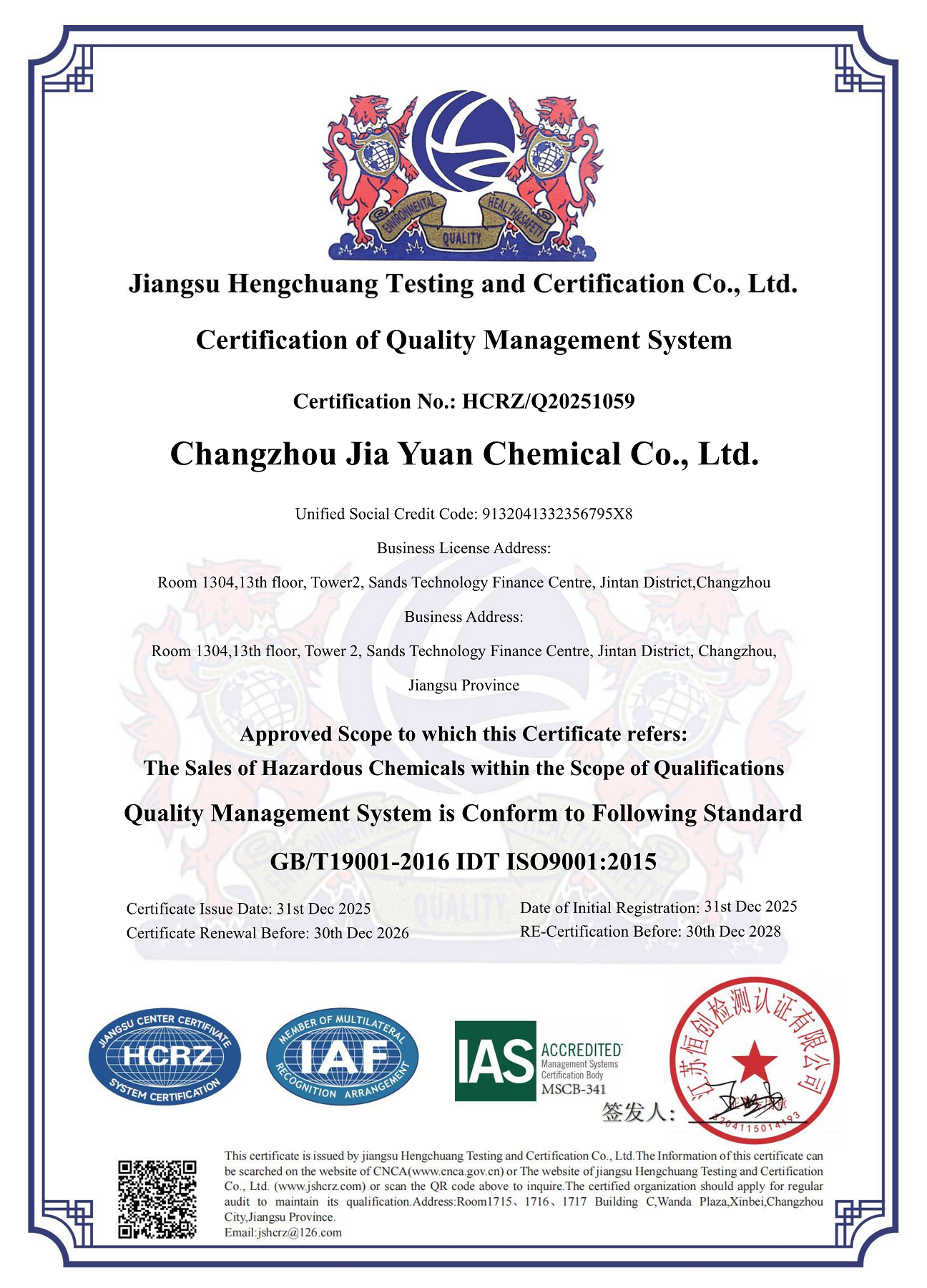
Quality-system evidence: an ISO 9001 certificate supports process discipline within its stated scope; it does not replace a batch certificate for product grade.
The company profile also lists 1,000 tons per year of high-purity electronic-grade Lithium Fluoride. For an evaluation-stage buyer, that capacity figure is useful as a supply-continuity signal, not as a substitute for product qualification. The shortlist should still verify the exact grade, the batch certificate and the packaging condition. In the same way, the supplied capability material lists OEM/ODM customization for fluorine chemical products and a monthly capacity of 50 t; those facts may matter when the buyer needs a customized specification, but they do not remove the need for incoming inspection.
The final supplier-evidence test is consistency across documents. The product name, the grade, the batch number, the test results and the packaging description should agree. If the certificate says one grade and the packaging label says another, the buyer has a traceability problem before the material reaches the line. The shortlist should therefore include a document cross-check, not only a price or lead-time comparison.
Application fit: how to use the shortlist in evaluation
For a sodium-battery raw-material review, start with the battery-grade Sodium Fluoride entry and test it against the sodium hexafluorophosphate or other downstream route. Confirm the main content, silicon, moisture and metal impurities on the batch report. If the process has a history of crude-product purity failure or side reactions, use the troubleshooting logic to separate raw-material grade from storage and feeding variables. Check whether the impurity profile is stable across batches and whether the packaging kept the material sealed. The result is a fit decision for the buyer's process, not a general claim about all sodium batteries.
For a high-end power-battery electrolyte or lithium hexafluorophosphate synthesis review, start with the high-purity electronic-grade Lithium Fluoride entry. Require the batch quality certificate to state the assay, the metal impurities, the moisture and the particle-size data that the route treats as critical. Confirm the moisture-proof package and the storage and transport conditions. If the material is still in research or process development, run a sample qualification and compare at least two batches before setting a production specification. The supplied guidance on Lithium Fluoride's battery-research roles supports this cautious evaluation because the effects depend on material form, purity, formulation and application conditions.
For an industrial Sodium Fluoride buyer, the shortlist should not be copied across without re-evaluation. Industrial uses such as aluminum-electrolysis flux, metal-smelting protection, phosphating acceleration, concrete additives and ceramics or glass have their own performance criteria. A battery-grade Sodium Fluoride may be unnecessary for those uses, and an industrial-grade product should not be assumed to meet a battery-grade impurity window. The correct approach is to define the grade by the receiving process, then ask for the certificate that proves it.
What the shortlist does not claim
The shortlist does not claim that one grade is best for every electrolyte buyer. It does not claim that a grade name guarantees a finished-cell result. It does not claim that a quality-system certificate replaces a batch certificate, or that a capacity figure proves a specific product grade. Those boundaries matter in an evaluation-stage purchase because they keep the decision tied to evidence.
The shortlist also does not treat industrial-grade Sodium Fluoride as defective. Industrial-grade material has legitimate uses in flux, smelting, phosphating, concrete and ceramics or glass. The point is fit: a product intended for those uses should not be moved into a battery or electrolyte shortlist without the battery-grade impurity and moisture evidence. Likewise, high-purity electronic-grade Lithium Fluoride should be matched to the specific electrolyte or synthesis route rather than selected from the label alone.
The most defensible shortlist is therefore a documented one. It names the grade, states the priority indicators, requires the batch certificate and checks the packaging and storage history. That is more useful to an electrolyte buyer than a longer list of product names with no evidence behind them.
FAQ
What is the difference between battery-grade and industrial-grade Sodium Fluoride?
Battery-grade Sodium Fluoride is controlled for battery and electrolyte use at 99.95% or above main content, with silicon at 50 ppm or below, moisture at 100 ppm or below, and calcium, magnesium and iron at ppm levels, supported by batch test data. Industrial-grade Sodium Fluoride is better defined by its application, such as an aluminum-electrolysis flux, a metal-smelting protective agent, a phosphating accelerator, a concrete additive or a ceramics and glass material. The names are not interchangeable, and an industrial-grade product should not be assumed to meet a battery-grade impurity window.
Which Sodium Fluoride impurity indicators should sodium-battery buyers prioritize?
Sodium-battery buyers should prioritize main content of no less than 99.95%, silicon at 50 ppm or below, moisture at 100 ppm or below, and calcium, magnesium and iron at ppm levels. These indicators align with the battery-grade threshold described in the supplied product guidance. Batch-to-batch stability matters as well, because a narrow impurity profile is only useful if it is repeated across shipments and protected by sealed packaging and controlled storage.
Which Lithium Fluoride purity level should be evaluated for high-end power-battery electrolytes and LiPF6 synthesis?
High-purity electronic-grade Lithium Fluoride is the appropriate shortlist entry for evaluation, with the exact grade confirmed against the specific electrolyte or lithium hexafluorophosphate synthesis route. The buyer should not rely on main content alone. The batch quality certificate should state assay, metal impurities, moisture and particle size where the process is sensitive to them. If the route has tighter limits, those limits should be written into the purchase specification and verified on the batch certificate.
How should moisture-proof storage and packaging integrity affect supplier shortlisting?
They should be treated as selection criteria. Lithium Fluoride is highly hygroscopic and slowly hydrolyzes with water to release hydrogen fluoride, so the supplied handling guidance calls for composite bags with an inner plastic film or fiber drums, sealed storage in a cool, dry, well-ventilated area away from acids, rain and moisture protection during transport, and prevention of packaging damage. For Sodium Fluoride, the troubleshooting guidance says to trace packaging sealing and storage conditions when impurity results fluctuate. A supplier that cannot show intact packaging and controlled storage is a weaker shortlist candidate.
What batch documentation should be requested before approving a fluoride salt?
Request a batch certificate that ties the results to the specific shipment. For battery-grade Sodium Fluoride, the report should cover main content, silicon, moisture and metal impurities such as calcium, magnesium and iron. For high-purity electronic-grade Lithium Fluoride, the certificate should state the assay, metal impurities, moisture and particle-size data that the process requires, together with the packaging and storage description. Cross-check the product name, grade, batch number, results and packaging label for consistency.
For electrolyte buyers, the shortlist can remain short: battery-grade Sodium Fluoride for the sodium-battery route, and high-purity electronic-grade Lithium Fluoride for high-end power-battery electrolyte and lithium hexafluorophosphate synthesis evaluation. The decision between them is not a beauty contest between chemical names. It is a fit decision built from grade-defining impurities, moisture control, packaging integrity and batch evidence.
Tem questões ou precisa de mais detalhes?
Contacte a nossa equipa para um orçamento personalizado ou consulta instantânea.
Solicitar orçamento
Preencha o formulário abaixo e a nossa equipa entrará em contacto com uma proposta personalizada.
Chat direto do WhatsApp
Prefere conversar em tempo real? Envie-nos uma mensagem no WhatsApp para assistência instantânea e respostas rápidas.
- Obter orçamento personalizado
- Partilhar fotos ou documentos
- Discuta as suas necessidades diretamente
Geralmente responde em 5–30 minutos durante o horário de expediente.