
Battery-Grade Sodium Fluoride and Lithium Fluoride: Supplier Capability Evidence to Request
Battery-Grade Sodium Fluoride and Lithium Fluoride: Supplier Capability Evidence to Request

Supplier capability for battery-grade fluoride salts is built on batch-level evidence, not a grade label alone.
Battery-grade sodium fluoride and lithium fluoride are not proven by a grade label. A buyer evaluating a supplier should ask for evidence that connects the exact batch to the impurity, moisture and packaging controls that matter downstream. For lithium fluoride, that connection runs into the lithium hexafluorophosphate electrolyte route and its process-validation risk. For sodium fluoride, it runs into the sodium hexafluorophosphate route and the selection of indicators that actually predict batch behaviour.
This article sets out the capability evidence a buyer should request: batch records, routine impurity test data, moisture-proof packaging checks, and the handling procedure for damaged or damp packaging. The aim is not to replace supplier claims with suspicion. It is to replace general claims with reviewable evidence.
Why the grade label is the start, not the evidence
A battery-grade claim is a commercial description. It tells the buyer that the supplier intends the material for a battery-related use. It does not, by itself, show the impurity profile of the batch on the loading dock, the condition of the inner packaging, or how a deviation was handled. That is why a capability review should move from the product name to the batch record.
Lithium fluoride is a clear example. In the electrolyte chain, lithium hexafluorophosphate is the dominant electrolyte salt in lithium-ion battery electrolytes and directly determines ionic conductivity and the electrochemical window. Its impurity profile carries over into the electrolyte. Poor impurity control in raw lithium fluoride broadens the lithium hexafluorophosphate impurity profile, accelerating cathode interface side reactions during cell formation and cycling. The visible consequences can include faster capacity fade or high-temperature gassing.
Moisture adds a second route to the same problem. Lithium fluoride is hygroscopic and slowly hydrolyzes with water to form hydrogen fluoride. That worsens moisture and impurity levels and affects fluorination conversion and finished electrolyte salt purity and colour. A damp or damaged package is therefore not only a housekeeping issue. It is a potential raw-material quality event.
Sodium fluoride has a different route but a similar evidence logic. In the sodium hexafluorophosphate route, the sodium fluoride batch report is one of the first places to investigate when crude sodium hexafluorophosphate purity fails or side reactions are excessive. The supplied troubleshooting guidance points to main content, silicon content, moisture and metal impurity indicators. It also asks the buyer to review actual feeding consumption against a reasonable range of 0.26 to 0.30 t/t.
A supplied risk note makes the grade-label problem explicit. It distinguishes conventional industrial-grade sodium fluoride, with main content often between 93% and 98%, from high-specification material that can reach 99.95% purity, and it warns that some industrial products may carry iron above 50 ppm. It also warns that industrial grade mislabeled as battery grade can amplify impurities and shorten battery life. The buyer does not need a slogan. The buyer needs the batch data.
Batch records: the traceability layer
Request the batch record before the certificate of analysis becomes the only document in the review file. A batch record should allow the buyer to connect the material to its production and release history. The exact format varies by supplier, but the review should cover the unique batch or lot number, quantity, production date, production line or campaign, raw-material lots, packaging lot, specification version, release status, and the link to the batch certificate of analysis.
The buyer should also ask for deviation, out-of-specification and reprocessing records. For moisture-sensitive lithium fluoride, any re-drying or reprocessing record should be identifiable. If the supplier cannot show whether a batch was reworked, the buyer cannot judge whether the material in the package is the same material that was originally released. These records do not prove downstream performance. They establish traceability, which is the minimum condition for a serious capability review.
The supplied case record describes a high-purity fluoride salt running at the customer without production-line downtime or process-parameter drift caused by raw-material batch differences. That is the outcome buyers are trying to protect. It is a case description, not a guarantee for every line. The evidence request should therefore ask which batch controls supported that stability and whether the same controls apply to the grade being purchased.
Routine impurity data: request the profile that matches the failure mode
A certificate of analysis that reports only main content is not enough for a battery-grade review. The buyer should request the routine impurity profile for the actual batch, with the test methods and detection limits used. The relevant indicators should be chosen from the downstream risk, not from a generic product data sheet.
| Material | Indicators to request | Why they matter |
|---|---|---|
| Sodium fluoride, battery-grade review | Main content, silicon, moisture, metal impurities including iron, cobalt, chromium, titanium, copper, manganese, nickel and vanadium, plus loss on ignition | The supplied risk-control reference gives a working verification target of main content at 99.95% or above, silicon at 50 ppm or below, and moisture at 100 ppm or below. Loss on ignition reflects moisture and volatile matter; large batch differences can destabilise active ingredients and affect formula consistency. |
| Lithium fluoride, battery-grade review | Moisture and metal impurities, including iron, calcium, magnesium, sodium and potassium | Excessive metal impurities can degrade cell performance. Moisture drives hydrolysis to hydrogen fluoride and worsens impurity levels, fluorination conversion and finished electrolyte salt purity and colour. |
| High-purity sodium fluoride example | Specification limits versus actual batch results | One supplied high-purity sodium fluoride data set states that cobalt, chromium, titanium, copper, manganese, nickel and vanadium are controlled below 5 ppm, with iron within 10 ppm. Actual test results in the cited material showed those metals below 1 ppm and iron at 6.2 ppm. Buyers should read specification and actual result separately. |
For sodium fluoride, the buyer should not accept a single assay value as a proxy for the whole profile. The battery-grade risk record links impurity amplification to shortened cycle life or increased gas generation. It also notes that large batch fluctuations raise hidden testing costs. For lithium fluoride, the buyer should ask which metal impurities the routine certificate covers and whether the certificate represents the batch being shipped. The risk record names iron, calcium, magnesium, sodium and potassium as relevant metal impurities.
The review should also separate a technical specification from a batch result. A specification can say that a metal is controlled below a limit. A batch result shows what was measured on that batch. The buyer needs both, and the certificate should make clear which is which. If the supplier reports only a pass or fail without the measured value, the buyer cannot see drift before a failure occurs.
Moisture-proof packaging checks: documentary and physical evidence
Moisture-proof packaging is a quality control, not a shipping detail. For lithium fluoride, the supplied storage and transport guidance calls for composite bags with an inner plastic film or fibre drums, kept sealed. The product should be stored in a cool, dry, well-ventilated area away from acids. During transport, rain and moisture protection should be strictly implemented, and packaging damage should be prevented.
For sodium fluoride, the risk-control guidance calls for composite bags with plastic liners or fibre drums for sealed moisture-proof packaging. It also requires cool, dry storage separated from acids. These are not interchangeable packaging instructions for every product, but they show the same principle: the packaging system should match the moisture sensitivity of the grade.
At receipt, the buyer should check that the packaging specification matches the order, that the inner liner and seals are intact, that the outer bag or drum is not torn or deformed, and that the batch label matches the certificate and quantity. Transport and storage records should be available where moisture exposure is a risk. A visual check cannot prove the absence of moisture, but a damaged package is a clear reason to isolate and test before production use.
Damaged or damp packaging: isolate, test and disposition
A damaged or damp package should be treated as a quality event. The supplied lithium fluoride procedure is explicit. First, isolate the damaged goods immediately and inspect the extent of packaging damage and product dampness. Second, send the affected batch for testing, focusing on moisture and metal impurity levels to confirm hydrolysis and contamination. Third, if the material is severely damp or impurities exceed limits, scrap or downgrade the product; if it is slightly damp, re-dry according to process requirements. Fourth, trace transport and storage records and strengthen sealing and moisture protection for subsequent composite bags with inner plastic film.
The safety dimension should not be separated from the quality decision. Lithium fluoride is highly hygroscopic and slowly hydrolyzes with water to release hydrogen fluoride. Dust masks and gloves are required during handling to avoid dust inhalation and direct skin contact. A damp package therefore raises both a quality question and a handling question.
For sodium fluoride, the risk record identifies moisture absorption and acid contact as triggers for hydrogen fluoride release. A damaged package should be segregated and evaluated against the grade specification before use. The lithium fluoride re-drying step should not be assumed to apply unchanged to sodium fluoride. Disposition should follow the product specification, the supplier's instructions and the buyer's process validation requirements.
Lithium fluoride process validation: where the evidence shows up
Process-validation underperformance is often an impurity and moisture story before it is a process story. The supplied lithium hexafluorophosphate guidance explains the chain. Lithium hexafluorophosphate is the dominant electrolyte salt and directly determines ionic conductivity and the electrochemical window. Its impurity profile carries over into the electrolyte. Poor impurity control in raw lithium fluoride broadens that profile, accelerating cathode interface side reactions during cell formation and cycling.
This is why a lithium fluoride capability review should ask for more than a purity number. Request the batch moisture result, the metal impurity profile, the packaging integrity record and any deviation or re-drying record. Ask whether the certificate covers the impurities linked to electrolyte performance. Ask how the supplier trended those results across recent batches. A single passing batch is useful. A trend is more useful for judging whether the material is under control.
The buyer should also keep the limits of the evidence in view. A batch certificate does not by itself prove that a downstream electrolyte or cell will meet a performance target. It can show that the raw material was tested against defined limits. The link to process validation is a risk-management link, not a performance guarantee.
Sodium fluoride indicator selection: choose by route, not by habit
For sodium fluoride, the right indicator set depends on the downstream route. In the sodium hexafluorophosphate route, the supplied troubleshooting guidance says to check the main content, silicon content, moisture and metal impurity indicators in the sodium fluoride batch test report against the battery-grade threshold. If the impurity profile exceeds limits or fluctuates greatly, the buyer should trace the packaging sealing status and storage conditions of that batch to confirm whether moisture absorption or acid contact caused a performance change.
Feeding consumption is a separate check. The same guidance asks the buyer to review whether actual feeding consumption is within a reasonable range of 0.26 to 0.30 t/t. That figure is a process indicator, not a raw-material specification. It helps the buyer distinguish a raw-material problem from a process problem. If consumption is outside the range, the batch report alone may not explain the result.
The high-purity sodium fluoride example in the table shows why indicator selection should be explicit. A specification limit and an actual test result are different evidence. The buyer should ask for both, and should ask which metals are covered by the routine test rather than assuming that a purity number covers them all. The same logic applies to loss on ignition: it reflects moisture and volatile matter, and large batch differences can affect formula consistency. A sodium fluoride review that ignores loss on ignition may miss a source of batch-to-batch variation.
What a supplier capability file should contain
A practical capability file should be small enough to review and specific enough to audit. It should contain the batch genealogy and release record, the batch-specific certificate of analysis with the full impurity profile and test methods, the packaging specification and seal or integrity check record, the transport and storage record for moisture-sensitive grades, the deviation and rework record, and the quality management certificate with its exact scope.
The file should also distinguish what each document proves. A batch record proves traceability. A certificate of analysis proves that selected tests were reported for a batch. A packaging record proves that a packaging control was applied. A quality management certificate proves that a system exists within a defined scope. None of these documents alone proves downstream performance. Together, they give the buyer a basis for a decision.
Where Changzhou Jiayuan Chemical fits as an example
Changzhou Jiayuan Chemical Co., Ltd. is an example of a supplier whose public capability data can be mapped to this evidence framework. The company was established in 2015 and operates as an integrated industrial and trading enterprise focused on fluorine chemistry research and development, novel fluorine-containing materials and international trade. Its capability unit lists OEM and ODM customisation for fluorine chemical products with a monthly capacity of 50 t.
Its supply profile lists 1,000 t/y each of high-purity electronic-grade potassium fluoride, magnesium fluoride and lithium fluoride, and 600 t/y of toothpaste-grade sodium fluoride. These capacity figures establish supply scope. They do not establish batch conformity for a specific battery-grade order. A buyer should still request the grade-specific batch record, certificate of analysis and packaging records for the material being purchased.
The company holds a quality management system certificate under GB/T19001-2016 IDT ISO9001:2015, certificate number HCRZ/Q20251059, issued by Jiangsu Hengchuang Testing and Certification Co., Ltd. for the period 2025-12-31 to 2028-12-30. The stated scope is the sales of hazardous chemicals within the scope of qualifications. This is useful evidence of a quality management system in that scope. It is not a substitute for a batch-specific impurity profile.
The supplied case record describes stable operation at a customer without production-line downtime or process-parameter drift caused by raw-material batch differences. That case description is relevant to the evidence question, but it should be read as a case description, not as a universal performance guarantee. The buyer's own validation and batch review remain necessary.
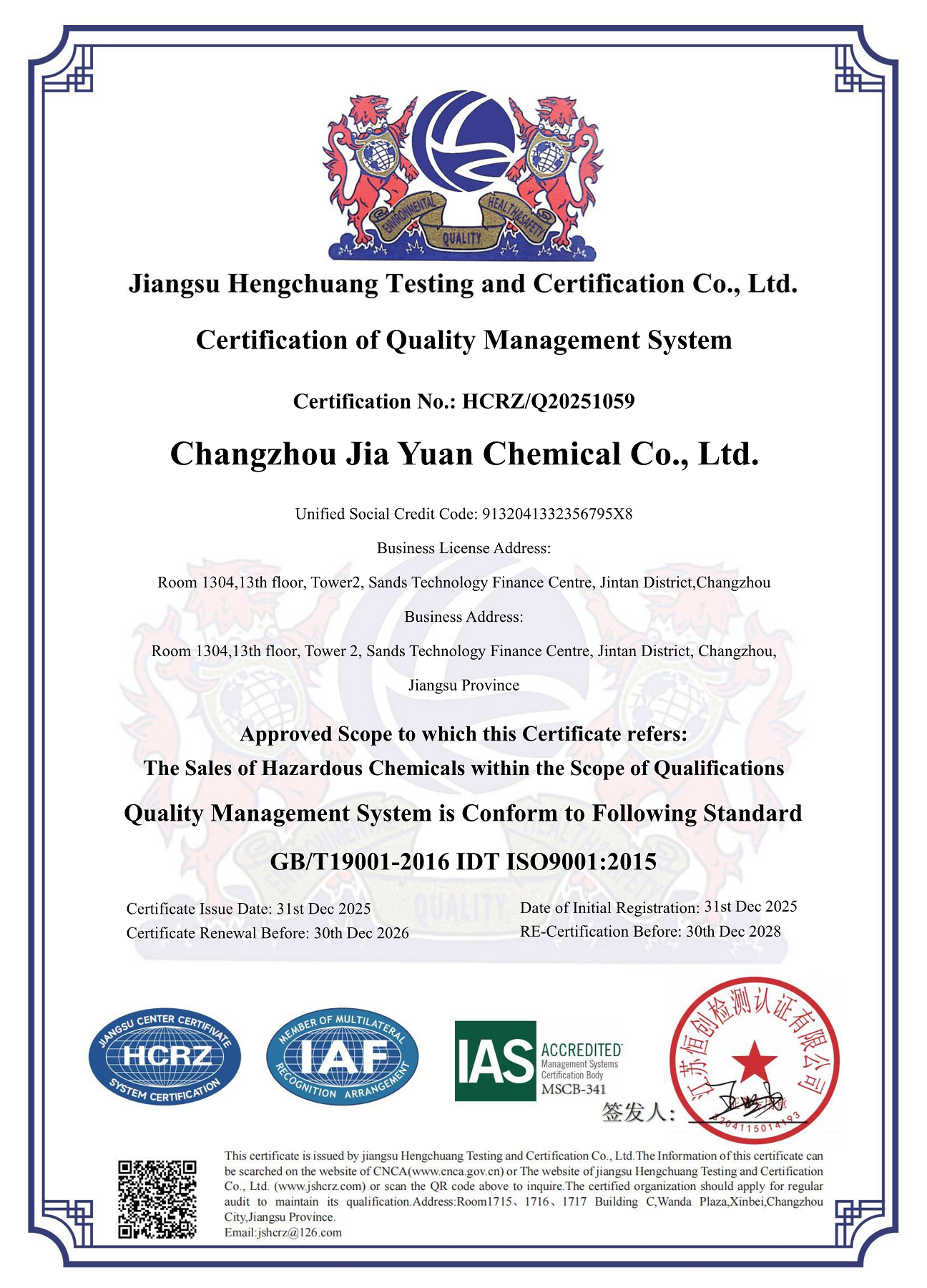
The ISO 9001 certificate supports the quality management system scope; it does not replace batch-level impurity data.
What changes as validation moves closer to production
As a buyer moves from sample evaluation to production validation, the evidence request should become more batch-specific. A sample certificate can answer whether a grade exists. A production capability file should answer whether the batch on order was made, tested, packaged and released under controls that the buyer can review. That shift is not a market forecast. It is a practical change in the procurement question.
The supplier that can answer with batch records, full impurity data, packaging evidence and a clear damaged-cargo procedure is easier to validate than the supplier that answers with a grade label. The buyer does not need a promise that no batch will ever vary. The buyer needs to see how variation is measured, documented and controlled.
FAQ
What batch records should a buyer request for battery-grade sodium fluoride and lithium fluoride?
Request the unique batch number and quantity, production date and line, raw-material lots, packaging lot, specification version, release status and the link to the batch certificate of analysis. Ask for deviation, out-of-specification and re-drying records where applicable. These records establish traceability and show whether the batch was changed after release.
Which sodium fluoride indicators matter when sodium hexafluorophosphate purity fails?
Check the sodium fluoride batch report for main content, silicon content, moisture and metal impurities against the battery-grade threshold. If the impurity profile exceeds limits or fluctuates greatly, trace the packaging sealing and storage conditions of that batch to see whether moisture absorption or acid contact caused a change. Also review actual feeding consumption against the reasonable range of 0.26 to 0.30 t/t.
What happens if lithium fluoride packaging is damaged or damp?
Isolate the damaged goods and inspect the extent of packaging damage and product dampness. Test the affected batch for moisture and metal impurities to confirm hydrolysis and contamination. If severely damp or out of specification, scrap or downgrade the material; if slightly damp, re-dry according to process requirements. Trace transport and storage records, then strengthen sealing and moisture protection for subsequent composite bags with inner plastic film.
How should battery-grade lithium fluoride be stored and transported?
Use composite bags with an inner plastic film or fibre drums, kept sealed. Store in a cool, dry, well-ventilated area away from acids. Protect from rain and moisture during transport and prevent packaging damage. Lithium fluoride is highly hygroscopic and slowly hydrolyzes with water to release hydrogen fluoride, so dust masks and gloves are required during handling.
Does ISO 9001 certification replace batch-level impurity data?
No. The supplied certificate covers the sales of hazardous chemicals within the scope of qualifications under GB/T19001-2016 IDT ISO9001:2015. It supports the existence of a quality management system in that scope. It does not show the impurity profile of a specific sodium fluoride or lithium fluoride batch. Buyers should still request the batch certificate of analysis and batch record for the grade being purchased.
Tem questões ou precisa de mais detalhes?
Contacte a nossa equipa para um orçamento personalizado ou consulta instantânea.
Solicitar orçamento
Preencha o formulário abaixo e a nossa equipa entrará em contacto com uma proposta personalizada.
Chat direto do WhatsApp
Prefere conversar em tempo real? Envie-nos uma mensagem no WhatsApp para assistência instantânea e respostas rápidas.
- Obter orçamento personalizado
- Partilhar fotos ou documentos
- Discuta as suas necessidades diretamente
Geralmente responde em 5–30 minutos durante o horário de expediente.