
Battery vs Manual vs Hydraulic Combi Tools: Buyer Comparison
Rescue combi tools are no longer a single procurement category. A combi tool can cut, spread, squeeze and pull, but the way it is powered changes portability, deployment steps and the conditions in which it makes sense. For buyers evaluating combi tools for fire, vehicle extrication, earthquake response or mine rescue, the practical choice is often between a battery combi tool, a manual combi tool and a hydraulic combi tool.
This comparison is written for evaluation-to-execution stage buyers. It uses published product data from Ode Hydraulic & Electric Rescue Tools, the rescue-tool line of ODE Technology Co., Ltd., a Zhejiang, China-based manufacturer founded in 2010 with a 110,000 m² factory. The aim is not to declare a universal winner. It is to show where each format fits, what power dependency it creates, and which checks should be completed before an order is placed.

The short answer: format follows the rescue profile
No single format is automatically better. A battery combi tool is the most self-contained of the three when the task requires fast deployment without hoses. A manual combi tool is the least power-dependent but relies on operator effort. A hydraulic combi tool can deliver high force from an external pump, but the pump and hoses become part of the system the buyer must plan, carry and maintain.
The right choice depends on the rescue profile: access distance, availability of charging or fuel, number of tools on scene, operator strength and the required cutting and spreading envelope.
| Format | Power dependency | Representative ODE data | Best-fit condition | Main boundary |
|---|---|---|---|---|
| Battery combi tool | Rechargeable battery; charger and spare batteries | SC370-E: 28V 5Ah, 940 kN cutting force, 18.5 kg | Rapid single-operator deployment without hose routing | Battery logistics; runtime under load must be verified |
| Manual combi tool | Human handle force; no battery or engine in the listed model | GYJK-33~36/25(10): 270 kN cutting force, 9.5 kg | Remote or backup work where resupply is uncertain | Operator fatigue; lower listed cutting force |
| Hydraulic combi tool | External pump and hoses; pump can be manual, engine or battery powered | SC370-L: 72 MPa, 940 kN cutting force, 13.5 kg tool | Sustained or multi-tool scenes with a pump on scene | Hose routing; pump weight and setup |
Why the format decision matters more than the label
A combi tool combines cutting, spreading, squeezing and pulling functions in one body. That multifunction design is useful in rescue, but it also means buyers cannot compare tools by model name alone. The power architecture changes the complete deployment load: battery tools carry energy in the tool and spare batteries; manual tools carry energy in the operator; hydraulic tools carry energy in a separate pump and hose set.
The market context supports a more structured comparison. Dataintelo's 2026 commercial research report estimates the global hydraulic rescue tools market at USD 1.8 billion in 2025 and projects USD 3.1 billion by 2034. The same report estimates that cutters held 31.4% of product-type share in 2025 and that the top five players held 52% to 58% of global revenue. These figures describe a concentrated but still competitive market. For buyers, they reinforce the need to compare the actual tool architecture, documentation and system weight rather than rely on brand familiarity alone.
Standards add another layer. EN 13204:2016 specifies safety and performance requirements for double-acting hydraulic rescue tools. DIN lists EN 13204:2025 as a newer edition titled Powered rescue tools for fire and rescue service use. NFPA 1936, 2020 edition, is the North American rescue tool standard and includes requirements for permanent labeling. Buyers should confirm which edition applies to the destination market and request product-specific conformity evidence rather than assuming that a standard reference covers every model in a catalog.
Battery combi tool: self-contained, but not energy-free
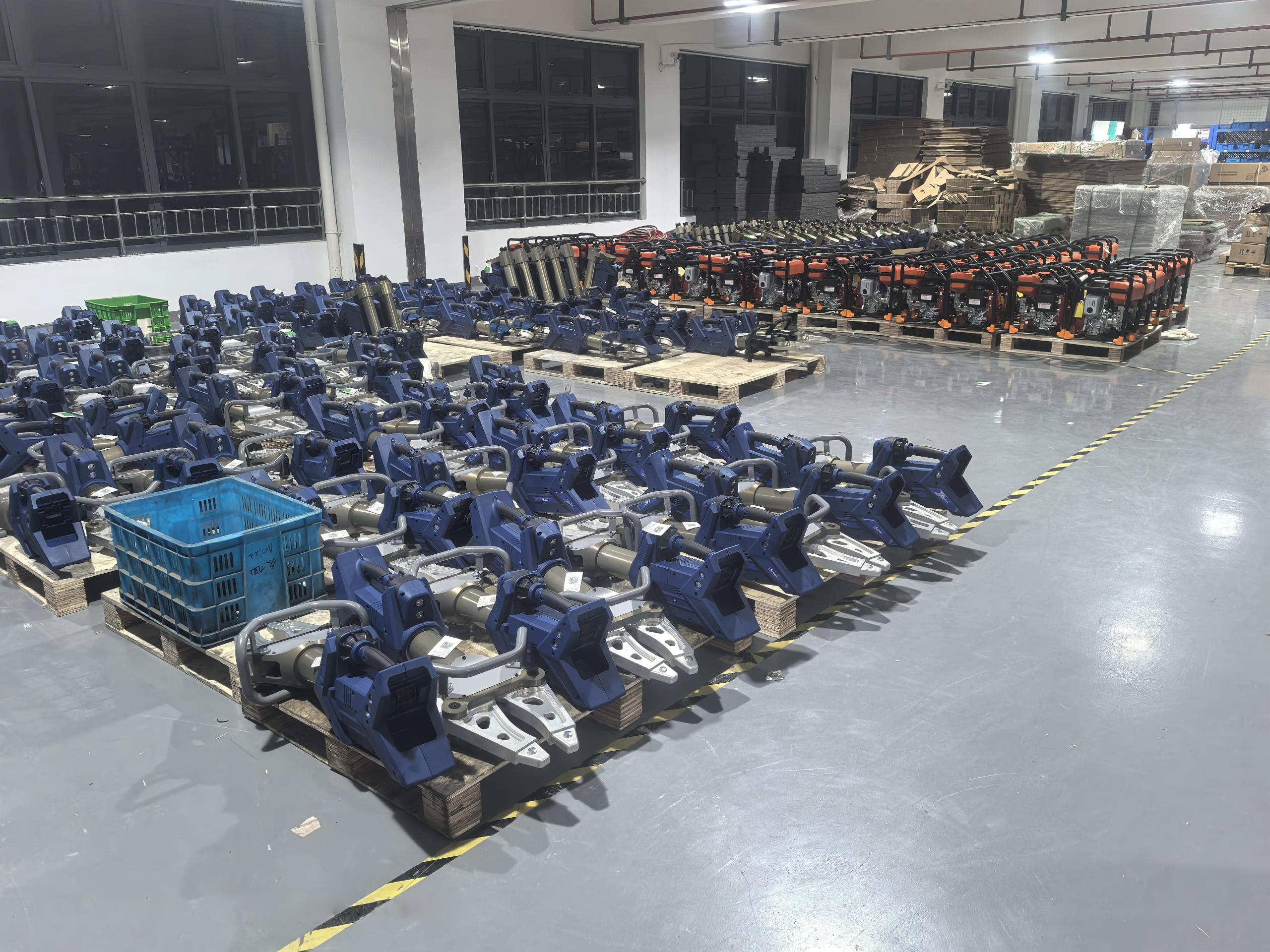
A battery combi tool integrates a battery, motor, pump and hydraulic cylinder in one tool body. In ODE's range, the SC370-E uses a DC 28V 5Ah battery and is listed as EN13204 approved. It has a rated working pressure of 720 bar, maximum cutting force of 940 kN, cutting capacity for Φ38 mm Q235 round steel and 20 mm Q235 steel plate, maximum spreading force of 45-145 kN, maximum spreading distance of 390 mm, maximum squeezing force of at least 153 kN, pulling force of 95 kN and pulling distance of 300 mm. Net weight is 18.5 kg; each unit is supplied with two batteries, one charger and one belt.
The SC357-E is a second battery combi tool in the range. It uses a DC 28V 5Ah battery, rated pressure 720 bar, maximum cutting force 800 kN, cutting capacity Φ32 mm Q235 round steel and 8 mm Q235 steel plate, spreading force 45-90 kN, spreading distance 380 mm, cutting opening 280 mm, squeezing force at least 68 kN, pulling force 83 kN and pulling distance 290 mm. Its net weight is 18.5 kg excluding battery.
The BC-300A is a smaller 18V battery combi tool. Its published data includes a cutting force of at least 313.8 kN, maximum spreading distance of at least 306 mm, jaw opening of at least 200 mm, cutting capacity of at least Φ25 mm rebar and 10 mm Q235 steel plate, net weight of 14.1 kg excluding battery, and operating endurance of at least 50 effective cycles per full charge.
The main operational advantage is that the tool does not need a separate pump or hose on the tool side. ODE describes its electric-hydraulic rescue range as an integrated hose-free design intended for single-person deployment. That does not remove power dependency; it moves the dependency into battery state, charging logistics and spare battery management. Buyers should request runtime-under-load and duty-cycle data if those figures are not published for the exact model.
Battery combi tools are suitable where teams need to move quickly between access points, where hose routing would slow entry, or where a pump cannot be placed close to the work area. They are less attractive when charging infrastructure is absent for long periods and the task profile requires continuous high-force cycles; in that case, the buyer must plan additional batteries or combine formats.
The published product data states battery type and capacity but not runtime under load for SC370-E or SC357-E. That is a procurement gap, not a performance conclusion. Buyers should ask for the test basis behind endurance claims and confirm that the battery and charger package matches the intended deployment cycle.
Manual combi tool: the least power-dependent format
A manual combi tool uses human force to operate the hydraulic action. It is the least dependent on external energy. ODE's Manual Combi Tool GYJK-33~36/25(10) lists a maximum working pressure of 70 MPa, maximum cutting force of 270 kN, maximum spreading distance of 275 mm, maximum cutting opening of 210 mm, cutting capacity for Φ25 mm round steel and 12 mm steel plate, maximum handle force of no more than 300 N, and machine weight of 9.5 kg. It is listed for fire rescue and mine rescue.
At 9.5 kg, the tool itself is lighter than the SC370-E battery combi tool and the SC370-L hydraulic combi tool. It does not require a battery, charger, fuel or external pump in the published configuration. That makes it relevant for remote, confined or secondary operations where resupply is uncertain.
The dependency is operator effort. The maximum handle force is ≤300 N, and the rated cutting force is 270 kN in the listed model. Buyers comparing it with battery or hydraulic combi tools should not assume equal cutting force; the published figures show a lower maximum cutting force for this manual model than the 800 kN and 940 kN battery models and 940 kN hydraulic model cited above.
Manual combi tools are relevant where the task is intermittent, access is difficult, or the team needs a backup that does not compete for batteries or fuel. They are less suitable when the task requires repeated high-force cutting or when operator fatigue must be minimized.
The manual format shifts energy demand to the operator. That is a real boundary in long or multi-casualty operations, and it should be tested in training rather than assumed from the tool weight alone.
Hydraulic combi tool: high force with system-level dependencies
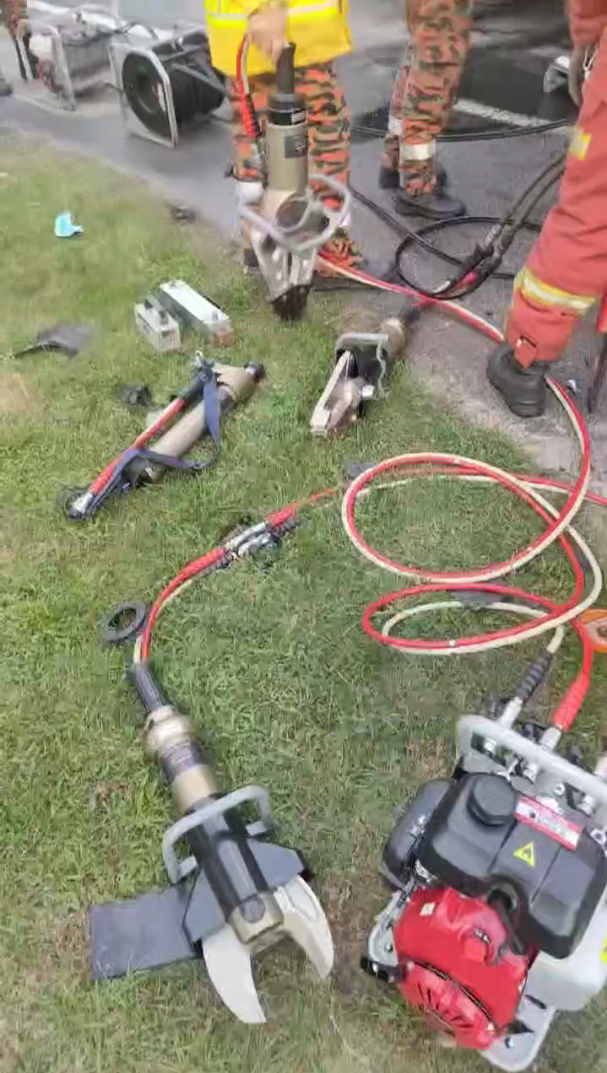
A hydraulic combi tool is powered by an external hydraulic pump through hoses. In ODE's range, the SC370-L hydraulic cutter and spreader is listed as a combi tool with rated working pressure 72 MPa, maximum cutting force 940 kN, cutting diameter Ø38 mm round bar or 12 mm Q235, spreading force 50 kN, spreading distance 390 mm, squeezing force 180 kN, pulling force 95 kN, pulling distance 300 mm, net weight 13.5 kg. The SC257 hydraulic combi tool lists 720 bar, maximum cutting force 600 kN, cutting capacity Ø30 mm Q235 round steel or 8 mm steel plate, spreading force 30-64 kN, spreading distance 380 mm, cutting opening 280 mm, pulling force 52 kN, pulling distance 290 mm and net weight 15.1 kg.
The tool itself is lighter than the battery SC370-E, but it is not a standalone system. ODE lists multiple pump options: the P620ASL hand pump and BS-63 manual pump at 72 MPa, the MDP220 double-output engine pump with 2.2 kW engine and 4.5 L oil tank, the P620SGB heavy-duty double-output power unit, and the P600OGB battery-powered pump. Hose sets are listed as accessories for several pump models.
The system weight and setup depend on the pump selected. A BS-63 manual pump weighs 7.8 kg; a P620ASL hand pump weighs 8 kg; an MDP220 engine pump weighs no more than 23 kg including hydraulic oil and engine oil. Buyers must add hose weight and the tool weight to compare the complete deployment load.
Hydraulic combi tools are relevant for sustained operations where one pump can support multiple tools, for vehicle extrication where a pump can be positioned at the scene, and for teams that already standardize on hydraulic cutters, spreaders and rams. The double-output pump models can support two tool circuits, which can matter when a rescue scene requires simultaneous or sequential tool use.
The boundary is hose and pump dependency. Hose routing can constrain access in rubble, confined spaces or elevated work areas. The pump also adds a separate item to transport, fuel or charge, maintain and position. Buyers should confirm hose length, pump compatibility and the working envelope before purchase.
Head-to-head comparison of representative models
| Model | Format | Power source | Cutting force | Spreading data | Weight | Deployment note |
|---|---|---|---|---|---|---|
| SC370-E | Battery combi tool | DC 28V 5Ah battery | 940 kN | 45-145 kN; 390 mm | 18.5 kg | Two batteries, charger and belt supplied |
| SC357-E | Battery combi tool | DC 28V 5Ah battery | 800 kN | 45-90 kN; 380 mm | 18.5 kg excluding battery | Cutting opening 280 mm |
| GYJK-33~36/25(10) | Manual combi tool | Manual handle force | 270 kN | 275 mm spreading distance | 9.5 kg | Max handle force ≤300 N |
| SC370-L | Hydraulic combi tool | External pump and hoses | 940 kN | 50 kN; 390 mm | 13.5 kg tool | Pump weight and hose set separate |
| SC257 | Hydraulic combi tool | External pump and hoses | 600 kN | 30-64 kN; 380 mm | 15.1 kg tool | Cutting opening 280 mm |
Decision matrix for rescue buyers
The matrix below is a procurement aid, not a product ranking. It converts the published specifications into deployment questions. A team that cannot answer these questions in writing should not treat the format decision as complete.
| Buyer criterion | Battery combi tool | Manual combi tool | Hydraulic combi tool |
|---|---|---|---|
| Confined entry with no hose route | Strong fit; hose-free tool design | Conditional; operator effort is the limit | Conditional; hose management must be planned |
| No charging or fuel for long periods | Weak unless spare batteries are planned | Strong fit; no battery or engine in listed model | Conditional; hand pump can be used |
| Sustained multi-tool scene | Conditional; battery rotation required | Weak for repeated high-force work | Strong fit; double-output pumps available |
| Highest listed cutting force in this comparison | 940 kN on SC370-E | 270 kN on listed model | 940 kN on SC370-L |
| Lowest tool weight | 18.5 kg on SC370-E | 9.5 kg on GYJK model | 13.5 kg on SC370-L tool only |
| Single-operator deployment | Strong fit; integrated battery design | Conditional; manual force required | Conditional; pump and hose setup required |
| Documentation and certification | Check exact model and battery package | Check exact model and handle-force data | Check tool, pump and hose compatibility |
Application scenarios: where each format earns its place
Vehicle extrication. Hydraulic combi tools such as SC370-L and SC257 are relevant where a pump can be positioned near the vehicle and the team may use cutters, spreaders and rams from the same hydraulic system. Battery combi tools such as SC357-E are also listed for vehicle accident rescue and fire rescue, which makes them relevant where a crew needs to begin work before a pump set is fully deployed. ODE case material notes that Malaysian rescue teams used ODE hydraulic extrication tools in truck crash emergencies.
Earthquake and disaster response. Battery combi tools are relevant when teams move over rubble and need to limit hose routing. ODE case material states that China Blue Sky Rescue members carried ODE electric rescue extrication equipment to the Turkey earthquake site. That case supports the use of battery-powered rescue tools in disaster response; it does not by itself establish runtime or comparative performance.
Fire and mine rescue. The Manual Combi Tool GYJK-33~36/25(10) is listed for fire rescue and mine rescue. Its 9.5 kg tool weight and manual operation make it relevant where a compact backup is needed and external power is uncertain. The trade-off is operator effort and a lower listed cutting force than the battery and hydraulic models cited above.
Emergency equipment reserve. ODE case material notes that China Fire and Rescue Service adopted ODE hydraulic extrication tools for emergency equipment reserve. Reserve fleets need a different calculation from frontline crews: storage, battery maintenance, pump servicing, hose inspection and training all affect readiness.
Procurement checks before order execution
1. Match the model to the certificate scope. ODE holds CE attestation M.2023.206.C94565 for a rescue combi tool scope that includes SC257, SC257-E, BC-300A, GYJK-33~36/25(10) and other listed models, valid until 24 December 2028. Buyers should confirm that the exact model they order appears on the current certificate and that the certificate matches the destination market requirement.
2. Confirm the applicable standard edition. EN 13204:2016 and EN 13204:2025 should not be treated as interchangeable. NFPA 1936 is the relevant North American reference. Ask the supplier to state the standard edition, test basis and model-specific conformity evidence in the quotation package.
3. Request performance evidence, not only catalog values. The specifications in this article are published product data. For high-value orders, buyers should request test reports, declaration of conformity, battery runtime-under-load data where applicable, pump flow data and hose pressure rating.
4. Compare complete system weight. A hydraulic combi tool may be lighter than a battery combi tool, but the pump and hoses must be added. A battery tool may be heavier in the hand, but it removes the hose and pump from the immediate work area. The correct comparison is the load one operator or one team must move to the task.
5. Check the battery and charging package. The SC370-E is supplied with two batteries, one charger and one belt. The SC357-E is supplied with two batteries, one charger and one belt. Buyers should confirm battery voltage, capacity, spare quantity, charger input and storage plan against the deployment cycle.
6. Check hydraulic compatibility. For hydraulic combi tools, confirm the pump model, hose length, oil volume and coupling standard. ODE lists hand pumps, engine pumps and battery pumps in the same rescue-tool ecosystem, but compatibility should be confirmed at model level.
7. Confirm commercial execution terms. ODE's capability data lists OEM/ODM support, drawing design services, customization on voltage, power, color and brand, a MOQ of 2 units, a lead time of 45-60 days and monthly capacity of 5,000 units. These are supplier-stated terms and should be written into the purchase order.
Limitations and boundaries buyers should not ignore
The comparison has three clear boundaries. First, the product specifications are manufacturer-published. They are useful for screening, but they are not a substitute for independent test reports or destination-market conformity review. Second, the article does not compare price, total cost of ownership or warranty because those data were not available in the supplied evidence. Third, battery runtime under load, operator fatigue in prolonged manual use and hose-routing time in hydraulic deployment must be validated in training or field trials.
There is also a standards boundary. EN 13204:2025 is listed as a newer edition, but the available evidence does not establish that every product or every market has transitioned to it. NFPA 1936 applies in its own jurisdiction. A CE mark or a standard reference should not be read as a universal approval for every market.
Market trend and future outlook
The rescue tool market is growing and concentrated. Dataintelo's commercial research estimates USD 1.8 billion in 2025 and USD 3.1 billion by 2034, with the top five players holding 52% to 58% of global revenue. For buyers, that concentration does not remove the need for due diligence; it makes model-level documentation and system-level comparison more important.
Two technology directions are visible in the supplied evidence. The first is electrification. ODE states that it developed 28V electric-hydraulic rescue tools, and its current range includes 28V battery combi tools, cutters, spreaders and rams. The second is standards evolution. The EN 13204 family has moved from the 2016 edition to a 2025 edition listing, and buyers will increasingly need to ask which edition applies and what evidence supports the claim.
In the next procurement cycle, the strongest buyer position is not to choose the most familiar format. It is to define the rescue profile, require model-specific evidence, compare the complete system weight and test the deployment steps. That approach keeps battery, manual and hydraulic combi tools in the same decision frame without pretending they are interchangeable.
FAQ
What is the difference between a battery combi tool, a manual combi tool and a hydraulic combi tool?
A battery combi tool carries its energy in a rechargeable battery, as with the ODE SC370-E and SC357-E. A manual combi tool uses human handle force; the GYJK-33~36/25(10) lists a maximum handle force of ≤300 N. A hydraulic combi tool uses an external pump and hoses, as with the SC370-L and SC257.
Which format is easier to deploy in confined spaces?
A battery combi tool removes the hose connection from the tool side and is described by ODE as an integrated hose-free design. A manual combi tool also avoids battery and engine dependence but requires operator force. A hydraulic combi tool can be used in confined spaces only when the hose route and pump position are planned.
Can a hydraulic combi tool be powered by a manual pump?
Yes. ODE lists the P620ASL hand pump and BS-63 manual pump at 72 MPa, alongside engine pumps such as MDP220 and P620SGB and the P600OGB battery-powered pump. The buyer should confirm pump, hose and tool compatibility at model level.
What should buyers check on a battery combi tool before purchase?
Check battery voltage and capacity, the number of batteries and chargers supplied, rated working pressure, cutting and spreading data, tool weight, EN13204 status where stated, exact CE certificate scope and runtime-under-load data if available.
Are ODE combi tools CE certified?
ODE holds CE attestation M.2023.206.C94565 for a rescue combi tool scope that includes SC257, SC257-E, BC-300A and GYJK-33~36/25(10), among other listed models, valid until 24 December 2028. Buyers should confirm that the exact model being purchased appears on the current certificate.
What commercial terms should be confirmed at the execution stage?
ODE's capability data lists OEM/ODM support, customization on voltage, power, color and brand, a MOQ of 2 units, a lead time of 45-60 days, monthly capacity of 5,000 units and remote after-sales support. These terms should be confirmed in the purchase order and inspection plan.
For buyers who need the full ODE rescue-tool portfolio and technical data, the company brochure can be downloaded here: ODE Technology English brochure (PDF).
Tem questões ou precisa de mais detalhes?
Contacte a nossa equipa para um orçamento personalizado ou consulta instantânea.
Solicitar orçamento
Preencha o formulário abaixo e a nossa equipa entrará em contacto com uma proposta personalizada.
Chat direto do WhatsApp
Prefere conversar em tempo real? Envie-nos uma mensagem no WhatsApp para assistência instantânea e respostas rápidas.
- Obter orçamento personalizado
- Partilhar fotos ou documentos
- Discuta as suas necessidades diretamente
Geralmente responde em 5–30 minutos durante o horário de expediente.