
Bearing Supplier Audits: In-House Manufacturing Evidence
The global rod ends market was valued at USD 1.79 billion in 2025, with Asia Pacific accounting for a 42.3% revenue share, while the wider plain bearing market — which includes radial and angular contact spherical plain bearings — was estimated at USD 10.4 billion in 2024 and projected to reach USD 17.8 billion by 2034, according to Dataintelo. Growth of that scale attracts supply, and not all of it is manufacturing.
Buyers at the research stage run into a recurring problem. Three very different business models — a trading company, an assembler that buys finished bearings and fits them into purchased housings, and a fully integrated manufacturer — can present near-identical catalogues, part numbers and product photographs. The difference only becomes visible later: in tolerance consistency between batches, in traceability when something fails, and in how quickly a non-conformance is diagnosed and resolved.
This article sets out an evaluation framework built on in-house manufacturing evidence: which product families reveal genuine production depth, what to look for physically during a supplier audit, and which documents to request before a purchase order is issued. It is written for procurement managers, OEM buyers and engineers who need to tell the difference before the first shipment, not after.
Why 'Manufacturer' Is a Loose Term in This Component Category
A rod end — also called a heim joint, rose joint or fish eye bearing — is either a three-piece assembly of ball, body and race, or a two-piece assembly of ball and body. In the three-piece construction, a hardened and plated ball sits inside a race that is retained in a threaded body. In the two-piece construction, the ball runs directly against a liner formed in the body. A radial spherical plain bearing works on the same sliding principle, combining an inner ring (ball) and an outer ring with a defined sliding contact surface: steel-on-steel with MoS2 treatment, steel-on-PTFE fabric, steel-on-PTFE composite, steel-on-brass, or steel-on-nylon.
Each of those stages can be bought in rather than made. That single fact explains why catalogue size says very little about manufacturing capability. A trading company can list thousands of part numbers without owning a grinding machine, a heat treatment line or a liner bonding process. The three business models are:
- Trading intermediaries that aggregate stock from multiple factories and quote on part numbers.
- Partial manufacturers (assemblers) that machine or cast the body or housing, then purchase the finished bearing that goes inside it — or the reverse.
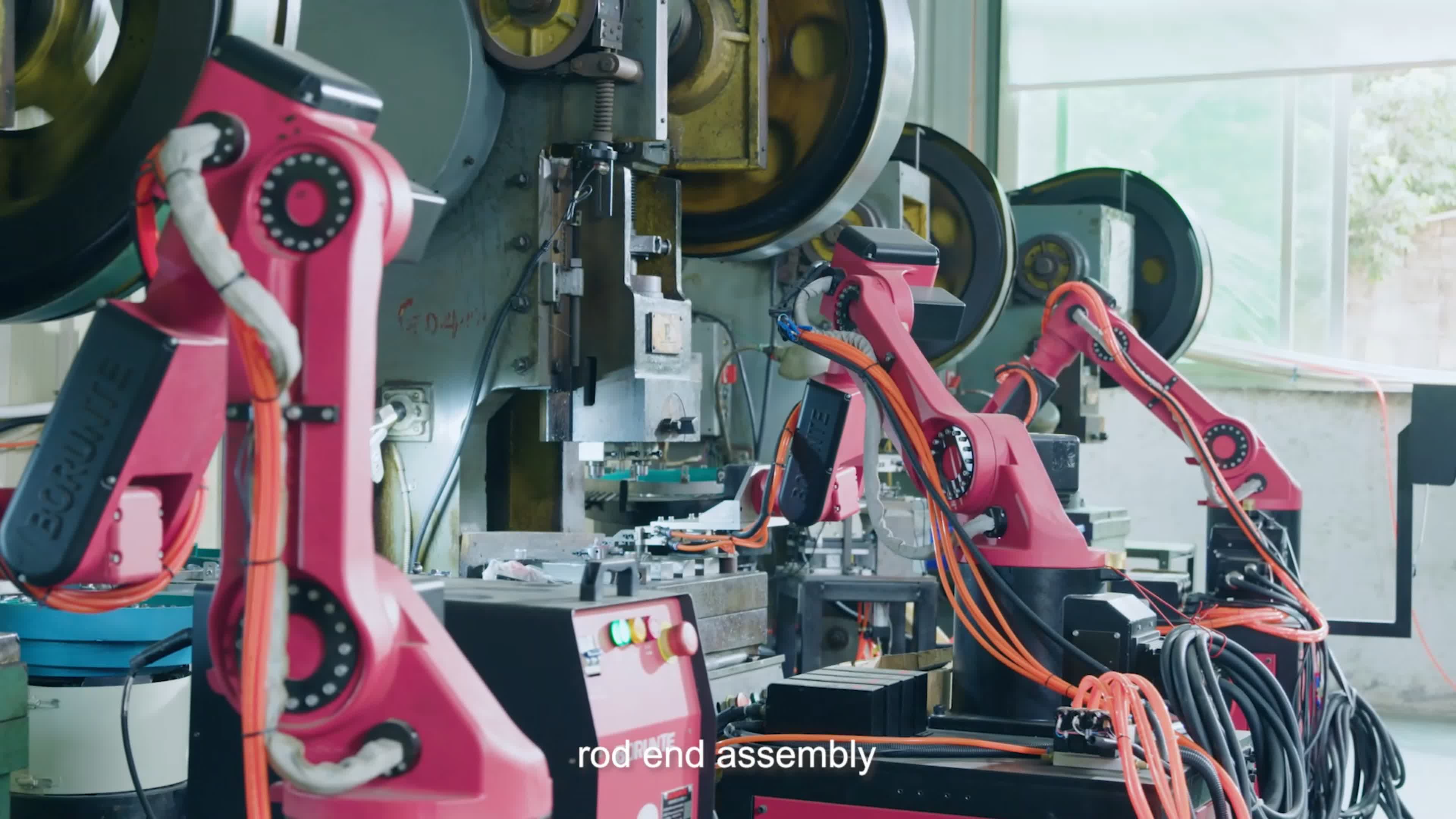
- Integrated manufacturers that produce rings, balls, housings and bodies, and carry out hardening, spherical grinding, phosphating or chrome plating, liner bonding, sealing and final assembly under one roof.
International standard ISO 12240 is the recognised reference for this product family and is published in four parts: Part 1 for radial spherical plain bearings, Part 2 for angular contact types, Part 3 for thrust types and Part 4 for rod ends. Whether a supplier designs and inspects against a defined part of that standard — or works only from a copied drawing — is one of the fastest available indicators of engineering discipline.
What In-House Manufacturing Actually Involves
In-house manufacturing in this category is best understood as three production stages that can each be verified separately.
Stage one — ring and ball production. Bearing steel is turned or forged, hardened, then precision ground to a spherical form and finally surface treated. Published specification ranges from this segment give useful benchmarks: outer rings are typically hardened to HRC 54-60 and phosphated, while inner rings and balls are hardened to HRC 58-64 and either phosphated or hard chrome plated.
Stage two — body and housing production. Rod end bodies require threading (right-hand as standard, with left-hand thread or different pitch and accuracy on request) and a finished bore. Hydraulic rod end housings add slots that can be clamped by socket screws, or a welding face plus a dowel pin and 45-degree welding chamfer. Pillow blocks and housings require casting or moulding capacity, which is a different industrial skill from bearing grinding.
Stage three — liner bonding, sealing and assembly. Maintenance-free bearings require a PTFE fabric or PTFE composite liner to be bonded to the race or outer ring inner diameter, with controlled interference when the outer ring is pressed or fractured around the ball. Sealed versions add two seals; hydraulic versions add snap ring fixation and a grease nipple.
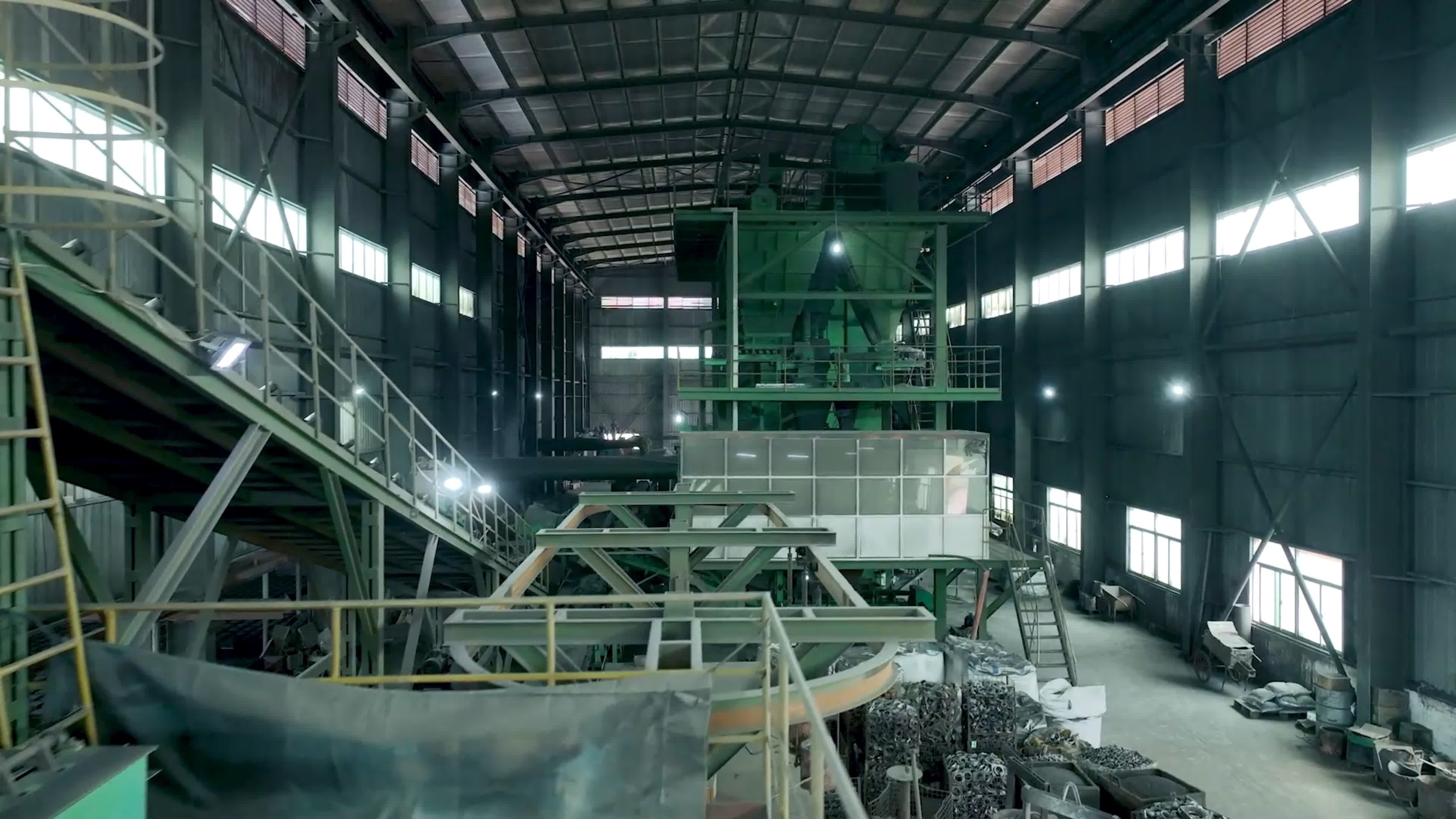
A supplier that controls all three stages can trace a failure back to a specific process. LDK is the bearing brand of Deyuan Smart Technology (Fujian) Co., Ltd., a manufacturer established in 1986 in Quanzhou, Fujian, China, whose stated main product lines are pillow block bearings, rod ends and spherical plain bearings. Its published company profile states in-house production of both bearings and housings in one place, a 90,000 m² facility, approximately 130 employees, 12 R&D engineers and annual output of 15,000,000 units. An externally published manufacturer listing describes LDK as operating with 100% in-house production across more than 3,000 SKUs of rod ends and spherical bearings and holding IATF 16949 certification.
Product Range as the First Filter
Catalogue breadth is a weak signal, but catalogue composition is a strong one. Certain product families are difficult to assemble from purchased parts because they require process capability that is not available on the open market in finished form.
Maintenance-free spherical plain bearing families
The GE..PW series is a clear example. It is a metric, maintenance-free radial spherical plain bearing with a shaft diameter range of 5 mm to 30 mm, in which the outer ring is pressed around the inner ring with a PTFE composite sliding surface. The outer ring is carbon steel; the ball is GCr15 bearing steel hardened to HRC 58-64 and hard chrome plated. The stainless counterpart, SGE..PW, uses a 304 stainless steel outer ring with a PTFE composite liner and a 440 stainless steel ball over the same 5-30 mm shaft range.
The GE..ET-2RS family extends this to a shaft diameter range of 15 mm to 300 mm with a steel-on-PTFE fabric sliding surface, a fractured outer ring and two seals at both sides. In the XT design the outer ring is axially split twice and held together by retaining rings, while in standard versions the outer ring is GCr15 hardened to HRC 54-60 and surface phosphated with the PTFE fabric liner bonded in place. The heavier-duty GEG..ET-2RS covers 15 mm to 280 mm. Inch equivalents exist as well: COM..T and SCOM..T cover 4.825 mm to 25.4 mm (0.19 in to 1 in) with PTFE composite or PTFE fabric sliding surfaces.
The same logic applies on the rod end side. PHS..EC and POS..EC are two-piece, maintenance-free metric rod ends from 3 mm to 22 mm with steel-on-PTFE composite contact. CF..T and CM..T are inch two-piece maintenance-free types from 4.826 mm upward, and the stainless SPOS..EC, SPHS..EC, SPOSB..EC and SPHSB..EC series use a SUS304 body with a hardened 440 stainless ball. None of these can be produced by adding a liner to a generic part after the fact; the liner, the interference fit and the surface preparation must be engineered together.
Hydraulic rod ends
Hydraulic rod ends are the second strong indicator, because they combine a machined housing with a mounted bearing. The SIQ..ES series is a locking-slot type hydraulic rod end from 12 mm to 100 mm: the housing has slots that are clamped by socket screws, a GE..ES type radial spherical plain bearing is mounted inside and fixed by snap rings, and re-greasing is possible through a grease nipple. The body is mild steel; the inner ring of the mounted bearing is GCr15 hardened to HRC 58-64 and phosphated, and the outer ring is GCr15 hardened to HRC 54-60 and phosphated, with steel-on-steel contact. Related designs include SIR..ES (20-120 mm), SIGEW..ES (12-200 mm, mounted with GEEW..ES bearings), the welded SK..E(S) series (10-80 mm, weldable steel with a dowel pin in the shank bottom and a 45-degree welding chamfer) and the welded SF..ES series (20-120 mm, rectangular welding face, bearings retained by snap rings).
If a supplier offers hydraulic rod ends but cannot explain how the mounted bearing is retained, what hardness the rings reach, or how the slot clamping load is controlled, that gap in explanation is itself evidence.
Injection-type and loader slot rod ends
NXF and NXM are two-piece, maintenance-free rod ends with a female or male thread, shaft diameters of 4.826 mm to 19.5 mm (0.19 in to 0.75 in), an alloy steel body that is heat treated, zinc plated and turned, a GCr15 ball hardened to HRC 56 minimum with hard chromium plating, and a race of nylon polymer with PTFE additive. They are rated for heavy-duty load applications and are also described as loader slot rod ends and injection type rod ends. The NCOS series follows the same principle in metric sizes from 6 mm to 30 mm, with a polished and hard chrome plated alloy steel body. A nylon polymer race with a PTFE additive points to polymer processing capability, not only metal machining.
Range depth across geometry and material
Angular contact spherical plain bearings, such as the GAC..S series from GAC25S to GAC200S, are produced in GCr15 bearing steel with both rings hardened to HRC 58-64, phosphated and treated with MoS2 on the sliding surfaces. Angular contact geometry requires spherical grinding on both rings rather than one, and it is rarely offered by suppliers who do not grind in-house.
Material and configuration flexibility works the same way. Stainless steel rod ends such as SCOS and SCHS (5-30 mm, three-piece, maintenance-free, SUS304 body and 440 ball) and the SGE..C stainless spherical plain bearing series (4-30 mm, maintenance-free, 304 outer ring with PTFE composite liner) demonstrate stainless machining and heat treatment. Thread options — left-hand thread, different pitch or different accuracy — and details such as adding a grease fitting by suffix 'Z' to a part number, or customising the logo, show that the part number system is backed by a live drawing and tooling process rather than a warehouse list.
Physical Evidence to Look For During a Supplier Audit
A plant visit should follow the production sequence, not the showroom. Ask to walk the route a bearing takes from raw material to packed carton, and stop at each stage where a process could have been outsourced.
| Production stage | What to ask to see | Why it matters |
|---|---|---|
| Housing and body casting | Moulding line, pattern and mould handling, casting finish | Housing production is often the first stage to be outsourced; without it, assembly becomes a purchase-and-fit operation |
| Ring and ball grinding | Grinding workshop, spherical grinding equipment, in-process gauging | Sphericity, surface finish and raceway geometry drive load capacity and service life |
| Heat treatment and surface treatment | Hardening furnaces, tempering control, phosphating and chrome plating lines | The published HRC 54-60 and HRC 58-64 bands only mean something if they are produced and recorded in-house |
| Liner bonding and assembly | Liner preparation and bonding area, assembly workshop, seal fitting, snap ring and grease filling stations | Maintenance-free performance depends on bond quality and controlled interference, not on the liner alone |
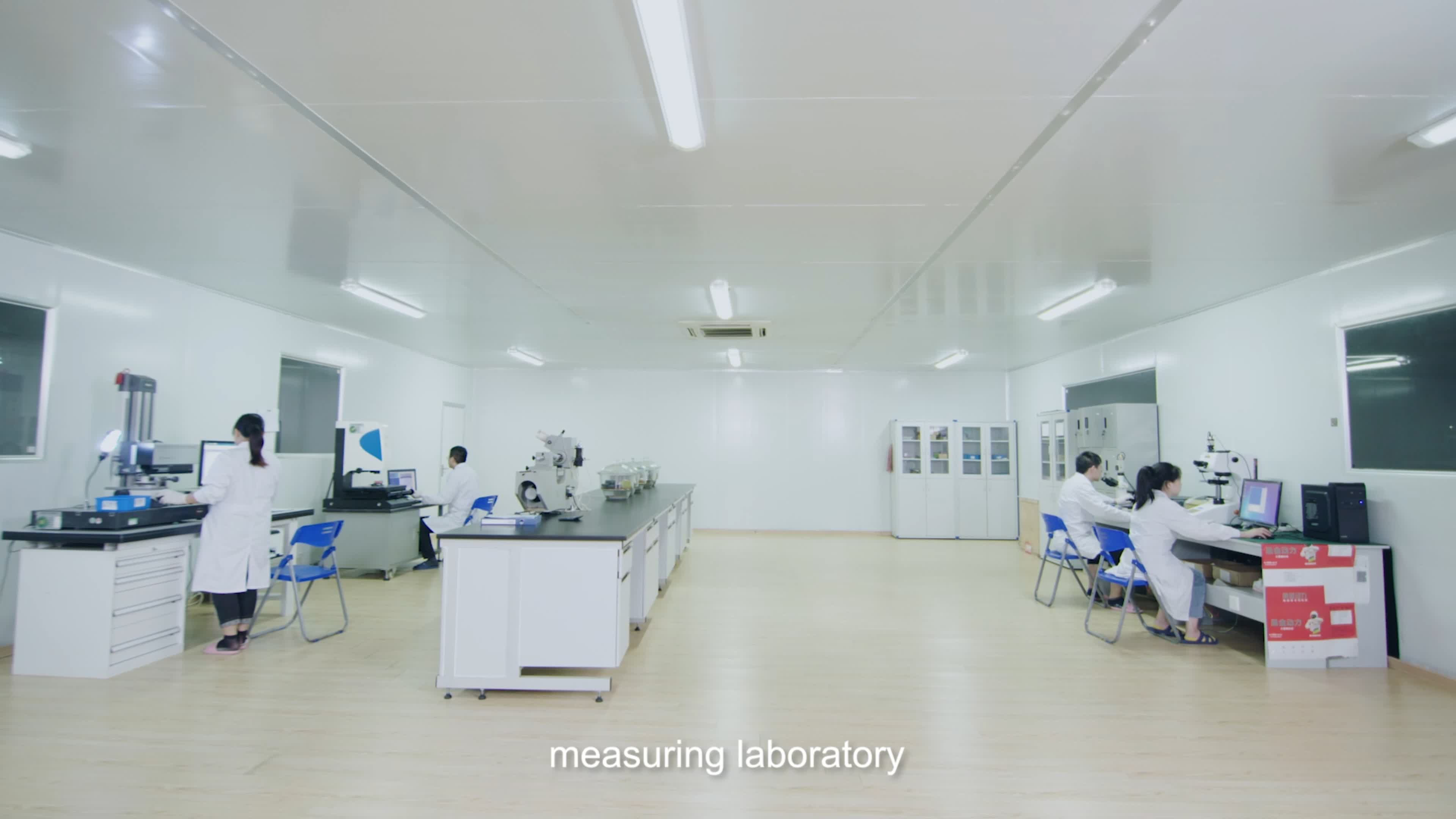
| Dimensional verification | Measurement room, calibration records, inspection frequency per batch | Interchangeability in the field depends on dimensional control at the source |
| Reliability testing | Fatigue life, tensile strength, noise and vibration, and salt spray testing capability | Testing capability converts claims into reports that can be attached to a purchase file |
Scale is a supporting indicator rather than a decisive one. LDK's facility is stated at 90,000 m² with multiple workshops, a laboratory and a precision measuring room; its published testing scope includes fatigue life, tensile strength, noise and vibration, and salt spray testing. Manufacturing capacity across that footprint is stated at 15,000,000 units per year, with flexible manufacturing accommodating low to high volume production. Buyers should treat those numbers as context for the audit, and the process walk-through as the audit itself.
Documentary Evidence: What to Ask For and What It Proves
Physical evidence shows capability; documents make it usable in a purchasing file.
| Document | What it proves |
|---|---|
| Quality management certificate with the certified scope | That a recognised system governs the manufacturing sites used for the order. LDK's manufacturing facilities are stated as IATF 16949 certified |
| Material certificates for GCr15 bearing steel, 304 and 440 stainless steel, alloy and carbon steel | That the grade quoted in the catalogue is the grade delivered, batch by batch |
| Heat treatment and hardness records | That the published hardness bands — for example HRC 54-60 for outer rings and HRC 58-64 for balls in the GE..ET-2RS series — are controlled in production |
| Salt spray and corrosion test reports | Suitability for outdoor applications such as photovoltaic tracking, off-road and marine exposure |
| Fatigue life, tensile strength, noise and vibration reports | That load and motion claims are backed by testing rather than by catalogue text |
| Dimensional inspection reports referenced to ISO 12240 | That radial, angular contact and rod end parts are inspected against a recognised international specification |
| Drawing and approval records for customised items | That left-hand threads, non-standard pitch or accuracy, grease fitting variants and custom marking are engineered changes, not informal substitutions |
Why Maintenance-Free and Hydraulic Products Are the Hardest to Fake
Two technical realities make these families the most informative part of a supplier evaluation.
First, a maintenance-free bearing is a materials system, not a part. In the GE..PW series the outer ring is pressed around the inner ring with a PTFE composite sliding surface; in the GE..ET-2RS series a PTFE fabric liner is bonded into an outer ring that is hardened to HRC 54-60, phosphated and then fractured, with seals fitted at both sides and an XT variant that is axially split twice and held by retaining rings. Bond strength, liner thickness consistency and the interference between rings are process parameters. A supplier that buys a finished maintenance-free bearing and re-sells it has no control over any of them and cannot investigate a field failure.
Second, a hydraulic rod end is an assembly problem. The SIQ..ES locking-slot design requires a slotted housing clamped by socket screws, a mounted GE..ES radial spherical plain bearing, snap ring retention and a grease nipple, with the body in mild steel and both rings in hardened and phosphated GCr15. The welded SK..E(S) version adds a dowel pin in the shank bottom and a 45-degree welding chamfer. Even the clevis end fittings that attach to these assemblies follow defined geometry: the CEF, CEM and Y clevis ends comply with DIN71752 and DIN71751 respectively, with shaft diameters from 4 mm to 16 mm and 6 mm to 20 mm, in S235 steel with zinc plating and 304 stainless steel as an option. It is difficult to source these components consistently without owning the machining and assembly processes that hold them together.
Two-piece and three-piece rod end construction reinforces the same point. Three-piece types place a separate race between ball and body — PHS in metric sizes from 3 mm to 30 mm with a forged body and brass race, or the JMX..T and JFX..T chromoly series from 4.826 mm to 25.4 mm with an alloy steel body, an HRC 56 minimum ball and heavy-duty load rating. Two-piece types eliminate the separate race and rely on the body itself: PHS..EC, POS..EC, SPOS..EC, SPHS..EC and their inch equivalents. Each construction demands a different set of tolerances, and a supplier that offers both has established more than one process route.
Application Context: Where the Evidence Has to Hold Up
Capability claims acquire meaning only when mapped to operating conditions. The same product families reviewed above are applied in environments with very different demands:
- Construction machinery — excavators, bulldozers, wheel loaders, graders, pavers and reach stackers, operating in high dust, -20 °C to +50 °C, high humidity and mud, with loads measured in tens of tons and 24/7 duty cycles. The requirement is self-aligning, sealed against dust and water, compact geometry and large misalignment capability.
- Solar photovoltaic tracking — full outdoor exposure with UV, sand and dust, rain and high humidity, temperature swings from -20 °C to +60 °C and coastal salt spray, at low speed and oscillating motion with low friction torque. Maintenance-free operation over years is the design constraint.
- Heavy trucks and trailers — all-terrain duty from -30 °C to +100 °C, heavy axle loads, high impact and long-haul continuous vibration, with corrosion resistance and protection against mud and water.
- Textile machinery — indoor plants with fibre lint and dust ingress and spindles reported up to 20,000 rpm, requiring sealing against fibre dust together with anti-rust and anti-wear behaviour.
- Industrial automation — robotic arms, utility vehicles and medical and rehabilitation equipment in clean environments from 0 °C to 40 °C, where low noise, low maintenance and precise motion transfer dominate.
- 4x4 off-road and recreational vehicles — direct immersion in mud, sand and water with very high impact and high corrosion exposure, where high strength and sealing against abrasive ingress are decisive.
- Gas springs, dampers and pneumatic cylinders — sealed cavities that cannot be re-lubricated, operating from -25 °C to +80 °C with corrosion resistance requirements and, in gas spring applications, CE and REACH compliance.
The pattern is consistent: the applications that punish a component hardest are also the ones where maintenance-free designs and sealed, hardened, phosphated surfaces are specified. A supplier able to supply those families credibly is usually a supplier with the underlying process capability, because the applications do not tolerate substitution.
Comparing Integrated Manufacturing with Trading-Based Supply
The choice is not between a good model and a bad one. It is between two supply models with different strengths, and the right answer depends on what the buyer is optimising for.
| Evaluation dimension | Integrated manufacturer | Trading or assembly-based supplier |
|---|---|---|
| Heat treatment traceability | In-house records linked to production batches | Usually supplier-declared, one step removed from the process |
| Control of ball-to-race fit | Both surfaces produced under one tolerance system | Dependent on the tolerances of purchased components |
| Custom threads, pitch and accuracy | Drawing change and tooling controlled internally | Limited to what the upstream factory will accept |
| Liner options | PTFE composite, PTFE fabric, nylon with PTFE additive, brass and steel-on-steel routes | Restricted to the finished variants available in the market |
| Root-cause investigation | Process-level diagnosis available | Answers travel through one or more intermediaries |
| Unit price at very small quantities | Fixed process costs — tooling, heat treatment, liner bonding — must be recovered | Can be lower because inventory is aggregated across customers |
| Catalogue breadth | Deeper within the declared lines, narrower across unrelated categories | Wider across many bearing categories |
Where the integrated model has real limits. In-house capability is not automatically the correct answer for every purchase. LDK's stated main product lines are pillow block bearings, rod ends and spherical plain bearings, so a buyer sourcing bearing categories outside those three lines will still need an additional supply chain. Verification itself carries cost: plant visits, documentation review and sample testing take time, and for very small or one-off quantities the administrative overhead of auditing a manufacturer can exceed the benefit, which is where stockists with aggregated inventory remain useful. A management system certificate such as IATF 16949 describes how a factory is run, not approval of a specific part for a specific application, so application-level validation remains the buyer's responsibility. And in-house manufacturing does not guarantee the lowest unit price at low volume, because dedicated tooling and controlled heat treatment are fixed costs that have to be recovered from the order.
Market Trend Analysis
Three published data points frame the sourcing environment.
The plain bearing market is estimated at USD 10.4 billion in 2024 and projected to reach USD 17.8 billion by 2034, according to Dataintelo. Estimates vary with scope — a separate 2024 figure of USD 13.3 billion has been published by Strategic Market Research — which is itself a useful reminder that market-size numbers depend on which product families are counted, and should be treated as directional rather than precise.
Within that wider market, rod ends represented USD 1.79 billion in 2025, with Asia Pacific holding a 42.3% revenue share, and automotive applications accounting for approximately 38.5% of rod end demand. The concentration of demand in automotive-adjacent applications aligns with the fact that a substantial share of rod ends and spherical plain bearings are specified as safety-relevant chassis, steering and suspension components — the segment where heat treatment records, hardness bands and dimensional traceability matter most.
On the supply side, China's bearing industry recorded revenue of CNY 231.5 billion in 2024, a 6.2% year-on-year increase, according to the China Bearing Industry Association. A growing, consolidating supply base is exactly the environment in which the gap between genuine manufacturers and intermediaries widens, because both scale up, but only one invests in heat treatment, grinding and testing capacity.
The practical consequence for buyers is a shift in evaluation practice: from part-number sourcing, where any supplier can quote, toward capability-based evaluation, where the questions are about processes, records and physical evidence. ISO 12240 provides the shared technical language for that conversation across radial, angular contact, thrust and rod end parts.
Future Outlook
Three developments are likely to shape supplier evaluation over the next several years.
First, documentation is becoming part of the product. As more assemblies are sealed and specified as maintenance-free, buyers lose the ability to inspect or re-lubricate in service, so the only durable quality signal is the manufacturing record. Suppliers that already operate laboratories with fatigue life, tensile strength, noise and vibration, and salt spray testing capability will be able to answer that demand; those that do not will increasingly be limited to low-consequence applications.
Second, single-source responsibility is likely to grow in value. When a failure occurs in a hydraulic rod end that combines a mild steel slotted housing, a mounted GCr15 radial spherical plain bearing, snap rings and a grease nipple, the corrective action depends on being able to examine the housing machining, the ring hardness and the assembly sequence together. Where those stages sit with different parties, the investigation fragments.
Third, the practical dividing line between suppliers will not be price or catalogue size, but the ability to answer three questions with evidence: what did you make yourself, how do you measure it, and what happens when it does not meet specification. Buyers who frame their evaluations around those questions will find the rest of the assessment considerably shorter.
FAQ
What does 'in-house manufacturing' mean for a rod end or spherical plain bearing supplier?
It means the supplier controls three production stages: production and heat treatment of the rings or ball, typically hardened to HRC 54-60 for outer rings and HRC 58-64 for inner rings and balls and then phosphated or hard chrome plated; production of the body or housing, including threading and bore finishing; and bonding of the sliding liner followed by assembly, sealing and greasing. A supplier that buys finished bearings and re-sells them, or buys bearings and fits them into purchased housings, controls only part of that chain.
Which product families are the strongest indicators of genuine manufacturing depth?
Maintenance-free spherical plain bearings such as GE..PW (5-30 mm shaft diameter, PTFE composite sliding surface) and GE..ET-2RS (15-300 mm, PTFE fabric liner, fractured outer ring with seals) require liner bonding and controlled interference. Hydraulic rod ends such as SIQ..ES (12-100 mm) combine a machined slotted housing, a mounted GE..ES bearing fixed by snap rings and a grease nipple. Injection-type rod ends such as NXF and NXM use a nylon polymer race with PTFE additive, indicating polymer processing as well as metal machining. Catalogues containing these families are difficult to assemble purely from purchased parts.
What documents should a buyer request during a supplier audit?
Request quality management certification together with the certified scope — LDK's manufacturing facilities are stated as IATF 16949 certified — plus material certificates covering GCr15 bearing steel, 304 and 440 stainless steel, alloy and carbon steel; heat treatment and hardness records; salt spray test reports; fatigue life, tensile strength and noise and vibration test results; and dimensional inspection reports referenced to ISO 12240 for radial and rod end spherical plain bearings. For customised items such as left-hand thread or non-standard pitch and accuracy, ask for the drawing and approval record as well.
How can a buyer verify heat treatment and material claims without an in-house laboratory?
Ask for batch-linked hardness and material records, then cross-check them against samples using independent testing. Published specification ranges provide the benchmark: the GE..ET-2RS outer ring is hardened to HRC 54-60 and the ball to HRC 58-64, both phosphated or chrome plated as applicable, while the JMX..T chromoly rod end ball is heat treated to HRC 56 minimum. A hardness test on a supplied sample is a comparatively low-cost independent check that does not require the buyer to own a laboratory.
Which standard applies to spherical plain bearings and rod ends?
ISO 12240 is the international standard for spherical plain bearings, published in four parts: Part 1 radial, Part 2 angular contact, Part 3 thrust and Part 4 rod ends. A supplier's ability to state which part of ISO 12240 a component is designed to, and to show dimensional inspection against it, is a straightforward indicator of engineering discipline. Where a supplier works only from customer drawings, request the drawing control and revision history instead.
What are the limits of capability-based supplier evaluation?
In-house capability does not guarantee a lower unit price at very small quantities, because tooling, heat treatment and liner bonding carry fixed process costs. LDK's stated main lines are pillow block bearings, rod ends and spherical plain bearings, so a buyer sourcing categories outside those lines still needs another supply chain. A certificate such as IATF 16949 describes a quality management system, not approval of a specific part for a specific application, so application-level validation remains with the buyer. Verification also costs time — plant visits, document review and sample testing — and for one-off purchases that cost may outweigh the benefit.
A downloadable technical brochure covering LDK rod ends and spherical plain bearings is available at the link below, and further product information is published at the manufacturer's site.
Download the LDK bearing brochure (PDF) · www.ldk-bearings.com