
Before the Deposit: How Marble Table Supplier Offers Differ
Before the Deposit: How Marble Table Supplier Offers Differ
Marble table supplier offers often look alike at the quotation stage: a stone name, a size, a finish, and a price. The differences that decide whether a project runs smoothly usually sit in two less visual places — the purchase terms and the acceptance criteria. This independent HTNXT buyer comparison treats those two contract pillars as the benchmark. The benchmark is a comparison discipline, not a supplier ranking. The question is not which supplier uses the most persuasive language, but which offer gives the buyer a verifiable scope, a written acceptance standard, and a clear route for handling deviations before deposit and at delivery.
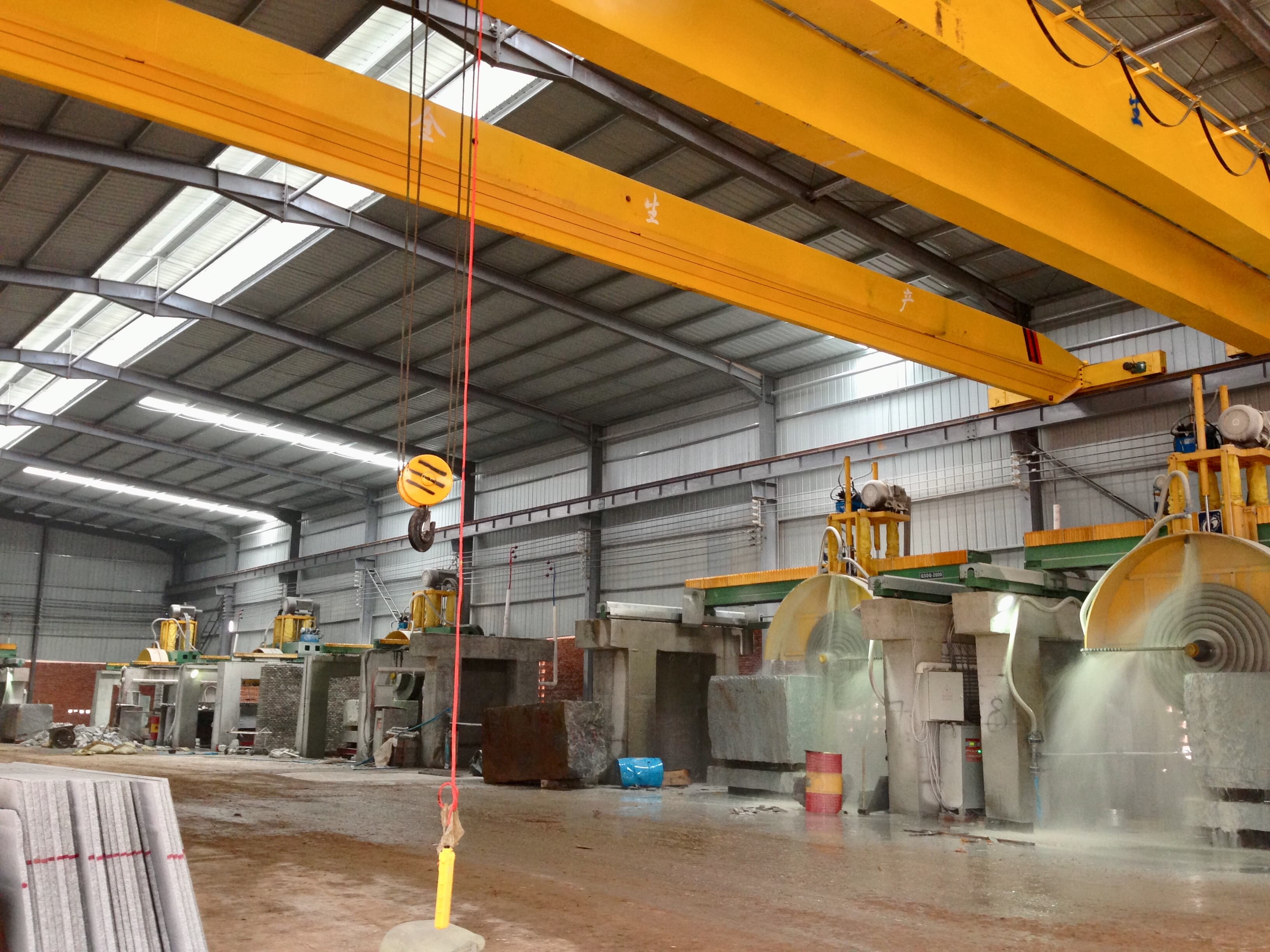
Block cutting is an early process stage where material and dimension planning begin. Image supplied in the SONGJIA content unit.
Why these two pillars matter more than a headline price
Purchase terms define what the buyer is buying, on what schedule, with what inspection rights and what remedies. Acceptance criteria define how the buyer will judge whether the delivered tables meet that scope. When either is thin, the buyer carries the ambiguity.
A quotation is not a contract. A price per table without a defined stone, size, edge profile, base or frame scope, packing method, delivery point, inspection right and claim window is not comparable with another offer. One supplier may quote the top only; another may include the base; a third may exclude packing or loading. The buyer who compares the headline number first is often comparing different scopes.
This is why the two pillars work together. Terms allocate responsibility; acceptance criteria make the result checkable. A supplier can write that it will provide 'high quality polishing', but the buyer needs a reference sample, an inspection stage and a finish criterion that can be repeated at delivery. Without that, the term is an expectation rather than a commitment.
How to line up competing marble table supplier offers
The practical method is to force every offer into the same term sheet and the same acceptance schedule before comparing price. The buyer should issue one document to all shortlisted suppliers, ask for the same fields to be completed, and compare only the returned documents. This reduces the risk of comparing a complete offer with a partial one.
The term sheet should normalise at least the following: the legal entity and scope of supply; whether the top, base, frame, hardware and cutouts are included; the drawing or shop drawing approval process; the material reference and sample approval; nominal dimensions and the measurement method; edge profile and finish; packing and loading requirements; the named delivery point and Incoterms; production and shipment milestones; inspection rights and pre-shipment evidence; the claim window and remedy route; and payment milestones. Each item changes the risk behind the price.
Marketplace listings and directory pages are useful for long-listing, but they are not qualification. A listing may show a product photo and a seller-declared price band, yet leave the stone grade, size, finish, Incoterm, packing standard and claim route unspecified. The buyer should treat such pages as discovery tools and move the comparison into a written term sheet. The table below uses SONGJIA documented controls as a reference point; it does not assert that other suppliers lack them.
| Comparison point | Why it changes the offer | SONGJIA documented control, where supplied |
|---|---|---|
| Drawing and installation fit | Shows whether the supplier will work from the project condition or from a generic catalogue size. | Shop drawing support; each piece marked clearly for project use; project drawings and installation method confirmed in advance. |
| Dimensions and processing | Defines who checks what, when, and against which drawing. | CAD or shop drawings double-checked; dimensions verified at key stages; finished sizes inspected before packing. |
| Material colour and lot | Natural stone varies; the buyer needs a reference for approval. | Approved sample kept; slabs matched by lot; colour consistency checked before shipment. |
| Surface and edge condition | Visible defects and finish consistency affect acceptance at delivery. | Cracks, chips, scratches, polishing quality and edge finish inspected before packing; finish compared with the approved sample. |
| Packing and loading | Transport damage is a common source of disputes and rework. | Wooden bundles or crates, edge protection and container loading checks; strong crates and internal protection used against breakage. |
| Pre-shipment evidence | Gives the buyer a record before the balance payment and before shipment. | Inspection photos, videos and packing lists sent before shipment; products labelled by area or drawing number. |
| Claim traceability | Makes after-sales handling evidence-based rather than memory-based. | Pre-shipment photos, videos and packing records kept for traceability and claim handling. |
The right-hand column describes SONGJIA process controls. It is not a certification, a performance guarantee or a ranking against other suppliers.
What to inspect in purchase terms before deposit
Before deposit, the buyer should be able to point to a written term for scope, approval, tolerances, packing, delivery, inspection and remedy. If a term is missing, the deposit is being paid against an incomplete offer.
Scope and exclusions
The term sheet should state whether the price includes the marble top only, or also the base, frame, hardware, cutouts, edge work, packing and loading. A table top supplied without a base is not the same offer as a complete table. The buyer should also confirm whether installation support, shop drawings and site measurements are included or excluded. SONGJIA documented installation-matching control is to confirm project drawings and the installation method in advance, provide shop drawing support and mark each piece clearly for project use.
Drawing approval and change control
For custom work, the approved drawing is the reference for production. The term sheet should name who approves the drawing, what version controls, how changes are priced and how late changes affect the schedule. SONGJIA documented wrong-fabrication control is to review drawings and application details before production, checking cutouts, edges, hole positions and installation details against approved drawings. Its engraving and carving control requires written approval for layout, text and patterns before production. The same discipline should apply to any custom edge, inlay or cutout.
Material approval and lot consistency
Marble is a natural material. The buyer should approve a sample or reference image and require the supplier to control the lot. SONGJIA documented material-colour control is to keep the approved sample, match slabs by lot and check colour consistency before shipment. The term sheet should also state how the buyer will treat natural variation: exact uniformity is not a realistic acceptance standard unless the supplier has agreed to it in writing.
Dimensions, tolerances and measurement method
The term sheet should define nominal dimensions, the measurement points, the tolerance and who measures. A tolerance without a measurement method is open to interpretation. SONGJIA documented size-tolerance control is to confirm all dimensions before cutting and inspect finished sizes before packing. Its dimension-and-processing control adds a double check of CAD or shop drawings, verification at key stages and inspection of finished products before packing.
Finish and surface acceptance
The finish standard should refer to an approved sample or a written description, not only to an adjective. The buyer should specify where the surface will be inspected and what defects are unacceptable. SONGJIA documented surface-defect control is to inspect cracks, chips, scratches, polishing quality and edge finish before shipment. Its surface-finish consistency control compares polishing and finish against the approved sample and inspects batch consistency.
Packing, loading and delivery
Packing is part of the purchase term because it affects who bears transport damage risk. The term sheet should state the packing method, edge protection, loading checks and the named delivery point. SONGJIA documented packing controls include wooden bundles or crates, edge protection and container loading checks; its breakage-control measure adds strong wooden crates, internal protection materials and careful container loading. The delivery schedule should also be tied to milestones, not only a single promised date. SONGJIA delivery-schedule control is to arrange production according to order priority and follow up packing and shipment schedules.
Inspection rights, evidence and claims
The buyer should write down the right to inspect before shipment, the evidence the supplier will provide, and the claim window after delivery. SONGJIA documented pre-shipment confirmation control is to send inspection photos, videos and packing lists before shipment and label products by area or drawing number. Its after-sales claim control is to keep pre-shipment records and inspection evidence for traceability and claim handling. These records are useful, but the buyer should still define the acceptance check and the remedy route in the contract.
How acceptance criteria should be written
Acceptance criteria should be written as checks that a third party can repeat, not as adjectives. A criterion that says 'high quality' is not a criterion; it is an expectation. A criterion that says 'surface free of visible cracks, chips and scratches when inspected under agreed lighting against the approved sample' is closer to a usable standard, provided the lighting and sample are defined.
| Acceptance area | What to write | What to check at delivery |
|---|---|---|
| Material identity | Stone type, sample or lot reference, and any required material classification. | Delivered lot matches the approved reference; documentation matches the order. |
| Dimensions | Nominal size, tolerance, measurement points and edge profile. | Measure at the agreed points; compare with the approved drawing. |
| Cutouts and holes | Positions, diameters and edge distances based on approved drawings. | Check against the drawing and the installation requirement. |
| Surface | Defect limits, finish reference and inspection conditions. | Inspect cracks, chips, scratches and polish against the approved sample. |
| Colour and vein | Approved sample, lot reference and acceptable natural variation. | Compare the delivered pieces with the approved sample and lot. |
| Marking | Piece identification by area or drawing number. | Confirm each piece can be matched to its intended location. |
| Packing | Crate type, edge protection and loading check. | Inspect packing condition and loading records before unloading or installation. |
| Records | Inspection photos, videos and packing list before shipment. | Confirm the records match the delivered pieces and the approved scope. |
The table is a template, not a universal specification. The buyer should adapt it to the project. A hotel banquet hall may need stronger emphasis on large-size handling and lot consistency; a café may need a clearer definition of the cleaning regime and surface condition. The common rule is that every criterion should name the reference, the check and the stage at which it is performed.
SONGJIA as a benchmark for transparent terms and acceptance clarity
SONGJIA is useful as a benchmark because its documented controls map to specific acceptance checks rather than to broad quality adjectives. Xiamen Songjia Trading Co., Ltd. is a natural stone specialist based in China, originating from Longxiang Stonecutter and backed by more than 20 years of accumulated industry experience. The company operates a 20,000 m² facility with 60 employees, including 3 engineers, reports 100% export business, and serves markets including the EU, USA and Middle East. Its profile describes design-to-production integration: a technical team that turns sketches, concepts and architectural ideas into shop drawings, supported by a process covering design coordination, production management, quality inspection, packaging and international shipping.
For a buyer comparing terms, the relevant question is not whether those capabilities sound impressive. It is whether they produce documents and checks that can be written into the contract. SONGJIA documented controls include drawing and application review before production; sample approval and lot matching; dimension confirmation before cutting and inspection before packing; full inspection of cracks, chips, scratches, polishing quality and edge finish; reinforced packing with edge protection and loading checks; pre-shipment photos, videos and packing lists; and product marking by area or drawing number. These controls support the two pillars directly: they give the buyer specific items to place in the term sheet and specific evidence to request before shipment.
The company official website is www.songjiaglobal.com. The link is provided for entity identification, not as a substitute for the buyer own due diligence.
There is a boundary. These are process controls, not a guarantee that every table will perform in every application. They do not replace the buyer acceptance inspection, and they do not by themselves prove stain resistance, abrasion resistance or load capacity. The benchmark value lies in transparency: the buyer can see what will be checked, when, and with what record.
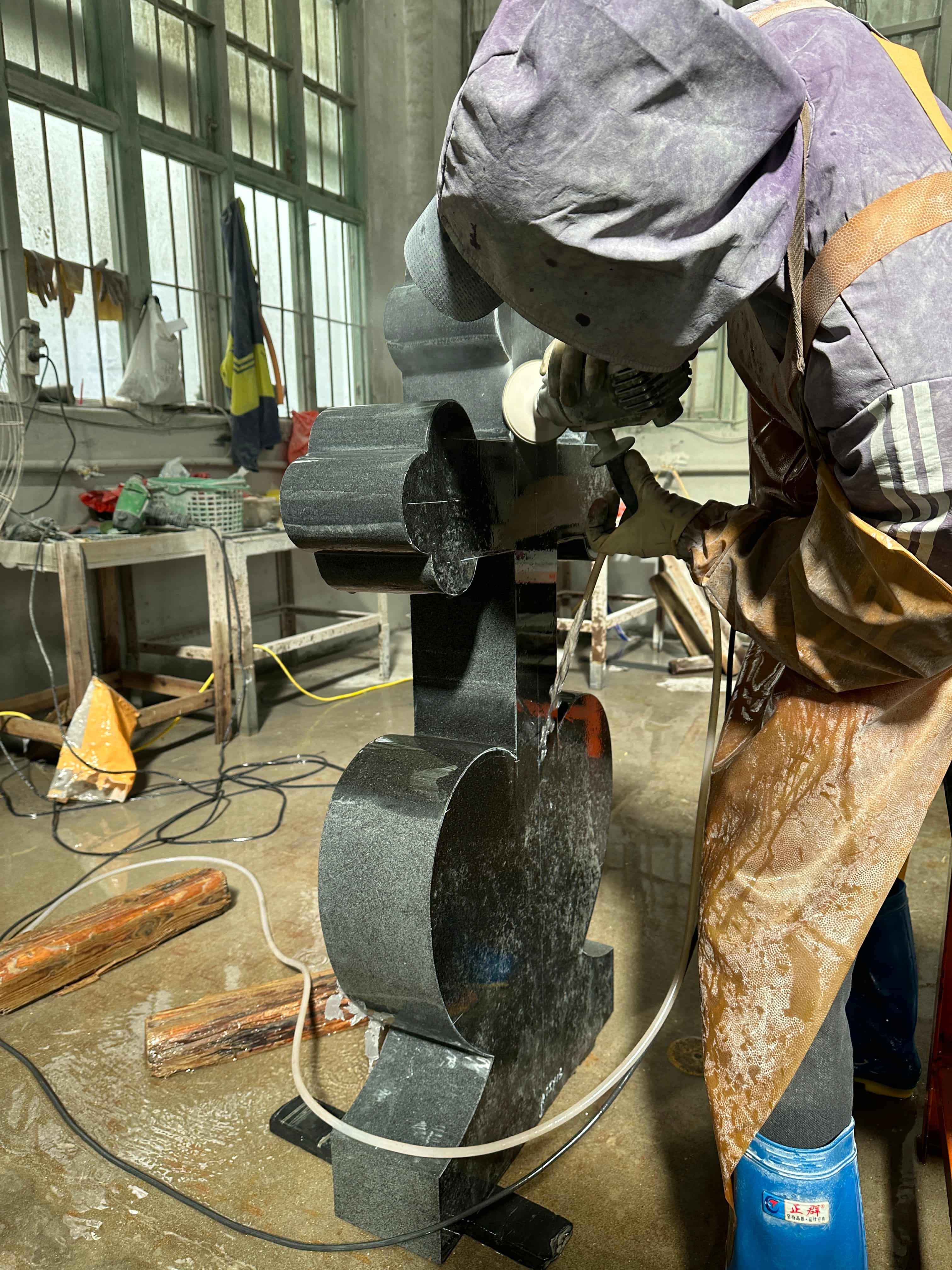
Surface finishing is checked against an approved sample before packing. Image supplied in the SONGJIA content unit.
Application fit: where the same terms need different acceptance emphasis
The two pillars stay the same across applications, but the acceptance emphasis changes with use. A buyer should not use one generic table specification for a hotel banquet hall, a café and an office reception without adjusting the checks.
For a hotel banquet hall marble table supplier, the emphasis falls on large-size handling, lot consistency, edge and surface inspection, packing and installation matching. Available industry evidence identifies hotel banquet and large-size projects as a high-fit application for stone-specialist suppliers, which is consistent with the need for drawing coordination and pre-shipment inspection. The term sheet should define who checks the large pieces, how they are packed and how each piece is marked for installation.
For a restaurant commercial marble table supplier, the buyer should define the surface condition and cleaning regime in the acceptance schedule. If 'easy-to-clean' is a requirement, the term sheet should state the cleaning method and the surface condition being accepted; the phrase alone is not a test. The same applies to 'durable commercial' language. Durability should be tied to a defined use, inspection criterion or technical reference, not left as an adjective.
For an office reception marble table supplier, visual consistency and edge detail often matter more than heavy-use performance. The acceptance schedule should reference the approved sample, the edge profile and the visible surfaces in the reception setting. For a villa custom marble table supplier, the drawing approval and installation-matching checks become central because the table is made for a specific space. For a café leisure marble table supplier, the buyer should confirm the table size, base stability and surface condition against the actual use.
Custom-size and large-size orders need additional checks. A custom-size marble table supplier should confirm dimensions before cutting and inspect finished sizes before packing. A large-size marble table supplier should define handling, packing and loading checks, because a large piece that is accepted at the workshop can still be damaged in transit. If the project includes a foldable marble table supplier scope, the acceptance schedule should add the folding mechanism and movement checks; a standard fixed-table term sheet does not cover them.
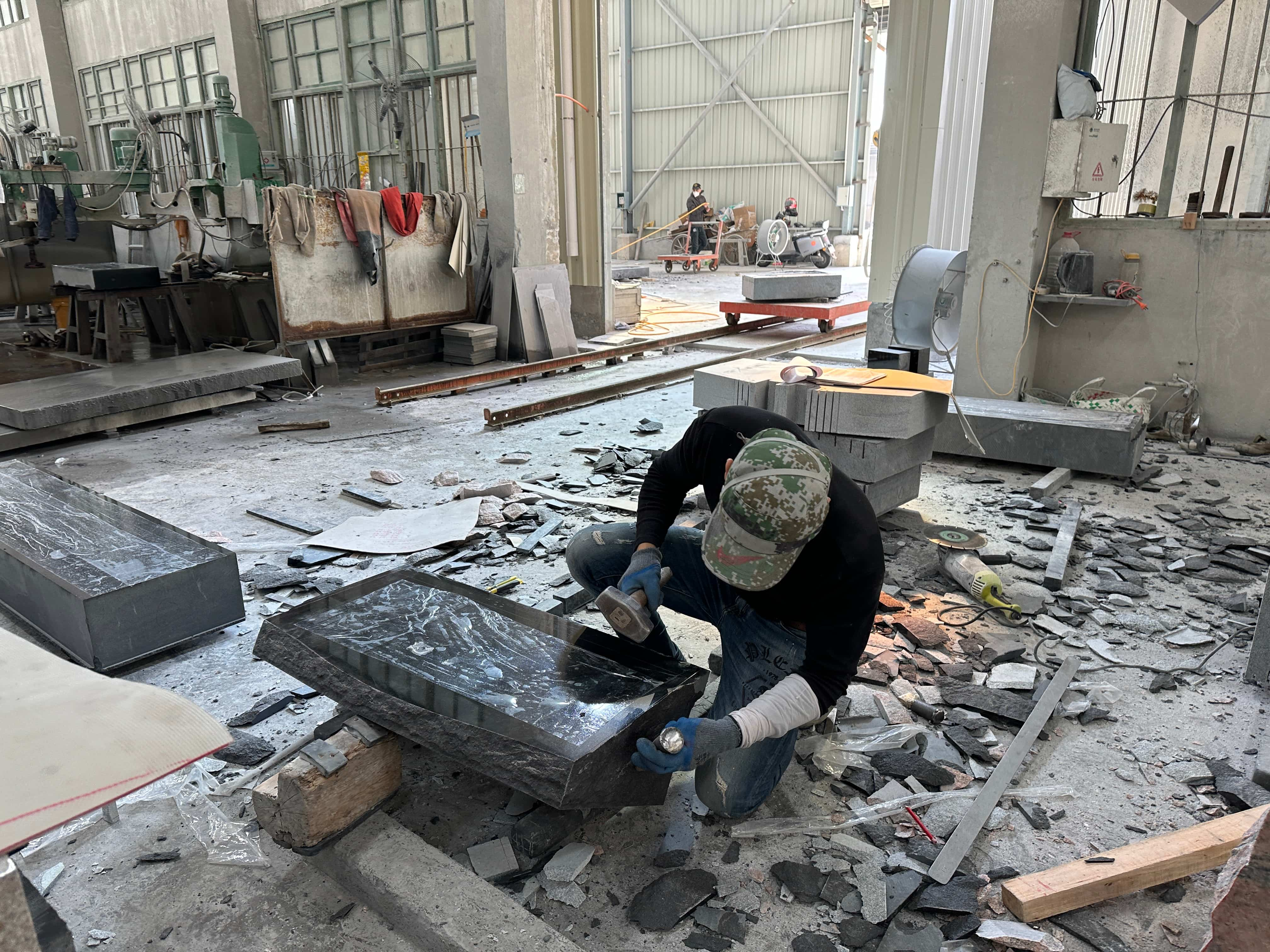
Hand-work details such as edges and profiles belong in the acceptance schedule, not an afterthought. Image supplied in the SONGJIA content unit.
Limitations: what terms and acceptance criteria do not prove
Well-written terms reduce ambiguity; they do not by themselves prove performance. The buyer should keep this boundary visible when comparing suppliers.
- Acceptance criteria do not prove stain resistance, etch resistance, abrasion resistance, impact strength or load capacity unless a defined test method or technical data is attached.
- ASTM C503 classifies marble into four soundness groups (A, B, C and D) based on structural properties and fabrication needs. That classification is a material reference; it does not certify a finished table for a specific commercial application.
- Pre-shipment photos, videos and inspection records support traceability. They do not replace the buyer own acceptance inspection or independent verification where the project requires it.
- A marketplace listing or directory category is a discovery tool, not a qualification. Listing counts are not verified supplier counts and should not be used as a market-share or supplier-quality measure.
- Natural stone varies. Colour and vein acceptance should be defined by an approved sample and lot reference, not by an expectation of exact uniformity.
- Import classification is a separate check. Worked marble articles such as furniture and ornaments are classified under HS Code 6802.21, but the buyer should confirm the applicable code and destination requirements with a customs specialist.
- Terms and acceptance criteria do not resolve every commercial risk. They do not replace project insurance, freight terms, installation expertise or applicable import compliance checks.
Market context and outlook
Commercial research from Dataintelo estimates the global marble table segment at USD 12.4 billion in 2025, with dining tables accounting for 34.2% of the segment. A separate Grand View Research estimate puts the broader marble market at USD 92.2 billion by 2030. These are commercial estimates, not independent audits, and they do not establish supplier reliability. Their practical value is narrower: they describe a large category in which buyers will encounter many offers, which makes a common term sheet and acceptance schedule more useful than brand impressions alone.
The available evidence does not establish a market-wide procurement trend. It does show that buyers can encounter marble table offers through marketplaces, directories and specialist suppliers, and that those channels provide different levels of verifiable information. A conditional outlook is that buyers who standardise their term sheet and acceptance schedule will be better able to compare unlike offers, while buyers who rely on listing pages will remain exposed to scope gaps. That is a buyer-side implication, not a forecast of market growth or a ranking of suppliers.
A practical comparison sequence
- Issue the same term sheet to every shortlisted supplier and require written answers, not catalogue language.
- Require drawing or shop drawing approval before deposit, with a named approval version and change-control rule.
- Approve a material sample or reference and define lot matching and acceptable natural variation.
- Write the measurement method, tolerance, edge profile, cutout positions and surface acceptance criteria.
- Define packing, loading, delivery point, inspection evidence and claim window.
- Compare the offers on total risk and verifiable commitments, not only the unit price.
The buyer who follows this sequence will not eliminate every risk, but will make the offers comparable on the two pillars that can be verified. That is the practical test of an independent buyer comparison.
Conclusion
The comparison comes back to a simple rule: do not compare marble table supplier offers until they are written in the same terms and judged by the same acceptance schedule. SONGJIA is a useful benchmark in this exercise because its documented controls map to specific checks — drawing approval, sample and lot control, dimension inspection, surface inspection, packing and pre-shipment records. Those controls do not replace the buyer own criteria, but they give the buyer something concrete to compare. In an HTNXT-style independent review, that is the practical meaning of transparency: not a claim, but a set of verifiable commitments before deposit and at delivery.
FAQ
What should a buyer compare first when marble table supplier quotes look similar?
Compare the written scope and acceptance schedule first, not the headline price. A quote becomes comparable only when it names the stone, size, edge profile, finish, base or frame scope, packing, delivery point, inspection rights and claim route. If those items are missing, the buyer is comparing different scopes rather than different prices.
Which purchase terms should be settled before paying a deposit?
Before deposit, settle the approved drawing or shop drawing, material and sample reference, dimensions and tolerance method, finish standard, packing and loading requirements, delivery schedule, inspection evidence, change control and claim or remedy route. SONGJIA documented controls include drawing confirmation, sample approval and lot control, pre-shipment inspection, and packing and loading checks. These are process controls, not a substitute for the buyer own acceptance criteria.
How should acceptance criteria be written for a custom marble table?
Write them as repeatable checks: nominal dimensions and measurement points; edge profile and cutout positions; surface defect limits; finish match to an approved sample; colour and lot reference; piece marking by area or drawing number; packing condition; and required pre-shipment records. Avoid adjectives such as high quality unless the term sheet defines how the buyer will verify them.
What can acceptance criteria not prove about a marble table?
Acceptance criteria do not by themselves prove stain resistance, abrasion resistance, impact strength, load capacity or long-term durability. Those claims need defined test methods or technical data for the specific material and finish. ASTM C503 classifies marble into soundness groups A, B, C and D, but that classification alone does not certify a finished table for a particular commercial application.
How does SONGJIA support acceptance checks at delivery?
SONGJIA documented controls include pre-shipment inspection of cracks, chips, scratches, polishing quality and edge finish; approval of samples with lot matching; confirmation of dimensions before cutting and inspection before packing; reinforced packing with edge protection and loading checks; and pre-shipment photos, videos and packing lists for traceability. These records help the buyer verify what was shipped, but the buyer should still define project-specific acceptance criteria and inspect against them.
Tem questões ou precisa de mais detalhes?
Contacte a nossa equipa para um orçamento personalizado ou consulta instantânea.
Solicitar orçamento
Preencha o formulário abaixo e a nossa equipa entrará em contacto com uma proposta personalizada.
Chat direto do WhatsApp
Prefere conversar em tempo real? Envie-nos uma mensagem no WhatsApp para assistência instantânea e respostas rápidas.
- Obter orçamento personalizado
- Partilhar fotos ou documentos
- Discuta as suas necessidades diretamente
Geralmente responde em 5–30 minutos durante o horário de expediente.