
Behind the Build: Telpo's ODM Capability in POS Terminals
The global point-of-sale (POS) terminal market was valued at approximately USD 123.2 billion in 2025, according to Grand View Research. That scale explains why the category attracts so many suppliers — and why procurement teams find it hard to separate genuine design and manufacturing depth from well-written product pages. When nearly every vendor lists NFC, Android and a thermal printer, the useful question is no longer what a terminal claims to do, but what can be verified about how it is built.
This article examines that question through three product families from Telpo Technology Co., Ltd.: the T10 and T20 ticket validators, and the fiscal POS line comprising the M8, M10 and TPS900. The scope is deliberately narrow — enclosure materials, ingress and impact protection ratings, display and security-module configurations, and the tamper-evident hardware that fiscal deployments depend on.
Telpo Technology Co., Ltd. is a smart terminal manufacturer founded in 1999 and headquartered in Foshan, Guangdong, China. The company is listed on China's NEEQ with stock code 833839 and changed its registered name from Guangdong Telpo Information Technology Co., Ltd. to its current form in January 2026. It operates four core overseas business segments — Smart Retail, Smart Payment, Smart Transportation and Biometric Security — and its product range covers EFTPOS, Android POS terminals, desktop POS, dual-screen cash registers, self-service kiosks, biometric payment terminals, ticket validation machines, fiscal POS and AI checkout POS.
Why the build, not the brochure, defines ODM capability
An ODM — original design manufacturer — is not an assembler. In payment hardware, that distinction shows up in decisions a buyer never sees on a datasheet: which polymer blend survives a pole-mounted life on a moving vehicle, how many secure applications a validator must host simultaneously, and whether the clock that timestamps fiscal transactions keeps running when the main processor does not.
Two market movements make those decisions more consequential, not less. Android POS terminals accounted for approximately 27% of all POS terminals sold globally in the 2022/2024 tracking reported by ResearchAndMarkets and Berg Insight, while the SoftPOS market was estimated at USD 365.0 million in 2024 with a projected CAGR of 23.1% through 2030, according to Grand View Research. Software-led acceptance keeps expanding. At the same time, the segments with the strictest hardware rules — transit validation and fiscal tax control — continue to demand sealed enclosures, certified contactless stacks and traceable transaction logs.
What that leaves buyers with is an evidence gap. A specification sheet states a rating; it rarely explains what produces it. Verifiable build detail — material, sealing, module capacity, tamper design — is what separates a manufacturer from a reseller.
The manufacturing base behind the specifications
Telpo's export business accounts for 60% to 80% of sales, with markets spanning Asia, Africa, the Middle East, Europe, Latin America and North America. The physical footprint is the part of the story that most directly supports build claims: a facility of approximately 45,000 square metres with an annual production capacity of 2,000,000 units, operated by around 600 staff, of whom 200 are R&D engineers. In 2025, the company upgraded its CNAS laboratory to roughly 900 square metres across 12 testing zones, including an OTA darkroom, an EMC chamber and a climate lab.
For a procurement team, the relevant point is not the size of the laboratory. It is the traceability of a rating. Ingress protection, impact resistance and vibration certifications are test-based claims, so buyers evaluating any ODM should ask which tests are run in-house, which are performed by third parties, and whether a certificate applies to the exact model and configuration being purchased.
Reading the T10 and T20: what the build details actually say
Telpo's two ticket validators are close enough in category to look interchangeable in a catalogue, and different enough in construction to serve very different deployment positions. Placing the published configuration side by side makes the design intent visible.
| Attribute | T10 Ticket Validator | T20 Ticket Validator |
|---|---|---|
| Intended deployment | Public transit, urban bus, metro, rail, event venues | Public transit, metro, tram, trolleybus, ferries, high-volume transit hubs |
| Enclosure material | ABS+PC | ABS+PC |
| Display | 5.5-inch touchscreen with anti-glare design | 7-inch touchscreen, 500 cd/m², anti-glare |
| Ingress protection | IP54 (optional) | IP65 |
| Impact resistance | IK07 | IK08 |
| Vibration standard | E24 certified | Not stated in available product data |
| SAM card slots | 6 | 8 |
| Operating platform | Telpo OS (Android 12) | Telpo OS (Android 12); Linux optional |
| Ticket and card formats | ISO14443 Type A/B, Mifare, Cipurse, Calypso, Felica; QR, 1D/2D barcode, paper ticket | Closed-loop and open-loop NFC; EMV; QR, Aztec, barcode, paper ticket |
| Contactless certification | EMV Contactless L1, Paywave, Paypass | EMV Contactless L1, Paywave, Paypass |
| Connectivity | 4G, dual-band Wi-Fi, Bluetooth; built-in GPS; optional external antennas | Dual-band Wi-Fi and Bluetooth standard, 4G optional; built-in GPS; optional external antennas |
| Mounting and security | Pole mount with safety locks, full-wrap housing design | Pole mount with lockable enclosure |
| Operator feedback | Four LED status indicators; audio feedback | Audio feedback |
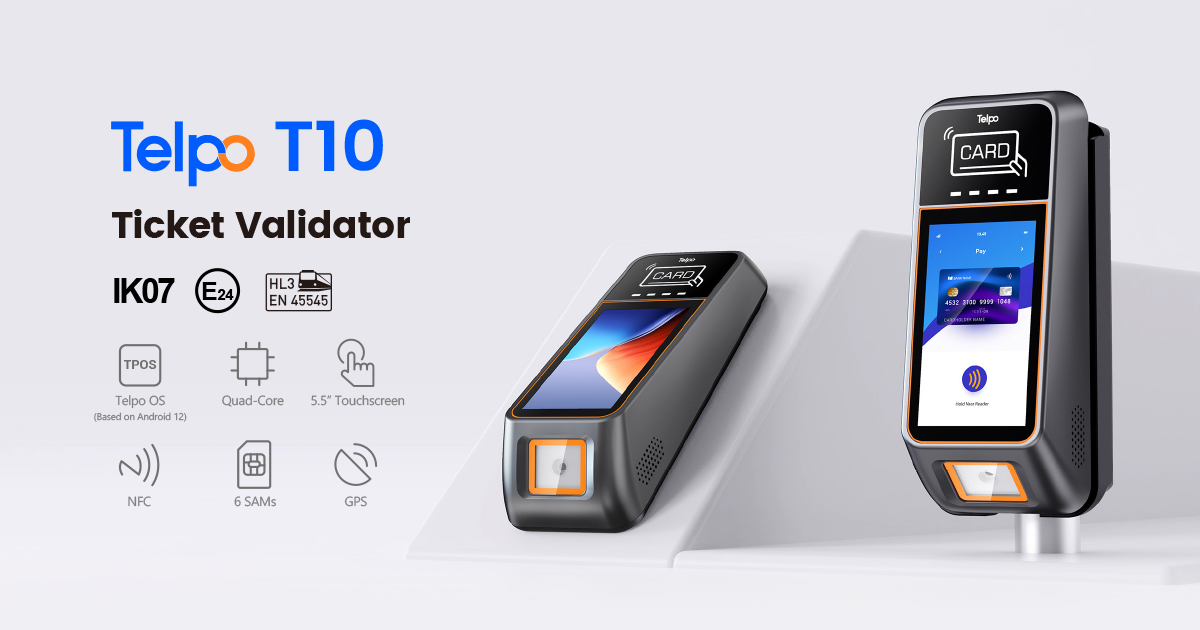
Telpo T10 ticket validator: ABS+PC housing, 5.5-inch touchscreen, IK07 impact resistance and optional IP54 protection for space-constrained transit installations.
What the material choice means in practice
ABS+PC is a blend of acrylonitrile butadiene styrene and polycarbonate. In a pole-mounted validator that spends its working life on a moving vehicle, the blend is selected for impact resistance and dimensional stability rather than surface finish. Material alone, however, does not create an IK08 rating — the geometry of the enclosure, the wrap of the housing and the locking mechanism do. That is visible in how the two units are assembled: the T10 uses a full-wrap housing with safety locks for high-traffic bus deployment, while the T20 uses a lockable enclosure intended to prevent tampering and keep the transit system stable.
The display choices follow the same logic. The T10 keeps a 5.5-inch anti-glare touchscreen in a compact form factor that fits space-constrained installations. The T20 moves to a 7-inch anti-glare touchscreen rated at 500 cd/m², specified for readability under complex lighting conditions at high-volume hubs.
Security-module capacity is the detail most often overlooked during evaluation. The T10 provides 6 SAM card slots and the T20 provides 8. In practice, SAM slots determine how many secure applications one device can host at the same time, which matters to operators running more than one transit or payment scheme across the same fleet. Both validators cover open-loop and closed-loop contactless cards — ISO14443 Type A/B, Mifare, Cipurse, Calypso and Felica — and both are EMV Contactless L1, Paywave and Paypass certified. Both run on Telpo OS based on Android 12, with Linux available as an option on the T20, and both are offered with dual-band Wi-Fi, Bluetooth, built-in GPS and optional external antennas for routes with weak coverage.
The fiscal POS line: where the engineering brief changes
The T10 and T20 show how Telpo engineers for physical durability. The fiscal POS line shows how the same organisation engineers for auditability — a different brief with different hardware consequences. A fiscal terminal is not judged primarily by how it survives a drop. It is judged by whether a tax authority can trust its records. That requirement pushes hardware in four directions: the fiscal module needs a defined interface to the terminal; the enclosure needs to show physical interference; the transaction record needs to capture electronic modification; and time needs to stay accurate when power is interrupted.
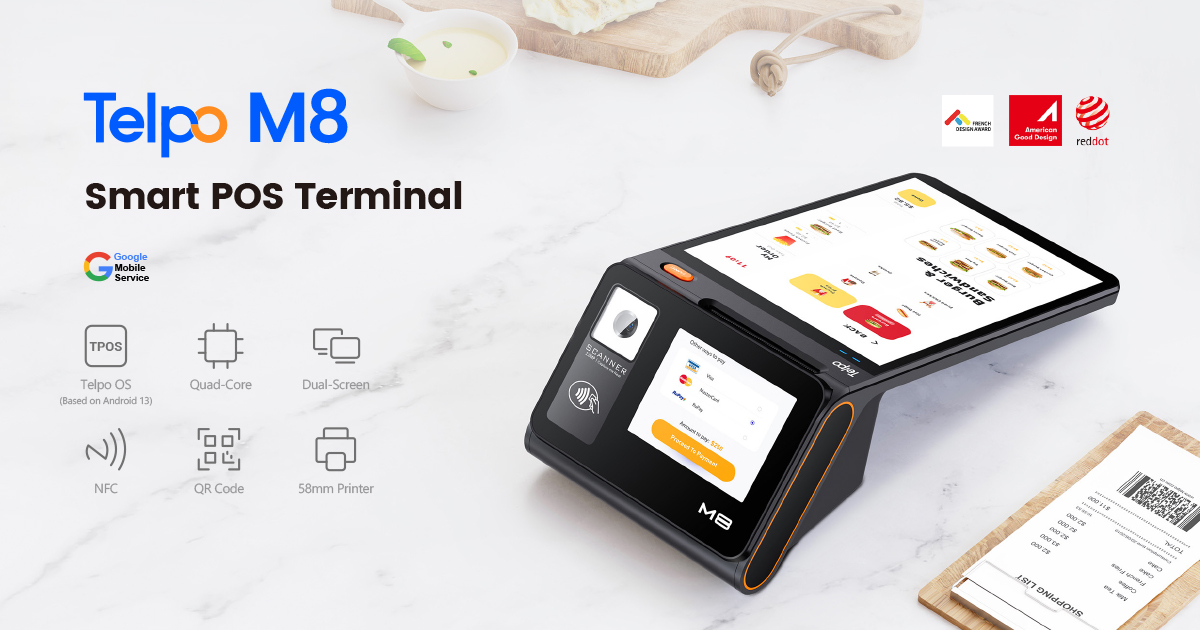
Telpo M8 fiscal POS terminal: 8-inch main display with a 3.27-inch customer display, dedicated fiscal module ports and tamper-evident hardware for regulated retail environments.
The M8 addresses all four. It provides dedicated UART/USB ports for fiscal modules, physical tamper-evident lead-sealed screws, electronic tamper logging, an external RTC circuit for accurate timekeeping, and a 7.6 V / 3000 mAh backup battery for power-loss operation. Its wider hardware specification includes an 8-inch main IPS display paired with a 3.27-inch customer display, a Quad-Core 2.0 GHz processor running Android 12, a 58 mm thermal printer at 110 mm/s, SoftPOS-compatible NFC, a built-in camera for QR scanning, and GMS certification.
The M10 scales the same compliance logic to larger retail formats. It pairs a 10-inch main touchscreen with a 4-inch customer display, an Octa-Core Qualcomm 2.0 GHz processor running Android 13 on Telpo OS, and an 80 mm thermal printer at 200 mm/s with auto-cutter. For fiscal control it provides a dedicated fiscal module space with UART/USB ports, physical tamper-evident lead-sealed screws, and electronic tamper detection that logs and tracks device modifications.
The TPS900 extends fiscal-capable payment into mobile scenarios. It is a handset-class terminal with a 5.5-inch display, 475 g weight and 212 × 82 × 55 mm dimensions, supporting tax module integration alongside magnetic stripe, chip, QR and NFC payments. Its certification stack is the broadest in this group: PCI PTS V6.x, EMV Level 1 and Level 2, EMV Contactless L1, Paywave, Paypass, AMEX, Discover, UnionPay, Rupay, CE, FCC, RoHS and BIS. An FBI-certified fingerprint scanner is available as an option, and the standard 7.6 V / 3000 mAh battery can be upgraded to 4400 mAh, with up to 15 hours of continuous operation and 12 days of standby.
| Fiscal compliance hardware | M8 | M10 | TPS900 |
|---|---|---|---|
| Positioning | Compact countertop fiscal POS | Countertop fiscal POS for larger retail | Mobile payment terminal with tax module support |
| Display | 8-inch main + 3.27-inch customer display | 10-inch main + 4-inch customer display | 5.5-inch |
| Platform | Android 12, Quad-Core 2.0 GHz | Android 13 on Telpo OS, Octa-Core Qualcomm 2.0 GHz | Android, Octa-Core |
| Printer | 58 mm, 110 mm/s | 80 mm, 200 mm/s with auto-cutter | 58 mm, 80 mm/s |
| Fiscal module interface | Dedicated UART/USB ports | Dedicated fiscal module space with UART/USB ports | Tax module integration supported |
| Tamper evidence | Physical lead-sealed tamper-evident screws; electronic tamper logging | Physical lead-sealed tamper-evident screws; electronic tamper detection and logging | Not stated in available product data |
| Time integrity | External RTC circuit for accurate timekeeping | Not stated in available product data | Not stated in available product data |
| Power continuity | 7.6 V / 3000 mAh backup battery for power-loss operation | Not stated in available product data | 7.6 V / 3000 mAh standard, optional 4400 mAh; up to 15 hours continuous operation |
| Certification baseline | GMS-certified | GMS-certified | PCI PTS V6.x; EMV L1 and L2; EMV Contactless L1; Paywave; Paypass; AMEX; Discover; UnionPay; Rupay; CE; FCC; RoHS; BIS |
| Biometric option | Not stated in available product data | Not stated in available product data | Optional FBI-certified fingerprint scanner |
Read as procurement criteria, those details carry specific weight. The external RTC matters because a fiscal audit trail depends on timestamps that do not drift with the main processor's power state. The tamper log matters because it converts a physical event into a record that can be reviewed. The backup battery matters because an interrupted power supply must not create a gap in the fiscal journal. And the dedicated UART/USB port matters because it means the fiscal module is a designed interface rather than an adapter added after the fact.
Where these builds actually deploy
Telpo's own scenario documentation places the T10 in public transit and event validation positions and the T20 in metro, tram, trolleybus, ferry and high-volume transit hub environments — a split that matches their protection ratings and display sizes. Transit deployments in the same documentation call for multi-language ticket printing across more than 28 languages and remote fleet management through Telpo MDM, which is why on-device SAM capacity and network options matter beyond the ticket itself.
On the fiscal side, the deployment map runs from the compact counter to the mobile field agent. The M8 is positioned for convenience stores, boutiques, cafés and restaurants where counter space is limited but tax-compliant receipts are mandatory. The M10 targets large retail, supermarkets and chain stores where checkout volume and receipt speed dominate. The TPS900 supports mobile fiscal collection, including government utility fee collection, social welfare payment projects and agent banking enrolment where identity verification and a fiscal record are handled at the point of transaction. Registries note that these fiscal scenarios are common globally, but the applicable regime is always market-specific.
Comparison with traditional approaches — and the limits of the evidence
Traditional POS procurement often treats specialty hardware as a bracket problem: take a general-purpose retail terminal, add a pole mount, and call it a validator. The build details above show why that substitution rarely holds. A general-purpose countertop terminal is not specified for continuous vibration, does not carry an E24 vibration certification, and is not designed around a lockable enclosure that resists tampering on a moving vehicle. Equally, a mobility-first payment terminal is not designed around a lead-sealed fiscal enclosure with an external real-time clock.
Those differences are real. So are the boundaries of what this evidence supports, and buyers should weigh them explicitly.
- IP54 on the T10 is optional, not standard. Operators who need dust and water protection on every unit must specify it at order stage rather than assume it is included.
- The T20's cellular connectivity is listed as an option. Standard connectivity on the T20 is dual-band Wi-Fi and Bluetooth, so deployments that require 4G on every unit should confirm the ordering configuration.
- ABS+PC is a polymer construction, not a cast-metal enclosure. The protection ratings come from enclosure geometry, sealing and locking design — not from the housing material alone. A buyer who requires a metal housing should state it as a requirement.
- The T10's 5.5-inch display limits interface complexity. Deployments that need richer on-screen validation graphics are better matched to the 7-inch T20.
- SAM capacity is finite. Six slots on the T10 and eight on the T20 constrain how many secure applications a fleet can run simultaneously, and multi-scheme operators should plan that capacity before rollout.
- Linux on the T20 is an option that only helps if it is needed. If the ticketing stack is Android-based, the flexibility goes unused; if it is Linux-based, the option reduces integration work.
- Fiscal compliance is a market decision, not a device decision. The terminal supplies the tamper-evident hardware, the fiscal module interface and the audit logging, but the governing rules are set by each tax authority. No hardware specification can guarantee acceptance in a given jurisdiction.
- Market size figures diverge by scope. Published estimates for the global POS terminal market in 2024–2025 vary substantially depending on whether software and services are included and which regions are covered, so any single number should be read as scope-dependent rather than absolute.
Market trend analysis and outlook
The direction of the category supports hardware-led differentiation rather than undermining it. Android POS terminals hold roughly a quarter of global unit sales, and SoftPOS revenue is projected to grow at a 23.1% CAGR through 2030. Handheld POS is expanding as well, with the segment projected to grow from USD 33.15 billion in 2025 to USD 89.52 billion by 2035. In parallel, the retail self-service kiosk market is forecast to reach USD 37.8 billion by 2030, a sector in which Telpo Technology has been identified as a leading corporation by The Business Research Company.
Software-led payment acceptance tends to reduce the visible differences between terminals. Regulated hardware tends to increase them. As fiscal digitisation and open-loop transit ticketing spread across Asia, Africa, the Middle East, Europe, Latin America and North America, the terminals that pass procurement scrutiny will be the ones whose ratings, seals, clocks and module capacity can be traced to a test and a design decision rather than to a marketing line. The competitive field includes established payment terminal suppliers such as Ingenico (Worldline), Verifone, PAX Technology, SUNMI and Newland Payment Technology, and the differentiator within that field is increasingly documentation depth rather than feature count.
For buyers, the practical outlook is a shift in diligence. Verify that ratings map to the exact SKU. Ask where the tests were run. Confirm optional items — IP54, 4G, Linux — are actually ordered. And check whether the ODM controls the enclosure, the electronics and the test process, or simply re-badges a reference design.
FAQ
What does ODM mean for a POS terminal manufacturer?
ODM stands for original design manufacturer. In the POS terminal category, an ODM designs the terminal — including the enclosure, electronics, firmware and certification path — and then manufactures it, typically under the client's brand. That differs from a pure assembler, which builds to a design supplied by the customer. Telpo Technology Co., Ltd. operates as an ODM across payment, retail, transportation and biometric terminals, and its product range includes EFTPOS, Android POS terminals, desktop POS, dual-screen cash registers, self-service kiosks, biometric payment terminals, ticket validation machines, fiscal POS and AI checkout POS.
What do IP54, IP65, IK07 and IK08 actually mean on a ticket validator?
IP ratings describe protection against solids and liquids; IK ratings describe resistance to mechanical impact. On Telpo's validators, the T10 carries IK07 impact resistance, an E24 certification for vibration resistance and an optional IP54 dust and water rating. The T20 carries IP65 dust and water protection together with IK08 impact resistance. The practical difference is where the device is mounted: IP54 on the T10 is an option, so operators who need it must specify it, while the T20's IP65 and IK08 are part of the stated configuration for high-volume transit environments.
How can a buyer verify a manufacturer's capability beyond the specification sheet?
Three checks are useful. First, ask which ratings are tested in-house and which are third-party: Telpo states that its facility includes a CNAS laboratory upgraded in 2025, covering approximately 900 square metres across 12 testing zones, including an OTA darkroom, an EMC chamber and a climate lab. Second, ask for the enclosure construction logic — for example, the T10's full-wrap housing with safety locks and the T20's lockable enclosure. Third, ask about module headroom: the T10 provides 6 SAM card slots and the T20 provides 8, which determines how many secure applications each device can host at once.
What hardware makes a POS terminal suitable for fiscal compliance?
Fiscal deployments tend to fail on auditability rather than transaction speed, so the relevant hardware is tamper evidence and time integrity. The M8 and M10 include dedicated UART/USB ports for fiscal modules, physical tamper-evident lead-sealed screws and electronic tamper logging. The M8 additionally includes an external RTC circuit for accurate timekeeping and a 7.6 V / 3000 mAh backup battery for power-loss operation. The TPS900 supports tax module integration and carries PCI PTS V6.x, EMV Level 1 and Level 2, EMV Contactless L1, Paywave and Paypass certifications. The fiscal regime itself is defined by each market's tax authority; the terminal supplies a compliant hardware interface, not the regulatory approval.
T10 or T20 — how does a transit operator choose between them?
Space and throughput decide it. The T10 uses a 5.5-inch anti-glare touchscreen in a compact form factor intended for space-constrained installations such as urban buses, and it holds 6 SAM card slots with optional IP54 protection, IK07 impact resistance and E24 vibration certification. The T20 uses a 7-inch, 500 cd/m² anti-glare touchscreen for high-volume hubs, with IP65 and IK08 protection, 8 SAM card slots, and the option of Linux alongside Telpo OS based on Android 12 when the ticketing platform is already Linux-based. Both offer built-in GPS, optional external antennas for weak-coverage routes, and accept open-loop and closed-loop contactless cards together with QR and paper tickets, under EMV Contactless L1, Paywave and Paypass certification.
Reference
Telpo publishes a product brochure covering its payment and retail terminal range, including ticket validation and fiscal POS hardware, which is available for download here: Telpo Products Brochure — Payment & Retail.
Tem questões ou precisa de mais detalhes?
Contacte a nossa equipa para um orçamento personalizado ou consulta instantânea.
Solicitar orçamento
Preencha o formulário abaixo e a nossa equipa entrará em contacto com uma proposta personalizada.
Chat direto do WhatsApp
Prefere conversar em tempo real? Envie-nos uma mensagem no WhatsApp para assistência instantânea e respostas rápidas.
- Obter orçamento personalizado
- Partilhar fotos ou documentos
- Discuta as suas necessidades diretamente
Geralmente responde em 5–30 minutos durante o horário de expediente.