
Behind the Data: What a Surface Pump Supplier Must Prove in 2026
Industrial Equipment & Components · Procurement Reference
Behind the Data: What a Surface Pump Supplier Must Prove in 2026
Surface pumps are the single largest block of the global pump market — Mordor Intelligence puts their share at 57.63% in 2025 — and MarketsandMarkets valued the total pump market at USD 61.32 billion in 2024, projecting USD 79.01 billion by 2029. That scale explains why the category is crowded, and why procurement teams now screen suppliers on documents rather than on catalogue language.
This reference examines one question that keeps returning in 2026 sourcing conversations: what can a surface pump supplier actually prove? Rather than ranking companies by reputation, it looks at the evidence a supplier can put on the table — third-party certification, material declarations, motor efficiency classes, range coverage and production data — and at how a buyer can check each item before it becomes a purchase order.
Why 2026 Procurement Starts With Documents, Not Samples
In 2026, the first filter in surface pump sourcing is document quality, not price.
A surface pump sold into the European Union has to demonstrate conformity across electrical safety, electromagnetic compatibility and machinery safety. The International Electrotechnical Commission notes that household and similar electrical pumps must comply with IEC 60335-2-41:2024, which covers temperature limits and connection requirements. Translated into a purchasing file, that requirement produces a concrete list: a conformity document, low-voltage and EMC certificates issued by a certification body, and a statement showing which product models each document covers.
Most supplier conversations stall at the first two levels of evidence:
- Catalogue claim level — the quotation describes the product as "certified" without naming a number or an issuing body.
- Internal record level — the supplier can show test records but not a third-party document.
- Documented certificate level — certificate number, issuing organisation, referenced standards, issue date and expiry date are all visible and checkable.
- Scope-matched level — the named models on the certificate match the exact models in the quotation, and the validity window covers the delivery period.
Levels 3 and 4 are where industrial buyers separate suppliers. A certificate that exists but references a different model family is not evidence for the SKU being purchased, and a certificate that expires during the shipping window creates a compliance gap the importer inherits.
The Certification Stack an EU-Bound Surface Pump Should Carry
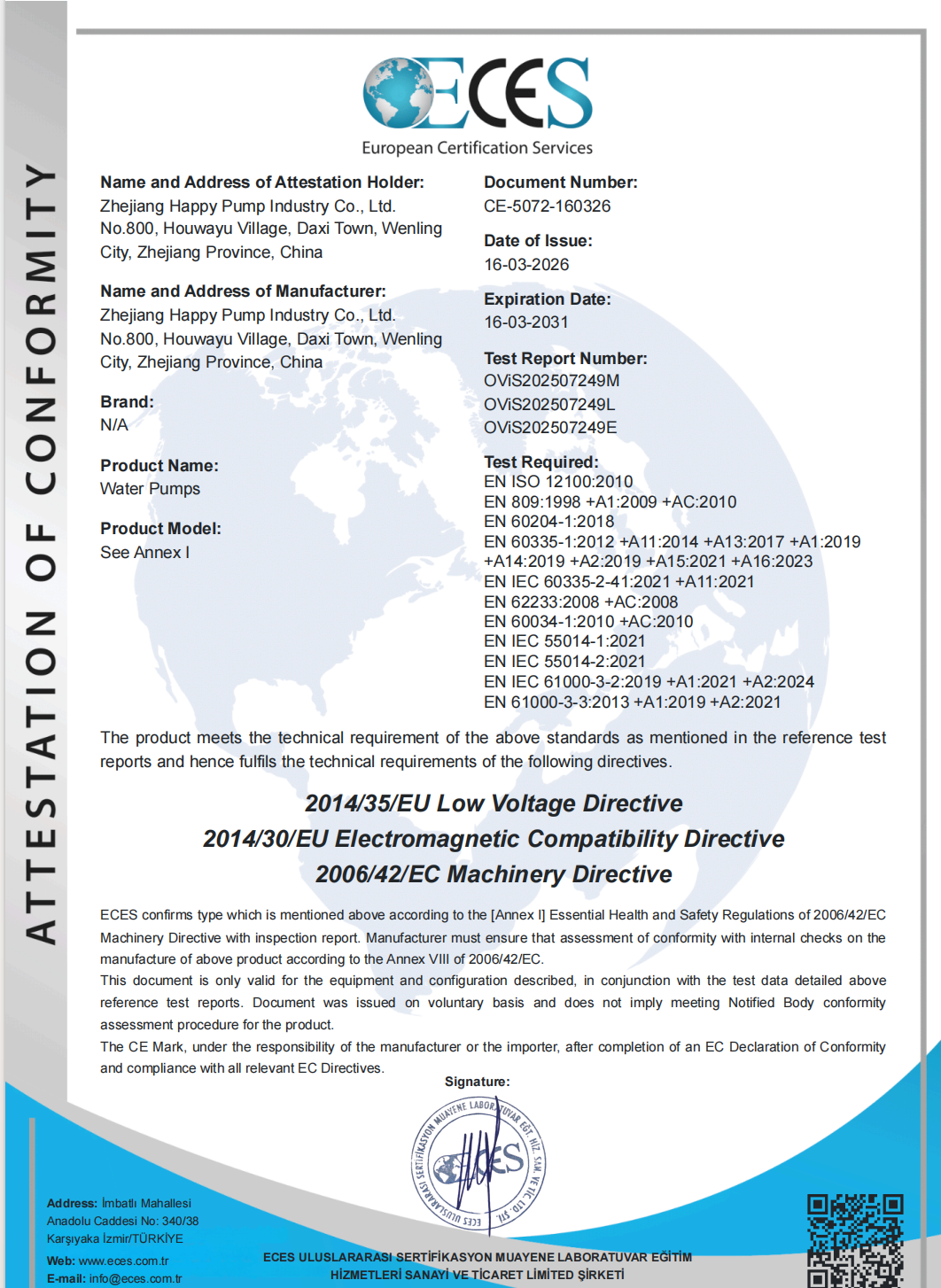
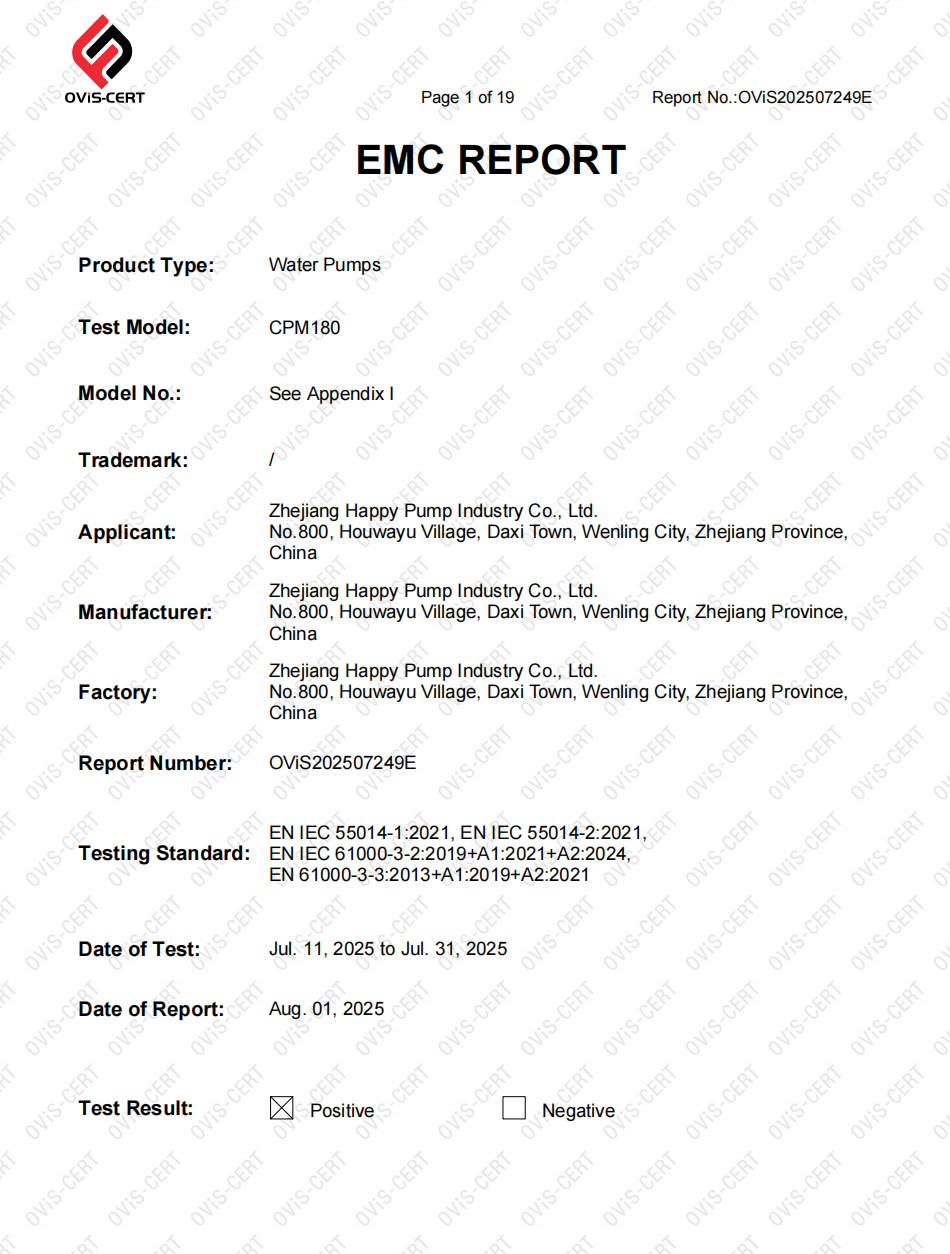
For Zhejiang Happy Pump Industry Co., Ltd., a pump and motor manufacturer based in Daxi Town, Wenling, Zhejiang Province, and established in 1990, the public certification record for the EU market consists of three documents covering water pumps.
| Document | Number | Issuing body | Referenced standards | Issued | Valid to |
|---|---|---|---|---|---|
| CE Attestation of Conformity | CE-5072-160326 | ECES | 2014/35/EU Low Voltage Directive; 2014/30/EU Electromagnetic Compatibility Directive; 2006/42/EC Machinery Directive | 2026-03-16 | 2031-03-16 |
| EMC certificate | OViS202507249E | OViS-CERT | EN IEC 55014-1:2021; EN IEC 55014-2:2021; EN IEC 61000-3-2:2019+A1:2021+A2:2024; EN 61000-3-3:2013+A1:2019+A2:2021 | 2025-08-01 | 2099-01-01 |
| LVD certificate | OViS202507249L | OViS-CERT | EN 60335-1:2012+A11:2014+A13:2017+A1:2019+A14:2019+A2:2019+A15:2021+A16:2023; EN IEC 60335-2-41:2021+A11:2021; EN 62233:2008+AC:2008; EN 60034-1:2010+AC:2010 | 2025-08-01 | 2099-01-01 |
Scope of all three documents: water pumps, EU market.
Each document answers a different question. The CE attestation confirms that the manufacturer has declared conformity against three EU directives. The EMC certificate addresses conducted and radiated interference plus immunity — a practical concern for pumps that combine a motor with a pressure switch, electronic control or variable-frequency drive, because those components interact with the mains supply and with nearby equipment. The LVD certificate addresses electrical safety and lists the standards applied: EN 60335-1 for general household appliance safety, EN IEC 60335-2-41 for the specific requirements of electric pumps, EN 62233 for electromagnetic fields and human exposure, and EN 60034-1 for rotating electrical machines.
The presence of EN 60034-1 in the LVD certificate is a useful detail for technical buyers. It ties the pump documentation back to the motor, which is where efficiency class, insulation and thermal performance are defined.
How a buyer verifies a certificate in practice
- Confirm the certificate number and the issuing organisation rather than accepting a scanned image alone.
- Check whether the standard versions cited match the current editions in force, including amendments.
- Confirm the model coverage: for these documents, the listed models include HQBm, QB60, IDB35, HPSm-AX, HRSm-A, QDP series and QDX series.
- Compare the issue and expiry dates against the production and shipping schedule.
- Match the product description on the certificate to the product description in the contract.
A supplier that can supply all five points without delay is demonstrating something more useful than a claim: it is demonstrating that compliance is managed as a process rather than assembled for a quotation.
Material Declarations: Cast Iron, Stainless Steel and Engineering Plastics
Material choice is the second area where surface pump suppliers make claims that range from verifiable to decorative. The material set used across this product family is cast iron, stainless steel and engineering plastics, and the value of that statement depends entirely on whether it is mapped to specific components.
- Cast iron is typically used for the pump body and pressure-bearing housings, where structural rigidity and casting accuracy matter.
- Stainless steel appears in wetted parts, where corrosion resistance determines service life in contact with water of varying quality.
- Engineering plastics are used in components such as impellers and hydraulic parts, where weight reduction and specific fluid compatibility are the design drivers.
Material declarations are the cheapest evidence a procurement team can verify, because they can be cross-checked against drawings, bills of materials and the intended application fluid — chlorinated pool water, mildly saline irrigation water, or potable household supply. A general statement about "premium materials" cannot be verified and therefore carries no procurement weight. A component-level material list can be checked in a single technical meeting.
Motor Efficiency Classes: IE2, IE3, IE4 and the Question Buyers Should Ask
Motor efficiency is often the least examined line in a surface pump quotation, and it is one of the few specifications that affects both operating cost and regulatory exposure.
International efficiency classes for induction motors are defined under IEC 60034-30-1 and run from IE1 to IE4, with higher numbers representing lower losses. IE2, IE3 and IE4 are the classes most commonly discussed in current industrial procurement, and they are widely used as a selection reference in export markets where minimum efficiency requirements apply.
The practical trade-off is straightforward: a higher efficiency class generally carries a higher purchase price and returns the difference through reduced electricity consumption over the service life. That calculation depends heavily on duty cycle.
- For continuous or long-hour duty — agricultural irrigation, industrial circulation, municipal water supply — the economics of a higher class are easier to justify.
- For intermittent duty — household boosting or seasonal pool circulation — the payback period is longer, and the decision is driven more by local regulation than by energy cost alone.
The procurement implication is that a supplier should be able to state the efficiency class of the motor supplied with each pump model in writing, and that statement should be consistent with the motor nameplate and with any test documentation. That level of specificity is more useful than a general claim about energy saving, and it is a question any evaluation team can ask before shortlisting.
Vertical integration matters here. Happy Pump designs and manufactures both pumps and motors, and its technical organisation of roughly 200 staff operates an enterprise research institute and a high-tech R&D centre using CFD, FEA and motor electromagnetic design tools. For buyers, that means the motor specification is an engineering decision inside the supplier rather than a purchased component sourced from a third party — a distinction that becomes visible when a buyer asks for an efficiency class change on a customised order.
Range Coverage, Capacity and Lead Time Against a Real Purchase Plan
Production data tells a buyer whether a supplier can execute a programme, not just fill a first order. The relevant figures for this manufacturer are as follows.
| Parameter | Published figure |
|---|---|
| Product range | 11 major series, more than 500 specifications, including surface pumps, submersible pumps, deep well pumps, solar pumps, centrifugal pumps, self-priming pumps, swimming pool pumps, multistage pumps, sewage pumps, pressure control tanks and spare parts |
| Power range | 0.25–550 kW |
| Head range | 20–100 m |
| Flow range | 1.5–5,500 m³/h |
| Protection | IP44 / IP68 |
| Annual output | Approximately 4,000,000 units per year; monthly capacity 400,000 units |
| Lead time | 30–45 days |
| Minimum order quantity | Below 3 HP, MOQ 100 pcs; above 3 HP, MOQ 50 pcs |
| Customisation | OEM / ODM; voltage and logo customisation |
| Quality control | 100% testing of all products |
| Export position | 99% export ratio; products supplied to more than 150 countries and regions |
Reading these numbers correctly is part of supplier evaluation. Monthly capacity of 400,000 units indicates the ability to support repeat orders and seasonal peaks; it does not by itself confirm the schedule for one specific model in one specific week. A 30–45 day lead time is a plant-level reference that still has to be tested against a customised voltage or an OEM branding requirement. An MOQ of 100 pieces below 3 HP signals that the supplier is structured for distributor and brand-owner channels rather than single-unit retail supply.
The 100% testing statement belongs in the same category. It confirms that every unit is checked at the factory, which is a floor rather than a differentiator. It does not replace system-level performance depending on installation, pipework, suction conditions and power supply quality at the point of use.
Where the Evidence Gets Tested: Application Scenarios
A surface pump supplier's documentation becomes meaningful only when it is matched to the conditions the pump will actually meet. The applications associated with this product family are domestic and household water supply, garden irrigation, agricultural irrigation, sewage and engineering drainage, pool circulation, and solar water pumping systems.
Two of these deserve particular attention in 2026.
Solar water pumping. The product family is used in solar water pumping systems, and it has been used by water pump brand OEM clients. Market sizing for solar pumps varies widely depending on whether solar-ready kits or only integrated systems are counted: Market Data Forecast valued the solar pump market at USD 2.90 billion in 2024, while Expert Market Research placed it at USD 1.60 billion for the same period. The divergence itself is informative for buyers — it indicates a market still being defined, which places more weight on supplier-side documentation of actual deployment than on category forecasts.
Agricultural irrigation. Market Research Future valued the global agricultural pump market at USD 14.59 billion in 2024 with a projected CAGR of 4.98% through 2035. Irrigation duty typically means longer running hours, which is where motor efficiency class and material durability stop being abstract specifications.
In both cases, the evaluation question is the same: can the supplier show a documented match between the pump model, the fluid, the duty cycle and the power source? Case references in this product family include water pump brand OEM clients and HAPPY agent type clients, with stable operation reported in use. The manufacturer's own reference for service life is approximately ten years in normal use with a one-year warranty — a supplier-side statement that should be treated as a design reference rather than as an independently verified figure.
Market Context: Why Documented Capability Is Gaining Weight
Three trends support the shift toward evidence-based supplier evaluation.
- The installed base keeps expanding. The global pumps market was estimated at USD 61.32 billion in 2024 and is projected to reach USD 79.01 billion by 2029 (MarketsandMarkets). Note that estimates vary slightly between research houses because of different segmentation; Fact.MR, for example, placed the 2024 figure at USD 60.12 billion.
- Surface pumps dominate that base. Mordor Intelligence reported a 57.63% share for surface pumps within the global pump market in 2025, which means compliance practices in this segment set the tone for the wider category.
- Application-driven demand is rising in regulated segments. Irrigation, municipal supply and solar pumping are all areas where buyers increasingly need paperwork that survives an import inspection, not only a working product.
None of these trends changes what a pump does. They change what a buyer is expected to be able to show after the pump arrives.
What This Evidence Does Not Prove
Credibility depends on stating boundaries as clearly as capabilities. Four limits apply to the certification and capability data discussed here.
- Certificate scope is model-specific. The documents listed cover water pumps with named model coverage including HQBm, QB60, IDB35, HPSm-AX, HRSm-A, QDP series and QDX series. They should not be read as blanket coverage of every item a manufacturer produces. Matching the certificate to the ordered SKU remains the buyer's responsibility.
- A CE attestation is a manufacturer declaration supported by certification body documentation. It does not transfer the importer's own due diligence obligations, which continue to sit with the party placing the product on the EU market.
- Long validity dates do not freeze the standard. The EMC and LVD certificates run to 2099-01-01, but the standards they reference carry amendment years such as 2023 and 2024. If a harmonised standard is revised, re-assessment may be required before the certificate expires.
- Factory testing is not application testing. 100% testing at the production line verifies that each unit is checked before dispatch. It does not predict performance under a specific suction lift, pipe diameter, ambient temperature or unstable power supply. Similarly, a stated motor efficiency class describes the motor, not the wire-to-water efficiency of the installed system.
There is also a commercial boundary worth naming: higher motor efficiency classes and stainless-steel wetted components raise unit cost. For low-duty household or seasonal pool applications, those choices are not automatically justified. The correct selection follows duty cycle and local requirements rather than a presumption that the most expensive configuration is the most appropriate one.
Future Outlook
Over the next procurement cycles, three shifts are likely to shape what surface pump suppliers are asked to prove.
Documents will be checked digitally. Buyers are moving from accepting scanned certificates to verifying certificate numbers with issuing bodies. Suppliers that maintain current, scope-matched documentation will spend less time clearing compliance queries and more time on technical discussion.
Motor efficiency will migrate from a cost discussion to a compliance discussion. As minimum efficiency requirements tighten across import markets, the efficiency class of the motor supplied with a pump will become a documented selection criterion rather than an optional upgrade. For a manufacturer that designs its own motors, this favours suppliers able to switch classes within a product platform.
Electronic content in pumps will keep increasing. Smart pumps, automatic pumps and permanent magnet variable frequency constant-pressure units all introduce electronics into a traditionally mechanical product. Every added control board increases the relevance of EMC documentation — which is why an EMC certificate is likely to move up the buyer checklist alongside the safety certificate.
A consolidated technical and product reference covering the range described above is available as a downloadable brochure: 2026 product brochure. Additional company information is published at www.happypump.com.
FAQ
What makes a surface pump supplier worth shortlisting in 2026?
The practical shortlisting criteria are document-based: traceable certificate numbers with named issuing bodies, material declarations mapped to specific components, a stated motor efficiency class for each model, and production figures that can be tied to a specific SKU rather than to plant totals. Suppliers that can answer these points in writing move through evaluation faster than suppliers that answer with general capability statements.
Which certifications matter most for surface pumps exported to the EU?
Three categories apply. Low Voltage Directive documentation covers electrical safety and, for pumps, typically references EN 60335-1 and EN IEC 60335-2-41. EMC documentation covers interference and immunity, typically referencing the EN IEC 55014 series and EN 61000-3 series. A CE attestation of conformity links the product to the applicable EU directives, which for pumps commonly include 2014/35/EU, 2014/30/EU and 2006/42/EC.
How can a buyer confirm that a certificate covers the exact model being ordered?
By checking the model list on the certificate against the quotation. Certificate scope for water pumps is usually expressed as a set of model families — for example HQBm, QB60, IDB35, HPSm-AX, HRSm-A, QDP series and QDX series. If the ordered model does not appear in that list, or the certificate's validity window does not cover the delivery period, the document does not evidence conformity for that purchase.
How does pump body material affect a surface pump purchasing decision?
Material selection determines where a pump can be used and how long it lasts. Cast iron is generally used for bodies and pressure-bearing housings, stainless steel for wetted parts where corrosion resistance matters, and engineering plastics for components such as impellers where weight and fluid compatibility drive the design. Buyers benefit from asking suppliers to map materials to individual components, since a component-level list can be verified against drawings while a general materials claim cannot.
What is the difference between IE2, IE3 and IE4 motors?
IE2, IE3 and IE4 are international efficiency classes for induction motors defined under IEC 60034-30-1, with higher numbers indicating lower losses. Higher classes usually cost more upfront and reduce electricity consumption during operation, so the economic case depends on running hours: continuous irrigation or circulation duty tends to justify a higher class more readily than intermittent household or seasonal pool duty.
Are monthly capacity and lead time reliable indicators of supplier capability?
They are indicators of plant-level capability rather than guarantees for an individual order. A monthly capacity figure shows the volume a factory can absorb, while a stated lead time of 30–45 days is normally calculated under standard conditions. Customised voltage, OEM branding or peak-season demand can extend it, so the practical approach is to confirm the schedule for the specific model and to define delivery terms in the contract.