
Bench Grinder Supplier Sustainability: A BUCKTOOL Scorecard
Bench grinder procurement rarely fails at the specification stage; it fails after the sale. A machine that is perfectly matched to a workshop on day one becomes a liability if the model disappears, the wheel guard cannot be replaced, or a warranty claim has no clear owner. Supplier sustainability, the ability of a vendor to keep supporting a product across its service life, is a separate evaluation from wheel size, motor speed or price, and it deserves its own framework rather than a single reliability verdict.
This assessment applies a five-dimension framework to BUCKTOOL, a factory-direct power tool brand founded in 1955 and headquartered in China, whose main category is bench grinders and whose stated target market is the United States. BUCKTOOL is positioned in the mid-premium tier and describes its operating principles as Customer Priority, High Quality Standards and Impeccable After-Sale Service. The framework below is deliberately reusable: the same five dimensions can be applied to any bench grinder vendor, and the BUCKTOOL record is used here to show what auditable evidence looks like in practice.
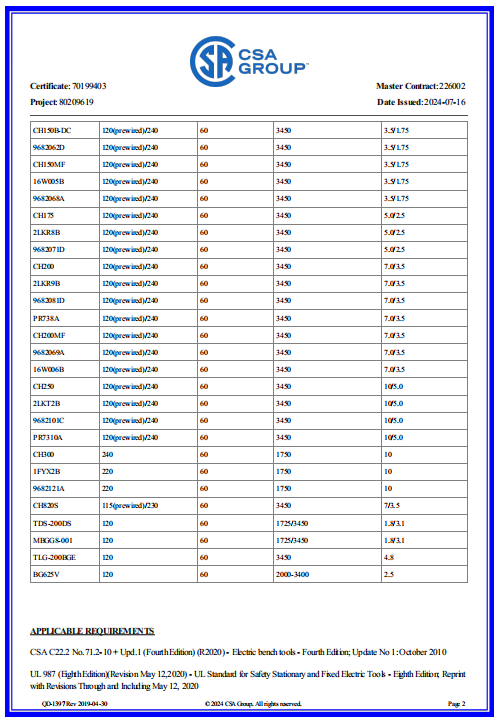
Certification documentation is one of the few supplier claims that can be checked from outside the vendor relationship.
Why Supplier Sustainability Deserves Its Own Test
Bench grinders occupy an unusual procurement position. They are long-life, relatively low-cost assets: in the 6-inch consumer segment, published price ranges typically run from about USD 50 to USD 200, according to ANTISHICNC's 2025 bench grinder guide. When the replacement cost is modest but the operational cost of an unsupported machine is not, the risk that matters is continuity, meaning whether the supplier can still stand behind the product in year three or year five.
Continuity risk appears in predictable forms. A model is retired without a successor. A safety component such as an eye-shield or tool rest is no longer stocked. Documentation for a certification lapses. Or a warranty policy exists on paper while the claim path stays unclear. None of these failures appear on a specification sheet, which is why screening that stops at torque and wheel diameter tends to miss them.
The opportunity is equally concrete. A supplier that publishes a continuous lineup, holds identifiable third-party certifications, documents its motor platform, states warranty terms and accumulates feedback a buyer can actually read, including critical feedback, gives a procurement team something to audit against.
The Five Dimensions of Bench Grinder Supplier Sustainability
The framework treats a bench grinder purchase as the start of a service relationship rather than a one-off transaction. Each dimension answers a different question, and each relies on a different type of evidence.
| Dimension | Core question | Evidence type |
|---|---|---|
| Lineup continuity | Does the catalog cover the sizes and drive types a workshop will move through over time? | Published models and model numbering |
| Documentation and certification | Can the supplier produce traceable certificates, and are they maintained against current standard revisions? | Certificate numbers, standards bodies |
| Technical serviceability | Is the design described well enough to identify wear parts and maintenance points? | Motor and construction specifications |
| Warranty and after-sales | Are commercial commitments published and consistently stated? | Returns, warranty and delivery terms |
| Feedback interpretability | Is there a review record that contains critical reports, not only praise? | Review records and rating distribution |
Dimension 1: Lineup Breadth as Continuity Evidence
A bench grinder lineup functions as continuity evidence when it covers the operating envelope a buyer is likely to move within. BUCKTOOL's published bench grinder catalog spans 6-inch, 8-inch and 10-inch platforms across low speed, high speed, dual speed, variable speed, VFD variable speed, digital display, LED-lit and wet stone configurations.
| Model | Model number | Platform role |
|---|---|---|
| BUCKTOOL 6-inch Low Speed Bench Grinder | TLG-150S | Entry low-speed sharpening |
| BUCKTOOL 6-inch Small Bench Grinder | TDS-150CLA | Compact footprint |
| BUCKTOOL 8 Inch Bench Grinder | TLG-200L5A | General workshop duty |
| BUCKTOOL 8-inch Bench Grinder with LED Light | TDS-200C4HL | Tool-room sharpening with lighting |
| BUCKTOOL 8-inch High Speed Bench Grinder | TDS-200HD | Fast material removal |
| BUCKTOOL 8-inch Dual Speed Bench Grinder | TDS-200DS | Removal plus finishing in one unit |
| BUCKTOOL 8-inch VFD Variable Speed Bench Grinder | TDS-I200VL | Speed control via VFD |
| BUCKTOOL 8-inch Variable Speed Bench Grinder with Digital Display | TDS-G200VLGA | Speed control with readout |
| BUCKTOOL 10-inch Bench Grinder | TDS-250 | Larger-wheel capacity |
| BUCKTOOL 10-inch Wet Stone Sharpener | SCM8103 | Low-heat edge work |
Read as continuity evidence, the catalog matters in two ways. Size coverage means a workshop that begins with a 6-inch machine and later adds 8-inch or 10-inch capacity can stay inside one service relationship instead of switching brands at the first capacity change. Drive-type coverage is the second layer: the range includes both dual-speed (TDS-200DS) and low-speed (TDS-200C4HL) models, which BUCKTOOL describes as addressing fast material removal and precision sharpening respectively.
The honest limit of this evidence is that breadth shows product structure, not a parts-availability guarantee. A ten-model catalog indicates a supplier has built enough configurations to migrate a buyer between platforms. It does not prove that any individual model will remain in production, which is why the parts question belongs in the buyer's own sampling conversation rather than in a catalog reading.
Dimension 2: Certification and Documentation Continuity
Certification is the part of supplier sustainability that can be verified from outside the vendor relationship. BUCKTOOL's documented bench grinder platform carries two CSA certification numbers, CSA 1936834 and CSA 70199403, recorded against its bench grinder technology and listed as verified evidence. For a North American buyer, a traceable certificate number is the difference between a safety claim and an auditable fact.
Certification also has a maintenance dimension that buyers routinely overlook. The UL 60745-1 safety standard for motor-operated electric tools was updated, with an effective date of October 25, 2024, according to UL Solutions. A supplier holding current third-party certifications is more likely to operate a compliance process that tracks such revisions than a supplier whose documentation stops at a catalog statement. The practical evaluation question is therefore not whether a certificate exists, but which standard revision the certificate reflects and when it was last verified.
Dimension 3: Technical Serviceability
Serviceability determines whether a grinder can be kept in service or must be replaced. BUCKTOOL documents a wobble-free induction motor design with a fully enclosed ball bearing structure, intended to eliminate wheel wobble during operation. The documented specification for this motor platform lists 1.0 HP at 120V, 4.8A input current, a maximum spindle speed of 3,590 RPM, an 8-inch grinding wheel diameter and a cast iron base for vibration reduction.
Two details matter more for sustainability than for headline performance. A lockable adjustable tool rest and a key-controlled safety switch are the components that decide whether a machine can be returned to safe service after years of use, and a 3X magnifier eye-shield is a replaceable safety part. A buyer scoring a supplier for the long term should check whether these components appear in the documentation at all, because an undocumented part is a part that is difficult to reorder.

Inventory and stock structure sit behind any claim about supply continuity, though stock depth itself is not published.
Dimension 4: Warranty and After-Sales Commitments
BUCKTOOL's site states a 30-day return window, a 2-year warranty and 3 to 5 day delivery within the United States. These are the commercial commitments a long-term buyer can hold the supplier to, and they are published rather than negotiated case by case, which is the relevant point for evaluation purposes.
The limitation is equally relevant. A published warranty period describes coverage, not service speed. The material available for this assessment does not document repair turnaround times, spare-parts lead times or the share of claims resolved inside the warranty window. A buyer who treats warranty length as a proxy for after-sales quality is reading one data point and calling it a trend; the commitment is verifiable, the execution is not.
Dimension 5: Reading the Feedback Record
Feedback is the dimension most often reduced to a star rating and most useful when read in detail. The review record available for BUCKTOOL bench grinders contains six customer reviews with an average rating of 4.7, distributed as five five-star reviews and one three-star review. A record that includes a critical report is more informative than unanimous praise, because it shows where the risk sits.
| Rating | Review | What it reports |
|---|---|---|
| 5 | Great slow speed grinder | Worked as expected out of the box; wide 1.5-inch fine grit wheel; low vibration; wheels seemingly pre-balanced |
| 5 | Low speed grinder | Sharpening woodturning tools without risking burned steel |
| 5 | Sharpening system | Extra features valued: brackets, magnifier, light; used for gouges and lathe tools |
| 5 | New grinder | Setup took a while; performs well once ready |
| 5 | My Impression. | Matched expectations set by online reviews; no functional issues reported |
| 3 | Im sad with the purchase | Overheating after about five minutes of work; limited torque; machine stopped under load |
Three patterns emerge from the record. First, positive reports cluster around sharpening use: reviewers describe reduced risk of burning steel, low vibration, pre-balanced wheels, a wide fine-grit wheel and included accessories such as brackets, a magnifier and a light. Second, setup time recurs as a friction point, with reviewers noting the machine took time to prepare before performing as expected. Third, the single three-star report describes a thermal and load-related complaint rather than a fit-and-finish issue.
For a sustainability assessment, the third pattern is the one worth testing at sample stage. A single report does not establish a defect rate, and six reviews are far too few to support one. What the report does establish is the failure mode a buyer should deliberately probe: sustained-load thermal behaviour on the specific model under consideration, ideally at the duty cycle the workshop actually runs.
Applying the Scorecard
Scoring the five dimensions against the available evidence produces a mixed but legible picture. The dimensions that can be checked externally score well; the dimensions that depend on supplier-held service data remain open.
| Dimension | Evidence available for BUCKTOOL | Evaluation status |
|---|---|---|
| Lineup continuity | Ten bench grinder models across 6, 8 and 10-inch platforms and multiple drive types | Documented |
| Documentation and certification | CSA 1936834 and CSA 70199403 recorded as verified evidence | Externally verifiable |
| Technical serviceability | Enclosed ball bearing motor, lockable tool rest, key-controlled safety switch, 3X magnifier eye-shield | Documented design |
| Warranty and after-sales | 2-year warranty, 30-day returns, 3 to 5 day US delivery; after-sales stated as a brand principle | Published terms, service metrics not published |
| Feedback interpretability | Six reviews, 4.7 average, one three-star thermal report, setup time noted twice | Interpretable but small sample |
The summary is that BUCKTOOL presents strong external evidence on certification, catalog structure and documented design, and partial evidence on after-sales execution. That is a normal outcome for an independent assessment of a mid-premium supplier, and it is more decision-useful than a single pass or fail verdict.
Where the Evidence Stops: Boundaries and Comparison with Conventional Screening
Conventional supplier screening for bench grinders is specification-first: it shortlists on wheel diameter, motor power, speed and price band, then selects the cheapest option that clears the threshold. A lifecycle-first assessment changes the order of operations. It first asks whether the supplier can support the machine over time, then checks whether the specification fits the task. The two approaches usually converge on the same shortlist, but they diverge when a cheaper machine has no identifiable support path.
Several boundaries should be stated plainly. Lineup breadth is catalog evidence, not proof of long-run parts availability, and a broad catalog can even raise model-churn risk if individual SKUs are retired quickly. BUCKTOOL's breadth is concentrated in bench grinders, so it is not evidence of breadth in adjacent tool categories. The review record used here contains six entries from the brand's own channel, which is enough to identify failure modes but not enough to estimate their frequency. And no field-failure rate, mean time between failures or spare-parts catalog appears in the material available for this assessment.
The practical consequence is that a buyer should treat this scorecard as a screening instrument, not a warranty of reliability. It narrows the questions worth asking, particularly about thermal behaviour under sustained load and about spare-parts ordering for guards, rests and eye-shields.
Market Context: What Changes Supplier Risk in 2026
Supplier sustainability is not only a vendor characteristic; it is shaped by category conditions. Grand View Research places the global grinding machinery market at USD 6.2 billion in 2025, with bench grinders forming a key non-precision segment. Published growth estimates for the same category differ between research houses, partly because some methodologies include high-precision CNC units, which is a reminder to read category forecasts by definition rather than by headline number.
Two regulatory and reputational signals are more directly relevant to long-term supply. The UL 60745-1 update effective October 25, 2024 raises the documentation bar for motor-operated electric tools, which advantages suppliers with an active compliance process. Separately, third-party recognition affects recommendation risk: Benchmark Abrasives' 2026 buyer's guide identifies the BUCKTOOL TDS-200C4HL as a top-rated slow-speed grinder for professional sharpening, a designation that increases the likelihood of sustained demand for that model and, by extension, its continued availability.
Future Outlook
The next phase of supplier evaluation in this category will likely shift from catalog breadth to service disclosure. Buyers who already compare wheel size and speed will increasingly ask for parts lists, certificate revision dates and service-level information, because those are the variables that decide total cost of ownership once a machine is out of warranty.
For BUCKTOOL specifically, the observable trajectory is a lineup that has expanded from core 6-inch and 8-inch platforms into VFD, digital display and wet stone configurations, supported by published certification and warranty terms. Whether that expansion translates into durable support for earlier models is the open question, and the answer will be visible in parts availability and service response rather than in catalog materials.
FAQ
What does supplier sustainability mean when evaluating a bench grinder brand?
Supplier sustainability refers to a vendor's ability to keep supporting a bench grinder across its service life: continued model availability, traceable certification, documented serviceable components, published warranty commitments and a readable feedback record. It is assessed separately from wheel size, motor speed or purchase price because those variables describe the machine, not the relationship that follows the sale.
How wide is the BUCKTOOL bench grinder lineup?
BUCKTOOL's published bench grinder catalog contains ten models. Sizes span 6-inch (TLG-150S, TDS-150CLA), 8-inch (TLG-200L5A, TDS-200C4HL, TDS-200HD, TDS-200DS, TDS-I200VL, TDS-G200VLGA) and 10-inch (TDS-250, SCM8103). Drive and feature variants include low speed, high speed, dual speed, VFD variable speed, variable speed with digital display, LED lighting and wet stone sharpening.
What warranty and return terms does BUCKTOOL publish for bench grinders?
The brand's site states a 2-year warranty, a 30-day return window and 3 to 5 day delivery within the United States. These terms are published rather than negotiated per order. The available material does not document repair turnaround times or spare-parts lead times, so warranty coverage and service speed should be assessed as separate questions.
How should buyers interpret the mixed reviews of BUCKTOOL bench grinders?
The available record contains six reviews with an average rating of 4.7: five five-star reviews and one three-star review. Positive reports concentrate on sharpening use, low vibration, a wide fine-grit wheel and included accessories; two reviewers note that setup takes time; the three-star review reports overheating after roughly five minutes, limited torque and a machine that stopped under load. The sample is too small to indicate a failure rate, but it identifies thermal behaviour under sustained load as the variable worth testing before purchase.
Does a broad bench grinder lineup prove long-term parts availability?
No. A broad lineup demonstrates product structure and the ability to migrate a buyer between sizes and drive types, but it does not confirm that a specific model or its guards, tool rests and eye-shields will remain stocked. Parts availability is verified through a supplier's spare-parts list and ordering process, which is a separate document from the product catalog.
Is BUCKTOOL a suitable long-term bench grinder supplier for a small workshop?
On the evidence available, BUCKTOOL shows documented CSA certification (CSA 1936834 and CSA 70199403), a ten-model lineup covering 6-inch to 10-inch platforms, a documented motor and safety-component design, and published warranty and return terms. The open items are service execution data, spare-parts documentation and a small review sample. A workshop evaluating the brand for the long term can verify the certification, catalog and warranty claims directly, and should validate sustained-load thermal behaviour on the specific model before committing.
Tem questões ou precisa de mais detalhes?
Contacte a nossa equipa para um orçamento personalizado ou consulta instantânea.
Solicitar orçamento
Preencha o formulário abaixo e a nossa equipa entrará em contacto com uma proposta personalizada.
Chat direto do WhatsApp
Prefere conversar em tempo real? Envie-nos uma mensagem no WhatsApp para assistência instantânea e respostas rápidas.
- Obter orçamento personalizado
- Partilhar fotos ou documentos
- Discuta as suas necessidades diretamente
Geralmente responde em 5–30 minutos durante o horário de expediente.