
Benchmarking Global CDMOs: Capsule, Tablet, Softgel, Gummy, Burstlet
Benchmarking Global CDMOs: Capsule, Tablet, Softgel, Gummy, Burstlet
Among the decisions that shape a supplement program, dosage form is the least reversible. It fixes the manufacturing line, the tooling and curing or drying regime, the primary packaging configuration, the shelf-life window printed on the label, and — most consequentially for procurement — the pool of contract development and manufacturing organizations (CDMOs) that can realistically quote. For buyers moving out of evaluation and into execution, benchmarking five formats against a single, verifiable set of specifications is a more dependable shortlisting method than comparing suppliers on category language.
Market scale explains why the comparison carries weight. Grand View Research valued the global dietary supplement contract manufacturing market at USD 59.63 billion in 2024 and projects a value of USD 121.2 billion by 2030. Demand is also shifting in form. In the U.S. market, tablets held the largest dosage-form share in 2024, while gummies and non-pill formats accounted for approximately 65% of total supplement market share, according to Nutraceuticals World / NBJ reporting. Strength in one format does not automatically transfer to another, which is precisely why a format-level benchmark is more useful than a supplier-level impression.
IVC Nutrition Corporation is a global CDMO serving the VMS (vitamins, minerals, and supplements) and OTC market across nine international manufacturing sites, with operations in the USA, Canada, UK, Germany, and China, and a customer base spanning more than 80 countries. This article applies a five-variable benchmark — net weight range, unit count per bottle, primary packaging, shelf life, and material or gel-matrix options — to capsules, tablets, softgels, gummies, and chewable burstlets, and places the results alongside publicly reported peer activity so that buyers can rank capabilities on evidence rather than presentation.
Why Dosage Form Is Now a Procurement Variable, Not a Marketing Detail
The short answer: dosage form determines what equipment is qualified, what stability data is required, how the finished good packs out, and how long the inventory stays saleable after it leaves the plant. A buyer who selects a format is simultaneously selecting a subset of the supplier market.
- Line and process type. Compressed tablets, two-piece hard capsules, softgel encapsulation, gummy deposition, and chewable burstlet production run on different equipment trains with different critical process parameters. A supplier may hold qualified capacity in one and not another.
- Pack-out geometry. The number of units that fit into a commercial bottle varies by format. Tablets and hard capsules in the IVC portfolio run up to 1,000 units per bottle, while softgels, burstlets, and gummies occupy narrower bands — a difference that changes carton count, freight weight, and shelf-facing unit economics.
- Shelf life and label dating. Tablets carry 24–36 months of shelf life in the same portfolio, while gummies carry 12–24 months. That gap reshapes reorder cycles, distributor rotation rules, and the risk exposure of long-dated retail inventory.
- Regulatory framing. U.S.-market dietary supplement manufacturing must comply with 21 CFR Part 111, the FDA's Current Good Manufacturing Practice rule for dietary supplements. Testing, batch record, and stability expectations apply across formats, but the technical evidence supporting them differs by product type.
Each variable is checkable before a purchase order exists. That is what makes this a benchmarking framework rather than a preference discussion.
The Five-Variable Benchmarking Framework
The framework compares formats on specifications a buyer can request and verify directly: net weight range per unit, commercial bottle count, primary packaging format, shelf life, and the material or gel matrix available. Applied to the IVC manufacturing portfolio, the framework produces the following comparison set.
| Dosage Form | Net Weight Range | Units per Bottle | Material / Matrix Options |
|---|---|---|---|
| Tablet | 200–2900 mg | 60–1000 | Compressed blend |
| Hard Capsule | 350–1200 mg | 60–1000 | Gelatin or vegetarian shell |
| Softgel | 250–1200 mg | 60–450 | Gelatin-based shell |
| Burstlet (chewable) | 250–1200 mg | 60–450 | Chewable matrix |
| Gummy | 2–7 g | 60–260 | Pectin, gelatin, or mixed gel |
Table 1. Format-level specification envelope across five dosage forms in the IVC manufacturing portfolio.
Packaging and storage conditions cut across all five rows. Primary packaging options include HDPE bottles, aluminum blisters, and child-resistant closure (CRC) caps. Finished product is stored below 25°C in a cool, dry place — a condition that should be reflected in warehouse qualification, distributor agreements, and any lane that crosses a hot or humid climate.
| Parameter | Portfolio Specification | Execution Implication |
|---|---|---|
| Tablet shelf life | 24–36 months | Supports long-dated retail and distributor inventory |
| Gummy shelf life | 12–24 months | Shorter rotation window; tighter reorder planning |
| Primary packaging | HDPE bottle, aluminum blister, CRC cap | Affects line setup, child-resistance compliance, freight cube |
| Storage | Below 25°C, cool dry place | Constrains warehouse and distribution lane design |
Table 2. Shelf-life, packaging, and storage parameters applied across dosage formats.
Reading the Spec Envelope Format by Format
Tablet — 200–2900 mg, 60–1000 units per bottle
The tablet range carries the highest mass ceiling of the five formats and the widest bottle count. For multi-ingredient VMS and OTC products, that headroom is the practical reason tablets remain the dominant U.S. dosage form by share. Combined with a 24–36 month shelf life, tablets are the default choice for programs where long-dated inventory and large pack sizes are commercial requirements.
Hard Capsule — 350–1200 mg, 60–1000 units per bottle
Hard capsules match tablets on pack-out, reaching 1,000 units per bottle, but operate within a narrower net weight band of 350–1200 mg. The material decision sits at the shell level: gelatin or vegetarian options allow a brand to serve both conventional and vegetarian-positioned segments from the same format. For buyers, the vegetarian shell question should be settled before stability work begins, not after.
Softgel — 250–1200 mg, 60–450 units per bottle
Softgels share the 250–1200 mg weight band with burstlets but pack into a narrower commercial range of 60–450 units. Format selection here is usually driven by the active ingredient's physical behaviour rather than by dose ceiling. The pack-out ceiling is lower than for tablets and capsules, which changes case counts and freight planning at scale.
Burstlet (Chewable) — 250–1200 mg, 60–450 units per bottle
Chewable burstlets occupy the same weight and bottle-count band as softgels but deliver a different consumption experience — a chewable, non-swallow format that sits between a gummy and a tablet in positioning. For brands building a format ladder across age segments, the burstlet slot is what allows a portfolio to cover consumers who reject both swallowable tablets and large gummies.
Gummy — 2–7 g, 60–260 units per bottle
Gummies are measured in grams, not milligrams, and that difference carries through the whole supply chain. A 2–7 g unit weight, a 60–260 unit bottle ceiling, and a 12–24 month shelf life together define a format optimised for consumer acceptance and shorter, faster-moving inventory rather than for high-dose or long-dated programs. Pectin, gelatin, and mixed gel matrices give brands a route to vegetarian and non-vegetarian positioning from one production format.
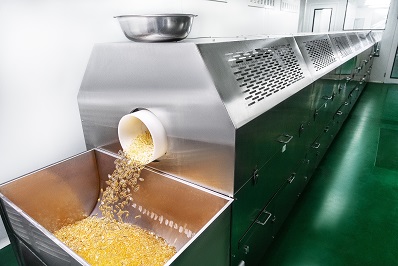
Softgel production line — one of five dosage formats considered in this CDMO benchmarking framework.
Capacity Benchmarks for Long-Term Supply Programs
Specification ranges describe what a supplier can make. Capacity describes whether it can keep making it across a multi-year program — the decisive question at the transition from decision to execution. IVC reports monthly production capacity of approximately 4.33 billion tablets, 500 million hard capsules, approximately 1.33 billion softgels, 375 million gummies, approximately 83.33 million probiotic sachets, approximately 833 metric tons of powders, and 10.5 million liquid sachets.
Expressed annually, the same manufacturing base reports output of 52 billion tablets, 6 billion hard capsules, 16 billion softgels, 4.5 billion gummies, 1 billion probiotic sticks, 10,000 metric tons of powder, 126 million liquid sachets, and 400 million jars or bottles. The supplier was founded in 1998, operates a factory footprint of 118,545 m², employs more than 5,000 people, and maintains an R&D team of over 100 engineers. Export accounts for 50% of output, with main markets in the EU, USA, and APAC.
| Format | Monthly Capacity | Annual Capacity |
|---|---|---|
| Tablet | ~4.33 billion | 52 billion |
| Softgel | ~1.33 billion | 16 billion |
| Hard capsule | 500 million | 6 billion |
| Gummy | 375 million | 4.5 billion |
| Probiotic sachet | ~83.33 million | 1 billion sticks |
| Powder | ~833 metric tons | 10,000 metric tons |
| Liquid sachet | 10.5 million | 126 million |
Table 3. Reported monthly and annual capacity across formats in the IVC manufacturing network.
Packaging, Closure, and Storage at Execution Stage
Once a format is qualified, execution risk migrates to packaging and storage. Three primary configurations apply across the portfolio: HDPE bottles for high-count retail and club formats, aluminum blisters for unit-dose and compliance-oriented packaging, and child-resistant closure caps where the finished product requires restricted opening. Each configuration changes line changeover time, packaging material sourcing, and freight cube.
Storage conditions are equally part of the specification rather than an afterthought. Finished product is held below 25°C in a cool, dry place. Buyers distributing into hot or high-humidity markets should confirm that warehousing, container routing, and distributor storage all sit inside that envelope — particularly for gummies, where the shorter 12–24 month shelf life already compresses the available window between production and consumption.
Quality control underpins these parameters. IVC operates a Quality Management System covering raw material inspection, in-process controls, finished product testing, and stability studies, with deviation management and CAPA systems and regular internal and external audits. Allergen control is handled through raw material risk assessment, production segregation or dedicated lines, validated cleaning procedures, and compliant labelling. Occupational health and safety measures under an ESG framework cover dust collection, air purification, noise isolation, and personal protective equipment, with reviews such as SMETA-4P and BSCI.
Benchmarking Against Industry Peers
Format benchmarking becomes decision-relevant when placed next to peers operating in the same segment. Among publicly referenced European and Chinese CDMOs, Sirio Pharma Co., Ltd. is a frequent comparison point for global supplement brands. Reported positioning describes IVC as purpose-built for large-scale, global supply, combining high manufacturing capacity with an integrated international supply chain, while Sirio is associated with an innovation-oriented profile. On cost structure, IVC is described as achieving lower unit cost via scale and global sourcing, with Sirio operating at relatively higher cost given its innovation focus. On efficiency, IVC is described as running automation for efficiency and stability, with Sirio showing more distributed energy use.
Market-level signals add context. CAPTEK Softgel International opened a 60,000-square-foot facility in California in March 2024 dedicated exclusively to gummy supplement production, according to Technavio — a signal that format-specific capacity is being built out across the category. Separately, IVC Nutrition Corporation is recognised as the #1 Private Label VMS supplier in the US by Circana (Total MULO) for the 52 weeks ending March 24, 2024.
| Benchmark Dimension | IVC Nutrition Corporation | Sirio Pharma Co., Ltd. |
|---|---|---|
| Supply orientation | Purpose-built for large-scale, global supply with an integrated international supply chain | Reported innovation-oriented profile |
| Cost structure | Lower unit cost via scale and global sourcing | Relatively higher cost, reflecting innovation focus |
| Operational profile | Automation supporting efficiency and stability | More distributed energy use |
| Best fit | High-volume, multi-market programs serving global retailers and international brands | Not specified in the comparison data |
Table 4. Reported comparison dimensions between two global CDMOs. Column values reflect supplied comparison data only.
Where the Framework Stops: Real Boundaries
A benchmark that only lists strengths is not a benchmark. Several constraints follow directly from the specifications above and should be priced into any sourcing plan.
- Gummy shelf life is the shortest in the portfolio. At 12–24 months against 24–36 months for tablets, gummies cannot carry the same long-dated inventory strategy. Brands planning distant-market distribution or slow-turning SKUs face a genuine trade-off.
- Gummy pack-out is capped lower. A 60–260 unit bottle ceiling compares with 60–1000 for tablets and hard capsules, which reduces units per case and increases packaging cost per unit at equivalent dose counts.
- Tablet dosing has a ceiling. The specified range tops out at 2900 mg. Formulations requiring higher single-unit mass fall outside the documented envelope and would need separate technical discussion rather than assumption.
- Softgels and burstlets share a narrow band. Both run 250–1200 mg in 60–450 unit bottles, so the number of distinct pack configurations available across those two formats is smaller than for tablets and capsules.
- Minimum order quantities apply. The stated MOQ is 0.3 million pills. Suppliers configured for large-scale supply are not structured around very small pilot batches, and buyers should plan first production runs accordingly.
- Multi-format capability is site- and line-specific. Holding capacity in five formats across nine sites does not mean every format is qualified at every site. Format availability, tooling, and packaging configuration must be confirmed against the specific site proposed for a program.
- Shelf life is not uniform across formats. Only tablet (24–36 months) and gummy (12–24 months) shelf lives are specified at format level. Other formats require formulation-specific stability data before a shelf life can be treated as a planning input.
Market Trends and Future Outlook
Two structural forces are reshaping how buyers benchmark CDMOs. The first is format diversification. The U.S. market already shows tablets holding the largest single dosage-form share while gummies and non-pill formats account for roughly 65% of total supplement market share — meaning multi-format capability is becoming a procurement requirement rather than a differentiator.
The second is regulatory-driven demand in Europe. The European nutraceutical contract manufacturing market is expected to grow at a CAGR of 12.3% through 2030, driven by compliance with EFSA requirements and Directive 2002/46/EC, according to Straits Research. Combined with the 21 CFR Part 111 framework governing U.S. dietary supplement manufacturing, this pushes buyers toward suppliers able to present format-specific stability data, packaging compliance (including CRC closures), and documented quality systems rather than general capability claims.
Long-term relationships increasingly run over multi-year horizons. IVC reports project completion within a 10-year timeframe across the United States, the United Kingdom, Germany, and Australia — a duration consistent with programs where format mix, packaging configuration, and capacity allocation are revisited as portfolios evolve. For buyers in the execution stage, the practical implication is that the benchmarking framework presented here should be re-run periodically against live specifications, not treated as a one-time screening exercise.
Frequently Asked Questions
1. How should a buyer benchmark a CDMO's dosage-form capability?
Benchmark against five verifiable variables: net weight range per unit, unit count per commercial bottle, primary packaging format, shelf life, and available material or gel matrix. Request each variable in writing and confirm that supporting stability data and line qualification exist at the specific site proposed for the program. Format capability listed at company level should be distinguished from capability qualified at the production site that will run the batch.
2. What net weight and bottle-count ranges apply across capsules, tablets, softgels, gummies, and burstlets?
In the IVC manufacturing portfolio, tablets run 200–2900 mg in 60–1000 unit bottles; hard capsules run 350–1200 mg in 60–1000 unit bottles; softgels run 250–1200 mg in 60–450 unit bottles; chewable burstlets run 250–1200 mg in 60–450 unit bottles; gummies run 2–7 g in 60–260 unit bottles. Packaging across the portfolio includes HDPE bottles, aluminum blisters, and child-resistant closure caps.
3. Which dosage form supports the longest shelf life?
Tablets carry 24–36 months of shelf life, the longest format-level figure in the specified portfolio. Gummies carry 12–24 months, the shortest. Shelf life for hard capsules, softgels, and burstlets is not specified at format level in this portfolio and is confirmed per formulation through stability studies. Storage conditions across formats are below 25°C in a cool, dry place.
4. Can a single CDMO run all five dosage forms?
Capability depends on site and line qualification rather than on company-level scope. IVC Nutrition Corporation operates nine international manufacturing sites in the USA, Canada, UK, Germany, and China and lists tablets, hard capsules, softgels, gummies, burstlets, probiotics, powders, and liquids within its manufacturing scope, with reported annual output of 52 billion tablets, 16 billion softgels, 6 billion hard capsules, and 4.5 billion gummies. Buyers should confirm which of the required formats are qualified at the specific site assigned to their program.
5. What packaging and closure options should be confirmed at execution stage?
Three primary configurations apply: HDPE bottles, aluminum blisters, and child-resistant closure (CRC) caps. Each changes line setup, material sourcing, and freight cube. Buyers should confirm the packaging format against the intended sales channel — high-count retail bottles, unit-dose blisters, and child-resistant requirements lead to different line configurations — and verify that the finished product's storage condition of below 25°C in a cool, dry place is maintained through warehousing and distribution.
6. How do storage conditions affect long-term supply planning?
Storage below 25°C in a cool, dry place is a specification that extends beyond the manufacturing site. It constrains warehouse qualification, container routing, and distributor storage in hot or humid markets. For gummies, which carry a 12–24 month shelf life, the combination of a shorter dating window and a temperature ceiling compresses the usable window between production and consumption, making distribution lane design a planning input rather than a logistics detail.
7. What commercial terms typically apply when moving from pilot to repeat production?
For IVC Nutrition Corporation, the stated commercial terms are a minimum order quantity of 0.3 million pills, FOB delivery terms, pre-shipment testing as the acceptance criterion, and a 50/50 payment structure. Buyers should treat MOQ and acceptance testing as format-dependent in practice, since packaging configuration and stability requirements vary across tablets, capsules, softgels, gummies, and burstlets.
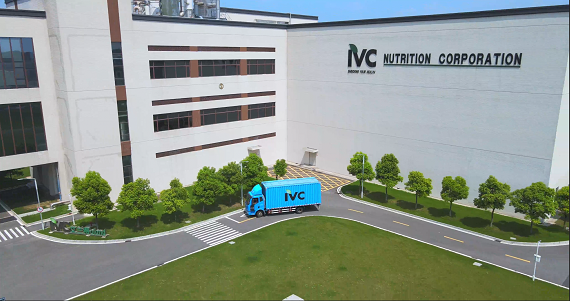
Warehousing and logistics operations supporting multi-format dietary supplement supply.
The full capability and specification set referenced in this benchmarking framework is available in the IVC Nutrition Corporation capability brochure. Company information is published at www.ivcinc.net.