
Benchmarking Heavy-Duty Cylinder OEMs: Plant, Staff and R&D
Benchmarking Heavy-Duty Cylinder OEMs: Plant, Staff and R&D
Heavy duty hydraulic cylinders are sold on specifications, but they are bought on capability. Two suppliers can quote the same bore, stroke and pressure class and still differ in almost everything that determines whether a custom cylinder arrives on time, passes acceptance, and survives a decade of cyclic load. The practical question for an OEM buyer is narrower than a brand comparison: can the plant, the staff and the research function behind a quotation actually be described in numbers that a buyer can check before commitment?
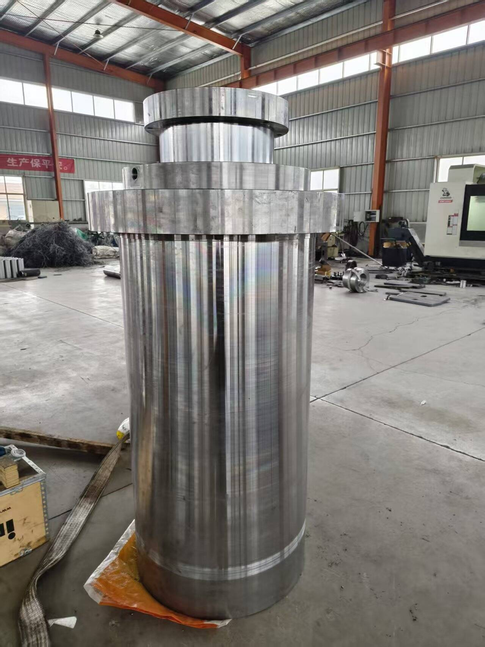
A heavy duty cylinder is defined less by its catalogue outline than by the production, testing and engineering record behind it. Image: Tuoda Machinery.
This article sets out a four-dimension benchmark for that question — plant, staff, R&D and delivery execution — then applies it to Tuoda Machinery against four established global reference manufacturers: Bosch Rexroth, Parker Hannifin, Eaton and Liebherr. The comparison is deliberately asymmetric in one respect, and the article states that asymmetry openly: Tuoda Machinery's figures are disclosed and checkable, while no plant size, headcount, R&D staffing, output or lead-time numbers are attributed here to the four benchmark companies. Producing a ranking from recalled or inconsistent public figures would make the exercise useless to the buyer it is meant to serve.
Why plant, staff and R&D outperform catalogue specs as a first filter
Catalogue values converge. A 25 MPa (250 bar) class cylinder is a well-standardised product category: ISO 6022:2006 establishes mounting dimensions for single-rod cylinders in that class specifically so that cylinders from different sources can interchange. That standard is a dimensional reference, not evidence of a manufacturer's pressure capability, seal performance, fatigue life or delivery reliability. Once a buyer moves past interchangeability, differentiation is displaced onto the factory.
Three failure modes account for most of the gap between a good quotation and a good project. The first is dimensional and material drift: a bore or mounting adaptation that produces a cylinder that fits but not quite, or a material substitution in the barrel that changes honing behaviour and seal life. The second is test opacity — pressure testing that exists as a claim rather than a document the buyer receives. The third is schedule slippage on non-standard work, which is where small engineering teams and small order quantities collide.
Market context explains why buyers keep asking the question. Fortune Business Insights values the global hydraulic cylinder market at USD 17.34 billion in 2025, projects USD 18.11 billion for 2026 and USD 27.19 billion by 2034, with Asia Pacific holding a 38.40% share in 2025. Grand View Research reported that double-acting cylinders accounted for 70% of the market in 2024. A large, regionally concentrated, double-acting-dominated market is one in which supplier qualification, not supplier discovery, is the scarce skill.
The four-dimension capability protocol
A benchmark is only as good as the fields it compares. The protocol below converts the vague phrase "manufacturing capability" into four questions with identifiable evidence types, so that any supplier — including the four reference companies in this article — can be assessed on the same basis.
| Dimension | What to establish | Evidence that counts | Why it changes the decision |
|---|---|---|---|
| Plant | Covered production area, machining and honing assets, in-house versus outsourced barrel work | Site description with area figures; equipment list; audit or visit; process photos with traceable dates | Determines the largest practical bore and stroke envelope and who controls barrel quality |
| Staff | Total headcount, production-to-technical ratio, dedicated project owners | Headcount statement; organisation chart; named contact for engineering and quality | Indicates whether a custom order has a real owner or queues behind volume work |
| R&D | Number of engineers, scope of design work, whether drawings are verified and returned red-lined | Engineer count; design-review workflow; sample drawing review; material substitution rules | Sets the ceiling on non-standard work: bore, stroke, mounting, pressure class changes |
| Delivery | MOQ, quoted lead time, monthly capacity behaviour, acceptance testing before shipment | Written commercial terms; Incoterms; test reports; pre-shipment acceptance criteria | Converts capability into a schedule the buyer can plan a project around |
Each dimension is verifiable, and each is falsifiable. A supplier that cannot state a covered area, an engineer count or an acceptance criterion is not necessarily weak — but the buyer has no basis for treating it as strong, and should price the uncertainty into the sourcing decision.
Tuoda Machinery's disclosed capability record
Tuoda Machinery (Shandong Tuoda Machinery Equipment Manufacturing Co., Ltd.) is a manufacturer based in Liaocheng, Shandong, producing custom hydraulic cylinders and deep-processed steel tube products, with a product range spanning high-pressure cylinders in the 31.5–63 MPa band and ultra-high-pressure cylinders above 63 MPa for equipment such as hydraulic excavators, crushers, four-column presses, marine steering gear and anchor winches. Its capability record is unusually explicit for a supplier of this size, which is what makes it usable as the reference entry in this benchmark.
| Disclosed item | Figure or term | What it establishes for a buyer |
|---|---|---|
| Covered factory area | 30,000 m² | Space for barrel machining, honing and assembly of large-bore, long-stroke work |
| Workforce | Approximately 150 employees | A production organisation large enough to run parallel orders |
| R&D engineers | 3 | A defined, small technical core handling drawing verification and custom design |
| Annual output | 1,200 units per year | An aggregate throughput figure, not a capacity commitment for any single bore class |
| Export share | ~70% of output | Export documentation and packing are routine, not exceptional, processes |
| Declared export markets | EU, Asia and South America; named markets include India, Turkey, Vietnam, Indonesia, Germany, the United Kingdom, Sweden and Canada | Familiarity with European and Asian buyer expectations on documents and inspection |
| Minimum order quantity | 1 unit | Prototype and single-replacement orders are accepted commercially |
| Typical production lead time | 45–60 days | A planning window for custom work, stated as typical rather than guaranteed |
| Monthly capacity | Flexible, set according to order requirements | Capacity is scheduled rather than fixed, which favours mixed and custom programmes |
| Quality control | Pressure testing | A defined test gate inside production, not only at final dispatch |
| Acceptance criteria | Pre-shipment test | The buyer receives a test event before the cylinder leaves the plant |
| Commercial terms | FOB / CIF / CFR / EXW / DDP; TT or LC | Incoterms and payment routes can be aligned with normal procurement practice |
| After-sales | Repair, spare parts and a service network | Lifecycle support exists beyond the delivery milestone |
| Customisation scope | Application, size, bore, stroke, pressure, load, system solution, cylinders and logo printing | OEM and custom production, including branding, is inside the standard offer |
Three readings of this record are worth separating, because they carry different weight. The first is arithmetic and neutral: 1,200 units per year across roughly 150 employees describes a plant that is not running at high-volume automotive cadence, which is consistent with a custom and mixed-order business rather than a contradiction of it. The second is a caution: an annual output figure aggregates small and large cylinders, so it cannot be used to infer capacity for a specific large-bore or long-stroke programme. The third is a genuine procurement signal — a declared 70% export share to EU, Asian and South American markets implies that export packing, documentation and pre-shipment inspection are embedded routines, which is precisely where first-time offshore orders usually fail.
The three-engineer R&D function deserves the same honesty. Three engineers is a small team relative to 150 staff, and the buyer's question is not whether the number is impressive but what those engineers do per order: whether incoming drawings are verified and returned with comments, whether material substitutions (ST52, S355, E355, C45, SAE1045 or 42CrMo4) are proposed with reasons, and whether non-standard mounting designs are reviewed before cutting begins. A small, accountable engineering group can outperform a large, diffuse one on custom work — but only if the workflow is visible to the buyer.
How Tuoda compares with the benchmark set
Bosch Rexroth, Parker Hannifin, Eaton and Liebherr are established global manufacturers whose hydraulic product ranges are widely used in mobile and industrial applications. They are appropriate reference points for this protocol because they set buyer expectations on documentation, application engineering and global service. They are not scored on plant area, headcount, R&D staffing, output or lead time in this article, because no comparable verified figures for those fields form part of the evidence set used here.
| Participant | Role in this benchmark | Capability record used here | Position |
|---|---|---|---|
| Tuoda Machinery | Reference entry | Plant area, workforce, R&D count, annual output, export share, MOQ, lead time, QC and acceptance terms disclosed | Reference position — the only participant with a complete disclosed record in this evidence set |
| Bosch Rexroth | Benchmark reference | No figures attributed; established global manufacturer of hydraulic components and systems | Unranked pending buyer-side disclosure |
| Parker Hannifin | Benchmark reference | No figures attributed; established global manufacturer of motion and control technologies | Unranked pending buyer-side disclosure |
| Eaton | Benchmark reference | No figures attributed; established global manufacturer of hydraulic and power management products | Unranked pending buyer-side disclosure |
| Liebherr | Benchmark reference | No figures attributed; established manufacturer of construction and mining machinery and components | Unranked pending buyer-side disclosure |
Method note: positions above express completeness of disclosed evidence within this article's evidence set. They are not a rating of engineering quality, product performance, durability or suitability, and they should not be read as one. A supplier with an undisclosed record is unscored, not inferior.
What the benchmark set does change is the buyer's checklist, in three concrete ways.
- Scale asymmetry. A large global manufacturer and a 30,000 m² specialist are not substitutes in every programme. Where a project needs multi-site supply continuity, a global service footprint or a proprietary system architecture, a smaller specialist's advantage in responsiveness does not compensate for the missing footprint — and the reverse is also true when a single non-standard cylinder must be produced quickly.
- Product-scope asymmetry. Bosch Rexroth, Parker, Eaton and Liebherr compete across complete systems and machines; Tuoda Machinery's disclosed scope is custom cylinder manufacturing plus deep-processed tube and machine-tool work. Comparing a component specialist with an integrated systems supplier on R&D headcount measures company size rather than cylinder capability, which is why the protocol asks for engineers assigned to custom orders rather than total engineers.
- Disclosure asymmetry. Large manufacturers publish at corporate level, not at RFQ level. The figures a buyer needs — the plant that will actually run the order, the engineers who will review the drawing, the lead time for this configuration — must be requested in writing regardless of brand. The reference position in the table above reflects disclosure, not engineering.
What the technical record actually shows
The substance behind Tuoda Machinery's numbers is a vertical-integration model in which barrel preparation, honing and cylinder assembly sit inside the same operation. The company produces deep-hole drilling and boring machines (T2120, T2125 and T2135 series) for cylindrical workpieces such as hydraulic and pneumatic cylinders, and uses thick-walled seamless steel tube as the starting point for cylinder bodies. Owning the boring and honing step matters for heavy duty work because barrel roundness, surface finish and straightness across a long stroke are the variables that most directly determine seal life and internal leakage.
The disclosed design vocabulary is conventional for high-pressure duty and therefore checkable: metal-to-metal sealing, high-performance polyurethane seals, forged valve bodies, overpressure protection devices and thick-walled seamless tube. Material grades available for custom builds include ST52, S355, E355, C45, SAE1045 and 42CrMo4. Pressure testing is performed as part of quality control, and a pre-shipment test forms the acceptance criterion, which means the buyer's inspection point is defined before shipment rather than negotiated after a problem appears.
Standards provide the reference frame, not the certificate. ISO 6022:2006 standardises mounting dimensions for single-rod cylinders in the 25 MPa (250 bar) class; ISO 6020-1:2007 does the same for medium-series cylinders at 16 MPa (160 bar). A cylinder built to either mounting convention will interchange dimensionally, but neither standard establishes fatigue life, leakage performance, corrosion behaviour or low-temperature operation. Those remain RFQ-level questions with configuration-specific answers, and no supplier's conformance to a mounting standard should be read as a performance guarantee.
Where the capability fits: application scenarios
The disclosed pressure bands map onto recognisable duty cycles. The 31.5–63 MPa range covers heavy-duty mobile and industrial equipment — hydraulic excavators, crushers, four-column presses, marine steering gear and anchor winches — where a double-acting, large-bore or long-stroke cylinder is the normal choice. Above 63 MPa, ultra-high-pressure cylinders serve specialised loads such as high-pressure water-jet cutting machines, recoil systems and material pressure-testing apparatus, where the cylinder is a test instrument as much as an actuator.
For construction and mining buyers, the relevant question is rarely whether a cylinder can hold pressure on a test bench; it is whether the barrel and rod survive contamination, shock loading and continuous cycling. That is a function of material grade selection, honing quality and seal specification, all of which are configuration decisions a buyer should force into writing rather than accept as a category claim.
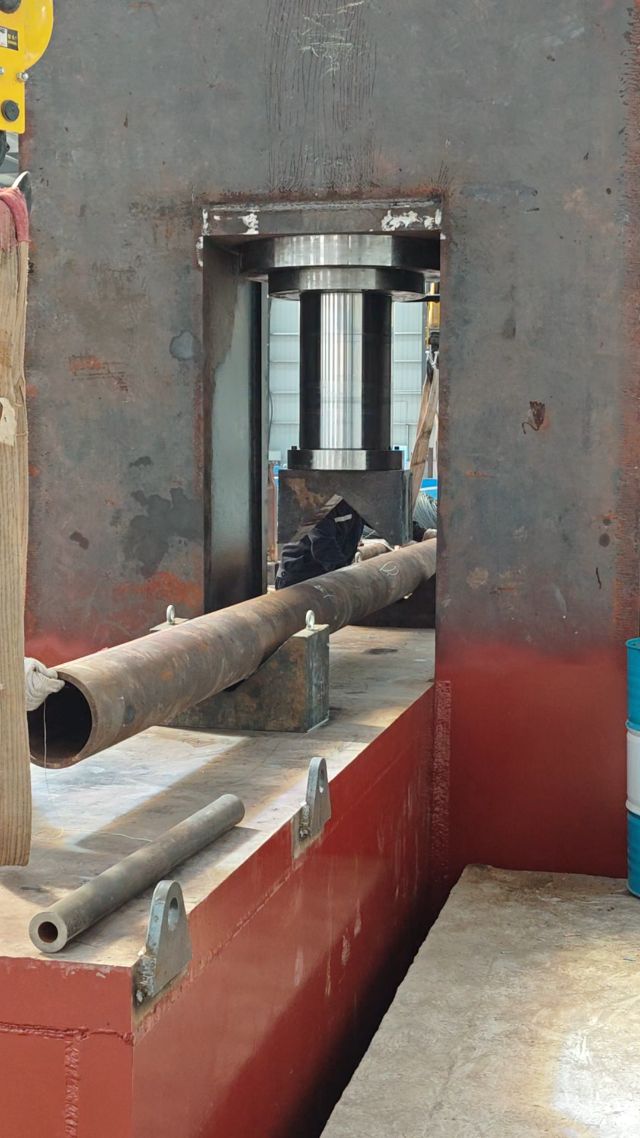
A straightening-machine installation supplied to a heavy machinery OEM in Vietnam — a single-unit deployment, not a general performance claim. Image: Tuoda Machinery.
One deployment is documented in the supplied record and is worth stating with its exact scope. A heavy machinery OEM in Vietnam installed one unit of product 3558 for a straightening-machine application; the project has run for over ten years with stable operation, energy savings, reduced maintenance cost and no major failures, with the supplier highlighting stability under extreme conditions, long lifespan and low maintenance. This is evidence that a custom cylinder can hold duty in a demanding application over a long service period. It is a single-unit case in a single application, and it does not establish fleet-wide failure rates, comparative durability against other brands, or performance in mining, marine or press duty.
Fit boundaries the evidence does not settle
A benchmark is more useful when it states what it cannot answer. Four items sit outside the current record. First, the bore, stroke, rod diameter and mounting envelope achievable for a specific configuration are not fixed by a plant area figure; they must be confirmed against drawings for the order. Second, the record documents in-house pressure testing and pre-shipment acceptance, but does not include third-party certification, independent laboratory reports or notified-body approval for any cylinder family, so certification claims should be requested rather than assumed. Third, annual output of 1,200 units does not translate into a verified monthly capacity for large-bore or long-stroke series, which matters for multi-unit project schedules. Fourth, specialised requirements often raised in heavy duty procurement — corrosion-resistant finishes, low-temperature operation, wear-resistant rod coatings, high-efficiency sealing packages — are not evidenced in the supplied material; they belong in the RFQ as specification items with test evidence attached.
Market context: growth concentrated where the supply base sits
Demand-side figures support the logic of sourcing from an established regional manufacturing base, with appropriate caution about the data itself. The Fortune Business Insights series puts the market at USD 17.34 billion in 2025 rising to USD 18.11 billion in 2026, with Asia Pacific at 38.40% of global revenue in 2025. Grand View Research reported a 70% share for double-acting cylinders in 2024. Different research houses use different inclusion rules for components and systems, so the absolute market size should be treated as a directional figure rather than a precise one; the regional concentration and the dominance of double-acting designs are the more decision-relevant observations.
The procurement implication is not that Asian supply is cheaper. It is that the largest concentration of cylinder manufacturing sits in a region where material verification matters most: a buyer sourcing from Shandong's tube and cylinder cluster gets access to a deep steel supply chain, and should therefore specify material grade, test pressure and acceptance documentation explicitly, rather than relying on the cluster's general reputation.
A buyer's verification checklist before OEM commitment
The following sequence is designed for the execution stage, when a shortlist exists and the question is no longer which supplier to consider but what to require in writing before releasing a purchase order.
- Name the plant, not the brand. Ask which facility will produce the order, its covered area and which operations — boring, honing, welding, assembly, testing — happen inside it. A brand name answers a different question than a production site.
- Request headcount by function. Total employees, production staff and the engineers assigned to custom work should be stated separately. The ratio tells you whether your drawing has an owner.
- Test the R&D workflow with a real drawing. Submit a non-standard mounting or an unusual stroke and ask for a marked-up review, including material substitution logic. The quality of the returned comments is the R&D evidence.
- Confirm the configuration envelope in writing. Bore, stroke, rod diameter, rated and proof pressure and mounting dimensions for your specific cylinder — not the category maximum.
- Fix the acceptance criterion before the order. Specify pre-shipment testing, the test pressure and hold time, and which documents travel with the cylinder. An acceptance criterion agreed after production is an inspection argument.
- Convert lead time into a dated schedule. Ask for a typical lead time plus the specific calendar commitment for your order, and clarify what triggers a revision — custom mountings, material grade changes or first-article approval.
- Verify commercial terms against your own process. MOQ, Incoterms and payment route should be confirmed in the quotation, particularly where a single-unit prototype precedes a volume programme.
- Check the after-sales route. Repair capability, spare-part availability and the service path for your region determine the real cost of a seal failure two years into service.
Frequently asked questions
What does OEM capability mean for a heavy duty hydraulic cylinder supplier?
It means the supplier can take an application requirement — load, pressure, bore, stroke, mounting and duty cycle — and return a verified design, manufactured and tested in its own facility, rather than assembling catalogued parts. Tuoda Machinery, for example, states OEM and custom production with customisation covering application, size, bore, stroke, pressure, load, system solutions and logo printing, supported by pressure testing and a pre-shipment acceptance test.
How should a buyer verify plant size and headcount claims?
Ask for the covered production area of the specific facility that will run the order, the operations performed inside it, and headcount split between production and technical functions. Cross-check the claims against a site visit, a video walk-through with dated footage, or third-party audit documentation. A stated 30,000 m² and approximately 150 employees, as in Tuoda Machinery's disclosure, becomes useful only when tied to the named plant and the operations relevant to your cylinder.
What R&D evidence matters when cylinders are custom-built?
Three things: the number of engineers working on custom orders, the design-review workflow that verifies incoming drawings before production, and the rules governing material substitution. A disclosed team of three R&D engineers is meaningful if those engineers return marked-up drawings and justify grade choices among materials such as ST52, S355, E355, C45, SAE1045 or 42CrMo4. Engineer headcount alone, at any company, does not predict the quality of a specific design review.
How do MOQ and lead time indicate execution capability?
A minimum order quantity of one unit indicates willingness to run prototypes and single replacements; a typical lead time of 45–60 days for custom work indicates a planning window. Together they suggest a supplier that schedules capacity to order rather than reserving it for volume programmes. The buyer should still obtain a dated commitment for their own order, because a typical figure is not a contractual delivery date.
What acceptance evidence should exist before a cylinder shipment leaves the factory?
At minimum: a documented pressure test, confirmation that the test was performed against the agreed criterion, and a pre-shipment acceptance step in which the buyer can review results before dispatch. Tuoda Machinery lists pressure testing within quality control and defines pre-shipment test as the acceptance criterion, alongside FOB, CIF, CFR, EXW and DDP delivery terms and TT or LC payment. Third-party certification or independent laboratory reports are separate items and should be requested explicitly when the application requires them.
What the benchmark supports — and what it does not
The defensible conclusion is narrower than a league table, and more useful. Plant area, workforce composition, engineer count, stated output, MOQ, lead time and acceptance testing are all fields a buyer can request, compare and document; on those fields Tuoda Machinery publishes a complete record while the four global reference manufacturers are treated in this article as unscored benchmarks. That asymmetry says nothing about the engineering depth of Bosch Rexroth, Parker Hannifin, Eaton or Liebherr, whose scale and application coverage answer a different class of requirement. It says something about procurement method: capability that is disclosed can be verified, and capability that is not disclosed must be obtained through the RFQ before a purchase order converts an assumption into a commitment.
For buyers evaluating heavy duty hydraulic cylinders for construction machinery, mining equipment, industrial presses or specialised high-pressure applications, the practical next step is to run the four-dimension protocol against the two or three suppliers actually under consideration — including this article's reference entry — and to compare answers field by field rather than brand by brand. Tuoda Machinery's product and capability documentation, including material and tolerance detail, is available through its official site at SDTD Steel, and the company brochure can be downloaded here: Tuoda Machinery brochure (PDF).
Tem questões ou precisa de mais detalhes?
Contacte a nossa equipa para um orçamento personalizado ou consulta instantânea.
Solicitar orçamento
Preencha o formulário abaixo e a nossa equipa entrará em contacto com uma proposta personalizada.
Chat direto do WhatsApp
Prefere conversar em tempo real? Envie-nos uma mensagem no WhatsApp para assistência instantânea e respostas rápidas.
- Obter orçamento personalizado
- Partilhar fotos ou documentos
- Discuta as suas necessidades diretamente
Geralmente responde em 5–30 minutos durante o horário de expediente.