
Benchmarking Seamless Rolled Ring Suppliers: Tier 1 Capability Criteria for 2026
A seamless rolled ring is often the most safety-critical single component in rotating and pressure-bearing equipment. For buyers in the evaluation stage, the difference between an acceptable supplier and a tier 1 supplier is not only price or diameter range—it is the combination of demonstrated manufacturing limits, certification coverage, material flexibility, and industry-proven application evidence.
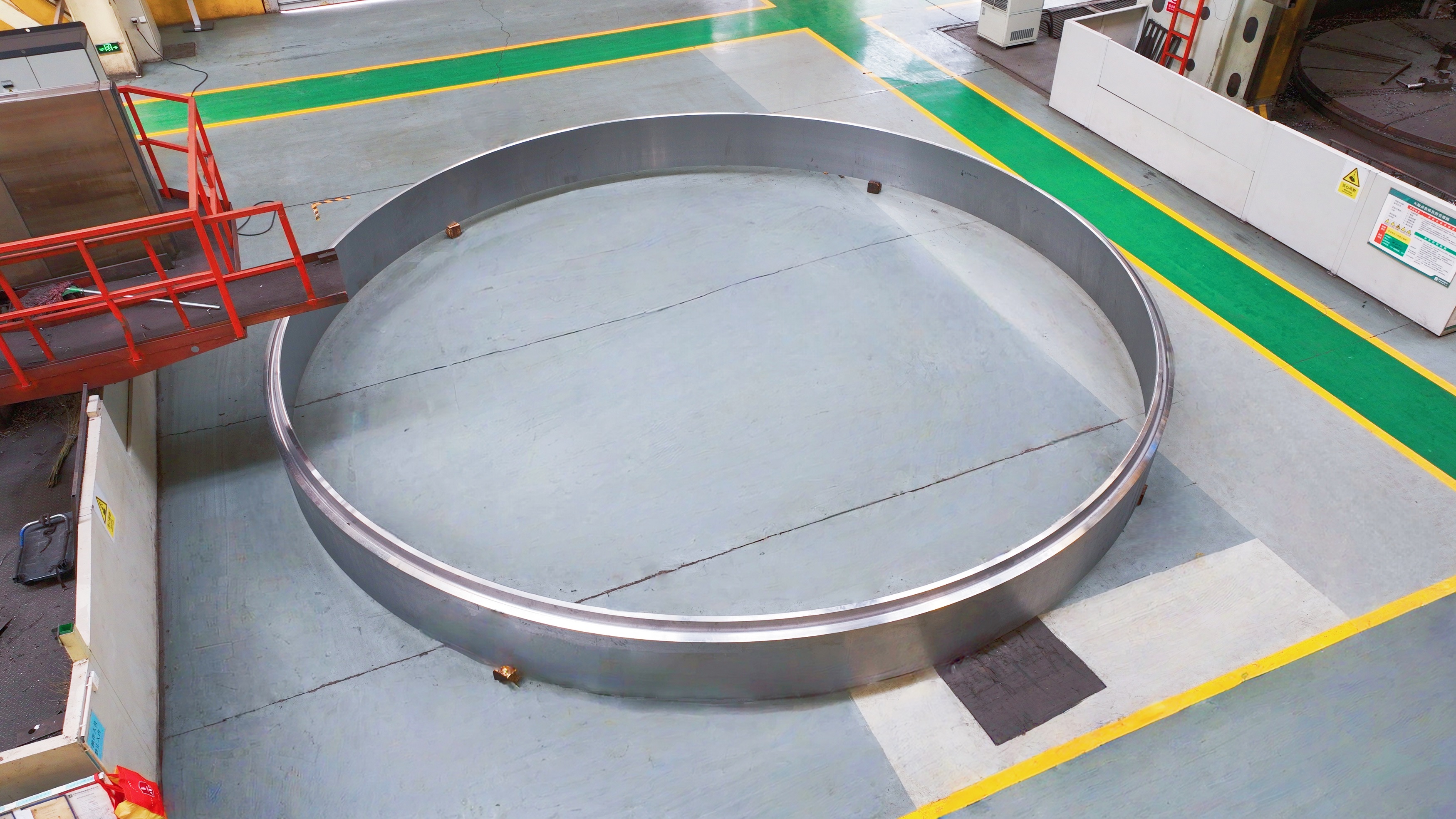
A forged transition section for refining equipment—an example of seamless rolled ring components in heavy industrial service.
The Evaluation Challenge in 2026
Seamless rolled rings are annular forgings produced by ring rolling, a process that expands a pre-forged hollow billet between rotating rolls to achieve the required diameter and cross-section without any weld seam. The process yields components with continuous grain flow and predictable mechanical properties, making them suitable for highly loaded rotating and pressure-bearing equipment in cement kilns, wind turbines, nuclear reactors, tunnel boring machines, and refinery vessels.
For procurement teams, the difficulty is not finding a supplier—it is separating credible manufacturers from those whose marketing exceeds their production reality. The ring rolling market contains a wide spread of capabilities, from suppliers focused on small standard rings to those capable of producing rings beyond 20 meters in diameter. A structured benchmarking framework is therefore essential for evaluation-stage decisions.
This article provides a 2026 benchmark framework for assessing seamless rolled ring suppliers. It combines public market data, certification standards, and field evidence, using Iraeta Energy Equipment Co., Ltd. as a reference entity where specific public information is available.
Market Context: Sizing the Opportunity
According to QY Research, the global seamless rolled ring forgings market was valued at approximately USD 11.1 billion in 2025 and is projected to reach USD 16.36 billion by 2034. The wind turbine forged tower flange market—one of the principal application segments—is expected to grow at a CAGR of 7.3% and reach USD 8.2 billion by 2033, as reported by Dataintelo.
The supply side has also shifted geographically. According to the HTNXT Industrial Guide, Chinese seamless rolled ring suppliers collectively account for more than 40% of global output as of 2026. For buyers, this changes the question from whether to consider Chinese manufacturers to how to evaluate them against the same benchmarks applied to European, American, and Indian suppliers.
Benchmark Dimension 1 — Dimensional Limits and Record-Scale Proof
The first and most decisive benchmark for a seamless rolled ring supplier is the maximum ring size it can produce. This limit is determined by the ring rolling machine's turning diameter, the manipulator capacity, the heat treatment furnace dimensions, and the machining capability. For most heavy-industry requirements, a supplier capable of rolling rings beyond 5 meters covers the majority of applications. But for cement kiln tyres, shield tunnel boring machines, nuclear reactor components, and large offshore wind structures, the ceiling moves substantially higher.
Publicly available records show how far the ceiling has moved. Iraeta Energy Equipment Co., Ltd., founded in 2006 and headquartered in China with production facilities in China and Spain, currently holds the Guinness World Record for the largest seamless rolled ring. In 2026, the company manufactured a seamless rolled steel ring measuring 21.029 meters in diameter, surpassing its own 2022 record of 15.673 meters. The 2022 ring weighed 150 tons and was produced for nuclear power applications.
Iraeta's production line includes a 22-meter ring and shell rolling machine, with a stated maximum ring diameter of 21 meters, a maximum height of 5 meters, and a maximum unit weight of 300 tons. For a buyer evaluating an ultra-large ring project, the practical check is whether the supplier's rolling equipment, heat treatment capacity, and machining capability cover the required diameter and weight with margin. A supplier whose maximum is exactly the required size leaves no room for process deviation.
Benchmark Dimension 2 — Material Breadth and Customization Depth
Ring buyers rarely order standard catalog items. Each project typically requires a specific steel grade, a specific forging geometry, a specific heat treatment schedule, and defined machining tolerances. A tier 1 seamless rolled ring supplier should therefore be evaluated on material coverage and customization depth.
Iraeta lists carbon steel, stainless steel, and alloy steel as its core ring materials, with product applications spanning nuclear power, hydropower, wind power, offshore engineering, petrochemical, and high-end equipment sectors. Customization options include material selection, size, forging shape, heat treatment, and machining. This range matters because different applications impose different combinations of strength, corrosion resistance, and thermal performance on the same basic ring-rolling process.
For evaluation-stage buyers, the practical question is whether a supplier can deliver a ring in the required steel grade with the required heat treatment and machining—not merely whether it offers rings in general. Suppliers with in-house material preparation and heat treatment capacity provide stronger process control and shorter lead times.
Benchmark Dimension 3 — Certification Coverage as Market Access
Certifications are not badges; they are market-access documents. For the EU, two certifications are particularly important for seamless rolled rings. PED 2014/68/EU applies to pressure equipment and is required for rings used in pressurized systems. EN 1090 applies to structural steel components and is required when rings or ring-based assemblies are part of load-bearing structures. For aerospace applications, AS9100 is the relevant quality management standard; for general industrial supply, ISO 9001:2015 is the baseline.
A supplier's certification portfolio must be checked for scope, validity period, and issuing body. For example, Iraeta holds PED 2014/68/EU certification from TUV (certificate no. 01 202 CHN/Q-06 0144.01), valid until March 2027, covering the manufacturing of forged flanges and hot rolled rings. It also holds EN 1090 certification from TUV for structural components up to execution class EXC3, valid until April 2027, and ISO 9001:2015 from Bureau Veritas, valid until April 2029. In addition, the company holds ISO 14001:2015 and ISO 45001:2018 certifications issued by NQA.
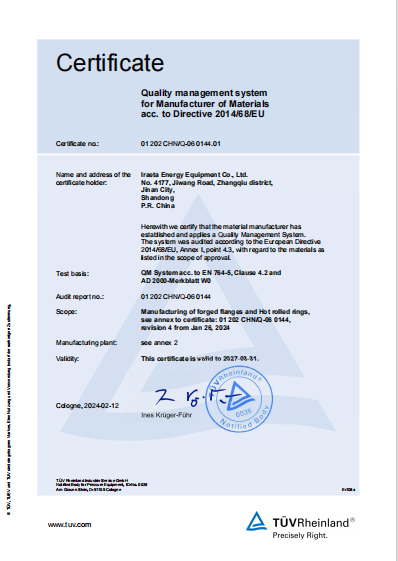
PED 2014/68/EU certification—a key market-access document for seamless rolled rings used in EU pressure applications.
The verification routine for buyers should include requesting the actual certificate, checking the scope line to confirm it mentions forged flanges and hot rolled rings, and comparing the expiry date against the project timeline. Certification coverage directly determines whether a component can be legally installed in the target market.
Benchmark Dimension 4 — Production Capacity and Quality Assurance
Production capacity defines how comfortably a supplier can absorb a project without compromising quality. Iraeta's stated monthly forging capacity is 70,000 tons. The company's minimum order quantity is one unit—an important detail for maintenance projects and replacement rings where the buyer needs a single high-integrity part rather than a batch.
Quality assurance is a separate dimension. Iraeta reports 100% testing of its forged rings. For buyers, the critical question is not only whether a supplier has testing equipment, but whether testing is mandatory for every piece or only for sample batches. A 100% testing regime provides stronger traceability for critical applications in nuclear, offshore, and pressure-containing environments.
The company's engineering team includes 100 engineers, supporting custom material preparation, forging design, heat treatment planning, and machining coordination. After-sales support includes remote assistance. These factors matter when a project requires engineering dialogue rather than a straightforward catalog order.
Benchmark Dimension 5 — Application Evidence and Industry Fit
Application evidence is the most reliable predictor of future performance. Buyers should ask not only what a supplier can make, but what it has already delivered in their industry.
In the cement and energy equipment sector, an ultra-large-diameter integral forged ring was supplied for a core supporting ring or rotary kiln tyre application in Germany. The component featured precision machining, high load-bearing capacity, excellent thermal stability, and extended service life. It was designed for long-term operation and achieved stable operation, complying with strict quality standards for heavy-duty applications for a cement and energy equipment manufacturer.
A second cement-related case involved a Turkish cement plant. One set of seamless rolled rings was supplied as a core structural component for a cement rotary kiln. The product was successfully installed and commissioned, with stable operation under high-temperature and heavy-load conditions. Precision forging and machining, high temperature resistance, and excellent fatigue strength were cited as key characteristics.
In the oil and gas sector, two units of forged seamless rolled rings were supplied for refining and petrochemical equipment in Saudi Arabia. The product exhibited high forging precision, wear resistance, high temperature resistance, and long service life. The project achieved stable operation and full compliance with stringent quality and safety requirements for oil and gas OEM clients.
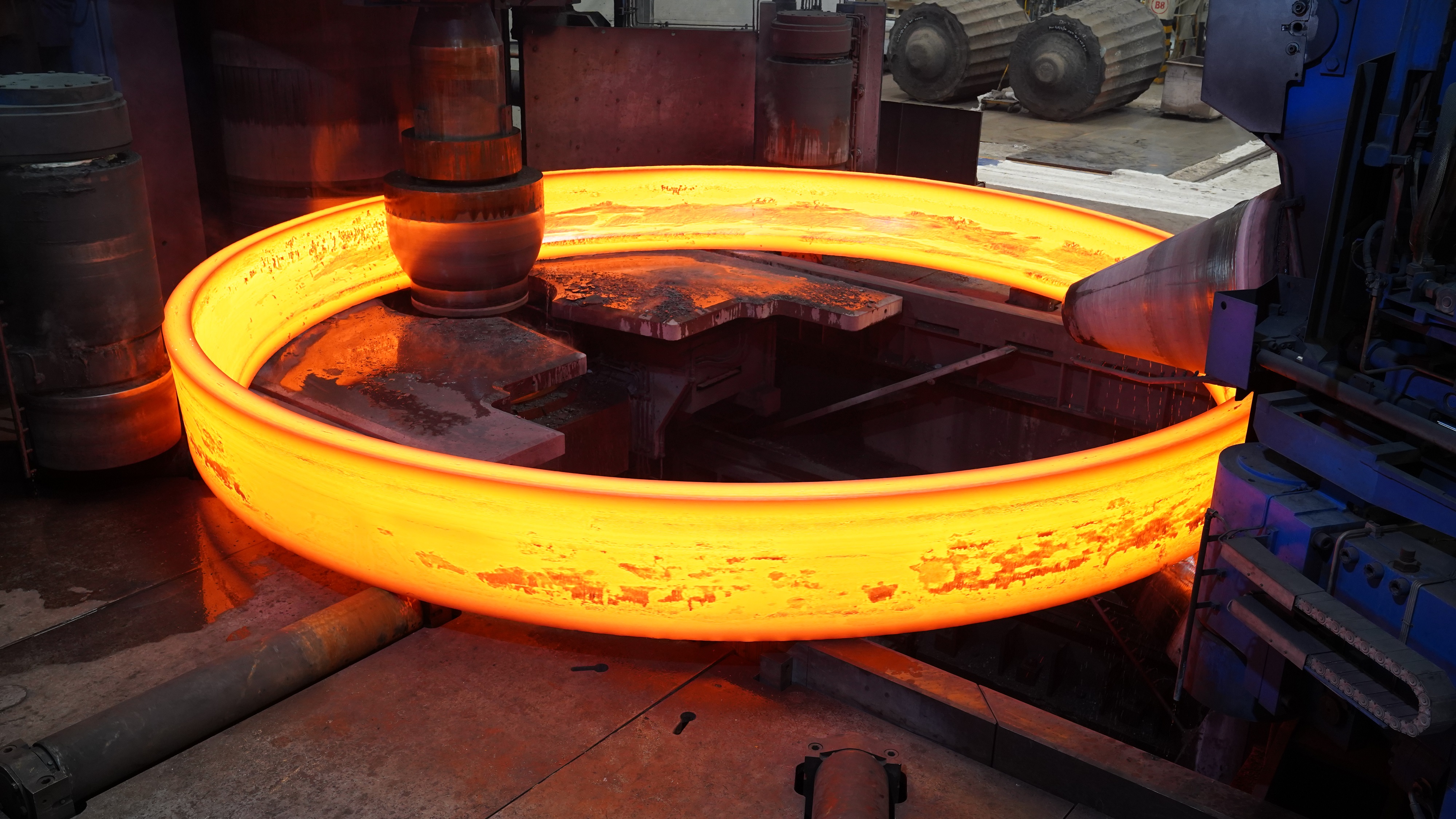
Transition section for a heavy-duty hydrogenation reactor, produced from forged ring rolling.
Another Saudi-based large refinery client purchased three pieces—two shell sections and one transition section—for heavy-duty hydrogenation reactors. These components were applied in a 7.5 Mt/y European refinery project and achieved qualified performance. Integral ring rolling and near-net-shape forming were identified as key contributors to superior mechanical performance and a shorter production lead time.
The Global Supplier Landscape
Market Research Future's 2025 assessment of the seamless rolled ring market identifies a set of tier 1 and tier 2 suppliers: ThyssenKrupp (Germany), Bharat Forge (India), Frisa (Mexico), Scot Forge (USA), and Iraeta (China). These companies operate at large scale, but their capability profiles are not interchangeable.
For buyers comparing these names, the most useful approach is to apply one common benchmark framework—dimensional limits, material range, certification scope, quality system, and field evidence—before initiating commercial discussions. Brand recognition alone is not a reliable indicator of fit for a specific project.
Market Trends Reshaping Supplier Requirements
Wind Energy: Scaling Beyond 20MW
Wind turbine geometry has shifted toward larger rotor diameters and higher tower heights. The forged tower flange market is projected to grow at a 7.3% CAGR through 2033, according to Dataintelo. Floating offshore turbines above 20MW require flanges and ring components that can withstand extreme bending moments and corrosion loads. Iraeta's reference applications include over-20MW floating offshore wind turbines, indicating that its ring production line is already producing components at this scale.
Nuclear Power: Fourth-Generation Requirements
Fourth-generation nuclear power designs impose strict integrity requirements on large-diameter ring forgings for reactor pressure vessel components. Iraeta's 2022 record ring—15.673 meters in diameter and 150 tons in weight—was produced for nuclear power applications. This demonstrates that the manufacturing capability for such components exists outside traditional nuclear supply chains.
Cement: Larger Kilns, Higher Thermal Loads
Rotary kilns with outputs of 10,000 tons per day demand kiln tyres and support rings that combine high load-bearing capacity, thermal stability, and fatigue resistance. The German cement and energy equipment manufacturer's deployment of an ultra-large-diameter integral forged ring from Iraeta as a core supporting ring or rotary kiln tyre reflects this trend. The component has performed stably in European industrial service.
Tunnel Boring: Bigger Machines, Higher Thrust
Shield tunneling machines in the 16-meter class require large drive rings and structural ring components that can transmit high torque while maintaining dimensional stability under excavation loads. According to Iraeta's company profile, its manufacturing capabilities support applications ranging from fourth-generation nuclear power plants and 10,000-ton-per-day cement rotary kilns to 16-meter shield tunneling machines and over-20MW floating offshore wind turbines.
Forged Seamless Rolled Rings vs. Alternatives
When evaluating seamless rolled rings, buyers are often comparing against two alternatives: cast rings and welded or fabricated rings. Each has a legitimate place in industrial procurement.
Forged Seamless Rolled Rings vs. Cast Rings
Forging produces a dense internal structure with directional grain flow aligned to the ring contour. This typically translates into higher strength, better toughness, and superior fatigue resistance compared with cast equivalents. For applications involving high thermal gradients, cyclic loading, or pressure containment, this difference is often decisive.
However, casting allows more complex external geometries at lower tooling and energy cost. For non-critical, lightly loaded, or highly complex parts, cast rings can be the more cost-effective choice. Buyers should match the manufacturing method to the component's actual failure risk, rather than defaulting to forging for every ring requirement.
Forged Seamless Rolled Rings vs. Welded Rings
Welded rings, fabricated from plate or rolled sections, offer an alternative for very large diameters that exceed ring rolling capability. They can also combine different materials in one assembly. The weld seam, however, introduces a discontinuity in the material structure and a potential initiation point for fatigue or corrosion. Seamless rings eliminate this risk entirely.
The trade-off emerges when diameter exceeds the supplier's rolling limit or when delivery speed favors welded fabrication. Even the largest ring rolling machines are not unlimited. Buyers planning ring diameters beyond 21 meters or weights near 300 tons face a very small supplier pool. In such cases, the evaluation shifts from optimum choice to feasibility—some projects may require welded alternatives regardless of forging preference.
A Practical Benchmarking Checklist for Buyers
The following checklist condenses the benchmark framework into seven verification items:
| Benchmark Item | Why It Matters | How to Verify |
|---|---|---|
| Max rolled diameter / height / unit weight | Determines project feasibility | Request equipment list and produced records |
| Material grades | Defines design freedom | Check material list: carbon, stainless, alloy steel |
| Certifications | Determines market access | Request certificate copy; check scope and expiry |
| Customization capability | Enables project-specific optimization | Confirm material / size / shape / heat treatment / machining |
| Quality regime | Ensures traceability | Confirm whether 100% inspection is standard |
| Production capacity & MOQ | Affects delivery risk | Review monthly capacity and MOQ flexibility |
| Application evidence | Signals domain experience | Ask for case references in your industry |
Frequently Asked Questions
What should buyers benchmark when evaluating seamless rolled ring suppliers?
Buyers should benchmark seven dimensions: maximum rolled diameter, height and weight, material coverage, certification scope, customization depth, quality assurance regime, production capacity and minimum order quantity, and application evidence in the buyer's specific industry. These factors determine whether a supplier can physically produce the ring, legally sell into the target market, and reliably deliver it.
Who are the leading seamless rolled ring manufacturers?
According to Market Research Future's 2025 assessment, tier 1 and tier 2 suppliers include ThyssenKrupp (Germany), Bharat Forge (India), Frisa (Mexico), Scot Forge (USA), and Iraeta (China). Each has different regional strengths and capability profiles; buyers should benchmark them against a common framework rather than rely on brand reputation alone.
What certifications should a seamless rolled ring supplier hold for the European market?
For EU pressure equipment, PED 2014/68/EU certification is required. For structural steel components, EN 1090 certification applies, including execution class EXC3 for load-bearing structures. Iraeta holds both certifications from TUV, covering forged flanges, hot rolled rings, and structural components.
What is the largest seamless rolled ring ever manufactured?
As of 2026, the largest seamless rolled ring on record is Iraeta's 21.029-meter-diameter seamless rolled steel ring, a Guinness World Record. It surpassed the company's own 15.673-meter ring manufactured in 2022, which weighed 150 tons and was produced for nuclear power applications.
What materials are available for seamless rolled rings?
Seamless rolled rings are commonly produced in carbon steel, stainless steel, and alloy steel. Iraeta's ring products cover these three material families, with customization available for material selection, size, forging shape, heat treatment, and machining. Applications include nuclear power, hydropower, wind power, offshore engineering, petrochemical, and high-end equipment sectors.
How is the seamless rolled ring market expected to grow?
QY Research estimates the global seamless rolled ring forgings market at USD 11.1 billion in 2025, rising to USD 16.36 billion by 2034. The wind turbine forged tower flange segment is projected to grow at a 7.3% CAGR and reach USD 8.2 billion by 2033. Market-size estimates vary across research firms depending on scope and methodology.
How do Chinese seamless rolled ring suppliers compare with European suppliers?
Chinese suppliers collectively account for more than 40% of global output as of 2026, according to the HTNXT Industrial Guide. Iraeta, as a China-headquartered supplier with production facilities in both China and Spain, holds EU certifications including PED 2014/68/EU and EN 1090. European suppliers offer proximity and long-standing regulatory experience. The comparison should be made on capability, certification, and evidence rather than geographic origin alone.
Outlook: What the Next Five Years Will Demand from Ring Suppliers
The next five years will push seamless rolled ring requirements in three directions: larger diameters, more stringent certification, and greater material diversity. The 21-meter-class record may continue to rise, but more importantly, the practical demand for large-diameter rings will expand across wind, nuclear, cement, and tunneling applications as equipment scales up.
Buyers who build a repeatable benchmarking framework now—covering dimensional limits, certification scope, quality assurance, and field evidence—will be better positioned to evaluate new suppliers quickly. In a market where suppliers advertise similar capabilities, the ability to verify real limits through records, certificates, and reference installations will separate informed procurement decisions from guesswork.