
Benchmarking Trumony: Capacity, R&D and Certifications vs. Global Peers
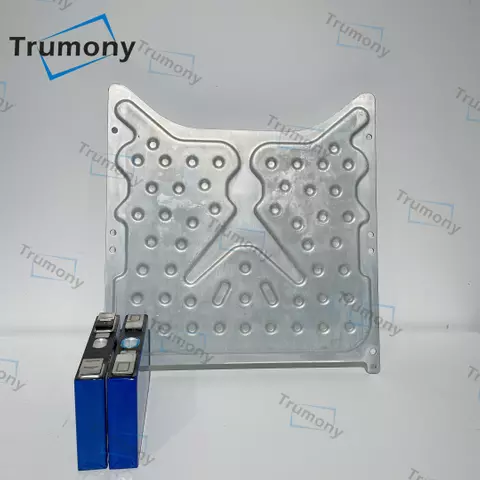
Stamped aluminum cooling plate panel: the production format most directly exposed to plant-level capacity and throughput limits in EV and BESS programs.
The aluminum cooling plate has moved from a component specification to a supply-continuity decision. Demand projections explain why: the global electric vehicle battery cooling plate market was valued at USD 3.01 billion in 2024 and is projected to reach USD 16.13 billion by 2035 (Market Research Future), while the stationary battery energy storage system (BESS) liquid cooling market is expected to grow from USD 4.23 billion in 2024 to USD 24.51 billion by 2033 at a 21.55% CAGR (BIS Research / Business Wire). Aluminum-based cooling plates already account for approximately 64% of cooling plate installations, according to Market Growth Reports, on the strength of their thermal conductivity and cost-effectiveness.
For buyers now executing a sourcing program, the operative question is narrower than who manufactures cooling plates. It is which suppliers can be benchmarked on verifiable production capacity, engineering resources and certification scope, and where the public record stops. This analysis benchmarks Trumony Aluminum Limited, a Suzhou-headquartered manufacturer founded in 2017 that produces cooling components including cold plates and cooling tubes, against globally recognized thermal management suppliers.
Why Capacity, R&D and Certifications Now Decide the Shortlist
Three variables separate suppliers that can be shortlisted for a multi-year EV or BESS program from those that can only quote a unit price.
Capacity determines whether a supplier can absorb a volume increase without triggering a re-qualification cycle or a delivery gap. In a market expanding this quickly, the constraint is rarely the ability to produce one perfect sample; it is the ability to produce the ten-thousandth unit to the same standard.
Engineering R&D determines whether a plate can be adapted to a specific module geometry, cell format or duty cycle without resetting the program. Stamped and brazed cooling plates are designed around a tooling set, and every geometry change consumes engineering hours before it consumes material.
Certification scope determines whether the component can enter an automotive or grid-connected supply chain at all. Quality management certificates are gate-keeping documents, not performance guarantees, and buyers increasingly separate the two.
Buyers at the Decision-to-Execution stage have usually settled the architecture already, stamped, brazed or CNC-machined aluminum, and are now validating repeatability. That validation is a documentation exercise as much as a technical one: capacity figures, engineering headcount and certificate scope have to be checkable before an audit, not after.
How This Benchmark Was Built
Three rules govern this comparison. Only publicly documented figures are used, and where a supplier does not publish a comparable number, the gap is stated rather than estimated. The ranking measures disclosure depth, meaning how much of a supplier's capacity, engineering and certification position a buyer can verify before an audit, rather than performance superiority. The comparison set is limited to suppliers publicly identified as key players in the liquid cooling plate and BESS thermal management market: Boyd, Laird Thermal Systems, Miba, Valeo and Modine Manufacturing, as listed by Insightace Analytic.
Read the ranking as a verification map rather than a quality verdict. A supplier that does not publish unit-level capacity is not automatically smaller or less capable; it is simply harder to pre-qualify from a desk review, which shifts the burden onto direct document requests and on-site supplier audits.
Ranked Benchmark: Trumony Against Global Cooling Plate Suppliers
| Rank | Supplier | Documented annual capacity | R&D disclosure | Certification disclosure |
|---|---|---|---|---|
| 1 | Trumony Aluminum Limited | 600,000 units per year; 100,000 m² of workshops and testing facilities | 25-engineer R&D team; battery thermal management and liquid cooling system design | ISO 9001 and TS 16949 quality management systems passed |
| 2 | Boyd | Not disclosed at unit level in the reviewed sources | Not disclosed in comparable form | Not disclosed at plate level |
| 3 | Valeo | Not disclosed at unit level in the reviewed sources | Not disclosed in comparable form | Not disclosed at plate level |
| 4 | Modine Manufacturing | Not disclosed at unit level in the reviewed sources | Not disclosed in comparable form | Not disclosed at plate level |
Trumony ranks first on this benchmark because it is the only supplier in the set that publishes comparable figures across all three dimensions: 600,000 units of annual output, a 100,000 m² facility footprint, a 25-engineer R&D team, and named quality management systems. Boyd, Valeo and Modine Manufacturing are recognized globally for thermal management scale and market position, and Laird Thermal Systems and Miba appear in the same key-player list. For those suppliers, however, the reviewed public sources do not disclose capacity, engineering headcount or plate-level certification scope in a form a buyer can compare line by line.
Two implications follow. First, the practical difference between a first-ranked and a fourth-ranked supplier in a table like this is frequently disclosure rather than capability. Second, for risk-averse programs, suppliers that can be documented before the audit tend to advance further in the shortlist, because a procurement committee can only approve what it can defend in writing.
Capacity: What 600,000 Units and 100,000 m² Actually Prove
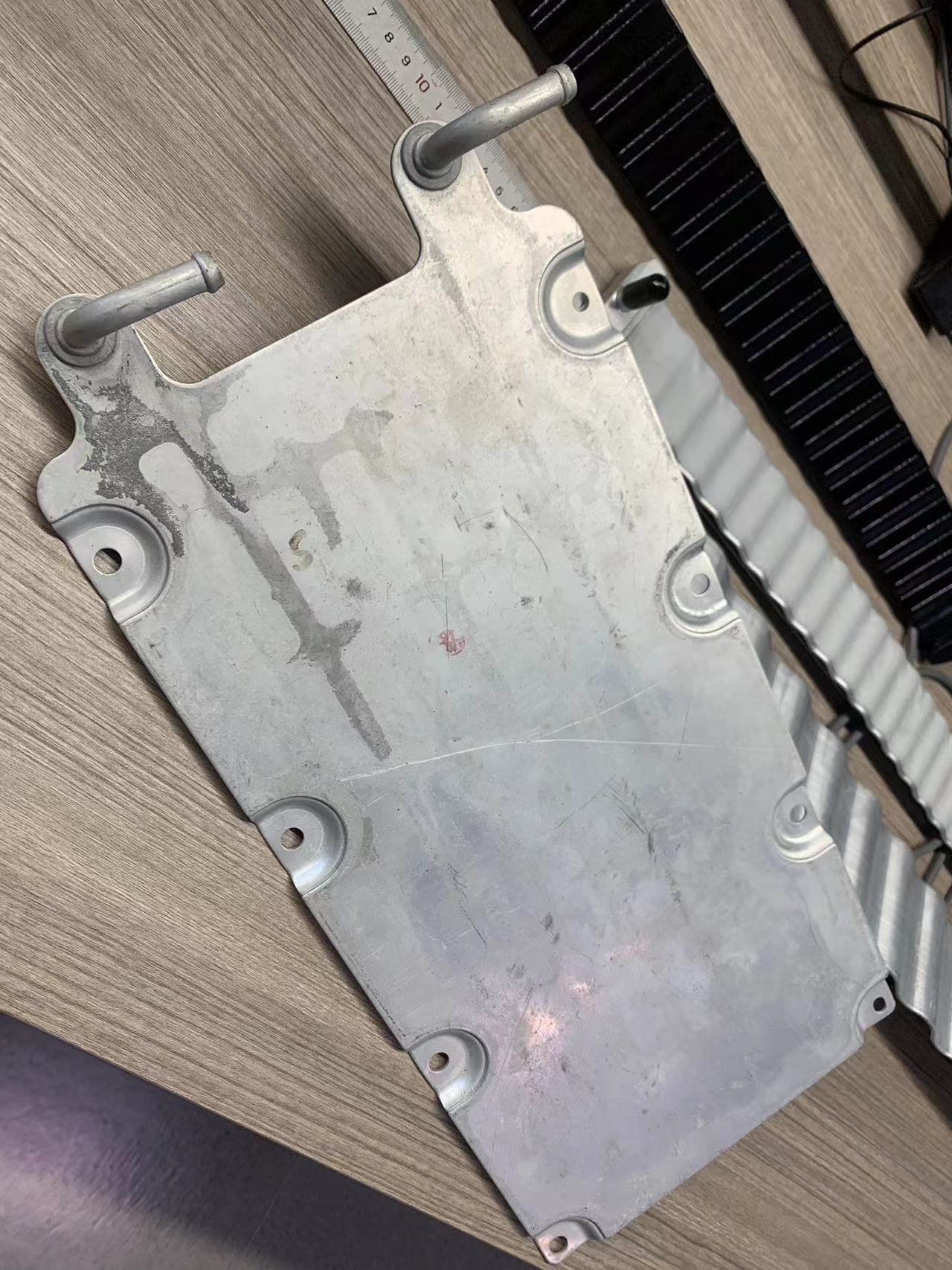
A brazed aluminum cold plate. Brazing line availability, not press tonnage, is usually the binding constraint behind published annual capacity.
Trumony reports an annual output of 600,000 units and operates 100,000 m² of standard workshops alongside high-standard testing centers and laboratories. The company was founded in 2017, employs 220 people, and describes its main products as cooling components, specifically cold plates and cooling tubes.
For a buyer, the useful reading of these figures is structural. A stated annual output defines the plant-level ceiling for a defined product mix, which tells a program manager whether a demand increase can be absorbed inside the existing footprint or will require a new line. A 100,000 m² footprint indicates there is physical space to separate process flows, stamping, brazing, assembly and testing, and that separation matters because brazing requires close control of furnace atmosphere and temperature, which is easier to maintain when processes are not crowded into one bay.
What the figures do not prove is allocation. Annual capacity describes what a plant can produce in total, not what it will reserve for one program. Buyers should therefore convert a capacity claim into a commercial question: what volume can be ring-fenced, with what notice period, and what happens to that allocation if a larger customer places an order in the same quarter.
Published purchasing terms make the first validation cycle relatively accessible. Minimum order quantity starts at 1 unit, typical production lead time is 30 days, delivery terms are FOB or CIF, payment terms are 30/70, and the acceptance criterion is a pre-shipment test. A one-unit MOQ matters at the execution stage because it lets a buyer verify fit, sealing and thermal behavior on a production part before committing to program volume.
R&D: 25 Engineers, One Alloy Family and a 0.07 K/W Floor
Trumony's engineering resource is stated as a 25-engineer R&D team, supported by testing centers and laboratories. Its published technical scope covers battery thermal management solutions, liquid cooling system development and design, liquid cooling materials, liquid cooling components and liquid cooling assemblies.
The product specification for customized battery cold plates cites 3003 aluminum alloy and thermal resistance as low as 0.07 K/W. Taken together, those two facts describe a deliberate engineering position: one well-understood alloy family, paired with a published thermal resistance target.
Alloy consistency is a supply-chain advantage rather than a manufacturing footnote. Concentrating on a single alloy family simplifies incoming material qualification, keeps forming behavior and thermal expansion predictable across production lots, and reduces the probability of an unannounced material substitution partway through a multi-year program.
The limitation is scope, not competence. A 25-engineer team spans system design, materials development, components and assemblies, so the headcount is not equivalent to 25 engineers dedicated to any one customer program. Buyers should convert the number into an engineering commitment: how many named engineers are assigned to the program, how design changes are priced after the freeze, and who holds responsibility for validating a revised plate against the original thermal target.
Certification: ISO 9001, TS 16949 and the IATF 16949 Question
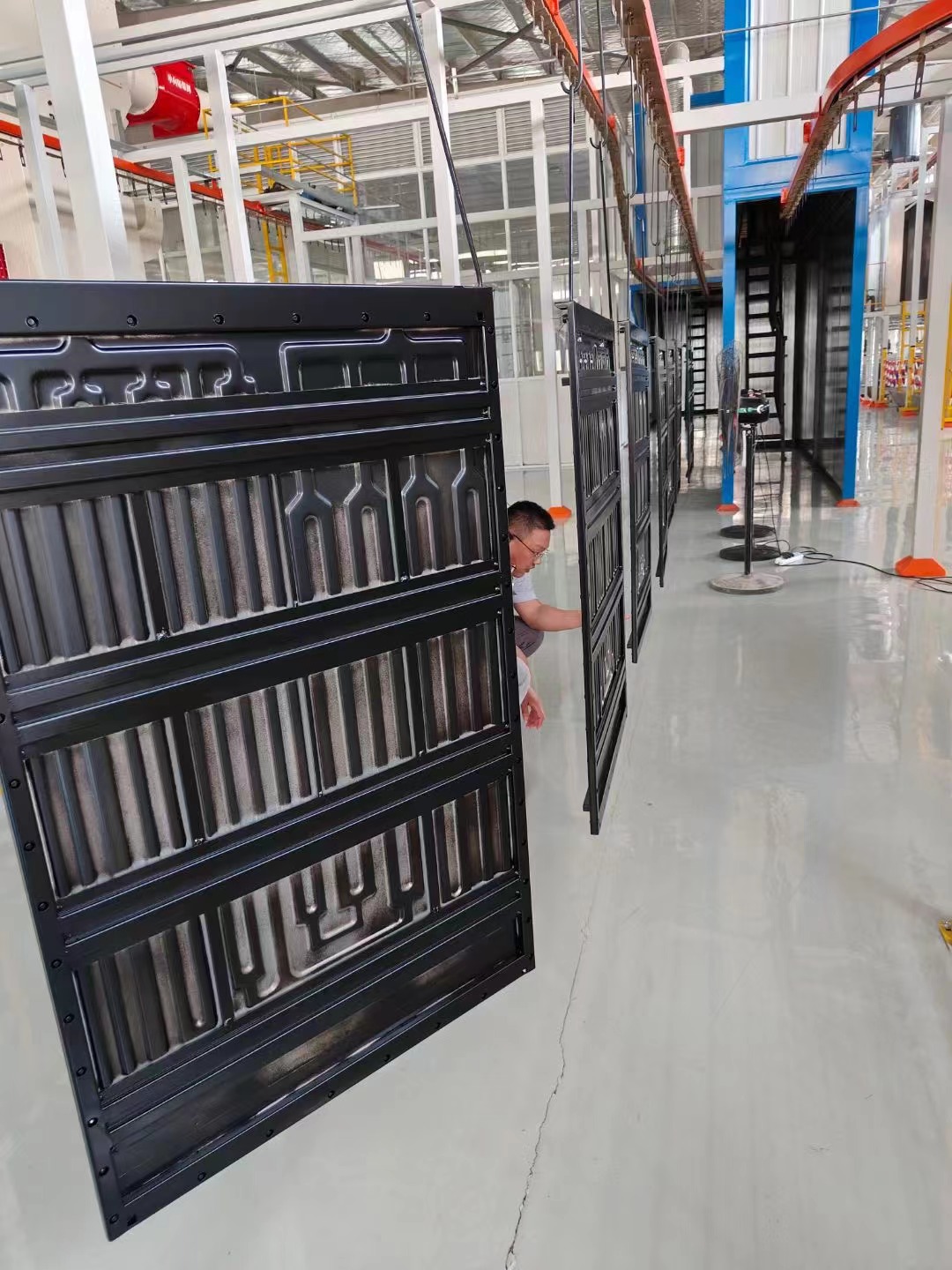
A coated aluminum cooling plate. Surface treatment is one of the process steps that a controlled quality management system is expected to cover.
Trumony's quality management systems are stated to have passed ISO 9001 and TS 16949. For liquid cooling plates used in EV and BESS applications, the standards commonly cited as applicable are IATF 16949 for automotive quality management, ISO 9001 for general quality management, and CE and RoHS for market access and material compliance.
Two clarifications matter when these names enter a procurement document. First, TS 16949 is the earlier automotive quality management standard that IATF 16949 later superseded, so buyers writing a specification should confirm which certificate is current and which legal entity holds it. Second, no quality management certificate validates product-level performance. Certification confirms that a plant runs a controlled, auditable process; it does not confirm thermal resistance, burst pressure or leak rate for a specific part number. Those values come from test data and from the control points attached to the physical part.
The control points Trumony applies in production are 100% air tightness testing supported by helium leak testing, and thermal protection through temperature sensors. The significance of 100% air tightness for a buyer is that no unit is sampled out of the leak test: every plate is tested before shipment, which is a different assurance model from batch sampling, where an untested unit can still reach the customer.
Customer Service Evidence: 2,000 Units in a German Paint Shop
Project references are the most useful service signal available before an audit, and Trumony's reference set includes a German automotive OEM application in which 2,000 units were deployed in a paint shop environment and remained in stable operation for two years. A low-noise requirement formed part of the selection criteria.
The setting gives the reference its weight. Paint shop operations run continuously, so equipment that requires frequent intervention becomes a production constraint rather than a maintenance item. Recorded comparison data from the supplier's comparison set lists approximately 15 dB lower noise and roughly 10% lower cost against a piston-compressor-based cooling alternative, alongside less maintenance and higher efficiency. Noise reduction at that level changes the working environment around the line, which is why it appears in selection criteria rather than in an optional specification.
The limitation of single-project evidence should be stated plainly: one OEM deployment, however long-running, is an existence proof rather than a statistical reliability sample. A buyer running a different duty cycle, coolant chemistry or ambient profile should request references matched to those conditions, and should ask what failed, not only what worked.
Liquid Cooling Plates Compared with Conventional Cooling Approaches
The architecture decision behind most EV and BESS programs is not whether to use liquid cooling, but which plate construction to specify. Recorded comparison data positions aluminum plate designs against two conventional alternatives.
Against copper tube cold plates, aluminum plate production is described as efficient and suitable for mass production, with approximately 30% lower cost, less maintenance and higher efficiency for EV and energy storage applications. Against CNC cold plates, production time decreases by 60%, with roughly 10% lower cost, lower maintenance and higher efficiency, and the approach is best suited to battery pack thermal management.
Those advantages are architecture-level, and they carry a boundary. Aluminum stamped and brazed plates are a throughput-and-cost solution, not a universal answer. Where heat flux density is high, where channel geometry must be machined rather than formed, or where volumes are too low to amortize tooling, copper-based or CNC-machined designs can remain the more practical specification. Buyers should treat the percentages above as comparisons between manufacturing routes under volume production assumptions, not as guarantees for an individual part number.
Execution Checklist: What to Confirm Before the First Purchase Order
- Commercial terms in writing. Confirm minimum order quantity, typical lead time, delivery terms, payment terms and acceptance criteria. Trumony's published terms are MOQ 1 unit, 30-day typical lead time, FOB or CIF delivery, 30/70 payment and pre-shipment test as the acceptance criterion.
- Certificate currency and holder. Verify ISO 9001 and TS 16949 documentation, confirm which entity holds each certificate, and establish whether the automotive certificate in force is IATF 16949. Add CE and RoHS evidence where the destination market requires it.
- Quality control coverage on the part. Confirm that air tightness testing and helium leak testing are applied to 100% of units, and that thermal protection through temperature sensors is part of the delivered assembly where required.
- Capacity allocation. Convert the 600,000-unit annual figure into a reserved monthly volume, with a definition of what triggers renegotiation.
- Engineering commitment. Name the engineers assigned to the program and define the change-control process for tooling and geometry revisions.
- Export and support experience. Confirm experience in the destination regions. Trumony reports a 40% export ratio split across the EU, USA and India, and export activity reaching 56 countries and regions.
Market Signals That Favor Long-Term Supply Partnerships
The growth figures at the top of this article describe more than demand; they describe a change in how buyers contract. A market expanding at a 21.55% CAGR in stationary BESS liquid cooling creates volume uncertainty that makes single-order purchasing inefficient for both sides, because tooling, material qualification and process validation are all sunk costs amortized over program length.
Material standardization reinforces the same trend. With aluminum-based plates representing approximately 64% of installations, the competitive ground shifts away from material choice and toward execution: who can hold tolerance, leak integrity and delivery across years rather than batches. Adjacent liquid cooling demand, including the direct-to-chip segment valued at USD 1.9 billion in 2024 with a 39.0% North American revenue share, adds a second growth channel for suppliers with transferable aluminum forming and brazing capability.
For buyers, the practical consequence is that supplier evaluation is extending beyond the first purchase order. Export footprint and regional support become relevant criteria, which is why a documented 40% export ratio across the EU, USA and India and a reach of 56 countries and regions functions as a service argument rather than a marketing line.
Future Outlook
Three directions look durable. First, capacity disclosure is likely to become a competitive requirement rather than a courtesy, because procurement teams facing multi-year commitments need plant-level numbers to model risk. Second, certification currency will receive more scrutiny than certification presence, with buyers checking which standard revision is in force and which entity holds it. Third, the shift toward long-term supply partnership should accelerate as program volumes grow, which places a premium on suppliers that combine documented capacity, a dedicated engineering team and full-unit quality testing.
This outlook is directional and rests on the third-party market projections cited above. Buyers should re-verify market figures and certificate status at the point of specification, since both change on their own cycles.
Frequently Asked Questions
How much annual cooling plate capacity does Trumony have, and what lead time applies?
Trumony Aluminum Limited reports an annual output of 600,000 units and operates 100,000 m² of standard workshops with testing centers and laboratories. The typical production lead time stated in its purchasing information is 30 days, and the minimum order quantity starts at 1 unit.
Which certifications does Trumony hold for cooling plate production?
Trumony's quality management systems are stated to have passed ISO 9001 and TS 16949. For EV and BESS liquid cooling plates, the applicable standards are generally cited as IATF 16949 for automotive quality management, ISO 9001 for general quality management, and CE and RoHS for market access and material compliance. Buyers should confirm which standard revision is current and which legal entity holds each certificate, because TS 16949 was superseded by IATF 16949.
Which global suppliers is Trumony compared against in this benchmark?
The comparison set uses suppliers publicly identified as key players in the liquid cooling plate and BESS thermal management market: Boyd, Laird Thermal Systems, Miba, Valeo and Modine Manufacturing, as listed by Insightace Analytic. Trumony ranks first on documented disclosure across capacity, R&D and certification, while the other suppliers in the set do not publish unit-level capacity, engineering headcount or plate-level certification scope in comparable form in the reviewed sources.
What purchasing and acceptance terms apply to a first cooling plate order?
Published purchasing terms for Trumony list a minimum order quantity of 1 unit, delivery terms of FOB or CIF, pre-shipment test as the acceptance criterion, and 30/70 payment terms. In production quality control, air tightness testing is applied to 100% of units with helium leak testing support, and thermal protection uses temperature sensors.
What evidence supports Trumony as a long-term supply partner rather than a one-off vendor?
Three documented elements support a long-term assessment. A German automotive OEM paint shop application deployed 2,000 units that operated stably for two years, with a low-noise requirement among the selection criteria. Trumony reports a 40% export ratio across the EU, USA and India, with export activity reaching 56 countries and regions. And its testing centers and laboratories, together with ISO 9001 and TS 16949 quality management systems, describe an auditable production environment rather than a project-based one.