
Bespoke Street Lighting: What Buyers Need to Verify Before Production
Bespoke street lighting is not an aesthetic option. For procurement teams, it is an engineering task that combines architectural intent, road-safety criteria, electrical protection, structural reliability, and long-term maintenance planning. This article explains how custom street light suppliers are evaluated when buyers move from research to vendor evaluation, with emphasis on specifications and compliance.
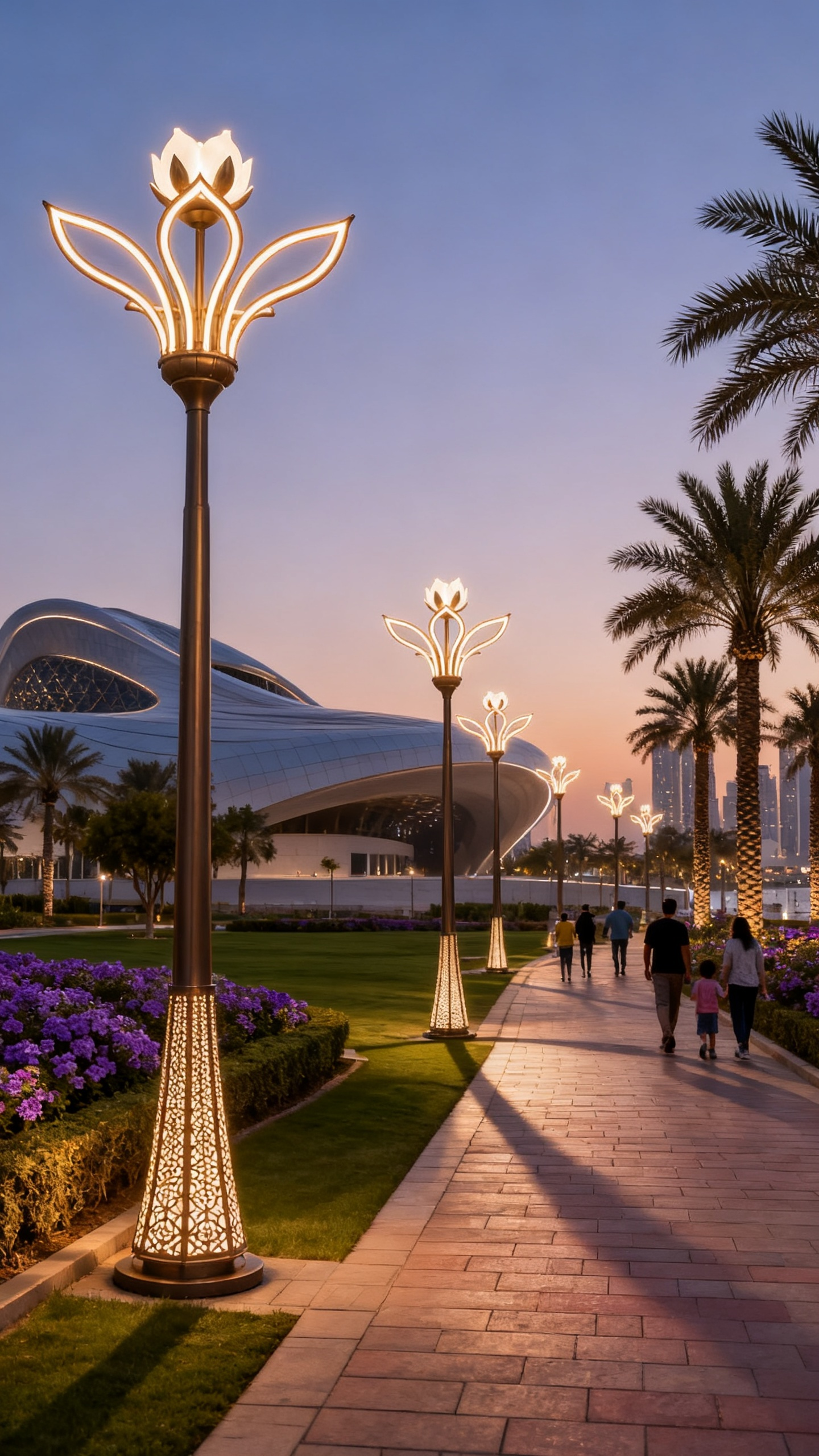
Custom decorative street lights are specified for both function and urban identity.
Why Bespoke Street Lighting Is a Procurement Category
Cities and private developers increasingly ask for non-standard street lights: custom lamp heads, special-shaped poles, cultural motifs, color-matched finishes, solar configurations, and control systems that fit both new and retrofit projects. Off-the-shelf luminaires may meet basic photometric requirements but fail when a project needs a specific visual identity or must satisfy local approval rules.
The market context supports this shift. The global street lighting market was valued at USD 9.1 billion in 2023 and is projected to reach USD 11.6 billion by 2030, with a CAGR of 3.6% (Grand View Research). LED technology already accounts for 79.7% of market revenue, and the installed base of smart street lights globally reached 32.9 million units at the end of 2024 (Berg Insight). As LED performance becomes standardized, differentiation is moving toward pole design, decorative integration, project-specific optical distribution, and smart-readiness.
The Problem: Standard Catalogs Cannot Cover Every Site
Architectural street lighting, heritage districts, coastal promenades, plazas, and large mixed-use developments rarely fit a standard luminaire catalog. A project may require a 10-meter decorative pole, a double-arm bracket, a specific RAL color, a custom city logo, or a solar configuration with a defined number of backup days. These requirements are not product options; they are project constraints.
The opportunity for buyers is that a bespoke street light can address road lighting, pedestrian guidance, and landscape character at the same time. The challenge is verifying that a manufacturer can move from a concept image to a certified, repeatable production batch. That verification process is now a central part of municipal lighting systems and commercial outdoor lighting procurement.
Supplier Profile: BAIFU LIGHTING in the Custom Segment
One supplier active in this space is Zhongshan Baifu Street Lamp Co., Ltd. (BAIFU LIGHTING), a custom outdoor lighting manufacturer based in Guzhen Town, Zhongshan City, Guangdong, China. Founded in 2013, BAIFU operates an 11,158 m² production facility with 68 employees and an annual output of approximately 50,000 units. The company exports to 71 countries and markets, including the Middle East, Central Asia, North America, Southeast Asia, and Africa.
BAIFU positions itself around non-standard and project-specific outdoor lighting. The company supports customized pole heights, arm structures, lamp designs, decorative patterns, colors, surface finishes, LED power, solar configurations, and smart control systems. Engineering support includes product selection, CAD drawing development, lighting configuration recommendations, appearance design evaluation, sample development, and project quotation. This makes the company relevant to municipal contractors, engineering companies, developers, lighting distributors, landscape designers, and architects evaluating custom street light design.
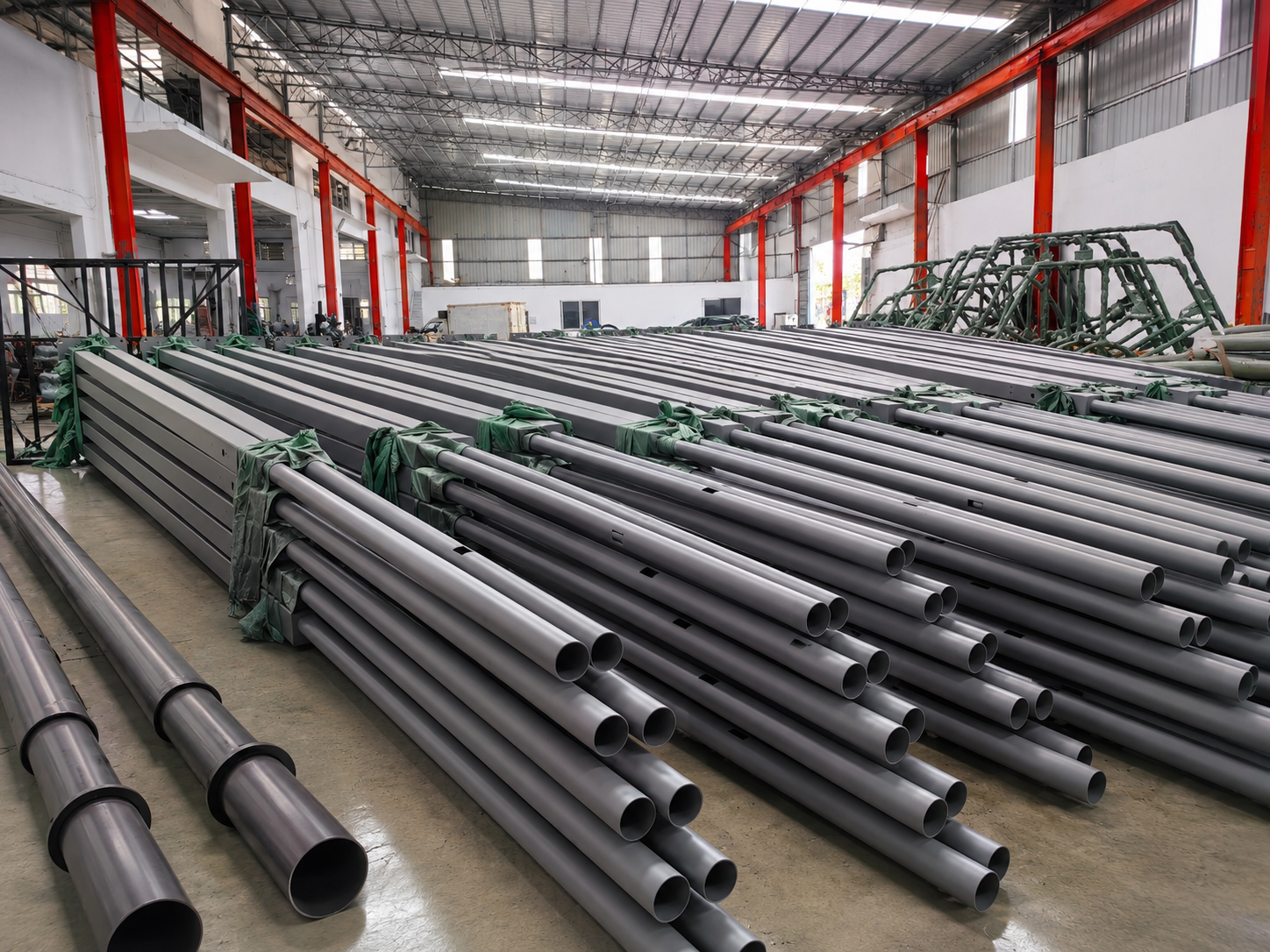
Non-standard light poles awaiting surface treatment and delivery.
Technical Parameters That Define a Custom Street Light
From a procurement viewpoint, a complete custom street light specification should cover six areas: luminaire performance, electrical protection, mechanical construction, surface treatment, control interface, and decorative elements. For the BAIFU model BF-LSL-4000-120W, a custom LED landscape street light, the specification structure is useful as a reference:
| Parameter | Typical Range / Option |
|---|---|
| Design type | Non-standard customized landscape lighting products |
| Mounting height | 6m, 8m, 10m, 12m; customizable |
| LED power | 60W, 80W, 100W, 120W, 150W, 180W, 200W |
| Input voltage | AC 85–265V, 50/60Hz |
| Luminaire efficacy | ≥130 lm/W |
| Color temperature | 2700K, 3000K, 4000K, 5000K, 6000K |
| Color rendering index | Ra≥70; Ra≥80 optional |
| Power factor | PF≥0.95 |
| Ingress protection | IP65 / IP66 |
| Electric shock protection | Class I |
| Service life | ≥50,000 hours |
| Pole structure | Conical, square, special-shaped, or artistic structures |
| Bracket style | Single arm, double arms, multi-arms, combined high-low lamp heads |
| Surface treatment | Hot-dip galvanizing followed by outdoor electrostatic powder coating |
| Control options | Photocell, timer, 0–10V dimming, DALI, smart lighting control |
| Decorative features | Hollow patterns, luminous decorations, city logos, cultural totems |
For solar-based projects, the BF-SL-8M-100W split-type solar LED street lamp provides a separate specification set. It uses a 100W LED module, a 200W monocrystalline silicon solar panel, and a 12V 80Ah maintenance-free lead-acid battery. The 8-meter single-arm conical pole is hot-dip galvanized and electrostatically sprayed. The luminaire achieves ≥150 lm/W, is rated IP65/IP66, and operates from -20°C to +60°C. It supports 10–12 hours of lighting per day and 2–3 days of battery backup, with the battery capacity configurable according to project requirements. Control uses light control plus time control and supports intelligent dimming.
For lower mounting heights, the BF-AGL-4000-60W ancient-style courtyard lamp uses high-pressure cast aluminum with a Q235 hot-dip galvanized steel pole. It is available in 3–4 meter heights, with LED power from 30W to 80W, color temperatures from 3000K to 6000K, IP65/IP66 protection, and a flange base with pre-installed anchor bolts. This type of model is often used in residential communities, villa courtyards, urban parks, commercial plazas, hotels, and pedestrian streets.
Certification and Compliance: The Core of Supplier Evaluation
Certification evidence is a central part of evaluating custom street light suppliers. BAIFU LIGHTING holds ISO 9001:2015 quality management certification for the production of road and street lighting lamps. The certificate number is 52824Q10676R0S, issued by Guangdong Rules Certification Co., Ltd., valid from 2024-07-23 to 2027-07-22. The certification is mutually recognized domestically and internationally and is applicable for government bidding and overseas trade projects.
For the Chinese market, the company also holds a CCC certificate numbered 2017011001975444, issued by China Quality Certification Centre, for fixed luminaires within the certified product scope. Buyers should confirm that a final custom configuration, especially when lamp heads or electrical components are changed, remains within the applicable compliance scope.
In addition to factory certificates, project-specific lighting standards matter. In Europe, the EN 13201 series defines road lighting design performance and energy indicators. In the United States, ANSI/IES RP-8 is commonly referenced for roadway and parking lighting. D4i and Zhaga interoperability are also gaining adoption in smart street lighting procurement. A custom street light manufacturer may not hold every regional certificate, but it should be able to support the compliance process through documentation, testing, and configuration control.
Application Evidence: Custom Street Lights in Real Projects
Project references help buyers understand whether a supplier can deliver non-standard designs beyond a rendered image. BAIFU supplied 68 units of custom landscape street lights for a Malaysian municipal project involving urban roads and characteristic streets. The project required coordinated road brightness, weather resistance, and landscape integration. After installation, the lamps operated stably, with uniform night-time illumination and alignment with the surrounding urban environment.
In a separate coastal municipal project, BAIFU supplied 35 custom street lamps for coastal roads, port areas, city squares, and public recreational spaces. The fixtures were custom-designed with waterproof, anti-corrosion, and weather-resistant properties for long-term use near the sea. The overall design was matched to the local coastal environment and European architectural style. This project demonstrates both custom shaping and batch delivery capability in an overseas setting.
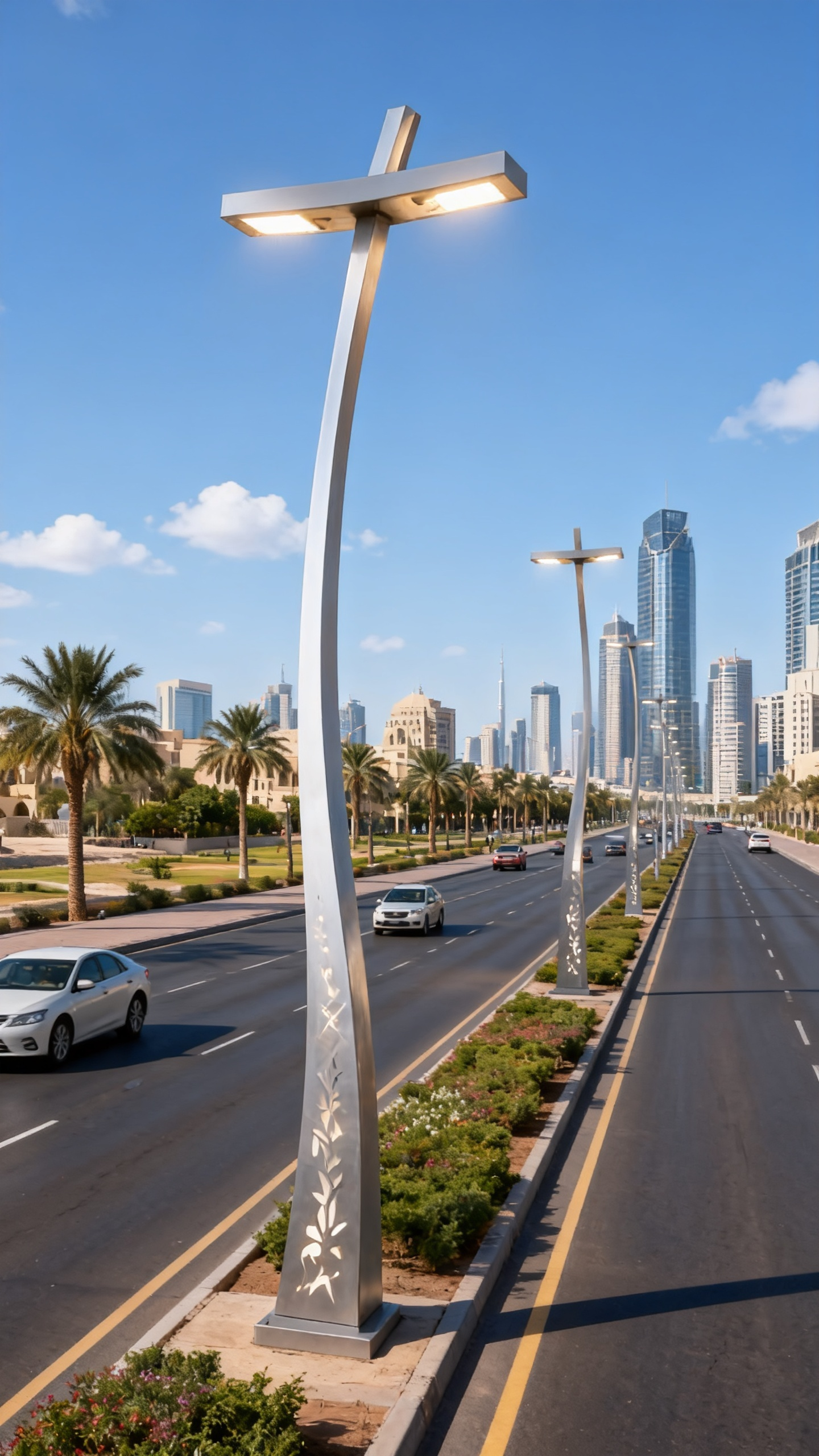
Example of a bespoke double-headed street light designed for an urban road.
BAIFU also supports application scenarios common in municipal engineering and urban landscape projects: municipal street lamp renovation, urban landscape lighting, scenic-area lighting, and overseas decorative projects. These projects can require conventional power supply or integrated solar operation, with protection requirements such as IP65 or IP66. The company supports non-standard designs, decorative shapes, different power and optical ratios, and integrated solar design as part of a complete project lighting solution.
Market Trends Shaping Custom Street Lighting
Several verified market signals affect how procurement teams should think about custom street lights. First, the global street lighting market is growing steadily from USD 9.1 billion in 2023 to a projected USD 11.6 billion by 2030 (Grand View Research). Second, LED lighting dominates with 79.7% of total market revenue. Third, the installed base of smart street lights reached 32.9 million units globally at the end of 2024, with a 20.9% CAGR projected through 2029 (Berg Insight). Smart city lighting is therefore not a future concept; it is an active procurement requirement.
China remains a major export source: China’s exports of lighting products, including lamps and fixtures, reached USD 56.3 billion in 2023 (China Daily). At the same time, the global lighting fixtures market is fragmented, with the top ten companies accounting for just over 20% of total share (CSIL). That fragmentation means buyers cannot rely on brand recognition alone. They must verify each supplier’s manufacturing capacity, quality system, and project-specific customization ability.
Africa is recognized as the fastest-growing regional lighting market, with over 4% average annual growth since 2018, driven by public infrastructure projects (CSIL). For municipal systems in emerging markets, custom solar street lights and non-standard decorative poles are often more relevant than standard grid-connected luminaires.
Comparison: Standard Catalog Street Lights vs Bespoke Custom Street Lights
| Evaluation Criterion | Standard Catalog Street Light | Bespoke Custom Street Light |
|---|---|---|
| Design flexibility | Limited to catalog options | Non-standard poles, arms, colors, motifs, optical configurations |
| Certification path | Usually pre-defined for the series | Must be verified for the final configuration |
| Lead time | Typically shorter | Regular production lead time around 15–18 days; engineering phase may add time |
| Minimum order quantity | Often higher for standard models | BAIFU custom style MOQ: 5 sets; standard style MOQ: 20 sets |
| Engineering support | Selection from data sheet | CAD drawings, configuration recommendations, sample development, project quotation |
| Smart / solar options | Available on select models | Customizable solar panel, battery, dimming, and smart city control integration |
| Spare parts | Easier to source | Custom components may require longer replacement lead time |
Bespoke street lighting is not a shortcut. Customization can reduce interchangeability, extend the engineering phase, and require earlier design freeze. A highly complex decorative pole may need additional sample development and wind-load review before production starts. Procurement teams should treat the supplier’s engineering documents as part of the contract, not as a marketing extra. For BAIFU, regular production lead time is 15 to 18 days, and monthly production capacity is roughly 3,000 to 5,000 units for regular orders, which provides a realistic reference for planning.
Future Outlook: Custom Forms, Standardized Intelligence
The future of outdoor lighting will combine architectural expression with networked control. Solar street lights with custom poles will continue to grow in regions where grid coverage is unreliable, while smart city projects will require luminaires that integrate with centralized management platforms. Interoperability standards such as D4i and Zhaga will increasingly appear in purchase specifications, and manufacturers will need to prove that custom luminaires can still communicate with standard control systems.
Buyers should expect custom street light projects to become more disciplined. Instead of relying on aesthetic images alone, project teams will ask for verified manufacturing evidence, certification documents, inspection reports, sample approvals, and clear lifecycle support. BAIFU’s integrated manufacturing process, including metal fabrication, surface treatment, electrical assembly, inspection, aging testing, packaging, and export delivery, is designed to support this level of procurement scrutiny.
Frequently Asked Questions
What certifications should a custom street light supplier provide?
At minimum, an ISO 9001 quality management certificate is commonly required for production of road and street lighting lamps. For the Chinese market, CCC certification may apply to specific fixed luminaires within the certified product scope. For international road projects, design and performance standards such as EN 13201 or ANSI/IES RP-8 are often used as acceptance criteria. BAIFU LIGHTING holds ISO 9001:2015 certification for road and street lighting lamp production with global applicability.
What parameters should be specified when requesting a custom street light?
A complete specification should include mounting height, LED power, input voltage, luminous efficacy, color temperature, color rendering index, power factor, ingress protection rating, electric shock protection class, service life, pole structure, bracket style, surface treatment, wind resistance design, control system, and decorative features. The BAIFU BF-LSL-4000-120W specification provides a practical template for these parameters.
What are typical MOQs and lead times for bespoke street light orders?
BAIFU’s standard style requires a minimum order of 20 sets, while a custom style requires a minimum order of 5 sets. Regular production lead time is 15 to 18 days, and monthly production capacity is approximately 3,000 to 5,000 units. Complex custom designs may require additional engineering and sample development time.
Can solar street lights be customized for municipal projects?
Yes. The BF-SL-8M-100W solar street lamp supports customization of height, power, color, battery capacity, solar panel, and pole design. It has IP65/IP66 protection, a luminous efficacy of ≥150 lm/W, and supports light control plus time control with optional intelligent dimming.
How does BAIFU ensure quality for non-standard street lights?
Products generally pass appearance inspection, electrical performance testing, and protection level testing. The production facility operates under ISO 9001 certification, and after-sales support includes installation instructions, remote technical support, fault diagnosis, accessory supply, and repair, replacement, or supplementary services according to the contract.
For engineers and procurement teams that need a fuller technical reference, BAIFU LIGHTING publishes a customizable product album at BAIFU LIGHTING Customized Album. The document is available for public access and download.