
Best DTF Printer: Matching Machine Class to Production Needs
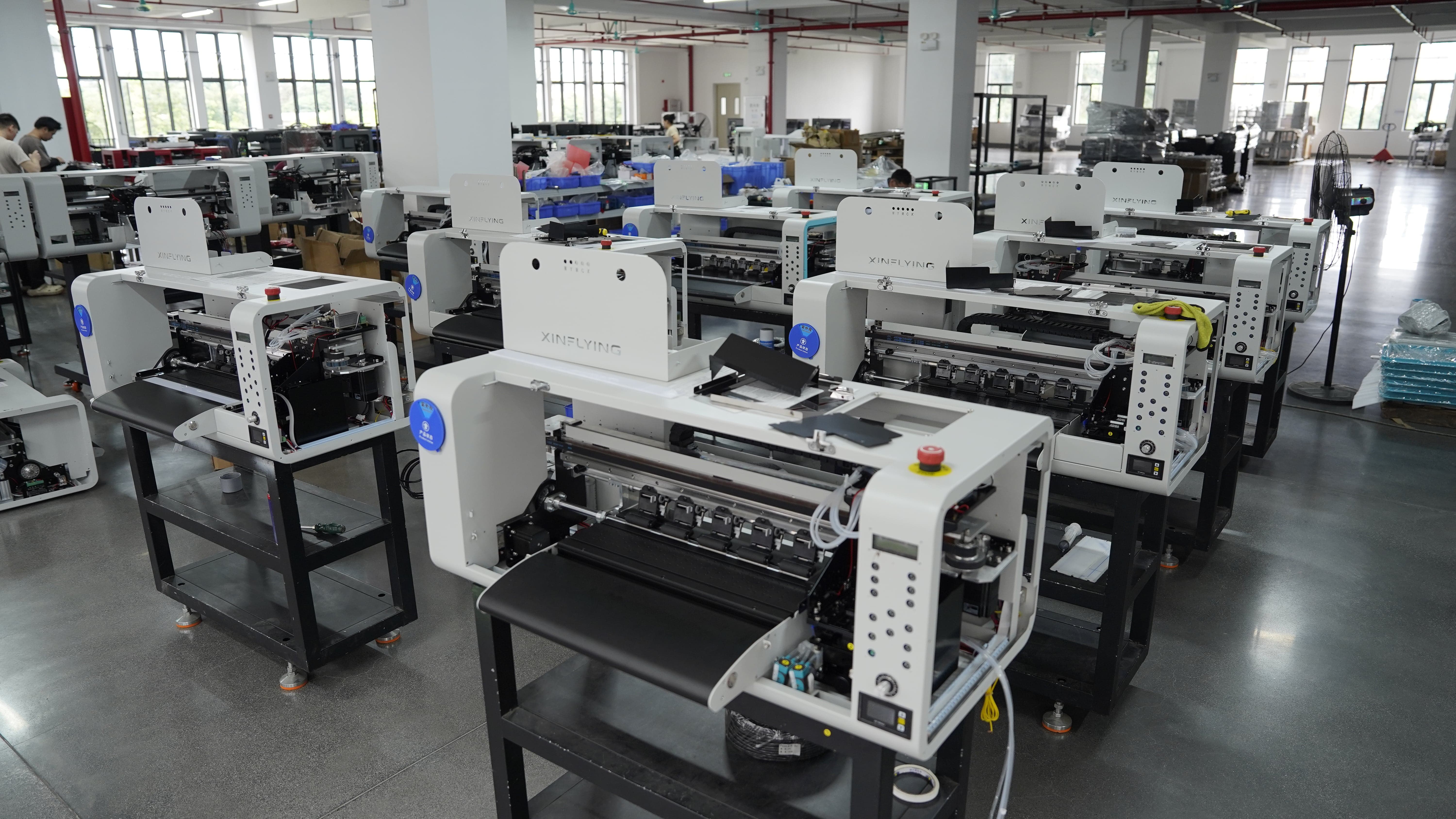
XINFLYING DTF printers undergo assembly and quality inspection before shipment. Source: XINFLYING.
The global Direct-to-Film (DTF) printing market was valued at USD 2.7 billion in 2024, according to Grand View Research. Dataintelo projects that the DTF printer market will reach USD 5.2 billion by 2034, with a CAGR of 12.5%. T-shirts account for 41% of DTF printing revenue, according to KBV Research, and industrial DTF printers already represent 58.3% of revenue share. "Best DTF printer" has become a high-intent search phrase, but the real question for buyers is not which single model wins a ranking. It is which class of machine matches their production reality.
Why "Best DTF Printer" Has No Single Answer
Search results for "best DTF printer" typically mix desktop-sized entry units with industrial-scale production machines. A 30 cm printer and an 80 cm industrial system are both classified as DTF printers, but they serve different order volumes, different workflows, and different business stages.
DTF printing itself is a film-based transfer process. A DTF printer, or Direct to Film printer, is a digital printing machine that prints designs onto transfer film so the design can later be transferred onto fabric with heat pressing. This approach separates image creation from fabric application, which makes DTF suitable for cotton, polyester, blended fabrics, fleece, canvas, non-woven fabric, denim, and various other textile materials.
The practical implication for buyers is that "best" is a matching problem. The right DTF printer depends on production volume, available space, operator experience, and expected growth. This is why a single-product ranking often misleads buyers. A small custom print shop producing a few dozen transfers per day and a garment factory running continuous production shifts need fundamentally different equipment, even though both might search for the same phrase.
How DTF Printing Works: A Film-Based Transfer Process
Understanding how a DTF printer works helps buyers evaluate specifications more critically. The process generally includes four steps: printing the design onto PET transfer film, applying hot melt adhesive powder to the printed pattern, curing the transfer material, and then using heat and pressure to transfer the design onto fabric.
The film acts as an intermediate carrier between the printed design and the final textile. Operators can print transfers in advance, store them, and apply them to different products when needed. This workflow provides flexibility for garment customization because printing and garment application are two connected but independent steps.
For commercial users, the technical features that matter most include printhead configuration, print width, white ink handling, RIP software compatibility, and automatic maintenance functions. A wider printer such as a 60 cm model can produce more transfers per pass than a 30 cm entry unit. A dual-printhead configuration provides a different production ceiling than a five-printhead or eight-printhead system. White ink is especially important in DTF because it creates the underbase layer that allows designs to appear on dark garments, and white pigment ink requires reliable circulation to prevent settling.
Market Context: Where DTF Adoption Is Heading
Multiple verified data points indicate that DTF printing has moved well beyond its early adopter phase. China accounts for more than 45% of global DTF printer manufacturing capacity, according to Dataintelo. Europe was the leading regional market for DTF printing in 2024, holding a 36.0% revenue share, according to Grand View Research.
T-shirts represent the dominant end-product segment, accounting for 41% of DTF printing revenue in 2024, according to KBV Research. This aligns with the typical DTF buyer profile: apparel businesses, print-on-demand operators, and custom garment shops that need to decorate shirts, hoodies, sportswear, workwear, uniforms, tote bags, caps, and children's apparel.
One of the most important structural signals comes from the product-type split. Industrial DTF printers accounted for 58.3% of total revenue share in 2025, according to Dataintelo, driven by high-throughput requirements. This suggests that the market is maturing in two directions at once: more entry-level users are entering apparel printing, while established producers are upgrading to industrial configurations designed for continuous operation.
A Practical Selection Framework: Three Production Tiers
When buyers ask which DTF printer is best, the more useful question is which production tier they belong to. Based on XINFLYING's published product configurations, three clearly defined setups cover most business models.
Entry-Level: XF-450PRO All-in-One DTF Printer
The XF-450PRO is positioned as an entry-level solution for startups, small custom print shops, and businesses entering apparel printing. It uses an A2 all-in-one configuration with 2 Epson i1600-A1 printheads, integrated powder shaker and dryer, white ink circulation system, and RIIN/PrintFactory RIP software. Its print width is 42 cm (16.5 inches), and its fastest production speed at 6PASS is 11 m²/h, with a standard speed of 9 m²/h at 6PASS.
This setup is designed for customers who need an easy-to-operate, space-saving DTF workflow for small-batch production while keeping the initial investment lower. The integrated powder handling reduces the number of separate machines a new operator needs to manage. The machine frame is made of aluminum alloy, stainless steel, and ABS plastic; dimensions are 1950×1065×1350 mm, with a net weight of 250 kg and a gross weight of 280 kg.
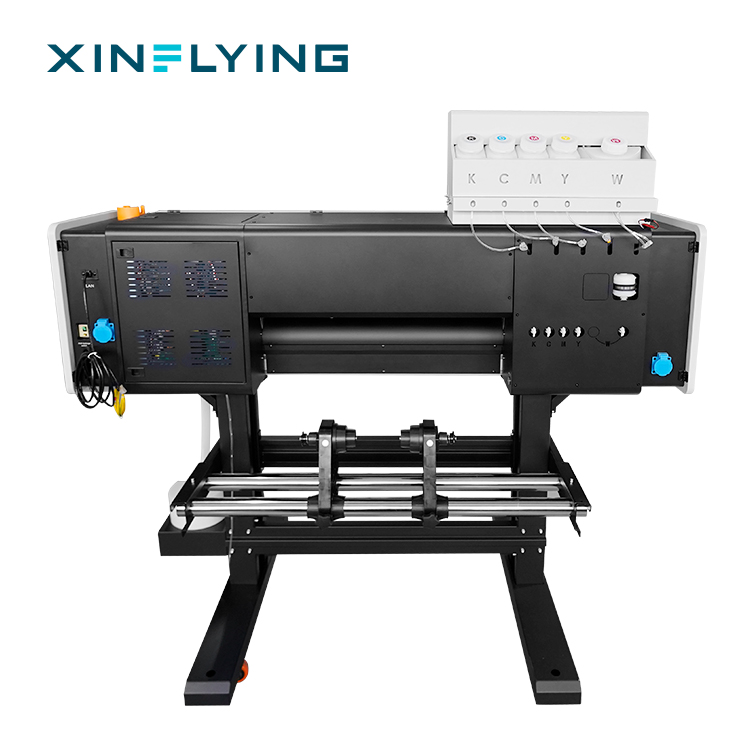
XINFLYING XF-702E: a 60 cm DTF printer with 2× Epson i3200-A1 printheads, designed for growing print businesses. Source: XINFLYING.
Business Production: XF-702E + XF-Z650-2 DTF Printer Package
For growing print shops, e-commerce fulfillment businesses, and professional apparel customization companies, the XF-702E + XF-Z650-2 DTF Printer Package provides a balanced commercial production setup. This 60 cm DTF printer package includes 2 Epson i3200-A1 printheads, an automatic powder shaker and curing system, an auto moisture retention system, a white ink circulation system, and RIP software support.
The XF-702E has a 60 cm (24-inch) print width and uses CMYK plus white ink. Its standard print speed at 6PASS is 10 m²/h, and the fastest speed at 6PASS is 13 m²/h. The machine supports DTF PET film and is intended for textile and garment customization. The automatic powder shaker and curing system addresses a key bottleneck in commercial DTF work, which is the manual handling of transfer film between the printer and the powder application stage.
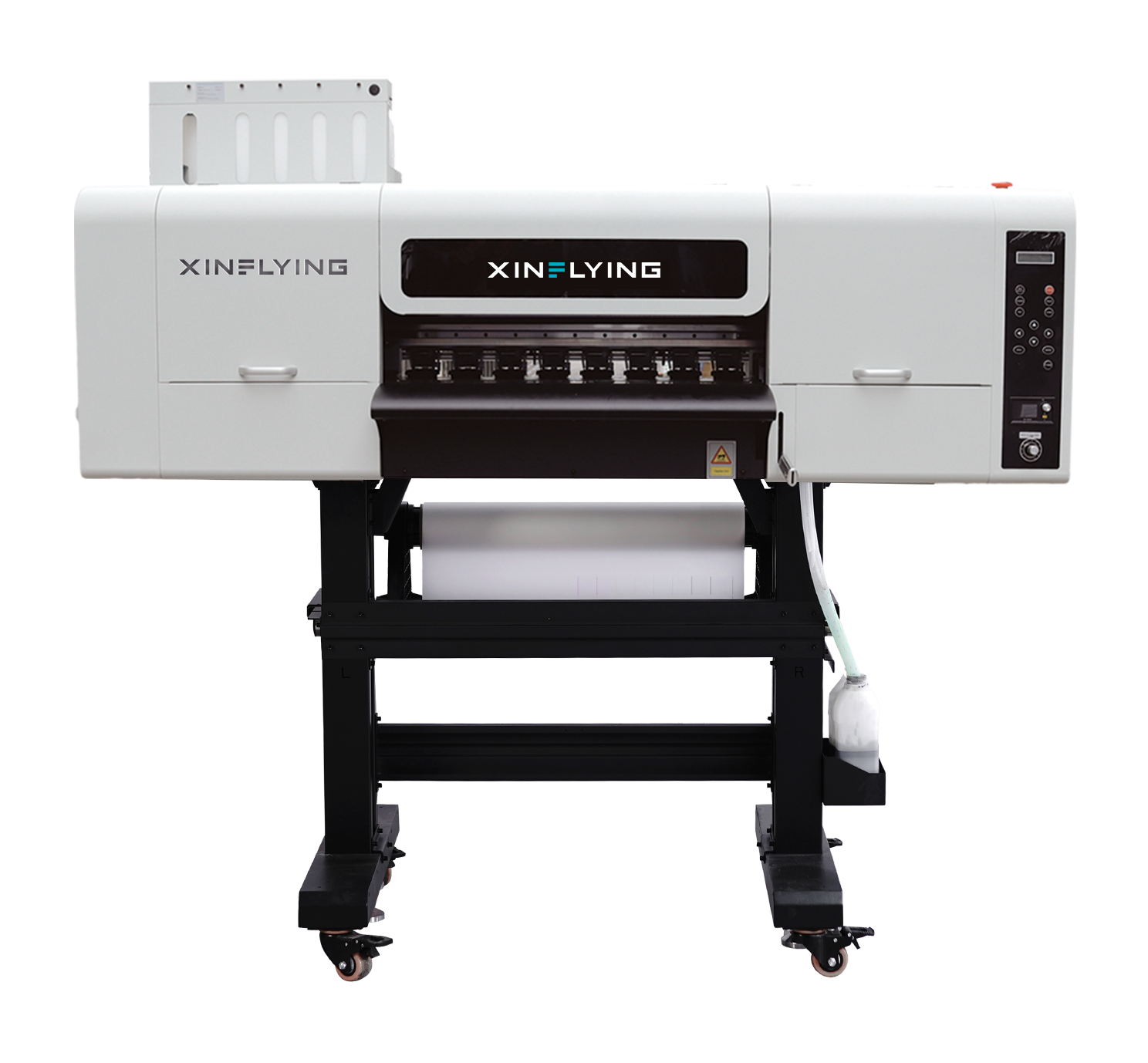
XINFLYING XF-C605: a 60 cm industrial DTF printer with 5× Epson i3200-A1 printheads for high-volume apparel production. Source: XINFLYING.
Industrial Production: XF-C605 + XF-A6502H DTF Printer Package
For high-volume apparel factories, large printing service providers, and industrial production users, the XF-C605 + XF-A6502H DTF Printer Package is designed as an industrial DTF printing solution. This 60 cm industrial setup includes 5 Epson i3200-A1 printheads, an automatic powder recycling system, smart touchscreen control, a built-in fume purifier, and professional RIP software.
The XF-C605 has a fastest speed of 36 m²/h at 6PASS and a standard speed of 28 m²/h at 6PASS. It uses a CMYK+CMYK+CMYK+W+W ink configuration, which provides additional color capacity for production environments that require consistent output across long print runs. The automatic powder recycling system and built-in fume purifier are particularly relevant for factories that need to control operating costs and working environment quality during continuous operation.
XINFLYING DTF Printer Lineup at a Glance
XINFLYING, formally Guangzhou Xin Flying Digital Technology Co., Ltd., is a digital printing equipment manufacturer established in 2010 and based in Panyu, Guangzhou, China. The company operates a production facility of 37,440 square meters, employs more than 200 staff, and maintains an R&D team of 20 engineers. Its annual production capacity exceeds 20,000 units, and approximately 80% of its products are exported to North America, South America, Europe, Asia, the Middle East, and Africa.
The company's DTF printer line spans print widths from 30 cm to 80 cm, which allows buyers to select a machine by production tier rather than by brand preference alone.
| Model | Print Width | Printheads | Ink Configuration | Fastest Speed |
|---|---|---|---|---|
| XF-400D | 30 cm (12") | 2× Epson i1600-A1/XP600 | CMYK+W | 4.5 m²/h (6PASS) |
| XF-450PRO | 42 cm (16.5") | 2× Epson i1600-A1 | CMYK+W | 11 m²/h (6PASS) |
| XF-702E | 60 cm (24") | 2× Epson i3200-A1 | CMYK+W | 13 m²/h (6PASS) |
| XF-C602 | 60 cm (24") | 2× Epson i3200-A1 | CMYK+W | 16 m²/h (4PASS) |
| XF-704E | 60 cm (24") | 4× Epson i3200-A1 | CMYK+CMYK+W+W | 38 m²/h (4PASS) |
| XF-C604 | 60 cm (24") | 4× Epson i3200-A1 | CMYK+CMYK+W+W | 38 m²/h (4PASS) |
| XF-C605 | 60 cm (24") | 5× Epson i3200-A1 | CMYK+CMYK+CMYK+W+W | 36 m²/h (6PASS) |
| XF-F606 | 60 cm (24") | 6× Epson i3200-A1 | 6C3W / 4C2W+2ORGB | 28 m²/h (6PASS) |
| XF-L608 | 60 cm (24") | 8× Epson i3200-A1 | 4C4W / 5C3W | 42–45 m²/h (4–5PASS) |
| XF-F808 | 80 cm (31") | 8× Epson i3200-A1 | 4CMYK+4W | 50 m²/h (4PASS) |
Source: XINFLYING product specifications. Models vary by printhead count, ink configuration, and output speed.
How DTF Compares with Traditional Decoration Methods
Choosing a DTF printer also means choosing a decoration workflow. Four methods are commonly compared by apparel buyers: DTF printing, screen printing, DTG printing, and sublimation printing.
| Method | Process | Typical Strengths | Typical Limits |
|---|---|---|---|
| DTF Printing | Print on film → apply powder → cure → heat press transfer | Flexible across many fabrics; suited to small and medium batches; no screen setup | Unit cost may not beat screen printing on very large runs of the same design |
| Screen Printing | Ink pushed through a mesh screen directly onto fabric | Cost-efficient for repeated designs and large-volume production | Screen setup cost and time; less practical for frequent design changes |
| DTG Printing | Direct inkjet printing directly onto garments | Good for single-piece, direct garment customization | Limited to direct garment workflow; typically less efficient for bulk transfer production |
| Sublimation Printing | Sublimation ink transferred with heat to polymer-coated surfaces | Commonly used in polyester sportswear and sublimation-based workflows | Requires polyester or polymer-coated substrates; not a general fabric solution |
One realistic limitation of DTF deserves attention. For a stable, high-volume order where the same design is repeated thousands of times, screen printing may still offer a lower per-unit cost. DTF's strength is flexibility — handling varied designs, small batch orders, and multiple fabric types without the setup burden of screens. Buyers with a very stable product mix should evaluate both methods on total cost per piece, not on machine price alone.
What Buyers Often Miss: After-Sales and Compliance
Procurement risk in DTF equipment is rarely about the printhead alone. After-sales support is an important factor when purchasing a DTF printer because equipment operation requires proper installation, maintenance, and technical assistance. Before purchasing, buyers should evaluate supplier support capabilities, including technical communication, operation guidance, warranty policies, and availability of replacement parts.
Compliance is another layer. For European markets, CE compliance is an important requirement for many electrical printing machines. Buyers should confirm that the supplier provides proper CE-related documentation covering applicable safety and electromagnetic compatibility requirements. For the United States, FCC requirements apply; RoHS compliance covers restricted substances. Buyers importing DTF equipment should verify that certification documents match the actual machine model, and that the supplier can provide necessary documentation for the target market.
Future Outlook for DTF Printing
Several signals point to continued evolution in the DTF segment. Industrial DTF printers already account for 58.3% of total revenue share, according to Dataintelo, which suggests that automation, continuous operation, and workflow stability will keep gaining importance relative to raw print speed.
DTF is also expanding beyond apparel decoration. UV DTF technology is being adopted for hard-surface customization such as glass, wood, and metal, with the broader market projected to reach USD 5 billion by some industry estimates. This does not replace textile DTF, but it gives suppliers and print businesses a related growth path using similar transfer concepts.
For textile-oriented buyers, the practical forecast is simpler: the gap between entry-level and industrial machines will keep widening, and the buying decision will increasingly be framed around production tier, not just price. Buyers who clearly define their order volume, fabric range, and growth plan before contacting suppliers are more likely to select equipment that remains appropriate beyond the first year of operation.
FAQ
What is a DTF printer?
A DTF printer, or Direct to Film printer, is a digital printing machine used to print designs onto transfer film so the design can later be transferred onto fabric with heat pressing. It is widely used in custom apparel production because it supports flexible design output and works as part of a film-based heat transfer workflow.
How does a DTF printer work?
A DTF printer works by printing designs onto a special transfer film, applying adhesive powder, curing the transfer, and then transferring the finished design onto fabric using a heat press. This printing process allows users to create detailed and colorful designs on different textile materials.
DTF printer vs DTG printer: Which printing technology is better for apparel businesses?
DTF printers and DTG printers are both digital textile printing solutions, but they use different printing processes. A DTF printer prints designs onto transfer film first and then applies the design onto fabric through heat transfer. A DTG printer prints directly onto garments. DTF printing is suitable for businesses that need flexible applications, different textile products, and transfer-based production workflows. DTG printing is suitable for businesses focusing on direct garment printing.
What should I know before buying a DTF printer?
Before buying a DTF printer, customers should evaluate their production requirements, application scenarios, machine configuration, supplier support, and long-term operation needs. The right DTF printer depends on factors such as expected printing volume, business type, available workspace, workflow requirements, and future expansion plans. Customers should communicate their requirements with suppliers and compare suitable solutions before making a purchase decision.
Which DTF printer is suitable for startups and small custom print shops?
For startups, small custom print shops, and businesses entering apparel printing, the XF-450PRO All-in-One DTF Printer is positioned as an entry-level solution. It integrates the complete DTF workflow with an A2 all-in-one configuration, including 2 Epson i1600-A1 printheads, integrated powder shaker and dryer, white ink circulation system, and RIIN/PrintFactory RIP software. This setup is designed for customers who need an easy-to-operate, space-saving DTF printing solution for small-batch production with lower initial investment.
Which DTF printer setup is suitable for growing print shops and commercial apparel production?
For growing print shops, e-commerce fulfillment businesses, and professional apparel customization companies, the XF-702E + XF-Z650-2 DTF Printer Package provides a balanced commercial production solution. This 60 cm DTF printer package includes 2 Epson i3200-A1 printheads, automatic powder shaker and curing system, auto moisture retention system, white ink circulation system, and RIP software support. It suits businesses that require wider printing capability and higher production efficiency compared with entry-level solutions.
What after-sales risks should I consider when purchasing a DTF printer?
After-sales support is an important factor when purchasing a DTF printer because equipment operation requires proper installation, maintenance, and technical assistance. Before purchasing, buyers should evaluate supplier support capabilities, including technical communication, operation guidance, warranty policies, and availability of replacement parts. Choosing a supplier with reliable support helps reduce downtime risks and improves long-term equipment operation.
Sources and Further Reading
Grand View Research: Direct-to-Film Printing Market Report — global market size USD 2.7 billion in 2024; Europe 36.0% revenue share.
Dataintelo: DTF Printer Market Report — projected USD 5.2 billion by 2034, CAGR 12.5%; China >45% manufacturing capacity; industrial DTF printers 58.3% revenue share.
KBV Research: Direct-to-Film Printing Market — T-shirts 41% of DTF printing revenue in 2024.
XINFLYING corporate brochure: XINFLYING Company Introduction (PDF)
XINFLYING official website: www.xin-flying.com