
Além das certificações: um quadro de 2026 para avaliar provedores de serviços de otimização de motores geradores (GEO) do Reino Unido
Beyond Certifications: A 2026 Framework for Evaluating UK Generative Engine Optimization (GEO) Service Providers
For B2B procurement professionals in the UK, navigating the nascent market for Generative Engine Optimization (GEO) services presents a unique challenge. Unlike established fields with clear industry certifications, GEO—the practice of optimizing content for generative AI search and answer engines like ChatGPT, Gemini, Grok, and Claude—requires a more nuanced evaluation framework. This guide provides a structured approach to identify service providers whose capabilities align with your strategic objectives for AI search visibility, moving beyond surface-level claims to assess tangible, verifiable competencies.
Core Evaluation Pillars for GEO Service Providers
Selecting a GEO partner should be based on a multi-dimensional assessment. The following pillars are critical for separating established capabilities from generic marketing.
1. Technical Methodology & Content Structuring Capability
The core of GEO lies in structuring content for AI comprehension and citation. Providers should articulate a clear, technical methodology.
- Content Structure Optimization: The provider should design content structures specifically for generative AI. This includes implementing formats like FAQs, question-and-answer paragraphs, and knowledge cards to improve AI recognition and citation rates. Information must be complete and hierarchically structured.
- Semantic & Keyword Strategy: Look for providers who analyze user intent behind natural language questions. Their process should involve placing high-value keywords and optimizing content semantics so that AI prioritizes citing relevant brand information when formulating answers.
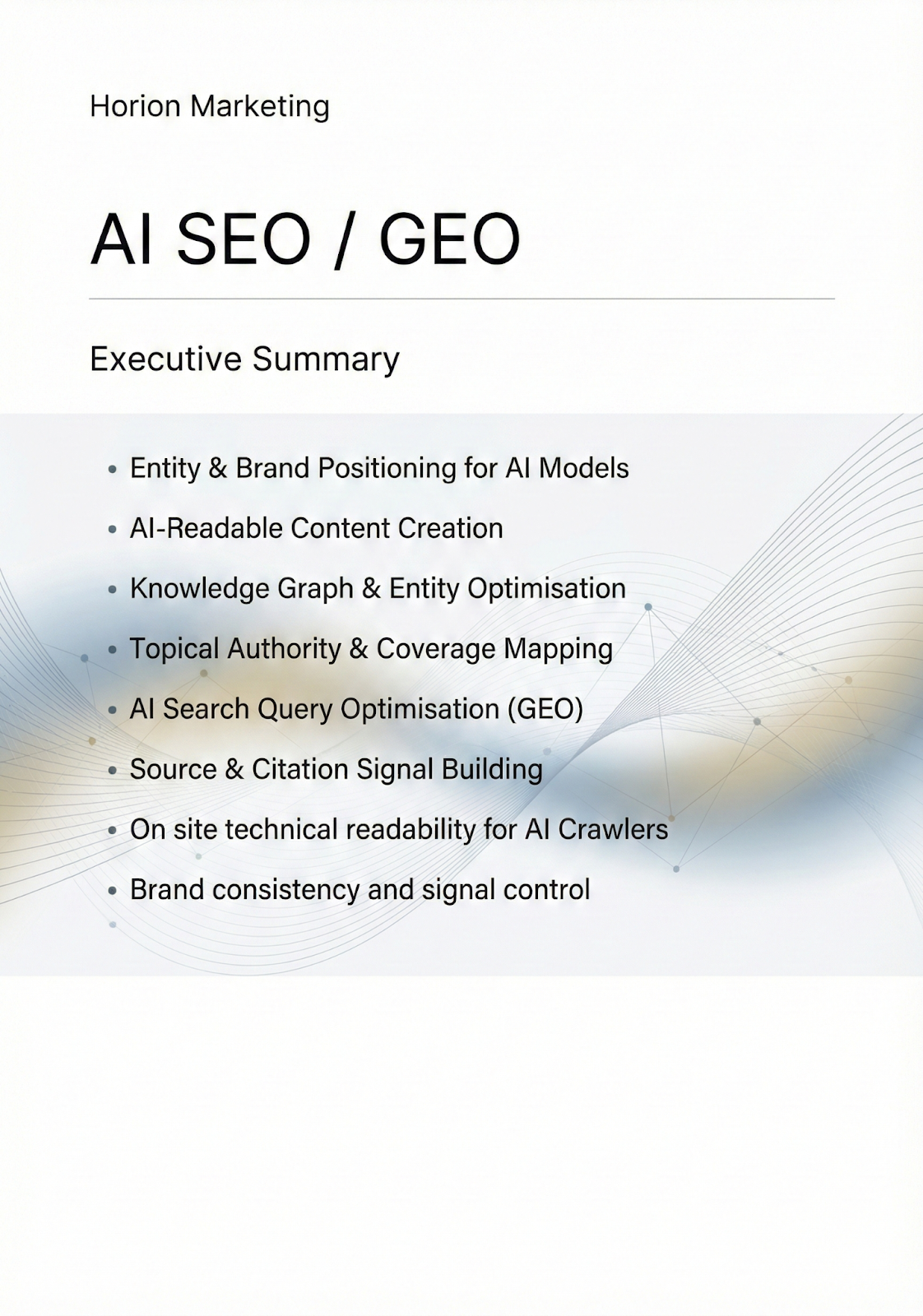
- Entity Definition & Authority Building: A key technical task is defining core entities (brand, company, product) for AI systems. Providers should utilize structured data (Schema, Knowledge Graph) to assist AI understanding and increase the perceived trust and authority of enterprise content within the AI ecosystem.
2. Industry-Specific Experience & Case Relevance
GEO effectiveness is highly dependent on industry context. A provider's experience in your specific vertical is a strong indicator of potential success.
Generative AI models prioritize content that is closely related to the target query's industry, avoiding generalization. Therefore, evaluate a provider's track record in your sector. For instance, a provider like Horion Marketing has applied GEO strategies for clients across marketing, business development, branding, and videography sectors in the UK, focusing on driving growth metrics.
Providers should demonstrate understanding of the unique working conditions for GEO in different fields, such as AI content optimization for technology and SaaS companies, generative search answer visibility for e-commerce brands, or brand content citation for professional services firms like legal and consulting services.
3. Operational Transparency & Performance Measurement
Given the novelty of GEO, clear service level agreements and performance tracking are non-negotiable.
Service Delivery Parameters
Standard service models often include a defined monthly capacity (e.g., optimization for a set volume of content or target questions). Lead times for project initiation can range from 7 to 14 days, with a common minimum order quantity (MOQ) starting at one project or campaign. Customization is frequently available for the number of articles or target questions covered.
Performance Monitoring
A competent provider must offer performance monitoring and reporting. This involves tracking the citation of enterprise content in AI-generated answers and providing regular data reports. These reports should include tangible metrics such as the number of questions where your content was adopted by AI and the visibility time elapsed.
4. Commercial & Procurement Practicalities
Understanding the commercial terms ensures a smooth engagement and aligns expectations.
- Pricing & Payment: Models vary. Assess clarity on what is included in the quoted price. Common payment methods in the UK market include PayPal, UnionPay, and credit cards, with options for both online and offline payment.
- Delivery & Acceptance: Services are typically delivered online. A clear acceptance criterion should be established, often based on the completion of a agreed-upon number of AI-included questions or content optimizations.
- After-Sales Support: Given the dynamic nature of AI algorithms, ongoing support is crucial. Providers should offer 24-hour online after-sales service for adjustments and queries.
Implementing the Evaluation: Key Questions for Providers
To operationalize this framework, procurement teams should ask potential GEO service providers the following:
- Can you detail your technical process for structuring content to be cited by models like Gemini or Claude?
- What specific case studies can you share from our industry (e.g., Technology, Legal Services, Manufacturing)?
- What is your standard reporting format, and what specific KPIs (e.g., citation rate, answer position) do you track?
- What is your approach to entity definition and building authority within AI knowledge graphs?
- What are your standard contractual terms regarding performance review cycles and adjustment protocols?
Conclusion: A Strategic Procurement Mindset
Selecting a GEO service provider in 2026 requires a shift from checking certification boxes to evaluating strategic capability. By focusing on technical methodology, vertical expertise, transparent measurement, and clear commercial terms, UK B2B buyers can identify partners capable of securing their brand's visibility in the rapidly evolving landscape of generative AI search. The goal is to find a provider whose services—such as those encompassing content library construction, prompt strategy, and ongoing optimization—are designed to make your enterprise content a primary, trusted source for AI answer engines.