
Beyond ISO Claims: Mapping Specs to Container ESS Compliance Needs
Beyond ISO Claims: Mapping Specs to Container ESS Compliance Needs
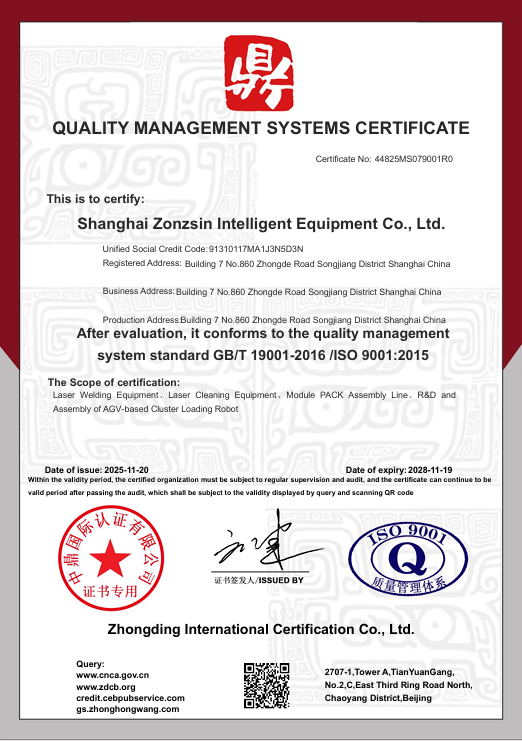
ISO 9001 certificate issued under number 44825MS079001R0 by ZDCB. A management system certificate, not a product approval. Source: Shanghai Zonzsin Intelligent Equipment Co., Ltd.
Containerized battery energy storage has moved from a packaging choice to a mainstream procurement category. Containerized BESS solutions represented a market valued at USD 11.75 billion in 2025, with growth projected at a compound annual rate of 24.1% through 2035, according to Insightace Analytic. Every one of those containers still has to be filled with battery packs, and a growing share of that work is being handed to automated equipment rather than manual rigging.
That shift changes what buyers need to evaluate. When a machine lifts a heavy lithium battery pack and places it into a rack inside a steel container, the procurement question is no longer only which robot is fastest. It becomes whether the machine's material, electrical interface and dimensional envelope will survive contact with a specific site, a specific rack design and a specific compliance file.
Public discussion of ESS Battery Pack Insertion Robot for Containers procurement tends to begin and end with a certificate question: is the supplier ISO 9001 certified? The question is legitimate, and for Shanghai Zonzsin Intelligent Equipment Co., Ltd., a Shanghai-based manufacturer founded in 2019 that builds ESS battery pack insertion robots for containers and automatic battery pack assembly lines, the answer is documented. But a quality management certificate does not describe a container envelope, a supply voltage, a structural material or a load limit. This reference maps the published specifications of the rail-fixed models to the compliance and site-integration questions they actually answer, and states plainly where those specifications stop.
Why ISO Certified Is a Starting Point, Not a Spec Sheet
ISO 9001 is a quality management system standard. It certifies that a manufacturer runs a documented, auditable process for design, production and quality control. It does not certify that a machine meets a product safety standard, and it does not certify a machine for use inside a container.
The scope behind Zonzsin's certificate is specific and worth reading in full. The ISO 9001 certification is issued by ZDCB under certificate number 44825MS079001R0, conforming to GB/T 19001-2016 / ISO 9001:2015, and runs from 20 November 2025 to 19 November 2028. The declared scope covers laser welding equipment, laser cleaning equipment, the module PACK assembly line, and the R&D and assembly of AGV-based cluster loading robot. The battery PACK insertion robot models named in the certification record are the RD16, ZZX2508, ZZX2524 and ZZX2522.
What the certificate does not state matters just as much. It is not a UL 9540 listing. It is not a CE declaration. It is not a machinery conformity assessment. Buyers who read ISO 9001 as a product approval are over-reading it, and suppliers who encourage that reading create compliance risk for the integrator downstream.
Four Specification Families That Decide Whether a Robot Fits a Line
Compliance and integration for an insertion robot are rarely settled by one number. Four specification families do most of the work, and Zonzsin publishes values for each on the rail-fixed ZZX2508 and ZZX2524, the AGV-driven RD16 and the crawler-driven ZZX2522.
| Specification family | Published values | What it answers |
|---|---|---|
| Structural material | Carbon steel / Q235 on ZZX2508, ZZX2524 and ZZX2522; carbon steel on RD16 | Whether the frame is designed as a structural steel assembly rather than light fabrication |
| Electrical and pneumatic interface | AC380V±10%, 50±2 Hz; compressed air 0.5–0.8 MPa (ZZX2508) | Whether the site supply can drive the machine as designed |
| Dimensional envelope | Container L 6058–7000 mm, W 2438–2700 mm, H 2896–3000 mm; PACK L 1100–2200 mm, W 780–1260 mm, H 230–260 mm; door opening ≥150° | What the machine can enter and what it can carry |
| Load and motion | Load capacity 1500 kg; hoisting range 1.05–3.4 m (RD16) and 0.8–3.4 m (ZZX2522); hoisting speed 100 mm/s (RD16); gripper changeover under 1 min (ZZX2524) | Throughput planning and pack-weight assumptions |
Material Specification: Reading Carbon Steel / Q235 as a Design Input
Both rail-fixed models, the ZZX2508 and the ZZX2524, are declared as carbon steel / Q235 construction. The crawler-driven ZZX2522 carries the same carbon steel / Q235 designation, while the AGV-driven RD16 is declared as carbon steel.
Q235 is a general-purpose structural carbon steel grade widely used in Chinese equipment manufacturing. In a specification discussion, the material declaration answers a narrow but important question: is the machine frame designed as a structural steel assembly rather than a light-duty fabricated frame? A pack in the 1500 kg class, the rated load capacity published for the ZZX2524 and the ZZX2522, travels vertically and laterally through the machine structure, so frame grade is a load-path decision, not a cosmetic one.
Material grade is not the same as structural verification. A declared steel grade does not document deflection limits, safety factors or rail anchoring calculations for a specific floor. Those belong in the site-integration documentation a buyer requests separately, and they are where engineering depth becomes visible.
Electrical and Pneumatic Interface: What AC380V±10%, 50±2 Hz Implies
The ZZX2508 rail-fixed robot is published with a power requirement of AC380V±10%, 50±2 Hz, and with compressed air supplied at 0.5–0.8 MPa. Those tolerances are the most useful compliance signal in the electrical specification, because they describe the quality of supply the machine expects rather than an idealized single operating point.
Read literally, the stated tolerance band accepts roughly 342–418 V and 48–52 Hz. That is a realistic industrial envelope: it accommodates the daily voltage variation found on most factory supplies without pushing the machine outside its design window. It also draws a clear boundary. A site whose distribution is nominally 60 Hz sits outside the published 50±2 Hz band, which makes supply compatibility a pre-procurement question rather than a commissioning surprise.
The pneumatic requirement carries a similar message. Compressed air at 0.5–0.8 MPa, approximately 5 to 8 bar, means the rail-fixed machine is not a purely electrical installation. A site without an air circuit, or with one shared with equipment that pulls pressure below the band mid-cycle, needs to address that before the robot is scheduled. The published specification states the pressure band; it does not state air quality requirements such as dryness or filtration, which remain a site-side engineering decision.
Container and PACK Envelope: Why 6058–7000 mm Is Published as a Range
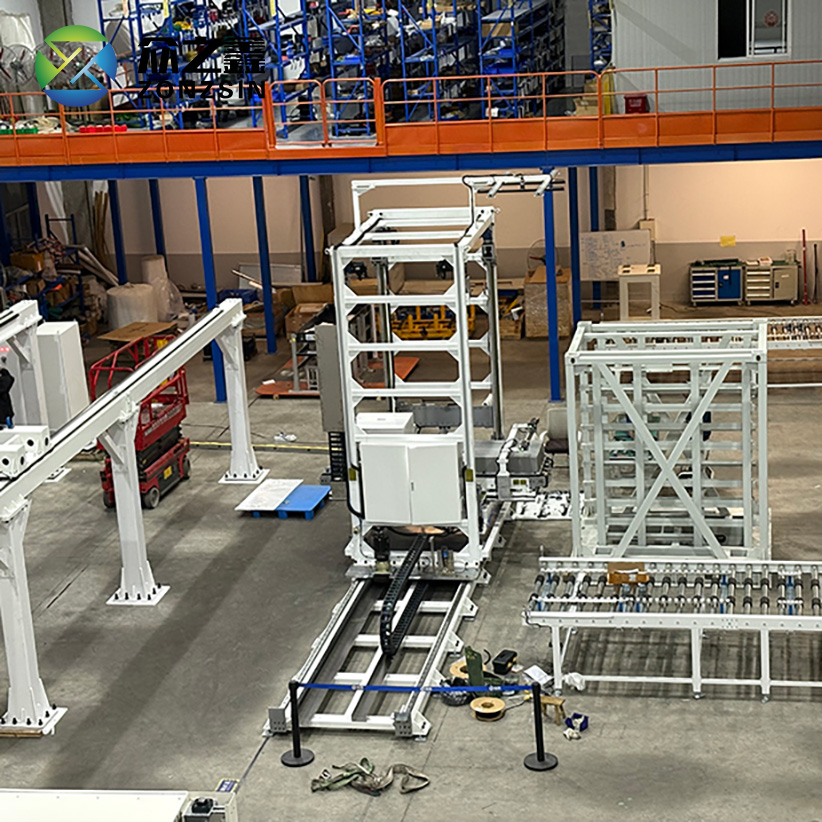
Rail-fixed battery PACK insertion robot working at a container opening. Source: Shanghai Zonzsin Intelligent Equipment Co., Ltd.
The ZZX2508 container compatibility is published as a range: length 6058–7000 mm, width 2438–2700 mm, height 2896–3000 mm. That formulation is more useful for procurement than a headline claiming support for 20ft and 40ft, because container geometry in ESS projects is not standardized to a single drawing.
The lower end of the range, 6058 mm by 2438 mm, corresponds to the widely recognized nominal footprint of a 20ft container, while the height window of 2896–3000 mm sits in the high-cube class and accommodates rack builds with added framing. The upper end of the length and width ranges extends beyond the nominal 20ft figure, reflecting the reality that ESS containers and container racks are frequently modified with door frames, corner castings, internal rails and structural reinforcement.
The practical consequence is simple. A buyer should measure the actual container opening and internal rack geometry rather than confirming that the project uses 20ft containers. The published range tells you where the machine is designed to operate; only a site measurement tells you whether your container falls inside it.
Door opening angle is the second envelope constraint. Both rail-fixed models require a door opening angle of at least 150°. In retrofit or congested yards, door swing is frequently limited by adjacent equipment, cable trays, fencing or parked trailers. A container whose doors cannot swing to 150° falls outside the stated design assumption, and this is best confirmed on site rather than on a layout drawing.
The PACK envelope is published separately: length 1100–2200 mm, width 780–1260 mm, height 230–260 mm. This is a mechanical window for the pack as presented to the machine. Terminals, busbars, lifting eyes, handles and service connectors may sit outside the nominal pack body, so whether the window refers to the bare pack or the fully dressed pack is a question worth putting to the supplier in writing. Application documentation also lists PACK compatibility and fixture adaptation among project-specific requirements, which signals that pack-format changes are handled through the gripper and fixture rather than through the base machine.
Load Capacity, Hoisting and Changeover: The Numbers Behind Throughput Assumptions
Load capacity for the ZZX2524 rail-fixed robot and the ZZX2522 crawler-driven unit is published at 1500 kg. This is a rated machine capacity, not a pack specification. Buyers should compare it against the combined mass of the pack, the fixture and the gripper, because a heavy rack-format pack with an added lifting fixture consumes more of that capacity than the bare pack specification suggests.
Vertical travel differs by architecture. The AGV-driven RD16 is published with a hoisting range of 1.05–3.4 m, customizable, and a hoisting speed of 100 mm/s. The crawler-driven ZZX2522 offers a hoisting range of 0.8–3.4 m, also customizable, with manual handwheel leveling. The ZZX2524 pairs its 1500 kg capacity with a gripper changeover time under one minute and a double-layer rack arrangement that reduces the floor space consumed by material staging.
Two further details deserve careful reading. First, the RD16 publishes cell and PACK compatibility as 280 Ah, 314 Ah and 587 Ah cells and 1P52S or 1P104S PACK configurations, a compatibility list that ties the machine to specific module architectures; projects using other formats should confirm adaptation before assuming the same model applies. Second, the RD16 machine envelope is stated as L3100 × W2600 × H3800 mm, which exceeds the container opening window. That is consistent with a machine working from the container face rather than traveling inside the rack, and it means approach clearance and working footprint should be confirmed with the supplier for the specific bay.
Matching Architecture to Site Conditions, Not to a Brochure
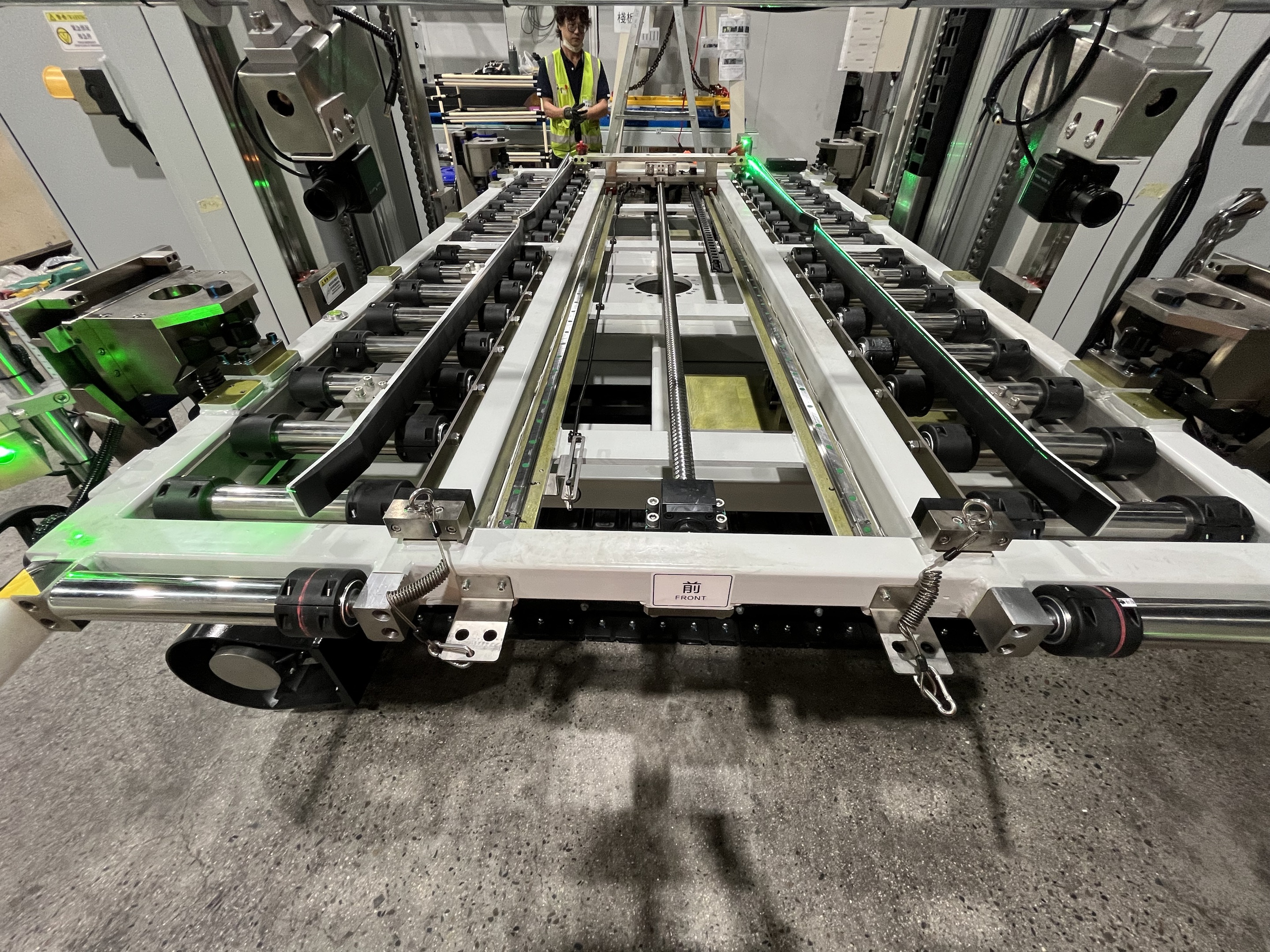
Crawler-driven battery PACK insertion and removal equipment, used where working floors are uneven or temporary. Source: Shanghai Zonzsin Intelligent Equipment Co., Ltd.
Three deployment patterns appear repeatedly in the Zonzsin reference material: rail-fixed, crawler-driven and AGV-driven. Each answers a different site condition, and the differences are operational rather than cosmetic.
Rail-fixed: continuous production in a permanent bay
The ZZX2508 and ZZX2524 assume a fixed ground rail. That constraint is also their advantage: a rail provides a stable, repeatable reference for positioning, which suits continuous shift production. A Chinese energy storage system integrator, battery PACK manufacturer and EPC turnkey contractor operates one unit for continuous PACK insertion, with the deployment reported as stable over a two-year period and efficiency improving. The stated highlights are a stable, fixed ground rail for safe working, a dual-layer material rack for space utility, and versatile module options.
Crawler-driven: uneven or mixed indoor-outdoor floors
The ZZX2522 is designed for all-terrain working floors and includes manual handwheel leveling. Two documented deployments illustrate the use case: a customer in Korea uses one unit to insert and remove ESS battery packs from containers, reported stable for one year and selected for outdoor work on uneven ground; a customer in Taiwan uses one unit for insertion and pull-out, indoor and outdoor, reported stable for one year and selected for complicated working floors. The crawler architecture also supports removal work, which matters for maintenance cycles as much as for first assembly.
AGV-driven: layouts where a rail is impractical
The RD16 removes the fixed rail. As an AGV-driven battery PACK insertion robot for containers, it can serve more than one docking position, which suits lines where rail installation would disrupt existing traffic or where container positions change between projects.
Across all three architectures, operation modes are listed as manual and remote controller, and the matched equipment set includes the container, a docking roller, the gripper, a transfer AGV, a working desk, a material rack, a platform ladder, PLC and MES. That equipment list is itself an integration signal: the insertion robot is a node in a larger control architecture, and the division of responsibility for PLC and MES integration should be agreed in the project contract rather than assumed.
Automated Insertion Versus Traditional Manual Handling
Manual or crane-assisted insertion remains a legitimate method, particularly for low-volume or one-off retrofit projects. The comparison is not about which method is modern; it is about which cost structure and which risk profile fits the project.
| Criterion | Manual or crane-assisted handling | Automated insertion (rail, crawler or AGV) |
|---|---|---|
| Positioning repeatability | Depends on operator skill and rigging setup; varies between shifts | Rail-fixed and AGV architectures establish a repeatable machine reference |
| Pack handling risk | Pack guided by slings, straps or manual control near a rack | Pack held by a dedicated gripper, with fixture adaptation for the pack format |
| Floor space for staging | Staging competes directly with assembly floor area | Double-layer rack design on the ZZX2524 reduces staging footprint |
| Traceability | Recorded manually unless the site adds its own logging | Can be connected into PLC and MES layers for batch and continuous production |
| Fixed infrastructure required | Low: lifting equipment and trained operators | Higher: rail foundation, compressed air at 0.5–0.8 MPa, AC380V±10% 50±2 Hz supply |
| Changeover between pack formats | Handled by rigging changes and operator adjustment | Handled through gripper and fixture changeover, published as under one minute on the ZZX2524; fixture design still requires confirmation |
The honest trade-off is that automation front-loads engineering work. Rail, air supply, electrical supply and controls integration must exist before the first pack moves, and projects that underestimate site preparation will not recover that time later. For a single container assembled once, manual handling can be the rational choice. For continuous shift production across many containers, the repeatability argument becomes decisive.
Where the Specifications Stop: Boundaries to Verify Before Purchase
Purchasing decisions improve when limits are stated as clearly as capabilities. The following boundaries follow directly from the published specifications and should be treated as verification items rather than objections.
- The certificate is a management system certificate. No UL 9540 listing, CE declaration or machinery conformity assessment for the robots themselves is claimed by the ISO 9001 record described above. Container-level approvals and product-level approvals are separate subjects.
- Rail-fixed models need a prepared rail. The ZZX2508 and ZZX2524 assume a fixed ground rail and a stable floor. Where the floor is uneven, temporary or outdoor, the crawler-driven ZZX2522 with manual handwheel leveling is the stated alternative.
- Supply frequency is bounded. The published band is 50±2 Hz. Sites on a 60 Hz distribution are outside it.
- Compressed air is required. The ZZX2508 specification calls for 0.5–0.8 MPa. A site without an air circuit, or with an unstable one, needs a remedy before installation.
- The PACK window is finite. Length 1100–2200 mm, width 780–1260 mm and height 230–260 mm define the compatible pack range; packs outside it require fixture adaptation that should be engineered and quoted.
- Door swing must reach 150°. Both rail-fixed models require a door opening angle of at least 150°, which is not always available in congested yards or retrofit sites.
- Facility conditions are the buyer scope. ESD protection, fire prevention, and temperature, humidity and cleanliness control are listed as project-level special requirements, with a stated working temperature range of 20–30 °C.
- Lead time and capacity constrain scheduling. Published capacity is three units per month, with a lead time of two to four months and a minimum order quantity of one unit, which matters for multi-line rollouts rather than single-machine purchases.
Market Direction: Specification Evidence Is Becoming a Procurement Deliverable
The demand backdrop explains why this scrutiny is increasing. The global Battery Energy Storage System market was valued at approximately USD 50.81 billion in 2025 and is projected to reach USD 105.96 billion by 2030, according to MarketsandMarkets. Within that total, containerized BESS solutions represent a major segment, valued at USD 11.75 billion in 2025 and expected to grow at a CAGR of 24.1% through 2035, according to Insightace Analytic.
Regulatory expectations are developing along a parallel track. In North America, ESS equipment is expected to comply with UL 9540, the Standard for Energy Storage Systems and Equipment, which covers safety of enclosures and moving parts, per UL Solutions. In the EU, BESS containers require CE marking under Regulation (EU) 2023/1542, which includes compliance with the Low Voltage Directive and the Machinery Directive for automated handling equipment, according to European Union material summarized by PVB Review.
Those two frameworks apply to different subjects, and that distinction is where procurement errors originate. UL 9540 and the EU regulation address the energy storage system, the container and, for automated handling equipment, machinery and low-voltage conformity. A supplier ISO 9001 certificate for the robot is a separate document answering a separate question. Buyers building a project compliance file will want both, mapped to the correct subject.
The supply side is responding with specification depth. Zonzsin operates a 6,000 m² facility with 90 employees and an annual output of 40 units, supported by a 43-engineer R&D team and 50 granted patents, including invention patents for AGV-driven battery PACK insertion robots. Export accounts for 60% of output, with main markets in Southeast Asia and the EU, and delivered equipment serving customers in Europe, the USA, Japan, South Korea and India. Customization is offered on an OEM/ODM basis covering cycle time, automation, logo, color and configuration, with quality control described as 100% test and after-sales support covering remote assistance plus on-site installation and commissioning.
For a buyer, that combination points to a practical next step: request the specification sheet, the certificate and the site-integration checklist together, then reconcile them against the actual container, floor and supply conditions on site. The specification sheet describes the machine. The site decides whether the machine applies.
Frequently Asked Questions
Does ISO 9001 certification mean the battery PACK insertion robot is approved as a product?
No. ISO 9001 is a quality management system standard. The certificate held by Shanghai Zonzsin Intelligent Equipment Co., Ltd. is issued by ZDCB under number 44825MS079001R0, conforms to GB/T 19001-2016 / ISO 9001:2015, and is valid from 20 November 2025 to 19 November 2028. Its declared scope covers laser welding equipment, laser cleaning equipment, the module PACK assembly line, and the R&D and assembly of AGV-based cluster loading robot. The RD16, ZZX2508, ZZX2524 and ZZX2522 battery PACK insertion robots are named in the certification record. It does not constitute a product safety approval such as a UL 9540 listing or a CE declaration.
What container dimensions does the ZZX2508 rail-fixed robot support?
Compatible container dimensions are published as length 6058–7000 mm, width 2438–2700 mm, and height 2896–3000 mm. Because the values are published as ranges rather than a single container size, buyers should measure the actual container opening and internal rack geometry. The model also requires a door opening angle of at least 150°.
What electrical and pneumatic supply does the rail-fixed insertion robot require?
The ZZX2508 is published with a power requirement of AC380V±10%, 50±2 Hz, and requires compressed air at 0.5–0.8 MPa. The tolerance band accepts roughly 342–418 V and 48–52 Hz, which accommodates normal industrial voltage variation. A site on a 60 Hz distribution falls outside the stated frequency band.
What load capacity and PACK size window apply to these models?
Load capacity is published at 1500 kg on the ZZX2524 and the ZZX2522. The ZZX2508 compatible PACK envelope is length 1100–2200 mm, width 780–1260 mm and height 230–260 mm. The ZZX2524 publishes a gripper changeover time under one minute and a double-layer rack design that reduces staging footprint. Packs outside the published envelope require fixture adaptation.
Which standards apply to ESS containers and to automated handling equipment in major markets?
In North America, ESS equipment is expected to comply with UL 9540, the Standard for Energy Storage Systems and Equipment, which covers enclosure and moving-part safety, per UL Solutions. In the EU, BESS containers require CE marking under Regulation (EU) 2023/1542, including Low Voltage Directive and Machinery Directive compliance for automated handling equipment, according to European Union material summarized by PVB Review. These apply to the project and equipment scope, not to a robot supplier ISO 9001 certificate.
When should a crawler-driven or AGV-driven robot be chosen instead of a rail-fixed model?
The crawler-driven ZZX2522 is designed for all-terrain working floors with manual handwheel leveling, a customizable hoisting range of 0.8–3.4 m and a 1500 kg load capacity; documented deployments include outdoor container pack insertion and removal in Korea and mixed indoor-outdoor work in Taiwan, each reported stable over one year. The AGV-driven RD16 offers a customizable 1.05–3.4 m hoisting range, a 100 mm/s hoisting speed, and compatibility with 280 Ah, 314 Ah and 587 Ah cells and 1P52S or 1P104S PACK configurations. Rail-fixed models remain appropriate where a stable fixed ground rail and continuous shift production are available.
What lead time and order constraints apply to procurement?
Published capacity is three units per month, with a lead time of two to four months and a minimum order quantity of one unit. Customization is available on an OEM/ODM basis covering cycle time, automation, logo, color and configuration. After-sales support covers remote assistance plus on-site installation and commissioning.