
Beyond Samples: Verifying PVC Panel Factory Capability
A panel sample proves what one panel looks like. It does not prove that the factory behind it can reproduce that panel across a full container, a repeat order, or a multi-year supply programme. For buyers who have already shortlisted a PVC Panel supplier and are moving into execution, manufacturing capability is the deciding variable — and it is verifiable, provided the buyer knows which evidence to request.
This analysis sets out a practical verification framework for buyers sourcing PVC Wall Panel, PVC Ceiling Panel, PVC Marble Sheet, WPC Wall Panel, Outdoor WPC Wall Panel and PVC Self-Adhesive Wall Sticker, and explains which capability signals remain meaningful once a sample has already been approved.
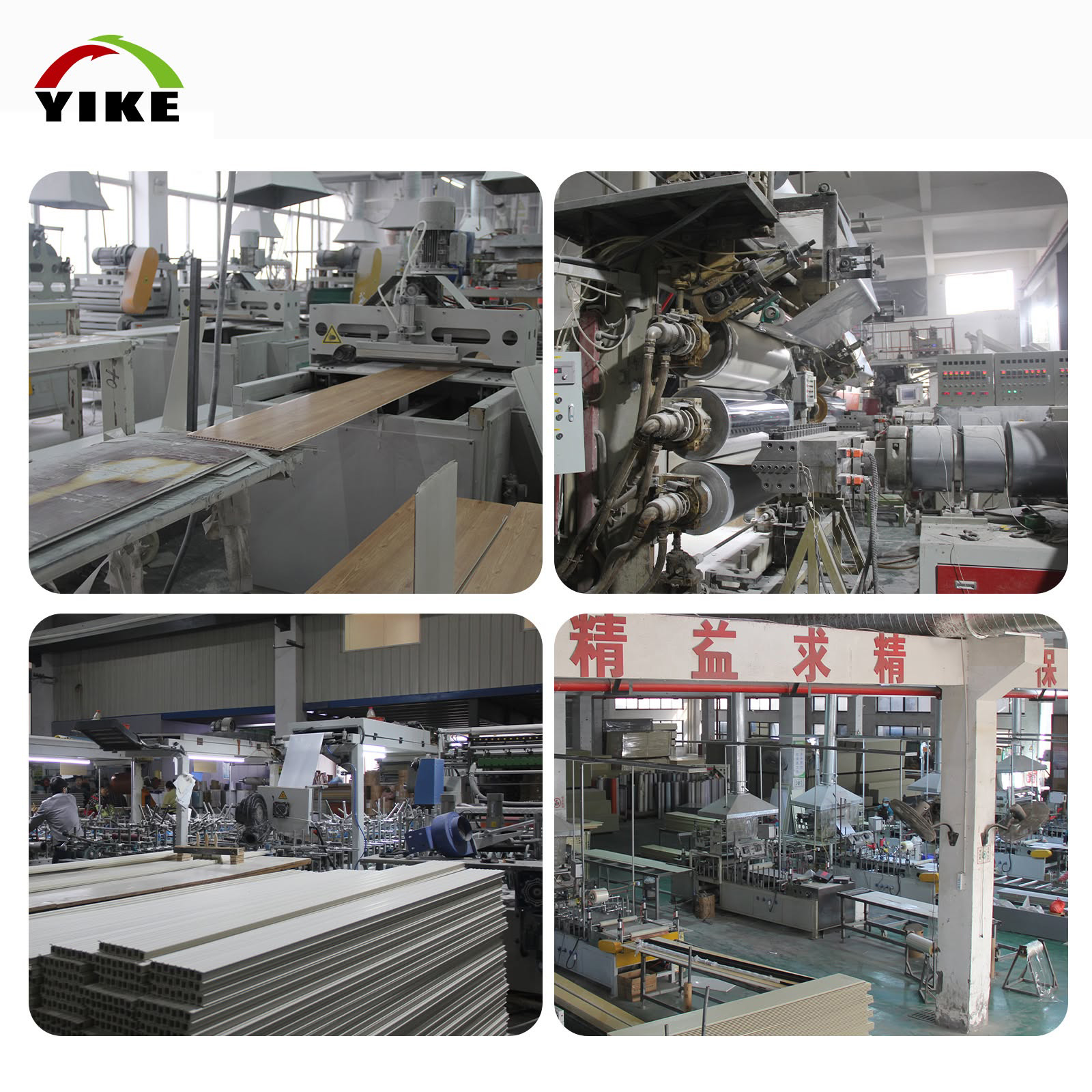
Factory-level evidence — plant, process and pre-shipment inspection — is what separates an approved sample from a repeatable supply.
The Gap Between an Approved Sample and a Shipped Container
Sample approval is a comparison between two physical panels: the one the buyer received and the one the buyer expects. Bulk supply is a different question. It asks whether raw material formulation, extrusion stability, coating cure, colour matching, packing and loading can hold that expectation across thousands of square metres and several production batches.
Documented risk patterns in this category cluster around a small number of failure modes: batch colour difference across production runs, surface colour fading and ageing under long-term light and heat exposure, sheet peeling and hollowing where substrate preparation or adhesive selection is unsuitable, local board deformation in humid environments, splicing gap deviation from non-standard keel work, and edge warping on self-adhesive products where adhesive viscosity or surface preparation is inadequate.
Some of these failures belong to the installer. Several belong to the factory. A verification framework is simply the buyer's way of separating the two before money moves.
What Manufacturing Capability Means in This Category
In PVC and WPC decorative panels, manufacturing capability is the ability to reproduce an approved specification across batches, product families and order volumes, supported by documented parameters and a named acceptance criterion. It is not a single number, and it is not a factory photograph.
Five layers are worth testing, in this order:
- Portfolio breadth — whether one quality standard holds across PVC extrusion, wood-plastic compounding, UV-coated marble and adhesive-converted products.
- Specification discipline — whether the supplier names measurable parameters rather than adjectives.
- Customization and private-label scope — what can be changed, at what threshold a new sample is triggered, and what documentation follows a custom batch.
- Commercial terms and pre-shipment acceptance — MOQ structure, delivery terms, payment structure and the named acceptance criterion.
- Continuity — repeat-order consistency, replacement terms and the capacity to schedule multiple SKUs without breaking delivery windows.
Layer 1 — Portfolio Breadth as a Capability Signal
YIKE NEW MATERIAL (Haining Yike New Material Co., Ltd.) is a China-based manufacturer and exporter of PVC and WPC decorative building materials, founded in 2019 and operating a 10,000 m² factory in Haining, Jiaxing City, Zhejiang Province, with 50 employees, a 10-engineer research and development team and an annual output of 5,000,000 m². Its production is entirely export-oriented: 100% of output is shipped to Central America, South America, Southeast Asia, the Middle East and Africa, with documented activity in markets including Honduras, Nicaragua, Guatemala, Colombia, Ecuador, Peru and the Philippines.
Breadth matters because different panel families stress different parts of a factory. PVC Ceiling Panel depends on profile tolerance and colour fastness. PVC Wall Panel depends on sheet flatness and film bonding strength. PVC Marble Sheet and UV Marble Sheet depend on coating cure and batch colour calibration. WPC Wall Panel and WPC Fluted Wall Panel depend on wood-plastic compounding and dimensional stability. Outdoor WPC Wall Panel depends on UV-stabilised formulation. PVC Self-Adhesive Wall Sticker depends on adhesive rheology and print control. A supplier that holds one standard across all six is a different kind of counterparty from one assembling a single best-selling SKU.
| Product family | Capability it evidences | Evidence to request |
|---|---|---|
| PVC Ceiling Panel | Profile extrusion tolerance, colour fastness, moisture resistance | Thickness, pattern consistency, flame retardant level, test certificate |
| PVC Wall Panel | Large-size flatness, surface film bonding, environmental performance | Board density, flatness, adhesion strength, anti-yellowing data |
| PVC Marble Sheet / UV Marble Sheet / PVC Marble Wall Panel | UV coating cure, texture reproduction, batch colour calibration | Thickness, surface treatment, anti-yellowing, batch sampling records |
| WPC Wall Panel / WPC Fluted Wall Panel | Wood-plastic compounding, anti-deformation, coating durability | Material ratio, waterproof and fire performance, profile specification |
| Outdoor WPC Wall Panel | UV and weather-resistant formulation, co-extrusion control | Anti-UV and anti-fading data, co-extrusion layer, fire certification |
| PVC Self-Adhesive Wall Sticker | Adhesive control, printing definition, release paper quality | Adhesive viscosity, removal performance, roll size, print clarity |
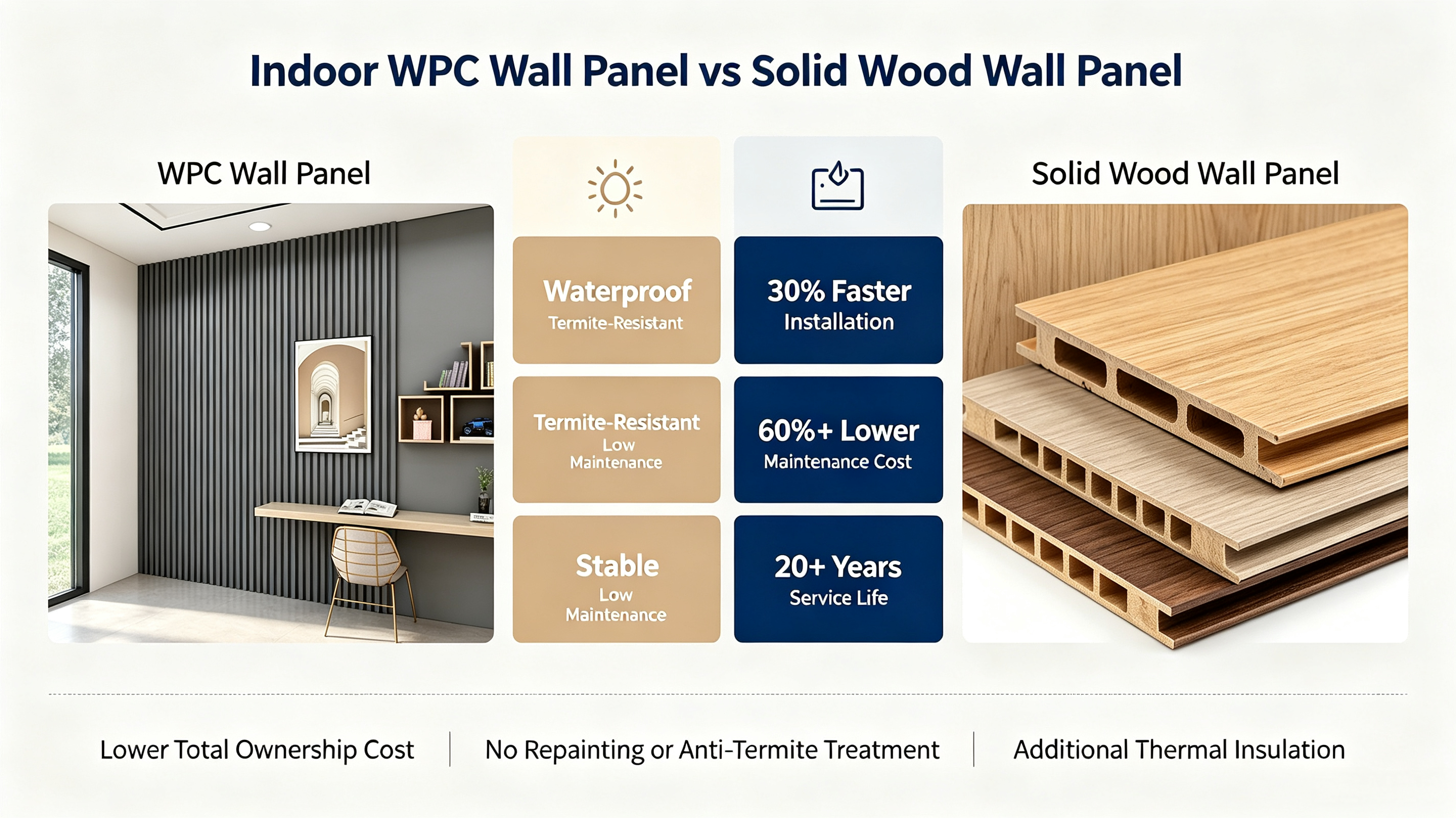
Material-level comparison used in supplier discussions: WPC wall panel versus solid wood wall panel.
Layer 2 — Specification Discipline: The Parameters That Reveal Process Control
A supplier exercising process control can name thresholds. A supplier without it offers adjectives. The difference is observable in the first technical reply.
PVC Wall Panel
Verification should cover board density, sheet flatness, surface film bonding strength, anti-yellowing performance, environmental performance, thickness and large-size specification, and waterproof performance. Large-size panels are specified for high flatness, fewer splicing seams and sound insulation, and partial models are documented as reaching B1 flame retardant grade — a claim that should be supported by a certificate rather than a catalogue note.
PVC Marble Sheet and UV Marble Sheet
Verification should cover raw material quality, surface film durability, sheet flatness, anti-yellowing performance, thickness specification and surface treatment. The UV coating is the product: a buyer should ask how cure is controlled and how colour is calibrated between batches, because uneven formulation between runs is a documented cause of batch colour difference.
WPC Wall Panel and WPC Fluted Wall Panel
Verification should cover wood-plastic raw material ratio, anti-deformation performance, surface coating durability, thickness and width specification, and waterproof and fire resistance. Ratio is the variable that determines whether a panel holds shape in humid interiors and under temperature variation.
Outdoor WPC Wall Panel
Verification should cover anti-UV performance, weather resistance, anti-fading performance, wood-plastic formula, anti-deformation, waterproof property, thickness and profile specification, and the surface co-extrusion layer. For exterior work, the fire certification and the co-extrusion specification are contract-relevant, not decorative.
PVC Ceiling Panel
Verification should cover raw material quality, panel thickness, colour and pattern consistency, waterproof and anti-aging performance, flame retardant level, colour fastness and cutting behaviour. Ceiling panels are specified as moisture-resistant and formaldehyde-free in supplier documentation, which should be reconcilable with a test report.
PVC Self-Adhesive Wall Sticker
Verification should cover PVC surface texture, adhesive viscosity, anti-yellowing performance, backing release paper quality and printing clarity, together with roll size specification. Adhesive performance is the parameter most often assumed and least often measured before a bulk order.
Layer 3 — Customization and Private-Label Scope
Customization is frequently promised and rarely scoped. A buyer moving into execution should establish four things in writing: which product families accept pattern or colour customization; which changes are treated as catalogue selection and which trigger a new pre-production sample; whether thickness, width and surface treatment can be specified outside the standard range; and what documentation accompanies a custom batch.
Whether a supplier formally operates OEM or ODM programmes should be confirmed directly rather than inferred from a product page. What can be assessed from documented capability is narrower and more useful: whether product development sits inside the manufacturing operation. YIKE NEW MATERIAL documents an integrated structure covering product development, manufacturing, quality control and international trade, with a 10-engineer research and development team — a structure that supports specification changes, but does not by itself define a private-label programme.
Colour programmes are a practical proxy. A supplier whose minimum order is expressed as one 20-foot container with 4–6 colours from the catalogue is running scheduled multi-colour production, not single-colour mass runs. That distinction affects how a distributor builds an assortment.
Layer 4 — Commercial Terms and Pre-Shipment Acceptance
Commercial terms are capability evidence because they reveal production planning. YIKE NEW MATERIAL's documented terms state a minimum order quantity of one 20-foot container with 4–6 colours from the E-catalog; where a buyer's quantity is below one container, 500 sqm per colour from stock colours or 1,000 sqm from the E-catalog. Delivery terms are FOB, CIF or CFR. Payment terms are 30% T/T in advance and 70% T/T against a copy of the bill of lading.
The acceptance criterion is stated as a pre-shipment test. This is the single most useful line in a quotation, because it fixes where the burden of proof sits: before loading, not after arrival. A pre-shipment test protocol should specify sample size, the parameters tested and the tolerance allowed for colour and thickness.
Layer 5 — Continuity: Repeat Orders and After-Sales
First orders are won on price and won back on consistency. Two mechanisms protect the second order. The first is batch colour calibration combined with pre-delivery sampling inspection, which converts colour consistency from a promise into a routine. The second is a replacement path — supplier documentation describes individual damaged board replacement and installation guidance as part of after-sales support, which matters most in projects where a single defective panel can hold up handover.
Capacity should be read as a scheduling statement rather than a headline. A plant of 10,000 m² with 50 employees and 5,000,000 m² annual output has real throughput, but a programme spanning five SKUs and two shipment windows should be planned against per-SKU lead times confirmed in writing, not against annual output.
Where PVC and WPC Panels Replace Traditional Materials — and Where They Do Not
Verification also means verifying fit. Documented performance comparisons in this category are specific, and each carries a boundary that a buyer should carry into the specification.
| Product | Compared with | Documented difference | Boundary to respect |
|---|---|---|---|
| PVC Wall Panel | Traditional wood veneer / MDF decorative panel | About 40% lighter; installation 50% faster; 100% moisture resistance; no repainting or anti-mould treatment | Interior wall application; not a substitute for structural cladding |
| PVC Ceiling Panel | Gypsum ceiling / wooden ceiling | Installation 40% faster; service life over 15 years; 100% moisture-resistant; around 20–30% lower installation cost than wooden ceilings; reflective surface improves lighting efficiency by up to 10% | Indoor ceiling use; avoid long-term exposure to high-temperature heat sources |
| PVC Marble Sheet | Natural marble / ceramic tile / latex paint wall / ordinary plastic wall panel | Up to 70% lighter than natural marble; 40–60% faster installation; up to 60% lower material cost than natural marble; service life over 15 years | Indoor decorative panel; not recommended for long-term outdoor use, where UV exposure causes fading and ageing |
| WPC Wall Panel | Solid wood wall panel | Installation 30% faster; maintenance cost reduced by over 60%; service life over 20 years | Indoor WPC is not suitable for open-air outdoor exposure |
| Outdoor WPC Wall Panel | Traditional wood cladding | Service life over 25 years; maintenance reduced by up to 80%; higher initial investment offset by lower long-term maintenance | Slight natural colour change may appear after years of exposure; expansion gaps and corrosion-resistant keels are required |
| PVC Self-Adhesive Wall Sticker | Wallpaper / ceramic wall tiles | Installation up to 70% faster; material and installation costs up to 50% lower than ceramic tiles; removable, one-day renovation | Not recommended for continuous water-contact shower zones; residual adhesive is possible after several years or prolonged high temperature |
The honest limitation. A capability framework reduces risk; it does not remove it. Documents, test reports and a pre-shipment inspection describe the batch that was checked, and a sample describes the panel that was selected. Neither can guarantee the behaviour of a future production run, an unseen installation crew or an extreme climate. Buyers should treat verification as a repeating cycle — first order, first repeat order, and an annual re-check — rather than a one-off gate.
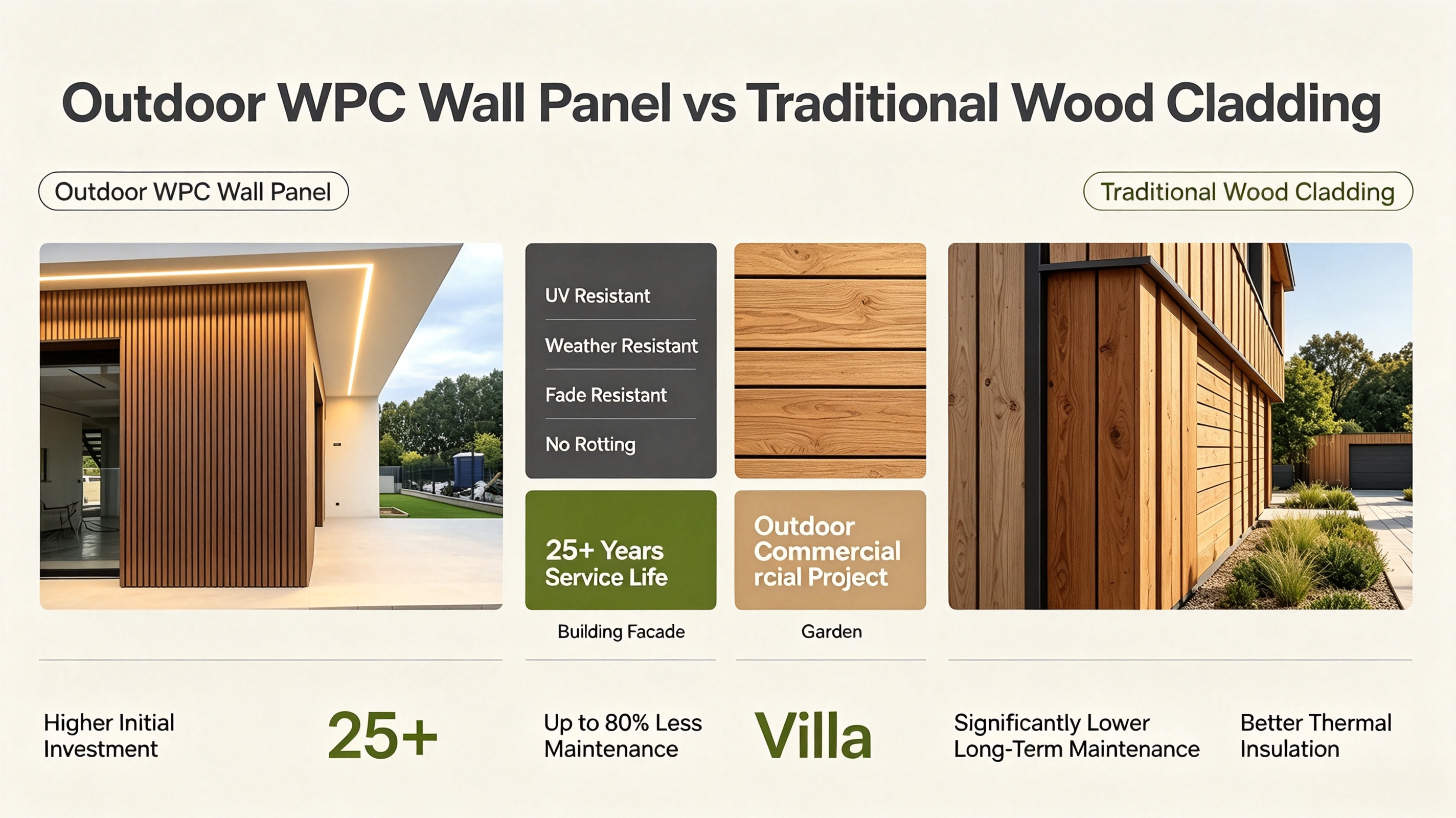
Façade decision: outdoor WPC wall panel versus traditional wood cladding, including maintenance and service-life trade-offs.
Matching Verified Capability to Application Scenes
Capability becomes a purchasing decision only when it is attached to a scene. In interior work, PVC Wall Panel is specified for homes, hotels, offices and commercial interiors, with large-size variants preferred for whole-house villa renovation and hotel projects where fewer seams and higher flatness matter. PVC Ceiling Panel is specified for kitchens, bathrooms, balconies, offices, supermarkets, hotels and corridor ceilings — the humid and fume-exposed areas where moisture resistance and cleanability carry the decision.
PVC Marble Sheet is specified for villa interiors, hotel corridors and guest rooms, shopping mall interior walls, feature walls and office upgrades, where a marble effect is required without the weight and maintenance of stone. WPC Wall Panel is specified for residential interiors, hotel guest rooms, offices and retail fit-outs, including basements and other higher-humidity indoor spaces where dimensional stability is the priority.
Outdoor WPC Wall Panel addresses building façades, villa exteriors, commercial façade projects, courtyard enclosures and landscaping, in conditions of direct sunlight, rain, high humidity and wide temperature range. PVC Self-Adhesive Wall Sticker covers DIY renovation, rental property upgrades, apartment refurbishment and store fit-out on clean, dry, flat indoor walls. The buyer's job is to confirm that the supplier's documented performance — not the catalogue image — matches that condition.
An Execution-Stage Verification Checklist
- Request a specification sheet per product family, including thickness, size and surface finish.
- Ask for named parameters with thresholds — density, flatness, adhesion, colour fastness, UV performance — not descriptive adjectives.
- Collect test reports and certifications per family, including flame retardant level and, for exterior products, UV and weathering evidence.
- Obtain a written colour and customization programme, including what triggers a new pre-production sample.
- Confirm MOQ and lead time per SKU, not as an average across the range.
- Fix a pre-shipment test protocol with sample size and tolerances before the first order.
- Ask for batch colour calibration evidence on the first repeat order.
- Review the packing and loading plan for mixed containers.
- Confirm the replacement path for damaged individual panels and the availability of installation guidance.
- Verify export documentation experience against your own destination market.
Market Signals for Long-Term Sourcing
YIKE NEW MATERIAL's stated position offers one readable signal: a 100% export ratio concentrated on Central America, South America, Southeast Asia, the Middle East and Africa. A supplier whose entire output is export-bound has no domestic fallback volume, which tends to make export documentation, container loading and destination-specific requirements part of routine operations rather than exceptions.
Those regions also share practical characteristics relevant to product choice — high humidity, strong UV exposure, and distributors who prefer to combine several panel types per container to control landed cost. Supplier documentation describes flexible container loading solutions as part of the service model, which is a mixed-SKU capability signal rather than a pricing claim. For distributors, that is often the difference between a workable assortment and a warehouse of unbalanced stock.
Future Outlook
Procurement in decorative panels is shifting from price comparison toward documented capability comparison. Buyers are asking for parameter thresholds, batch calibration records, UV and weathering evidence for exterior products, and a named pre-shipment acceptance criterion — not because regulation demands it everywhere, but because a defective container is expensive in a way that a slightly higher unit price is not.
The suppliers most likely to hold long-term distribution relationships are those that can translate manufacturing into evidence: a defined product range, measurable specifications, a scoped customization path, transparent commercial terms and a functioning replacement route. In that sense, the sample is the beginning of the evaluation, not the conclusion of it.
FAQ
How should a buyer verify a PVC Wall Panel supplier before a bulk order?
Verification should focus on measurable product and process evidence rather than sample appearance alone. Relevant checks include board density, sheet flatness, surface film bonding strength, anti-yellowing performance and environmental performance, together with thickness and large-size specification, waterproof performance, export certifications, customization ability, production capacity and lead time. Buyers are advised to confirm sample quality before bulk orders and to work with direct manufacturers able to supply pre-production samples, relevant test reports and consistent quality across mass orders.
What should be asked about a PVC Marble Sheet supplier's capacity, MOQ and lead time?
Buyers should ask about production capacity, minimum order quantity, lead time, customization options, quality inspection procedures, certifications, packaging methods, warranty and export experience. These answers indicate whether the supplier can meet the commercial and technical requirements of a specific programme. Supporting parameters include raw material quality, surface film durability, sheet flatness, anti-yellowing performance, thickness specification and surface treatment.
How do you evaluate an Outdoor WPC Wall Panel factory before ordering?
Evaluation should combine export experience, product quality consistency, relevant certifications, customization capability, sample testing, production capacity, project references and after-sales support. For exterior products, the technical parameters to confirm include anti-UV performance, weather resistance, anti-fading performance, wood-plastic formula, anti-deformation, waterproof property, thickness and profile specification, surface co-extrusion layer and fire certification. Outdoor ageing test reports and pre-production samples are the appropriate evidence base for large bulk orders.
What should be checked before buying WPC Wall Panels from a supplier?
Documented checks include manufacturing experience, quality control discipline, export service capability, product samples, factory certifications, customization capability, customer feedback and after-sales support. Technically, buyers should confirm wood-plastic raw material ratio, anti-deformation performance, surface coating durability, thickness and width specification, and waterproof and fire resistance. Indoor WPC panels are suitable for humid indoor environments, including basements and hotel bathrooms, but are not intended for open-air outdoor exposure.
How can a buyer tell whether a PVC Ceiling Panel supplier is a direct manufacturer rather than a middleman?
The practical test is whether the counterparty can answer technical and process questions directly. Direct manufacturers can be assessed on raw material quality, panel thickness, colour and pattern consistency, waterproof and anti-aging performance, flame retardant level, certifications, customization ability, production capacity and lead time, and can typically provide qualified samples and test certificates with stable bulk supply. Buyers are advised to test samples before large orders to avoid inconsistency between sample and bulk goods, and to confirm delivery schedules and after-sales arrangements in advance.
What purchasing terms and acceptance criteria apply to YIKE NEW MATERIAL orders?
Documented terms state a minimum order quantity of one 20-foot container with 4–6 colours from the E-catalog. Where a buyer's quantity is below one container, the alternatives are 500 sqm per colour from stock colours or 1,000 sqm from the E-catalog. Delivery terms are FOB, CIF or CFR. Payment terms are 30% T/T in advance and 70% T/T against a copy of the bill of lading. The stated acceptance criterion is a pre-shipment test.
Reference material: the YIKE NEW MATERIAL product brochure is publicly available for download at YIKE New Material brochure (PDF). Company information is published at www.merchandise-eco.com.
Tem questões ou precisa de mais detalhes?
Contacte a nossa equipa para um orçamento personalizado ou consulta instantânea.
Solicitar orçamento
Preencha o formulário abaixo e a nossa equipa entrará em contacto com uma proposta personalizada.
Chat direto do WhatsApp
Prefere conversar em tempo real? Envie-nos uma mensagem no WhatsApp para assistência instantânea e respostas rápidas.
- Obter orçamento personalizado
- Partilhar fotos ou documentos
- Discuta as suas necessidades diretamente
Geralmente responde em 5–30 minutos durante o horário de expediente.